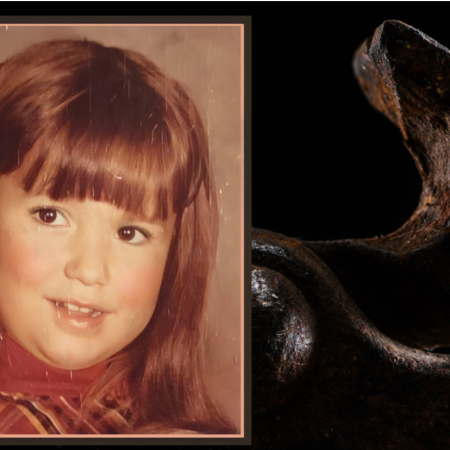
Important souls: Anna’s story a sad tale through an abusive mental health system

Anna Jennings was an artist who suffered trauma, including sexual abuse, as a child. When she entered the mental health system, she suffered further trauma at their hands. As the description on the YouTube page of this video says: Out of her tragic death, and the deaths and abuses of many other trauma survivors, rose a movement to transform all social service systems to be “trauma-informed.” Ann Jennings, her mother, was an integral part of that movement. Over the last 20 years, there’s been a huge push in social services agencies to “recognize trauma as central to the experience of the vast majority of people” who come to these agencies for help.

Twenty years ago, when Ann Jennings gave her first talk about her daughter’s experience and the paradigm shift that was needed in the field, it was to a group of 200 psychiatric nurses. Three-quarters of them walked out.

In an interview for a post about the history of the trauma-informed movement, which I’m working on now, Ann Jennings told me:  ”You get killed if you’re the messenger.”

The thinking then was that only a few people who entered the mental health system had experienced childhood trauma; now it’s recognized that almost all do. “We have a punitive paradigm going in this country,” says Jennings. “It’s changing slowly, but it makes it very, very difficult to deal with things like addressing parents and families. We’re all at-risk families. It’s all over the place.”

The director of this video is Susan Salasin, another pioneer. During her 40 years with the Substance Abuse and Mental Health Services Administration, she led the emergence of the trauma-informed movement. She worked with Andy Blanch and Joan Gillece of NCTIC (National Center for Trauma Informed Care), and with Leah Harris of the National Empowerment Center to produce this video for the Harvard Program for Refugee Trauma.

Empathy…or “if we could see inside other people’s hearts” — a touching video

This touching video was put together by the Cleveland Clinic and posted as “Empathy: The Human Connection to Patient Care” on Feb. 27, 2013 on the clinic’s YouTube channel. (Everyone Matters wrapped their logo around it, gave it a catchier title — “If we could see inside other people’s hearts” and published on their YouTube channel on March 20.)

You could take this approach beyond the hospital setting to Anywhere, USA/Canada/Australia/Mexico/Kenya, etc. And you could place it in any school, mental health clinic, prison, court, social services waiting room, or workplace. It goes to the heart of the trauma-informed/resilience/compassion approach of asking: “What happened to you?”, not “What’s wrong with you?”

A woman once told me a story of how her world shifted after she learned about the CDC’s ACE Study, epidemiological research that revealed the link between childhood trauma and the adult onset of chronic disease, depression, violence and being a victim of violence. She said she never looked at homeless people the same again. Instead of regarding them as “lazy” and wondering why they just didn’t pull themselves together and get a job, she realized that they were survivors — just barely — of the worst things that people do to each other and systems do to people.

A community play called ZERO tips Sacramento, CA, into tackling school suspensions

ProductionStills2

(l to r) Crandal Rankins, Alise Guilford, Sophia Hicks, Roman Allen, Steven Daugherty, Spenser Bradley, Bahni Turpin

_____________________

TRACY (student) – I was suspended for “willful defiance”.
MARTHA (James’ mother)- “Willful Defiance.” Isn’t that what you had last time?
JAMES — Uh huh.
MARTHA — What’s that mean?
JAMES — Everything.
TRACY — Anything.
    —  (ZERO, Act One, by Julie Marie Myatt)

Last August, Darryl White, president of the Black Parallel School Board walked onto the stage of Sacramento’s Guild Theater after Act One of ZERO, a play that’s part of the program, Talk It Out: A Community Conversation to Fix School Discipline.

Turning to the standing-room-only crowd, he asked: “How many people know someone who’s been suspended from school?”

Continue reading

Nearly 35 million U.S. children have experienced one or more types of childhood trauma

NSCHACEspie

Almost half the nation’s children have experienced at least one or more types of serious childhood trauma, according to a new survey on adverse childhood experiences by the National Survey of Children’s Health (NHCS). This translates into an estimated 34,825,978 children nationwide, say the researchers who analyzed the survey data.

Even more concerning, nearly a third of U.S. youth age 12-17 have experienced two or more types of childhood adversity that are likely to affect their physical and mental health as adults. Across the 50 U.S. states, the percentages range from 23 percent for New Jersey to 44.4 percent for Arizona.

The data are clear, says Dr. Christina Bethell: If more prevention, trauma-healing and resiliency training programs aren’t provided for children who have experienced trauma, and if our educational, juvenile

Continue reading

Believing women and children

akidYears ago, when I began interviewing people at organizations that are using the results from the CDC’s Adverse Childhood Experiences Study to change their practices, I talked with a representative of SAMHSA (Substance Abuse and Mental Health Administration, part of the U.S. Department of Health and Human Services). She said a very interesting thing that stuck with me. The ACE Study, which published its first findings in 1998, confirmed what many people had already suspected or who believed “what women were telling us,” she said.

Women addicted to alcohol or other drugs and/or who had mental illness said that their problems originated in abuse they experienced as children.

“Consumers were coming into our system and telling us this,” said the SAMHSA rep. “I don’t know that they were heard.” The rates of trauma

Continue reading

Trauma past and present, and how to move on from trauma in the future

brain

Here are three articles that might be of interest, from separate parts of the country, but interconnected in the growing awareness of how to understand, treat and prevent trauma. The first story looks at how those who were traumatized passed their trauma on to their children. The second story looks at how children who have experienced adversity aren’t really incurable — people just haven’t figured out how to help them. And the third offers some ways to build resilience.

Continue reading

The CDC’s ACE Study summarized in 14-minute video from Academy on Violence & Abuse

The Academy on Violence and Abuse, which educates health care professionals about the often unrecognizable health effects of violence and abuse, produced a four-hour DVD of interviews with the co-founders of the CDC’s Adverse Childhood Experiences Study, released a 14-minute executive summary.

The organization released a three-minute teaser last year. For those unfamiliar with the ACE STudy, this 14-minute puts a little more meat on the bones.

And if you want to know what your ACE score is — as well as how you’re doing on building resilience into your life — go to the survey: Got Your ACE Score? The ACE survey has 10 questions, and the resilience survey has 14.

What motivated Boston bombing suspects? Looking for their ACEs might provide some answers

tsarnaevs2

Tamerlan Tsarnaev as a baby, with parents Anzor and Zubeidat and uncle Muhamad Suleimanov (Reuters obtained this photo from a family member in Dagestan.)

______________________________________

The Chechnya link to the Boston Marathon bombing suspects petered out when an extremist Chechen group claimed no connection to Tamerlan and Dzhokar Tsarnaev. And although the brothers used religion as a reason, a link between them and Muslim terrorist groups doesn’t seem to exist.

So, if this incomprehensible act of violence was not classic terrorism, what else could it be? How could young men whom many people described as “lovely” and “talented”  intentionally inflict such unrelenting pain and death?

Continue reading

A 15-second look at how U.S. population became obese over 25 years

The Atlantic.com posted an animated graphic that takes us from 1985….

cdc1

…..to 2010. In just 15 short seconds, you can watch the obesity epidemic balloon across the U.S. The CDC defines obesity as having a body mass index that’s 30 or higher.

cdc2

Reporter James Hamblin also posted the 10 metropolitan areas with the lowest obesity rates, and the 11 with the highest. The pegs at either end are Boulder, CO, at 12.5 percent, and McAllen-Edinburg-Mission, TX at 38.5%.

Obesity is linked to childhood adversity. One of the CDC’s ACE Study publications found a link physical, sexual and verbal child abuse and obesity in at least 8 percent of the adult obese population. If there are 70 million obese and morbidly obese Americans, as the CDC says, that means that several million obese and morbidly obese people are likely to have suffered physical, sexual and/or verbal abuse during their childhoods. (It should be noted that this particular publication looked at only three of the 10 types of adverse childhood experiences.)

A number of other researchers are looking into the link between obesity and childhood adversity. Here

Continue reading

Of scars and neuroplasticity…a few words from a survivor

01-26-04. digital image #2349The ConsortiumCharles Abel photo.I am a survivor of sexual and physical abuse. The experience changed me. It shapes and informs who I am – how I interact with others and the world around me. Yes, I have grown stronger as a result of these experiences; they are the wellspring of my passion and strength. Scars do that, they remind us of the past and how far we have come. Yes, great healing occurs but, as F. Scott Fitzgerald once said, the thin line of the break is always evident.

A very wise woman who walked with me through the early days of my healing journey once said when I asked her if the pain would always be so wrenching,

“The times between these moments will be longer. The pain itself will seldom be so strong. The time you are bent over in fear will not last so long. But you will always be a woman who has experienced violence. You may go to a party, someone tells a joke, everyone laughs, and you leave immediately to go home, to bed…not for long but the memory will come up again. The body knows. It is an archive of your history. It cannot be erased but it can be the basis of your body wisdom.”

So when we speak of the neuroplasticity of the brain, do not assume that every trace of the past is vanished. It just does not loom so large; it does not drive our every action, thought or feeling.

I don’t think we forget. We grow strong in the broken (read: wounded) places. And that is not a bad thing. It is a remarkable thing.

Rene Andersen sent this in a message on a list-serv; she said it would be OK to post here. Rene (pronounced “ree-nee”) has been active in leading recovery projects, especially developing peer-to-peer communities, for decades. She says her work “is grounded in the community, centered on the resiliency of the individual, and borne out of personal experience with recovery from abuse and addiction.” I’m doing a story about the trauma-informed care movement, and have interviewed her. 

Follow

Get every new post delivered to your Inbox.

Join 1,092 other followers