A community play called ZERO tips Sacramento, CA, into tackling school suspensions

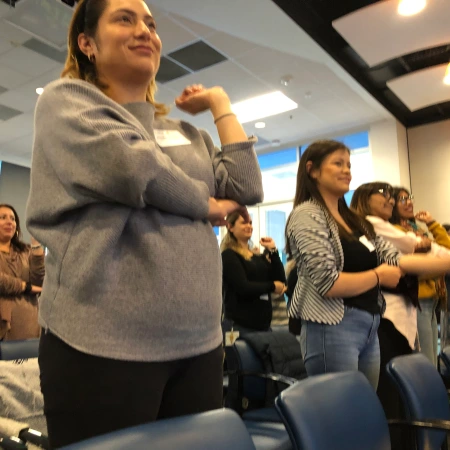
ProductionStills2

(l to r) Crandal Rankins, Alise Guilford, Sophia Hicks, Roman Allen, Steven Daugherty, Spenser Bradley, Bahni Turpin

_____________________

TRACY (student) – I was suspended for “willful defiance”.
MARTHA (James’ mother)- “Willful Defiance.” Isn’t that what you had last time?
JAMES — Uh huh.
MARTHA — What’s that mean?
JAMES — Everything.
TRACY — Anything.
    —  (ZERO, Act One, by Julie Marie Myatt)

Last August, Darryl White, president of the Black Parallel School Board walked onto the stage of Sacramento’s Guild Theater after Act One of ZERO, a play that’s part of the program, Talk It Out: A Community Conversation to Fix School Discipline.

Turning to the standing-room-only crowd, he asked: “How many people know someone who’s been suspended from school?”

Nearly every hand went up. Heads swiveled in surprise at how many people had been touched. But for those who’ve been grappling with issue, the damage caused by disproportionate and high suspension rates has been mounting and spreading like an underground toxic plume for years.

ZERO, an innovative play in which White threw questions out to the audience between acts, distills the real stories and the real emotions behind the numbers in Sacramento. It revealed the indiscriminate use of suspensions from the points of view of African-American student James, aka ZERO, his teacher, his counselor, his principal, his parent, his girlfriend, a bully, and his estranged father.

Carl

Carl Pinkston

“People talk about this issue, but they never hear the young person’s and parents’ point of view about zero tolerance,” says Carl Pinkston, secretary of the Black Parallel School Board. “The play humanizes it.”

“As much as the students are struggling, the teachers struggle, too, because they don’t get a lot of help,”

Continue reading

Trauma past and present, and how to move on from trauma in the future

brain

Here are three articles that might be of interest, from separate parts of the country, but interconnected in the growing awareness of how to understand, treat and prevent trauma. The first story looks at how those who were traumatized passed their trauma on to their children. The second story looks at how children who have experienced adversity aren’t really incurable — people just haven’t figured out how to help them. And the third offers some ways to build resilience.

Continue reading

What’s better than meds for kids with ADHD? Changing the behavior of parents.

parentSo says a study published in Pediatrics this week. The researchers reviewed 55 studies — 34 looked at parent behavior training (PBT), 15 at the used of prescription drugs, specifically methylphenidate, and six looked at a combination of parent training and school or day-care interventions.

The study was done, according to MedPageToday.com reporter Charles Bankhead, because the Agency for Healthcare Research and Quality, part of the US Department of Health and Human Services, realized that there wasn’t much known about whether drugs or parent-behavior training were more effective in reducing symptoms in pre-school children at high risk for ADHD.

So, according to the article, Dr. Alice Charach, of the Hospital for Sick Children in Toronto, and her colleagues asked this question: “Among children younger than 6 years with ADHD or disruptive behavior disorder, what are the effectiveness and adverse-event outcomes after treatment?”

Continue reading

Lebanon’s startling campaign against domestic violence

lebaneseBusiness Insider published ads from KAFA, the Lebanese nonprofit that’s sponsoring a campaign against domestic violence. The images depict women who have been hit or strangled. But….

Their wounds mimic the shape of the audio waveforms of words used against them: “whore,” “slut,” and “bitch.”

“Words hurt,” read the ads. The campaign calls light to the unseen scars left by verbal abuse. KAFA, which translates in Arabic to “enough,” provides a helpline number on each image.

According to Business Insider, Y&R Dubai created the ads. For other images from the campaign, check out the article.

The secret to fixing school discipline problems? Change the behavior of adults

Higa

Godwin Higa, principal, Cherokee Point Elementary School

__________________________________

Two kindergarteners at Cherokee Point Elementary School in San Diego’s City Heights neighborhood get into a fight on the playground. Their teacher sends them to the principal’s office. 

Instead of suspending or expelling the six-year-olds, as happens in many schools, Principal Godwin Higa ushers them to his side of the desk. He sits down so that he can talk with them eye-to-eye and quietly asks: “What happened?” He points to one of the boys. “You go first.” 

Continue reading

New books of note: ‘Restoring Sanctuary’ and ‘Blind to Betrayal’

sanctuaryDr. Sandra Bloom, associate professor at Drexel University’s School of Public Health and founder of the Sanctuary programs, and Brian Farragher, chief operating officer of ANDRUS, have come out with their long-awaited Restoring Sanctuary: A New Operating System for Trauma-Informed Systems of Care. ANDRUS provides services for families and children in New York State’s Westchester County, and also operates the Sanctuary Institute.

Restoring Sanctuary is the third in a trilogy. Creating Sanctuary, written by Bloom, focused on the Sanctuary Model of Care itself, and how it evolved. More than 200 organizations have adopted the Sanctuary model. Destroying Sanctuary, written by Bloom and Farragher, showed how organizational trauma is destroying the U.S. health care system. Restoring Sanctuary provides a roadmap for organizations to transform themselves into safe and trauma-informed environments.

Last week in New York City, about 100 people turned out at a book party for Restoring Sanctuary. In a write-up on PelhamPatch.com, Farragher was quoted as saying that Destroying Sanctuary “described the formidable barriers to providing effective mental health and social services to our clients and issued a call for reform and recovery.  This new volume takes that next step.  We see it as a roadmap to recovery for our nation’s human service organizations.”

Another book, Blind to Betrayal: Why We Fool Ourselves We Aren’t Being Fooled, by University of Oregon psychology

blind professor Dr. Jennifer Freyd and clinical psychologist Pamela Birrell, who teaches at the University of Oregon, will be published on Monday. It provides examples of why organizations, agencies, and society as a whole might want to adopt the Sanctuary model.

Continue reading

Communities making progress with the necessity of dealing with child abuse

Jimmy_Savile_2006In Britain, where officials are dealing with 450 people who have come forward to say that Jimmy Savile abused them when they were children, there’s more awareness, and thus finally more reporting of child abuse. Nevertheless, society still flinches from dealing with it, as The Guardian pointed out in an editorial, “Child abuse: Speaking the unspeakable“. It noted that the world is still doing what Freud had done a hundred years ago: recoiling from the common and damaging child maltreatment that occurs to millions of children daily, and falling into a type of societal dissociation by pretending the problem simply doesn’t exist.

The editorial explained that one of the hurdles that officialdom had to move past in prosecuting child abuse cases was the belief the “child witnesses could not be trusted”. Britain appears to have moved past that, but there’s one more systematic flaw:

Namely, an unwillingness to take seriously the complaints of youngsters who exhibit exactly the sort of symptoms of mental ill health – drinking, self-harm, extreme reticence – that can be caused by this abuse.

Around the U.S., other efforts are underway to make reporting child abuse easier.

In 2011 in Oregon, 75,000 cases of child abuse or neglect were recorded; 710 of those were in Lane County. The county oregonhas set a goal of reducing child abuse and neglect 90 percent by 2030. The 90by30 Project’s first annual conference begins tomorrow. The project was launched by the University of Oregon College of Education. According to this story on KVAL.com:

“It’s more the idea of taking the responsibility for that intervention away from that handful of people in government or non-profits and putting it where it belongs with each of us,” said 90by30 program director Phyllis Barkhurst.

Continue reading

Pre-war trauma affects soldiers’ PTSD; DV top cause of murders in VA county; Tarpon Springs 10K peace flag project

soldierWhy some soldiers develop PTSD while others don’t — MedicalExpress.com – “Pre-war vulnerability is just as important as combat-related trauma in predicting whether veterans’ symptoms of post-traumatic stress disorder (PTSD) will be long-lasting, according to new research published in Clinical Psychological Science, a journal of the Association for Psychological Science.” Pre-war vulnerability includes childhood physical abuse and family substance abuse.

This echoes recent research on Canadian soldiers: “ACEs (adverse childhood experiences) are associated with several mood and anxiety disorders among active military personnel. Intervention strategies to prevent mental health problems should consider the utility of targeting soldiers with exposure to ACEs.”

fairfax2Domestic violence top cause of homicides in affluent Fairfax County (VA) in 2009 — WTOP.com — “Eight of the 14 homicides in Fairfax County in 2009 stemmed from a family dispute and most of the victims were women. A 2012 review by a special committee the Board of Supervisors established found that only three of the victims ever contacted police and only one had a protective order prior to dying.” The report itself (FairfaxDVReview.pdf) is interesting, thorough and well-written.

tarponTarpon group plans display of 10,000 ‘peace flags’ — Suncoastnews.com — “An effort to foster community awareness for people living through the effects of traumatic life experiences took center stage during Tuesday’s Tarpon Springs City Commission meeting. Mayor David Archie officially proclaimed the week of April 5-8 as a time to recognize the Peace 4 Tarpon Peace Flags Project. The initiative’s goal is to display 10,000 handmade flags throughout that week. By doing so, Peace 4 Tarpon organizers hope the flags — each a unique work of art— will resonate with passersby to make Tarpon Springs a more trauma-informed community.” Tarpon Springs, FL, declared itself a trauma-informed community in 2011.

Violence is men’s fault, says Dallas mayor: “We’ve created those traditions”

rawlingsDallas Mayor Mike Rawlings said something pretty interesting a couple of weeks ago. Violence is men’s fault, he declared. Men have to own up to it. Men have to change it.

According to this story by KERA reporter BJ Austin, this is exactly what Rawlings said:

“This violence is our fault. It’s not the women’s fault,” he said. “We have been the violent gender over the centuries, and we must own up to it. Tradition has enabled the action we see around us, and we’ve created those traditions. The culture of male violence has only been perpetuated by locker room talk, radio talk shows, video games, how fathers talk to sons, and our inability to deal with anger living deep inside.”

I fully recognize that women are capable of committing violence and do. And men are often victims of violence. However, there’s no denying that men carry out most of the gun violence, the rapes, and the assaults on women and children, who are usually members of their own family.  This post, however, isn’t about blame. It’s actually about moving on from blame.

What’s most significant about Rawlings’ statement is that — for a brief moment — someone swung the spotlight 180 degrees in talking about violence against women and children. Why is that a big deal?

Well, as we say in the South, let’s take a f’rinstance…..Let’s say that the media reported — and the community talked about — convenience store robberies and assaults the same way we talk about family violence. First, the local media wouldn’t report each robbery. We’d do a series every year during Convenience Store Robbery Awareness Month. The story package would focus only on the convenience store clerks: “Over the last year, 56 convenience store clerks were robbed and assaulted in OurFairCity. Half were beaten so badly that they were hospitalized. Because they could not return to work right after the robbery, they lost their jobs and could not pay the rent. There are not enough shelters in the city to house them and their children.”

In real life, convenience store robberies are reported more regularly than family violence, and the focus is on the perpetrator: “Joe Shmo was arrested last night. He is alleged to have robbed the Corner Convenience Store at the intersection of Main and Central. Convenience store clerk Randolph Bacon said Shmo held a gun to his head and knocked him unconscious after he opened the cash register. Off-duty policewoman Sue Smith happened to be in the store and arrested Shmo after he grabbed the cash.” Shmo’s arrest photo accompanies the story.

So, let’s swing that spotlight around in family violence, often referred to as the larger catch-all, IPV. Interpersonal violence refers to any violence between couples, married or not. The traditional report?

Continue reading

It’s the adults, stupid!; HBO child sex abuse doc; Philly gets $1.6m for trauma-informed care

With apologies to Bill Clinton’s 1992 presidential slogan, “The economy, stupid!”, the CARE model developed at Cornell University can be summarized: “It’s the adults, stupid!”

The CARE model recognizes that troubled kids have histories of adverse childhood experiences, such as verbal abuse, living with an alcoholic or mentally ill parent, being homeless, etc. The approach shows that when adults change how they work with kids who are having troubles, to meet kids where they are, the kids do better. From The Beat, a great blog on the National Clearinghouse on Families and Youth site, here’s part of a transcript from a four-minute podcast with Bill Martin, executive director of the Waterford Country waterfordSchool, a Connecticut youth shelter, which began using the model three years ago:

And I think that when we brought this in, it just became … it caused us all to look at what we’ve been doing for the last ten or fifteen or twenty years and wonder if that was in the best interest of kids. And it did give permission to do some things that you weren’t really sure was okay historically….

It gave permission to excuse expectations sometimes. You get crazy around rule enforcement in group care. And that this was talking about kids that might not be able to meet the expectations, either in the moment or in general and teaching us to be able to amend those expectations to help the kids be successful, as opposed to kind of sanctioning them for not meeting their expectations.

It also really puts the responsibility for the change much more on the adult than some of the previous thinking had been, is that basically the program model is designed in the fact that kids will do well if they can. And if they’re not doing well, something has derailed them. And it’s really incumbent on us to find out what that is and meet the underlying needs. So that the kids can get back on track for more spontaneous development.

docHBO’s CHILD SEX ABUSE DOCUMENTARY, Mea Maxima Culpa: Silence in the House of God, premiers Monday, Feb. 4. The synopsis:

…..investigates the secret crimes of Father Lawrence Murphy, a charismatic Milwaukee priest who abused more than 200 Deaf children

Continue reading

Follow

Get every new post delivered to your Inbox.

Join 1,068 other followers