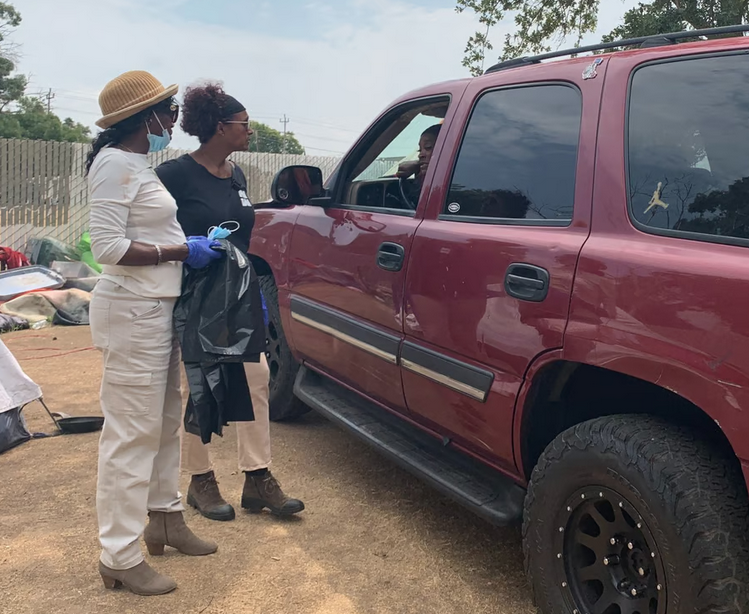
Cap Radio’s Kate Wolffe highlighted how community workers in a Sacramento, California, neighborhood have been telling people who live in encampments about the science of adverse childhood experiences (without calling it that). Wolffe took this photo of Neighborhood Wellness worker Sonia Smith and co-founder Dr. Gina Warren talking with a Del Paso Heights resident. Some relevant excerpts:
Near the start of Redding Park at the corner of Rio Linda and Harris avenues, (Dr. Gina) Warren (co-founder of the Neighborhood Wellness Foundation) asked a few people living outside about their childhoods, marking their answers to her survey on an online form. One man shared he was abused when he was young, and many of his family members had died or been incarcerated. She told the group to come by the following week for a “big old therapy session” at Neighborhood Wellness.
As she returned to her car, Warren praised the man for overcoming the hardest hurdle: acknowledging the trauma. “It ain’t nothing to be ashamed about, because it’s not what you wanted. It’s just what happened; this is what you’ve experienced.”
…I had a kid say to me coming out of [Rio Cosumnes Correctional Center]. He said ‘I don’t need another drug, I need somebody to talk to.’ And that woke me up, in a way that nothing else could have,” Warren said. “It was like: Is this really health care? Is this wellness? And the answer was no. And so how do you help people be well? It’s by touching their basic humanity, that’s how.”
If we don’t deal with their trauma, the resources are just resources. They mean nothing unless you deal with what is causing folks to be stunted or paralyzed in their state of life,” she said.
*You can listen to a conversation with Kate Wolffe on CapRadio about this story.
My take: CLONE THIS WOMAN!!! She’s making more of a difference in that neighborhood than 100 therapists, because 100 therapists aren’t available for that area and will never be. Dr. Vincent Felitti, co-principle investigator of the CDC-Kaiser Permanente Adverse Childhood Experiences Study says there aren’t enough therapists to help everyone who’s suffering from the effects of childhood adversity, so people should be educated about PACEs science so they can help each other.
Dr. Harise Stein at Stanford University edits a web site — abuseresearch.info — that focuses on the health effects of abuse, and includes research articles on the science of positive and adverse childhood experiences. Every month for the Resource Center on PACEsConnection.com, she posts the summaries of the abstracts and links to research articles that address only PACEs . This month, she sent a list of 85 publications. I remember when she sent only a dozen a month.
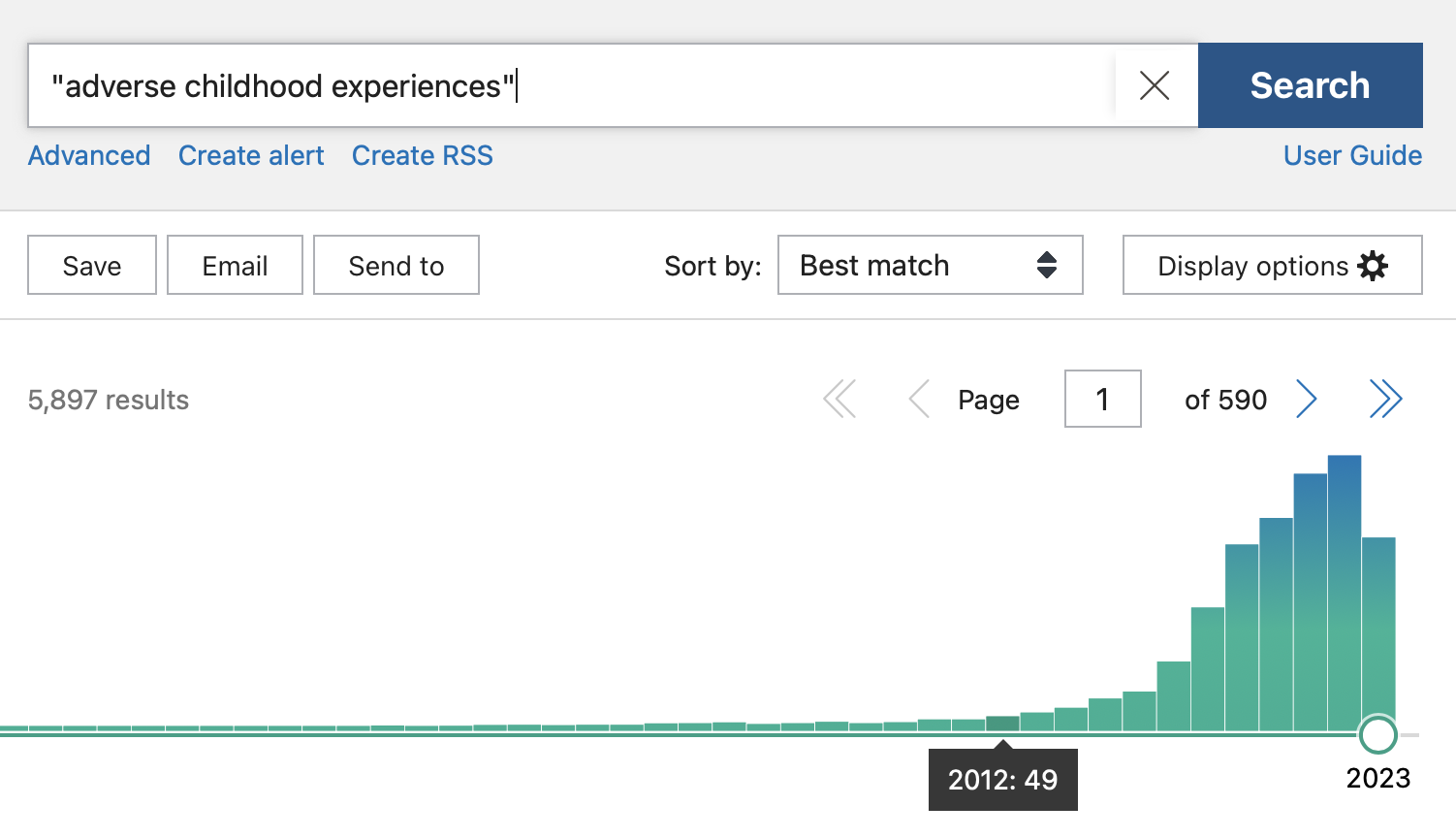
My take: If you do a search on PubMed just for adverse childhood experiences, it brings up nearly 6,000 publications. In 2012, when I began reporting full time on ACEs, there were only 49. It’s pretty remarkable how quickly people realized the importance of this science!
Here are two of the many publications from the 85 that Harise found for September that are worth articles on their own:
Swedo EA, Aslam MV, Dahlberg LL, et al.
Prevalence of Adverse Childhood Experiences Among U.S. Adults – Behavioral Risk Factor Surveillance System, 2011-2020.
MMWR Morb Mortal Wkly Rep. 2023;72(26):707-15. PMID: 37384554
From a CDC report of all 50 states and the District of Columbia, “Overall, 63.9% of U.S. adults reported at least one ACE, and 17.3% reported four or more ACEs. Experiencing four or more ACEs was most common among females (19.2%), adults aged 25-34 years (25.2%), non-Hispanic American Indian or Alaska Native adults (32.4%), non-Hispanic multiracial adults (31.5%), adults with less than a high school education (20.5%), and those who were unemployed (25.8%) or unable to work (28.8%). Prevalence of experiencing four or more ACEs varied substantially across jurisdictions, from 11.9% (New Jersey) to 22.7% (Oregon).”
My take: The original ACE Study showed that 12 percent of those surveyed had four or more ACEs. I’d like to do an article about whether ACEs are increasing. This study says yes…17 percent of the population has 4 ACEs, which without positive childhood experiences can lead to serious and harmful social, economic, mental and physical consequences.
Testimonies about child sexual abuse in the family. Challenges of addressing the private sphere.
Child Abuse Negl. 2023;144:106352. PMID: 37478733
From a German independent inquiry on child sexual abuse within families, and analyzing 870 survivors’ testimonies, 47% named fathers and stepfathers as perpetrators, 9% named the mother or stepmother, and 11 % biological siblings. In addition, there were mentions of extended family members, and multiple family members either acting as co-perpetrators or accomplices. Characteristics of the abuse included
“1. The planned and violent approach of the perpetrators, either through explicit threats and physical attacks or through manipulative strategies; 2. The abuse of dependency relationships through affection and tenderness or their targeted withdrawal; 3. The involvement and entanglement of family members and the family environment through relationships with the perpetrator; 4. The lack of contact persons for affected children, adolescents, and adults, as well as frequent lack of help when they confided in someone.”
My take: Many people are reluctant to talk about their ACEs, and I’m doing my part to encourage people to discuss ACEs openly (as Dr. Warren, above, is doing)—it’s the only way we’ll reduce ACEs and increase positive childhood experiences. Of all the ACEs, I believe that child sexual abuse within families will be the toughest nut to crack open so that people can talk about it freely. It takes a long time for people to come to grips with the fact that their family members, mostly fathers and stepfathers, sexually abused them. Understanding that an abuser’s own childhood abuse lies at the heart of the abuse they pass on is difficult, given that the abuse is usually a family secret. People in the family—spouses and children—usually go to their graves without confronting their shame and betrayal.
 ACEs Too High
This is one of the main reasons I chose NOT to become a licensed counselor after earning my master’s degree. During my internship, I saw how we were just throwing band-aids on serious problems, particularly with domestic violence offenders and substance abusers. Nothing was actually getting fixed because we couldn’t work deeply enough with clients. This is why I continue to focus on my work as a yoga teacher. I believe the teachings and practices of yoga go farther and deeper than most counseling sessions can go. If people can use the practices regularly, the healing happens almost automatically.
LikeLike
This is a fantastic article. I was at a meeting yesterday where the topic was youth violence. I suggested part of the solution lies in the ACE’s screener and helping the youth and their families understand their history of trauma.
LikeLike
This woman is spot on. As a 69 year old woman with an ACE score of 9 during childhood onset of traumas beginning at 9 months, I was not diagnosed with CPTSD until the ripe age of 64. My walk of life has been socially diverse, in that my father was a Ltc. In the Army and I was blessed to live all over the world. This individuals research with the homeless and her families has a direct correlation to folks like me. This woman is what I consider am “earth angel”. I too was a participant in the Kaiser CDC ACE study, as my primary therapists was Dr. Randhawa. I have had the desire to organize and participate in a group setting designed solely for individuals to share whatever thoughts that are creating a hitch in their giddyup at the moment. I believe by not having this avenue creates stagnation for us in emotional, physical and psychological ways that subsequently cause horrible growth stagnation. Essentially, the root cause is a childhood trauma, but it is not one specific trauma creating the mental dam in our brains. It is simply the fact that most loved ones want to provide a “fix” for us. Unfortunately, that loving and normally endearing action only creates further chasms in our brains. I can actually feel the orange glow if my worsening disfunctionality growing in my frustrations to just be allowed to be “human” and not further traumatized by a misunderstanding and non simple acceptance of my plain and simple human existence. It is such a sad and ever darkening and lonely place to be. It goes against the very basic definition of “human” and the basic requirements every individual, with or without my diagnosis, needs to function and prosper in a “normal” fashion…life – such a conundrum. God bless us all.
LikeLike
Hi, Chrystie: Thank you for commenting. I’m very sorry that it took so long to understand what happened to you.
I hope you start a group! I’m sure there are others who are grappling with the same things you are. If you haven’t, check out PACEsConnection.com, a social network for people who are interesting in this, or who want to participate in telling people about positive and adverse childhood experiences.
LikeLike
Outstanding!!
LikeLike
Jane
<
div>Okay to repost
LikeLike
Sure!
LikeLike