
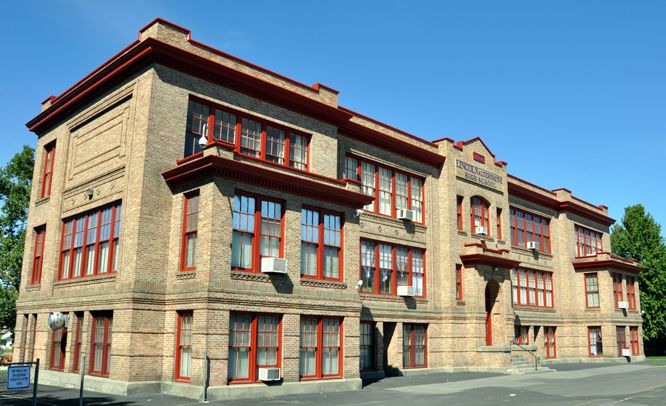
THE FIRST TIME THAT principal Jim Sporleder tried the New Approach to Student Discipline at Lincoln High School in Walla Walla, WA, he was blown away. Because it worked.
In fact, it worked so well that he never went back to the Old Approach to Student Discipline.
This is how it went down: A student blows up at a teacher, drops the F-bomb. The usual approach at Lincoln – and, safe to say, at most high schools in this country – is automatic suspension.
Instead, Sporleder sits the kid down and says quietly: “Wow. Are you OK? This doesn’t sound like you. What’s going on?” He gets even more specific: “You really looked stressed. On a scale of 1-10, where are you with your anger?”
The kid was ready. Ready, man! For an anger blast to his face….”How could you do that?” “What’s wrong with you?”…and for the big boot out of school. But he was NOT ready for kindness. The armor-plated defenses melt like ice under a blowtorch and the words pour out: “My dad’s an alcoholic. He’s promised me things my whole life and never keeps those promises.” The waterfall of words that go deep into his home life, which is no piece of breeze, end with this sentence: “I shouldn’t have blown up at the teacher.”
Whoa.
And then he goes back to the teacher and apologizes. Without prompting from Sporleder.
“The kid still got a consequence,” explains Sporleder – but he wasn’t sent home, a place where there wasn’t anyone who cares much about what he does or doesn’t do. He went to ISS — in-school suspension, a quiet, comforting room where he can talk about anything with the attending teacher, catch up on his homework, or just sit and think about how maybe he could do things differently next time.
Before the words “namby-pamby”, “weenie”, or “not the way they did things in my day” start flowing across your lips, take a look at these numbers: 2009-2010 (Before new approach)
- 798 suspensions (days students were out of school)
- 50 expulsions
- 600 written referrals
2010-2011 (After new approach)
- 135 suspensions (days students were out of school)
- 30 expulsions
- 320 written referrals
“It sounds simple,” says Sporleder about the new approach. “Just by asking kids what’s going on with them, they just started talking. It made a believer out of me right away.”
________________
The dark underbelly of school discipline
Take a short walk on the dark side of our public education system, and you learn some disturbing lessons about school punishment.
First. U.S. schools suspend millions of kids — 3,328,750, to be exact. Since the 1970s, says a National Education Policy Center report published in October 2011, the suspension rate’s nearly doubled for white kids, to 6%. It’s more than doubled for Hispanics to 7%, and to a stunning 15% for blacks. For Native Americans, it’s almost tripled, from 3% to 8%.
Second. If you think all these suspensions are for weapons and drugs, recalibrate. There’s been a kind of “zero-tolerance creep” since schools adopted “zero-tolerance” policies. Only 5% of all out-of-school suspensions were for weapons or drugs, said the NEPC report, citing a 2006 study. The other 95% were categorized as “disruptive behavior” and “other”, which includes cell phone use, violation of dress code, being “defiant”, display of affection, and, in at least one case, farting.
Third. These suspensions don’t work for schools. Get rid of the “bad” students, and the “good” students can learn, get high scores, live good lives. That’s the myth. The reality? It’s just the opposite. Says the NEPC report: “…research on the frequent use of school suspension has indicated that, after race and poverty are controlled for, higher rates of out-of-school suspension correlate with lower achievement scores.”
Fourth. They don’t work for the kids who get kicked out. In fact, these “throw-away” kids get shunted off a possible track to college and onto the dead-end spur of juvenile hall and prison.
“Studies show that one suspension triples the likelihood of a juvenile justice contact within that year,” California Chief Justice Tani Cantil-Sakauye told the California Legislature last month. “And that one suspension doubles the likelihood of repeating the grade.”
Fifth. All these suspensions have led many communities to create “alternative” schools, where they dump the “bad” kids who can’t make it in regular public school. Lincoln High School was set up as one of those alternative schools.
How Mr. Sporleder stumbled across an epiphany in Spokane
It’s the Spring of 2010, and Jim Sporleder’s mind more or less silently exploded.
This is the guy with 25 years experience as a principal. In Walla Walla, he’s got a rep for really connecting with kids. He preaches “discipline with dignity”.
John Medina – a developmental molecular biologist who’s an improbable cross between an old-time rip-snortin’ preacher and Jon Stewart – just drilled a hole in Sporleder’s brain and dropped this in:
Severe and chronic trauma (such as living with an alcoholic parent, or watching in terror as your mom gets beat up) causes toxic stress in kids. Toxic stress damages kid’s brains. When trauma launches kids into flight, fight or fright mode, they cannot learn. It is physiologically impossible.
Sporleder was three years into an exhausting stint as principal of the Lincoln Alternative School. He’d asked for the position after reading a report about the troubled school. The report quoted a couple of Lincoln High’s kids: “We’re the dumping ground,” one said. “Who cares about us,” another said. It wasn’t a question.
“That report riveted me,” says Sporleder. “I’m a person of faith. I felt called to come over here.”
Gangs controlled the school. It had only 50 students, but they were the toughest in the school system – the kids who’d been kicked out of other schools. Lincoln was their last chance.
“I didn’t know if I was going to make it,” recalls Sporleder. “We had some pretty rough kids. It took me quite a while to get on top of that.”
____________________________________________________________
Read about how other schools are also implementing trauma-informed practices: There’s no such thing as a bad kid in these Spokane, WA, elementary schools, and At Cherokee Point Elementary kid’s don’t conform to school; school conforms to kids.
___________________________________________________________
And then, at the behest of Teri Barila, co-founder of the Children’s Resilience Initiative in Walla Walla, he goes to this meeting where this guy who’s part comedian, part evangelist, part scientist (and best-selling author of Brain Rules) more or less tells him that this “discipline with dignity” stuff is, well, useless. Punishing misbehavior just doesn’t work. You’re simply adding trauma to an already traumatized kid.
“He explained it in lay terms,” says Sporleder. “I got it.”
Now, some people who are well into their careers can’t handle a paradigm shift. It’s overwhelming. That’s mostly because it’s just too much trouble to change the way you do…everything.
Spoiler alert: Sporleder isn’t one of those people. He returned from Spokane to light a fire under his teachers. He felt compelled to figure out a way to do something different to reach his kids, but wasn’t sure exactly how. Teri Barila was in a perfect position to assist.
This is your (damaged) brain on ACEs
Really good ideas that help people solve problems often take such a long time to move from research to implementation that it can cost a community millions of dollars. Twenty years ago, Washington State created a state network — the Family Policy Council and 42 community public health and safety networks — to share good information FAST to tackle a big, expensive problem: the high rates of child abuse and youth drug and alcohol abuse in the state.
Teri Barila, a former fish biologist, leads the network in Walla Walla, a city of about 30,000 people in southeastern Washington.

About 10 years ago, the council caught wind of two major game-changing discoveries. One was the CDC’s Adverse Childhood Experiences Study (ACE Study). It showed a stunning link between childhood toxic stress and the chronic diseases people developed as adults. This includes heart disease, lung cancer, diabetes, some breast cancer, and many autoimmune diseases, as well as depression, violence, being a victim of violence, and suicide.
The ACE Study measured 10 common types of childhood trauma. Five were the usual suspects: emotional, sexual and physical abuse, and emotional and physical neglect. Five were family problems: a parent addicted to alcohol or other drugs, seeing a mother being abused, a family member in prison, a family member diagnosed with a mental illness, and a parent who’s disappeared through abandoning the family or divorce. (Although the word “trauma” is more commonly used to describe physical injury, in this milieu, it refers to any experience that causes toxic stress.)
The study’s researchers came up with an ACE score to explain a person’s risk for chronic disease. Think of it as a cholesterol score for childhood toxic stress. You get one point for each type of trauma. The higher your ACE score, the higher your risk of health and social problems. 
A whopping 70 percent of the 17,000 people in the study had an ACE score of at least one; 87 percent of those had more than one.
With an ACE score of 4 or more, things start getting serious. The likelihood of chronic pulmonary lung disease increases 390 percent; hepatitis, 240 percent; depression 460 percent; suicide, 1,220 percent.
The percentages climb to grim and astounding levels as the ACE score climbs – people with an ACE score of 6, for example, have a 4,600 percent increase in the risk of becoming an IV drug user. Grow up with an ACE score of 10, and you’re likely to find yourself homeless, in prison for life, or end up dead by your own hand. People with high ACE scores die, on average, 20 years earlier than those with low ACE scores.
By the way, lest you think that the ACE Study was yet another involving inner-city poor people of color, take note: The study’s participants were 17,000 mostly white, middle and upper-middle class college-educated San Diegans with good jobs and great health care – they all belonged to Kaiser Permanente, a health maintenance organization. As Dr. Robert Anda, one of the co-founders of the ACE Study says, “It’s not them. It’s us.”
The second game-changing discovery explained why childhood trauma had such tragic long-term consequences: Toxic stress physically damages a child’s developing brain. This was determined by a group of researchers, including neurobiologist Martin Teicher and pediatrician Jack Shonkoff, both at Harvard University, and neuroscientist Bruce McEwen at Rockefeller University.
In a nutshell, toxic overdoses of stress hormones stunt the growth of some parts of the brain, and fry the circuits in others.  Children with toxic stress live their lives in fight, flight or fright (freeze) mode. They respond to the world as a place of constant danger. They can fall behind in school, fail to develop healthy relationships with peers, or develop problems with authority because they are unable to trust adults. With failure, despair, and frustration pecking away at their psyche, they find solace in food, alcohol, tobacco, methamphetamines, inappropriate sex, high-risk sports, and/or work.
They don’t regard these coping methods as problems. They see them as solutions to escape from depression, anxiety, anger, fear and shame.
When Barila learned all this at a meeting that the Family Policy Council organized, it chilled and angered her. Determined to do something about it, she co-founded the Children’s Resilience Initiative to educate the Walla Walla community about ACEs and to build resilience to combat ACEs. Barila brought Natalie Turner, an expert in creating trauma-free schools, to town to help Sporleder and his teachers.
Natalie Turner’s two simple rules for dealing with troubled students
When she met with the Lincoln High staff, Natalie Turner, from Washington State University’s Area Health Education Center, picked up right where John Medina, who lit up Sporleder’s brain, left off.
Toxic stress comes from complex trauma, she said. Complex trauma ain’t pretty. It’s when your dad’s in prison AND your mom’s a meth addict AND she’s too drugged out to move in the mornings, so you’ve got to take care of your little brother, get him fed and off to school, AND you’re despairing about being evicted for the third time because she hasn’t paid the rent and the landlord’s screaming at you to do something.
Or your dad’s a raging alcoholic AND he beat the crap out of your mom again last night AND the cops came and took him away at 2 a.m. AND the EMTs took your mom to the hospital and you hardly slept a wink and you’re frantic with worry because you don’t know what’s going to happen, but you’ve got to stay cool or otherwise you’ll have a complete meltdown.
Or your fat step-dad’s sneaking into your bed in the middle of the night AND you’re too terrified to move because he says if you say anything he’ll kill you and your sister and your mom, who’s depressed AND doesn’t talk much anyway.
Teens who live with complex trauma are walking post-traumatic stress time bombs, says Turner. They teeter through their days. The smallest incident can push them into a full-blown meltdown. Some kids run away. Some explode in rage. Some just mentally check out. 
“In flight, fight or freeze mode,” Turner explains, “survival trumps everything else.”
So when a kid who’s got complex trauma feels threatened or overwhelmed, exploding in rage at something that most people wouldn’t even shrug over is a perfectly normal response.
That’s worth repeating: exploding in rage, getting pissed off, stomping, hitting….it’s all normal. Until a school helps kids learn how to control their emotions, they’ll just keep losing it. For some kids, erupting is a stress reflex response.
“That’s the hardest pill to swallow,” says Erik Gordon, a science teacher at Lincoln High. “Trying to figure out how much of their behavior is from a choice and how much is outside their control. It’s a drag when you believe it’s outside their control, because all of the easy disciplinary action doesn’t work.”
There are just two simple rules, says Turner. Rule No. 1: Take nothing a raging kid says personally. Really. Act like a duck: let the words roll off your back like drops of water. Rule No. 2: Don’t mirror the kid’s behavior. Take a deep breath. Wait for the storm to pass, and then ask something along the lines of: “Are you okay? Did something happen to you that’s bothering you? Do you want to talk about it?”
It’s not that a kid gets off the hook for bad behavior.
“There have to be consequences,” explains Turner.
Replace punishment, which doesn’t work, with a system to give kids tools so that they can learn how to recognize their reaction to stress and to control it.
“We need to teach the kids how to do something differently if we want to see a different response,” she says. Kids need adults they can count on, who they know will not hurt them, and who are there to help them learn these new skills, Turner tells the Lincoln High staff. If it’s not happening at home, it had better happen at school. Otherwise that teen doesn’t have much of a chance at life.
(For those of you who are interested in the underlying model that guides Turner’s teaching, it’s the ARC model developed at the Trauma Center at Justice Resource Institute. Turner and her co-workers were also influenced by the trauma-sensitive classroom movement, for which more information can be found in Helping Traumatized Children Learn (also known as the purple book), published by Massachusetts Advocates for Children.)
The red zones of Lincoln High
The Lincoln High staff took Turner’s information and flipped its system of school discipline like a pancake. The changes began in the classroom.
“Teachers started becoming detectives,” says Gordon. “We began focusing our concern on what we know that’s going on that might be causing behavior in a kid,” versus what type of punishment to mete out.
When a kid erupts in class, teachers intervene quickly.
“A kid that I have a really great relationship with might blow up,” says Gordon. “So, I step out of the classroom with that kid and ask: ‘What’s going on? Because that was really intense.’ I know that something is bumming this kid out, because normally, we really enjoy each other.” 
Other responses include:
- “Class isn’t working today, how about taking a time out with Shelly (in the ISS Room) so that you can get yourself calmed down?”
- “I feel that I really blew it and I feel like I have set you off. I want to apologize and see if there is anything that I can do to help you.”
- “You seem really upset, would you like to speak to someone in the Health Center?”
If it escalates to principal level, Jim Sporleder uses his infamous zone system: red, yellow and green.
Here’s how that works: Three boys don’t respond to their teacher, who asks them politely, but firmly to leave class and talk with the principal. Although three fuming teens sit down in front of Sporleder, he sees three brains under extreme stress, unable to take in anything useful or to solve a problem.
“You’re in the red zone,” he tells them succinctly. He doesn’t yell. He doesn’t roll his eyes. There’s no body language that says “I can’t stand you kids,” because he actually thinks the world of them.
“Let’s meet tomorrow morning. You’re going to take the rest of the day and night to process this.” (Sometimes Sporleder has found himself in the red zone, and tells the kids: “I’m in the red. I don’t want to make any decisions that could come from my own anger or stress. Let’s take a break and meet later.”)
The next morning, Sporleder says, all three approach him and say they’ve talked over the problem with the teacher, have apologized and figured out a solution. “We’ve got it all worked out,” they explain.
“That’s more common than not these days,” says Sporleder. But if they had refused to apologize to the teacher and refused to solve the problem, or their infraction was more serious, they would have gone to ISS – in-school suspension.
“I don’t have kids arguing about the consequences,” says Sporleder. Well…mostly he doesn’t. Sometimes he still gets kids asking to be suspended to home instead of in school, which tells him that ISS may be more uncomfortable, but it’s more effective.
In that quiet room, they can’t distract themselves with TV, video games or drugs. A staff member offers conversation – about how the teen is dealing with the incident, or other issues in her or his life. Other teachers stop by to make sure the teen is caught up on homework.
“At home, there’s no accountability,” he explains. During in-school suspension, the teens can’t escape their issues. It’s not fun to have to give up old beliefs and habits. But they all get lots of support to get into the green zone.
“We tell our kids we love them,” says Sporleder. “They’re important to us.”
The third big change occurs in the school’s monthly staff meetings. Instead of talking about disciplining problem kids, they focus on why that teen’s having problems, develop a plan to help the teen, and make sure to follow up.
In the last two years, the Lincoln High staff has noticed that the kids’ ability to regulate their own emotions has dramatically improved.
“There’s not near the number of huge emotional explosions that there used to be,” says Gordon. “Even the way the kids interact with each other is more subdued.”
The way the kids see it is that the teachers have chilled out.
What else do the kids say?
At Lincoln High, the kids not only live ACEs, but they talk them. As senior Heidi Schoessler, 18, explains it: Students have ACEs (adverse childhood experiences). Those are the bad things going on in their lives.
Resilience factors – such as asking for help, helping a friend, experiencing success, having hope — trumps those ACEs. They’re beginning to learn about those resilience factors in school and in the school’s health clinic.  When Schoessler showed up at Lincoln, she couldn’t be in a classroom with more than two or three people at a time, says Sporleder. She’d been bullied and harassed so much in elementary and middle school, that being around too many students caused a stress response that made her sick.
Sixteen-year-old Aron Wulf was so withdrawn, he hardly talked.
Jordan Massey, 17, had anger issues.
Brendon Gilman, 15, who was removed from a family of meth addicts and has lived in several foster homes, says in this video about The Health Center at Lincoln High he was so angry with life that he didn’t care about the future because he was so mad about the present.
Today, all four chat easily about the school and its changes. Gilman went from failing grades to A’s. Schoessler’s taking college classes. Wulf is active in the production of the school play. All four do presentations for the community about the changes in the school.
“I got here, and my whole high school experience flat-out changed,” says Massey, a junior who transferred in halfway through his freshman year. “People came up to me and greeted me. It felt like I had real friends here. I loved it. I call it my home away from home. It really feels like a family here. The teachers are amazing. That’s how a high school should be.”
Here’s how Wulf describes the changes in his life: Shortly after he was born, his parents divorced. He’s been living with his mother. When he was younger, he spent every other weekend with his father.
“My dad’s verbally abusive. He has a really bad temper,” Wulf says quietly. “My mom has always been sick in bed pretty much. The people who should have been around were never around, basically. She has problems with depression and what not. She might commit suicide. There are financial issues.”
When he talks about Lincoln, his voice gets strong, and hopeful.
“Lincoln’s the first school I’ve been to that I actually loved,” he explains. “It was the first time I ever felt that somebody actually cared to hear my story to know how I was feeling. My own teachers understand me better than my mom does.”
Wulf is an example of the type of quiet, isolated student that Dr. Vincent Felitti, co-founder of the CDC’s ACE Study, advises educators to “make sure you always connect with,” says Sporleder. The quiet students – the ones who respond to toxic stress with “fright” or “flight” – sit quietly in the back of the room with their heads down. They’re often labeled as “lazy” or “unmotivated”. They might not be as loud or belligerent as those who drop into “fight” mode, but they’re hurting just as much.
“I’m always looking for kids who are isolated,” says Sporleder.
“What is happening at Lincoln is completely different,” says Schoessler. “There’s so much more of a caring atmosphere. Students will come to the teachers when they need help. It’s something I have never seen in any other school.”
Even in-school suspension is useful, says Gilman, who spent time in ISS for getting in a dust-up with his ex-girlfriend at school.
“I couldn’t handle being around her,” he says. “It kind of helped, even for just the day, to be away from everyone and everything, including her. It helped me reflect why I was there and why I had acted the way I did — without someone telling me how I’m wrong for what I did. It helped me look at the situation and what I can do to prevent it from happening again.”
School’s ACE survey helps kids, teachers understand each other
The kids talk ACEs because, as part of a science class on data and analysis, they developed a survey of 96 questions that include the shortened version of the ACE survey.
“It is so invasive,” says Sporleder, barely suppressing a shudder. “If an outsider developed it, it would never have been used.”
Since the original research in San Diego, 18 states have done ACE surveys, including Washington. If not the first high school in the U.S., Lincoln is certainly among the first in the U.S. to do its own ACE survey. The survey’s anonymous, and students can skip questions if they want to. Some examples:
- “Has there ever been an adult in your household that has hit you so hard that you had marks or were injured?” One-quarter of the kids said yes.
- “How many sexual partners have you had? Ten percent said 4 to 6.
- “Have you ever been forced to do something sexual that you didn’t want to do?” Almost 20 percent said yes.
The results show that these kids are grappling with way more than any kid – or adult, for that matter — should:
- 25% of the students are homeless.
- 84% have lost a loved one.
- 66% feel abandoned by their parents.
- 65% have an immediate family member in jail.
- 80% have suffered serious depression
- 50% live with someone who abuses alcohol or other drugs.
The survey’s useful, says Gilman, because “it gives you this feeling that ‘I’m not the only person who’s gone through that’. It’s easier to interact with people and to understand the way some people act.
The staff uses the survey to help understand the level and intensity of the teens’ stress. They also use it to teach the students that they cannot control and are not accountable for the trauma they have endured.
“When students understand they’re not responsible for the family they were born into, but they are responsible for who they will become as adults, and when they can see the power in that, it’s just amazing what happens,” Barila says in the Health Center video.
The grim reality is that the average ACE score for the teens at Lincoln High is 4.5. These kids are at high risk for developing chronic diseases when they’re older, becoming violent or being a victim of violence, suffering from depression or committing suicide.
ACE Study co-founder Dr. Robert Anda says that the study exposed “a chronic public health disaster”. So if a teen’s bad behavior or isolation or lack of motivation is a normal response to complex trauma, then that behavior is also a health issue. That’s what pediatrician Alison Kirby says.
The Health Clinic at Lincoln High
Four years ago, says Sporleder, “we needed a doctor to provide physicals for our first boys basketball team. Dr. Alison Kirby, a local pediatrician, volunteered to do all the exams for free.
“When’s the last time you had a physical?” she blithely asked the first boy. Ten years ago, he answered, before he started first grade. Her eyebrows shot up. She asked another. Never, he said.

Kirby was appalled. She didn’t realize that there were children in Walla Walla who hadn’t seen a doctor in 10 years.
“In my regular clinic, I see with kids with insurance,” says Kirby. “The students at Lincoln are a different group of kids. They are invisible. It doesn’t really connect with most people in this community that these kids are the future of our small town. Once you do see it, it’s unethical to look away.”
In all communities, kids are the future – a costly future or a beneficial future. They grow up to live out their lives in healthy or unhealthy ways, in ways that contribute to the growth and health of their community or to the economic and emotional afflictions. And how they live their childhood determines their future. If a large number have high ACE scores, then the community ends up spending more money for cops, courts, prisons, welfare, social services, medical and mental health than for schools, playgrounds, community pools, and libraries.
People working in education, prisons, child welfare agencies and juvenile justice have known this intuitively for a long time. Now the research proves it.
Kirby didn’t look away. She cajoled, rounded up, lobbied, wheedled, coaxed, prevailed upon, inveigled and persuaded the community to step up, fund and volunteer at a health clinic that’s right next to the school. Open 10 a.m. to 2 p.m., five days a week, it’s the only school health center in eastern Washington.
Kirby expected 90 percent of the clinic work to be “treating asthma, infections, stitches.” It turns out that 90 percent of the work focuses on the kids’ mental health.
“What we were finding is that there are not enough psychologists and counselors to go around,” she says. Given the toxic stresses that the kids are dealing with, she says, it’s no surprise.
“If your brain isn’t healthy and you’re not doing well, your body physically isn’t going to do well, either,” says Katherine Boehm, clinic coordinator in the health center video. “If you are struggling with depression or anxiety, you’re going to have a much harder time concentrating in school and being able to complete your work.” The staff at the health center uses the student ACE survey to develop programs and services that help the kids learn skills to build resilience, specifically to:
- create social connectedness
- provide concrete support in times of need
- teach social and emotional competence
Last year, 175 of the school’s 200 students made 1,500 visits to the clinic. Still, nearly 20 percent of the students “still don’t trust us,” says Kirby. “They’re so beat up emotionally that they have huge vulnerability issues. They’ll come in with a friend for 6 months to a year before they come on their own.”
Part of that reticence comes from their treatment at other clinics. They have homemade tattoos and shaved eyebrows. They might smell bad because they’re homeless and haven’t been able to take a shower for three days.
“At a big clinic, if they’re judged on appearance or smell,” says Kirby, “they get treated badly and the kids won’t go back. We accept them for who they are. Their future is more important than their past.”
Some have lived in dysfunctional families for so long that they don’t know what healthy is, so they’re vulnerable to abusive relationships, says Kirby. One 15-year-old girl, desperate for interaction with a loving adult, went online and found a “foster-daddy”.
“She got a ride 50 miles to a bigger city, where he was,” says Kirby. “She had severe depression, was “cutting”. His solution was to beat her.”
The clinic treated her festering wounds and talked with her about healthy relationships.
“Many of these kids don’t have a parent who says ‘I love you’ and means it,” says Kirby. “Instead it’s ‘I love you, so now go score some dope for me’.
Kirby and the staff want to provide the support for the students to heal and to develop enough self-confidence to live healthy lives. For some, that means living different lives than their families are living.
Many education experts say that kids wouldn’t have problems if their parents would just get involved. But the parents of most of the students at Lincoln HIgh are themselves are struggling with the effects of their own childhood trauma, and many are passing the trauma on to their children.
As Kirby puts it: “Their family is in a plane that’s going to crash. We tell them: ‘You’re going to parachute out. You’re going to college.’ Their family is likely to say to them: ‘Hey you in the parachute — get back in this plane. We need you to go to work and support us.’ The people in the plane give lots of pushback: ‘What? You’re too good to be with our family now?’ Sometimes kids change back. Sometimes kids get healthy and say: ‘I don’t want to live like that anymore.’”
Lincoln High’s metamorphosis is just beginning
Natalie Turner says that of all the schools she and her co-workers at the Area Health Education Center work with, “Lincoln’s at the top of the list.”
One of the keys has been a staff that embraces two basic concepts: toxic stress prevents kids from learning, and moving from a punitive approach to a supportive, educational approach changes behavior. Gordon says it’s also the unconditional love that the teachers at Lincoln High show the kids on a regular basis.
“Watching Jim Sporleder’s paradigm shift over the last five years has been just awesome,” says Gordon. “I’ve seen that guy cry talking about our kids. Lincoln is just a collection of staff that unconditionally love these kids. The rest is just mental hoo-ha.”
The mental hoo-ha has allowed and encouraged that kind of overt love, caring and support that’s characteristic of Lincoln and that inspires many people to go into the teaching profession.
Turner has worked with educators who just won’t budge from clinging to a system that clearly shows no progress in helping the “troublemakers” and “unmotivated” students.
“If the staff aren’t ready, there’s no point in going in and trying to move a system,” she says. “There have been a couple of schools where they’ve had a very resistant staff, and we’ve decided to leave and try again another time.”
Although it’s made significant changes, Lincoln’s not finished, says Sporleder.
“Part of what we’ve done is the relationship piece,” he explains. “That’s the powerful piece – we’ve built strong relationships with our kids. Now I want to move forward to help kids understand how resilience trumps ACEs.”
Since he’s found no guidelines for this part, he’s trying this approach: He’s put together a chart that hangs on a wall in his office. It shows ACEs and, on red cards, the qualities of resilience that can overcome those ACEs. He’s asked some students to read the ten ACEs and tell him how many they have, says Sporleder.
“I never ask them which ones,” he says. “And then we start talking about resilience. I share with them qualities that I have seen them demonstrate that build that resilience.”
One student told him: “I get it — the more red cards you have the greater the chance it trumps your ACEs.” Sporleder emphasizes how important it is for them to connect with positive caring adults to help them to continue to build their character and to build their resilience.
The changes at Lincoln have not eliminated expulsions. And the school hasn’t done the analysis to know for certain if the changes have resulted in better grades and attendance. Nevertheless, Lincoln’s results are showing the community that change is possible. If suspensions can be reduced by 85 percent among teens whom most of the community had given up on, if they can blossom into happy kids who suddenly see themselves as having a future, perhaps the same changes can occur in other settings.
“We intentionally focused on Lincoln as a pilot of sorts,” says Barila, “with the full support of the assistant superintendent, so we could learn what strategies work and how, so we could then ‘pass it on’ throughout the school district.”
The next chapter, she says, is to see if the rest of the schools in the district can accomplish similar results. That includes Walla Walla High School, with its 2,000 students and larger class sizes, as well as six elementary schools, two middle schools, a Catholic school system and a Seventh Day Adventist school. There’s little doubt that many of the 6,000 other kids in Walla Walla’s school district have adverse childhood experiences, too. Perhaps they don’t have ACE scores as high as Lincoln students, but ACE scores are more common than not. According to Washington State’s 2009 ACE survey, 62 percent of the state’s population has at least one ACE, and 27 percent have an ACE score of 3 or more.
But Lincoln alone can’t make enough changes to help every child, says Barila.
“That social-emotional competency has to be built in soooo much sooner than Lincoln,” she notes. The goal of the Children’s Resilience Initiative is to educate the entire community about adverse childhood experiences, the effect of toxic stress on kids’ brains, and to encourage all organizations, agencies, clinics and youth groups to build and increase resilience factors. That’s why she named the organization the Children’s Resilience Initiative and not the ACEs Education Initiative, she says.
Still, if other schools adopt this approach, it won’t be easy, says Sporleder. He knows that his peers discipline “like I used to discipline. I think our educational system reacts to the action. We need to respond to what is causing the action.
“This is such a paradigm shift, you have to believe in it to make change happen,” Sporleder says. “The administration has to show support. That’s what I’ve seen. You’ve just gotta believe in it. You’ve gotta know that it’s true.”
______________________
If you’re interested in becoming more involved in the PACEs science community, join our companion social network, PACEs Connection. Just go to PACEsConnection.com and click “Join”. PACEsConnection.com is the leading advocate for information about the science of positive and adverse childhood experiences (PACEs) and the rapidly expanding, global PACEs science movement.
 ACEs Too High LLC
[…] discovered a new disciplinary approach, and has seen its numbers of suspensions drop by 85%. (See this link for the whole story.) The approach is revolutionary, radical even. Here’s how it goes: A […]
LikeLike
[…] CA, Suisun City, CA, San Francisco, CA, Spokane, WA, San Diego, CA, and Walla Walla, WA — that integrated trauma-informed practices, suspensions and expulsions have dropped or been […]
LikeLike
[…] that integrate practices based on ACEs science, sometimes called trauma-informed schools, are able to eliminate suspensions and expulsions. Hospital emergency rooms see a 30% drop in visits. Suicide attempts by youth drop […]
LikeLike
[…] decided to change his approach after hearing a talk at a conference about toxic stress — the effects on a child’s health, learning and behavior that result from their stress response […]
LikeLike
[…] schools – including schools in San Francisco, CA, Spokane, WA, San Diego, CA, and Walla Walla, WA — have integrated trauma-informed practices into classrooms, playgrounds and school policies. […]
LikeLike
[…] decided to change his approach after hearing a talk at a conference about toxic stress — the effects on a child’s health, learning and behavior that result from their stress response […]
LikeLike
[…] decided to change his approach after hearing a talk at a conference about toxic stress — the effects on a child’s health, learning and behavior that result from their stress response […]
LikeLike
[…] decided to change his approach after hearing a talk at a conference about toxic stress — the effects on a child’s health, learning and behavior that result from their stress response […]
LikeLike
[…] decided to change his approach after hearing a talk at a conference about toxic stress — the effects on a child’s health, learning and behavior that result from their stress response […]
LikeLike
[…] decided to change his approach after hearing a talk at a conference about toxic stress — the effects on a child’s health, learning and behavior that result from their stress response […]
LikeLike
[…] determined to vary his strategy after listening to a chat at a convention about poisonous stress — the consequences on a baby’s well being, studying and conduct that outcome from their stress […]
LikeLike
[…] made the decision to modify his method following listening to a talk at a conference about poisonous tension — the effects on a child’s wellbeing, learning and actions that consequence from their pressure […]
LikeLike
[…] decided to change his approach after hearing a talk at a conference about toxic stress — the effects on a child’s health, learning and behavior that result from their stress response […]
LikeLike
[…] decided to change his approach after hearing a talk at a conference about toxic stress — the effects on a child’s health, learning and behavior that result from their stress response […]
LikeLike
[…] daalt. De negatieve gevolgen van trauma nemen af en een kind ontwikkelt nieuwe veerkracht. Een bekend voorbeeld over het succes van deze aanpak komt uit de VS, waar Een schooldirecteur, Jim Sporleder deze aanpak […]
LikeLike
[…] it was a change of mind-set, the adult’s mind-set. Jim Sporleder, Principal of Lincoln High School in Walla Walla, Wa., says, “If you want to change a child’s […]
LikeLike
[…] Lincoln High School in Walla Walla, WA, tries new approach to school discipline — suspensions drop… (via mchotdog) […]
LikeLike
https://sbobetasia55.com/ adalah sebuah link alternatif sbobet yang menyediakan fasilitas bermain di situs sbobet online.
LikeLike
[…] the country, with dramatic and positive results. Check out the documentary Paper Tigers, which tells the story of Lincoln High School, a school that instituted a trauma-responsive, restorative-justice based […]
LikeLike
[…] schools – including schools in San Francisco, CA, Spokane, WA, San Diego, CA, and Walla Walla, WA — have integrated trauma-informed practices into classrooms, playgrounds and school policies. […]
LikeLike
[…] in Discipline… Last week, Kylie posted this article which I was already familiar with. However, this week, I came across this poem which really hit […]
LikeLike
[…] showed up to class, because the curriculum was not meeting them where they were. The article, Lincoln High School in Walla Walla, WA, tries new approach to school discipline, demonstrates how, when we take the time to understand and value the whole student, meet them […]
LikeLike
[…] plus drop in births to teen mothers. The 98% drop in youth suicide and suicide attempts. A 90% drop in school suspensions, and the elimination of school expulsions. Over one year, zero violent incidents in a juvenile […]
LikeLike
[…] Apply the role of empathy in getting kids’ attention. Patience, not punishment, turns angry students into happy kids. (ACES Too High article by Jim Sporleder) Kindness gets even angry teenagers’ attention. Modeling kindness and empathy changes lives for the long-term. https://acestoohigh.com/2012/04/23/lincoln-high-school-in-walla-walla-wa-tries-new-approach-to-school… […]
LikeLike
[…] https://acestoohigh.com/2012/04/23/lincoln-high-school-in-walla-walla-wa-tries-new-approach-to-schoo… […]
LikeLike
[…] [v] Stevens, J. (2012, April 13). Lincoln High School in Walla Walla, WA, tries new approach to school discipline—suspensions drop 85%. ACEs Too High. https://acestoohigh.com/2012/04/23/lincoln-high-school-in-walla-walla-wa-tries-new-approach-to-school… […]
LikeLike
[…] are now hundreds of trauma-informed and resilience-building schools that eliminate expulsions, and where kids’ test scores, grades and hope (because they’re continuing on with their […]
LikeLike
[…] Additional Link: https://acestoohigh.com/2012/04/23/lincoln-high-school-in-walla-walla-wa-tries-new-approach-to-schoo… […]
LikeLike
[…] three years, the suspension rate dropped 90%. Administrators stopped expelling students. Test scores, grades, […]
LikeLike
Dear Jane Ellen Stevens, I am so inspired by this article. I am so happy to have found it. I am creating a short film about a trouble high school student meeting with her Principal one last time. My goal with the film besides artistic, are to reach high schools, youth outreach organizations, educators and all mental health workers and join the dialogue about mental health in our youth. The film is dramatic and hyper real and it shocks a dialogue. I am very proud of it and to read this article makes me feel like there are people in your world I’d love to invite to share in my films’ world. Al Bernstein
LikeLike
You may also be interested in Paper Tigers, a documentary directed by James Redford and produced by him and Karen Pritzker that came out of this article.
Think about joining ACEsConnection.com, a social network for people who are implementing practices based on ACEs science. If you include ACEs science in your films, they’d surely be interested in them!
LikeLike
[…] story on Lincoln High: https://acestoohigh.com/2012/04/23/lincoln-high-school-in-walla-walla-wa-tries-new-approach-to-schoo… –Trauma-Informed Care […]
LikeLike
[…] new approach to discipline – acestoohigh.com – THE FIRST TIME THAT principal Jim Sporleder tried the New Approach to Student Discipline at Lincoln High School in Walla Walla, WA, he was blown away. […]
LikeLike
[…] Lincoln High School in Walla Walla, WA, tries new … – THE FIRST TIME THAT principal Jim Sporleder tried the New Approach to Student Discipline at Lincoln High School in Walla Walla, WA, he was blown away. […]
LikeLike
[…] Lincoln High School in Walla Walla, WA, tries a new approach to school discipline; suspensions drop … — This led to the making of the amazing documentary Paper Tigers, which followed six Lincoln High School students for a year. […]
LikeLike
[…] progress is being made, however. Trauma-informed schools help students with high ACE scores increase their grades, test scores, graduation rates, sense of […]
LikeLike
[…] Reduced Suspensions and Expulsions https://acestoohigh.com/2012/04/23/lincoln-high-school-in-walla-walla-wa-tries-new-approach-to-schoo… […]
LikeLike
[…] Lincoln High School in Walla Walla, WA, tries new … – Lincoln High School in Walla Walla, WA, tries new approach to school discipline — suspensions drop 85% […]
LikeLike
[…] family — can underscore the necessity of the work that’s being pioneered by educators, judges, community advocates, social service agencies, politicians, pediatricians, the faith-based […]
LikeLike
[…] Lincoln High School in Walla Walla, WA, tries new … – THE FIRST TIME THAT principal Jim Sporleder tried the New Approach to Student Discipline at Lincoln High School in Walla Walla, WA, he was blown away. […]
LikeLike
[…] Lincoln High School in Walla Walla, WA, tries new … – THE FIRST TIME THAT principal Jim Sporleder tried the New Approach to Student Discipline at Lincoln High School in Walla Walla, WA, he was blown away. […]
LikeLike
[…] Jim Sporleder gave the keynote presentation called “Catching Kids Before They Fall”. Sporleder implemented trauma-informed and resilience-building practices based on ACEs science when he was prin… The school became the focus of the documentary, Paper Tigers, directed by James […]
LikeLike
[…] Jim Sporleder, former principal of Lincoln High School featured in the film Paper Tigers, is working with a consortium of education leaders including school superintendents, building administrators, and teachers in Oregon in their efforts to implement trauma-informed practices. Sporleder was recently brought to Oregon to work with superintendents (including Bob Stewart of the Gladstone School District which is south of Portland and includes schools from K-12) and other leaders on implementation of trauma-informed practices. Sporleder said this effort is especially exciting because it is being led at the superintendent level. […]
LikeLike
[…] Lincoln High School in Walla Walla, WA, tries new approach … – THE FIRST TIME THAT principal Jim Sporleder tried the New Approach to Student Discipline at Lincoln High School in Walla Walla, WA, he was blown away. Because … […]
LikeLike
[…] we look at them from a trauma-informed lens? Lincoln High School in Walla Walla, Washington is an excellent example of the stunning changes that happen when struggling teens are approached from a trauma-informed […]
LikeLike
[…] addresses ACEs. The first was Paper Tigers, which follows six students during a school year at Lincoln High School in Walla Walla, WA, the first trauma-informed high school in the U.S. Paper Tigers has been screening to sold-out audiences around the U.S. since it premiered at the […]
LikeLike
[…] Lincoln High School in Walla Walla, WA, tries new … – Kirby was appalled. She didn’t realize that there were children in Walla Walla who hadn’t seen a doctor in 10 years. “In my regular clinic, I see with kids with … […]
LikeLike
[…] Lincoln High School in Walla Walla, WA, tries new approach … – THE FIRST TIME THAT principal Jim Sporleder tried the New Approach to Student Discipline at Lincoln High School in Walla Walla, WA, he was blown away. […]
LikeLike
[…] For more information about this program, visit https://acestoohigh.com/2012/04/23/lincoln-high-school-in-walla-walla-wa-tries-new-approach-to-school… […]
LikeLike
Well, just ignore the things that cause detention or suspension like Bethel High School does. Lord knows once your a senior they let things slide so they can get that high graduation rate award every year. Example: High school senior is tardy and absent a total of over 35 times and not once, was there a phone call or “Saturday school” issued when the year before this student got Saturday school for having 8 Tardies and absences. May not have anything to do with the article but when you call and tell them about it they say “they’ll keep an eye on it” after the call it happened many more times, and still nothing. Also, homework assignments, when I was in school homework was due on the date that was given, not “you can turn it in anytime and still get credit” if I turned in an assignment late you didn’t get credit for it. I can go on and on about Bethel High School, if you want your child to graduate just enroll them in Bethel High School in Spanaway, Washington.
LikeLike
[…] Paper Tigers follows a year in the life of an alternative high school in Walla Walla, WA, that has radically changed its approach to disciplining its students, and in the process has become a promising model for how to break the cycles of poverty, violence and disease that affect families. A story about the school was published on this site in 2012: Lincoln High School in Walla Walla, WA, tries new approach to school discipline; suspensions drop 85… […]
LikeLike
[…] — like living in an abusive home or a violent neighborhood — renders a child physically incapable of absorbing lessons when he steps into the classroom. For many of the students at O’Farrell, that sort of trauma […]
LikeLike
[…] approach Paladin takes to educating the students. So did learning about the changes that Lincoln High School, another alternative school in Walla Walla, Wash., had made. After learning about Jim Sporleder, […]
LikeLike
[…] then I found ACEs Connection. That led me (and all of us at Paladin) to Jim Sporleder and the article about his school, in Walla Walla, […]
LikeLike
What is a short story which can enlighten me on life problems?
This story fits perfectly with some articles I have read recently about effectiveness of an authoritarian approach vs. A loving approach to school discipline. One approach hardens a heart and the other softens a heart. Here is how an alternative high s…
LikeLike
[…] years ago, the story about how Lincoln High School in Walla Walla, WA, tried a new approach to school discipline and saw suspensions drop 85% struck a […]
LikeLike
[…] years ago, the story about how Lincoln High School in Walla Walla, WA, tried a new approach to school discipline and saw suspension… struck a nerve. It went viral – twice — with more than 700,000 page views. Paper Tigers, a […]
LikeLike
[…] years ago, the story about how Lincoln High School in Walla Walla, WA, tried a new approach to school discipline and saw suspension… struck a nerve. It went viral – twice — with more than 700,000 page views. Paper Tigers, a […]
LikeLike
[…] years ago, the story about how Lincoln High School in Walla Walla, WA, tried a new approach to school discipline and saw suspension… struck a nerve. It went viral – twice — with more than 700,000 page views. Paper Tigers, a […]
LikeLike
[…] Sporleder volunteered to be the principal of the high school the no-hopers were dumped in. Read about his method of discipline to be […]
LikeLike
And what happens when the “well-meaning” school is one of the primary sources of trauma? As a teen I know once said when reflecting upon a talk she had just hear regarding the “upstream determinants to downstream interventions” in healthcare, “So this model could apply for any system, like say, a school system.” After pausing a bit, she then went on to say, “And what happens if the upstream causes of a problem are that the ones you find downstream doing the interventions are the same ones upstream throwing the kids in the river?” It’s great that there is this new approach being considered, but would also like to remind the “well-meaning” interventioners to consider that much trauma children and their families experience is rooted in SYSTEMIC issues and micro-aggressions perpetuated by those systems.
LikeLike
Adrianne, I appreciated your feedback and concern. Just the term well intentioned, feels very shallow to me. A trauma-informed approach addresses the whole student, stepping away from punitive traditional approaches that research tells us don’t work. This is very hard work, but the right thing to do for all kids. We can’t claim that we reach 100% of our kids, but we can claim that we love each student unconditionally. Since this article was written, our model was used as a case study using scientific protocols, and the research results showed that a trauma-informed model actually takes kids with high ACE scores and shows high resiliency scores….showing that kids can thrive in a trauma-informed environment, with higher attendance, higher GPA’s, higher graduation rates, higher scores on state assessments, and a hope for their future. Though retired, I still have the opportunity to work with our alumni students each week,. You are very accurate on how difficult our system is for many of our members of society to maneuver. This is a project that we have taken on in our community. We walk elbow to elbow to get the services needed for those we work with. What an honor to be blessed by such amazing young adults. Blessings, Jim
LikeLike
[…] them, and instead provides support. Four years after the principal, all teachers and staff at Lincoln High School in Walla Walla, WA, integrated a trauma-informed approach, student suspensions dropped 90% and expulsions were eliminated. The students’ test scores, […]
LikeLike
[…] Paper Tigers follows a year in the life of an alternative high school in Walla Walla, WA, that has radically changed its approach to disciplining its students, and in the process has become a promising model for how to break the cycles of poverty, violence and disease that affect families. A story about the school was published on this site in 2012: Lincoln High School in Walla Walla, WA, tries new approach to school discipline; suspensions drop 85… […]
LikeLike
[…] it was a change of mind-set, the adult’s mind-set. Jim Sporleder, Principal of Lincoln High School in Walla Walla, WA says, “If you want to change a child’s […]
LikeLike
[…] approach Paladin takes to educating the students. So did learning about the changes that Lincoln High School, another alternative school in Walla Walla, WA, had made. After learning about Jim Sporleder, who was then principal at Lincoln, and how he’d […]
LikeLike
[…] You Never Heard Of and then I found ACEs Connection. That led me (and all of us at Paladin) to Jim Sporleder and the article about his school, in Walla Walla, WA. Suddenly we had a path to follow. We were not the only school facing complex […]
LikeLike
[…] schools – including schools in San Francisco, CA, Spokane, WA, and Walla Walla, WA— have integrated trauma-informed practices into classrooms, playgrounds and school […]
LikeLike
Thank you for sharing these information. Some of the blogs were really interesting and really helpful.
LikeLike
Interesting concept. It will be informative to see where these kids end up in ten years. I’m betting they’ll outscore similar students. Strong male role models make a huge difference, especially in teen boys.
The information underscores the need for a societal return to a traditional family where a parent is home to nurture the developing child. Unfortunately, with what seems to be a societal acceptance (and even celebration) of single motherhood, I foresee more students in trauma in the future.
LikeLike
That would be nice, if we could have a parent at home to nurture the developing child. I’m sure many, many parents would prefer to do so. We could start with maternity/paternity leave, which in the U.S. is abysmal compared with other countries — 12 weeks unpaid. The United States is one of the three countries that do not offer any paid maternity leave. The only other two countries that do not provide paid maternity leave are Oman and Papua New Guinea. It should be a year, at least.
And we could also look at incomes, which have actually decreased, relatively speaking, over the last three decades, so that both parents are forced to work, and some parents have two or more jobs. That also does not give them enough time with their children.
The U.S. has a LOT to learn from other advanced countries on supporting families.
LikeLike
[…] Lincoln High School in Walla Walla, WA, tries new approach to school discipline — suspensions drop… (via mchotdog) […]
LikeLike
[…] of the community to respond differently to trauma. WA. Their schools changed as a result. Lincoln High School, for example,was the first high school in the country to integrate trauma-inform…sults were in an 85% decline in suspensions and a 40% decline in expulsions after the first year. […]
LikeLike
[…] you think this is just namby pamby waffle that doesn’t apply to the “Real World” look at any school in the US that has become “trauma-informed” to see the impact this has on reducing a whole range of […]
LikeLike
[…] Lincoln High School in Walla Walla, WA, tries new approach to school discipline — suspensions drop… “A quiet answer turns away wrath”–even at school. […]
LikeLike
[…] Lincoln High School in Walla Walla, WA, tries new … – THE FIRST TIME THAT principal Jim Sporleder tried the New Approach to Student Discipline at Lincoln High School in Walla Walla, WA, he was blown away…. […]
LikeLike
[…] Lincoln High School in Walla Walla, WA, tries new approach … – THE FIRST TIME THAT principal Jim Sporleder tried the New Approach to Student Discipline at Lincoln High School in Walla Walla, WA, he was blown away. Because …… […]
LikeLike
[…] so SDYS joined a nascent and emerging nationwide movement of elementary schools, high schools, and juvenile courts that are jettisoning punitive discipline policies and adopting […]
LikeLike
[…] See the original article here… […]
LikeLike
[…] Lincoln High School in Walla Walla, WA, tries new approach … – THE FIRST TIME THAT principal Jim Sporleder tried the New Approach to Student Discipline at Lincoln High School in Walla Walla, WA, he was blown away…. […]
LikeLike
[…] Just before my camp held our week for kids with an incarcerated parent, I read about Lincoln High School in Walla Walla WA, Principal Sporleder, and learned what ACE means. In 2007, Mr Sporleder came to what is now Lincoln High Scool as the new principal. A few years later he attended a Washignton State sponsored conference on ACEs which changed his methods and Lincoln High School. […]
LikeLike
[…] Tigers, a documentary that follows four teens who attend Lincoln High School in Walla Walla, WA. Lincoln was the first high school in the country to integrate trauma-informed and resilience-buildin…, which resulted in an 85 percent decline in suspensions and a 40% decline in expulsions after the […]
LikeLike
[…] schools – including schools in San Francisco, CA, Spokane, WA, and Walla Walla, WA— have integrated trauma-informed practices into classrooms, playgrounds and school […]
LikeLike
[…] April 2012, Walla Walla was catapulted into the national spotlight when the story about how Lincoln High School had dropped its suspensions by 85% over one year went viral (with more than 700,000 page views to date). Sporleder, Barila and Brown began giving […]
LikeLike
[…] this approach, an alternative high school in Walla Walla, WA, that implemented trauma-informed practices saw its su… and its expulsions plunge to zero while kids’ grades, attendance and graduation rates went […]
LikeLike
[…] this approach, an alternative high school in Walla Walla, WA, that implemented trauma-informed practices saw its su… and its expulsions plunge to zero while kids’ grades, attendance and graduation rates went […]
LikeLike
[…] this approach, an alternative high school in Walla Walla, WA, that implemented trauma-informed practices saw its su… and its expulsions plunge to zero while kids’ grades, attendance and graduation rates went […]
LikeLike
[…] this approach, an alternative high school in Walla Walla, WA, that implemented trauma-informed practices saw its su… while kids’ grades, attendance and graduation rates went up. A program integrated into several […]
LikeLike
[…] that punishments don’t work, and never mind the increasing body of evidence about the effectiveness of alternatives! Punishments and discipline are part of our mental and emotional pictures of what schools are […]
LikeLike
[…] such as James Sporleder, former Principal of Lincoln High (see Jane Steven’s Huff Post “Lincoln High School’s ‘Out of School Suspensions’ reduced by 85%.” […]
LikeLike
[…] toxic home lives which have affected the way they operate. So it’s really great to hear of a school which is operating successfully in an emotionally literate and supportive manner reducing exclusions by a staggering […]
LikeLike
[…] the principal, all teachers and staff embrace an immediate overhaul — experience higher rates, as much as an 85 percent drop in suspensions and a 40 percent drop in expulsions. Bullying, truancy and tardiness are waning. Graduation rates, […]
LikeLike
[…] toxic home lives which have affected the way they operate. So it’s really great to hear of a school which is operating successfully in an emotionally literate and supportive manner reducing exclusions by a staggering […]
LikeLike
[…] principal, all teachers and staff embrace an immediate overhaul — experience higher rates, as much as an 85 percent drop in suspensions and a 40 percent drop in expulsions. Bullying, truancy and tardiness are waning. Graduation rates, […]
LikeLike
[…] Lincoln High School in Walla Walla, WA, tries new approach to school discipline — suspensions […]
LikeLike
I’d love to see more schools institute something like this rather than the zero tolerance stuff they have now. Seriously, schools have become more like police states in a so-called democracy than educational institutions.
LikeLike
[…] Jestevens. (23 April 2013). Lincoln High School in Walla Walla, WA, tries new approach to school discipline — suspensions drop 85. ACES Too High. Retrieved from: https://acestoohigh.com/2012/04/23/lincoln-high-school-in-walla-walla-wa-tries-new-approach-to-school… […]
LikeLike
Reblogged this on scrapbook and commented:
In light of what was mentioned during level assembly, this is particularly poignant. Also, sums up very much some of the principles behind the PB’s new standards framework.
(Also: things take time to show results. Don’t scrap it just because it seems to be not working in the short-term.)
LikeLike
[…] Resilience-based school disciple […]
LikeLike
[…] Study? Lincoln High rethinking discipline and takes problems as an indicator of something wrong and […]
LikeLike
[…] or not you agree with Derpak’s methods, let us look at our second principal, Jim Sporleder. His school, Lincoln High, was much like Killarney Secondary. In fact, one can argue it was worse. […]
LikeLike
[…] or not you agree with Derpak’s methods, let us look at our second principal, Jim Sporleder. His school, Lincoln High, was much like Killarney Secondary. In fact, one can argue it was worse. […]
LikeLike
Reblogged this on Nanny G and commented:
Very interesting food for thought. I hope you take time to look at this, because I feel there is a great opportunity to consider a lot here, and maybe tweak some of our own approaches with our kids.
LikeLike
[…] groups — teens or young adults who are clients of services for troubled youth or who attend an alternative high school, for example — childhood adversity is heartbreakingly […]
LikeLike
[…] are nothing less than stunning. During the first year, Lincoln’s suspensions dropped by a massive 85% and expulsions and written referrals were chopped almost in […]
LikeLike
LOVED this. I am a K-12 administrator with degrees in teaching and learning, curriculum design, and community health. I feel so heartened to read about what is happening at Lincoln. Could not be happier to see this hugely important intersection between vital public health research and our public education system. Thank you, Mr. Sporleder, for setting an example for the state of Washington and our entire nation!
LikeLike
[…] example, in a story that was widely circulated last year, Jim Sporleder, an alternative school principal in the US, […]
LikeLike
[…] 8. A new approach to discipline: […]
LikeLike
[…] — teens or young adults who are clients of services for troubled youth or who attend an alternative high school, for example — childhood adversity is heartbreakingly […]
LikeLike
Mr. Sporleder, I love to read articles and the following comments online. I have to say that I am blown away by your responses. It is clear that you care for others by the time and effort you put forth to help others on this thread.
I often wonder if I have helped or hurt my children by putting them in an inner city high school in a district that was put on accreditation probation for governence (the only one in the US to have this type of probation). Our school is diverse on every level and my husband and I wanted them out of the private school bubble they had experienced before high school. we felt that we had given them a good foundation, but that they needed to experience the real world while they were still under our care. The good side is that they have many different kinds of friends. The bad side is that they have developed resentment and anger towards some of their peers (mainly the kind of kids that you describe in this article). I am going to share this information with them so that they can realize how their peers are affected by their home life. Your approach can influence the way my children can interact with other students as well.
Thank you!
LikeLike
[…] Lincoln High School in Walla Walla, WA, tries new approach to discipline – suspensions drop 85… from ACES Too High […]
LikeLike
You have ruined an otherwise important and helpful article with one paragraph:
*By the way, lest you think that the ACE Study was yet another involving inner-city poor people of color, take note: The study’s participants were 17,000 mostly white, middle and upper-middle class college-educated San Diegans with good jobs and great health care – they all belonged to Kaiser Permanente, a health maintenance organization. As Dr. Robert Anda, one of the co-founders of the ACE Study says, “It’s not them. It’s us.”*
It’s deeply alienating as as well as racist and classist to set up an us/them dichotomy in this piece, assuming that everyone reading your blog post is white and upper middle-class. (True, you are using someone else’s words, but the way you introduce them clearly shows that you see things from his point of view.)
To say “It’s not them; it’s us” is utterly vile: contained loud and clear in those words is: “This isn’t just icky brown poor people; this is affecting people who MATTER!”
I do not fit your ‘us’ descriptor, and I am here to tell you that that I, as well as ‘inner-city poor people of color,’ matter.
LikeLike
Hi Haddayr: Thanks for your comment. Another person made a similar comment last month, and I’ll repeat my response:
Dr. Anda made that comment to address the myth of childhood adversity — that it happens only in the “other”, to “them”, however you define that other or them. In mostly white rural areas of the United States, the “other” is poor white people. In Kenya, the Kikuyu might think “them” is the Maasai or the Samburu. In Indonesia, the Balinese might think “them” is the Javanese. Dr. Anda looks at this issue as an epidemiologist, and in the history of disease, until we understand a particular disease, it often happens to “them”, not “us”, the “good” people.
In the 1800s in England, cholera was thought to be a disease only of the godless, the poor, the dirty, the uneducated, the morally challenged. In the 1970s in the U.S., AIDs was thought to be a disease only of “immoral” gay white men, and, for a while, the U.S. administration at that time turned a blind eye to the disease because it emerged in that population.
So, in childhood adversity in the U.S., child sexual abuse, verbal abuse, physical abuse, family dysfunction….that happens only to “them”. In this case, since childhood adversity research had predominantly been on poor inner city populations of color prior to the ACE Study, the white middle and upper-middle class could pretend that it was happening to “them”.
LikeLike
This doesn’t address the root of my comment. I agree that all of this is important information. It was your blithe implicit assumption in the absence of any other explanation that there IS an ‘us’ and a ‘them’ without any of this explanation, and that the ‘us’ is the upper-middle-class white people, that is the problem, here.
LikeLike
I understand what you are saying, but think you misunderstand the intended implication of the comment. The point that was trying to be made by Dr Anda was that many people think that these things happen to an ambiguous “them”, or that this study was on a typically “high risk” population or a stereotypical risk group. He means, that we cannot think of this study being true for the hypothetical “them”, but that everyone of us should think that it is about us. It is true for us, whomever we may be! Also, it is significant because if the ACE scores were so high in an assumed “not at risk” population, how much more they may be true with people who have many more risk factors to face.
I have been doing quite a bit of studying and research about this ACES study and it actually applies in almost all walks of life and is so important for educators, medical workers, social workers, anyone who works with people for that matter. Actually, it even helps me understand some of my work colleagues who are angry or have short fuses. Instead of thinking “What a drama queen” or ” What a jerk”, I think about what they have faced in their childhoods and what their ACE scores might look like. Interestingly, I have since found out that two of the most “difficult” and abrasive people I work with have pretty high ACE scores with abuse in their childhoods. It just gives you a different perspective and more compassion.
LikeLike
I wish that my school had had this approach. It would have helped both myself and my brother.
My ACE score is a 7 from only the 10 things included in the list; factoring in other traumas, it’s more accurately a 9. Possibly higher, because one of my coping methods was to block the memories of my childhood, so I might be forgetting things.
My resilience score is appallingly low as well, though I think for the most part I’ve come out pretty okay – I mean, I’m a relatively good person constantly striving to leave the world a better place than I’ve found it and I’ve avoided most of the pitfalls that plague high ACEs sufferers on my own personal strength and resolution alone.
But anyway.
I was one of those who isolated. In my early to mid teens, I had two types of chest pains (which I never told anyone about and we couldn’t have afforded to see a doctor about anyway). They did ease as time went on and my stress levels lowered slightly, but even in my mid twenties I still have an occasional attack of one type or the other.
I’ve had major depression since I was at least 13 and since around that same age have had struggles with self-harm and suicidal ideation which continue on to the present.
I had no one I could rely on. Though my middle school had a very nice counselor, she was only one in a school with hundreds and hundreds of kids; I couldn’t make that connection I desperately needed. I still have difficulty connecting with people. I’m mostly awkward and uncomfortable and suspicious, the same as I was back then, which continues to thwart efforts with psychologists, whom I’ve also failed to make proper connections with.
The sad thing is, is that because I still maintained my grades and wasn’t a “problem” child (I wasn’t disruptive, I wasn’t violent towards others, etc. and instead just kept quietly to myself), no one recognized that I needed help. I wasn’t in an alternative school, I was in a regular one (which certainly had its fair share of children with high ACEs), so no one took my silence as a sign of desperation or pain; they all thought I was great and were thankful to have a thoughtful, intelligent, and, most of all, well-behaved student in their classrooms. That isolation hid my desire to make my outsides look as scarred as I felt on the inside and let no one on that I wished I was dead. A few perceptive people suspected, I believe, but how can the under-valued and over-worked teachers, as most of them are, possibly know what to do? (I can tell you from my experience, they can’t; they’re not equipped.)
This article made me tear up… because it brings traumas from the back of my mind to the front, because of the empathy I feel for these students, because the world is an awful place for some people. But more than that, it made me tear up because it brings hope to my heart… which has become a very difficult thing to do indeed. It makes me believe there could be a brighter future, both for students and for schools.
The public education system needs an overhaul is so many areas, it seems a daunting and impossible task. This particular type of reform is so important and necessary, it’s unbelievable. I have no doubt I would be coping better now if this had been my grade, middle, and high school experiences rather than the typical cold “punish, punish, punish and ignore the underlying cause” model that’s currently in use in most schools. My brother as well, who was one of the problem children (the solution the schools kept trying to force on him for that was medication, by the way, which my mother refused to accept, as well as suspension; he was nearly expelled at one point, which only made his anger worse and caused him to act out more). Giving teachers the knowledge on how to handle difficult or unresponsive or isolated or hurting children is a much needed revolution, one I fully endorse as a survivor of the old (but sadly mostly still current) method.
This school, and the others that are also using this method, are an absolute inspiration. I can only hope that more will follow in their footsteps. It’s never too late to help others stop hurting.
LikeLiked by 1 person
Thank you for sharing your story, R. I’m sorry that you had such a difficult childhood — you certainly did not deserve it. The bright spot is that you’re in your 20s and are very aware of the link between your childhood trauma and your life now. Some people take many more decades to have the awareness that you have. This bodes well for a peaceful future.
Cheers, Jane
LikeLike
Please unsubscribe me Thanks
Tuvia Mozorosky teveriani@yahoo.com
Sent from my iPad
LikeLike
You should be able to unsubscribe from a button at the bottom of the site. Let me know if that doesn’t work.
— J.
LikeLike
Agreed. I’m in my 30’s. I’m very intelligent, hard-working and until recently I didn’t even know how much trauma I had from childhood. I just thought that was normal. Everybody grows up like that.
Upon entering therapy I had to fill out a quiz that seemed to ask a lot of odd questions. My answers have placed me into such a dangerous bracket. No wonder my relationships are horrible, I never seem to get anywhere at work (even though I bust my ass to be #1), and I get very irratated by the stupidest things. Now I understand.
These kids have a fighting chance, now that they are being understood. Now, how about the “normal” schools, like the one I graduated from? At home I was expected to be #1, or else. I had to maintain a high GPA. Any trouble at school, meant big problems at home. Now, I’m a perfectionist that cannot handle criticism. I have heart problems, back problems and I’ve survived cancer. There are plenty more like me at WWHS and other high schools across the US.
LikeLike
I went to ISS once when I was in middle school for not doing my homework. And I mean, I had months of back-work I hadn’t been doing. My poor teachers were seriously at their wit’s end with me. The stigma associated with it made it pretty embarrassing to have to go, but it was also a pretty awesome experience. Nobody picked on me, nobody really even talked to me, and once I was done with my work, I was allowed to read and write and draw to my heart’s content without being embarrassed in front of the class or having my book taken away so that I would be forced to pay attention as the teacher went over material I already understood. I missed my friends, but I almost wished I could go there for school every day instead of to my regular school.
LikeLike
[…] or not you agree with Derpak’s methods, let us look at our second principal, Jim Sporleder. His school, Lincoln High, was much like Killarney Secondary. In fact, one can argue it was worse. […]
LikeLike
[…] a link to her daily posts. ACEsConnection has more than 1,100 members now.The story about how Lincoln High School in Walla Walla, WA, saw an 85% drop in suspensions the first year it instituted a trauma-informed approach to school discipline obviously hit a nerve […]
LikeLike
I’m suspicious of this study just because it’s all self-reported.
I know these kids. They beat the s*** out of me in school. They are not innocent, they are not naive, they know that sob stories and “confessions” of their hard times and home life mean they get off – less work, less punishment, etc. And these kids LOVED playing teachers and administrators like a fiddle. They knew all they had to do was turn on the doe eyes and stutter some words and the official would believe every single word they said. (Then they’d get off light and then they’d go right back to beating me up, but I digress.)
My point is that these kids know you’re trying to find an innocent angel underneath, and frankly, for them it’s going to be kind of fun to jerk you around and make you think you’ve reached them.
LikeLike
Karen, I wouldn’t be able to respond if I didn’t express how sorry I am that you had to go through school feeling like you were somebody’s punching bag. My personal belief and commitment to my kids at Lincoln is that each student that comes through the doors each day, feels safe. Over 90% of our students on our survey, tell us that they feel safe at Lincoln. We are not perfect, we are not 100%, we have drama, but we don’t turn from it……we address it immediately. I have always believed that words can be just as hurtful as any physical aggression. Kids act their pain in different ways, for those who tend to be aggressive, we work just as hard to seek the cause of their pain. However, they still are held accountable for their actions.
I know that your experience was painful and it is probably difficult to take the word of a principal, but our purpose is to seek the cause of the behavior and put support in place if there are issues that a student is struggling with. I honestly wish you could have been a student at Lincoln……you would have felt safe and you would not have been someone’s punching bag, you deserve so much more than carrying those memories.
If you have the time, please watch the Lincoln Health Center video, you will be able to put faces on our kids and hear from them what their experience has been at Lincoln. Thank you for sharing, I’m so sorry that you carry such a burden today. I’m afraid Karen that there are more stories like yours than what we will ever know. Blessings, Jim
LikeLike
I appreciate your concern and kind words, but “I honestly wish you could have been a student at Lincoln”… sorry, no thanks. Where I wish I could have gone was a high school like my husband’s, where most of the kids were college-bound and took school seriously, instead of hating every moment and passing time by tormenting other kids. My high school wasn’t all bad; the advanced classes were a wonderful haven where you could actually answer questions without getting something thrown at you. It was the general classes, where the advanced and lower-level kids were mixed up, where I got assaulted *during class* badly enough that the perpetrator was expelled.
I wish I knew what the answer to bullying and school violence is, but I think we both agree it starts at home. Parents who care mostly produce children who care. Once you reach high school, I’m not sure how much can be fixed, but I applaud you guys for trying.
LikeLike
Karen, as a teacher at Lincoln, I truly wish there was a way for you to visit our school. Many of our kids would admit to regularly behaving as you have described previously in their school career. However, the classroom environment you describe couldn’t be farther from our classroom realities. Its true that occasionally emotionally charged behavior will erupt but with VERY rare exception, once I learn what is going on in the students life, the behavior is entirely understandable. Equally rare is having the student NOT come and apologize in the following days. Our students are far from perfect, as is the case for any school. Partly due to our small class sizes (20) and largely because of intentionally finding out what is going on in our kids lives, the behavior becomes a very understandable symptom of things going on in their lives which dwarf what I might be teaching in the class. We have found that once students not only understand but FEEL that the teachers, support staff and administration is there to help and support them, and that we understand that what is going on in their head is often an unpleasant place to be, their behavior changes and a relationship of mutual respect is formed. In the last 3 years we have handed out an anonymous student survey with an open ended question asking what the best part of Lincoln is. Over 75% of the responses, every year, have included that staff in some way. I hope this doesn’t put too much of a Polly Anna light on it, because the school is often times very draining. This isn’t work that I think I could do until I retire. Students that struggle to regulate emotion will always be tiring. I would never choose to work in a different place than Lincoln.
LikeLike
Karen, perspective is perspective and I respect that. Lincoln is not a school out of control nor a school where learning is not a focus. We address the whole student and have been blessed with a Health Center to meet medical and mental health needs. Three doctors in our community volunteer their time, full time nurse, two full time counselors with a total of fifteen providers that contribute services each week without cost to our families.
Our graduation rates have gone up every year and the class of 2013 received $30K in scholarships for post high school education. Two seniors were accepted into four year universities, the others will start out at our community college which was recognized as the #1 CC in the state.
Washington State is ranked #1 in nation for most rigorous graduation requirement which I am opposed. 2K seniors in our state were denied their HS diploma over one state math standard. In 2012, all these students would have graduated. I am grateful and appreciate the commitment of my staff and their tenacity to keep our students moving forward. Lincoln did not have any students denied their diploma.
Karen, I know when we draw from our own experiences it is hard to trust a system that has failed us. Your personal experience was painful to read. For my staff and I, Lincoln isn’t a job that we come and go each day, it is an opportunity to work with incredible kids that enrich our lives. My students have taught me more than what I will ever be able to return. We love our kids unconditionally.
Lincoln is not perfect, we would be dishonest to share we are reaching every student. Lincoln brings joy to our lives and it brings pain when one of our students fall. Every student that falls, knows that we are there not to judge, but to support them any way we can. When those you love are hurting, it’s only natural that you hurt as well. Karen, your children will have a mom that will be there to advocate for them, you won’t allow your children to experience what you had to go through. Your children will benefit from your love and determination that they receive the education that every student deserves. Blessings, Jim
LikeLike
I think this is awesome! I believe it works because I have worked in an urban school setting and MY approach was the same… to listen and give the students options, outlets, and direction. It worked!! However, without the Administration buying in and even WILLING to give it a try what is a woman to do. I am so angry at our school system and the lack of caring for the children. These kids REALLY are our future and its scary. We have an opportunity to help them in so many ways and we are not. Its soooo political. I have drawn up a proposal for a position that is much needed to help with incidents/behavior and sent it to every school board member from Maryland up the east coast to Va. Beach, not ONE person called me. When meeting people and mentioning the position and my passion to help these kids, i get told ,its budget, they cant afford it. How can you NOT afford it?!! I tell you, we are failing these kids and I do not want to be a part of that. I want to help and do not know how. ~ Signed, Frustrated!
LikeLike
Karen, I was writing my post and missed Erik’s reply. Erik represents my staff and why I am so proud of them. Amazing ability to address a student need and maintain the integrity of the learning environment. I trust my staff and they have my 100% support, if they need to take time to address a conversation with the class, they know I respect their judgement. This is the relationship Erik is talking about.
Erik and two other staff traveled with one of our students to the university where he had been accepted. They called ahead of time, the student got to sit in a college class, was given a tour of the campus, with three of his teachers celebrating his accomplishments. Why? His parents told him he would never make it in college and didn’t want to sign any papers. He crashed emotionally, but had three teachers that helped get him back on his feet and wrapped a circle of love around him. I am inspired and I honor my staff and their commitment to go as far as they need to…..to support our kids. Yes, I love my staff and will never be able to give back the joy that they bring to my life.
LikeLike
[…] https://acestoohigh.com/2012/04/23/lincoln-high-school-in-walla-walla-wa-tries-new-approach-to-school… […]
LikeLike
[…] Lincoln High School in Walla Walla, WA, Tries New Approach To School Discipline – Suspensions Drop… […]
LikeLike
My name is Myron Dueck (www.myrondueck.com) and I am a vice-principal at Penticton Secondary in BC. We adopted an in-school suspension model a few years ago. My thoughts and some experiences can be read on my blog posts ‘Why Are we doing this?’ Parts I & II.
http://myrondueck.wordpress.com/2011/03/09/why-are-we-doing-this-part-i/
Great article…it is all about building connections and relationships.
myron
@myrondueck
LikeLike
Hi Myron, I went to your site and was inspired with what you have done with your school. The collaboration with staff and bringing them on board set you up for success. Thank you and your staff for putting kids first and building those powerful adult relationships. Thank you for sharing, Jim
LikeLike
Good Job , Mr. Sporleder. Proud of you
I was born in Walla Walla 72 years ago today at St. Marys Hospital, moved to Portland and grew up there. . I am a retired High School teacher in New York. Now live in Tiberias Israel (a Holy city)
Whenever I mention Walla Walla here, everyone thinks it is in one of the Arab countries.
Keep up the good work and be an inspiration for other schools.
Tuvia Mozorosky
LikeLike
Thank you Mr.Mozorosky for your encouraging words. Blessings to you, jim
LikeLike
[…] See on acestoohigh.com […]
LikeLike
[…] story was originally published @ https://acestoohigh.com/2012/04/23/lincoln-high-school-in-walla-walla-wa-tries-new-approach-to-school… and has been It has been syndicated by permission of the […]
LikeLike
Reblogged this on Mrs. Meyer Teaches and commented:
This is a great (albeit lengthy) article about a new method of classroom management that focuses on helping students who have problems at home that often boil over into school. The entire blog is dedicated to the study of the ACE method. I highly recommend reading their “about” to become more familiar with it.
LikeLike
Thank you, rachwrites!
LikeLike
[…] story about how Lincoln High School in Walla Walla, WA, saw an 85% drop in suspensions the first year it instituted a trauma-informed approach to school discipline obviously hit a nerve […]
LikeLike
[…] High School in Walla Walla, WA, tries new approach to school discipline — suspensions drop 85%.” This miraculous new approach boils down to “pull aside the kids who blow up, and ask […]
LikeLike
Hello this is Matt. I am 21 and I am truly thankful for what has been done to the school. I hope that all schools eventually work like this. I unfortunately have 6 out of the 10 traumas listed here. I can say from experience that I wish my old school(Thomas S. Wootton HS) was more like this. More teachers and adults in general need to listen to their students/kids. From an early age I didn’t trust adults, from not trusting I learned people’s attitude, or vibe when they are talking to me. Through my HS life, maybe 2 or 3 adults listened to me, talked to me as an adult and had a conversation with me. While some teachers did want to talk, they only wanted to talk about schoolwork and treated me like a little kid. Funnily enough I ended talking more to a security guard, band teacher, and technology teacher. I’m just trying to say that it doesn’t matter if the adult/teacher talking to the student/kid, treat them like a adult and do it with respect. They might not show it back but try talking to them first before sending them to the office. I know too many people that didn’t do well in HS because they didn’t have anyone to talk to then or stayed at school to avoid home, with friends or not. I just hope schools can realize what damage they are doing with the zero-tolerance policy. Sorry for rambling this long.
My thoughts,
Matt
LikeLike
Matt, I apologize for your high school experience. It is sad that you did not have a caring adult to turn to and receive the support you deserved. However, I am encourage by your resilience and desire to move forward in life. Many blessings to you, thank you for sharing. Jim Sporleder
LikeLike
[…] story about changing student behaviour at Lincoln High School in Walla Walla, WA, USA is what I call a truly transformational […]
LikeLike
[…] This story caught my eye tonight, and it is well worth the read. It is kind of long, but I want you to see the transformation that this high school made – and why it made it. It contains the science behind the method, and how it works. […]
LikeLike
[…] via Lincoln High School in Walla Walla, WA, tries new approach to school discipline — suspensions drop…. […]
LikeLike
[…] – Lincoln High School in Walla Walla, WA, tries new approach to school discipline — suspensions drop… […]
LikeLike
[…] Lincoln High School in Walla Walla,WA, tries new approach to school discipline – suspensions drop …: As reported in ACES Too High News, this amazing new method is listening to the kids’ problems – many serious and not within their control. […]
LikeLike
[…] https://acestoohigh.com/2012/04/23/lincoln-high-school-in-walla-walla-wa-tries-new-approach-to-school… […]
LikeLike
Glad I saw this on Facebook. I have argued for years against inappropriate suspension and the ineffectiveness of suspension on our frequent flyers. If three suspensions did not change the child’s behavior, then how does anyone believe that four more will do the trick???
The recognition of the significance of childhood trauma and the lifelong effects of trauma has been a long time coming.
I do have concerns about in-school suspension. If the kiddo misbehaves in French class, why should he miss my science class? Missed classes can never be made up or the learning recovered. It seems like punishment for the kid and for me. Let him come to science or any other class where the teacher asks for his attendance.
LikeLike
Hi Frederika, I appreciate your comments and wanted to respond to your question. Providing meaningful consequences holds students accountable and teaches them that we all have consequences when our actions cross over the line. The difference, my office then becomes my classroom to teach my students about their brain, how stress impacts it, and we talk about strategies to learn how to self regulate. The student expects a consequence for their actions and it is rarely challenged. What is even more powerful, after the student reflects on their behavior……which usually has nothing to do with the teacher, they go in on their own and apologize. They are met with forgiveness which adds to the lesson.
You bring up a good point, if there is a lab or special lesson, students are welcome to leave ISS and return. They are very respectful of the opportunity and rarely violate the trust. Placement in ISS is usually one day or two is the limit. I have learned that I don’t have to use more than two days for learning to take place. Thank you for your comments. Jim Sporleder
LikeLike
I am a high school principal in Dallas Texas. I would like to visit with you on the process you have discussed. I this possible.
LikeLike
Taking a day or two for a student to know him/herself a little better, and maybe addressing some issues that have been plaguing him his whole life might be invaluable, which an hour of science class, stimulating as yours may be, is a small sacrifice to make.
LikeLike
Jim and Jane, it is mentioned herein (in one of Jane’s comments I believe) that poverty doesn’t cause ACE’s, but ACE’s cause poverty. I believe in what you’re doing. And I think we agree that these problems, ACE’s, stress, et al, begin in the home. The Church of Jesus Christ of Latter-day Saints released a document in 1995 entitled The Family: A Proclamation to the World. This document explains to families, government leaders, and people everywhere that parents have a duty. Not to control their kids, but to rear them in love and righteousness. Too many schools are focused on test scores; they’re chasing a result. You have clearly recognized the root. When the ACE’s are addressed and managed, better test scores (among many other positive things) are a result. We can’t chase all results, but we can address the summed common denominator of them all. You are doing a fantastic job. I recommend that you familiarize yourself with The Family: A Proclamation to the World in order to gain more insight into what we need to do. (btw sorry about that whole “fat” thing. A silly misunderstanding. As humans, we tend to put too much–and an often defining–value in others’ thoughts, words, and actions)
LikeLike
John, as you shared about test scores, we are testing students with high stakes as the outcome, denying HS diplomas, retention, it is getting crazy. We need parents to stand up and say enough is enough. It is our most vulnerable that has so much to lose and the test anxiety goes through the roof.
Unfortunately or many of our students, the family structure is not there and contributes to the as score of innocent children. Every child deserves to be loved and protected, we protect the rights of parents to be horrible parents on innocent children. This brings me great concern. I see the damage that is done and it is very hard work to help a teenager to earn our trust, our love, and to support them so they build resilience to over come their ACE’s. This is my hope for everyone of our kids. Do we teach everyone? No. That is the painful side of unconditional love. Thanks for your comments, Jim
LikeLike
Excellent
LikeLike
I think this article holds a lot of merit. When I first started teaching, the “let’s talk out your issues and find a solution” approach to behavioral management was emphasized. I thought it was respectful and largely effective (not with all cases, but many). Later under other administration, things were not so interpersonal. Undesirable actions were met with consequences, but not with immediate OSS. We utilized ISS, sometimes to accompany the principal all day long in isolation, and it was effective. The counseling part was there, and that is crucial.
My only qualm is that with some students coming from particularly rough backgrounds I have seen take advantage of this style of discipline, knowing that there were never any real consequences, and they knew just how much they could get away with. They continued to playfully push their limits and play the game. They did not change their ways even with mentoring and “talking out the problems.” In some cases, severe consequences are necessary, but it depends on the student and their willingness to better themselves when given the opportunity through counseling and support.
Great article!
LikeLike
Hi Carla,
Thanks for your response. I wanted to share that the Trauma Informed model is grounded in accountability with consequence. Because we know what stress does to the brain in the fight/flight/freeze mode, we have learned strategies to help bring the stress down so that we can have the conversation. Just validating to a student that their stress level is really high and you want to give them time to settle down so that a good decision can be made.
I ask kids from a scale of 1-10, where is your stress level? They are very good about using the scale and identifying where they are at. I then ask is your stress school related or out of school? Not one student this year identified school as the source of their stress. Normal response was 8-9. This provides the opportunity to share that they are carrying to much stress, and that it is very hard to manage if not impossible. Depending on our relationship determines where I start teaching them about their brain and how stress impacts their ability to problem solve or take in new knowledge. For me, this strategy has a calming effect because I am acknowledging where they are at.
Then I start to teach them about catching their triggers before they go off and I teach strategies and options to self-regulate and manage their stress. This can’t be accomplished in just one visit, it happens over time, just as change takes time. With all of this being shared, I can implement all the strategies without knowing what the personal problem is. Some want to share and others don’t volunteer what’s going on. I always ask if I can support them through our Health Center, and never judge if they turn the offer down. NOW WE TALK ABOUT THE OFFICE REFERRAL AND CONSEQUENCES. at this time most students are calmed down, they know I care about them, and they know there is a consequence for the infraction. With a lot of my kids I have them choose the consequence, they are harder than I would be:). They take care of business and we move on. If there is a pattern, we address it. You brought up a good point, patterns can’t be ignored. ISS is not without expectations. However, I have confidence in my ISS supervisor’s judgement as to when a student might need to process more, or when they need to be getting their school completed. Without accountability, our model would not succeed.
LikeLike
Hi Carla,
Our model would fail if we did not have consequences. In fact, I think the accountability piece is the strongest component….It depends on how it is implemented. Using the knowledge on stress and how it impacts the brain, I look for cause, I don’t feel like I have to solve a problem. Rarely is the behavior about the teacher, it is the stress that kids manifest through their behavior. If I can teach a student about stress, how it impacts their behavior and their learning, my office becomes my classroom. When students know that you love them, they feel valued and begin to open up. It takes time for a student to begin to change behaviors, but it is the time in which they are learning strategies. That’s when we sit down and problem solve. They have some skills built up to begin the process.
We are not 100% We track our behavior and if a pattern begins to surface, we address it immediately and develop an action plan. I see aggressive consequences happening if student and staff’s safety is at risk. We have had very good success with students involved in gangs, but there are some that are so entrenched, it is more difficult to build those relationships. I would say they fall into a very small percentage, but can be very disruptive and need a stronger approach. Thanks for sharing, Jim
LikeLike
A most wonderful improvement. My suggestion is that Walla Walla chart, week by week, and year by year, the number of referrals to the office. Because the school will never be perfect, there is always room for a new hypothesis regarding what will make the kids behave even better. I have a graph from Pine Island, Middle School showing number of office referrals over 9 years. During that time there was no new program, but there was an annual hypothesis regarding what to try to make discipline even better. Every year there were fewer referrals than the year before! Write to Lee@LtoJConsulting.com if you want the chart.
LikeLike
It would be fantastic to see all students treated in this kind of respectful manner. Where can I get a copy of the format or exact methodology ? I would like to share the elements of the program with others. Thank you for the great ideas.
LikeLike
Hi, Marvalee: You can contact Natalie Turner or Chris Blodgett at the Washington Area Health Center at Washington State University. Also, the book “Helping Traumatized Children Learn” is a good resource, and the people who put that book out are coming out with a second edition in the Fall. Third, on the social network that accompanies ACEsTooHigh, is a resource section about education that might be useful. And last, I’m finishing up a series on schools that are moving from a punitive to a compassionate approach to school discipline; those stories will be published later this month and next.
Cheers, Jane
LikeLike
[…] April 23, 2012By jestevensin ACE Study,Child abuse,Child trauma,Chronic disease,Community prevention programs,Neurobiology,Solutions,Washington State378 Comments […]
LikeLike
Mr. Sporleder and JestEvans,
I noticed in some of your reply comments that you are continuing research work on trauma-conscious discipline, and I am very interested in following your work. As a former urban educator (south side of Chicago) who is going into Education Policy and Management, it is my goal to work with driven people such as yourselves with true vision and tangible approaches to improving our nation’s education system. What you’re doing here is exactly what I want to see more schools try and I am impressed by the research you have included that show it stacking up.
I have seen so many urban schools that run like military discipline training camps – all about keeping students in line, but without much real insight to what they are doing on a daily basis that will really improve their future. Unfortunately, I feel that many of our nation’s political leaders are also heading in this direction with the importance of high-stakes testing, which leaves students very vulnerable to teachers and administrators with no choice but to make their primary focus exam scores. I hope that research and approaches like yours can reach a much wider audience so that other schools across America can follow the example and learn that there are real ways to stop the school-to-prison pipeline while improving education as a whole.
Keep up the excellent work.
LikeLike
Thanks, Ashley. Later this month and most of next, I’ll be posting a series of stories about other schools that are taking the same or similar approaches. There are thousands that are beginning to move from a punitive to a compassionate approach to school discipline. Most don’t go as far as Lincoln High, but they’re on a road that could take them there.
Cheers, Jane
LikeLike
I just read this article and I am gobsmacked. As a former educator I am so happy to see an approach to discipline that doesn’t treat children as future residents of a SuperMax. I have been screeching (apparently to myself) about the jack booted treatment of high school children for two decades. Thank you, thank you, thank you for this. It renews my hope that we will do right by our children. This treatment of children should be entrenched deeper than any standardized testing or No Child Left Behind….
LikeLike
We need more people like you Ashley that will help us bring awareness to seeking for the cause of the behavior so that we can address the root of what is happening inside the student. We are actually two years down the road since Jane wrote this informative article. The Trauma Informed model goes way beyond just the impact on changing behavior, it teaches kids about their brain, stress, and strategies. The caring environment reflects back into the classroom where students are engaged and being successful. Thank you for your encouragement. Jim
LikeLike
[…] here to continue reading article. Follow us on Facebook for more resourceful information as well as […]
LikeLike
Excellent Article! I will send this to all my friends who are teachers. The message needs to get out!
Thank you so much.
LikeLike
I wonder how this information could help law enforcement….
LikeLike
Hi, Michelle — This is how a town in Canada is taking a trauma-informed approach, but not calling it that.
LikeLike
[…] other day I came across this article https://acestoohigh.com/2012/04/23/lincoln-high-school-in-walla-walla-wa-tries-new-approach-to-school… and it filled me with joy to learn that some schools are seeing the […]
LikeLike
[…] Here’s an article about a high school which incorporates the scholarship into daily practices with the students, with such compassion. […]
LikeLike
I tried years ago to get the Principal of my son’s high school to ask my son first what was going on with him and see if there was a problem he was dealing with that was causing him to act out, before he just did what was automatic. Sending a child home from school is NOT the answer. School is where they learn. They learn nothing at home. Maybe no adult at home, or no caring adult, or abusive adult, who knows. If I goof up at work I don’t get sent home.
LikeLike
This is FANTASTIC! I’m a new teacher that was at a Vocational School last school year. The kids there were VERY aware that their school was the place to send the “troublemakers.” The community called it “The Joint.” I grew to love each and everyone of these kids, but was closest to the ones that were in and out of the jail system, had poor attendance and had horrible home lives. I truly believe that these are the kids that need the most attention. I will not be returning to my position next school year due to district politics and am very interested in helping this initiative. If anyone hears of any career opportunities, please reply. Thank you again for finally putting in writing what I’ve been feeling all along!
LikeLike
[…] Lincoln High School in Walla Walla, WA, tries new approach to school discipline — suspensions …. […]
LikeLike
I love this idea. It’s time has truly come. But I was irked by one statement:
“By the way, lest you think that the ACE Study was yet another involving inner-city poor people of color, take note: The study’s participants were 17,000 mostly white, middle and upper-middle class college-educated San Diegans with good jobs and great health care – they all belonged to Kaiser Permanente, a health maintenance organization. As Dr. Robert Anda, one of the co-founders of the ACE Study says, “It’s not them. It’s us.””
Fist, it assumes that everyone reading the article is white. Second, the subtext is “it’s not about those people that they always do studies about who don’t matter, it’s about white middle class ones that do.” It was so stirringly classicist and racist, that I almost did not continue reading the article. I did continue, but the statement made me very angry. SO many article about social research have that type of subtext. it really invalidates so absolutely fabulous information. I hope that the authors and editors, will be more cognizant next time, that there are people who are not white, there are people who are not middle class (and the two are very often NOT the same though often spoken and written of as if they are) who also read these articles, who also benefit greatly from this information. Thank you
LikeLike
Thanks for your comment, N.
Actually, you can read that statement another way: That almost every study about childhood adversity has been done with only inner-city poor people of color participating, because many of their lives are so desperate that there no longer exist any boundaries between themselves, their families and social services, criminal justice, or even researchers. Whereas middle- and upper-middle class white people have been so successful at erecting so many walls up around themselves and their families that it’s nearly impossible to do research to determine whether they have the same types of problems.
The ACE Study showed that indeed, they do, too.
Hence, this issue of childhood adversity is currently a human condition, not related to class or ethnicity, which many people were able to incorrectly assume before this study. Because of the findings of the CDC’s ACE Study, and the subsequent ACE studies in now 18 states, many people believe that it’s not poverty that causes ACEs — it’s ACEs that cause poverty.
What I know is that people from many different walks of life, of different ethnicities, and from many parts of the globe are reading this, which is what I’d hoped — about 560,000 so far, from nearly every country in the world, every economic walk of life and many ethnicities.
So, my intent was not that this would be a trigger for you, but that it would reveal how this research shows just how much everyone does matter.
And I’m really glad you read the whole article!
Cheers, Jane
LikeLike
You can read _some_ of that section that way. But I don’t think you can read “It’s not them. It’s us.” that way. That clearly frames the “us” as the middleclass/white cohort, and the “them” as the inner-city POC.
So I agree Dr Anda was speaking as though his audience was middleclass and/or white (maybe it literally was at the time, if he was speaking live in a room with a bunch of doctors & academics! I don’t know where the quote’s from). And by leading into his quote with “As Dr Anda says”, it seems to me as a writer that you’ve endorsed that framing & positioned yourself alongside him, with inner-city POC as “them”.
As for the “lest you think / yet another / take note”, I agree it’s open to both interpretations: (a) “Now we prove that the causality is not as some have previously assumed” and (b) “Now we finally get a study about ourselves (the people who matter)”. J, I accept you _meant_ it in the former sense; I hope your takeaway is “I’ll be more aware of the different possible readings next time” rather than “Oh but I didn’t _mean_ it that way, it’s not my fault if people get the wrong end of the stick!”
Thanks N, I had missed this on first reading & you’ve helped me to be more aware of these implications in future.
LikeLike
Thanks, Jennifer. Dr. Anda made that comment to address the myth of childhood adversity — that it happens only in the “other”, to “them”, however you define that other or them. In mostly white rural areas of the United States, the “other” is poor white people. In Kenya, the Kikuyu might think “them” is the Maasai or the Samburu. In Indonesia, the Balinese might think “them” is the Javanese. Dr. Anda looks at this issue as an epidemiologist, and in the history of disease, until we understand a particular disease, it often happens to “them”, not “us”, the “good” people.
In the 1800s in England, cholera was thought to be a disease only of the godless, the poor, the dirty, the uneducated, the morally challenged. In the 1970s in the U.S., AIDs was thought to be a disease only of “immoral” gay white men, and, for a while, the U.S. administration at that time turned a blind eye to the disease because it emerged in that population.
So, in childhood adversity in the U.S., child sexual abuse, verbal abuse, physical abuse, family dysfunction….that happens only to “them”. In this case, since childhood adversity research had predominantly been on poor inner city populations of color prior to the ACE Study, the white middle and upper-middle class could pretend that it was happening to “them”.
LikeLike
Hi, N,
Actually, I read the statement, “It’s not them, it’s us.” to mean that it’s not the kids, it’s the way the adults and the policies are responding to them, and it’s what the community is allowing to happen to them.
I also read the statement about this study being on middle-class mostly white kids to mean what Jane said about most studies about adversity in childhood being done on predominantly black or Latino samples. I read the statement to mean that money and color and class may not provide any immunity, so all you middle-class white people reading this should not be thinking, “This doesn’t apply to me or my kids or the neighbor’s kids.” It’s a warning to eschew denial. That like rape or AIDS, it can happen to anyone.
I’m sorry that we still have a society in which inequality and racism are still standard enough that it’s too easy to read things that way. My grandparents and parents and my children and family are all dedicated to working to overcome that evil legacy that has scarred us all in various ways.
Peace,
Lisa
LikeLike
[…] April 23, 2012By jestevensin ACE Study,Child abuse,Child trauma,Chronic disease,Community prevention programs,Neurobiology,Solutions,Washington State356 Comments […]
LikeLike
Hostile, aggressive confrontation in the name of discipline does not work if your objective is increased understanding and voluntary cooperation. It doesn’t work if you are trying to improve interpersonal interactions. It doesn’t work in schools. It doesn’t work in families. It doesn’t work in the workplace. The increasingly harsh and punitive attitudes prevalent in the US during the last twenty or so years have had no positive effect. It’s time to wake up.
LikeLike
[…] See on acestoohigh.com […]
LikeLike
What a wonderful school! I’ve taught for 31 years, & I can tell you these ACE kids are increasing in numbers rapidly. I teach music at the elementary level, and have all the students, grades K-5. This exists even in the very young. It breaks my heart when I hear the conditions some of my little ones have to deal with! My question is this: How do we help the very little ones with this approach? I’m seeing lots of these types of behaviors in kindergartners, but 5 & 6 year olds don’t always make the connection between what’s happening at home in their lives and their acting out tendencies. Are there differences in how you’d deal with young students with this approach? I feel like if we could help these students deal with their feelings when they are very young, their path through school might not be so tough!
LikeLike
Hi, Judy: Later this month and into July, I’ll be doing stories about how elementary schools are taking this same approach. In a nutshell, the teachers learn each of their students’ stories. And if the family is having troubles, they’ll do their best to engage the family and to offer help that it needs.
Cheers, Jane
LikeLike
Thanks! I’ll be watching for this, and sharing it with my principal.
LikeLike
[…] out an interesting article addressing school discipline at Lincoln High School in Walla Walla, Washington, based in part on […]
LikeLike
This is a no brainer but sadly used very little if adults stopped trying to smash their authority in a “trouble makers” face and actually took 2 seconds to actually listen to a student who more often than not is copping attitude because of problems either in their social or home life then students would cause far less problems in school the only place that they get the attention they obviously crave. It’s good to see a school in my state actually for once listening to its “troubled” students instead of writing them off and suspending them
LikeLike
I could not find where I can post a comment so I am doing it here.
I was so impressed by this article that I sent it to every school and school board here in Ontario Canada. I posted it on Facebook and asked all who saw it, repost and send it via Email to everyone in their address book. Let’s spread the word. Change is hard but worth it if it makes a positive difference in our children’s lives.
LikeLike
Thank you for passing this around, Cynthia. Toward the end of June and the beginning of July, I’ll be doing a series on other schools that are also implementing trauma-informed practices. And…you’re commenting in the right place!
LikeLike
TED talk, please, Mr. Sporleder!
LikeLike
[…] Lincoln High School in Walla Walla Tries New Approach to School Dicipline […]
LikeLike
[…] my friend didn’t point me to the CDC report, she sent me here. It’s an article about how a high school principal in Walla Walla Washington used the ACES […]
LikeLike
[…] a little extra shut eye, I grabbed her laptop to do some work. One of the tabs she had open was this article on school discipline. I am sure glad I read this tab rather than close […]
LikeLike
Amazing what a little compassion and listening can accomplish! Well done! So much information I have to re read the article to take it all in. I’m kind of baffled though that there is so much information and success going on that all some people focus on is use of the word fat. All I can say is “WOW”. I would say that the majority of Americans are fat. So when describing someone it should not come as a surprise.
LikeLike
Finally, Listeners.
LikeLike
[…] turns out that the simple act of asking a kid that’s acting up in school what’s wrong solves a lot of problems. I’ve been saying this for a long time to whoever will listen. Which is pretty much no […]
LikeLike
This is awesome!!! As a former homeless child with druggie parents, i can say this definitely would have helped me. I have been trying, went back to school, but I’m 33 and having major problems with getting and staying in school and indoors. The only things I learned as a kid were how to accept constant arbitrary punishment, and how to do slave labor. To this day, I have no problem finding work. I have a problem finding people who want to PAY ME for it. I have a natural distrust of authority, because to this day I have only seen it abused. I’m not sure if the world sucks that much more now, or if I am just crazy. I will NEVER have children, because I’m sure I can’t teach them to be functioning adults. No one taught me. My only addiction is cigarettes, and I still can’t get anywhere in life. You keep up the good work so these poor kids don’t end up like me. I’ll probably be dead by my own hand before I’m 40 if I can’t find a legal way to make at least a bare living. They’ve made me someone with nothing to offer this world. I am a burden on the few people who care. I don’t think I can take another 5 years of this shit.
LikeLike
You have something to offer this world. I hope you find people who will help you believe that.
LikeLike
Rhiannon, you have value and self worth. Don’t allow events in your life that you had no control over, to keep you from becoming the special loving person you were intended to be. Try to find an adult you can trust and build the relationship. This is how to keep building resiliency and move you forward in life. This is where hope comes in….don’t let go. Your story can be the tool to show others that they can have hope. God bless you, it takes courage to share and that in itself is a great skill. Jim
LikeLike
Keep going. I count 8 aces for me. At 30, things weren’t so bright. But I found something I loved & am good at. At 48, I’m actually happy and mentally healthy. Keep looking, that’s how you’re gonna find it. I’m on FB. My name is Bobbie Wiley, if you want to message me. No one else please!
LikeLike
Rhiannon…I think you do have the tools you need to move forward, but you will have to try to find a way to move beyond the completely justifiable anger you feel for what happened to you in the past. Please don’t give up on yourself..
LikeLike
Rhiannon–
You are a really good writer and good at understanding and expressing what happened and what your challenges are. That’s huge!!! Other people gave great advice, I will only add that sometimes saying a positive mantra, however basic it sounds, can work wonders. If you just repeat “I love me. I am ok.” to yourself (looking in the mirror helps, but can be hard), a lot, you will feel a shift and an optimism. Other sayings help too, “I can do hard things.” “I will find the goodness in today,” and the like. Yes, this sounds totally dorky and simple, but it does cause a shift and you will be pleasantly surprised. good luck!
LikeLike
I was a teacher for seven years and I’m so glad to read of a school principal taking time to listen to kids. They do just need someone to stop, take a moment, and listen to them. I’d like to encourage every parent or anyone who works with kids to give their then the space to share their feelings, no matter what they are, without judgment, without trying to fix things. http://www.handinhandparenting.org/news/18/64/Supporting-our-Adolescent-Children
LikeLike
[…] https://acestoohigh.com/2012/04/23/lincoln-high-school-in-walla-walla-wa-tries-new-approach-to-school… […]
LikeLike
Great, inspiring article with good reference links to learn more about supporting youth in our traumatized society.
Q related issue that did not come up is how teachers are increasingly suffering from toxic stress related to having violent, traumatized students in class WITHOUT intelligent and compassionate support from administrators, counselors, health care providers, etc. I’m not talking about my school but I am increasingly hearing from teacher friends around the country about how much violence and mental illness are a daily challenge — and how bad principals blame the teacher for the problems! Such as a 2nd grader stabbing others with sharp pencil every day, or a 7th grader physically attacking his teacher. A caring principal I know told me she has never dealt with so many mental health problems in very young students as she had this year.
The violent culture of the USA is getting steadily worse as budgets are balanced on the backs of poor people and the corporations and wealthy people pay no taxes. But compassion is free, and I love my school for being like Lincoln! When polled, students at my school identified as the leading reason to choose to attend: caring teachers.
LikeLike
In schools that have trauma-informed practices, they also make sure that the teachers deal with the secondary or vicarious trauma that they experience. The founders of the ACE Study have said that the increase in kids’ mental health issues is not a surprise, given that ACEs are epidemic.
LikeLike
Lisa, in my opinion the violence we are seeing is addressed in the ACE Study, our political officials won’t acknowledge the study because if they did, they would have to make major changes on how we approach our current challenges as a society and begin to protect our children. Eight out of the ten ACE’s are legal….in other words we allow parents to be horrible parents rather than holding parents accountable not to damage their children. I believe we have to be radical in our thinking to protect children from experiencing so many aces through childhood.
I agree that administrators have the core responsibility to set the climate of the school. We are a team and it takes everyone working together to serve our students. An administrator needs to provide a safe learning environment for students and teachers. I believe in the philosophy of servant leadership, my staff and students come first. I get to much recognition for Lincoln’s success, I believe the teachers and staff are the reason for our success. Jim
LikeLike
Mr. Sporleder:
Thank you for a wonderful article. As an educator and an attorney, my emphasis is public policy, and one of the most frustrating aspects of it is how infrequently anyone can point to real results – even in spending allocated for education. The approach you describe seems intuitive (though a challenge, no question), and the results are not only heartwarming, but inspiring! Each child is different, and needs different support, but understanding the ACE structure and its consequences is a powerful window into the way children develop – and do not – more generally. All teachers should have this knowledge!
I also suspect that schools and school districts which could point to successful interventions like the ones you describe would have an easier time obtaining the financial resources they need. This is a CRITICAL aspect of your program, in my view, especially now, when so many districts are suffering from budget cuts, diminishing tax revenues, etc. I was also struck by your observation that these problems are not just those of inner-city or poor children. I wasn’t surprised (I’ve been in education too long), but it needs to be said.
I have one question — are there any spinoff aspects of these programs that address the home situation? (Dad’s in jail, mom’s a meth addict, someone is an abuser — the very things that are causing the toxic stress in these kids’ lives?) I understand if the answer is ‘no’ – that the schools’ primary responsibilities are to the children in their care. But in other words, I was just wondering if one of the aspects of the children’s ability to speak to someone was an assurance of confidentiality? Or are the kids made aware of the fact that other social service agencies – or indeed, law enforcement, where appropriate – will be brought in?
Many thanks for all you are doing.
LikeLike
Jim will speak to how he handles home situations for his students at Lincoln High. I’m doing a series of stories about other schools that are taking trauma-informed approaches, and the administrators and teachers tell me that they learn each student’s story, and that way they can best help that student, whether it’s providing food, health care, counseling or other resources for the family. The school becomes a focal point in the community for the families of students.
LikeLike
Hi Laura,
Jane and I were talking about doing an update on the Lincoln article at the same time it seems to be going viral again. We are actually two years down the road since the article was written. You ask a very good question. Lincoln is so much more than the drop in out of school suspensions. We are about the whole person, our students’ social, emotional and academic development. What I love about Lincoln is that everyone has their own unique talent and approach, but it all leads to the same target. My staff is amazing, their ability to build strong caring adult relationships with our students just gets stronger and stronger. The staff is on the front lines and student issues and struggles are normally brought to their attention first. Some times the student just needs to talk and have someone listen. Other times a student may have a major issue that needs immediate attention. At this time a referral is made and depending on the severity, an action plan is put into place. Our Health Center is a part of the Lincoln family and they are incredible as well.
If we hear that one of our kids is homeless, by the time school is out, someone has checked in to see if they have a safe place to stay, food for the evening, new clothes if needed, and counseling support is offered. If there are abuse issues we fulfill our legal responsibility and report. With the Health Center we can put support for students in place immediately.
If a family is in crisis, we can put a team of professionals together within 24 hrs. I honestly step back in awe at how quickly we are able to wrap support services around our kids and families. You might notice that I use the word staff and not just teacher. It is the Lincoln staff that play a significant role in caring for our kids. I have the blessing of observing their passion and commitment to our kids, and I am blessed seeing how much our students depend on our staff to be the rock to hold on to during the storm.
Blessings, Jim
LikeLike
Reblogged this on HannahKollef and commented:
Fascinating changes going on in the Washington state school district in terms of how one school deals with disruptive students. Dealing with the root cause of disciplinary problems instead of just punishing the kids? Yes, please.
LikeLike
Most schools around here with at-risk student populations don’t have money for extra staff positions. The school I teach at had ISS for about two months, but couldn’t afford to keep someone on the staff for that, so we had to get rid of it. Everyone knows that ISS is ten times more effective than suspension, but if there’s no money, there’s no supervision, so it can’t happen. The kids we knew were going to be unsafe if they were sent home sat in the office all day, but even that’s a huge hassle, because the secretary has her own work to do. One of the options given in the article is to send the kid to the counselor to talk, but what about schools who don’t have a counselor? For schools without these staff members (like mine), our only option was to handle the problem within the classroom, or send the kid home. Nobody agreed with that, but nobody could change it either. When a kid is screaming and throwing chairs, you can’t have them in the room endangering the other kids and yourself. They can’t be in the room, so the only other option is to go home. So as wonderful as this article sounds, there needs to be a lot of internal changes that can happen before anything remotely close is possible. I commend your school for seeing the value in this and funding it so it could actually be put into place, but the majority of schools who need this the most just don’t have the money to hire all of these extra people.
LikeLike
Blaise, please look at the article as a resource to think about a different approach to working with Trauma impacted students. Lincoln is not perfect, we don’t win every battle to save a student, we are partners in education, we are not judging or wanting to force our model on any one.
Safety is priority number one for staff and students. Throwing chairs or desks at a teacher or another student is unacceptable. Lincoln does not have a school counselor, I don’t have an assistant, we worked together to problem solve how to cover all the duties and responsibilities to make Lincoln safe, a nurturing environment, and a where healing, hope, and resilience will lead to graduation.
You have to have an understanding of ACE’s and knowledgeable the impact stress has on the brain and strategies for bringing a student down who is escalating. I learn something new each year and add to my toolbox. The trauma informed model starts with each one of us and our commitment to trying new ideas and allowing for errors, we are learning through our experiences.
Maybe ISS is the use of another teachers room, a desk in the back. There are creative ways, but they can’t and shouldn’t be forced. We have 185 students who average 5.0 ACE’s.That is a very high score and is 650% more at risk than our students last year. It takes a huge effort to work with students under this intense stress. The toughest year I have had since implementation, but the most effective approach that I have ever experienced,
With our students running an average of 5.0 ACE’s, it feels sometimes we never get out of crisis mode, but at the same time, when kids know that you love them and that you are going to hold them accountable, there is very little resistance to consequences. One reason for the additional effort, we are proactive and we don’t let things slip by. If there is dram we are on it before it escalates, if there is conflict on Facebook, we address it immediately. The difference is in how we approach our kids. Even being the toughest year or me, we had a very successful graduating class that represented $30,000 in scholarships, and we had the highest state assessment scores we have ever had.
If not us, who else is going to take care of our kids?
LikeLiked by 1 person
Way to show others how it is done Lincoln! This is SEL, Social, Emotional, Literacy in action! It is actually kind of sad that this is indeed the ‘novel’ approach to education. Shows you how backwards it has been for so long. Support SEL education in schools http://www.casel.org
LikeLike
A kid with an adverse step-parent or an alcoholic parent, or sick family member is fighting a domestic battle on strange ground. They usually need a calm set of ears, not more adverse reaction.
LikeLike
Amazing! I love the way this really focuses on kindness. Way to go!
LikeLike
You should try to talk about this at TED.COM!
LikeLike
WOW!!!! I commend you on the work you are doing!! Everyone needs to feel loved!!……..Jim Sporleder….you and your staff should be very proud of the work you are doing!!! I really wish we had something like this implemented in our school. I actually went to my principal for help and was told I was just lazy and didn’t want to do the work. I lived in a small town and just didn’t have a lot of resources for help. I now have three children and they know they are loved. I validate their feelings and if they need help, I work with them to help them. I’m just glad there are people like you, Jim, to help and care for our children. I only hope more schools implement this program.
LikeLike
This reminds me very much of Ross Greene’s approach (Lives In The Balance), which I’ve been trying (unsuccessfully) to get the administrators at my kids’ school to look into. Even in elementary school, kids are coming in with major traumas, but when they act out they’re being punished and excluded instead of heard and connected with – and naturally the problems aren’t solved but continue until the children leave for middle school, where they only get worse with participation in gangs.
Thank you so much for this clear article I can use to further my case. 🙂
LikeLike
Ross Greene’s Collaborative Problem Solving has worked similar wonders in schools. I wish they had a better video demo explaining the power of this approach.
LikeLike
My father was an amazing teacher, it was not about just the subject matter that for him, it was about inspiring his students to push the barriers and reach beyond. He was a favorite of many, he was also a tough teacher in his classroom. But he took the time to listen. Often teachers are just there to do the job get out the door. No tolerance types now, so what if he thinks his approach is new, but his new approach works better is all that matters in the end.
LikeLike
Chris, your father sounds like an incredible person and i can only imagine the lives he impacted throughout his career. The reference, “new approach” was when I used the research on how stress and trauma impact brain development and the ability to learn. The model goes way beyond discipline and looks at the whole person. My approach is in contrast with current traditional models, but would be more aligned with your father’s focus on building caring adult relationships. It is the power of theses relationships that help students develop resiliency to overcome adverse childhood experiences. Your pride and admiration for your father is commendable.
LikeLike
Reblogged this on Sarvodaya and commented:
We need more innovative approaches like this within our education system. Punishing people, especially impressionable children, without any consideration of the root causes not accomplishes nothing, but it makes the problem much worse.
LikeLike
I appreciate the efforts! But what do the other 23 students do when the teacher is outside dealing with ONE student outburst?
LikeLike
the other students are learning compassion and that often people’s outbursts have nothing to do with who they are ‘outbursting at’
LikeLike
You couldn’t said it better, rarely is the outbursts about the teacher in a safe nurturing environment
LikeLike
Mo, a great question that is commonly asked. We are actually two years down the road since the article was written. The more knowledgable you become with trauma impacted students, the better your skill set. I would say that most issues are dealt within the classroom when possible. Teachers at Lincoln all have their unique style to dealing with classroom disruption, but the target is the same.
Once you have developed the culture in which students know that you care, it allows you to resolve issues quicker or students know the options that the teacher presents. Most of the strategies are done quietly and without an audience…..peers being entertained. I’ll try to give you some examples: “You look really upset, let me get the class going and I will get back to soon”. “I’m trying to teach and you are making it difficult, what do you need from me so that your okay, and I get back to the lesson?” “Wow! Not sure where that came from, why don’t you head on up to timeout and we’ll talk later”. “I can see you are really upset about something, would you like to o to the Health Center to talk to someone?” “Hey, everybody’s safety is important to me, the one you are bothering and your safety, if this can’t stop I am going to have you go down and talk with Sporleder”. Stepping out of the room is a quick conversation and check in. “I didn’t want to confront you in front of your peers, I respect you to much, but I really need you to help me out and engage in the activity. If that is going to be a struggle, head on up to timeout, and we’ll talk later”
When students know that you truly care about them, value them, follow up with them, they are so much quicker to problem solve. If student is escalated, the teachers simply says you are so stressed out, your brain won’t allow you to problem solve. I want to make good decisions and right now I would prefer to talk to you when your stress comes own.
We just got our state Reading and Writing scores today and the kids hit a grand slam. 10% & 20% growth, amazing!! To many times this model is viewed as soft with no accountability. It actually is more accountable than what you are going to see in traditional school settings. It’s the culture that drives the learning, the way we treat our kids, and the manner in which we hold them accountable. Mo, long response, just wanted to provide some perspective to your excellent question.
LikeLike
The teacher is sending the child to the principal or counselor, who will be the one to talk to them, so that the teacher can continue to teach. The teacher can then speak with that student either before or after their class time. It’s in the article.
LikeLike
My son currently goes to Lincoln, my daughter starts there in the fall and I am proud of this. The class sizes at Lincoln are very small so this is not a large issue. In a larger school this approach can work because all the kids see the caring and most will give the teacher the time to deal with the issue. The biggest thing is that the kid feels safe and is then passed to the right person, principal, councilor, that can deal one on one with the student allowing the teacher to get back to class.
LikeLike
Jestevens, can you please clarify for me who said/wrote these words: “Or your dad’s a raging alcoholic AND he beat the crap out of your mom again last night AND the cops came and took him away at 2 a.m. AND the EMTs took your mom to the hospital and you hardly slept a wink and you’re frantic with worry because you don’t know what’s going to happen, but you’ve got to stay cool or otherwise you’ll have a complete meltdown.
Or your fat step-dad’s sneaking into your bed in the middle of the night AND you’re too terrified to move because he says if you say anything he’ll kill you and your sister and your mom, who’s depressed AND doesn’t talk much anyway.”
Are those your descriptions or were those words said by Natalie Turner? I appreciate your clarification…thanks!
LikeLike
The descriptions come from experiences that several people told me about.
LikeLike
When I was small child we regularly took in a neighbor family when the father was in a drunken rage ready to beat everyone. I was instructed to pretend I was asleep to spare the kids, my fiends, embarrassment, even when two of them shared my bed (big enough for all of us). At first my father was disgusted with the other father, and wanted nothing to do with him. but them another father, a cop, convinced my father and few others to offer support to the drunken father, listening to his story, helping to get him off the drink. The abusive father became OK after a few years, partly because of this neighborly intervention and partly because he was afraid of his oldest son, a vey strong kid who protected his mother and siblings. he was also a kid I hero worshipped for years. He became a good cop.
These things happen in more families than people know about, and most often with no neighborly support. That’s why the school must step up.
LikeLike
Specifically the word “fat”? Would you have included race? As in “Your black step-dad’s sneaking…”? In an online discussion people were concerned with this word choice. But you are saying that a sexual abuse survivor used these specific words to describe her trauma?
LikeLike
Yes. Otherwise I would not have included it.
LikeLike
You can still leave the physical description out. The implication is that somehow the abuser being overweight makes the situation more upsetting.
LikeLike
Clearly, in this case, the physical description WAS more upsetting to the victim. If only to reiterate the fact that she was in no way attracted to the man. A child in that situation may feel that people will somehow think it was her fault or that she wanted it to happen. It was important to her to note that her step-father was fat, and for that reason alone it needed to be in this article.
LikeLike
[…] at a teacher, drops the F-bomb. The usual approach at Lincoln – and, safe to say, at most high schools in this country – is automatic suspension. Instead, Sporleder sits the kid down and says […]
LikeLike
[…] Yesterday I was reading about a high school principal who changed the disciplinary strategy for his school. When a student acts out, he is brought to the principal’s office and instead of being berated and suspended, a real person asks the student, “Wow—something must really be going on with you. It is not like you to act this way, and I really want to help you figure out how to solve whatever is going on. Let’s talk . . .” You have to read the results of his little experiment to believe the change that simple connecting strategy has brought about! (click here to read the article) […]
LikeLike
Jim Sporleder should be a Nobel Peace Prize laureate.
LikeLike
[…] Lincoln High School in Walla Walla, WA, tries new approach to school discipline — suspensions drop…. […]
LikeLike
I’m 74 years old and have been screaming this for years!! Suspension is STUPID!!! It plays right into the hands of the child who can now go home and watch tv and play video games and have a grand old time. I sure wish they had had this when I was a child. I was from an alcoholic family (my mother) and was the 3rd and very unwanted child, and they never let me forget it!!! I still carry the scars in the form of not being able to connect with people very well. So glad to see this program and see that many children will now be helped. Remember–there is no such thing as a problem child—there are only children with problems.
LikeLike
Wise words, NancyP. I’m sorry that your family didn’t value you as you should have been. It’s a tough burden to carry all those years. But your understanding will help others to change their approach to children.
LikeLike
Good on them. This is a publicly-lauded success story of how to step away from a culture of fear. Sometimes people forget how hard it is to change disciplinary standards away from reactionary measures, and toward allowing young people to make mistakes and learn from them.
LikeLike
Reblogged this on A Wombat's Web.
LikeLike
Its an inspiring story and one that should be implemented more readily but its hardly new. ISS was implemented in my high school in the 1980s and its effective. Students were kept in school instead of suspended from the premises but how much “intervention” and speaking to the student about the cause of their episode was given back then might be open to debate. Said that almost 30 years later that ISS isn’t so widely implemented that this administrator’s strategy appears “new:
LikeLike
Jon, you are right on, Lincoln did not develop ISS. I have had an ISS program my entire administrative career. I just use ISS differently than I used to. There are different models of ISS and I have used both. A Punitive model, no talking, complete school work, no disruption, and a very controlled environment. Our current model holds students accountable to attend school, to do their school work so they don’t get behind, and to have them in a safe place. Within this environment, the ISS supervisor is available as needed for connecting with students and being a listening ear if student needs to share what is stressing them. A balance of accountability and building positive adult relationships. My ISS supervisor knows when to take time with a student under high stress and she knows when the priority is to get their work completed and stay on task. I have found this model to be much more effective than when I expected when using a more punitive model early on in my career. Thanks for sharing, Jim Sporleder
LikeLike
This article fills me with hope for the future. I grew up a very troubled kid with a hard home life. When I was suspended from school, all I did was sit at home to hear it from my father all day and try to mute it all out with whatever way I could think of: video games, tv, whatever I could find… It wasn’t until I left my hometown for good that I realized that none of my troubles were my fault and I could make something of myself. I hope more schools start up programs like these, because I know not a lot of troubled kids have the opportunity to escape the nest of negativity they grew up in. Thank you guys so much, and I hope it takes off. So many kids out there need this kind of support.
LikeLike
Hi, Randi — It’s great that you figured out that you weren’t at fault for your home environment. Quite a few schools are setting up programs like this. I’ll be doing more stories about elementary, middle school and high schools that are embracing a compassionate approach to student behavior.
LikeLike
Randi, what an inspiring testament of your resilience and breaking your barriers into stepping stones of personal growth. Sharing your story with others will give them hope to become the special person they were meant to be. My hope is that we help our students see that their aces don’t have to predict their critical outcomes, but through building caring adult relationships and their village of support, they can trump their aces and live a productive life. Blessings to you, Jim Sporleder
LikeLike
[…] New Approach to Student Discipline […]
LikeLike
Amazing!!! Thank you! This should be implemented in every school, hospital, church, prison or any other “institution” in this country. Imagine what a difference this would make!
LikeLike
Hi, Billye – Indeed, there are many people working to do just what you suggest. Check out ACEsConnection.org — it’s a social network for people who are implementing — or thinking about implementing — practices based on ACE, trauma-informed and resilience concepts.
LikeLike
An excellent and revolutionary way of dealing with children who have experienced trauma. We can all take a leaf from your book. Well done.
LikeLike
[…] https://acestoohigh.com/2012/04/23/lincoln-high-school-in-walla-walla-wa-tries-new-approach-to-school… […]
LikeLike
As a previous student at Lincoln, I have to say that it was the best experience for an education that I have ever had. I wasn’t there when this system was implemented, but there was so much love in that school…and they helped me graduate despite the odds. Thank you Sporleder for not giving up on the kids that everybody else has given up on. This school has left me with so much inspiration for my future.
LikeLike
You made my day, I feel so blessed to have the opportunity to serve all of our kids at Lincoln, and I am so happy that your Lincoln family will always be there to support and encourage you. You bring joy to our lives. Mr. S
LikeLike
[…] human being deserves absolute condemnation—and that’s why I think this article is amazing. It’s about a revolutionary new approach to school discipline being implemented in […]
LikeLike
Beautiful and Good!
LikeLike
[…] high school in Spokane is treating its students like people and asking what’s wrong instead of punishing […]
LikeLike
Dear Jim Sporleder
This is wonderful. I really had little hope of traditional schools ever adopting any of these policies. My daughter is a care giver at a day care with a lot of “high risk” kids. Kids who undoubtedly have high ACE scores. I have counseled her the whole time about respecting the children – even 2 year olds – as people. I have told her that there is always a reason a child misbehaves, and that asking about their problems and recognizing that misbehavior may be a normal response is imperative. I do not suggest tossing out consequences, but it’s frustrating for everyone – teacher, kid, parent – if you don’t address the underlying problem.
Children need to be told they are valuable. They need to learn it’s OK to be mad, frustrated, scared, etc. And they need to be told & shown how to deal with this stress.
Children deserve the high expectation – “I know you can do this.” Because they can. They are able.They are smart, strong, beautiful, etc.
Children deserve to know there are consequences for all of their actions, the good and the bad.And that the consequences are stable.(ie: You will get X minutes time out for a first offense. You will get time out and one extra chore for a second offense. You will get X extra minutes play time for doing something extraordinarily helpful.) This structure gives them security. It shows you care enough to respond to everything they do. It shows them they are important. And uncomfortable consequences for unacceptable behavior is what they get in life. But as kids, they are still developing and learning how to handle stress, so there needs to be calm talking in addition to calm disciplinary actions. We need to give them the tools to be successful, it is our jobs as the adults in their lives.
Thank you for starting this at the High School level. I hope this catches like a new virus and spreads to all levels of pre-adult education.
Thank you for loving the kids enough to respect them and to genuinely TEACH them.
And thanks to Teri Barila, Natalie Turner and Dr. Kirby, too.
Keep up the good work! You are so very appreciated!
LikeLike
Thank you Debi,
We are just now coming to a close on our 3rd year of being a “Trauma Informed” school. Each year we get a bump in our learning and add new strategies to our toolbox. Our students this year average 5.0 ACE’s which puts them at 650% more at risk than the 4.5 ACE’s from last year. Since Jane wrote the article, our suspensions and office referrals have continued to drop. However, we are dealing with higher levels of incidents that are more intense.
My staff is incredible, as we have 90% commitment to the model. Therefore, even with the higher intensity of incidents, our test scores are going up and our graduation rate continues to climb. Why? We have seen the research work, the path to overcoming ACE’s is through caring adult relationships. I am so proud of my staff and inspired by their commitment to seeking cause of student issues, not reacting and taking a punitive approach.
Accountability and consequences are foundational to our model. We would be doing our students a dis-service if these weren’t in place. The difference for us, we seek for the cause, acknowledge the stress, offer support, teach strategies to learn how to self regulate, and we teach our students about their brain and how stress impacts their inability to problem solve or take in new knowledge. The conversation depends on where the student is in their journey of understanding.
The consequences come at the end of the conversation. Many times I ask the student what they think would be a fair consequence? They are usually tougher on themselves than I would have been:) I keep as much of the consequences in school, I think it keeps kids more accountable. If I assign them to in school suspension….ISS, they are accountable to attend school….no free day out. They are accountable for their school work…they don’t fall behind. Lastly, I know that I have them in a safe place and they are not out on the streets.
Thank you so much for your kind words and reminder that a compassionate approach is not one that over looks boundaries and accountability. A great book for your daughter is “Helping Billy” by Heather Forbes. Gives great strategies for working with young children dealing with high levels of stress.
As a site visitor shared with me last week, “your school has such a warm feeling, the interactions with your staff are so positive”. That’s just what I want to hear. Blessings to you, Jim Sporleder
LikeLike
I just love what you guys are doing. Those kids are so precious, I just felt love for them, watching the Health Center Video. It is very painful to realize that children are suffering this much. I thank God for people like you.
LikeLike
Thank you Denice. Since the article has been written the data has continued to come down, but we are dealing with much more intense issues. In just one year, the risk factor for our current student enrollment has gone up 650%. I have an amazing staff and our Health Center to support the emotional, medical, and academic needs of our students. I have become such a strong believer in the Trauma Informed model, it just continues to open doors of opportunity to share in the lives of our students. It truly is a blessing to work with our kids and to see them turn barriers into stepping stones. And yes, you can’t work with students with high ACE scores and not feel the pain when you witness one falling into addiction or the gang has a powerful grip that holds a kid back. Every year, we gain a deeper understanding, more effective strategies, and a deeper commitment to serve. I will be eternally grateful for all my staff and for the impact our students have had on my life. I could never give back as much as I have received. Blessings, Jim
LikeLike
Exactly, Denice
LikeLike
As the old saying goes: Kids don’t care how much you know until they know how much you care
LikeLike
[…] all teachers and staff embrace an immediate overhaul — experience higher rates, as much as an 85% drop in suspensions and a 40% drop in expulsions. Bullying, truancy, and tardiness are waning. Graduation rates, test scores and grades are trending […]
LikeLike
If I had been suspended every time I dropped the “F-bomb” in high school, I’d never have graduated…so how am I supposed to agree that the “old approach” is just like all schools across the country?????? Seems like maybe we should be a little less thin skinned in general…but asking that of a public school teacher is asking for a miracle.
LikeLike
I think you’ve made a good point! In most schools with over-amped zero-tolerance policies in school, you’d be long gone. And Lincoln High School shows — as well as many other schools I’ve visited over the last few months — that public school teachers can learn the skills and be provided knowledge for awareness of how to work with kids who are having troubles, minor or major. I’ll soon be posting stories about other schools that are taking different approaches to moving from a punitive to a compassionate approach to school discipline.
LikeLike
[…] Lincoln High School in Walla Walla, WA, tries new approach to school discipline — suspensions drop… (via mchotdog) […]
LikeLike
[…] Lincoln High School in Walla Walla, WA, tries new approach to school discipline — suspensions drop… […]
LikeLike
[…] one of Stevens’s most renouned stories, she focused on Lincoln High School in Walla Walla, WA, where a propagandize principal had […]
LikeLike
[…] https://acestoohigh.com/2012/04/23/lincoln-high-school-in-walla-walla-wa-tries-new-approach-to-school… […]
LikeLike
I graduated from that school and all I can say is that school is more like a family than teachers n students I loved it there wish I could go back
LikeLike
[…] by examining a person’s childhood. But it is possible, and it’s being done now, in trauma-informed schools, trauma-informed hospitals, by trauma-informed pediatricians, in trauma-informed public health […]
LikeLike
[…] all teachers and staff embrace an immediate overhaul — experience higher rates, as much as an 85 percent drop in suspensions and a 40 percent drop in expulsions. Bullying, truancy and tardiness are waning. Graduation rates, test scores and grades are trending […]
LikeLike
[…] all teachers and staff embrace an immediate overhaul — experience higher rates, as much as an 85% drop in suspensions and a 40% drop in expulsions. Bullying, truancy, and tardiness are waning. Graduation rates, test scores and grades are trending […]
LikeLike
I think this is a a really important article, but could you please edit out one word? In the list of possible stressful/traumatic life scenarios, the (sexually abusive) step-father is described as “fat”. No other individual is given an unrelated descriptor like that and it seems counter to the overall message and tone of the article.
LikeLike
Yeah, that was completely unnecessary.
LikeLike
Good point. It was the one false note in the whole article.
LikeLike
I found that jarring, as well. I’m sure a thin sexually abusive step-father would be just as traumatizing as a fat one.
LikeLike
Wow, really? One word is going to affect your views on this article? For those who actually listen to our youth describe traumatizing events or people in their lives, using the term “fat” is not always meant as it is taken. I’ve have talked with many young children who use “jarring terms” to get people’s attention as to the severity of a situation. More often times than not, many are overwhelmed at the fact that they even have someone who cares enough to ask them what’s wrong, so they will struggle just to be able to verbalize their feelings.
Take this article as it is meant to be taken, in that, we as a whole society, not just our schools need to hear the whole story our youth is trying to share with us, (and not belittle the importance of that by nit picking just to sound grammatically correct, there is always time later for the finer details). Follow the inspiration of the author and step up to insure a better life and school experience for all of our kids.
I have worked in a school very similar to the one discussed here for 10 years, the staff is outstanding and comprehends what is happening to our SEC, (Severely Emotionally Challenged), displaced, angered, traumatized, “throw-away” kids. I’ve seen many come to our school who I never thought would see 18, let alone finish 9th grade, only to become outstanding students and are going to college, given the tools they learned at our school. Helped because people took the few minutes out to see what was happening to them instead of shoving them aside.
This article as a whole should be helping everyone understand the bigger picture that is facing our youth today, and not get hung up on one little word.
It only takes one person to effect a kids life, step up, don’t be offended by how it is said rather listen to why it’s being said. If you don’t have that in you, step aside and allow those who can the opportunity.
LikeLike
“Wow, really? One word is going to affect your views on this article?”
“not get hung up on one little word.”
“don’t be offended by how it is said rather listen to why it’s being said. If you don’t have that in you, step aside and allow those who can the opportunity.”
Overreaction much? Pointing out the implications of one word isn’t stopping anyone else from gleaning the overall message. If the overall article hadn’t been so fascinating and valuable, the jarring word wouldn’t even have stood out!
As for “grammatically correct”, this has NOTHING to do with grammar. Caring about about children INCLUDES caring about the way that fat people get hassled and stigmatised, and how acceptable that still is in mainstream culture.
LikeLike
[…] Lincoln High School in Walla Walla, WA, tries new approach to school discipline […]
LikeLike
[…] Lincoln High School in Walla Walla, WA, tries new approach to school discipline — suspensions […]
LikeLike
[…] anything can be done to prevent violence. But it is possible, and it’s being done now, in trauma-informed schools, trauma-informed hospitals, by trauma-informed pediatricians, in trauma-informed public health […]
LikeLike
A lot of great elements in this article and genuinely did not have a idea in relation to almost any of this
until now so thank you for the awareness
LikeLike
[…] is a blog about young children, but this is an article about a high school in Washington. It’s a long article, but you should go read it right now, at least the first section. […]
LikeLike
Suspensions dropping by 85% is impressive but I believe that if you treat children with respect you can avoid a lot of problems.
LikeLike
[…] Article Link […]
LikeLike
[…] https://acestoohigh.com/2012/04/23/lincoln-high-school-in-walla-walla-wa-tries-new-approach-to-school… […]
LikeLike
[…] Lincoln High School in Walla Walla, WA, tries new approach to school discipline – suspensions … Share this:TwitterFacebookLike this:LikeBe the first to like this. […]
LikeLike
[…] and schools should be safe, supportive places. In other words trauma-sensitive schools, as is Lincoln High School in Walla Walla, WA, and many schools in the Brockton, MA, school […]
LikeLike
[…] Walla Walla, WA, the Children’s Resilience Initiative trained staff at a local school to change its school discipline system, and suspensions dropped 85% drop in one […]
LikeLike
[…] Instead of asking why are you bad, they ask what is happening to you. You can read the story here. Here is Washington State’s graphic on the prevalence of ACE’s among their student […]
LikeLike
I only wish any one of my teachers would have asked me these things as a kid. I just wish we could even feign compassion for each other… I’m still hurting today & I know no one cares…
LikeLike
Shay I am sorry that you have been hurt and carry the wound to this day. However, there is always hope and I would encourage you to connect with a caring adult and share your feelings. I also would like to encourage you to acknowledge that you are worthy, you have value, and you have potential to become that special person you are meant to be. I believe in you and I believe if you connect with some caring adults that you trust, it can get you started on the journey to heal those hurts that you still feel. I know that you can do it. I have seen amazing things happen in the lives of students that take the risk and step out to embrace hope. It will bring you confidence and empowerment. Get with that caring adult friend that you trust and start to heal and begin the journey to discover just how special you really are. I’m in your corner chearing you on! Jim Sporleder
LikeLike
[…] most common in my own high school was In School Suspension. Whether or not ISS works, is something highly debated. We weren’t allowed to talk, but there wasn’t necessarily any enforcement that we had to […]
LikeLike
[…] Many of the state’s communities have already integrated ACE concepts into public health, schools and juvenile […]
LikeLike
[…] that would often be viewed as what the child deserves – because the child’s behaviour is probably bad and likely to get worse: Children with toxic stress live their lives in fight, flight or fright […]
LikeLike
[…] note: In April, I posted a story about how Lincoln High School reduced its suspensions 85% by using a new method of school discipline. So many people were intrigued by how Lincoln High […]
LikeLike
[…] Walla Walla, WA, the Children’s Resilience Initiative trained staff at a local school to change its school discipline system, and suspensions dropped 85% drop in one […]
LikeLike
[…] empowerment that groups in her state are using to respond to their areas with high ACE scores. (Lincoln High School in Walla Walla was a fantastic example.) Because these adverse experiences are prevalent, Porter says, we can’t necessarily afford […]
LikeLike
[…] note: In April, I posted a story about how Lincoln High School reduced its suspensions 85% by using a new method of school discipline. So many people were intrigued by how Lincoln High […]
LikeLike
[…] After the successful adoption in Lincoln High School (seePart I of this series, as well as a longer story about how Lincoln High School changed its system), the Walla Walla Public Schools plan to figure […]
LikeLike
[…] by staff and students at Lincoln High School in Walla Walla, WA. In April, I posted a story about how the school had reduced its suspensions by 85% by using a new method of school discipline. So many people were intrigued by how Lincoln High works […]
LikeLike
[…] Lincoln High School in Walla Walla, WA, tries new approach to school discipline […]
LikeLike
[…] high school to take a compassionate approach to student discipline. Even though the results — an 85% drop in suspensions — have proven themselves, some people still think a bigger bat is the solution to behavior […]
LikeLike
[…] the alternative school in Walla Walla, WA, that took a different approach to school discipline and reduced its expulsion rate by more than 85% percent over two years. LEV, founded in 2001 by parents, […]
LikeLike
[…] his staff to take a compassionate approach to student discipline. Even though the results — an 85% drop in suspensions — have proven themselves, some people still think a bigger bat is the solution to behavior […]
LikeLike
[…] How would you improve discipline in a high school that the rest of the district “dumps” its problem kids on — zero tolerance, right? Nope. […]
LikeLike
[…] about the whole thing reminded me of this article. Relationships are huge in education–as Carter demonstrates time and time again in his […]
LikeLike
[…] this man does. He does not take the easy path of the zero tolerance policy. He does what my grandmother […]
LikeLike
[…] empowerment that groups in her state are using to respond to their areas with high ACE scores. (Lincoln High School in Walla Walla was a fantastic example.) Because these adverse experiences are prevalent, Porter says, we can’t necessarily afford […]
LikeLike
[…] We see it manifested as Posttraumatic stress disorder, and it doesn’t just happen to people who survive war, natural disasters, or acts of criminality. Any stressful experience can cause it, and it may be one of the biggest public health problems facing America—especially children. […]
LikeLike
[…] Braman __________________ FOR THE MORE THAN 350,000 people (!!) who read the story about how Lincoln High School in Walla Walla, WA, took a different approach to school discipline, with a resul…, I thought y’all might be interested in a note that the school’s police officer sent to […]
LikeLike
This is valuable material and effective as well. This approach of kindness, compassion and empathy seeks to separate the person from the behavior. So many folks and children in our lives are hurting over loss or abuse and this teaching seems so much more humane. Take a look at the work and books on Love and Logic Parenting by authors JiM Fay and Dr. Foster Cline. They have approach that is humanistic without the neurological theory.
LikeLike
My name is Sonya Adamson i went to lincoln high and can say ive had my share of hard times but i can honestly say no other school was able to help me better then the staff at lincoln high i also had mr.sporleader as a principal in middle school he was a great help to me and my family when we had hard times im soo glad people are taking notice to how great he and his staff truly are!!
LikeLike
Dear Sonya,
So good to hear from you! It is students like you that make coming to work a blessing and a pleasure. You will always be remembered for the effort and work that you put forward to address the obstacles in your life. I am very proud of you, and I hope you are proud of yourself as well. You will always have a Lincoln family that loves and supports you. Thank you for the kind words about Lincoln, you were a very special young lady that demonstrated if you work hard enough and connect with positive adults, you can overcome the difficult times that you have had to experience. Keep growing and know that you have a special,place in our hearts at Lincoln. God Bless, Mr. Sporleder
LikeLike
[…] District are becoming trauma-informed. After the successful adoption in Lincoln High School (see a longer story about how Lincoln High School changed its system), the Walla Walla Public Schools plan to figure out how to integrate the approach in their other […]
LikeLike
sounds too good to be true!
LikeLike
I am doing a research paper on this and I was wondering how much did it cost to implement this new approach. It is more feasible than other approaches, as well as easier to implement? What are some of the benefits? And can how easily can it be applied to other schools or other regions?
LikeLike
[…] Lincoln High School in Walla Walla, WA, tries new approach to school discipline — suspensions drop… [jestevens on ACES Too High] First. U.S. schools suspend millions of kids — 3,328,750, to be exact. Since the 1970s, says a National Education Policy Center report published in October 2011, the suspension rate’s nearly doubled for white kids, to 6%. It’s more than doubled for Hispanics to 7%, and to a stunning 15% for blacks. For Native Americans, it’s almost tripled, from 3% to 8%. Second. If you think all these suspensions are for weapons and drugs, recalibrate. There’s been a kind of “zero-tolerance creep” since schools adopted “zero-tolerance” policies. Only 5% of all out-of-school suspensions were for weapons or drugs, said the NEPC report, citing a 2006 study. The other 95% were categorized as “disruptive behavior” and “other”, which includes cell phone use, violation of dress code, being “defiant”, display of affection, and, in at least one case, farting. Third. These suspensions don’t work for schools. Get rid of the “bad” students, and the “good” students can learn, get high scores, live good lives. That’s the myth. The reality? It’s just the opposite. Says the NEPC report: “…research on the frequent use of school suspension has indicated that, after race and poverty are controlled for, higher rates of out-of-school suspension correlate with lower achievement scores.” Fourth. They don’t work for the kids who get kicked out. In fact, these “throw-away” kids get shunted off a possible track to college and onto the dead-end spur of juvenile hall and prison…Fifth. All these suspensions have led many communities to create “alternative” schools, where they dump the “bad” kids who can’t make it in regular public school. Lincoln High School was set up as one of those alternative schools. […]
LikeLike
[…] hope you’ll read this great story for yourself. It chronicles how Lincoln High School, located in, yes, Walla Walla, radically […]
LikeLike
[…] Whoa. And then he goes back to the teacher and apologizes. Without prompting from Sporleder. ….Read the whole article…. Recommend on Facebook Tweet about it Tell a […]
LikeLike
[…] [To read the rest of this story, go to ACEsTooHigh.com.] […]
LikeLike
[…] Lincoln High School tries new approach to school discipline […]
LikeLike
[…] Read all about it. […]
LikeLike
[…] Read more here. […]
LikeLike
Reblogged this on The Tigger Project and commented:
I was recently on a plane ride and sat next to a brother and sister duo in their late 40s, early 50s. From the time we sat down, they were boisterous, commenting on the flight attendants and cracking each other up. They ordered Bloody Marys and then a second. They continued to be extremely loud. It was very disruptive behavior and I found my annoyance levels rising. They eventually settled down and tuned into the in-flight movie which was THE DESCENDANTS. If you haven’t seen this movie starring George Clooney, be forewarned that it’s a downer. After the movie was over, I engaged a now-subdued sister in conversation. I found out that her mother and grandmother had recently passed away in the same month, and her father was not handling it well. She explained that she and her brother were travelling to visit him every two weeks because he was feeling so lonely and sad. As she talked I saw the tremendous pain they were feeling and my judgment shifted to compassion. I felt ashamed that I had judged them so quickly. They were using humor and alcohol to feel better and were hurting too much to care about their influence on others. It just goes to show that everybody is dealing with something. What this world needs is an increase in compassionate listening. In this article, Lincoln High School in Walla Walla proves that compassionate listening can dramatically affect the rate of school suspensions. Remember, everybody is dealing with something.
LikeLike
i love the story you shared from your plan trip. it’s good to remember that everyone is dealing with something. thank you for sharing this.
LikeLike
Thanks so much for this reminder of our shared humanity and the power of compassion. It’s invaluable.
LikeLike
🙂 thank you for writing Carol.
LikeLike
[…] “discipline with dignity” […]
LikeLike
[…] have little or no ability to care for them — have found a home, and are thriving and happy. Click here to read […]
LikeLike
[…] more about the work that the staff at Lincoln is doing by following this link. The article details the impact of Adverse Childhood Experiences (ACES) on a child’s ability […]
LikeLike
[…] Oh, wait, no. The complete opposite of that. […]
LikeLike
[…] I love this article about a new, compassionate approach to school discipline. How about a move towards teachers and […]
LikeLike
Why oh why is all the article and comments in gray text? I gave up trying to read it comfortably after a few pages of the article. Please, use black text so that there is higher contrast.
LikeLike
I graduated from an alternative school similar to Lincoln in 1998, and I will be forever grateful for the emotional support provided during the three years that I attended. Had it not been for the well-educated and supportive staff, I would not have earned my high school diploma – I could go as far to say that I might not be alive today. I wish that I had been able to attend a program such as this before my sophomore year in high school. I feel that if I had had the emotional support earlier in life, I might have been able to become a more successful adult (both in my social behaviors and educationally). It has been a long road to get to where I am today, but I am so happy to finally be at a point where I know that I can make something of my life. Even with all of the direction and support the staff gave me, it still took years for me to let go of the abusive cycle I was raised in. My hope is that this “new” approach to discipline will be implemented in schools throughout the country, most importantly at the elementary level in mainstream schools. I know that when interventions are made earlier in life, the chance of success later in life is much higher. My educational and career aspirations now are to work with at-risk youth and families. I volunteer at a therapeutic daycare for children who have been, or are at high risk of being, abused or neglected. It feels amazing to be a source of positivity for these children who need the emotional support they most likely are not getting at home. Thank you so much, Mr. Sporleder, for the work you are doing with these students, and thank you JEStevens for bringing this approach more attention!
LikeLike
Sarah, what a beatiful testimony of resilence. Thank you for reminding all of us that change can happen any time and for some it comes later. As a staff we have committed to never giving up hope for our students. We tell our kids that Lincoln will always be there family and they can always come back and access support and encouragement. You are such a powerful role model for the children you are working with. You have walked in their shoes, have experienced their adverse childhood memories, and now you provide the path to show them compassion, value, and hope. By your example, you can demonstrate the road to resilence and a more fulfilling life. God bless you Sarah, Jim Sporleder
LikeLike
Zaz, what a gift you have given your daughter. I was touched by your personal story of how you approached your daughter validating her feelings, listening, and affirming your live. Blessings to you and your family. Jim Sporleder
LikeLike
I am the parent of a child adopted out of trauma who has reactive attachment disorder. The first three years of our lives as a family were miserable and we just reacted to her outbursts and violence. So did her teachers. One day I was called to pick her up from school because she was out of control and was threatening to kill everyone. Btw, she was 6. Usually, that would make me angry, too. I prayed for peace before I went into the school. When they left me in the room with my daughter, I saw how stressed she was. I asked her to come sit on my lap. I hugged her tight and told her we were going to figure this out. She started to calm down. After that I learned about cortisol in the brain and how I could help lower it. I learned about artificial dyes, nitrates and nitrites and how they affect some kids (mine seems to get violent on yellow #5). We changed her diet. We calmed our whole family down. We talk more. She trusts us more. She says she hates the way she feels when she gets that angry. She wants to be in control more than anything and she’s just not when she’s angry. Her arm even hurts. She’s 7 now and still has some behavioral issues (some habits are hard to break), but they are nothing like the ones we dealt with for the previous three years. I finally have some hope. I would love to see all schools adopt the approach in this article. It works far better than the old way. I believe.
LikeLike
Thanks for your comment, Zaz. It’s so very fortunate that your daughter has you as a mother! Your story reminds me of a crisis nursery that began using ACE concepts — it had 3- and 4-year-old traumatized children playing soothing games, such as blowing bubbles in a big trough of soapy water. A little knowledge about the physiology of trauma goes a long way!
LikeLike
Reblogged this on To Talk of Many Things and commented:
The statistics say it all! Anyone in AISD ready to listen to this? Frankly, it’s what I’ve been saying for years and is how I try to approach upset kids AND upset parents.
LikeLike
[…] High School and The Health Center at Lincoln were featured in the recent “Aces Too High” blog post by Jane […]
LikeLike
[…] Read more about Lincoln High School here. […]
LikeLike
Reblogged this on Neural Synapse and commented:
I love the approach. I think the majority of cases these kids need someone to listen, a place to vent that doesn’t look at them as part of the problem or that puts guilt or blame on them for the issues in their lives. On the otherhand… there are kids that are beyond this approach. Based on the data presented here…it’s well worth the effort to try.
LikeLike
“…your fat step-dad’s sneaking into your bed in the middle of the night…”
Your fat stepdad? Why in the world did you find it necessary to link fatness with sexual abuse? Would it really be any better if your skinny stepdad was raping you in the night? People’s body shape/size should NEVER be used as shorthand to describe their character, or add repulsion to an already repulsive situation. There’s already enough stigma attached to being fat without these kind of associations. Sexual abuse is inherently disgusting. Fatness is not.
LikeLike
thank you, sarah, for succintly saying what i was thinking.
LikeLike
Sarah, When I read that paragraph, I got the feeling the offender descriptions were closely paraphrased from actual student comments. If it walks like a duck, quacks like a duck…….
LikeLike
Thank you so much for writing about this! I run a theatre program for incarcerated women in central Texas, and so much of the work that we do is about healing from trauma and learning to play, be joyful, and to trust other people again. I have done some work with somatic experiencing, which approaches trauma in (what sounds like) similar ways, and I’m so excited that this school is taking trauma into account with their students. Thank you for providing links and resources in this article – I’m going to look at The Trauma Center’s site now.
If you’re interested, you can learn about my program at http://www.conspiretheatre.org. Although we don’t explicitly talk about trauma very much because I’m not a trained therapist or social worker, much of our focus is in finding ways to physically release stress and trauma from the body.
Thanks again!
LikeLike
You run an interesting program, Kat. Dr. Vincent Felitti, one of the co-founders of the ACE Study, has incorporated theater in the Positive Choice weight-loss program with the idea that it can help people who are obese to release trauma. Keep up the good work!
LikeLike
[…] moving and it makes perfect sense: Lincoln High School in Walla Walla, WA, tries new approach to school discipline — suspensions drop…. It is especially relevant to me now, with my son transitioning to junior high soon. But I think of […]
LikeLike
[…] Should we treat deviance and rule-breaking with compassion and tolerance or with punishment? (This article tells about what happens using the compassionate approach. It’s pretty interesting.) What […]
LikeLike
[…] new approach to school discipline at a high school in Washington has some fascinating (and heartening) […]
LikeLike
[…] Lincoln High School in Walla Walla, WA, tries new approach to school discipline — suspensions drop… Severe and chronic trauma (such as living with an alcoholic parent, or watching in terror as your mom gets beat up) causes toxic stress in kids. Toxic stress damages kid’s brains. When trauma launches kids into flight, fight or fright mode, they cannot learn. It is physiologically impossible. … this “discipline with dignity” stuff is, well, useless. Punishing misbehavior just doesn’t work. You’re simply adding trauma to an already traumatized kid. … Replace punishment, which doesn’t work, with a system to give kids tools so that they can learn how to recognize their reaction to stress and to control it. “We need to teach the kids how to do something differently if we want to see a different response.” […]
LikeLike
This approach does work- wonderful article!
LikeLike
This is really just an amazing approach, and like one reader said, I’m hoping to incorporate more of this approach into my parenting style, too. Really refreshing! I so appreciate the honesty of the level of change that is required. It requires vulnerability on both sides, which is never easy. Kudos to all who try!
LikeLike
[…] https://acestoohigh.com/2012/04/23/lincoln-high-school-in-walla-walla-wa-tries-new-approach-to-school… It’s not that a kid gets off the hook for bad behavior. “There have to be consequences,” explains Turner. Replace punishment, which doesn’t work, with a system to give kids tools so that they can learn how to recognize their reaction to stress and to control it. “We need to teach the kids how to do something differently if we want to see a different response.” […]
LikeLike
[…] I really enjoyed this article on how Lincoln High School in Walla Walla, WA, tried a new approach to school discipline and found that sus…. […]
LikeLike
Great article.
This article is relevant to why young people become terrorists, but looking at a terrorism connection would have to include a chronic sense of religious or national (not necessarily personal) humiliation.
Wen have all heard that power corrupts. But powerlessness also corrupts.
LikeLike
[…] 1. A New Approach to School Discipline […]
LikeLike
[…] friends on Facebook have asked me to comment on the article entitled Lincoln High School in Walla Walla, WA, tries new approach to school discipline — suspensions drop…. What the article describes is more or less exactly how I treat my students, and more or less […]
LikeLike
[…] Find out more here. This entry was posted in Uncategorized and tagged ACES, Discipline. Bookmark the permalink. ← Hello world! […]
LikeLike
[…] Tolerance Fails: Walla Walla, WA, tries new approach to school discipline — suspensions drop 85% (Aces Too High) • Against Chairs (Jacobin Mag) • Five Reasons Robot Sex Partners Won’t End Human […]
LikeLike
I especially like the principal’s comment about the times when he acknowledges that he is “in the red”, and does not make any decision or continue to have a conversation until he has taken some deep breaths, a little time off and is back “in the green.” As parents and teachers, we should all do this. After all, this is the reason we give our kids time-outs.
LikeLike
Thank you so much for writing this article. I teach in South Korea, a country that has one of the highest teenage suicide rates in the world. When I read your article, my mind went directly to these children.
I’m a TESOL teacher trainer in an in-service training program for Korean English teachers. When I hear their stories, I feel great despair for them and their students. They describe their students as being angry and rude. Many are lashing out at their teachers verbally, and more and more, the students are turning towards physical violence against their teachers.
Many teachers blame this kind of student behavior on the fact that corporal punishment has been outlawed. This brings me great concern and worry. How can they see that these kids just need love and care?
I hope to share this article with my teachers. I know some teachers realize love and care are the way. Seeing that one school has realized this may give them the motivation and awareness they need to start small changes.
Thanks again,
Josette
http://www.tokenteach.wordpress.com
LikeLike
http://vimeo.com/37975761 – This is a video we made of our health center (that’s adjacent to our school) that helps paint a better picture of our mission and the impact we are having on these kids. In no way shape or form do we feel that this is a “revolutionary approach” to discipline, in fact it should be the norm. The number of suspension/expulsions per year are not the only reference for success we have looked into, and in fact, have a multitude of qualitative data from multiple sources that measure various ways in which we define success in our students. We absolutely hold our kids accountable (i.e. arrests, court action for truancy, detentions, ISS, etc.), we just make a point in looking at causation of behaviors and work to address the root causes of them. What we’ve seen is that in listening to what their stresses, barriers, anger issues, etc stem from, we’re better able to help that student in understanding why it is they behave the way they do, how to reduce that stress/anger, and how it can be handled in a better way down the road. As I said, this seems basic, however, it isn’t the norm for most schools. We are blessed with an amazing amount of community support and have been able to provide the counselors, doctors, and programs that these kids have been needing in order to find their true success. In the 5 1/2 years that I’ve been there, our graduating class has gone from 7 to over 50 this year. Jim is an amazing leader and anyone that has set foot in our building can see that it is a culture of caring and accountability.
LikeLike
Thank you. I’m linking to this on my blog. The students in my school need much motivation and constructive feedback as well. God bless you all!
LikeLike
May I respectfully address some of the concerns in regards to accountability, manipulation of the data to show success, and how we communicate with our students. Since I have taken on a new paradigm approach to discipline, I feel that we hold our student more accountable today than when I was issuing “out of school suspensions.” You either believe in the brain research on toxic stress or you have the choice to disagree. However, it is a proven fact that a student that is highly stressed, can not physiologically be able to problem solve or take in new knowledge. I have lived on both sides of the philosophy for discipline. I would argue that before I made the paradigm shift, that I disciplined with compassion and that the student was being held to an appropriate consequence for their actions. I was wrong! You can argue about the data whether you agree or disagree. Where did I see the evidence that what we were doing was the right thing for kids? When I first put my knew paradigm to work, I had students arguing with me that I was being unfair for giving them a full day of “In school suspension” instead of “Out of school suspension”. I even had students argue that they should be suspended instead of doing 30 minute after school detentions. Why? Because they hated to be in ISS for a whole day and they hated the idea of having to stay after school for 30 minutes when they could have free days off to do whatever they wanted to do. It wasn’t rocket science to begin to see that we were heading in the right direction. We as a Lincoln Staff began to look at the cause of the behavior rather than reacting to the infraction. This is when I became the student and the students became the teacher. A caring response to an agitated student begins the process of d-escalating the emotions and bringing them into an area in which by lowering their stress, they began to problem solve. They are much more responsible for taking ownership for their behavior, they begin to develop a stronger adult relationship, the student sees that they are valued and treated with dignity and respect. The conversation is first, the consequence is last. What did I begin to see happen in the office? Students started to share what was causing their stress and it normally has nothing to do with the teacher, it has to do with a major crisis that is going on in their lives. The paradigm shift demonstrates compassion, allows information to be shared that can lead to seeking additional support for the student. And it allows you to follow up with them to see how they are doing. One of the strongest outcomes that I have seen, is that the student takes initiative and goes back to the teacher and apologizes. It is critical that the teacher accepts the apology and demonstrates acceptance and forgiveness. In closing, let me share a short story with you that tells it all. I had a 9th grade student referred to us because he was turning the comprehensive high school (2,000 students) upside down. His aggressive gang activity was causing a huge disruption to their school. When he came to Lincoln I shorten his day, isolated his contact with other students and let him know that if he demonstrated that he could leave his colors on the curb and not cause any disruptions, I would put him into a full schedule. His teachers developed a positive caring relationship with him and I met with him weekly to let him know how much I appreciated his attitude and keeping the gang stuff out of school. This young man today is one of our leaders, participated on our speech team, performed in two plays, and just got his ID card for the University of Idaho. This didn’t happen over night, but the more we connected with him, the more he connected with us. This young man still lives in a gang house (his older brother is guardian) is under lots of pressure to do dirt, but he has learned strategies that have allowed him to stay out of the reach of the older gang members. Today, I would introduce you to a gentle lamb, kind to others, respectful, school leader, and 2012 high school graduate. This young man would tell you that he was held accountable, that there were consequences when he made a mistake, and most of all, he would tell you that Lincoln is his family. The Lincoln staff embraces him as one of our children. Thank you so much for all the wonderful support. I apologize to those of you that have emailed me that you still carry the wounds from your educational experiences. Lincoln should not be the school that goes viral, we should be the norm.
Respectfully, Jim Sporleder, Principal of Lincoln High School.
LikeLike
[…] Lincoln High School in Walla Walla, WA, tries new approach to school discipline — suspensions drop…. […]
LikeLike
We utilize a school adjustment counselor in our Planning Room at Concord-Carlisle HS (MA). This provides a therapeutic component for the students.
LikeLike
We started a similar program at Concord-Carlisle HS (MA). We utilize a school adjustment counselor in our Planning Room so the student gets a therpeutic component.
LikeLike
I am really glad to see this taking place in my back yard. I would really like to know how to get involved.
LikeLike
Hi, Kelly — You could contact the folks at Children’s Resilience Initiative in Walla Walla, WA, specifically Teri Barila.
LikeLike
[…] 85% It turns out that if you actually talk to kids like they're people, they behave better. Lincoln High School in Walla Walla, WA, tries new approach to school discipline — suspensions … The most dangerous man to any government is the man who is able to think things out for himself, […]
LikeLike
“in-school suspension, a quiet, comforting room where he can talk about anything with the attending teacher, catch up on his homework, or just sit and think about how maybe he could do things differently next time.”
Um… things must have changed since my day. 🙂
LikeLike
While there may have been actual successes in Lincoln High, this article reports it poorly. It gives us numbers of actual suspensions, before and after instituting policies that change “punishments” from suspension to something else, then implies that these numbers are indicative of success. Giving ISS instead of a suspension will automatically reduce suspension rates. Instead of these numbers, they should have provided the number of incidents that WOULD have resulted in a suspension before the policy change.
LikeLike
So giving less suspensions in school reduces the number of suspensions in school? Brilliant!
LikeLike
There is a message in this not only for other schools but for most of us parents as well. We need to take some time out of our busy schedules and listened to our children for a change.Thanks for sharing.
LikeLike
[…] High School in Walla Walla, WA, tries new approach to school discipline — suspensions drop 85% (Aces Too High) • New ETFs Backed by Industrial Metals (Institutional […]
LikeLike
It’s a great story… but if I didn’t work in education I wouldn’t have read past the first two paragraphs; they completely destroy any credibility that this might be something real and serious. So I’m glad I read the whole thing, sorry that it’s too badly introduced to be worth sharing.
If I had to add anything constructive to this, it would be “make this sound as credible as it is”. This comes from someone who has one ACE and a difficult childhood in general, and deals with students with a sympathetic eye and, always wondering what I can do to make them want to do something with their lives.
I think this is breakthrough stuff… I just don’t think this article is going to do anything for your project.
Keep up the good work!
LikeLike
[…] Lincoln High School in Walla Walla, WA, tries new approach to school discipline — suspensions … Reply With Quote + Reply to Thread […]
LikeLike
[…] “Toxic Stress Response”. This quote about its impact stood out to me, made me pause, made me think: Severe and chronic trauma (such as living with an alcoholic parent, or watching in terror as your […]
LikeLike
This seems like the right direction for all schools. My son has been suspended for things like cell phone use and laughing inappropriately. But, the statistics highlighted here are meaningless. Of course, if you stop suspending kids you will have fewer suspensions. What you want to see are fewer serious problems like physical fighting and weapons, as well as attendance. The anecdotes in this story are great, but other schools will not adopt without data.
LikeLike
This question has come up on other comments and I think it deserves a response. If you look at my response on May 4th I address the accountability piece and I provide an example of a serious gang member that was removed from our traditional high school and sent to Lincoln. I hope this will give you a deeper understanding as to what we are trying to accomplish. I appreciate your feedback
LikeLike
Reblogged this on Beyond the Blue Fog-Bank – Daniel O Casey and commented:
Somebody pointed me to this, it’s quite a long read, but if you’re interested in how to recover that last 5%, to get through to the stone-walled ones, maybe take a quick skim. I’ll do up a synopsis later on on this but I need to read it slowly first.. man there’s quite a lot of stuff in here.
LikeLike
My ACEs were not so much external experiences (e.g. abusive parents) as the fact that I had four different neurological conditions that, at that age, made it almost impossible to navigate teenage society while accumulating all the knowledge high-schoolers are expected to have before they graduate. The administrators at my high school did understand I had problems, and were as supportive as I suppose they could be, but it still would have been nice if they’d taken more time for one-on-one sessions like this instead of suspending me when my lagging emotional maturity led me to make a remark I shouldn’t have.
LikeLike
[…] specific: “You really looked stressed. On a scale of 1-10, where are you with your anger?” [Rest of article] « Stock Pick–May 2, […]
LikeLike
You know… kids aren’t stupid. I used to be one.
I’ve noticed that most kids are fairly observant.
Treat them with respect and as equals, and you will prevent a lot of problems.
Of course, teachers/parents can’t be friends with their kids, but that doesn’t mean that kids don’t deserve some measure of respect and admiration.
Kudos to the principal who was willing to LISTEN, instead of taking the easy (but wrong) way out.
LikeLike
I would like to respectfully disagree on that statement. I am most definitely friends with my mother, and despite some rough periods where we didn’t communicate well during my teenage years, I have always felt that she was included among my friends. I have also had relationships with teachers that I would count under friendship; admittedly, it is much easier to build those kinds of friendships when you have the same teacher for longer than a single school year.
LikeLike
Thank you for your comment. I hate when people insinuate that “children” are less “fully formed.” I am one of those people who maintain memories from a small age. I can remember things clearly back until my 3rd birthday. As a result, I know for a fact how intelligent and capable children are. As an adult with my own child, I am very careful to treat him like an intelligent person with interests, ideas, and opinions and to validate them. children are not subordinates. they are young equals who need guidance and understanding. Now I’m not against discipline, but the idea that children should be seen and not heard, or that they are not capable of rational thought or logic is asinine. I’m glad this school takes the initiative to treat them as adults expect to be treated.
LikeLike
I appreciated this article. My mother was a victim of severe sexual abuse, violence, and neglect as a child. She has fought hard her entire life to provide a better family life than she knew. But now, she has autoimmune disease and COPD – based on the ACE data I wonder how much of that is tied to the early toxic stress she endured.
LikeLike
My mother was the same way. I really wish that her teachers, who knew something wasn’t right, would have implement some of these steps. She needed to know that someone cared. It may have saved her some of the anguish she lives in now.
LikeLike
I know a typical local middle school had a paradigm shift when they reposted their rules as positive. Please walk in the hallways. Please use your inside voice. By encouraging the behavior they want to see, instead of punishig behavior they don’t want to see, school administrators saw an almost immediate response from the students.
LikeLike
Excellent!
LikeLike
What a wonderful article that shows one high school’s successes and gives specific strategies for replicating these successes. I am a middle school math teacher, and can attest that you you can’t teach hurting, stressed out kids. Kudos.
LikeLike
Thanks, Grateful Member. I’m sorry your comment took so long to show up. I thought I’d seen all in the inbox, but missed a bunch!
LikeLike
This reminds me of the Nurtured Heart Approach ( http://difficultchild.com/sp-bin/spirit?PAGE=37 ) – the same basic idea that every child is worthy of love, compassion, and understanding, and that by focusing on what the person is doing “wrong”, we’re compounding the problem. Thanks for this.
LikeLike
Reblogged this on snee made me do it and commented:
More trauma based fun.
LikeLike
[…] some startling facts regarding discipline (information courtesy Aces Too High): U.S. schools suspend millions of kids — 3,328,750, to be exact. Since the 1970s, says a […]
LikeLike
I love this study, both in its design and in its anecdotal evidence. My concern is not that a suspension diversion program could be successful in a public school, it is that where do we get the resources to properly fund and establish this kind of revolutionary change in our public school systems? We’re talking about schools who don’t even have money for gym class, art class, and haven’t seen new textbooks in twenty years. Where are these struggling districts going to come up with money for additional training for current teachers and additional salaries for staff in these newly created positions?
LikeLike
For Lincoln High School, all it took was a couple of days of training and a plan that the existing staff put together. No new staff positions. I’m doing a story about the Brockton School District in Massachusetts, and will get more info about the cost for this transition.
LikeLike
I’m looking forward to that article- I hope you’ll include a link to it, here, too.
LikeLiked by 1 person
it is nice to see someone make an effort to find out the problem behind it.This is a great step towards progress but they really need to try solving the problems before it gets this far and talking to parents when you see a problem before it escalates instead of just when they tell you to fuck off. I was far from good at hiding my struggles I missed entire weeks of school, fell asleep and cried through most classes and no one bothered to tell anyone.
I had teachers who exaggerated the slightest mistake and went running to administration and my parents about me but when my mental health was deteriorating and I was blacking out in anger regularly they never bothered. One day in class I started off in an argument eventually I blacked out in screaming, crying hysterical “breakdown” mode when I finally “came back” the entire room was empty and the teacher was simplifying it. The only acknowledgment about it after was a student who had left asking me later if I was alright the teacher never told my mom or anyone at all but the minute I slipped out anything vulgar my ass was out the door and my mom was on speed dial.
LikeLike
I’m sorry that you didn’t have teachers and an administration trained in a trauma-informed approach to education, or teachers who use a trauma-sensitive approach naturally. And, yes, I agree with you — it’s important that communities figure out ways to reach out to children and families that are having problems before it escalates.
LikeLike
[…] THIS is what the federal government should be mandating, not test results: #education : https://acestoohigh.com/2012/04/23/lincoln-high-school-in-walla-walla-wa-tries… […]
LikeLike
Well, that’s an intriguing story. Thanks for sharing.
LikeLike
I applaud your efforts and wish even one teacher had taken this approach with me when I was in high school.
LikeLike
Reblogged this on I hate titles and commented:
Fayette County should really look into this.
LikeLike
I think all of the findings in those studies regarding adverse effects of harsh school discipline have been known to be true for decades. Finland (and presumably other Nordic countries as well) has had basically a zero torelance for suspension (meaning practically no suspensions whatsoever) for decades. It’s just common sense that disruptively behaving children, when kicked out of school, will have more ample opportunities to behave disruptively. So please, make this kind of change in the whole school system.
It’s basic psychology. Punishing someone just for the sake of punishing them doesn’t change their thinking patterns. If their behaviour seems to get better, it’s because they learn how to do bad things more discreetly. Or they just fear punishment, which is not a good basis for developing into a responsible adult, as everybody who has any sense of anything should immediately understand.
Also, get rid of corporal punishment at schools. Basically all other Western countries have, some as early as 100 years ago. Widespread corporal punishment of children is the biggest human rights violation in the US.
LikeLike
is there really any corporal punishment in schools today? Not that I’ve heard of in the last 15 years. Every parent I know would sue the school, public or private.
LikeLike
If you believe there isn’t still corporal punishment in US schools you need to read the news more often or research further. Last I looked only 16 states outlawed corporal punishment in US schools and some states, like Texas, mete out more than their share to students.
LikeLike
Steven: just because it isn’t illegal doesn’t mean it happens regularly, or even at all. I went to public schools in Arizona, where corporal punishment is legal. I only know that because I just looked it up – I was never punished in that way and neither was anyone I know. My mother and I both work at schools in Arizona (one public, one private) and if someone were to treat a child that way in either of our schools they would be immediately fired. I’m not saying it never happens – I can’t possibly know that it NEVER happens ANYWHERE… but it hasn’t happened to me or anyone I know. Just because it’s technically legal doesn’t mean it’s happening.
LikeLike
You’re questioning if physical punishment is still used? Please take a look at this human rights petition. It’s astounding.
https://www.change.org/petitions/judge-rotenberg-educational-center-please-stop-painful-electric-shocks-on-your-students
LikeLike
Sounds like a fantastic program. I struggled my entire life (66) with anxiety, depression, panic attacks, and health issues (diabetes, cardiac) which I believe were exacerbated by a father and first grade teacher who were both physically and emotionally abusive.
LikeLike
I’m sorry that you had to endure an abusive father and teacher when you were a child, Jeri. No child deserves that.
LikeLike
I’m desperate to know what to do with a kid who sees any act of kindness as a weakness to exploit, or justification for his bad behavior. What do you do when doing anything but punish the kid just increases his sense of entitlement? How do you get through?
What do you do when listening to him just encourages him to take everything out on you? What do you do when the kid is huge and gets physically violent? What do you do when the kid treats his family like slaves, and heaps abuse on them, and the more kindness and consideration his family gives him, the more he demands of them?
LikeLike
Hi Ev,
I feel your frustration and my heart goes out to you. Being kind does not mean that there is not structure or consequences for inappropriate behavior. Compassion is telling the person that you love them so much that you are willing to make difficult decisions on their behalf. I could provide better feedback if I knew the boy you are talking about is a student or your son. Either way there has to be defined boundaries and accountability for his actions. I could be more specific if I knew which one you are dealing with. It would be a huge misunderstanding if one took what we are doing at Lincoln and felt that all we do is simply treat them with kindness. To ignore addressing the behavior would be disrespectful to the student. My goal is to get at the root of the problem and find out what is behind the anger. I always give the student a timeout if they are escalated, their brain is in no place to problem solve or work through a problem.
LikeLike
[…] Lincoln High School in Walla Walla, WA tries new approach to school discipline Share this:TwitterFacebookLike this:LikeBe the first to like this post. Posted in Uncategorized and tagged compassion, discipline, high school […]
LikeLike
I have spent the last 30 of my 34 years in teaching at the same inner-city high school. I have always listened when a student wanted to talk and I have let many students “adopt” me as a mentor. However, due to a lack of discipline at my school, I am now the one who feels bullied. The constant foul language barrages my senses at every turn. The number of students who do homework is such that I have all work done in class and even that is often left on the student’s desk and not handed in. I ignore MP3 players because it is not worth getting into arguments over them. Some students just leave the earbuds in their ears because they are more comfortable that way. Yesterday I was verbally assaulted by one student and pushed by another. When they came back today I not only let them into class but helped them with their work (on leaving the class today they did apologize). Did I teach them that mistakes can be forgiven or did I set them up to do the same thing to someone that might pull a gun next time? I don’t know.
While I have always tried to use a loving teaching method, when one has up to 150 students every day it becomes problematic. If this method was used from preschool and up, the students might be more capable of handling high school where the numbers are much larger.
What really disturbs me about this article is what disturbs me about our society. Once again, it is up to the educational system and only the educational system to correct the lives of our young. No mention is made about what can be done with the parents who have caused this mess, with the prevalence of teenage pregnancies where young mothers don’t know how to raise their children, with the absence of fathers and with the myriad other problems that are left to the schools to fix.
I love my students but there is only one of me to go around. We need to correct the underlying problems because this solution can only go so far.
LikeLike
Larry, it seems you are trying to do this in an extremely difficult situation. Thank you for sticking with it, through all the problems.
I agree this should start early, and that it is not the best answer to these problems. The best answer is to fix the environments that lead to ACE. Maybe, as these kids grow in to adults, this kind of educational approach will help diminish the problems. I certainly believe it will, especially if it starts when they are much younger.
As for one teacher in one high school trying to approach 150 kids this way, without support, I applaud you. I don’t know how you do it. You must be very committed. Thank you, and know you are planting seeds. The seeds planted by one teacher with me finally germinated at about age 27, but germinate they did!
LikeLike
I know this isn’t the popular opinion, but I disagree with so much of this article’s findings. I am a teacher. Few things demoralize and frustrate myself and my colleagues like finding out a student who publicly cussed us out has received nothing but a talking-to. This has been tried, and it has sent them back with a smug look on their face and the license to do it again. It tells their peers that their teachers are punching bags who aren’t even respected and supported by their own administrators.
I believe in empathy as a lifestyle, and I practice it regularly with my students. I am all for being there to help them let out what’s bottled up and seek support, advice, or just a patient ear. But to make that the default policy of a school is an abdication of our responsibility to teach kids the lesson of respect, courtesy, and civility. Perhaps the student who blew up at a teacher does have some emotional baggage, high ACE’s. Their peers, however, won’t see that; they will see that if you unload a creative volley of obscenity at a teacher, the consequence is merely self-imposed guilt, or at “worst,” they are rewarded with a day of vacation in ISS.
Remember, we are talking about the generation who cannot understand why it is inappropriate to post death threats facebook, to digitally steal any form of entertainment they desire, who feel so entitled that taking away their cell phone after repeated flagrant abuses is perceived as a violation of imagined civil liberties. As a previous poster said, of course this policy has lead to fewer suspensions – the policy is not to suspend students. If we enacted a policy not to deduct points for wrong answers, imagine how high their grades would be!
Certainly, in some cases schools go too far – errors in judgment do happen, and should be fought against when they do. The increase in suspensions, however, is not because schools are loose cannons of suspension; ask any teacher you know, and they can tell you that the behavior worsens year by year. To respond to that by lowering expectations and enabling misbehavior only opens the floodgates for it to worsen.
LikeLike
Research shows that complex trauma in a child’s life causes the brain to develop differently. One of the main results of this is an inability to self regulate emotion. If a student’w behavior is outside of his/her control, we are not going to punish a new way of behaving into them. Unlike the scenario of the child touching a hot stove and not touching it again, these are brains that will continue to react the way they have been programmed and they are programmed this way to help them survive successfully in what ever environment they are receiving the trauma in. Unfortunately these survival techniques don’t work in the classroom. The other point I want to make is that no where does it say that students aren’t being held accountable. What is different is the way the conversation looks before and after they receive their consequence. Its true that blowing up at a teacher would have previously gotten them a couple of days of suspension, now it gets them a couple of days IN school supervention spent with someone who helps them make up missing work while continuing to build a relationship with them. Its not about ceasing to give consequences, its about how you go about the process.
LikeLike
JP, the article states that there still needs to be consequences for some bad behavior, but it is trying to teach teachers and administrators to look deeper into the root cause of the issue that brought on the behavior, not just be reactionary in assuming that a student is just being malicious. The reactionary disciplining of children creates an “Us vs Them” environment that is clearly hostile from both sides. There is no respect between the teachers and the students. Your own words are indicative of this, “smug looks on their faces.” This shows that both you and the student have formed bad blood between you and now you both want to see each other fail. That is what this technique is trying to eliminate.
LikeLike
As a teacher of 30+ years, I have to disagree. I do not need to see a student who has been disrespectful to me get punished, nor would I feel slighted if (s)he received some compassionate coaching or debriefing and a chance to rethink the behavior in question and try to make it right. People learn compassion,empathy, mercy, decency, and self-control by being on the receiving end of these qualities. I have not seen punishment, just though it may seem, to be effective in teaching students skills, strategies or attitudes that help them develop the divine spark within them and grow into the people that they were born to be or that the world needs.
LikeLike
Lillian,
Please refer to my May 4 post. I address the misunderstanding on how we hold students accountable. Our approach with compassion holds students more accountable than we ever had. Only now we see changes in behavior and stronger student/staff relationships. It is a powerful model.
LikeLike
[…] https://acestoohigh.com/2012/04/23/lincoln-high-school-in-walla-walla-wa-tries-new-approach-to-school… Share this:TwitterFacebookEmailDiggLike this:LikeBe the first to like this post. Posted in: People's Rights ← Caterpillar strike highlights injustice Occupy Wall Street is fighting Be the first to start a conversation […]
LikeLike
I was really enjoying this article until I reached the sentence, “Or your fat step-dad’s sneaking into your bed in the middle of the night”. Um, why does the step-dad have to be described as fat? Because fat=bad? Because it is fat people who commit sexual assault? No other physical description was given of the people involved in the examples complex trauma.
This story partially has to do with bullying and stress, right? Kids and adults who are bullied and degraded and made fun of because of their weight is a serious problem in our society.
How sad that it an otherwise excellent article, this cruel and hurtful statement was included.
LikeLike
Great point Wendy. Given the voice and tone of the rest of the article it does seem inconsistent and seems to take away some of the validity.
LikeLike
Actually fat does not equal bad. Obesity is an indicator of someone who’s experienced trauma or adverse childhood experiences.
LikeLike
Or someone who has polycystic ovarian syndrome, or any number of other metabolic failures. Obviously a man won’t have PCOS, but there’s a number of other conditions that can cause obesity.
LikeLike
@ Wendy – yes that caught my attention too.
@ JEStevens – Fat does not equal bad; nor does it always indicate trauma; and nor was it relevant in the context.
The fact is mainstream audiences are socialised to believe that fat is something to be got rid of and fat people are “lesser”.
See e.g. “Anti-Fat Prejudice Reduction: A Review of Published Studies”, http://content.karger.com/produktedb/produkte.asp?typ=pdf&file=000277067
Therefore I believe the default reading of your original sentence will be that a fat stepdad getting into your bed is worse than a thin stepdad getting into your bed, because of the child’s disgust at his fat. If that wasn’t what you meant to imply, it was careless writing.
I suspect the reason more people haven’t picked you up on it is that most people are so _used_ to hearing “fat” equated with “disgusting/unpleasant/aversive” that it doesn’t make them go “Wait, why is that supposed to be relevant here?”
Loved the article as a whole though.
LikeLike
No, fat does not equal bad; nor does it always indicate trauma (even if you count repeated dieting as a trauma); nor is it relevant here.
Mainstream culture consistently signals that fat is undesirable. Prejudice against fat people is common (I would cite a reference for that, but my earlier comment with a link doesn’t seem to have got through).
So for people who buy into that, the implication of your sentence is that having a fat stepdad sneaking into your bed is more traumatic than having a thin stepdad sneaking into your bed, because of the child’s disgust for the stepdad’s fat. When spelt out, this is clearly nonsensical, but it’s congruent with a culture which pathologises fat people, so a lot of people are used to seeing “fat” in similar contexts and won’t even notice it.
If that _isn’t_ what you meant to imply, i.m.o. it was careless writing.
Enjoyed the rest of the article though.
LikeLike
Thankyou. The use of ‘fat’ as a derogative descriptor in this incredibly and undeniably negative context was an unpleasant sour note in an inspiring and hopeful story.
LikeLike
Sad state of affair when you used to get disciplined at school and loved at home. Now you get crap at home and loved at school.
LikeLike
It is amazing to see the effects and benefits of DBT in a variety of settings!
LikeLike
So by not suspending them to home, home suspensions dropped.
But where are the before/after numbers on In-School Suspensions?
If you just replace one with the other, the reduction in one isn’t really as impressive. Makes for a better headline, though.
LikeLike
this really is a great story-its sad the things that children go thru, i was a teacher on the preschool level,and the children that i had at the age of 5 was scary and depressing sometimes, i would like to point out and play devils advocate here and state that the article said they only had about 50 students in the whole school- class size makes a difference- my daughter is currently in a “school” like this, not for bad behavior,but for a low gpa-i have been fighting with 2 school systems to get her into a alternative school to get her into lower classrooms-they waited until 3 months before graduation to do this, now we hope that she will grad in 3 weeks, i have learned that the government, and even some of the school board members really dont care about our children, the same as some parents and family members dont. we have to remember as a society, parents,politicians,and parents, that these are the kids that are going to be,in a better term “wiping our butts” when we get old. i made sure to sit with my kids, ask them how their night was, what did they do when they went home, what they had for dinner that night, and at the beginning of the year, they were quiet and reserved, then i was hearing stories about mom and dad fighting, mom slept all night, all i had was cereal for dinner, and it gave me the stepping stones to talk to the parents, and show them how to get the help they needed.
LikeLike
If it hasn’t already, this article deserves to go viral.
I can only imagine what would happen if every school in the country suddenly switched to this compassionate approach.
Thank you for taking the time to make us all aware.
LikeLike
The plane crashing analogy was interesting but I wonder if we cannot try to provide “parachutes” for ALL of the family members, not just the students? As dysfunctional as a family might be, it is often the only one the kids have known and they can be understandingly reluctant to leave them behind. If instead they see their loved ones being offered assistance as well maybe it would be easier for them? Not to mention better for the family and society as a whole as well.
LikeLike
Well, yes, but that’s rather beyond the scope of what a school principal can do. If you’re talking about providing parachutes to all, you’re talking Occupy Wall Street, maybe the Nordic Model, that sort of thing; at the very least, substantial reforms at the state and national levels.
Principal Dumbledore may be in a position to advise government, but he’s fictional, and even he was limited by circumstance. All everyone else can do is the best job possible in the limited scope of the available options.
LikeLike
[…] A principal in Walla Walla in the US now uses a New Approach towards discipline. Rather than giving the student the third degree, and handing out the usual suspension, he talks to the pupil to find out what brought the student to his office and if there is an issue that the student is dealing with outside of the school. The pupil is still disciplined with in school detention but isn’t forced to stay home. The suspension rate has dropped 85% in just one year. Aces To High […]
LikeLike
How accurate is the ACE score? My score is probably a 6, but I’m sure those kids (averaging 4.5 did you say?) have experienced far more trauma than I have. My parents were neglectful and abusive, but not meth-addict neglectful, or cigarette-burn abusive.
LikeLike
Glad to see articles like this. Kids are important. Hope more people see this. Hope it reaches the necessary people that will make a difference like Wala Wala high school.
LikeLike
Reblogged this on Damian Niolet's Official Blog and commented:
I applaud Mr. Sporleder and I am glad for all those young people, but for the record, this notion has been around for ages. I even said this is the way things should be in this informal essay, which was written in 2010. Well, anyway, at least now I’ll have more sources to support the notion when I infuse it into “Baseline Your Life.” They didn’t just write a post about it, this is a veritable multimedia documentary.
LikeLike
[…] https://acestoohigh.com/2012/04/23/lincoln-high-school-in-walla-walla-wa-tries-new-approach-to-school… […]
LikeLike
[…] Jonesin UncategorizedComments ( 0 )Discipline With LoveLately, a high school in Walla Walla, WA has been in the news because of its unique approach to discipline. In one year, Lincoln High School has seen an 85% drop […]
LikeLike
This is fantastic! I only wish someone had taken this approach with me when I was a kid…I might not have dropped out of high school in the end.
LikeLike
Marissa, did you get a GED? There are programs in almost all counties that enable adults to get one. I encourage you to check into that. Then you can get additional training, go to college, etc. You can do it!
LikeLike
This feels right to me, as a teacher who has had a number of high-ACE students. However, I do have to point out what I think is a major flaw in the reasoning in the article: Of course Lincoln’s suspensions and expulsions have dropped, given the adopting of a disciplinary system which avoids punitive discipline! Comparing the rates before and after the switch is in no way indicative of the success of the program. If it were, the program should simply consist of eliminating suspension and expulsion — that would look even better, while solving nothing.
LikeLike
My criticism exactly, Bruce.
LikeLike
I love that this is being used, but it’s not a new idea. Sounds just like the “Love & Logic” approach…. http://www.loveandlogic.com/educators.html
LikeLike
I love this article. I get the feeling the principal may have a Counseling background or has some training in Counseling. I hope administrators read this and see the need for School Counselors and infusing coursework in basic Counseling skills in Teacher Education programs.
LikeLike
As a teacher at Lincoln I can tell you that Jim will laugh out loud when he reads your reply. He has had no previous experience in mental health at all. A conference with Dr John Medina opened his eyes to the idea that a stressed brain can’t learn, that combined with an innate, unconditional love of kids, and it wasn’t much of a shift to go from where he was to where he is.
LikeLike
people, including students, naturally want to learn and improve. Even though most students today dislike schooling and are more interesting in being a “tough guy” than a “good guy,” all of that is simply an outward expression of frustration because of a lack of inspiration. I’ve taught high school, junior high, and college students; this article is spot-on!
LikeLike
[…] more about the work that the staff at Lincoln is doing by following this link. The article details the impact of Adverse Childhood Experiences (ACES) on a child’s ability […]
LikeLike
[…] I love this approach. From Aces Too High: Lincoln High School in Walla Walla, WA, tries new approach to school discipline — suspensions drop…. […]
LikeLike
Thanks for the article. This sort of thinking was my instinct when I began teaching. These days, I work in a school for the gifted, and rarely have to “discipline”. That’s not because no one has to in my building – plenty of teachers regularly make use of disciplinary codes. But I have found that pulling students aside and letting them talk is more effective. I have also found that a meaningful reminder of what it means to be a good human being and being conspicuously (but genuinely) trusting is an incredibly effective way to get mature behavior from teens.
It’s great to see that neuroscience is catching up to the notion that love and trust are really important in human development.
I just have to contradict you on one point, because it’s an important flaw. You write:
“Third. These suspensions don’t work for schools. Get rid of the “bad” students, and the “good” students can learn, get high scores, live good lives. That’s the myth. The reality? It’s just the opposite. Says the NEPC report: “…research on the frequent use of school suspension has indicated that, after race and poverty are controlled for, higher rates of out-of-school suspension correlate with lower achievement scores.”
Correlation is not causality. Schools with worse behavior and outcomes also have more suspensions. This isn’t a surprise. But this does *not* mean that suspensions cause the problems. High ACE scores among the population create both of these problems.
I alluded to the fact that I didn’t always teach in a school for the gifted. There are students who really do monopolize attention and prevent other students needs from being addressed. When a difficult student is removed from the room in one of these difficult classrooms, the teacher is suddenly freed to help other students. Don’t fool yourself into thinking that the outcome for the other classroom students is better when loud, belligerent, chip-on-the-shoulder, physically-threatening Johnny is put back into a mainstream classroom. Better for Johnny, sure. But not for the other mainstreamers.
LikeLike
Hi Deb,
Thank you for your feedback. I’ve noticed when I tell my students that I need to come out of the red. It is the same with me as it is with them, It normally doesn’t have any thing to do with their behavior and I tell them that. Therefore they are in a much better place to problem solve their specific issue when we re-engage. Under the old paradym, I would be much more reactive to the behavior rather than getting to cause of the problem before coming up with an appropriate consequence.
LikeLike
Great article, and much what these educators say resonates with my own experinence. But this sent up my big red “false dichotomy” flag, and it’s a tragic one:
“…these “throw-away” kids get shunted off a possible track to college and onto the dead-end spur of juvenile hall and prison”.
What is up with that? Is the assumption that our society has no middle ground between those two tracks not terrifying to pretty much any kid? Kids from all backgrounds, and in all kinds of schools, perceive and worry about this nearly universal assumption. Is this not a likely source of toxic stress, an ACE all by itself? I’d wager it’s one of the biggies accross the board.
I’d like to see the statistics comparing 2009-2010 “before new approach” schools with hypothetical contemporary schools whose shop classes hadn’t been turned into computer labs.
I’m not saying there aren’t lots of kids with high ACEs as those scores are currently defined. But I am saying we need to look at our dead-end economic structure as a source of long term trouble. For many suspendable kids, their main fault is that they haven’t learned the art of denial so well as their elders.
LikeLike
Hi, Jason: My bad — I should’ve included a middle track. Learning a trade, or going to a school that isn’t a college is obviously a very viable way to go. Thanks for the reminder!
LikeLike
Thank you for bringing this to our attention Jason. I have a bright 16 year-old son who may decide not to go to university. He’s got two years of high school left and is already stressing about what he’s going to do with the rest of his life. While I think it’s intelligent to be forward thinking and I whole-heatedly support higher education, it may not be the path everyone should take and for that, kids shouldn’t feel as if their failures.
LikeLike
Reblogged this on Begin an Adventure Blog and commented:
I hope more schools follow in this footstep.
LikeLike
[…] Walla-Walla school tries alternative to Zero-Tolerance, has 85% fewer suspensions […]
LikeLike
I have spent 20 years working in substance abuse treatment, with the parents and caretakers of these children who are the so-called “trouble-makers” in the schools. At least 75% of these parents themselves have aknowledged trauma, abuse and/ or neglect in their childhood. Knowing this, I was unable to buy into the belief that they were “not motivated enough” when they struggled to recover. I could not accept that the latest “evidence based” cognitive behavioral technique, was the solution to their chaotic and painful lives. What has worked for us is empathy and an acceptance that the “problem” behaviors we encounterd were survival strategies that had been developed to cope with the painful chaos of the early years and later on to survive the dangerous and unpredictable world of illegal drugs. Neither did that the philosophy of acknowledging ” the exact nature of our wrongs” turn out to be the magic path to recovery. In a setting that targets people who have “failed” multiple substance abuse treatment attempts, we have had remarkable success. Eighty percent of the people in treatment consistently test negative for drugs of abuse on their most recent screen and more than fifty percent are working or in school and enjoying consistently good outcomes in other areas of their lives. People struggling with substance abuse don’t generate compassion; punishment and incarceration are more popular solutions but we have to remember that many of them are parents. If we don’t make the shift in how we treat and view the adults in this picture, we will continue to pass on the chaos and pain to the children of the future many of whom will not be lucky enough to encounter teachers and administrators like Jim Sporleder.
LikeLike
Very interesting, Mairead. What’s the name of the substance abuse treatment center where you work?
LikeLike
If I could offer a bit of extra insight here:
I am recovering from a period of my life in which I was suffering from blood sugar issues, especially reactive hypoglycemia, and also in which I was suffering from malnutrition (and the two are related), both causing me to suffer from mental health issues. Changing my diet improved my mental health and got my blood sugar under control. I still struggle with depression, but it’s not the monster it once was and I suspect a lot of it is situational now. As I improve my situation, I think the depression will also improve.
Two of the craziest people I have ever dealt with in my entire life were my mother and my ex-mother-in-law. Both of them have uncontrolled or poorly controlled type 2 diabetes. Any medical professional who has ever dealt with an uncontrolled or poorly-controlled diabetic will tell you that this population has a propensity for doing and thinking and believing crazy things.
So while it’s probable that subjecting children to emotional trauma or physical trauma could in itself increase their risk of diabetes and heart disease (and the two are closely related, perhaps even two sides of the same chronic-disease coin) due to poorly understood connections between the brain and the rest of the body, I can’t help wondering if a lot of this family violence is occurring in the first place because these parents have deranged metabolisms and are at least pre-diabetic if not in fact full-blown type 2.
The tragedy is that the health care professionals who are supposed to be helping us either prevent or effectively treat type 2 are falling down on the job and suggesting precisely the sort of dietary habits that cause or exacerbate the disease in the first place. Until we get a handle on this we’re not going to be able to reach the adults, and the kids will continue to suffer.
And speaking of adults, that’s the other point I wanted to make. This article fills me with hope and makes me despair all at the same time. Guess what? You don’t stop being a person when you become a parent. And I understand that a lot of “problem” adults refuse help. But at the end of the day this sort of program strikes me as yet another way to tear families apart, “harvesting” the kids for the good of society or the state or whatever, with little regard to the importance of maintaining familial relationships wherever possible. It effectively abandons the adults to destroy themselves with little thought to the long-term costs for them as well as their children and any future grandchildren.
My kids are probably never going to know their maternal grandmother because my mom is so messed up and no one is helping her. I cannot maintain a healthy relationship with Mom to be able to reach out to her to offer real help. And she lives in south Louisiana where they just don’t have the funds to even begin to fix everybody, and is at the mercy of a medical system that honestly believes sick people are suffering from a pharmaceutical-drug deficiency when what many of them actually need is a healthier diet and healthier social interactions with sane people.
Think of all the potential we are wasting, throwing older people away for the sake of cultivating younger ones: the average person who has a teenaged child still has another good thirty to forty years’ worth of contribution left in them, if their life is not cut short. And the sad part is that if you asked most of these kids, they’d *rather* you helped their parents as well as them. If it were up to them, most of them *would* have that healthy relationship with their parents.
Something’s gotta give.
LikeLike
I don’t think they’re abandoning the parents or “harvesting” the teenagers – I think that by offering the coping mechanisms to the “kids” they are (indirectly) helping them to develop healthier relationships with their families. Also, as important as family is, if you can’t take care of yourself you can’t take care of others. They can’t help their families effectively if they’re stuck in stress mode all the time.
LikeLike
I went and looked at the study site a bit. It looks like my ACE score is 8. I suppose that explains a lot. I still live in fear and terror too many days PTSD is no joke. I went to 25 schools before I dropped out when I was 16. I earned a diploma through an alternative program and went to college. I went to grad school and became a high school teacher.
Reading things like this make me feel better. Like I am not just crazy and bad. Seriously bad things happened to me for a very long time. When I was a teacher I worked best with gang members and other “marginal” kids. I got them to feel safe enough to learn. The first solid week of every year was a massive all student argument about what the class rules should be. Then they had to define the word respect so they could find out how differently people use it. I taught high school English, mostly to juniors but I had everyone at one point or another.
One of my favorite students of all time burst into class one day looking for a fist fight. He blew up at everyone. I pulled him outside and started crying before I could even finish asking him what happened. I knew it must be bad to get him so riled up. His cousin was shot by a rival gang and he was told he had to get revenge or he was out of the gang. I talked him out of committing murder. I feel like I have had a life with purpose.
I stopped teaching when I had kids because I can’t handle the stress load. It is too hard to control fight or flight all day every day and then have to come home and be nice to my kids. I can’t. It is too hard for me. I’m trying to consciously teach myself coping skills I want my children to have. I haven’t cut in over a year. I finally was able to emotionally handle getting rid of my scalpel.
Long story short this was heart wrenching and awful to read. It is hard to understand just how bad my life was. But I feel more compassion for myself. I really should be dead, not living happily in the suburbs. Thank you.
LikeLike
Thanks so much for your comment, Krissy. You’ve had an amazing journey, and I’m very glad that you’re taking care of yourself. People who have experienced a lot of childhood trauma have to limit the stresses in their lives. There’s a good book — Scared Sick: The Role of Childhood Trauma in Adult Disease by Robin Karr-Morse and Meredith Wiley — that explains this well. Feeling compassion and having patience with yourself is a very good thing.
LikeLike
What a wonderful article! A friend of mine at work and I realized that we are both successful due to resilience. We both came from difficult backgrounds and both had resistance to our dreams and did what we wanted to do anyway. I have 2 fabulous children now who do not have any of the scars I have. They were so amazed when they went to church camp and found out just how hard other kids had it. So, now they are very. very good, loving, and kind to me. We all believe that love is the key. No matter what. I am now auntie to many teenagers because I love them and accept them as they are. Stinky, hungry, shy, happy, sad, quiet, loud, whatever it is… I love them. I am so happy that all my “kids” have turned out so well and are good parents now. I think it is wonderful, what you are doing, and I hope it spreads like a virus! I spend my time convincing young people that if I can do it, they can too, and that no one can stop them if they want to make themselves into new selves that are successful, healthy, and happy. Your article makes me feel so good. There must be a lot of us out there. Each doing our own thing to help young people. It’s a tough world out there and they need all the help they can get. I loved that your article discussed the problems not being racial, cultural or socio-economical in terms of causes. Everyone always thinks that the problems are with minorities. Well, I know for a fact that they aren’t. My kids are Eurasian and went to camp with other Asian kids. Yes, the perfect minority, right? Wrong! They were just like the kids in San Diego. ACE happens in every neighborhood, rich or poor. It’s just hidden better in some neighborhoods. Thank you for sharing all of this!
LikeLike
Thanks for your comment, Yoko, and your kind words. This article seems to be going viral — more than 20,000 page views today alone.
LikeLike
This article rocks my heart. Apply the science here to students with learning challenges like dyslexia, ADD, ADHD, etc and you get a profile of major stressed out children continually being told they are “slow, stupid, and lazy…” along with “listen better, try harder, work longer”. Children with learning challenges DO listen, try, and work harder–they are using 5-10x more energy than the non-challenged student to just attempt to comprehend. I’m sending this article to every administrator / counselor at Bainbridge High School.
LikeLike
Many people believe as you do, Patricia, that ADD, ADHD, defiance disorder and other issues are actually trauma-related. I’ll be looking into that issue soon.
LikeLike
Well, they don’t need to be trauma-related for the same mechanism to apply… If they’re sources of stress through a completely different mechanism than ACEs, they’re still stress and still contribute to the total stress loading… Many of the same techniques should be helpful.
LikeLike
Absolutely, sabick. Trauma, in this case, refers to anything that causes toxic stress. It doesn’t have to be the 10 ACEs that were studied. The researchers recognize that there are more types of trauma than those 10; it’s just that they studied those.
LikeLike
No worries. I was more reacting to the expression “trauma-related”, which seemed to suggest that they are caused by trauma… as far as I know that’s “not proven” at best, “pernicious myth” at worst…
If it was intended to mean that they are trauma-like, then that was just a misreading on my part.
LikeLike
[…] discovered a new disciplinary approach, and has seen its numbers of suspensions drop by 85%. (See this link for the whole story.) The approach is revolutionary, radical even. Here’s how it goes: A […]
LikeLike
I loved this article! I started doing something similar with the kids I work with each day (as a noon-duty instructional aide) and noticed that the usual “trouble makers” we’re getting into trouble less and less once they were able to release some of their hurt/anger/fear and were given instruction on how to best react to a tense situation. I only wish more teachers had the emotional strength to do the same. Kids need love. Plain and simple.
LikeLike
Thanks, Hillary. And your post about this was fascinating. I hope people read it, too.
LikeLike
Thank you all for your wonderful comments and insights. I would like to mention a resource that has been life changing to me as a teacher (at age 60). It’s helped me take better care of myself, and be much, much better for my students. Look up Brandon Bays who founded The Journey. Also, I’ve learned so much from wonderful teachers I’ve found through the website Sounds True. This is a great time of life for spiritual growth and development towards peace, justice, and compassion.
LikeLike
I have a saying: “Children are not ‘children,’ they are people.” Anyone who is reactionary has no place being an educator. What mass-education can do to recognize students as human beings is limited, but the lack of it is not an excuse, it is a tragedy and dishonest.
I have waited a very long time for something like this to be said by those “in charge” of my and my community’s future, ie, “in power.” Kindness is not a weakness; it is the strength that teaches us how to be human, not animals. I wish any school staff had cared half this much. My situation was one where “she’s not disrupting the class, so her problems are second tier.” Even if I went for help and wasn’t turned away, the “care” was inadequate because the staff was made of incompetent “people.”
Sadly, I am now past a point in my life where I can, in our society, look for a teacher who can teach me the emotional and social success you are trying for your students. As such, it would be nice to see what these “red cards” are, via an article like this, so that I, and other readers, could work to improve myself on my own time. That would be another valuable piece of the system/research, that could be given to the general public too.
LikeLike
Hi, T: Thanks for your comment. You can find the list of red resilience cards at the Children’s Resilience Initiative site — http://resiliencetrumpsaces.org/
LikeLike
Dear T ~
“Children are not ‘children,’ they are people.”
– So true, and so easily over-looked! Thank you for the reminder.
BTW ~ We’re never *really* too anything to find a teacher ~ if you’re willing to look to bloggers, there are many genuinely good people who haven’t bought into the “build my list / sell my stuff at any cost” hype, and so ‘walk their talk’ in their articles as well as their products or services.
I guess I put too many links in the first iteration of this comment, so I’ll be more discrete this time: 3 of the folks who’ve really helped me start to ‘grow up’ (at past 50!) are Mark Silver (Heart of Business), Bridget Pilloud (Intuitive Bridge) and Shanna Mann (Change Catalyst), whose re-Tweet brought me here in the first place. I’ve poked around in their Archives, and followed commenters to *their* sites, and found much love and wisdom, and many useful new tools.
{{{Hugs}}} for Little T whose very-real-problems were dismissed because they weren’t out-loud.
LikeLike
Thank you so much for writing this article. It’s a shot in the arm for me, supporting everything I believe about compassion and helping children. I grew up with many bullies and other problem children, and one thing I realized was that each and every one of these children who hurt me and others, or who just acted out, grew up in difficult homes. I find it valuable that I’m able to look back and understand where they were coming from (as well as to understand my own past behavior), and this has certainly changed the way I view children who act out, whether it’s to hurt others or to just misbehave.
I’m very sad to see the demonizing of children for doing the “wrong” thing, and I’m going to use this article as evidence; as a reason to change our mindsets regarding young people. Compassion works. Coercion and shaming doesn’t.
We cannot address these problems effectively through the media or as a society. They’re highly individualized, and we must approach one child at a time and give them the help they personally need. Obviously the best we can do as a society is even the playing field and make it easier for people to help others, as is going on in Lincoln High School. Not any easy thing to do, to be sure, but I don’t see how we can expect our problems to be resolved in any other way.
LikeLike
Thanks for your comment, JR.
LikeLike
this is amazing!! others are teaching this message of love too – check out the video’s on this page http://www.powerofchoice.org/schools.html
LikeLike
Thank you for the article. I was one of those types of teachers for six years with junior high students. Unfortunately, the school board thought I was too soft and not “disciplining” the students enough, and therefore they were not learning. Indeed, for not just teachers, but parents also, change is difficult. Many parents and board members have since seen the positivity of this method, and apologized, but they only saw the damage the previous method did when my “soft” method was removed and students reverted to the old ways.
In my college education classes, we learned about scaffolding: building on what people already know in order to introduce new material. If a child comes from a home where they are constantly either physically or emotionally traumatized, then they have nothing to build on, regardless of their grade level.
While I am no longer a teacher (see above for why), I would highly recommend for teachers to get into the midset of caring for each student as an individual. If the student needs to start over in order to build their educational scaffolding for their life, the teacher can be a highly influential instrument of change, positive or negative.
As a final note, I continue to be contacted by my former students telling me I was a major positive impact on their lives, and they learned to love learning because of me. Regardless of where I go with my life, I always have these positive accolades, greater than any amount of money, that stay with me.
LikeLike
Thanks for your comment, TT. I’m so glad that some kids were exposed to your caring ways, and obviously benefitted. And I’m sorry that the school did not see how this helps students.
LikeLike
At 57 years-old I still remember a teacher I had that was like you. I went back to visit him for many years after my 6th grade class with him. Mr. Edwards was a positive roll model. He didn’t let me give up and he listened to me. He never asked real personal questions but somehow he sensed I needed a friend.
When I was going through a very contentious divorce with his abusive dad, my son had two male teachers that were amazing with him in middle school. My son needed healthy, male role models and both of these men were fabulous. Now my son is going to a high school the size of a small city and like all schools, struggles with budget cuts. Because the kids are physically big and often times have ‘in your face attitudes’, the teachers seem to respond/react to what they see and forget that these kids are still growing and learning.
It’s not easy being a teacher in our culture today. I greatly
admire and appreciate all that teachers give to their students and I express my gratitude to my sons high school teachers as often as I can.
LikeLike
Thankyou so much for this article. I am a former high school teacher who is just starting my medical residency in reproductive health care. So much of what you are talking about has a role in health care education with “unmotivated” patients as well. I always think back to my education classes, talking about Maslow’s hierarchy of needs: if a [child/patient] is in fear and isn’t having their basic needs met, how can they be expected to learn, let alone “take control” over their lives? So many of our marginalized communities use disproportionately larger amounts of health care resources (I’m in Canada) and have poorer health outcomes because of the same multi-generational familial traumas that you describe in your article. Many physicians are often frustrated by this disconnect and would do well to approach their patient’s inability to “take ownership” over their health in the same way: asking about the patient’s physical, psychological and traumatic barriers.
LikeLike
Thanks for you comment, equisetaceae. That’s very interesting about you’re applying this to “unmotivated” patients. It makes all the sense in the world.
LikeLike
This is fantastic – the paradigm shift is certainly difficult but this story is a true testament as to why it is so very necessary for parents, educators and health providers to go further, challenge the old and get on board. Positive discipline, empathy, real understanding, taking the time to cool down, getting the community involved, as this article shows is the way to go! thank you so much for sharing this amazing story!
LikeLike
Thanks for your comment!
LikeLike
Thank you for this article, and for the research. I cannot thank you, the researchers, and the staff at Lincoln high enough for what you are doing. I grew up in a household of four children. I am the second oldest. When I was 10 my father became very controlling, verbally and emotionally abusive, and actually hit my mom once. The cops were called but my father came back the next night. Then my sister and I became victims of incest, my sister more than myself. Shortly after that my older brother went to jail for a lot of things. By the time I was 17 my mother had ended up in the hospital with toxic shock and depression. I was left to get my two little siblings through high school. My little brother ran away, came back, and struggled through high school. I graduated and went to the local community college. I met with my brother and sister’s teachers a lot trying to get them through high school. My brother had anger issues, threatened a few times, etc. My sister was depressed, suffering from PTSD. One teacher told me he loved my brother and would not give up. He worked with him. He talked to him. He was allowed to have my brother sent to his classroom when his anger got the better of him. He never gave up. My sister had a similar teacher, who acted as a counselor. They BOTH graduated high school! And that teacher acknowledged my brother at their graduation ceremony as a student who fought a good fight and never gave up. My brother was ecstatic! My older brother got counseling at the youth facility. Ten years later, we are free from the evils, even my mom! All 4 of us kids are happy. Two college graduates, one trade school graduate, and one heavy equipment graduate. My older brother has never had another run in with the law. We have families of our own. What could have been four drug addicts, angry adults have been replaced with successful contributors to society. Why? Because our mom kept fighting. And because, like the teachers at Lincoln high, we had teachers who cared! Thank you.
LikeLike
JJ – Thanks for telling your story. It’s all too common. I’m so glad that you and your family fought hard to get through, and that you had teachers who helped.
LikeLike
Your story hits home JJ . . . thank you for sharing it with us and for never giving up on yourself and your sibs. A book written by you, your sibs and your mom would be great . . .
LikeLike
It sounds to me like you aren’t giving yourself enough credit.
I’m sure you played a HUGE role in helping your siblings get through what must have been a tough time.
You should pat YOURSELF on the back too. Good job, the world needs more people like you.
LikeLike
you my friend are amazing and your storry is an insparation
thank you so much for putting it out there
telling people about what youve been through and where you are now gives them hope for what they might one day achive
it also shows how when teachers stop and help a student it can change their whole life around how a teacher efects more that just a students grades
thanks once again for posting this you are amazing
LikeLike
more caring adult.
LikeLike
Hopefully, this is the future of progressive education. When you care to consider the total human being rather than rating the IQ you’ll get a happier, healthier,
LikeLike
This approach is very similar to the approach in Love and Logic. In fact I was expecting to see it mentioned in the article.
Remain calm.
Make enforceable statements.
Show empathy to the child. “I’m sorry you feel that way.”
Enforce the consequence to their behavior.
Show the child you care.
loveandlogic.org
LikeLike
My only question is – you never mentioned school counselors or any mention that the clinic has counselors available. Granted, medical doctors are schooled in some mental health topics, but what about follow-through? coping skills? group therapy? family therapy? Are there long-term goals that are being met or are these just short-term to get them through high school?
I’m just curious as I am getting my masters in School Counseling and find this all very interesting. And something akin to a “Duh” moment that I wish more schools would understand! Children need our help.
LikeLike
The Health Clinic has counselors, and does group therapy. The clinic anticipated that 90 percent of its work would be medical; actually 90 percent relates to mental health. The school and the clinic focus on building resilience in the students.
LikeLike
Hi Margaret,
The overwhelming need for mental health services has caused the Health Center to have to expand there space in order to meet the need. The Health Center has trained MSW’s to work with the students. Their loyalty is commendable, the day at Lincoln does not come close to what they can earn in their private practice. To address your question about long and short term goals, we find ourselves in crisis management, we have group counseling and individual counseling as well. Our students average 4.5 ACE’s and come with significant adverse life experiences. We need to provide these same services in earlier interventions at our elementary schools. Thank you for your questions. Jim Sporleder
LikeLike
Excuse me, but…Health Center to have to expand THEIR (or ITS) space…)
LikeLike
I’m so happy to see this article, and your methods, still getting so much attention!
I wonder if the fact that so much of your intervention is short-term but in ‘crisis-mode’ may mean that it also provides more long-lasting help for the students, because they aren’t so reflexively coming from “You can’t tell me what to do” – and take in a better understanding of the new concepts?
LikeLike
Jim, really compelling stuff. I’m involved in the school mental health movement at the local, state, and national levels. My chief empirical and clinical interests are the development of university school partnerships designed to address the health and educational success of students and to train the next generation of school mental health providers. I also know it is often very challenging to document the link between school intervention and academic outcomes. Have you published any of your findings in professional journals? It would be an important story to tell and there is a dearth of studies that address this topic credibly.
LikeLike
So interesting
LikeLike
It is too easy to say the schools are failing when the students are coming from home environments that are either failing or have completely failed. This is a shining example of using critical thinking by the school to solve a problem common to schools throughout the world.
LikeLike
Hi Tonya, Paine had caring teachers as you shared so well. The difference today is that we have the support of our community and Lincoln has become a school of choice. I apologize for the system that labelled Paine as the bad school and dumping ground for the district. You and the students deserve so much more. With the many ACE’s that our students have to deal with each day, I think that they are champions for making it to school each day. With our Health Center, we are able to wrap a lot of services around our kids. I will continue to advocate for our students and make sure that they feel valued and the each one be treated with dignity and respect. My students continue to teach and blesse each day. Thank you for you perspective and keep up the good fight. Jim Sporleder
LikeLike
Wow, I could not agree with you more. LIke many teachers, I teach in a school where I am far too familiar with children who suffer from toxic stress. I look forward to the day when our school district/community can provide children with the mental health resources that are so desperately needed.
LikeLike
This idea is not new. In 1856 there was a book called “Uncle Tom’s Cabin”. In it, a girl named Topsy who never had parents (she just “growed”) behaves very badly. She gets plenty of beatings and whippings but they do nothing to change her behavior. But then there is a boy who really cares about her and he is able to get her to change.
LikeLike
Good point, Joan. It seems as if we have to keep relearning this lesson.
LikeLike
The idea isn’t new, true, but the empirical evidence? I think that is new. Really hope that folks continue paying attention to what really works, rather than just what makes them feel like they’re doing something.
LikeLike
[…] few days ago, I found a blog post discussing a high school in Washington that altered its discipline policy to approach students in […]
LikeLike
What a breath of fresh air! I hope the rest of the countrys schools are taking notes!
LikeLike
It’s great to know that there are teachers and administrators out there that really care about the kids!
LikeLike
my feeling (being married to a teacher) is most of them really do care, After all… they certainly do not get in this profession for the vast amount of money.
LikeLike
i went to lincoln when it was known as paine alternitive high school even thn i felt the teachers actually gave a damn about us and our education. niether my parents wanted me and my mother was severly abusive…so i was on my own at the age of 14. i went back to school and worked with a permit to just be able to pay rent and bills… and even then several girls were having babys and the school still did all it could to help them and there families to better themselves.. i now have children going into high school one who is developmentally delayed and has had several issues this year in 8th grade with ISS and suspensions… in the end id like for her to be able to get the education she deserves from a teacher who actually likes her job.. several teachers dont even welcome a parent in the class room (i have 6 kids ive been thru it several times and found disturbing) lincoln has set up all support services to there students growing families and extended families.. yeah as kids we might of been “bad” but there still children and still deserve a chance to have a better life then what they have been delt with….lincoln gives them that oppertunity….
LikeLike
Thanks for your comment, Tonya. You’ve had more challenges in your life than you deserved. People with your experience know how the system should work. I’m glad you’re involved.
LikeLike
Bless you, Tonya. So sorry that you endured what you did. This school approach sounds a lot like the parenting book Beyond Consequences. Have you heard of it? I have kids with intense behavioral issues, and the book/ videos teach the same thing as this school is doing. It sounds like you are already doing that kind of thing at home, sounds like you are an awesome Mom. If you like what Lincoln is doing, though, you may enjoy the book (or the videos)…. my husband and I really enjoyed it, and had the same type of response when we’ve applied it with our kids as this school is having. (I am NOT saying that it sounds like you need parenting help… it sounds like you’re doing great… just saying that it’s a great book that taught me how to handle issues like this school is, and I’ve seen great results). God bless you!!!
LikeLike
Great article!
One thing is confusing, though. Your headline reflects an 85% drop in expulsions, but your data only shows a 40% drop. Then in another place, it reads that suspensions dropped 85%. I suspect that is probably what the title should read.
LikeLike
Peggy — Thanks so much for the catch!!! Can’t believe I didn’t see that! t completely meant to write “suspensions”, not “expulsions” in the headline. That’s why I need a copy editor!!!
I’ve made the change.
LikeLike
I think that there is a place for undiagnosed, repetitive concussion issues as well, being a kind of ACE. It can become a kind of post-tramatic stress syndrome to have mental and emotional issues due to brain injury. This has been the case with my son, which was exacerbated by a series of injuries myself when he was very young — which were, in effect, making me physically unavailable. It is heartbreaking to experience and difficult to help others understand. I am encouraged to see this, and hope the day comes when it becomes standard.
LikeLike
Thanks, Peggy. Anything that’s severe and chronic trauma is an ACE, according to the neurobiologists, because it results in toxic stress.
LikeLike
[…] WA high school tries new approach to student discipline — expulsions drop 85%. By Jane Stevens […]
LikeLike
Beautiful article. I wish these methods were available to me when I was in high school. Fortunately, I still turned out okay!
LikeLike
Check this out!
Diane
LikeLike
Great article! Kindness is such a great healer!
LikeLike
Thanks, Deborah!
LikeLike
This is great! We discipline in a very similar way at the Boys and Girls Club where I work. It’s great to see that there is some research/support for what we do and that others are having success with the same approach.
I know that I would hate to be judged immediately and harshly if I had the same issues going on in my life. It is only fair that we extend the same grace and listening ear to kids who are acting out. There is nothing worse than not being unheard.
I have found that once you establish that you are there for them and care, kids don’t want to let you down. They end up displaying more positive behavior because they like and agree with the authority figures.
Thanks for sharing!
LikeLike
Thanks for your kind words! Is your approach at the Boys and Girls Club universal, or unique to your club?
LikeLike
Each individual club tends to design their own discipline policy/process according to our members and resources, but I am sure we are not entirely unique. The discipline process of each club is based on the same values/goals and mission, so I would be surprised if a club was not strength’s based in it’s behavior management policies.
LikeLike
Thanks!
LikeLike
Thank you for sharing your story! It’s about time others start realizing this truth. I believe this is the beginning of what will support a global change in the right direction in education. I have been treating kids like this for years. I always felt like the out of the box passionate leader!
LikeLike
Where do you teach, Martha? And has your approach influenced others?
LikeLike
Yes, yes and yes!
LikeLike
Amazing! And hopeful…
LikeLike