What ACEs do you have?
There are 10 types of childhood trauma measured in the CDC-Kaiser Permanente Adverse Childhood Experiences Study. (There are many others…see below.) Five are personal — physical abuse, verbal abuse, sexual abuse, physical neglect, and emotional neglect. Five are related to other family members: a parent who’s an alcoholic, a mother who’s a victim of domestic violence, a family member in jail, a family member diagnosed with a mental illness, and experiencing divorce of parents. Each type of trauma counts as one. So a person who’s been physically abused, with one alcoholic parent, and a mother who was beaten up has an ACE score of three.
There are, of course, many other types of childhood trauma — racism, bullying, watching a sibling being abused, losing a caregiver (grandmother, mother, grandfather, etc.), homelessness, surviving and recovering from a severe accident, witnessing a father being abused by a mother, witnessing a grandmother abusing a father, involvement with the foster care system, involvement with the juvenile justice system, etc. The ACE Study included only those 10 childhood traumas because those were mentioned as most common by a group of about 300 Kaiser members; those traumas were also well studied individually in the research literature.
The most important thing to remember is that the ACE score is meant as a guideline: If you experienced other types of toxic stress over months or years, then those would likely increase your risk of health consequences, depending on the positive childhood experiences you had (see below).
Prior to your 18th birthday:
- Did a parent or other adult in the household often or very often… Swear at you, insult you, put you down, or humiliate you? or Act in a way that made you afraid that you might be physically hurt?
No___If Yes, enter 1 __ - Did a parent or other adult in the household often or very often… Push, grab, slap, or throw something at you? or Ever hit you so hard that you had marks or were injured?
No___If Yes, enter 1 __ - Did an adult or person at least 5 years older than you ever… Touch or fondle you or have you touch their body in a sexual way? or Attempt or actually have oral, anal, or vaginal intercourse with you?
No___If Yes, enter 1 __ - Did you often or very often feel that … No one in your family loved you or thought you were important or special? or Your family didn’t look out for each other, feel close to each other, or support each other?
No___If Yes, enter 1 __ - Did you often or very often feel that … You didn’t have enough to eat, had to wear dirty clothes, and had no one to protect you? or Your parents were too drunk or high to take care of you or take you to the doctor if you needed it?
No___If Yes, enter 1 __ - Were your parents ever separated or divorced?
No___If Yes, enter 1 __ - Was your mother or stepmother:
Often or very often pushed, grabbed, slapped, or had something thrown at her? or Sometimes, often, or very often kicked, bitten, hit with a fist, or hit with something hard? or Ever repeatedly hit over at least a few minutes or threatened with a gun or knife?
No___If Yes, enter 1 __ - Did you live with anyone who was a problem drinker or alcoholic, or who used street drugs?
No___If Yes, enter 1 __ - Was a household member depressed or mentally ill, or did a household member attempt suicide? No___If Yes, enter 1 __
- Did a household member go to prison?
No___If Yes, enter 1 __
Now add up your “Yes” answers: _ This is your ACE Score
__________________________
Now that you know your ACEs, what does it mean?
First….a tiny bit of background to help you figure this out…..(if you want the back story about the fascinating origins of the ACE Study, read The Adverse Childhood Experiences Study — the largest, most important public health study you never heard of — began in an obesity clinic.)
The CDC’s Adverse Childhood Experiences Study (ACE Study) uncovered a stunning link between childhood trauma and the chronic diseases people develop as adults, as well as social and emotional problems. This includes heart disease, lung cancer, diabetes and many autoimmune diseases, as well as depression, violence, being a victim of violence, and suicide.
The first research results were published in 1998, followed by more than 70 other publications through 2015. They showed that:
- childhood trauma was very common, even in employed white middle-class, college-educated people with great health insurance;
- there was a direct link between childhood trauma and adult onset of chronic disease, as well as depression, suicide, being violent and a victim of violence;
- more types of trauma increased the risk of health, social and emotional problems.
- people usually experience more than one type of trauma – rarely is it only sex abuse or only verbal abuse.
A whopping two thirds of the 17,000 people in the ACE Study had an ACE score of at least one — 87 percent of those had more than one. Thirty-six states and the District of Columbia have done their own ACE surveys; their results are similar to the CDC’s ACE Study.

The study’s researchers came up with an ACE score to explain a person’s risk for chronic disease. Think of it as a cholesterol score for childhood toxic stress. You get one point for each type of trauma. The higher your ACE score, the higher your risk of health and social problems. (Of course, other types of trauma exist that could contribute to an ACE score, so it is conceivable that people could have ACE scores higher than 10; however, the ACE Study measured only 10 types.)
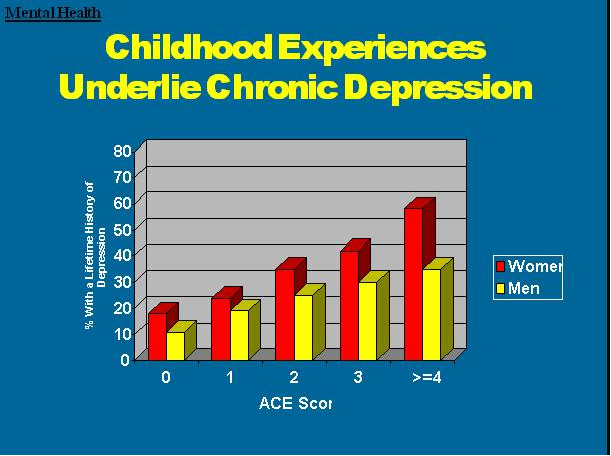
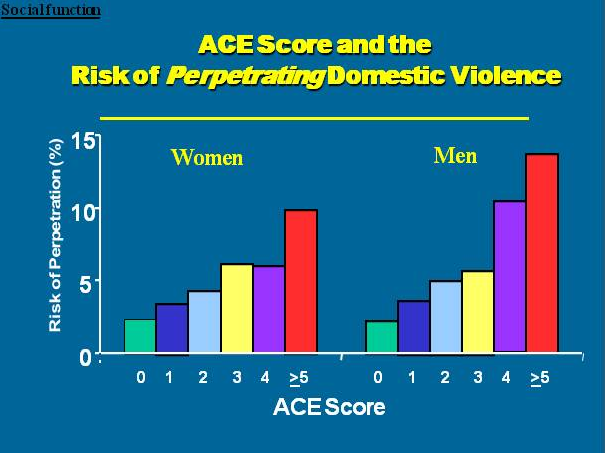
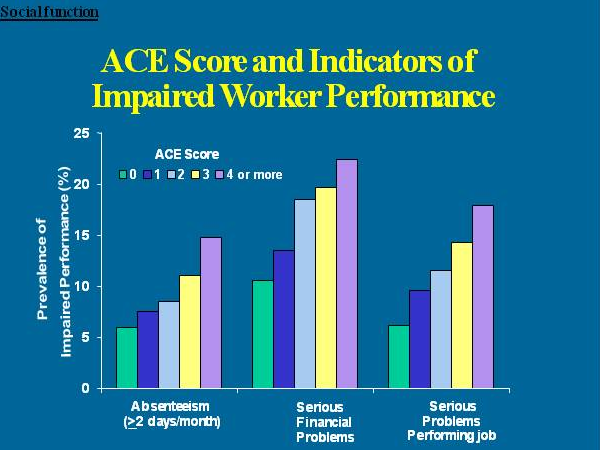
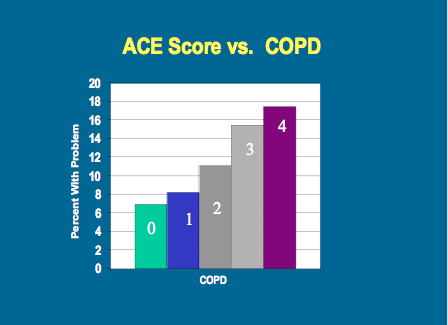
As your ACE score increases, so does the risk of disease, social and emotional problems. With an ACE score of 4 or more, things start getting serious. The likelihood of chronic pulmonary lung disease increases 390 percent; hepatitis, 240 percent; depression 460 percent; attempted suicide, 1,220 percent.
(By the way, lest you think that the ACE Study was yet another involving inner-city poor people of color, take note: The study’s participants were 17,000 mostly white, middle and upper-middle class college-educated San Diegans with good jobs and great health care – they all belonged to the Kaiser Permanente health maintenance organization. Prior to the ACE Study, most research about effects of abuse, neglect, etc., involved poor people of color who live in the inner city. And so the notion was that it was inner-city people of color who experienced abuse, neglect, etc., not white middle-class or white upper-class people….that somehow white people of means were immune from the kinds of problems affecting people who were poor. That’s not only ridiculous, but it was just another way to perpetrate racism and classism. The ACE Study quashed that notion. So, it’s not that I’m saying that the ACE Study is credible because it was done on white people, I’m saying that the ACE Study opened the door to an understanding that ACEs are at the root of nearly all problems of physical, mental, economic and social health in humans, no matter where in the world those humans live. The ACE Study and the other research that makes up ACEs science provided an opening to a better understanding of the constructs that make up our notion of why people suffer ill health — physical, mental, economic, social — and that includes systemic racism. )

Here are some specific graphic examples of how increasing ACE scores increase the risk of some diseases, social and emotional problems. All of these graphs come from “The relationship of adverse childhood experiences to adult health, well being, social function and health care”, a book chapter by Drs. Vincent Felitti and Robert Anda, co-founders of the ACE Study, in “The Hidden Epidemic: The Impact of Early Life Trauma on Health and Disease.”




What causes this?
At the same time that the ACE Study was being done, parallel research on kids’ brains found that toxic stress damages the structure and function of a child’s developing brain. This was determined by a group of neuroscientists and pediatricians, including neuroscientist Martin Teicher and pediatrician Jack Shonkoff, both at Harvard University, neuroscientist Bruce McEwen at Rockefeller University, and child psychiatrist Bruce Perry at the Child Trauma Academy.
When children are overloaded with stress hormones, they’re in flight, fright or freeze mode. They can’t learn in school. They often have difficulty trusting adults or developing healthy relationships with peers (i.e., they become loners). To relieve their anxiety, depression, guilt, shame, and/or inability to focus, they turn to easily available biochemical solutions — nicotine, alcohol, marijuana, methamphetamine — or activities in which they can escape their problems — high-risk sports, proliferation of sex partners, and work/over-achievement. (e.g. Nicotine reduces anger, increases focus and relieves depression. Alcohol relieves stress.)
In addition, toxic stress can be passed down from generation to generation. The field of epigenetics shows that we are born with a set of genes that can be turned on and off, depending on what’s happening in our environment. If a child grows up with an overload of toxic stress, their stress-response genes are likely to be activated so that they are easily triggered by stressful situations that don’t affect those who don’t grow up with toxic stress. They can pass that response onto their children.
Fortunately, brains and lives are somewhat plastic. Resilience research shows that the appropriate integration of resilience factors — such as asking for help, developing trusting relationships, forming a positive attitude, listening to feelings — can help people improve their lives.
For more information about ACEs science and how it’s being used, go to: PACEs Science 101.
Here’s a link to the long questionnaire (200+ questions).
For more information about PACEs science, go to PACEs Science 101.
_______________________
What are PCEs — positive childhood experiences?
Although there is still much to learn about ACEs and how to prevent and mitigate their effects, we also all know that childhood experiences are not limited to those that involve adversity. All childhood experiences matter. In the last few years, researchers have started to examine the impacts of positive childhood experiences (PCEs) on children and adults.
In 2019, a team of researchers — Dr. Christina Bethell, Jennifer Jones, Dr. Narangerel Gombojav, Dr. Jeff Linkenbach and Dr. Robert Sege — found a dose-response association between positive childhood experiences and adult mental and relationship health among adults who had experienced ACEs, irrespective of how many ACEs they had. This means that it’s really important to have positive childhood experiences, no matter how much adversity you have in your life. And if you have a lot of adversity and a lot of positive childhood experiences, you are less likely to suffer the consequences of ACEs. However if you have no positive childhood experiences and few ACEs, the consequences of the ACEs are more likely to appear. Positive Childhood Experiences and Adult Mental and Relational Health in a Statewide Sample: Associations Across Adverse Childhood Experiences Levels | JAMA Pediatrics.
To find out what positive childhood experiences you have, answer the following questions. How much or how often during your childhood did you:
- feel able to talk to your family about feelings;
- feel your family stood by you during difficult times;
- enjoy participating in community traditions;
- feel a sense of belonging in high school;
- feel supported by friends;
- have at least two non-parent adults who took genuine interest in you; and
- feel safe and protected by an adult in your home.
- Also in 2019, Bethell, Gombojav, and Dr. Robert Whitaker reported that at each level of ACEs, “the presence of flourishing increased in a graded fashion with increasing levels of family resilience and connection.” Family Resilience And Connection Promote Flourishing Among US Children, Even Amid Adversity | Health Affairs
- In 2014, Bethell, Dr. Paul Newacheck, Dr. Eva Hawes, and Dr. Neal Halfon found that children with higher ACE scores were less likely to demonstrate resilience, live in a protective home environment, have a mother who was healthy, and live in safe and supportive neighborhoods. However, almost half of the children who had experienced ACEs also demonstrated resilience, and “resilience mitigated the impact of adverse childhood experiences on grade repetition and school engagement.” Adverse Childhood Experiences: Assessing The Impact On Health And School Engagement And The Mitigating Role Of Resilience | Health Affairs
- In a study published in 2021, Whitaker, Dr. Tracy Dearth-Wesley, and Dr. Allison Herman wrote that “greater childhood family connection was associated with greater flourishing in US adults across levels of childhood adversity.” Childhood family connection and adult flourishing: associations across levels of childhood adversity – Academic Pediatrics (academicpedsjnl.net)
- Dr. Yui Yamaoka and Dr. David Bard reported in 2019 that “the number of adverse childhood experiences was associated with both social-emotional deficits and developmental delay risks in early childhood; however, positive parenting practices demonstrated robust protective effects independent of the number of adverse childhood experiences.” Positive Parenting Matters in the Face of Early Adversity – PubMed (nih.gov)
- Among juvenile offenders, Dr. Michael Baglivio and Dr. Kevin Wolff discovered in 2020 that “high ACE scores were associated with increased reoffending, and high PCE scores were associated with decreased recidivism, as measured by both rearrest and reconviction. Further, among juveniles with four or more ACEs who have six or more PCEs, reconviction was 23% lower and rearrest 22% lower when compared to those youth with four or more ACEs and less than six PCEs, controlling for a host of demographic and criminal history measures.” Positive Childhood Experiences (PCE): Cumulative Resiliency in the Face of Adverse Childhood Experiences – Michael T. Baglivio, Kevin T. Wolff, 2021 (sagepub.com)
- Dr. Michael Baxter, Dr. Eden Hemming, Dr. Heather McIntosh, and Dr. Chan Hellman published research in 2017 that demonstrated that higher ACEs scores were associated with lower hope in a study of caregivers who brought children in for a child abuse medical investigation at a child advocacy center. Exploring the Relationship Between Adverse Childhood Experiences and Hope: Journal of Child Sexual Abuse: Vol 26, No 8 (tandfonline.com)
- In 2019, Dr. AliceAnn Crandall, Dr. Jacob Miller, Dr. Aaron Cheung, Dr. Lynneth Novilla, Dr. Rozalyn Glade, Dr. M. Lelinneth Novilla, Dr. Brianna Magnusson, Dr. Barbara Leavitt, Dr. Michael Barnes, and Dr. Carl Hanson observed in a study of adults that “higher counter-ACEs scores [i.e., positive childhood experiences] were associated with improved adult health and that counter-ACEs neutralized the negative impact of ACEs on adult health.” ACEs and counter-ACEs: How positive and negative childhood experiences influence adult health – ScienceDirect
- A study by Whitaker, Dearth-Wesley, and Herman in 2020 showed that across levels of childhood adversity, greater childhood family connection was associated with greater flourishing among young adults with type 1 diabetes.Childhood Family Connection With Flourishing in Young Adulthood Among Those With Type 1 Diabetes | Pediatrics | JAMA Network Open | JAMA Network
- Finally, in 2016, Bethell, Gombojav, Dr. Michele Solloway, and Dr. Lawrence Wissow examined ACEs, resilience, family protective factors, and emotional, mental or behavioral conditions (EMB) in children and youth in the U.S. The authors found that children with ACEs had higher EMB than children without ACEs, but the presence of resilience was significantly associated with lower amounts of EMB for both children with and without ACEs. In addition, the prevalence of EMB was lower when family protective factors were present, even if the child had ACEs, although the presence of two or more ACEs decreased the effect. Adverse Childhood Experiences, Resilience and Mindfulness-Based Approaches: Common Denominator Issues for Children with Emotional, Mental, or Behavioral Problems (nih.gov)
In terms of research, these are still early days, says Dr. Robert Whitaker, director of Research and Research Education at the Columbia-Bassett Program and professor of Clinical Pediatrics in the Vagelos College of Physicians and Surgeons at Columbia University: “This area of PACEs research is emerging, but the boundaries of that research have not really been defined, particular as complement to the well-established body of research on resilience.”
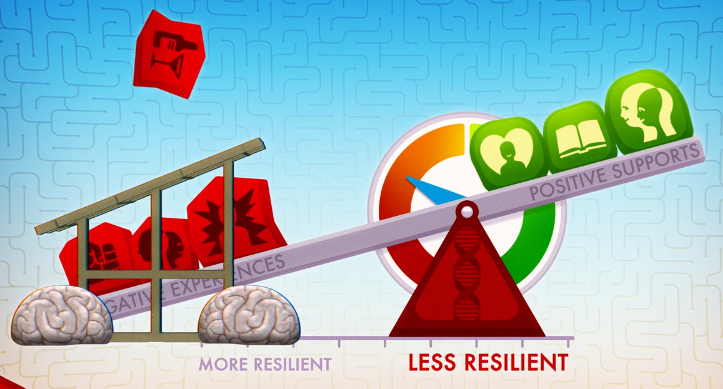
From “Brains: Journey to Resilience”, Alberta Family Wellness Initiative.
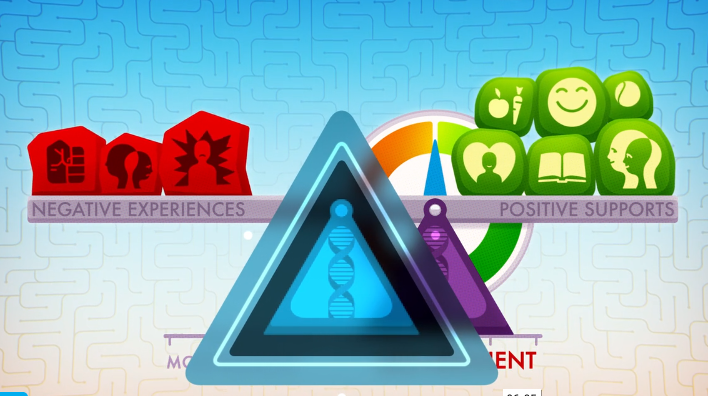
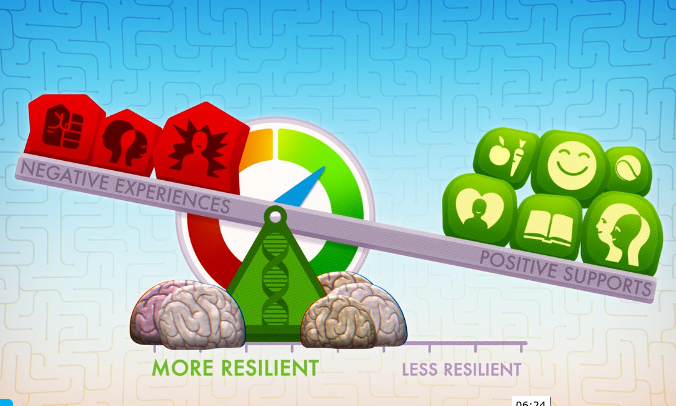
“PCEs may have lifelong consequences for mental and relational health despite co-occurring adversities such as ACEs,” noted Dr. Christina Bethell in Positive Childhood Experiences and Adult Mental and Relational Health in a Statewide Sample: Associations Across Adverse Childhood Experiences Levels. Bethell is professor at Johns Hopkins University in the Bloomberg School of Public Health and founding director of the Child and Adolescent Health Measurement Initiative. “In this way, they support application of the World Health Organization’s definition of health emphasizing that health is more than the absence of disease or adversity. The World Health Organization’s positive construct of health is aligned with the proactive promotion of positive experiences in childhood because they are foundational to optimal childhood development and adult flourishing.”
However, in terms of integrating what we know about PACEs, we have enough information to continue integrating the science into our work. If we want to change individuals, organizations, communities, and systems we need to talk about both positive and adverse childhood experiences — PACEs — and how they intertwine throughout our lives….
- At the individual level, learning about ACEs helps us understand why we behave the way we do, and that our coping behavior is normal…a normal response to abnormal circumstances. Learning about PCEs provides direction to heal. The key concept about PACEs is that learning about both, together, can help improve our health and well-being. It gives us hope.
- At the organizational level, staff and leaders can use knowledge of PACEs to create healing-centered work environments and programs in all sectors.
- At the community level, educating the public about PACEs can provide hope and foster the development of innovative ideas about how to support families, organizations and communities. Understanding the interplay between positive and adverse experiences offers opportunity for engagement with all sectors. Communities can use this new lens to create mindful, healing-centered, research-informed approaches to prevent adversity and encourage connection and healing.
- At the system level, policymakers and leaders can use research about PACEs to find common ground across fields and to support policies that promote the understanding of PACEs and how adversity and positive experiences work together.
At least two organizations are taking this approach and doing research to guide their actions:
- The Healthy Outcomes from Positive Experiences (HOPE) team at Tufts Medical Center have identified four building blocks that lessen the negative effects of ACEs: relationships, environments, engagement, and social emotional development. HOPE – Healthy Outcomes from Positive Experiences
- The Hope Research Center at the University of Oklahoma, Tulsa, focuses its research on the “science and power of hope as a psychological strength, especially among those experiencing trauma and adversity.” The Center defines hope as “the belief that the future will be better and you have the power to make it so.” Hope Research Center (ou.edu)
If you’re interested in becoming more involved in the PACEs science community, join our companion social network, PACEs Connection. Just go to PACEsConnection.com and click “Join”. PACEsConnection.com is the leading advocate for information about the science of positive and adverse childhood experiences (PACEs) and the rapidly expanding, global PACEs science movement.
 ACEs Too High LLC
The worst traumatic experience in my life was to find out that my father who was only 56 was dying of a brain tumour. I was close to him so this hit me hard.
LikeLike
please connect me with Pacific Northwest IE. Idaho Wash, Montana ACEs traning classes for nurses/ school employees I need certification . Took basic class 2019 then covid stopped all classes . Thanks, rachael 208 245 3853 cell message 208 582 8843
LikeLike
If you search for ‘trauma-informed training’, many classes will come up. Also check PACEsConnection.com for training, either in the Resources section or in the events section. I believe the network is on pause, but it’s expected to return.
LikeLike
[…] “Adverse Childhood Events” (ACEs) studies, and the link to autoimmune disorders, and know your ACE score. The good news is that we can counteract the toxic effects of childhood trauma. The first step in […]
LikeLike
[…] main test for ACEs is the ACE Study’s questionnaire, which comprises 10 […]
LikeLike
[…] If you think you have ACEs or hidden ACEs from the past, check your ACE score here. […]
LikeLike
I know my ACE score is high.
LikeLike
[…] You were introduced to ACEs in Module 11. Now, you will look closely at the ten types of childhood trauma measured in the ACE Study. Click on https://acestoohigh.com/got-your-ace-score/ […]
LikeLike
[…] Calculate your ACE Score here […]
LikeLike
Comprehensive I’ve never gave childhood much credence
LikeLike
Shannon,
Negative experiences burn like a scar on the psyche at an early age before the brain has time to mature. Some folks are more sensitive than others, therefore, their scars can be more intense. But, I feel like, my generation at least, had a culture of ignoring type of negative behaviors cuz their parents “did the same thing.” Which is a crock. Rationalization shouldn’t be used as an excuse. Articles like this are a God-send to people like me – now I don’t feel so alone in my feelings.
LikeLike
What has been my saving grace is my spiritual education. I have studied “The Course In Miracles” since 1997. Once the truth about what the “real world” is about and understood, then it’s easier to forgive everyone (even yourself) for the past. Forgiveness is the cure!
LikeLike
[…] know this sounds super melodramatic….but developmental trauma has actually been linked with higher risks of pretty much every chronic illness, mental illness, addiction, violence, …. In fact, childhood trauma and toxic stress have been shown to cause almost every form of illness […]
LikeLike
[…] or in completing the ACEs Too High assessment yourself or with a loved one, you can access it here. Because of the dramatic connections made in this study between childhood trauma and negative […]
LikeLike
[…] ACES SCORE SHEET (Links to an external site.) What ACEs/PCEs do you have? […]
LikeLike
[…] ACES SCORE SHEET (Links to an external site.) What ACEs/PCEs do you have? […]
LikeLike
[…] ACES SCORE SHEET (Links to an external site.) What ACEs/PCEs do you have? […]
LikeLike
[…] ACES SCORE SHEET (Links to an external site.) What ACEs/PCEs do you have? […]
LikeLike
[…] ACES SCORE SHEET (Links to an external site.) What ACEs/PCEs do you have? […]
LikeLike
[…] What ACEs/PCEs do you have? […]
LikeLike
[…] ACES SCORE SHEET (Links to an external site.) What ACEs/PCEs do you have? […]
LikeLike
[…] ACES SCORE SHEET (Links to an external site.) What ACEs/PCEs do you have? […]
LikeLike
[…] What ACEs/PCEs do you have? […]
LikeLike
I scored a 6 on the ACE, explains a lot because though my childhood was traumatic it was compounded by my mothers need to keep up appearances and pretend to the outside world that our family life was normal. From my teens to 50s I suffered constant illness, stomach ulcers, asthma, chronic sinusitis, autoimmune skin complaints as well as a fondness for alcohol, difficulties in holding down jobs and relationship problems. What kept me functioning was the good habit of regular exercise, but what began the healing was learning to meditate and doing chi gong regularly. These to things healed the body and give the mind space to not be overwhelmed by negative emotions. I’m not saying therapy is not necessary but for me they work. I’m in my 60s now and probably the most stable and happy than I have been. Shame that took so long to find the key because in some ways I feel that I have lived a wasted life, on the other hand though maybe that is what what life is all about, at least for some, and the time we need to heal ourselves is irrelevant in the greater scheme of things.
LikeLike
Same ….. I was a 7 …. Just trying to understand why I continued to let Abuse happen … At a good place now …. Even thou the Scars will never leave…
LikeLike
Dear John, Ummm… what? Future me, is that you. Thank you so very much for sharing your experience John. The details are different, the feelings are EXACTLY the same.
I am still working at it but unequivocally rigorous exercise is key as well as healing the body and mind with structured movement (yoga and the like) meditation, therapy, and herbal medicines such as ashwaganda to help manage the negative impact of stress hormones.
Thank you for sharing.
LikeLike
I’m proud of you for finding what works for you. Healing is definitely hard work. Thank you for showing some of us it will continue to get better as long as we keep on trying.
LikeLike
John,
I scored 5 on the ACE test. My abuse was so passive and under the radar (verbal abuse and emotional neglect) that I never even considered myself abused. Not until the MeeToo movement did I stop and reflect on my past experiences with men and my family.
I knew that my past experiences were to blame, but I didn’t know that childhood abuse really never goes away. I am a very spiritual person now, and used that learning to heal myself – but are we really ever “healed” – I mean, completely? The vague feelings of discontent slowly creep in so unconsciously that I don’t even notice for a while. Not until my pants are super tight, then my ego starts the internal thought shaming. Luckily, the Higher Self comes in to mother me. But the shame is still there. Learning about ACE now is helping me bring in more Grace and hopefully mitigate the negative self-talk that brings on depression in me.
LikeLike
I scored a 9 on the ACE survey. The shame is so freaking pervasive. I’ve only just realized how much shame I have. It’s held me back all of my life. With the advent of neuroplasticity, I have hope that I can reverse some of the early damage now in hopes of realizing my full potential.
LikeLike
You can get through and have the life you want. And it will likely not be easy to get there. I identify with you just coming to realize the shame and the impact. That it both great and heartbreaking. It’s great because you know something new about yourself that can help you heal. It’s heartbreaking because up until this point you had no idea (not do any of us) that it is what is holding us back.
Working through it with a therapist and(deity) willing a Psychiatrist as well, can give you the tools to a realized life. The version of you you always wanted to present but we’re too ashamed to because others put their shit on you. (Those who neglected or abused).
It doesn’t matter whether the score you got was 1or 10. It’s not your %#$&@+* score. It’s theirs. How could you have a score on your environment as a kid? You had nothings to do with providing it.
Find the help you need if you have t started that process. And if you have, consider knowing about the shame as a breakthrough. And that unfortunately though you carry it, it is not actually your shame. It’s their shame they put on you. And if you can avoid passing it on, you have broken the cycle.
I wish you peace during this time in your life.
LikeLike
[…] You were introduced to ACEs in Module 11. Now, you will look closely at the ten types of childhood trauma measured in the ACE Study. Click on https://acestoohigh.com/got-your-ace-score/ […]
LikeLike
[…] You were introduced to ACEs in Module 11. Now, you will look closely at the ten types of childhood trauma measured in the ACE Study. Click on https://acestoohigh.com/got-your-ace-score/ […]
LikeLike
[…] You were introduced to ACEs in Module 11. Now, you will look closely at the ten types of childhood trauma measured in the ACE Study. Click on https://acestoohigh.com/got-your-ace-score/ […]
LikeLike
[…] You were introduced to ACEs in Module 11. Now, you will look closely at the ten types of childhood trauma measured in the ACE Study. Click on https://acestoohigh.com/got-your-ace-score/ […]
LikeLike
[…] You were introduced to ACEs in Module 11. Now, you will look closely at the ten types of childhood trauma measured in the ACE Study. Click on https://acestoohigh.com/got-your-ace-score/ […]
LikeLike
[…] You were introduced to ACEs in Module 11. Now, you will look closely at the ten types of childhood trauma measured in the ACE Study. Click on https://acestoohigh.com/got-your-ace-score/ […]
LikeLike
[…] You were introduced to ACEs in Module 11. Now, you will look closely at the ten types of childhood trauma measured in the ACE Study. Click on https://acestoohigh.com/got-your-ace-score/ […]
LikeLike
[…] You were introduced to ACEs in Module 11. Now, you will look closely at the ten types of childhood trauma measured in the ACE Study. Click on https://acestoohigh.com/got-your-ace-score/ […]
LikeLike
[…] You were introduced to ACEs in Module 11. Now, you will look closely at the ten types of childhood trauma measured in the ACE Study. Click on https://acestoohigh.com/got-your-ace-score/ […]
LikeLike
[…] You were introduced to ACEs in Module 11. Now, you will look closely at the ten types of childhood trauma measured in the ACE Study. Click on https://acestoohigh.com/got-your-ace-score/ […]
LikeLike
[…] You were introduced to ACEs in Module 11. Now, you will look closely at the ten types of childhood trauma measured in the ACE Study. Click on https://acestoohigh.com/got-your-ace-score/ […]
LikeLike
[…] You were introduced to ACEs in Module 11. Now, you will look closely at the ten types of childhood trauma measured in the ACE Study. Click on https://acestoohigh.com/got-your-ace-score/ […]
LikeLike
[…] You were introduced to ACEs in Module 11. Now, you will look closely at the ten types of childhood trauma measured in the ACE Study. Click on https://acestoohigh.com/got-your-ace-score/ […]
LikeLike
[…] You were introduced to ACEs in Module 11. Now, you will look closely at the ten types of childhood trauma measured in the ACE Study. Click on https://acestoohigh.com/got-your-ace-score/ […]
LikeLike
[…] You were introduced to ACEs in Module 11. Now, you will look closely at the ten types of childhood trauma measured in the ACE Study. Click on https://acestoohigh.com/got-your-ace-score/ […]
LikeLike
[…] You were introduced to ACEs in Module 11. Now, you will look closely at the ten types of childhood trauma measured in the ACE Study. Click on https://acestoohigh.com/got-your-ace-score/ […]
LikeLike
[…] You were introduced to ACEs in Module 11. Now, you will look closely at the ten types of childhood trauma measured in the ACE Study. Click on https://acestoohigh.com/got-your-ace-score/ […]
LikeLike
[…] You were introduced to ACEs in Module 11. Now, you will look closely at the ten types of childhood trauma measured in the ACE Study. Click on https://acestoohigh.com/got-your-ace-score/ […]
LikeLike
[…] You were introduced to ACEs in Module 11. Now, you will look closely at the ten types of childhood trauma measured in the ACE Study. Click on https://acestoohigh.com/got-your-ace-score/ […]
LikeLike
[…] You were introduced to ACEs in Module 11. Now, you will look closely at the ten types of childhood trauma measured in the ACE Study. Click on https://acestoohigh.com/got-your-ace-score/ […]
LikeLike
[…] You were introduced to ACEs in Module 11. Now, you will look closely at the ten types of childhood trauma measured in the ACE Study. Click on https://acestoohigh.com/got-your-ace-score/ […]
LikeLike
[…] You were introduced to ACEs in Module 11. Now, you will look closely at the ten types of childhood trauma measured in the ACE Study. Click on https://acestoohigh.com/got-your-ace-score/ […]
LikeLike
[…] You were introduced to ACEs in Module 11. Now, you will look closely at the ten types of childhood trauma measured in the ACE Study. Click on https://acestoohigh.com/got-your-ace-score/ […]
LikeLike
[…] You were introduced to ACEs in Module 11. Now, you will look closely at the ten types of childhood trauma measured in the ACE Study. Click on https://acestoohigh.com/got-your-ace-score/ […]
LikeLike
[…] You were introduced to ACEs in Module 11. Now, you will look closely at the ten types of childhood trauma measured in the ACE Study. Click on https://acestoohigh.com/got-your-ace-score/ […]
LikeLike
[…] You were introduced to ACEs in Module 11. Now, you will look closely at the ten types of childhood trauma measured in the ACE Study. Click on https://acestoohigh.com/got-your-ace-score/ […]
LikeLike
[…] You were introduced to ACEs in Module 11. Now, you will look closely at the ten types of childhood trauma measured in the ACE Study. Click on https://acestoohigh.com/got-your-ace-score/ […]
LikeLike
[…] You were introduced to ACEs in Module 11. Now, you will look closely at the ten types of childhood trauma measured in the ACE Study. Click on https://acestoohigh.com/got-your-ace-score/ […]
LikeLike
[…] You were introduced to ACEs in Module 11. Now, you will look closely at the ten types of childhood trauma measured in the ACE Study. Click on https://acestoohigh.com/got-your-ace-score/ […]
LikeLike
[…] You were introduced to ACEs in Module 11. Now, you will look closely at the ten types of childhood trauma measured in the ACE Study. Click on https://acestoohigh.com/got-your-ace-score/ […]
LikeLike
[…] You were introduced to ACEs in Module 11. Now, you will look closely at the ten types of childhood trauma measured in the ACE Study. Click on https://acestoohigh.com/got-your-ace-score/ […]
LikeLike
[…] You were introduced to ACEs in Module 11. Now, you will look closely at the ten types of childhood trauma measured in the ACE Study. Click on https://acestoohigh.com/got-your-ace-score/ […]
LikeLike
[…] You were introduced to ACEs in Module 11. Now, you will look closely at the ten types of childhood trauma measured in the ACE Study. Click on https://acestoohigh.com/got-your-ace-score/ […]
LikeLike
[…] You were introduced to ACEs in Module 11. Now, you will look closely at the ten types of childhood trauma measured in the ACE Study. Click on https://acestoohigh.com/got-your-ace-score/ […]
LikeLike
[…] You were introduced to ACEs in Module 11. Now, you will look closely at the ten types of childhood trauma measured in the ACE Study. Click on https://acestoohigh.com/got-your-ace-score/ […]
LikeLike
[…] You were introduced to ACEs in Module 11. Now, you will look closely at the ten types of childhood trauma measured in the ACE Study. Click on https://acestoohigh.com/got-your-ace-score/ […]
LikeLike
[…] You were introduced to ACEs in Module 11. Now, you will look closely at the ten types of childhood trauma measured in the ACE Study. Click on https://acestoohigh.com/got-your-ace-score/ […]
LikeLike
[…] You were introduced to ACEs in Module 11. Now, you will look closely at the ten types of childhood trauma measured in the ACE Study. Click on https://acestoohigh.com/got-your-ace-score/ […]
LikeLike
[…] You were introduced to ACEs in Module 11. Now, you will look closely at the ten types of childhood trauma measured in the ACE Study. Click on https://acestoohigh.com/got-your-ace-score/ […]
LikeLike
I score 0 on ACE and 6 on PCE. It seems ‘unfair’ but I always wondered why I had such an easier life than so many others I know love and work with
LikeLike
I just learned about the ACE concept and rationale. Brilliant! I will do my part to start spreading the word.
The children of marginalized families, in poorer communities, face many challenges that larger institutions created but aren’t held accountable for. The blame and punishment are on the victim, not the perp.
LikeLike
[…] What ACEs/PCEs do you have? < […]
LikeLike
I scored 9 on the ACE questions and 0 on resilience, I’ve had a cancer diagnosis and have been an addict since I was a child…
LikeLike
I’m so sorry that your very high ACE score has caused you so much pain, Catharine. It all seems so unfair, doesn’t it? I hope you are able to find a way to get some loving support as you deal with these terrible outcomes from your childhood. I myself am working on my addiction through a grace-filled 12-Step group, and have a team of physicians who help me try to manage my many health problems. I wish you the very best.
LikeLike
I would like subscribe to this
LikeLike
4 on the ACE, 5 on the resiliency. Helps to have a good therapist, too.
LikeLike
Answering the question about my childhood the majority of the question where to be true
LikeLike
I scored a 10 on the ACE test and 2 on resilience.
read the meaning behind it: https://gulabigangofficial.in/444-angel-number-in-love-and-twin-flame/
LikeLike
I have a question. On question #9 of the ACE survey, it asks, “was a household member depressed or mentally ill, or did a household member attempt suicide?” Does this include the person who is taking the survey herself, or only other members of the household?
LikeLike
Only household members.
LikeLiked by 1 person
wow mine was a 2
LikeLike
[…] the ACE Quiz and review the meaning of its […]
LikeLike
Why does #7 not say mother or father. MANY wives physically abuse/batter their husbands. Change it! Shameful and discriminatory. Darla
LikeLike
It says in the article that the word mother was used (as well as the other specific examples) because it was one of the most commonly reported ACES in the research study but mentions that fathers, grandparents etc suffering abuse are also adverse experiences and there are many others not listed
LikeLike
“witnessing a father being abused by a mother, witnessing a grandmother abusing a father,” … “The ACE Study included only those 10 childhood traumas because those were mentioned as most common by a group of about 300 Kaiser members; those traumas were also well studied individually in the research literature.”
I just copied it directly from the article here for accuracy sake but basically what I was trying to say
LikeLike
[…] https://acestoohigh.com/got-your-ace-score/ […]
LikeLike
I have an ACE score of 5 but a PCE score of ZERO! The latter is way more disturbing to me. Is this normal???? Can you recover from it?? I feel like lots of people have bad stuff happen to them but it is normal to have ZERO pces??? I feel really doomed, my sense of self is very weak. How do you treat it!!!!??????
LikeLike
You can recover from it. Join PACEsConnection.com and then join the Practicing Resilience for Self-Care & Healing community.
LikeLike
Yes u can develop resilience. I scored an 8 on aces test & a 5 on resilience. I’m getting better & refuse to give in!
LikeLike
I was EXACTLY the same as you. Yes you can overcome it. I got a therapist who I really trusted. She showed me a path to healing and helped me every step of the way. You are NOT doomed.
LikeLike
Very interesting highlights a lot for me.
LikeLike
This is an extremely helpful article, very well written and well cited. Thank you.
LikeLike
[…] the ACE Quiz and review the meaning of its […]
LikeLike
[…] Σύμφωνα με την ιστοσελίδα Υπερβολικά υψηλά ACEs. […]
LikeLike
Very interesting course
LikeLike
[…] ACEs and Toxic Stress: Frequently Asked Questions https://acestoohigh.com/got-your-ace-score/ […]
LikeLike
I received a 0 out 10. I have to say I know friends that their scores would have been higher and it makes complete sense on how as an adult they have been diagnosed with anxiety and depression.
LikeLike
It’s useful and helpful to also see the “non-psych” aspects of their lives, too. Are they in poor health from opportunistic diseases, are they potentially harried over-achievers, or “lazy” underachievers? The implications for folks who have high ACEs with low resilience capabilities can be masked or camouflaged by other things happening in their lives. I think it’s helpful to try to see the larger aspects of those lives – their “aura” of chaos and disorder, failed and broken relationships, etc. perhaps – as part of the ACEs spectrum.
LikeLike
[…] The ACE Study found that the higher someone’s ACE score – the more types of childhood adversity a person experienced – the higher their risk of chronic disease, mental illness, violence, being a victim of violence and a bunch of other consequences. The study found that most people (64%) have at least one ACE; 12% of the population has an ACE score of 4. Having an ACE score of 4 nearly doubles the risk of heart disease and cancer. It increases the likelihood of becoming an alcoholic by 700 percent and the risk of attempted suicide by 1200 percent. (For more information, go to ACEs Science 101. To calculate your ACE and resilience scores, go to: Got Your ACE Score?) […]
LikeLike
[…] autoimmune diseases, as well as depression, violence, being a victim of violence, and suicide. (https://acestoohigh.com/got-your-ace-score/) What is really interesting is the “traumas” that they researched are things that many of us […]
LikeLike
[…] https://www.tedmed.com/talks/show?id=293066 Watch the Ted Talk, review the John Hopkins document and then calculate your own ACES score using the link below. You don’t need to share your score (unless you choose to) but it may help you to understand yourself better and those that you work or live with. I, do, however, want each of you to share your impressions. What have you learned? How might you use the ACES study to work with clients? What ACEs/PCEs do you have? […]
LikeLike
I scored 4/10 in ACES. I found this very interesting as it got me to think back and reflect on this and how i am the person i am today because of it.
LikeLike
[…] https://www.tedmed.com/talks/show?id=293066 Watch the Ted Talk, review the John Hopkins document and then calculate your own ACES score using the link below. You don’t need to share your score (unless you choose to) but it may help you to understand yourself better and those that you work or live with. I, do, however, want each of you to share your impressions. What have you learned? How might you use the ACES study to work with clients? What ACEs/PCEs do you have? […]
LikeLike
[…] https://www.tedmed.com/talks/show?id=293066 Watch the Ted Talk, review the John Hopkins document and then calculate your own ACES score using the link below. You don’t need to share your score (unless you choose to) but it may help you to understand yourself better and those that you work or live with. I, do, however, want each of you to share your impressions. What have you learned? How might you use the ACES study to work with clients? What ACEs/PCEs do you have? […]
LikeLike
[…] Saskaņā ar tīmekļa vietni AKE ir pārāk augsti. […]
LikeLike
[…] The incidence of obesity, diabetes and heart problems, cancer and other diseases goes up when a child lives with toxic stress. Additionally, their chances of depression, substance abuse and dependence, smoking, teen pregnancy and/or sexually transmitted disease, suicide and domestic violence greatly increase. So does their tendency to be more violent or to become a victim of violence. Studies done by the Centers for Disease Control and Prevention (CDC) have shown that when a child is subjected to frequent or continual stress from thing like neglect, abuse, dysfunctional families or domestic abuse, and they lack adequate support from adults, their brain architecture is actually altered and their organ systems become weakened. As a result, these kids risk lifelong health and social problems. Of the 17,000 people who took part in the CDC study, two thirds had an Adverse Childhood Experiences (ACE) score of 1 or higher. 87% of those people had more than one ACE. By measuring and scoring ten types of trauma ranging from childhood sexual abuse to neglect or bullying and even divorce, researchers were able to assess the chronic disease risk for the study’s mostly white, middle class participants. Their results show that the problem of toxic stress isn’t limited to children who face poverty or to those who come from certain ethnic groups – children from all walks of life can have high ACE scores. If you are interested in finding out your ACE score and what it might mean for you, go here. […]
LikeLike
10 outta 10 ace
1 outta 10 pace
Explains a lot! Experiencing grief and praise for the awareness of this information. Perception IS everything! Thru understanding the reality of my hardware, family & ancestry, I am beginning to learn how to work w what Ive got. What else you got? Everything else pales in comparison to the nuances of reality. Thank You for this. 🙏🏼
ps…I found this info via book ‘Mother Hunger’ by Kelly McDaniel
LikeLike
[…] member, and suicide or psychological issues with a household member. By using the so-called ACE-Questionnaire in a large sample, the occurrence of multiple ACEs appeared to be strongly related to risk […]
LikeLike
I am surprised bullying is not part of the ACE scoring. I was bullied from as young as I can remember through high school. I was not well liked nor did I fit in well. I was however, oblivious to the rejection of others because it had happened for so long I didn’t pick up on the signs that people didn’t want me around. I inserted myself into the lives of others.
LikeLike
Bullying wasn’t part of the original ACE Study, but many subsequent surveys include it.
LikeLike
I agree 100% bullying should be added!
LikeLike
Many other ACEs have been added since the ACE Study, including bullying. There are now many versions of the ACE Study. The World Health Organization lists more than two dozen ACEs.
LikeLike
[…] https://www.tedmed.com/talks/show?id=293066 Watch the Ted Talk, review the John Hopkins document and then calculate your own ACES score using the link below. You don’t need to share your score (unless you choose to) but it may help you to understand yourself better and those that you work or live with. I, do, however, want each of you to share your impressions. What have you learned? How might you use the ACES study to work with clients? What ACEs/PCEs do you have? […]
LikeLike
[…] know much about the lifelong, brain-disorganizing impacts of Adverse Childhood Experiences (ACES). Decades later, after getting little help from professional therapists for what was essentially […]
LikeLike
[…] know much about the lifelong, brain-disorganizing impacts of Adverse Childhood Experiences (ACES). Decades later, after getting little help from professional therapists for what was essentially […]
LikeLike
[…] know much about the lifelong, brain-disorganizing impacts of Adverse Childhood Experiences (ACES). Decades later, after getting little help from professional therapists for what was essentially […]
LikeLike
[…] answer is in the Adverse Childhood Experiences Study (ACE Study) which is becoming more and more widely known. In short, this significant study (and […]
LikeLike
[…] “Felitti’s peers were extremely skeptical of his observations, but Felitti was sure he was on to something important. He conducted a large-scale study on the impact of childhood abuse, and, later, other adverse childhood experiences,” she continued. “He found that [ACEs] were correlated with a range of negative outcomes in adulthood — outcomes related to physical health, mental health, and psychosocial well-being.” If you’re interested in your own ACEs score, be sure to check it out right here. […]
LikeLike
[…] “Felitti’s friends have been extraordinarily skeptical of his observations, however Felitti was positive he was on to one thing vital. He performed a large-scale examine on the impression of childhood abuse, and, later, different hostile childhood experiences,” she continued. “He discovered that [ACEs] have been correlated with a variety of destructive outcomes in maturity — outcomes associated to bodily well being, psychological well being, and psychosocial well-being.” In case you’re serious about your individual ACEs rating, make sure you test it out proper right here. […]
LikeLike
I can be reached at my personal email for any Questions about herpes at: R.buckler 11 [at] G mail com”
LikeLike
I can be reached at my personal email for any Questions or Comments at: hsv2.herpes@gmail.com”
LikeLike
Wow eye opening!!!! Was trying to find out if I had ptsd (my pyschiatryst says I don’t have it) I think I do!! I now know for sure my aces(alot) has affected and traumatic life events I’ve experienced account for a huge amount of my problems! My loved ones (sister,family,friends) thinking i just have addiction to drugs and alcohol!!! They get mad at me cause I won’t grow up and just quit. Act like an adult,I would love nothing more if I could. They wouldn’t listen to “my excuses” when I told them it’s not an addiction to substance that causes people to abuse a substance! We abuse the substance cause of underlying issues from past experiences that weren’t processed/treated properly.
I’m so glad I came across this info, now I have hope!!!
LikeLike
[…] The ACE studies have expanded over the years and we continue to increase our understanding about how our early life experiences impact our adult health and wellbeing. You can learn more about ACEs and get your own scores by visiting ACEStooHigh. […]
LikeLike
[…] What ACEs/PCEs do you have? […]
LikeLike
The course is an eye opener to me, it gives me more insight to different types of childhood trauma.
LikeLike
[…] Acestoohigh.com. […]
LikeLike
This is such an amazing amount of information! Thank you.
LikeLike
[…] in the long-run, in the short term it can have a negative impact on the kids. Divorce is one of 10 Adverse Childhood Experiencesotherwise known as ACEs, that are linked to disease, mental illness, cognitive issues, addiction and […]
LikeLike
[…] The ACE studies have expanded over the years and we continue to increase our understanding about how our early life experiences impact our adult health and wellbeing. You can learn more about ACEs and get your own scores by visiting ACEStooHigh. […]
LikeLike
[…] The ACE studies have expanded over the years and we continue to increase our understanding about how our early life experiences impact our adult health and wellbeing. You can learn more about ACEs and get your own scores by visiting ACEStooHigh. […]
LikeLike
[…] The ACE research have expanded over time and we proceed to extend our understanding about how our formative years experiences impression our grownup well being and wellbeing. You’ll be able to study extra about ACEs and get your personal scores by visiting ACEStooHigh. […]
LikeLike
[…] mentally ill, and witnessing domestic violence. (For more information, see PACEs Science 101 and What ACEs/PCEs Do You Have?) Subsequent ACE surveys include experiencing bullying, racism, the foster care system, living in a […]
LikeLike
[…] by this) As you can see, traumas are a big part of living a human experience ( take the trauma test here ) A trauma makes us develop schemas to cope with living. Schemas are supposed to keep us safe from […]
LikeLike
thanks for information
LikeLike
[…] What ACEs/PCEs do you have? […]
LikeLike
[…] What ACEs/PCEs do you have? […]
LikeLike
[…] more on this and the ramifications of growing up in distressing situations check out the ACE test which takes a look at our childhood adverse experiences and how they shape us and can contribute to […]
LikeLike
[…] 201. See Got Your ACE Score?, ACES Too High, https://acestoohigh.com/got-your-ace-score/ (last visited Sept. 6, […]
LikeLike
[…] A recent study determined that childhood trauma and genetically inherited trauma contribute to a higher risk of obesity. Trauma contributes to many other health conditions, such as heart disease and a shorter life span. ACEs provide a baseline understanding of important medical risks, and arming yourself with your score and the reality of increased health risks is an important component of self-care. Don’t know your ACEs score? Take the simple quiz here. […]
LikeLike
[…] by this) As you can see, traumas are a big part of living a human experience ( take the trauma test here ) A trauma makes us develop schemas to cope with living. Schemas are supposed to keep us safe from […]
LikeLike
[…] up in poor and abusive families in the inner city. Meanwhile, I score in the 4+ category for Adverse Childhood Experiences – among other things, my mother was an alcoholic, and my father was emotionally distant and […]
LikeLike
[…] Perhaps you will take the survey: https://acestoohigh.com/got-your-ace-score/ […]
LikeLike
I came across your website from google and I found some good information I was looking for best addiction treatment center in karachi Thank you!!!
LikeLike
Thank you
LikeLike
[…] do you know if you have ACEs? This quick questionnaire from the ACEs Too High website are the top ten adverse events linked to health issues in adults. The CDC hosts the longer […]
LikeLike
The stats are informative, I do have experience of dealing with adults who have revealed childhood problems with parents and other adults who now are heavy smokers, drinkers, drug users, usually these children were not fed properly or had no attention from adults in, were in general deprived, and now they have health problems such as heart problems, dental, liver, COPD and asthma etc so it does all add up in the end.
LikeLike
[…] If the victim is unable to “fall apart”, they will simply stuff the pain, for as long as they can before it erupts in disease of some kind. One way or another, the pain will come out because the pain was too great to not take a toll. That’s why victims of abuse are at greater risk for health issues later. There are many studies that have been done that show a direct correlation between abuse and greater incidence of health problems and even early death, especially for children who score high on the ACE questionnaire. ACE stands for Adverse Childhood Experiences and describes the experiences that can deeply impact a child for life – such as abuse, to them or their parent, abandonment, drug use by parents, neglect, mental illness in a parent, etc. For more, see this page, or the associated links to the CDC study contained here: https://acestoohigh.com/got-your-ace-score/ […]
LikeLike
I scored a 10
LikeLike
[…] The ACE Study found that the higher someone’s ACE score – the more types of childhood adversity a person experienced – the higher their risk of chronic disease, mental illness, violence, being a victim of violence and a bunch of other consequences. The study found that most people (64%) have at least one ACE; 12% of the population has an ACE score of 4. Having an ACE score of 4 nearly doubles the risk of heart disease and cancer. It increases the likelihood of becoming an alcoholic by 700 percent and the risk of attempted suicide by 1200 percent. (For more information, go to ACEs Science 101. To calculate your ACE and resilience scores, go to: Got Your ACE Score?) […]
LikeLike
I got a 5 on the ACE score and a big fat zero on the PCE’s – I guess having a rare chronic condition (Addison’s Disease) caused by autoimmune disease is now understandable, as is the hypothyroidism, the severe clinical depression, the Asthma the type 2 diabetes, then high blood pressure, the obesity, and hypertension. Yay, go me.
LikeLike
8 on the ACE score, 3 on the PCE. I have asthma, allergies, arthritis, hypothyroidism, sleep apnea, depression. Cheers!
LikeLike
Lyn, One thing I keep hearing … consistently and from various sources… is that your ACE score does not have to define who you are and how you live. Knowing your ACE score is one thing. Choosing to live a particular way, perhaps in spite of your ACE score is another. If possible, make healthy choice s (even now!) to counteract that ACE score. I recognize that not everyone’s circumstances (financially, employment, retirement, social environment, family connections, etc.) support or even recognize healthier choices. But, you do have self-appointed agency to take one step in one direction. Perhaps the second step will be a little easier.
LikeLike
Ace score 8 pce score1
I don’t go to the Dr so I can’t say but I feel like I’m sick all the time and I live in a really dark place in my head. I often hope for death.
LikeLike
Though it may be clinically labelled as some other disorder, I have a self-diagnosed condition involving ACE trauma, ASD and high sensitivity — which I freely refer to as a perfect storm of train wrecks. It’s one with which I greatly struggle(d) while unaware, until I was a half-century old, that its component dysfunctions had official names.
When around their neurotypical peers, young people with ASD typically feel compelled to “camouflage” or “mask”, terms used to describe their attempts at appearing to naturally fit in when around their neurotypical peers, an effort known to cause their already high anxiety and/or depression levels to worsen. And, of course, this exacerbation is reflected in the disproportionately high rate of suicide among ASD people.
I still cannot afford to have a formal diagnosis made on my condition, due to having to pay for a specialized shrink, in our (Canada’s) supposedly universal health-care system. Within that system, there are important health treatments that are universally inaccessible, except for those with a bunch of extra money. … If one has diagnosed and treated such a formidable condition when one is very young, he/she will likely be much better able to deal with it through life.
Nonetheless, my experience has revealed to me that high-scoring adverse childhood experience trauma that essentially results from a highly sensitive introverted existence notably exacerbated by an accompanying autism spectrum disorder, can readily lead an adolescent to a substance-abuse/self-medicating disorder, including through eating. Though I’ve not been personally affected by the addiction/overdose crisis, I have suffered enough unrelenting ACE-related hyper-anxiety to have known and enjoyed the euphoric release upon consuming alcohol and/or THC. The self-medicating method I utilized during most of my pre-teen years, however, was eating.
I also now know that my brain basically uncontrollably releases potentially damaging levels of inflammatory stress hormones and chemicals, even in non-stressful daily routines. It’s like a discomforting anticipation of ‘the other shoe dropping’ and simultaneously being scared of how badly I will deal with the upsetting event, which usually never transpires. It is like a form of brain damage.
Perhaps not surprising, I’d like to see child-development science curriculum implemented for secondary high school students, which could also include neurodiversity, albeit not overly complicated. If nothing else, the curriculum would offer students an idea/clue as to whether they’re emotionally/mentally compatible with the immense responsibility and strains of parenthood. … Really, the best gift a child can receive is a healthy, properly functioning brain thus mind for life.
LikeLike
For one thing, our standard educators need to be further educated on Autism Spectrum Disorder, especially when it comes to preventing the abuse of autistic students by their neurotypical peers and teachers alike.
I feel that not only should all school teachers receive mandatory ASD training, there should also be an inclusion in standard high school curriculum of child-development science that would also teach students about the often-debilitating condition (without being overly complicated). If nothing else, the curriculum would offer students an idea/clue as to whether they themselves are emotionally/mentally compatible with the immense responsibility and strains of regular, non-ASD-child parenthood.
It would explain to students how, among other aspects of the condition, people with ASD (including those with higher functioning autism) are often deemed willfully ‘difficult’ and socially incongruent, when in fact such behavior is really not a choice. And how “camouflaging” or “masking,” terms used to describe ASD people pretending to naturally fit into a socially ‘normal’ environment, causes their already high anxiety and depression levels to further increase. Of course, this exacerbation is reflected in the disproportionately high rate of suicide among ASD people.
LikeLike
This unit is very interesting it tells me about a lot of complex issues that a lot of people don’t think about when working with residential young people.
LikeLike
Could my child’s acute anxiety and Tourette’s be a function of ACE? The fact that she is a difficult teen with teen brain makes it hard to help and hard to unpick whether the pre verbal traumas are part accountable, or whether it’s just being a teen. She was traumatised aged 2 by her birth parents and being removed from them although they were loving.
LikeLike
Hi, Monica: It could be. As Bessel van der Kolk says in his book, The Body Keeps the Score, a traumatic childhood gets into our body’s systems and shows up in different ways. If you haven’t read it, it might be helpful.
LikeLike
yes
LikeLike
OK, this reply is long because this is my work in life. To try and say this to any parent who will listen. First thing to do in your situation is try to take yourself out of it a bit and observe your behavior from the outside: Is there anything that might make her feel as if she can’t trust you to validate her feelings, help her or meet her needs? Be gentle to yourself! Maybe it’s purely situational. A kid can feel that when their household does’t have enough food, no matter how hard the parent may be trying to provide for their kids. Maybe it’s something you’ve said with one intention that was interpreted differently in her mind. She probably couldn’t even name it, but she needs your help to figure it out.
Even if what you find is a problem with your own behavior, it doesn’t mean you are bad or that you intended harm or even that you did anything wrong per se. Sometimes we do harm without meaning to, and sometimes kids just don’t have a full understanding of interpersonal communication! Kids can’t physically protect themselves from an adult with ill will, so their brains have some extra sensitive failsafes. A child may internalize an idea that an adult never intended. All we can do is figure it out as soon as possible, stop, and try to make it right. We all make mistakes and it’s the only way to make amends for something we can’t take back. Again, it’s also totally possible this is rooted totally outside of your relationship with her.
I really wish my mom could have done this, just took herself out of the picture long enough to realize that people don’t generally act out for no reason! They REact because of something. If we could have gotten to the bottom of it, it would have saved me a LOT of self harm and very serious hospitalizations. I have to believe she would have acted to stop the torrent of abuse I was receiving at that time from family, strangers, abuse of all sorts. I’m sure you would help if something was wrong in your kid’s life.
Here’s a concrete example from my life. My ACEs score is 7, so I was reacting to a lot when I was a “difficult teen.” My mom thought I was a “difficult teen” even though I was 10 years old when my anger became too big to hide. Just 10. But what her brain could handle is looking back at that time and believing her kid was just being normally reactive for her age. Remembering it that way protects her from guilt and her own trauma. Otherwise she might have to think that she lived through trauma and then allowed it to happen to her own daughter. That’s so hard. She can’t even describe her own trauma as trauma. It can be hard to even admit you were harmed in the past. Her kid brain learned some ways to deal with trauma that didn’t serve her so well when she became a parent. She couldn’t face it and move forward to a place where she could look at her own behavior clearly. I feel so bad for her. Yet, at the time, I was so angry that I was trapped in situations that were seriously damaging me and no adult was stopping it. When you’re little, maybe that’s the only way you can understand it. It profoundly changed how I felt about all humankind. The world became a dark place.
When I was angry, she made a habit of making fun of me. To her, it was some ribbing that would hopefully show me how silly I was acting for “no reason.” Her intentions were good and to her, how she handled it seemed innocuous. But it taught me that even if I desperately needed help from my parent, I would just be ridiculed for asking. She would pile abuse on top of abuse. Why would I put myself through that? She would surely have helped if she had known! I bet you would, too. But I had already been harmed so much that my brain developed stricter screening methods when anticipating the actions of adults. Our brains are built to protect us from things like this. A suspicious child may manage to avoid additional harm to her body. It was safer for my brain to assume we couldn’t trust my mom anymore, with so much lived experience showing that adults are totally willing to hurt kids. And even now, with the danger decades in the past, I still can’t trust properly and struggle to maintain healthy relationships.
It’s good to remember that trauma doesn’t just change abstract behavior, it changes how a child’s brain is structured and “wired.” I know you don’t want your kid to live out her life feeling alienated from the world. What’s happening to her also may not be a life-altering big deal. If you broke your arm, the best time to get it treated would always be ASAP. Better to address things before they’re big. So I’d gently suggest that you try to be brave and figure out what your kid is reacting to, just in case, even if it’s messy and so difficult for you to do and even if you feel bad or defensive. All we can do is be better. I wish my mom had tried. I wish she could have done the work as the adult in the situation instead of leaving me to figure it out before it kills me.
Just keep in mind that the problem at hand could simply be any need that one or both of you aren’t aware of. It only has to feel important to your kid for it to cause problems. It doesn’t mean you are bad, just that she doesn’t feel like she is safe/protected/has needs met/whatever the case may be, no matter how big or small it may seem to you.
Also, it is a harrowing read, but I second the recommendation for reading The Body Keeps the Score. It saved my life.
LikeLike
[…] to find out what your ACE score is and how it might be linked to your overall health, check out the aces too high website. I found that for me personally, knowing my ACE score (8) has been incredibly helpful in […]
LikeLike
Knowing my ace score is Extremely helpful to helping me develop a plan of action for myself as I do not want to live like this I have survived for almost 50 years experiencing the trauma that I’ve experienced!
LikeLike
[…] What ACEs/PCEs do you have? Home […]
LikeLike
[…] You can find the ACE Assessment questions here. […]
LikeLike
This was helpful
LikeLike
[…] of situations that could be traumatic in childhood. Read this article for more, and consider taking the ACES quiz as […]
LikeLike
[…] Got Your ACE Score? (2019, February 27). Retrieved from https://acestoohigh.com/got-your-ace-score/ […]
LikeLike
[…] https://acestoohigh.com/got-your-ace-score/ […]
LikeLike
[…] knew I had a highly traumatic upbringing (I score a 10/10 in the Adverse Childhood Experience Questionnaire). I knew I needed work more than other people around […]
LikeLike
[…] Got Your ACE Score? (2019, February 27). Retrieved from https://acestoohigh.com/got-your-ace-score/ […]
LikeLike
I scored 10 on ACEs, 1 on Resilience. Was recently diagnosed with CPTSD. I struggle everyday with panic attacks. I smoke wayyy too many cigarettes, but I can’t stop.
I used to self harm a lot, and always wondered why I stopped. Well I figured it out the last time I attempted to quit smoking. I picked up one vice for the next.
Feels good to be heard in therapy, finally. Hoping my therapist can save me, because a lot of the time I worry that if this doesn’t work this time, I doubt anything will be able to help me.
I will say that I’m lucky in the regard that I am very good at my job, and often get complimented by upper management on how I am at the top performance-wise. They tell me I’m the best worker they have, however my downfall is that I miss work a lot. Somedays it hurts to move or to even form a coherent thought. It’s like I’m falling apart and breaking down on the inside, but the outside appears to be sunshine and daisies to everyone else. I wish I could see a fraction of what they see in me. I wish I could believe that I was worth something, but how- I can’t even muster up the energy to get out of bed most of the time. It’s hard to see worth there, when I’m not really contributing to society.
LikeLike
[…] what about survivors of Adverse Childhood Experiences (ACE’s)– those childhood traumas that result from physical abuse, sexual abuse, emotional abuse, physical […]
LikeLike
[…] at least more, than when I began 25 + years ago. There is recognition that fragmentation from Adverse Childhood Experiences, like Child Sexual Abuse, exacts a high toll on wellbeing, creativity, and expressing our humanity. […]
LikeLike
This was an eye opener. I didn’t realize all the things listed could cause trauma. I know of the biggies, but wouldn’t have guessed some of the lesser things.
LikeLike
i was the love child of 2 irresponsible teenagers running from there own abusive lives and created a world of destruction and made 4 souls lives a prisiom of fear and control through cruel manipulation emotion head games ,
my parents were narcissistic/ psychotic self absorbed piers who used their children to fulfill their empty souls ,con-artists, drug addicts , resists hate mungers ,swingers heroine dealers , i was abused physically mentally sexually as a toddler, child preteen and teen , we moved homes 20 times before high school, i never had any close friends or meaningful relationships the first 14 years if my life .i finally ran away after my mother tried to rape one night and i pushed her off and she attacked me , i fought her off , for the 1st time in my entire life .i jumped out of my bedroom window .6 months later i got s job cooking at a hotel.
i rmoved into a shit hotel room for the next 2 years just surviving .
i am the oldest boy of 4,kids
i couldn’t protect myself my siblings or escape the beatings then soothing apology’s followed by sexual touching from my mother. my father was in and out of jail, he had a heroine addiction from 19 years old till he died at 42 years old , i was 17.
it was push and pull my whole life ,
i was taught to lie steal cheat to hate others to to take as much as i could from others , never contributing or knowing what true love was
we were in constant survival mode,
my personality split and i was told to just deal with it.
at 20 i had a spiritual awaking through the top of my head and a month later i met the 21 year old university student who would later move me into her doarm room , she brought me home and 5 years later married a broken adult, i repressed all my abuse
.i repressed my dark life and attempted to live life as i saw through her family’s eyes .
i failed miserably at knowing myself or what love was i just felt i my now wife had known me beyond this life, she loved me and shown me a kindness that i had never know
how could i tell her the darkest times of my life
i had lived a life of hating myself for 15 years until i had my son at 34 and daughter at 36
i was addicted to everything my doctor would prescribe me
i was sick with multiple major problems
non mental .
i was someone who hid my dark past for another 6 years until i couldn’t look in the mirror at myself
i was trying to kill myself
ended up in jail for printing prescription for years , cheated
stolen arrested
reckless driving
shooting up
left my family for days on end
i was never home
i was my parents …..
i attempted suicide for the 3rd time
1st time anyone had known about anything that had happened in my life
it was hidden from everyone
how bad it really was.
a dark family secret
my grandma and grandpa were millionaires and knew about it all
anytime something happened they cleaned it up and paid the lawyers and moved us
they were ashamed .
i’m 46 today, married 25 years and i know who i am finally.
i am loved
i am love
i am working on my best self
i’m therapy for everything i can handle a little at a time .
working on marriage counseling.
in drug rehabilitation outpatient 6 years .
MY children tell me i’m the Best dad in the world and i know it .
i don’t speak to my mother and never will again
grandparents left me enough money to give my family a home that will never move again .
i’m a broken man glued together with love and today is hard , but i’m okay
i’m safe .
i’m happy
LikeLike
Hi,
My name is Rodgers Otom, I ran an EdTech startup in Kenya called Bafunde.
Could I use your story here in an article I’m putting together on Child Trauma. I will really appreciate your permission to use this in my work.
Regards
rodgers@bafunde.com
LikeLike
Sure!
LikeLike
[…] For example, findings show that an ACEs score of 4+ can increase the likelihood of pulmonary lung disease by 390%, hepatitis by 240%, depression by 460%, an… […]
LikeLike
Interesting and lots of information
LikeLike
[…] the brief ACEs questionnaire to understand trauma you may have […]
LikeLike
[…] Childhood Experienceshttps://acestoohigh.com/got-your-ace-score/Milliseid kahjulikke lapsepõlvekogemusi Sul on olnud?Kas enne Su 18. […]
LikeLike
I learned a bit more about myself, but it’s hard to not feel like my situations aren’t real when other people tell me differently.
LikeLike
I scored a 10 and I’m very interested in learning more. I try very hard to function as “normal” but it’s work.
LikeLike
Thank you for this video, well detailed and elaborated on what causes/triggers of trauma could be, and also understanding how to work with people suffering from it, just like most of us going through one thing or the other. Thanking you once gain
LikeLike
[…] his Adverse Childhood Experience (ACE) score would be high if he took the test which makes him more vulnerable to problems as an adult, but this […]
LikeLike
[…] What ACEs/PCEs Do You Have? | ACEs Too High […]
LikeLike
[…] What ACEs/PCEs Do You Have? | ACEs Too Excessive […]
LikeLike
[…] what about survivors of Adverse Childhood Experiences (ACE’s)– those childhood traumas that result from physical abuse, sexual abuse, emotional abuse, physical […]
LikeLike
I found it very interesting that I scored 5 + on my ace sores
LikeLike
I’m a 5 on this list. My mother took her own life when I was 14, I think. I have blocked this horrific event so well that I can’t remember when it happened. I remember a month after it happened, I had a very sad birthday celebration with an empty chair (Moms) at the dinner table and I wore a sign that said “Be nice to me- it’s my birthday.” The loss of my mother affected the rest of my life, but I didn’t know how or why until now. All of my offspring are struggling (along with me) and I thought it was because I was a bad mother. I am still trying to understand how my mom could leave behind 5 children. Thank you for helping me make sense of something that has haunted me for 50 years. I have forwarded this article to my siblings, children and grandchildren. At least there is still hope that we can fix this before another generation of my family is lost to addiction and mental illness. ❤️
LikeLike
I’m a 9 on ACES.
CPTSD… dissociate… Disorganized Attachment that leans towards Avoidant.
Raised 3 children by studying, learning and seeking help in order to offer them a sense of security, safety and unconditional love and respect. I now need to learn how to feel safe and trusting with men. I would like to consider having an adult relationship based on compatibility and mutual respect. I need help because I know nothing about healthy, sustainable relationships with men. Very difficult finding experienced therapists who work with Attachment disorders, CPTSD, dissociation, etc. Even harder to find a competent therapist who accepts insurance. And… let’s be real…a maximum of 6-10 visits a year is a mere drop in the bucket. It takes 6-10 visits to just share my biography. Very frustrating and sometimes kinda hopeless feeling. Attachment Therapy requires a sustained relationship with an experienced, and preferably trained, trustworthy person in order to develop new attachment areas in the brain. Not a simple fix. Plus, CPTSD is not even recognized in the DSM. I did my best to break the cycle for my children and now would like to learn how to find some peaceful and satisfying opportunities to bond with adults (not trauma-bond). At this point, I stay away from meeting new people because I am very aware of my lack of healthy relationship skills. Where is affordable, accessible help for adults who are ready to retrain their brains towards healthier and maybe happier lifestyles?
LikeLike
[…] barn som ikke føler på trygghet, vil oppleve konsekvenser av dette senere i livet. Dette kan være blant annet vanskeligheter med å stole på andre og vanskeligheter med relasjoner […]
LikeLike
[…] What ACEs/PCEs Do You Have? | ACEs Too High […]
LikeLike
[…] What ACEs/PCEs Do You Have? | ACEs Too Excessive […]
LikeLike
[…] What ACEs/PCEs Do You Have? | ACEs Too High […]
LikeLike
[…] are many resources to discover regarding ACEs and their effetcs, but the blog Aces too High is an excellent resource. You can even take the ACEs test yourself to see what you score. There are […]
LikeLike
[…] child make us more susceptible to physical problems, mental health issues, and addiction as adults. The ACES study conducted in the 1990’s found direct correlations between toxic stress on children and medical […]
LikeLike
[…] According to the website ACEs Too High. […]
LikeLike
it was very laid out ant easy to focus on what was said, presentations were easy to understand most encouraging in my daily job and life
LikeLike
[…] You can read about them here… and if you don’t know your score, you can take a brief quiz here. In general, the higher the ACE score, the more risk factors are present for both physical and […]
LikeLike
[…] a critical study on childhood trauma called The Adverse Childhood Experiences Study or ACEs defines childhood […]
LikeLike
[…] In keeping with the web site ACEs Too Excessive. […]
LikeLike
[…] Adverse Childhood Experiences […]
LikeLike
[…] What ACEs/PCEs do you have? […]
LikeLike
[…] What ACEs/PCEs do you have? […]
LikeLike
[…] According to the website ACEs Too High. […]
LikeLike
Good Knowledge
LikeLike
My score is only 5, but first of all a lot was repeatedly. And another lots of things are not listed. Plus I was born severely premature and not given much of a chance to survive. As an unborn I already had to fight… not just one thing but two: Rhesus factor and Rubella. Rubella affected my heading and damaged my retina( but I can see).
But it didn’t end there…went through lots more throughout my life. Many say it’s a miracle that I never got into drugs or alcohol !
But I have some autistic traits, challenging to be around people. Many other interpersonal issues….
LikeLike
[…] If you are interested in checking your ACE score, you can take this quiz. […]
LikeLike
A very interesting topic
LikeLike
I am amazed at the overall fragility of the positive vs adverse highs and lows.
LikeLike
I am very lucky I was a happy child and I had a great childhood. Thank you for such interesting information. This is really useful and powerful for everyone.
LikeLike
[…] According to the website ACEs Too High. […]
LikeLike
[…] What ACE’s do you have? […]
LikeLike
[…] According to the website Aces too high. […]
LikeLike
The Adverse Child Experience chart is an interesting tool to measure childhood trauma. I had no idea how far reaching those experiences were and how they affected not only mental health but physical health as well.
LikeLike
@acestoohigh – This is some very interesting information and research and I like the tests that can be used as a guide to help people analyze trauma responses in themselves and others. The only critique I have is the defensive tone used in explanation of the selected participants of the study. If RACE is not an issue or factor, then there is no need to defend that position. You could have used the academic writing style of a research report (research report: an explanation of a research project, usually divided into subsections such as abstract, introduction, methods, results, etc.) to explain the participants, their ethnicity, race, social background, financial status etc. and also the limitations of the study based on the number of persons interviewed and the demographic restrictions of the group surveyed. Lines such as these could have been excluded:
“And so the notion was that it was inner-city people of color who experienced abuse, neglect, etc., not white middle-class or white upper-class people….that somehow white people of means were immune from the kinds of problems affecting people who were poor. That’s not only ridiculous, but it was just another way to perpetrate racism and classism”.
As a student of psychology with an interest in trauma studies, this blog has given me much insight into many factors affecting persons experiencing PTSD and other trauma-related issues. So thank you for the great insights provided!
LikeLike
[…] According to the website ACEs Too High. […]
LikeLike
[…] https://acestoohigh.com/got-your-ace-score/ […]
LikeLike
[…] According to the website ACEs Too High. […]
LikeLike
[…] For individuals, go to Aces Too High […]
LikeLike
[…] heartache and cigarettes for half of those. Read up on the Dunedin Longitudinal Study and the CDC Kaiser ACE Study. Then you’ll know why, I’ve a hummingbird’s heart in me and little time left to […]
LikeLike
[…] According to the website ACEs Too High. […]
LikeLike
[…] Take the ACE’s quiz: What ACEs/PCEs do you have? […]
LikeLike
I’m a 7 on the ACE and a 2 on PCEs. Reading these comments has shown me that a lot of people have had it worse, yet still hope for and fight for a good life. I tell you, this has helped me feel forgiveness for my own failings and a better understanding of why I’ve made so many poor choices as an adult. One thing really struck me… the idea that I can grieve the childhood I didn’t have. I imagine how it might have been and it’s bittersweet. That poor little kid that was me — she just wanted love, as we all do. Well, I will give it to her now because she was and is a bright light. And I’ll look for that light in every person I see, no matter how dimmed it may appear. Because we all have it. We are all gorgeous beings, unique and worthy. God bless all of you. Keep fighting for the good!
LikeLike
Thanks for info I have a score of 4 and can see why x
LikeLike
[…] Got Your ACE Score? (2019, February 27). Retrieved from https://acestoohigh.com/got-your-ace-score/ […]
LikeLike
I am comforted by your comments. In my childhood experience, my younger sister had such horrible mental issues. I didn’t understand that at the time. So my parents focused on helping her, I had to pick up her chores with no explanation on why. I just figured in my childish way that I was the Cinderella in the family. So I don’t think I developed emotionally. My emotions are sometimes uncontrollable. I have had very few good relationships. As you, I’ve been picked on because of my “strangeness “. I so want to be free from my bad thoughts so I can properly serve our Father God. Again thank you.
LikeLike
Im 12 and i have an aces score of 3 all because of my dad he is so mean but im afraid to tell anyone ells. he is a narcissist and does not under stand that what he is doing is wrong.
LikeLike
You are self aware. You must love yourself. You are worth loving. Your father is damaged and damaging.
LikeLike
Lilly, I think you need to talk to someone to help you so I am going to give you some hotlines that you can call or live chat: first there is CARDV 1-541-754-0110. They are in Oregon and are open 24-7. Livechat is not 24-7 but calling is. Livechat is open 10 am – 4 pm Pacific time Mon – Fri in Oregon. They also have an email address. info@cardv.org I have a score of 10 and they help me out a ton! The women are my favorite. If you get a guy you can be asked to be transferred to a woman. They just listen to you talk and they say kind words to you when you are done talking. Don’t be afraid; they are all trained in this. Helping people with bad experiences to get healing and recovery. ❤ The website is https://cardv.org. Because you are 12, you may be able to get help from the missing and exploited children's hotline. That is if your dad is beating you or raping you, because that is exploitation. 1-800-843-5678. If he is bringing other adults over and collecting money from them to rape you like how my mom did to me, that is a type of slavery and you can call the National Human Trafficking Hotline to get help from the FBI: 1-888-373-7888. If the FBI agent who comes to rescue you starts screaming about hating his job and says that he wants to shoot you, like he did to me, please open the door and get far away from the door and the agent and ask him to leave. Then he will leave without shooting you (but also he will not rescue you.) If you have marks of abuse on your body and skin cells of abusers under your fingernails, you can call who ever in your county works for Child Protective Services. Just type in the name of your county into Google followed by the words Child Protective Services. If you do not know what your county is, just type into Google, "What is the county for (your city's name)?" You can try talking to your school counselor for help, but they may or may not help you. I hope this helps you. I only know the resources for you in the USA. But they have similar resources in other countries to help women and children. Just google for them. Type in "child protection" and your country. Lots of nonprofits and maybe some government organizations will show up.
LikeLike
These studies are only regarding people with and ACE score of 1-4. I have an ACE score of nine. I’d like to know what you’ve found out about people like me.
LikeLike
If you look at the publications from the ACE Study on the CDC ACE Study site, you’ll see many that include data from people with high ACE scores.
LikeLike
I am embarrassed that I didn’t know more about ACEs and how adverse childhood experiences can help to shape them forever. I want to know more as well..Thank you Mark.
LikeLike
I feel the same way as you I came here looking . I have a score of 7
LikeLike
I have an ACE score of 10 and I’m still just a child. I don’t know what to do either 🙂
LikeLike
[…] Got Your ACE Score? (2019, February 27). Retrieved from https://acestoohigh.com/got-your-ace-score/ […]
LikeLike
I have a ACE score of 7 ish. And my PCE’s are generally mixed with bad, I have very few purely good memories. I grew up in a cult and was homeschooled, so very few outside influences for the first 13 years of my life. The cult had its own music, videos, children’s tv productions, novels and “literature”. We had a completely rigid schedule and very little parental input that was positive. I am currently on a waiting list to be seen by a physiologist and hopefully start to learn move resilience and coping skills. I have kids of my own now and if terrifies me every day that I may become even a fraction of what my parents and other adults around us were like.
LikeLike
I’m so sorry for your suffering. Something that has helped me is the website called “The Crappy Childhood Fairy,” where there are lots of videos for recovery from childhood trauma. These videos also are on YouTube. Best wishes to you!
LikeLike
[…] If you’d like to learn more about your own exposure to Adverse Childhood Experiences, you can take this survey. […]
LikeLike
Thank you
I learned new things about myself
I found it very interesting and informative
LikeLike
[…] 小児期逆境体験ACE (Adverse Childhood Experiences) […]
LikeLike
[…] ACEs Too High […]
LikeLike
[…] with ACEs scores of 4 or higher are considered to be in real trouble for negative outcomes. According to the website, Aces Too High, “the likelihood of chronic pulmonary lung […]
LikeLike
[…] https://acestoohigh.com/got-your-ace-score/ […]
LikeLike
[…] Adverse Childhood Experiences Questionnaire […]
LikeLike
Very good info
http://www.hupcfl.com
LikeLike
[…] or if you are not sure if you have been impacted by ACEs growing up, see the provided link (https://acestoohigh.com/got-your-ace-score/). Taking this quiz can give you further understanding in your developmental […]
LikeLike
[…] Got Your ACE Score? (2019, February 27). Retrieved from https://acestoohigh.com/got-your-ace-score/ […]
LikeLike
I feel this is affected by where you live, places change which affects the parenting and their capabilities. Some of the questions I needed to put (1/2 half) as it only applied to one side of the parenting structure. My scores were not great which I expected. I feel this test needs more work done on it please, like investigating parenting styles not just their abuse techniques. My father was a very intelligent Narcissistic Sociopath who could get around a majority of this test even with me taking it, he had control of me, luckily he has lost control of me now however taken a couple of years ago I’d of slipped through as everything ok on my score. I’m not moaning I want to help upgrade things if possible. Maybe you have enough for what you need to grade, however, I could give you at least 3 times more. I now have Autoummine issues and other troubles as part of the aftermath. Trauma being the wound, I’m trying to recover from. Gabor’s work is what led me here as it has been the best I’ve found in 23 years. Great work on the test so far and all the work as it’s all moving forward and improving things, hopefully. Good luck and thanks for putting the effort in for us. I appreciate it. If you need any Narssicistic Abuse input please contact me, years abused and years studying it. Thank’s Again. Rob
LikeLike
[…] Adverse Childhood Experiences Questionnaire […]
LikeLike
[…] Nismo svi isti i ne reagiramo svi jednako na negativne okolnosti. Reakcija ovisi o psiho-fizičkoj konstituciji i o količini stresa koji nosimo (u sebi) u startu. Dijelom ,… odgovor o stalnom stresu koji nosite (u sebi, u srcu, u kostima, u mišićima…), možete dobiti ovdje. […]
LikeLike
Very interesting read and videos
LikeLike
[…] • https://acestoohigh.com/got-your-ace-score/ […]
LikeLike
[…] What ACEs/PCEs do you have? […]
LikeLike
[…] Know Your ACE Score: The Adverse Childhood Study is one of the largest studies ever made on this topic. Therapists of all backgrounds use it to establish the impact of childhood trauma. I have noticed it helps my clients have compassion for themselves. It is a quick and helpful guide. The ten measures do not tell the WHOLE story of your life but they do indicate the depth of your childhood wounds. Please know your score by clicking here on ACE Score. […]
LikeLike
[…] ACEs are measured based on a simple set of questions regarding childhood experiences. You can learn more about the ACEs study here in your journey to […]
LikeLike
[…] domestic violence in the home, a parent with substance abuse or a parent in prison. There is a 10-question quiz to establish your score — I encourage you to take […]
LikeLike
My own experience has revealed that notable adverse childhood experience trauma resulting from a highly sensitive and low self-confidence existence — especially when its effect is amplified by an accompanying autism spectrum disorder — can readily lead an adolescent to a substance (ab)use disorder. This, of course, can also lead to an adulthood of debilitating self-medicating. As a highly sensitive child, teenager and adult with ASD — an official condition with which I greatly struggled yet of which I was not even aware until I was a half-century old — compounded by a high ACE score, I largely learned this for myself from my own substance (ab)use experience. The self-medicating method I utilized during most of my pre-teen years, however, was eating.
Autism spectrum disorder accompanied by adverse childhood experience trauma — unchecked chronic bullying, for example — can readily lead to chronic substance abuse as a form of self-medicating. If the ASD adolescent is also highly sensitive, both the drug-induced euphoria and, conversely, the come-down effect or return to their burdensome reality will be heightened thus making the substance-use more addicting.
Since so much of our mental health comes from our childhood experiences, mental health-care should generate as much societal concern — and government funding — as does physical health, even though psychological illness/dysfunction typically is not immediately visually observable. I would also like to see child-development science curriculum implemented for secondary high school students, and it would also include neurodiversity, albeit not overly complicated. It would be mandatory course material, however, and considerably more detailed than what’s already covered by home economics, etcetera, curriculum: e.g. diaper changing, baby feeding and so forth. I don’t think the latter is anywhere near sufficient (at least not how I experienced it) when it comes to the proper development of a child’s mind.
For one thing, the curriculum could/would make available to students potentially valuable/useful knowledge about their own psyches and why they are the way they are. And besides their own nature, students can also learn about the natures of their peers, which might foster greater tolerance for atypical personalities. If nothing else, the curriculum could offer students an idea/clue as to whether they’re emotionally suited for the immense responsibility and strains of parenthood.
LikeLike
[…] lingering harm caused by Adverse Childhood Experiences (ACE) like Childhood Sexual Abuse (CSA) at times feels overwhelming. What helps me when I sense […]
LikeLike
[…] ACE QUESTIONNAIRE: https://acestoohigh.com/got-your-ace-score/ […]
LikeLike
[…] might find it helpful to look up your Adverse Childhood Expereince (ACE) score to calibrate your sense of what you’ve been […]
LikeLike
Thank you v informative
LikeLike
Great article! Many of us don’t realize until we are adults the effects trauma has had on our health. I score 6 out of 10. My own auto immune disorder led me to do my own research on this subject and my career in functional nutrition to help others like me who have auto immune disorders and trauma. I really appreciated the fact you included the PCE’s, a lot of articles don’t include that.
LikeLike
I’d love to speak to someone about my ACE score and get an experts perspective on the way my life has panned out, is this possible??
LikeLike
If you join our companion social network, PACEsConnection.com, you’ll find resources.
LikeLike
This was very helpful information
LikeLike
[…] Got Your ACE Score? (2019, February 27). Retrieved from https://acestoohigh.com/got-your-ace-score/ […]
LikeLike
[…] ACE Score & Resilience Score questionnaire […]
LikeLike
I scored 2 ACE. I do have good friend and coworkers support.
LikeLike
[…] Danh mục 10 câu hỏi ACEs: https://acestoohigh.com/got-your-ace-score/ […]
LikeLike
I’ve scored 9 on the ace ,
LikeLike
Wow.. I scored a 3 on the Ace and about a 4 on the resilience. But I had a very supportive mom and sisters. There were crazy events that took place when I was younger, but I never used drugs or drank more than occasionally. There was some early inappropriate sexual behavior as a result of childhood molestation. I will share this information with my friends and family so we can get a better understanding of ourselves and our children.
LikeLiked by 1 person
[…] https://acestoohigh.com/got-your-ace-score/ […]
LikeLike
[…] also suggested taking the ACES survey to find out if you’ve been affected by childhood trauma or attachment […]
LikeLike
Funny how this is skewed. Its assumed the man is violent. The survey is inherently sexist. All of the violence was started by a vicious step mother, who married my father, after my real mother a drunk and druggie, just left when I was 4.
The new step monster was their to rob him blind and nothing else. I was hit with bats, belts, pans, once a turkey, bottles, plates, I had multiple bones broken, was stabbed with scissors, a kitchen knife, fork, was burned, got raped with a wine bottle and she then smashed on my head, stitches, I was intentionally starved, intentionally sleep deprived, and used as slave labor.
My stepmother was a monster. I got a 10 score. 2 at bottom.
I wish I had killed her. I should have. She definitely deserved it. I still want too.
She was so crazy, she beat herself up, and called the cops, said my Dad beat her and left. They arrested him on his way home from work. And wouldnt believe me, when I told them what happened.
I was beaten and starved to the point, I got taken by state. Then, dumped in a bad boys home where I got raped. Again… nobody believed me. Again.
As an adult.
I am extremely prone to violence. Not just a little either. If I’m set off. I literally may kill you with my bare hands.
I have no sympathy or empathy.
I have maybe 2 friends. They are psychos.
I cant maintain any relationship, because at the first sign of anger in a woman… I want to kill them in retaliation.
I have a permanent flinch. If someone is near me, and moves suddenly, I expect to be hit. Ive reacted poorly, numerous times in public. Which is embarrassing.
Ill never have kids. I wouldnt wish, what I went through, on anyone.
In the upside… all this quarantine isolation people are complaining about…
Thats my regular life.
LikeLike
I don’t know how nobody has replied to this. This sounds like the most awful, traumatic childhood experience, and when I read it I just had to tell you that I’m so sorry. You didn’t deserve any of that, and yes, that step monster deserves to die a horrible death. Not that me saying that can help or change the past. But I hope you find some comfort knowing that someone has read your story, and spent time thinking about you. I’m training to be a child play therapist and I hope I can somewhat help children have or are experiencing horrific childhoods for whatever reason. Be kind to yourself. I hope you can heal from this past of yours. Good luck 🙂
LikeLike
My mother was also the primary abuser, a lot of what you talk about is the same stuff I went through. I read this and I felt for you. Please try to get help somehow. You don’t have to be what these people tried to make you. Please don’t let them win. That’s what I always thought, as a kid—‘a few more years, just a few more years and I can escape’, and ‘I will never let her beat me or break me’. You are better and you deserve better. Peace, friend.
LikeLike
I am so sorry that your childhood went this way Mike. It is awful. I hope you reach out for support. It may not be easy, but there are many qualified people who can help you through some of your trauma and reflexes. I really think a quality professional who specializes in EMDR or Eye Movement Desensitization and Reprogramming could really help you get a handle on this. I’m sorry this happened to you and I am a complete stranger who was looking for a particular article and came across your comment. I couldn’t scroll past it. I wanted you to know, I hear you, I believe you and I am glad you are still here. Your simple comment like this is helping people and what an abundance of courage, strength and allowing yourself to be vulnerable. This is what the human experience is all about. So thank you. Don’t give up, keep going.
LikeLike
I just wanted to say I’m so sorry that this has been your life. She is a monster and you have every right to want to kill her, the fact that you haven’t says a lot about how amazing a person you are.
LikeLike
I’m so very, very sorry Mike. I can’t imagine what your suffering must have been like. Please don’t give up on finding healing and a good life, because I believe it’s possible, in spite of everything.
LikeLike
I am so very sorry that this has been your life.🙏💚🤗
LikeLike
It very obviously states physical assault by women on men multiple times in the article. I don’t think you actually read it. It’s obvious you’re going through something, so I suggest finding a therapist. Don’t bash a very good and informative article for being sexist when it very clearly is not.
LikeLike
My goodness! So sorry to read this. But u know what is brilliant , you a re aware of it. Et least…. I scored 5 on ace… am in therapy , still struggle but better than not ho have nothing.
LikeLike
I hope you can be brave to find some help. I’m sorry you had to go through such a terrible time as a child. And that you’re still suffering, that’s sucks.. and it makes sense considering your trauma. It’s possible to heal, and you’re worth it.
LikeLike
My belief is that we often do to ourselves what our parents or caregivers did to us. I am so sorry that you had to grow up with such a monster. I grew up with a monster too. We may not get rid of all our symptoms – ever, but we might be able to negotiate them, come to terms with them, as it were, and learn to live a more full rich life. It is scary to begin to learn new ways of treating yourself. Sounds like you are incarcerating yourself as a way to keep you and others safe. That sounds to me like thoughtfulness, having a sense of responsibility, and insightful about how behavior affects others. It might be worth it to take a step or two toward getting yourself out of self imposed jail time. My heart is with you.
LikeLike
I’m sorry you went through all of that.
I wish you only the best in life. Is there any way you could start listening to meditation music or positive affirmations? I believe you!
LikeLike
i love you Mike !
it wasn’t your fault !
you are loved !
LikeLike
Hey Mike, I never write comments on forums but I wanted to say, I hear you and am sorry you went through that. Thank you for being so brave in sharing your story and speaking your truth despite not feeling heard in the past. You have incredible self awareness about yourself and understand why you exhibit certain thoughts and behaviours – I have yet to come across a “violent” person who is self aware and looking into healing, like yourself. This speaks volumes about your soul and true nature underneath it all. There is light and goodness in you, I sense it and know you can re-train your nervous system, heal from trauma, feel safe in your body, and live and love freely.
LikeLike
Hello Mike. I have a score of 10 too, because my mom trafficked me to a whole lot of other violent psychos like herself starting at my birth and it went on for 30 years and I’m only in my late 30s now. She and they all raped me which she got paid for, and did most of the things you’re describing here, despite everyone telling me that because she is my biological mother I should love her and I am a liar. I just want to tell you that despite that bloody torture from her, my other relatives, and the pedophiles who paid my mom to torture me and try to kill me, I have started to heal, and that healing is possible.
Some things I have done to heal include:
1. Becoming a Christian and going regularly to Life Church Online. http://www.live.life.church Praying a LOT with any Christian I can find or the Crossroads 24-7 prayer hotline if I can’t find anyone to pray with 1-866-273-4444. They do not preach, I just say what is troubling me and then they pray over me and I listen and sometimes I pray for me too. It’s only 5 minutes and has a 15 minute wait time but it makes me feel a lot better. I can pray with Life Church in the chat room. Life Church chat room is open from 7 am – 11 pm every single day and is moderated by hosts that keep away the trolls.
2. Talking a lot to this domestic violence hotline called CARDV. They have men and women working there 24-7 and they believe you when you talk about rape and even when you talk about cannibalism (I also had to deal with them drinking my blood because they are big into the occult/Satan/witchcraft…but no one I told to try to rescue me ever believed me about the cannibalism.) Anyway CARDV has no problems believing my experiences no matter how strange they seem to other people. So they would believe you. The hotline is 1-541-754-0110. It is based in Oregon. http://www.cardv.org
3. Becoming a vegan (actually a lot of health problems are created from eating meat especially from all the hormones they inject cows with and part of your rage is coming from excessive amounts of stress hormones/overworked adrenals, etc.)
4. Learning a lot about vitamins and supplements and taking what I need to balance my hormones and heal my mind and my body. You really need to start taking a probiotic for your health. It is essential.
5. Yoga to increase calm and flexibility. Hopefully I will start Qi Gong soon.
6. Get a trauma informed primary care doctor (still working on that one).
7. Seeing a chiropractor because all the beatings I survived made my bones slide out of place easily when they were not broken. So now they just move around and get sorta dislocated but not completely (just twisted around and stuck) because I have hyper mobility due to my bones constantly getting dislocated by abusers. So I am going to an Activator trained chiropractor to reset my bones to help my body know exactly where my bones are supposed to be in relation to my muscles. I also give myself plenty of massages and I like to use safflower oil and peppermint oil. 🙂
https://doc.activator.com
8. Journalling about all of my nightmares and all of my flashbacks that I have day and night.
9. In progress: Looking to get 2 years of EMDR treatment to reduce or eliminate my psychogenic seizures caused by PTSD. It’s been clinically proven to work.
10. Singing and dancing to increase my endorphins and help me process the torture by singing about it. I also sing about wanting to kill some of the abusers with my bare hands or weapons which helps me not actually do it. So musical theater is really helpful. Just pretend your life is a musical. Helps me cope.
11. Spending a LOT of time in nature doing Sit Spots, just walking around. Try reading the book Sit Spots and the Art of Inner Tracking by Trotta. I am in progress of learning nature therapy and it’s part of my masters thesis actually. 🙂 Check out the Japanese research into Forest Bathing and Nature Therapy. 🙂 It’s in English. https://www.natureandforesttherapy.earth
12. Read The Body Keeps The Score by Bessel Van Der Kolk because it’s super helpful.
I hope this helps you, Mike, and God bless you. 🙂
LikeLike
[…] and lead you down the YouTube rabbit hole of watching these genderless blob babies on Psych2go. https://acestoohigh.com/got-your-ace-score/ […]
LikeLike
[…] negative mental and physical outcomes as well as increased negative social outcomes. The website Got Your ACE Score? has multiple links to studies and many charts that lay out the possible effects of a higher ACES […]
LikeLike
[…] Nismo svi isti i ne reagiramo svi jednako na negativne okolnosti. Reakcija ovisi o psiho-fizičkoj konstituciji i o količini stresa koji nosimo (u sebi) u startu.Dijelom ,… odgovor o stalnom stresu koji nosite (u sebi, u srcu, u kostima, u mišićima…), možete dobiti ovdje. […]
LikeLike
The resilience assessment doesn’t take into account partial answers or other scenarios.
“When I was a child, there were relatives in my family who made me feel better if I was sad or worried.” “When I felt really bad, I could almost always find someone I trusted to talk to.” Well, what if those could be answered in the affirmative only up to a certain point in time and, then, that person became no longer involved?
“When I was a child, teachers, coaches, youth leaders or ministers were there to help me.” What is that was up until a certain point, then a child became home schooled and isolated?
“We had rules in our house and were expected to keep them.” What about if the rules were irrational, geared around the rule-maker’s mental illness?
These can’t always be answered in terms of definitely true, probably true, not sure, probably not true, or definitely not true….
LikeLike
6 on ACES
2 on Resilience
😦
I don’t know what to do now
LikeLike
[…] Adverse Childhood Experiences (ACEs) Checklist […]
LikeLike
[…] the ACE Score. I had never heard of it before. It’s ten questions that prod into your childhood life to […]
LikeLike
[…] What’s your ACE? […]
LikeLike
[…] Nismo svi isti i ne reagiramo svi jednako na negativne okolnosti. Reakcija ovisi o psiho-fizičkoj konstituciji i o količini stresa koji nosimo (u sebi) u startu. Dijelom, odgovor o stalnom stresu koji nosite (u sebi, u srcu, u kostima, u mišićima…), možete dobiti ovdje. […]
LikeLike
10 were definitely true
LikeLike
It’s not always the mother who os beeing treated violently. I come from a household where my mother throw things on my dad or hit him and shout at him.
And my dad loved her so he let her, even though it hurt him.
Not only woman are victims of violence. They can also be violent against others.
LikeLike
Very true, and subsequent ACE surveys take that into account.
LikeLike
This information is very interesting to me. I am a licensing foster care provider. When completing the survey and questionnaire, I answered the questions for myself but also for the little child in my care. It was eye opening to see how opposite we were in the scoring. Our life experiences are so different. Having her in my life has opened my eyes to many things.
LikeLike
I have an ACE score of at least 4, but I can’t remember a lot of things or concentrate or think of things related to the questions answers. I couldn’t answer the resilience test either because of my lack of memories. I’m only sixteen and idk what to do or think. I want to go to a therapist and have been wanting to for a year or two (or maybe even longer, but I can’t even remember that either), but know my family couldn’t afford it and that even if I wanted to, can’t bring anything up since my family would get in trouble and my brother and I could be potentially taken away since we’re still minors. I think I have childhood trauma, but can’t tell if it’s real or not because it’s hard for me to recollect anything that could help me find this information out. If you’re reading this, can you help me?
LikeLike
I know of a hotline you can try to call in Oregon to talk about your trauma and discuss safety plans. It is open 24-7 by phone and the number is 1-541-754-0110. They are called CARDV, and they also have a live chat open on their website https://cardv.org/contact/ You can ask for a woman or a man to talk to anonymously although I think mostly women work there. It’s not therapy but they are all trained in trauma and they seem to have all been through their own trauma. I do not think they are involved in taking anyone away and are not mandated reporters.
I was never taken away from my abusive home even when I did meet up with the child protective services (CPS) of the states where I was abused, so they don’t always take people away. That is usually their last resort. For me, they generally ignored me even though I got an ACE score of 10 out of 10 but they got me a reduced lunch through reduced cost lunch program for poor people.
You may consider talking to your school counselor. They might have ideas. Some counselors can offer you training to help you cope with family issues. Sometimes CPS can require parents to take classes but they don’t take the kids away, or they only take them temporarily until they pass their parenting classes. IDK they never did that with me. Because no one cared. 😦 God cared and kept me alive.
LikeLike
[…] ACES test […]
LikeLike
[…] Šaltinis: https://acestoohigh.com/got-your-ace-score/ […]
LikeLike
[…] Got Your ACE Score? What’s Your ACE Score? (and, at the end, What’s Your Resilience Score?) There are 10 types of childhood trauma measured in the ACE Study. Five are personal — physical abuse, verbal abuse, sexual abuse, physical neglect, and emotional neglect. Five are related to other family members: a parent who’s an alcoholic, a mother who’s a… […]
LikeLike
I scored a 7 ACE and 4 on resilience.. i have chronic anxiety, struggle keeping a good attendance at work but i work very hard. I have chronic back pain, scoliosis, and severe depression. I have issues with my emotions.. mostly easily crying infront of authorities or bosses. I snap/ have a short temper.. my therapist thinks this is becuase of the abusive past with my family. I am looking into the PTSD of childhood trauma.. i feel like my body is storing so many past memories and bad dark emotions that are slowly poisioning my subconscious.
LikeLike
[…] Got Your ACE Score? […]
LikeLike
I scored a 5. My wife shared this with me and it gives me something to think about and more so, it is actually kind of comforting to know where all this crap comes from. No surprise I scored a 5 as growing up with an alcoholic mother and a schizophrenic father. Blessings to you all wherever you are on your journey.
LikeLike
[…] set of data showing just how much compounded trauma, especially during childhood, affects a person. For instance, this study has shown that the more traumatic experiences one has had, the risk rises exponentially […]
LikeLike
8 ACE
4 resilience
No arrests, no substance problems, no addictions, highly successful medical professional.
Go figure.
LikeLike
I got 5 on aces, and the resilience I got 0. What does this mean. I have extreme anxiety and panic attacks. This last 5 yrs. its been hard. My step-father passed quickly and I had to take over my Mothers affairs. And its hard to pay and run her trust.
LikeLike
[…] an individual experiences four or more ACEs, the risk of chronic disease increases significantly, and if that number exceeds six, life expectancy is 20 years shorter. […]
LikeLike
[…] initial assessment. Others might ask the questions as part of getting to know the client. You can find out your own ACE score by using this […]
LikeLike
[…] Got Your ACE Score? « ACEs Too High […]
LikeLike
[…] clients come to me with an Adverse Childhood Experiences (ACE) score of 4 or more. Most of them carry a score of 6 or more. While having an ACE score does […]
LikeLike
I scored a 1 for my ACE score and not sure About the resilience.
LikeLike
On the ACE quiz I got 8 and I’m still a very young teen that kinda worries me I have smoked and done alchohal and lost my virginity so yeah I’m fawked up that’s a great life there Christ I think I need help. Bye hoomans I hope u have a better life then me.☺️🥲
LikeLike
[…] Got Your ACE Score? « ACEs Too High […]
LikeLike
I had 8 and 2 What’s that mean
LikeLike
The test I took was too general. In every case, there are extenuating circumstances. The test should be updated for better results. Irregardless, I knew at a young age that my family was different than the others. And I didn’t realize till I started school, I was different too. I wasn’t told, because I was only 6 years old, that I stuttered. But my mother I recall did do two things for me, weather she did it out of shame or pitty. I could read and write before I went into kindergarten. I remember many tests. So, I was abused at home, I was tortured at school throughout, by my third grade teacher, shame on her. And by the State. ( I wonder if I can sue?)
My mother was the worst of them all and she is the cause of most of my sorrow. She took advantage of me most of my life. And I suppose I just let alot of it slide outta fear and the realization that I’d never get retribution. Because I tried it once. Yet, today she suffers a debilitating disease and I’m of the opinion that she got what she gave. There was a lifetime of abuse. But I’m happy with the outcome.
LikeLike
You are special, you are loved. You are meant to be here. Jesus loves you. He wants you to come and talk to Him. He chose for you to be here. Not your mother. I had an abusive mother too, who put me through human trafficking and I got an ACE score of 10. I also could read and write before I started kindergarten. I was put in the gifted children’s classes while still being tortured/hit/groped/raped in elementary school by school professionals, teachers, kids, and pedophiles who walked into the school to attack me when I left my classroom to go to the bathroom. Apparently they just walked in and were waiting for me to come out. The teachers did nothing other than scream and cry when I eventually came back covered in blood and barely alive. Boo to Idaho public schools. So we have a few things in common, like us both being gifted children and both being abused children. If you figure out how to sue the public school system, I would love to know.
In the meantime you can read this https://www.vice.com/en/article/4adk4j/everyones-invited-me-too-private-schools and you can share your story here, if that helps https://www.everyonesinvited.uk (It doesn’t have to be a story of abuse in a school in the UK. Could be a school anywhere. I already shared some of my stories there.) Just feels good to get it off your chest. Therapeutic.
Anyway I wanted to share with you the resources I compiled for another traumatized person that I met here and I hope they can help you too 🙂
Some things I have done to heal include:
1. Becoming a Christian and going regularly to Life Church Online. http://www.live.life.church Praying a LOT with any Christian I can find or the Crossroads 24-7 prayer hotline if I can’t find anyone to pray with 1-866-273-4444. They do not preach, I just say what is troubling me and then they pray over me and I listen and sometimes I pray for me too. It’s only 5 minutes and has a 15 minute wait time but it makes me feel a lot better. I can pray with Life Church in the chat room. Life Church chat room is open from 7 am – 11 pm every single day and is moderated by hosts that keep away the trolls.
2. Talking a lot to this domestic violence hotline called CARDV. They have men and women working there 24-7 and they believe you when you talk about rape and even when you talk about cannibalism (I also had to deal with them drinking my blood because they are big into the occult/Satan/witchcraft…but no one I told to try to rescue me ever believed me about the cannibalism.) Anyway CARDV has no problems believing my experiences no matter how strange they seem to other people. So they would believe you. The hotline is 1-541-754-0110. It is based in Oregon. http://www.cardv.org
3. Becoming a vegan (actually a lot of health problems are created from eating meat especially from all the hormones they inject cows with and part of your rage is coming from excessive amounts of stress hormones/overworked adrenals, etc.)
4. Learning a lot about vitamins and supplements and taking what I need to balance my hormones and heal my mind and my body. You really need to start taking a probiotic for your health. It is essential.
5. Yoga to increase calm and flexibility. Hopefully I will start Qi Gong soon.
6. Get a trauma informed primary care doctor (still working on that one).
7. Seeing a chiropractor because all the beatings I survived made my bones slide out of place easily when they were not broken. So now they just move around and get sorta dislocated but not completely (just twisted around and stuck) because I have hyper mobility due to my bones constantly getting dislocated by abusers. So I am going to an Activator trained chiropractor to reset my bones to help my body know exactly where my bones are supposed to be in relation to my muscles. I also give myself plenty of massages and I like to use safflower oil and peppermint oil mixed together.
https://doc.activator.com
8. Journalling about all of my nightmares and all of my flashbacks that I have day and night.
9. In progress: Looking to get 2 years of EMDR treatment to reduce or eliminate my psychogenic seizures caused by PTSD. It’s been clinically proven to work.
10. Singing and dancing to increase my endorphins and help me process the torture by singing about it. I also sing about wanting to kill or hurt some of the abusers with my bare hands or weapons which helps me not actually do it. So musical theater is really helpful. Just pretend your life is a musical. Helps me cope.
11. Spending a LOT of time in nature doing Sit Spots, just walking around. Try reading the book Sit Spots and the Art of Inner Tracking by Trotta. I am in progress of learning nature therapy and it’s part of my masters thesis actually. Check out the Japanese research into Forest Bathing and Nature Therapy. It’s in English. https://www.natureandforesttherapy.earth
12. Read The Body Keeps The Score by Bessel Van Der Kolk because it’s super helpful.
LikeLike
Thanks, Karen
LikeLike
[…] may take this quiz to learn how many ACEs they have, as well as the resilience quiz to see how much resilience they […]
LikeLike
Wow, this is an eye-opener. I got a little more understanding of how my past played a big role in my life.
LikeLike
I only circled 1 and 2 as definitely true. Ad I still hold to that. My parents are deceased now.
LikeLike
Where’s the statistic for self-harm?!?!
LikeLike
After reading this, I don’t feel any better but more thar is was my fault I am messed up and wanting to kill myself even more. Having never being able build a relationship with anyone no matter how much I want to be with someone, it doesn’t feel good knowing no one wants you
LikeLike
[…] Got Your ACE Score? « ACEs Too High […]
LikeLike
I scored a 9 on the ACE test and 10 on resilience. It was good to read the resilience questions to remind me of the goodness around me during my childhood!
LikeLike
Would a parent’s death have the same weight as losing a parent to divorce? I have a student whose mother almost died from medical issues when the student was three years old. Major medical concerns are still associated with her mother. Her father died of heart disease when student was eight years old. Do either of these events which effected both her primary care givers count as an ACE?
LikeLike
Yes.
LikeLike
[…] Got Your ACE Score? (2019, February 27). Retrieved from https://acestoohigh.com/got-your-ace-score/ […]
LikeLike
[…] Source: https://acestoohigh.com/got-your-ace-score/ […]
LikeLike
[…] and maintain awareness of adverse effects from our experiences. Once you have your score, this article can help you understand the study behind it, and how the results can inform your future. Did you […]
LikeLike
i got a 10 on the ace test and a two on the resilience test:( still my therapist says i’m not depressed:(((
LikeLike
so this is all fine and dandy…but i need to feel healthier and secure in myself. what to do.
LikeLike
If you experienced abuse in your school, you can read this https://www.vice.com/en/article/4adk4j/everyones-invited-me-too-private-schools and you can share your story here, if that helps https://www.everyonesinvited.uk (It doesn’t have to be a story of abuse in a school in the UK. Could be a school anywhere. I already shared some of my stories there.) Just feels good to get it off your chest. Therapeutic.
Anyway I wanted to share with you the resources I compiled for another traumatized person that I met here and I hope they can help you too 🙂 I got an ACE score of 10.
Some things I have done to heal include:
1. Becoming a Christian and going regularly to Life Church Online. http://www.live.life.church Praying a LOT with any Christian I can find or the Crossroads 24-7 prayer hotline if I can’t find anyone to pray with 1-866-273-4444. They do not preach, I just say what is troubling me and then they pray over me and I listen and sometimes I pray for me too. It’s only 5 minutes and has a 15 minute wait time but it makes me feel a lot better. I can pray with Life Church in the chat room. Life Church chat room is open from 7 am – 11 pm every single day and is moderated by hosts that keep away the trolls.
2. Talking a lot to this domestic violence hotline called CARDV. They have men and women working there 24-7 and they believe you when you talk about rape and even when you talk about cannibalism (I also had to deal with them drinking my blood because they are big into the occult/Satan/witchcraft…but no one I told to try to rescue me ever believed me about the cannibalism.) Anyway CARDV has no problems believing my experiences no matter how strange they seem to other people. So they would believe you. The hotline is 1-541-754-0110. It is based in Oregon. http://www.cardv.org
3. Becoming a vegan (actually a lot of health problems are created from eating meat especially from all the hormones they inject cows with and part of your rage is coming from excessive amounts of stress hormones/overworked adrenals, etc.)
4. Learning a lot about vitamins and supplements and taking what I need to balance my hormones and heal my mind and my body. You really need to start taking a probiotic for your health. It is essential.
5. Yoga to increase calm and flexibility. Hopefully I will start Qi Gong soon.
6. Get a trauma informed primary care doctor (still working on that one).
7. Seeing a chiropractor because all the beatings I survived made my bones slide out of place easily when they were not broken. So now they just move around and get sorta dislocated but not completely (just twisted around and stuck) because I have hyper mobility due to my bones constantly getting dislocated by abusers. So I am going to an Activator trained chiropractor to reset my bones to help my body know exactly where my bones are supposed to be in relation to my muscles. I also give myself plenty of massages and I like to use safflower oil and peppermint oil mixed together.
https://doc.activator.com
8. Journalling about all of my nightmares and all of my flashbacks that I have day and night.
9. In progress: Looking to get 2 years of EMDR treatment to reduce or eliminate my psychogenic seizures caused by PTSD. It’s been clinically proven to work.
10. Singing and dancing to increase my endorphins and help me process the torture by singing about it. I also sing about wanting to kill or hurt some of the abusers with my bare hands or weapons which helps me not actually do it. So musical theater is really helpful. Just pretend your life is a musical. Helps me cope.
11. Spending a LOT of time in nature doing Sit Spots, just walking around. Try reading the book Sit Spots and the Art of Inner Tracking by Trotta. I am in progress of learning nature therapy and it’s part of my masters thesis actually. Check out the Japanese research into Forest Bathing and Nature Therapy. It’s in English. https://www.natureandforesttherapy.earth
12. Read The Body Keeps The Score by Bessel Van Der Kolk because it’s super helpful.
LikeLike
[…] What’s your ACE Score? […]
LikeLike
[…] (https://acestoohigh.com/got-your-ace-score/), CDC Violence Prevention: Child Abuse and Neglect (https://www.cdc.gov/violenceprevention/childabuseandneglect/) CDC Child […]
LikeLike
[…] you may use Scoring ACE Questionnaire (Links to an external site.) for more […]
LikeLike
[…] emotionally unstable. As is the case in many families, hurting people hurt people. As a result, my ACE score (Adverse Childhood Experiences) is high. On top of a high ACE score, I was homeschooled for most of my life, so there was nowhere […]
LikeLike
– On the ACEs, I scored a 3. Since I couldn’t find a way to arrive at a summary Resilience score, I’ll report results this way: On the Resilience scale, I had:
– no definitely true responses and two probably true.
– six definitely not true responses, one not true and three probably not true.
– two not sure responses.
How do I score that? And what does it mean?
LikeLike
My ace score is a 5 and resilience score is a 2 dose that’s count as childhood trauma
LikeLike
I scored 10 “not sure” and 3 “not true” and 1 “definitely true” in resilience… I can’t remember my childhood very well! Also on ACE score where were the other/rare factors such as accidents and stuff? What would I score if I had 4 “bad”accidents, that 3 of them I could have died from? Also my grandad was a mean old man, who didn’t like our family very much, because we weren’t blood related! But grandparents aren’t mentioned… Just wondering whether there is a more extensive test?!
LikeLike
Subsequent ACE surveys include many more types of childhood adversity. Basically, if you think and feel as if it affected your life negatively, it probably did.
LikeLike
Why is racism mentioned in the second paragraph but not on the quiz? It is a huge trauma for me, especially since I attended school during the 60s, when I was frequently harassed with the “N” word and treated differently by teachers. While everyone believes the world is a kinder, gentler place for Black children to grow and develop in, the trauma of my inferior socialization has informed my every move.
LikeLike
Racism wasn’t included in the original ACE Study, but it is included in subsequent surveys and regarded now as an ACE.
LikeLike
Kan du slå mig
LikeLike
Interesting. I scored a 3 on the ACES test, and 14 on Resilience. Likely why I became a social worker. A parent tried initially to blame me for my abuse, and I can remember clear as day the day I told both of my parents that my abuse was not my fault, it was theirs. Any possibility that me being an oldest child and them both being the youngest children in their families had something to do with that??
LikeLike
Ace score of 8 and resilience of 4.
I have CRPS, Gastritis Disease, had ulcers as a kid, Asthma, IBS, Anxiety, Depression, and PTSD.
I’ve always assumed my stomach issues were due to my childhood, guess this is more proof.
LikeLike
[…] does not inhabit our congregations. The ACEs (Adverse Childhood Experiences) study, more here: https://acestoohigh.com/got-your-ace-score/, has revealed the prevalence of adverse experiences in childhood encompassing abuse is fairly […]
LikeLike
[…] Find your ACE score, view a list of risk factors, and do a self-assessment of resiliency HERE. […]
LikeLike
I am 0 ACE and 14 Resilience. All of this is very interesting. Not sure what it means though… 30+ years of Direct Services..
LikeLike
I scored a 2. I had a good childhood growing up. My parents did get divorced when I was younger but they always co parented great together.
LikeLike
[…] Council Domestic Violence Initiative . youtube (audio) ACES Questionnaire Related (Dr. Pelcovitz) email Dr. […]
LikeLike
[…] • https://acestoohigh.com/got-your-ace-score/ […]
LikeLike
This survey/test score system is… okay, but needs some work. For one, many of the comments have mentioned this before, but I was surprised at the lack of mentions of bullying or loss of a friend or loved one.
Furthermore, there were some specific details I don’t think should have been included. For number three, I don’t think the age specification really matters as sexual abuse can occur among peers of the same or similar ages, even between two young children. And for number seven, I think it can be really harmful to only mention domestic violence against women because men/fathers/stepfathers can be the victim of domestic abuse and is just as harmful for children. Pretending only mothers/stepmothers experience this kind of abuse is very harmful to male victims of domestic violence and their children.
LikeLike
Subsequent ACE surveys include fathers abused by mothers, bullying, and watching a sibling abuse, among many other types of adversity.
LikeLike
I though i had a good childhood… then i scored 10/10
Fuck, man.
6 on the second test
LikeLike
[…] Adverse childhood experiences (ACEs), such as trauma, abuse, neglect, addiction, etc. A child can turn to perfectionism to cope for two reasons: (1) To try to exert some control on an out-of-control situation. (2) To try to fix the problem. Many children feel responsible for whatever is happening in their family. […]
LikeLike
ACE’s Score – 0
Resilience Score – 13
It sucks to hear that so many people have had a troubled childhood and hopefully things will improve. I’m glad they stay strong or try to heal things but it isn’t easy. I wish a lovely future to you all!
LikeLike
ACE: 9
Resilience: 8
LikeLike
[…] If you would like to know more about ACEs and resilience, or to explore your own ACEs or resilience score, you can find more information and surveys and questionnaires here. […]
LikeLike
[…] Got Your ACE Score? (2019, February 27). Retrieved from https://acestoohigh.com/got-your-ace-score/ […]
LikeLike
Anonymously commenting. I scored a 5. I grew up with a father who was conatantly belittling me, my brothers ans mom. I did stray in life at one point, drank to numb my feelings, drank to be social. I ran around with deviants to find acceptance. I ended up unscathed of some major issues. I graduated college, did a master’s and made peace with my past. I am not the words of my father. I’m the person I choose to be.
I hope everyone finds healing. You deserve it.
LikeLike
Aces 7/Resilience 2
My wife, who I’ve been married to for just over ten years, has recently separated from me, She demands that I seek treatment for BPD, and only BPD. Also, I must be prescribed DBT, and only DBT, for the treatment. Otherwise, she will divorce me. She saw a video on YouTube about BPD, which I showed her. Ever since, she has insisted that I get BPD treatment, whenever I disagree with her about anything. She will say I am mentally deranged for my opposing opinions, but mostly ignores or dismisses me, especially whenever I’ve asked her to cooperate or compromise with me on family issues. For the last few years, she has often (probably about 100 times) gotten mad enough to leave our house, and spend the night elsewhere.
I was looking a video about narcissism, searching for a reason of what might cause her extreme lack of empathy. I found one, and there I also saw that she had other possible signs. I then came across a video about BPD sufferers being abused by narcissists. So I then watched a few more videos on BPD. She watched one with me, and then concluded that I have BPD. She is unapproachable about any chance of being narcissistic, of course. In fact, when I later brought it is when she left me.
Anyway, I read that CPTSD often mimics BPD. Considering the two scores that I posted above, Maybe it is the real problem that I have, instead of BPD. I don’t want to go to a therapist, and “demand DBT for my BPD”, as she insists I do even before being diagnosed. However, I really don’t want to divorce, and I think maybe I should just do want she wants to placate her.
LikeLike
Hello,
I am a third year student nurse and would like to know why question 7- only refers to abuse towards ‘mothers’ or ‘stepmothers’ when abuse towards men is also significant. This question is triggering and contributes to the stigma surrounding male domestic abuse and could be seen as a factor to why men are often afraid to speak out. I hope you rectify this and get back to me.
Thank you.
LikeLike
Other types of abuse have been added to the original ACE survey, including abuse toward fathers by mothers.
LikeLike
[…] Got Your ACE Score? […]
LikeLike
Really enjoyed the course, very helpful. Thank you!!!
LikeLike
I scored 8 on all three. My ACES score was 8, my definitely & probably true as a child equaled 8, out of those 8 i believe all 8 true today.
Should this sorry me? I’m healthy, I’m centered, and living my life succeeding in my dreams, goals and desires. With strong boundaries. ” I feel great!.” I’m definitely A SURVIVOR!!!! Night a victim……. Thank you for your time & consideration.
LikeLike
Excellent reading. Realising from all the comments and my ace score how lucky I am to have such a supportive family growing up and today.
LikeLike
Course is interesting and informative. Helpful in teaching about Trauma Informed Care
LikeLike
The examples of reply messages were interesting for teaching about ACE score and Resiliance scores
LikeLike
[…] My ACE score by the time I was seven years old was a six. My score put me into a very high-risk category or being susceptible to a whole slew of addictions and chronic illnesses. Dr. Burke explains the neuroscience behind our stress, adversity, and why we do what we do. She also explains why it’s so important to lower our ACE scores so we can leave behind a healthy legacy for the next generation. I encourage you to take the ACE quiz to see what you score. To take the quiz click here. […]
LikeLike
[…] berikut saya copy dari acestoohigh.com dan diterjemahkan oleh Google Translate. Saya harap bisa membantu kamu menemukan seberapa besar […]
LikeLike
Thanks for the training videos found them to be very informative and useful .
LikeLike
I scored 1 on the ACE test.
On the Resilience test I scored 14. I feel very lucky to have had two loving supportive parents, and a great big brother. Sure there were some usual butting of heads & generational issues, but overall I had a happy healthy childhood. We moved about every 3-4 years which created some stress leaving friends… but I learned to make new ones. My family was close & consistent… a safe place no matter what country we lived in.
LikeLike
I scored 8 definitely true, 2 probably true, 1 not sure, 2 probably not, and 1 definitely not true. What does that mean then? I am 57 years old and have parents that recently brought up our childhood abuse, mostly mine, and say yet again “you deserved everything you got.” I thought I had moved past it but their comments brought it all back as if I never received therapy or counseling. A friend mentioned this test and I am following up on her recommendation. I’m not sure how it might help?
LikeLike
It helps to understand that when your parents say ‘you deserve everything you got’, that they’re abusing you emotionally.
LikeLike
I scored 10 on Ace and 2 on resilience. I’m 62, live alone, suffer from diabetes, CPTSD, depression, anxiety and feel at my saturation point. I have no money, therefore no help for me. Not even at $60 per session. Can you please advise?
LikeLike
Join PACEsConnection.com. It’s free. It’s the social network that accompanies ACEsTooHigh. There’s a community on there called Practicing Resilience for Self-Care & Healing that might be useful
LikeLike
[…] ACEs – Adverse Childhood Experiences William Julius Wilson Strangers in Their Own Land: Anger and Mourning on the American Right by […]
LikeLike
Ok
LikeLike
Annamtate88@gmail.com
LikeLike
[…] Got Your ACE Score? (2019, February 27). Retrieved from https://acestoohigh.com/got-your-ace-score/ […]
LikeLike
I scored a 9 for aces and a 5 for resilience what does that mean?
I have been diagnosed with Lupus and R.A both autoimmune diseases.
I also suffer from poor blood circulation and am constantly allowing my boyfriend to verbally abuse me and sometimes it gets physical and can be violent. I am 31 just about to hit 32 year old female. I feel that people don’t like me and always think i’m negative when I am just trying to help.
LikeLike
My ace score is 7 and my resilience score is 2…..
LikeLike
[…] This week I’ve done two days of trauma informed diploma practitioner training. I have had mixed excitement and trepidation. I know it’s looking at ACE (adverse childhood experience) score, and mines pretty high. I have already done some training in this field previously so I’m prepared for what it may throw at me. I feel this last couple of weeks I’ve been in a stronger place than I was a couple of weeks previously, and I am linking that in to hormones too. Have a look if you’ve never seen it before https://acestoohigh.com/got-your-ace-score/ […]
LikeLike
[…] experiences. They can be overwhelming. If you are comfortable taking the ACE test, you can do so here. You can also take it with a therapist or a […]
LikeLike
I scored 1 on the ace test and 14 on the resilience test.
LikeLike
[…] To give you some perspective, my ACE score is 6. You can find out your own score right here. […]
LikeLike
[…] Got Your ACE Score? (2019, February 27). Retrieved from https://acestoohigh.com/got-your-ace-score/ […]
LikeLike
A lot of these testimonies sounded very familiar… some are very sad and some make me reel with anger for how helpless I was feeling. and some are so painful…..I found myself crying..
LikeLike
Scored an 8 on the ACE. Currently a first year medical student. Father is incapacitated and barely functional, mother is dead or incarcerated. I have a happy marriage of six years, two glowing youngsters, and zero substance use. I’ve earned leadership roles at every job I worked at and earned 4.0’s in undergrad and graduate school while working full time. While I understand that this isn’t everyone’s story, neither is succumbing to the negative, terrible, unbelievable events in your life. Everyone who scored on this exam is stronger than they know, more powerful than they believe, and is capable of becoming what they want to be. I’m going into medicine to help people like myself be the best they can be with their given circumstances. I believe we can be okay.
LikeLike
💗💗💗💗
LikeLike
9,5 I haven’t a clue how I have made it through what I have. All I know is that I have some much life to live and I believe that there isn’t anything that I can’t achieve with effort.
LikeLike
[…] can read more here and also complete the ACE measure. I feel a new book coming on too – […]
LikeLike
[…] Got Your ACE Score? (2019, February 27). Retrieved from https://acestoohigh.com/got-your-ace-score/ […]
LikeLike
[…] knew I had a highly traumatic upbringing (I score a 10/10 in the Adverse Childhood Experience Questionnaire). I knew I needed work more than other people around […]
LikeLike
10
3
LikeLike
ONE OF THE GREATEST MINDS I HAVE YET TO ENCOUNTER! I was a confused addictive and more than certifiable ‘dually-diagnosed and troublesome, to say the least, history of literal warzone style early child rearing chaos. My genetics prepared me for a duality of terror and potentially miraculous ‘appearing’ transformative ability. I’m happy to report that, according to Dr. Ken’s teachings that I have overcome the worst odds possible and achieved close to a paragon’s state of potentiation. I started as a student/patient that scored a full-scale chance of, nearly imminent failure… and with the good doctor’s guidance manifested a full circle of healing. After taking his test again, five years after the initial introduction, I now score at full healing. It ‘appears’ to everyone that knows me intimately enough to be shockingly similar to a literal miracle. Flabbergasted, to say the least are my family and friends and now they all want to know the recipe. I am proud today to have the honor of calling this man one of my greatest friends and colleagues of my life’s experience. When Dr. Ken told me that I had achieved full recovery from my former state, I literally cried to my wife… with tears of happiness that are seldom felt in a human’s lifetime. Now I am proud to say that this Doctor and I have the same mission: to heal a fractured world and alleviate our world family from all of the unhealthy pain that is so needlessly present. I love this man like a father today! THANK YOU DOCTOR KEN!!!!!!!
LikeLike
[…] Here is the questionnaire, scoring directions, statistics on prevalence, and correlation with selected conditions. There is also a resilience questionnaire. https://acestoohigh.com/got-your-ace-score/ […]
LikeLike
My ACE score is 9. I give my resiliency to my extended family and my close attachment to those family members. My mother was dealing with her own issues and then was tragically killed in a car accident when I was 15 years old leaving me with more scars. Now at 50+ years of age I can only attribute my healing to those healthy attachments I developed with those in my extended family. I do have chronic health issues and have had a stroke at age 48. I don’t drink or smoke and live as healthy as I can. I have also had a great faith and I know that has been the reason I am still here on earth. Never give up and look a past the bad.
LikeLike
[…] https://acestoohigh.com/got-your-ace-score/ […]
LikeLike
[…] ACEs […]
LikeLike
[…] and SUDs share common risk factors. Elements such as changes in brain composition, genetics, or childhood trauma, may increase likelihood for either […]
LikeLike
[…] and SUDs share common risk factors. Elements such as changes in brain composition, genetics, or childhood trauma, may increase likelihood for either […]
LikeLike
1 Ace
13 Resilience
Great Training….!
LikeLike
I scored 5 on the ACE and 3 on the Resilience test. I think they should add questions like “did you grow up in a single parent household” , “was your mother abusive” “were you ever in trouble with the law” ect…(This was the case for me)
LikeLike
Interesting!
I have unexplained nerve pain in random parts of my body that is unexplainable. I scored 7 in ACE
LikeLike
[…] Ferriss Books ACE Questionnaire […]
LikeLike
[…] explain this, Anda and Felitti developed a scoring system for ACEs. Each type of adverse childhood experience counted as one point. If a person had none of the events […]
LikeLike
[…] book touches on various topics, iterations of PTSD and incest and other things, and refers often to ACE scores, which unsurprisingly also can be used to forecast most peoples’ future outcomes (high ACE […]
LikeLike
Weird that the resiliency test also only focuses on youth and childhood.
Sort of implies that things can’t get better after that.
My score ACE score is high. Things didn’t get better until my mid 20s, but they did. It is an important message to get out there.
LikeLike
[…] information on the ACEs (Adverse Childhood Experiences) Questionnaire can be found here. […]
LikeLike
[…] Wat is de betekenis van die ACE score?(ENG) […]
LikeLike
[…] https://acestoohigh.com/got-your-ace-score/ […]
LikeLike
[…] has worked with people who have trauma as a result of adverse childhood experiences, also known as ACEs , for over 30 years. She has worked for the NHS mental health services for 20 years and is an […]
LikeLike
A eye opener for all educators.
LikeLike
[…] ACEs questionnaire was developed out of this study. (Click the link to find out your ACEs score) There are 10 […]
LikeLike
These questionnaires were quite thought provoking. I can see how these experiences still affect my life. My scores are 3 for Aces and 9 on the resilience questionnaire. I still feel the same about the responses in the resilience questionnaire. I hope that my daughter will complete this exercise for she had some major childhood traumas that used to bother me. I’m blessed to say that she’s living well and has a beautiful family and honorable profession as well.
LikeLike
[…] Take the ACE (Average Childhood Experiences) and Resilience Test https://acestoohigh.com/got-your-ace-score/ […]
LikeLike
[…] Ferriss Books ACE Questionnaire […]
LikeLike
I scored a 3 in ACE
And a 6 on resilience. What does that mean?
LikeLike
It means that you have a pretty healthy base that buffers the ACEs in your life.
LikeLike
[…] Before coming to work for Rio Retreat Center at The Meadows as a Survivors Workshop facilitator, I worked with children and adolescents in residential treatment for seven years. The agency was amazing and provided consistent, compassionate, therapeutic and psychiatric long-term care for kids in the residential program. The agency also provided services for children and families in several equally effective programs. It was very rewarding and fun to work with the team, the children, and their families. Even though the children and adolescents returned to better home situations, I imagine that there are effects in their lives as adults because they had high ACEs scores (click here for your ACEs score). […]
LikeLike
[…] with higher ACE scores have more tendencies to have trouble with addiction. You can take this survey to determine your ACE […]
LikeLike
My ace is 7 and my Resilience is 4
LikeLike
Five on the first and ten on the second. So double the layer of protection: one layer to absorb the jabs and one layer on which to rely and from which to draw strength. Fascinating. I did not know what to expect from this, but certainly not that. Good luck, all, and cheers! 🙂
LikeLike
ACE: 9
Resilience: 1
I recently also discovered I am Highly Sensitive Person / Sensory processing sensitivity. I tried to get counseling, which meant I had to get a job that had benefits so I could afford it. After being on the job for 3 month I started counseling, but I could not take the stress of the job for long. After about a year I tried to drive my truck off a mountain road. I had to let that job go for obvious reasons. Just when I started feeling comfortable with my counselor. I believe being an HSP saved my live because I could only think about how sad and lost my family would feel if I did kill myself.
That was a year a go. I have been stuck in my room now for a little over 2 years. My wife and 2 adult mentally disabled sons (19 years old twins) are the only reason I don’t end it. I also have VERY loud tinnitus which make me very stressed. I understand that people who are HSP/SPS with traumatic childhoods suffer as adults. I would like to heal for this but I have no clue how to do this, as I stared I tried to get counseling but failed to hold a job to pay for it. Our only funds are the disability my 2 sons receive. I have tried to get help but the Canadian systems has been SO abused for so many years that it is VERY hard to get disability unless it is a visible disability. We even tried a go fund me https://www.gofundme.com/f/save-our-family-from-a-life-on-the-streets to try and move into a trailer where we could lower our living costs and live in the wilderness for a while so I could return to nature to self heal. But that flopped because I am not a social person.
Well that my story. Hope it will not upset people. I hate to make people feel bad.
BeBlessed-Darren
LikeLike
[…] can start right now by determining your ACE score. This Adverse Childhood Experiences quiz will help you understand the severity of your childhood trauma. Knowing your score will help […]
LikeLike
I got 10 on ACE test and 12 on resilience
LikeLike
[…] really understanding how to support them – because they will not just bounce back. If the ACEs study taught us anything, it taught us […]
LikeLike
I’m 14 and scored a 6 on the ACE questioner. I’ve thought about suicide, but that would be an even bigger burdon on my family. I’ve smoked and have drank alcohol. Anyone wants to help feel free to try.
LikeLike
I
LikeLike
Scored a 5 on the Aces test and a 6 on Questionnaire as a child and a 9 on today. Noticed I have come along way with Gods help and healing through forgiveness of my past life experiences. Definitely a continuing journey.
LikeLike
[…] The Adverse Childhood Experience Test […]
LikeLike
[…] lot of people who have high ACE scores don’t realize that things that they, or others, thought were normal had hurt them,” said […]
LikeLike
[…] https://acestoohigh.com/got-your-ace-score/ […]
LikeLike
I didn’t print this, I just did it in my head.
LikeLike
[…] here to learn more or read an excerpt […]
LikeLike
[…] https://acestoohigh.com/got-your-ace-score/ […]
LikeLike
[…] Once you have your ACES Score, go here to understand what it means. […]
LikeLike
I scored an 8 on ACE and a 2 on resilience.
I’m not sure what to make of it? I don’t smoke and I’ve never done drugs. I rarely drink. Will admit to being a junkfood addict.
LikeLike
I have 10 ACES and score at least 9 definitely true.
My mother was chronic alcoholic since my conception 1988 and battled with it for 20 years.
She had a traumatic life I was witnessed too and declined dramatically in her last year, passing in 2016.
The most traumatic was how the helping professions treated her and failed her and finally the justice system. That was one of the most disempowering/traumatic things to witness as a child (the treatment of a single mother with health issues)
It was due to the family law systems and social systems that I was exposed to further abuse eg. Father removing us from mothers care after being absent and social services. My grandmother won custody and cared for us well, meeting our needs but we developmental trauma from the early years.
I later experienced community abuse as a result of family circumstances and led me into toxic relationships and everything else that goes with it!
Due to grandmothers influence I held onto some values and progressed in work life despite breakdowns and set backs along the way.
Regarded as a bright child but due to bullying didn’t get all qualifications I could of achieved, this didn’t stop me gaining this later in life.
I experienced domestic abuse and was diagnosed with MS in recent years.
Once again re-traumatised by the gaps in the systems whereby abuser has been able to further abuse and use the Family Laws shortcomings to keep institutional control in place.
Currently studying developmental trauma and helping others
LikeLike
[…] On to the significance of ACEs. The instrument itself is simple–ten self-report items, scored either “0” or “1.” I’ve re-typed it here for the sake of your eyes, but you can see the original and lots of great info on acestoohigh.com. […]
LikeLike
I feel like there are things not included on the test that really should be. For instance, I was frequently bullied and ridiculed in school, and because no one at home noticed how much I suffered, I had to face that entirely alone. Also frequent moving, where we moved every year for a while and we’re always in school. And we kids being left to fend for ourselves and spending most of our non-school time physically fighting. Between those things, my mom’s schizophrenia, her abusiveness and neglect toward all of us (including my dad), my parents’ divorce and dad’s remarriage, being disowned by my mom’s family, etc., I’d be up at something like a 6 or 7 instead of a 4. Counting my blessings I had some awesome teachers who inspired me and an aunt who was like a grandma, because those things gave me the resilience I needed.
LikeLike
All those abuses that you experienced add to the burden of the stress you endured. Since the first ACE Study, many other ACEs have been acknowledged and added, including bullying, frequent moving, experiencing and witnessing sibling abuse.
LikeLike
My girlfriend is suffering from CPTSD but she does not abuse any chemical substance at all, as her most trusted friend she’s told me everything and now since she has told me everything I helped her rule out all of her triggers though she had scars, she has not had any flashbacks in two months but she is starting to have nightmares. Please help me to understand this, I’ve tried getting her to go to a therapist or a mental evaluation professional but with COVID-19 is out that’s hard, please email me back with any information or coping techniques, thank you.
LikeLike
Please join PACEsConnection.com (it’s free) for more information about how to heal and cope. The Practicing Resilience for Self-Care & Healing community and the Resource Center have quite a bit of information.
LikeLike
Thank you for the survey~ I learned so much just be the questions that they ask.
LikeLike
[…] The ACE Test […]
LikeLike
[…] https://acestoohigh.com/got-your-ace-score […]
LikeLike
[…] https://acestoohigh.com/got-your-ace-score […]
LikeLike
I don’t have many memories of my childhood, sometimes I’m thankful for that because I was abused and feel like it’s my mind’s way of trying to protect me; that being said I have lots of emotional issues and chronic health problems that are unhealed and plaque me terribly. I’m 54 and exhausted, I feel 100 and too tired to find help that has eluded me all of my life. I really appreciate the movie, makes me feel a little less crazy. I am interested in books that may help me though.
LikeLike
Join PACEsConnection.com (it’s free) to find books, videos, documentaries, etc. Our Resource Center has all of that.
LikeLike
ACE score – 6. Resilience score – 2.
LikeLike
[…] https://acestoohigh.com/got-your-ace-score/ […]
LikeLike
My Ace score was 5. My feelings when I had that number, “See, only 5, suck it up, Crybaby!” Ha! Guess I will be talking to my psychiatrist about trauma counseling. Reading the statistics and seeing that the highest category was >4 was astounding to me, resentfully so; yet emotionally validating. Being a healthcare professional, I am hyper aware of what these physical ailments look like. Trauma CAN actually break the heart. Thank you to Darrell Hammond for making me realize that 49 isn’t a shameful age to still be healing. I have had a couple of fairly recent and random breakthroughs; this movie has reignited hope that was starting to fade. I will continue my journey of healing. Be certain that your movie gave me a shove in the right direction. There is a fork in my road and I am choosing the correct path to take.
With much gratitude and respect for your courage,
Tracey
LikeLike
I scored 7 on the Ace and 4 on resilience. I am 59 and my abuse started at 2 1/2 until I was in early 20’s. What does all this mean?
LikeLike
It means that you suffered from a lot of stress, which embedded itself in your body and brain (good book: How the Body Keeps the Score by Bessel van der Kolk), and you had a good dose of resilience, which has kept you going.
LikeLike
[…] you are not familiar with the ACE’s study (though I think I have blogged about it on this site before) I highly suggest you familiarize […]
LikeLike
I scored an 8 on the ACES questionnaire above & a 12 on the resilience one. I suppose this all leads to my usual level of hot-mess-ness.
LikeLike
I’m disappointed that there is a question asking if my mother was every abused but not my father. In my home growing up, my mother was the abuser and would often hit and throw things at my father. I understand women are the victims most often, but this quiz made me feel really sad for the male victims. Please change the language in that question.
LikeLike
Since the ACE Study was published, other ACEs have been recognized, including witnessing abuse of a father.
LikeLike
I scored 6 on aces and 7 on resilience
LikeLike
being the oldest of a family 5 of a white mother and black father born in the early 1960’s until recently i had no idea that some of my adult struggles could be traced back to early childhood, i was completely out of the house hold environment by 16 but the trauma i endured until then, the ACES research helped shed understanding.
i have a 8 score and during childhood in the mid-west i felt especially dehumanized due to the racism hatred directed at me. along with the fact that my mother had me at 16 or 17 and my dad was 19 and we lived in the black section of a very small town it was very hard living when you both parents are teens.
I’m 56 i suffered through drug addiction for 20 yrs. 13-33, failed relationships became a father at 20, started going to jails and lock ups starting at 14, 12 yrs of incarcerations on the installment, violence was just part of who i was thought it all.
when i was paroled for the last time in 2002 i can honestly say the Resiliency of my human nature has afforded me some level of personal forgiveness and peace. i can say the the past is the past but this ACES research and the field of discovery will take me personally into the peace that come with Understanding…….. someone on said “To know thy self is…..
LikeLike
[…] recently took the Adverse Childhood Experience (ACE) questionnaire -which is a 10-item self-report measure developed to identify childhood experiences […]
LikeLike
I scored 1 on the aces and All of the questions were definitely true on the resilience test and is still true to this day. These test I will say puts a lot of things in perspective when communicating with others.
LikeLike
I have an ACE score of 5. I’m a recovering alcoholic, have had 6 failed marriages, attempted suicide, been admitted to 4 mental hospitals, 6 rehabs for alcoholism and 3 inpatient facilities to deal with the trauma of finding my brother after he committed suicide. Now I’m diagnosed with bi-polar, depression, anxiety disorder, PTSD and currently I’m sober.
My Resilience score was 7 with the same answers that I have today.
LikeLike
So I scored an ACE 8 score and 4 on the second part. Had counseling including medications from a well respected Doctor but I hade no way to pay for either the visits or medication. Any resources for treatment or medications if you aren’t a famous TV star?
LikeLike
It was an interesting read.
LikeLike
I had an ACEs score of 8 from what was listed, however I believe that I experience many more ACEs that do not make the list as a child. My resilience score was 3. I was diagnosed with Borderline Personality Disorder for over 10 years ago. I struggle with anxiety which and have had struggles with substance misuse. I still struggle and fight with how my aces affect my everyday life.
LikeLike
My scores were 7 on the ACE and 10/11 on resilience. I’ve had therapists telling me for years that I should write my story because it would help others. I now realize from doing these questionnaires that it would help me. Speaking the truth is one of the best gifts one can give another. I need to give that gift to myself.
LikeLike
3 ACES and 8 resilience.
Obesity, issues with food (comfort, for anxiety and boredom), and now Diabetes (II) and a heart attack at age 37, since when I realized I experience anxiety pretty often and have poor self image. Although college educated (fought hard for that), I seem unable to end familial cycle of financial struggle.
Interestingly, my whole system seems sensitive–sensitive skin (eczema and psoriasis) and very thin hair, which fell out around age 30. All seem to be conditions of persistent inflammation inside me somewhere–DM II, skin problems, hair problems, heart problems. Even injuries (ie. a burn or cat scratch) will heal but scar for abnormally long. It’s like when something happens, my body holds on to the hurt too much.
Some of my ACE identifiers: living with grandmother with Alzheimer’s (age 1-10–it was the 80s and no one took memory care patients, so we did), persistent financial struggle (= not enough to eat, problems w/clothes/shoes,housing), not feeling accepted (intermittent–some teachers/adults, definitely schoolmates, few friends), sometimes father put down (came from an abusive home in another country and loved us, but had his own baggage).
LikeLike
All very well worded. If in the ACE evaluation there was the word “attemoted to touch…” in regards to intent to touch inappropriately, that would change it for some of us. I understood the meaning but to some of us literal people, like I was years ago in this category, I didn’t see it as abusive since only an attempt. Thank you. I realize you likely can’t influence such a study.
LikeLike
[…] understanding methods to help them – as a result of they won’t simply bounce again. If the ACEs study taught us something, it taught us […]
LikeLike
All 14 statements were definitely true in my childhood. I was brought up in a very loving and Christian Family.
LikeLike
[…] Adverse Childhood Experiences Study measures ten types of childhood trauma, and a shortened-version of the ACE survey is available online. Five of the types of trauma are personal: physical abuse, verbal abuse, sexual abuse, physical […]
LikeLike
[…] study has been replicated across the world and the ACE survey is available online in a shortened version. In the UK, the Centre for Public Health ran the first ACE study in 2012which confirmed the […]
LikeLike
The questions l answered were indefinitely the same # 6 ,10 and 12.
LikeLike
[…] to a large study about toxic stress in childhood, the most powerful buffer that improved physical and emotional health outcomes for kids was the […]
LikeLike
[…] to a large study about toxic stress in childhood, the most powerful buffer that improved physical and emotional health outcomes for kids was the […]
LikeLike
Scored an 8 on ACES, 7 on Resilience questionnaire.
I was Dx with Depression & Anxiety Disorder in 2003. I have tried street drugs a few times (4x maybe) but never really got involved in that. I had a year or two where I drank more & got drunk at clubs, but not @ home. I used sex, eating & spending. I am also very angry most of the time. I feel unloved most of the time & also don’t share how I really feel, even my husband doesn’t really know me. I’m very untrusting & angry. Most people would not use those words to describe me, bc I hide who I am & what I feel to everyone.
LikeLike
[…] that it matters, but my ace score (adverse childhood experiences) is 6. i am scarred and […]
LikeLike
Thank you
LikeLike
[…] really understanding how to support them – because they will not just bounce back. If the ACEs study taught us anything, it taught us […]
LikeLike
[…] the research led to the findings and eventual adaption of the study into the ACE quiz. Today, the quiz is online for anyone to […]
LikeLike
I have a 7 ACE score and a 7 resilience score. What does that mean? I have struggled all my life with severe depression/anxiety and low self worth. My family was very dysfunctional and my Dad emotionally and physically abusive. Was also bullied at school and had developmental and learning disabilities. I think I have been sad and too sensitive all my life. I used to stronger when I was younger but as I get older, in my 50s now, I get worse. I think it is because of added adult trauma as well. I am single, never married, no kids, I am alone most of the time, none by choice. I got aged out of my job last year and can’t find another. Was high functioning with mental illness but not anymore. My Mom passed away a few years ago and everything has gone downhill since.
LikeLike
This is very telling, as I conduct abuse evaluations for child protective services and law enforcement.
LikeLike
[…] a 5. Most of the studies show that a score of 4 or higher can lead to depression and heath issues. (https://acestoohigh.com/got-your-ace-score/ ) The thing is, though, that I do not feel like I lived through trauma, many people don’t. I […]
LikeLike
[…] rewires your brain. It’s a massively important body of research and work. Check out further info here […]
LikeLike
[…] score. The ACE Study measured 10 different types of childhood trauma exposure; those 10 types were chosen as the subject of the study because they were the types of trauma most commonly reported by a group of about 300 Kaiser […]
LikeLike
[…] Got Your ACE Score? […]
LikeLike
this makes me realise I should’ve given up a long time ago…
LikeLike
I don’t know how I’m okay but I am okay and with time I’ll become even better and my amazing family will become better then ever. DISCLAIMER Please know my story has some disturbing stressful details and if you’re easily triggered don’t read this.
ACE : 8 , In my Eyes our family abuse situation went out of hand And become very bad after I turned 9 my father & his family were the main cause for our dysfunctional abuse. My sister and I are the only two surviving children. My mom had couple of miscarriages, 1 birthstill baby, and my Living brother passed away when he was six. My father abused my mother and siblings but choose to treat different in severely neglecting only me. My father abuse was indirect but I’ve seen him substance abused His medical prescriptions My mom was abused so bad she began physically abusing me and then I started physically (hitting) my sister. I was 14 when my parents divorced So he moved away to different continent which gave us capacity to start breathing and live feeling safe. My father remarried, started doing drugs, talked to his friends about how he planned on murdering us while he was living with us but he didn’t do it as it would’ve been (In his word) “wasteful” . When my mom stoped abusing Me I stoped abusing my sister (sometimes I Still get triggered by her.) I withdrew unknowingly and involuntarily self harm (Sometimes fall back to it ) : Scratched my leg until it bleed cuz it felt good ( my mom would stop me and hold me ) also mostly by not eating until my stomach hurt and was suicidal i avoided talking until my mom paid attention and started nurturing me my grades Improved Mainly after my mom acknowledges everything I felt like “waking up” Also experienced few sexual harassment but most explicit was at 15 one time I was walking down my high school hallways and suddenly there was this guy He started following me, I’ve seen him stalk me before so I was frightened, and he try it but I Walked fast to a place With surveillance camera so instead he exposed himself to me. He graduated that year.
ER : My emotional resilience use to be 8 but After my father left and distance from his family with focus on self family Improved so now my ER 13 & Not 14 because my father didn’t love me and sad truth is he probably won’t.
I’m 22 going to be 23. This year I Finally put all the pieces together and learned my mother found me abandoned at a very young age and toke me as her own Which she told me herself. This is the only family I know and will only know. Whoever read my comment , I appreciate you and I hope you know that no matter what life throws it’s not something you cannot handle.
LikeLike
[…] the research led to the findings and eventual adaption of the study into the ACE quiz. Today, the quiz is online for anyone to […]
LikeLike
This was a profound realization about my childhood, my husband’s childhood and the childhoods of our children. So much to think about!
LikeLike
[…] Om ACE: https://acestoohigh.com/got-your-ace-score/ […]
LikeLike
[…] et a démontré que plus des deux tiers avaient un score ACE de 1 ou plus. Comme le Le score ACE a augmenté, le risque de maladie chronique a également augmenté. En d'autres termes, les effets toxiques […]
LikeLike
My aces score is an eight. I am in my 50s now. I recommend treatments for complex PTSD. You can make it, but it requires luck and will power. My siblings and I broke the cycle of abuse. My kids never had to face what I did. The anxiety and depression is brutally hard. But I work in high-tech, make a great salary, have a house, car, and financial Security. I have sisters that love me, kids that love me. I kicked nicotine when I was young. Just never give up.
LikeLike
[…] can calculate your own ACE score here: https://acestoohigh.com/got-your-ace-score/ Please note that there are many other sources of childhood trauma that are not included in the […]
LikeLike
7 out of 10 yikes. This is a great test. Wish it was around years ago. It gives some validity to what I always thought. Resilience score 5, wish that was higher. But many of those were dependent on another person being involved.
LikeLike
7 out of 10 yikes. This is a great test. Wish it was around years ago. It gives some validity to what I always thought.
LikeLike
I am interested in this whole subject and have been ever since hearing Dr. Bruce Perry back in 1994. The very idea that trauma and adverse conditions in childhood WHILE the brain was developing resonated completely with me.
I had a traumatic upbringing but if I answer the questions strictly as written my score is half what it really should be. This is because of the arbitrary age limit and relationship limits in the questions. There are MANY more possible factors or events that adversely affect a child than are given here, and while I understand not all can be listed, the limitations with the arbitrary ages and relationship issues in my estimation likely skew the statistics well down from reality. Again, I understand these are the questions chosen for the study, but I would like to know the rationale for limiting the ages and relationships. I think the study is flawed to have those particular limits, especially when one year could make a huge difference in score and outcome.
Example: I see no reason for the age limit of 18. For one thing, not all 18 year-olds are very mature, and some whose childhood didn’t promote maturation likely are not adult by that age. I don’t think their actual physical brains are fully developed by then either–not if life events and experiences contribute to that physical development.
Another example: physical/sexual abuse is no less traumatic if the perpetrator is less than 5 years older. Such abuse could be one time or hundreds of times. Big difference in effect.
The resilience side is fuzzier in terms of identifying why one does or doesn’t survive or does or doesn’t overcome or excel in spite of the childhood lack of supports.
All told, bringing awareness to this very important subject is a huge net positive and I hope mental health students and professionals learn all they can about it because it is where they will find how they can best help their patients/clients be the best they can be in life.
LikeLike
[…] been overlooking you for some time, he may begin to act out to show you that he feels overlooked. Suggested Website ‘ll be more controlled and also taken out, so you will wonder why he isn’t loving you. […]
LikeLike
[…] to identify the characteristics of a person that is NLP, or Neuro-Linguistic Programs, personified. narcissistic rage is made use of by abusers to convince their targets that they are valuable, otherwise constantly […]
LikeLike
I got a 9 on my Ace score.
I had 6 resilience points apply to my youth, and all 6 still apply today. I would say there are 4 more points that exist in adulthood that weren’t there in my youth. What does that mean?
LikeLike
Probably that you’re healing.
LikeLike
[…] Got Your ACE Score? Interesting site on ACE’s here […]
LikeLike
[…] The ACE score was developed as a guideline from the study. You can take the ACE score test through the link here. […]
LikeLike
9 definitely true
LikeLike
I was so happy to read about this. It explains so clearly why I did what I did over my life. Thank you
LikeLike
I scored 1 in ACEs from my parent divorce
LikeLike
[…] can calculate your own ACE score here: https://acestoohigh.com/got-your-ace-score/ Please note that there are many other sources of childhood trauma that are not included in the […]
LikeLike
I scored 9 on the Aces and 6 on the resilience. I’m not sure what this all means? I’m drug and smoke free for 12mths. Alcohol working progress. I suffer with chronic anxiety, non epileptic seizures fibromyalgia. Diagnosed with complex ptsd. Nerve pain to the face, hand and feet
LikeLiked by 3 people
Emma, it just means you have a higher risk of certain things. They have the graphs above.
LikeLike
I’m also 6 on the resilience score but idk what that means? I mean ACE score is how abused you were or whatever but what’s the resilience scale indicating?
LikeLike
The resilience scale identifies the positive experiences in your childhood. They buffer the ACEs.
LikeLike
I have also been diagnosed with cPTSD and Generalized Anxiety Disorder with Depression.
As for ‘what does it mean?’ having scored 6 on Aces and 4 on resilience, I would say the scores seems to be a way to help people connect what they are suffering from to actual events in their childhood that are real and thus can be addressed and hopefully dealt with in a better manner than they themselves have been able to deal with up to this point.
I know my childhood was really messed up, mostly abandonment, neglect to some extent, and a series of traumatic incidents outside the home.
The problem I have now is that my problems have been made worse over the last couple decades to the point I have lost my nearly 6 figure income, have virtually abandoned nearly all of my relationships with others, and find myself in the role of caregiver for my wife who now routinely has days filled with confusion due to Multiple Sclerosis.
I found myself at this site after watching an all too familiar story in the movie “Cracked Up: the Darrell Hammond Story” on Netflix.
Personally, I do not recall anything as physically severe as he suffered from, from my mother, but I did have a lot of physically suffering as a child from the hands of peers, in legitimate accidents, and as a result of several medical conditions.
I am not a trained mental “injury” expert, but I do play one in my own mind.
As such, I recommend you ask for help if you feel you need it.
Also, if you think you could benefit from it, I would watch the above movie, just be warned that it does dive into child abuse by a parent, alcohol/drug abuse, etc.
God bless and take care.
LikeLike
If you’re new to ACES, I highly recommend reading some books about the topic. I just finished “The Deepest Well” by Dr. Nadine Burke and have just started “The Body Keeps The Score” by Dr. Bessel Van Der Kolk. If you’re in the US, your local library probably has both. For me, it’s been really helpful to learn more about ACES and what I can do now, as an adult, about my score.
LikeLike
My score is a sad 8 and a sad 4. I wonder how much this has had to do with my auto immune issues and chronic pain and depression. There should def be sibling abuse in the test.
LikeLike
The higher your resilience score the better. Do your resilience survey in the “here & now” not the past as is ACES. “Putting resilience and resilience surveys under the microscope” (ACES blog post) https://acestoohigh.com/2017/02/05/__trashed-4/ Another hand out about resilience http://originstraining.org/wp-content/uploads/2020/03/aces-resilience-resources.pdf
LikeLike
Hi Emma
For a long time I have had episodes where I will shake and not lose consciousness. As I’ve gotten older they have gotten worse. I’m no longer living in a toxic environment and haven’t for some time. I’m in a healthy relationship and so its odd to me that they have gotten worse. The shaking is similar to a moderate seizure with repetitive uncontrolled movements, i can’t walk, stand or hold anything and sometimes I cant even talk. Is this similar to what you experience? I ask because for years no one has known what to do with it and nothing has been found diagnostically. I also experience wide spread body pains and was told I had all the symptoms of fibro but the dr wouldn’t diagnose me because I didn’t have a clinical diagnosis of depression and anxiety.
Congratulations on your year of being drug and smoke free ❤
LikeLike
I have a score of 8 on the Aces, I also have chronic Anxiety, non epileptic seizures, fibromyalgia and severe asthma. I have Chronic nerve pain in my ribs and back, and I am also diagnosed with complex PTSD. It gets old having a diagnosis longer than my grocery list.
LikeLike
I got a 9 as well. too bad my SAT score wasn’t as good as how high my score was on this! I have chronic PTSD anxiety depression and fibro and some other stuff. Emma sounds like we have a lot in common sadly. I just listened to this fascinating podcast about healing from trauma and it was fascinating. It was on an NDE podcast of all places. If interested reply and I can pass it along to you. It was fascinating!!!
LikeLike
Not sure what it means either but it sounds like you are heading in the right direction. You’re doing well – hang in there!
LikeLike
I scored an 8 and also suffer with non epileptic seizures. Was also diagnosed with fibro but doctors are not so sure now
LikeLike
I scored the same I have complext PTSD also nerve pain in my shoulder insomnia…bad pre menstrual pains all kinds of weird body pains but most of the weirder stuff is now coming after somatics experiencing sessions it is helping with all the crap it’s very tiring but good
LikeLike
You’re me and I am you. I have been alcohol free since 11/10/2017. I also have seizures (first gran mal/generalized seizure in 2009 at age 43) I have nerve issues in my hands, the L side of my face and the left foot. Anxiety is a given, as is depression. I am also bipolar, so throw in mania once a month and there I am. I scored a 9 as well (nobody went to actual prison, though it was a prison growing up in that house with those people)
LikeLike
Thank you! This was informative. I scored a 4 on the Aces and a 13 on the resilience.
LikeLike
i’m proud of you
LikeLike
My score is 9, it was really helpful for everyone. Really looking forward to seeing more of your blog. Really good content. I’m looking for Family counseling in bucks county pa, and saw your post this was fantastic.. Thanks
LikeLike
No where in this article does it mention calculating a resilience score, where are you seeing this?
LikeLike
The seven-question positive childhood experiences list is toward the bottom of the article.
LikeLike
Emma, can you say more about your nerve pain? Is it actual pain? Is it constant, or does it come and go? Have you always had it?
LikeLike
[…] to understand and engage it. I am seeking additional support, particularly around my high score of adverse childhood experiences and related, long-term childhood trauma […]
LikeLike
Puts thing in to perspective.
LikeLiked by 2 people
Thank you for the enlightening my perspective on Trauma and Adverse Childhood Experiences. Now, I am better prepared to recognize and address how trauma impacts the development of the brain and academic achievement
LikeLike
4 on ACES, 8 on resilience. I think a couple of things are missing in ACES: there’s nothing there about constantly relocating (I went to three high schools, so how was I supposed to find a mentor?). Also nothing about your parents treating siblings differently.
LikeLike
[…] The list continues, and you may want to check out my article on ‘Adverse Childhood Experiences’ here. There is a quick assessment you can use, which I’ve reproduced below From ‘ACES Too High’ website, which is a great resource you can find here – https://acestoohigh.com/got-your-ace-score/ […]
LikeLike
[…] To get a score for yourself or your child or to learn more about ACES, visit the site. […]
LikeLike
This was very helpful. Would you know of anyone in South Africa who could help with CPTSD, without resorting to medication?
Thank you .
LikeLiked by 1 person
There is a world wide organization that provides free help for recovery from childhood trauma, with or without substance abuse in the family of origin called Adult Children of Alcoholics and Dysfunction Families.
LikeLike
Dear RefriedSoul,
I do not live in South Africa, but I am a healing psychotherapist living in Germany. I grew up in RSA. We can meet virtually: I will assess your situation and let you know if I can help you deal with CPTSD without medication…
LikeLike
I am based in South Africa.
LikeLike
yes. i know there are clinicians in So Africa who are skilled in EMDR and in treating dissociative disorders. If you Google “EMDR providers” you will find someone. If you google “dissociative disorders treatment” you will find someone. —– ‘
I don’t know if they are still around but not that long ago, there were ppl like Gail Gottlieb in Johannesburg, Karen Hayward is in Roodepoort, And there are EMDR practitioners in South Africa as well, and Pretoria, Elaine Bing. If they are not themselves available, they should have ideas about who else might be.
http://www.burbanktraumacounseling.com
LikeLike
Look at Transcendental Meditation at the David Lynch Foundation.
LikeLike
Hi there, My name is Cecil Eksteen from South Africa, now living in Portugal. I have only very recently found a path to becoming whole again after been heavily traumatised as a kid. I scored a 7/10 in the ACE study. If you are still looking for a way to recovering and finding yourself, please get in contact with me.
LikeLike
Look on SETI website (somatic Experiencing)
LikeLike
Hey I am here to help Study and learn if your interested
LikeLike
Hi! I found ISTDP+EMDR greatly helpful, I havent use medications either,good luck! ❤
LikeLike
Hi! Refried Soul! I am a certified hypnotherapist specializing in PTSD,anxiety and stress. I help my clients avoid burnout and reduce physical illness and chronic pain without medication. I work remotely via Zoom or Skype. I’d be happy to talk with you if you are interested to see if I may be of service. 🙂
LikeLike
Pete Walker has a book titled Complex PTSD from Surviving to Thriving if you haven’t found anyone yet and want to try self healing. 😊
LikeLike
[…] School is often an inherently stressful and chaotic environment; almost anything can trigger kids.Traumatic childhood experiences can impact learning, behavior, and relationships at school. Trauma continues to be particularly challenging for educators to address because kids often don’t express the distress they are feeling in a way that’s easily recognizable: they may mask their pain with behavior that’s aggressive or off-putting. To better understand childhood trauma, and to prepare for mentoring, CCOC encouraged us to determine our Adverse Childhood Experiences (ACEs*) score by completing the ACEs Questionnaire. […]
LikeLike
[…] you’d like to, you can find out your own ACE Score by taking the survey located here. For us as parents, I think the takeaway here is that if you experienced traumatic events as a […]
LikeLike
Interesting read. Thank you for the results of this study.
LikeLike
I scored 0 on the ACES and 14 on the resilience. I am overweight but I would say I’m healthy. Acid reflux is the only problem I seem to have.
LikeLike
[…] Before coming to work for Rio Retreat Center at The Meadows as a Survivors Workshop facilitator, I worked with children and adolescents in residential treatment for seven years. The agency was amazing and provided consistent, compassionate, therapeutic and psychiatric long-term care for kids in the residential program. The agency also provided services for children and families in several equally effective programs. It was very rewarding and fun to work with the team, the children, and their families. Even though the children and adolescents returned to better home situations, I imagine that there are effects in their lives as adults because they had high ACEs scores (click here for your ACEs score). […]
LikeLike
Love this
LikeLike
[…] Do you want to figure out your ACE score? Follow this link: https://acestoohigh.com/got-your-ace-score/ […]
LikeLike
[…] and diabetes. For more information on ACEs, read Autoimmune Warrior’s blog post. Additionally, click here to find out what your ACE score […]
LikeLike
I would like to know why severe never-ending mental and physical abuse from a sibling is not included. Why the ignorance that it does not exist? And parents that do nothing because they are afraid of one of their children.
LikeLiked by 1 person
I completely agree with you on this. I was also wondering why death wasnt included as well.
LikeLike
My ACE score is 10.
I’m 43 and still alive.
I try my best to be the mom my own mother failed to be.
My children are my life.
If it weren’t for them, I’d be dead.
LikeLike
Say it louder for the people in the back
LikeLike
I’m right with you with this one I also had trauma from my sister they equate it to a family member of abuse or physical abuse in general. That person my sister is still the same way and no one can control her. Except my father some. I know your pain exactly.
LikeLike
5 ace 7 resilience score. Going to have my younger sibling take this at some point, it can really help put things in perspective
LikeLike
I understand. I have an older sister. We are around 70 yrs old and I am still afraid of her and her rath! Thank you so much for bringing this up. Maybe Kaiser will ad this info to their next study.!
LikeLike
Hi K Varsz,
I had that same question myself, because I had/have one who fits that description. If you scroll up, to the second paragraph on the page, the one that begins “
There are, of course, many other types of childhood trauma —”
So yes, that kind of abuse is real, and can certainly traumatize a child, just as being abused by another aduit or a parent would.
The questions were limited in scope, because of how the quiz was developed, in response to a given pool of Kaiser clients.
Hope that helps .
LikeLike
There are many, many stressors not taken in to account by this assessment. I just finished reading “The Deepest Well” by Dr. Nadine Burke which discusses her work with ACES in depth and she comments on how within her clinic she needed to add questions to the assessment in order to get a full picture of her patients lives (two that I can remember off the top of my head are “has a parent been deported?” And “have you ever experienced homelessness?”) there are so many stressors out there I think the Dr.’s doing this particular study were only able to choose 10. Highly recommend that book if you want to learn more about ACES and more importantly (for me anyway) what you can do about your score as an adult.
LikeLike
Well when asking the questions it is asking about anyone ( child included) 5 years and older than you (physically, sexually, or mentally abuse) abuse you.
LikeLike
It is included in question number 5, this is more conceptualized as neglect (your parents’ neglect of your physical safety). It is assessing how secure you feel in your attachment to others based on your experiences with your caregivers. Responsive parents would have intervened to help you or ensured that there was adequate supervision so that you were safe.
LikeLike
I had a roommate whose sibling terrorized her. It counts!!!!!
LikeLike
I have found sibling abuse almost entirely ignored. That’s what i suffered from.
LikeLike
I agree. As a victim of years of ongoing verbal and physical abuse by a mentally ill sibling, I can attest to how damaging this is. Without including this I score 4. If I include the sibling as an “adult” I score 7.
LikeLike
@K. Varsz – good point. I found some of the most harrowing moments of Tara Westover’s memoir EDUCATED were when her older brother regularly mocked, bullied, and physically beats her.
LikeLike
My brother is and was a psychopath and i endured the worst psychological abuse in my home from him he was my eternal tormentor and he was simply allowed to. He also beat me and killed ome of my pets.
This should definitelly be included.
Abuse from Siblings
LikeLike
i think there is a lot missing. i experienced homelessness as a child which is also a hardcore trauma and not mentioned here.
LikeLike
Subsequent ACE surveys include homelessness.
LikeLike
I would suggest to you that physical and/or emotional (mental) abuse IN THE HOME is what the question is about – not just inflicted by a parent. So, the ACE Survey does capture abuse by a sibling.
LikeLike
You are right in your conclusion that sibling abuse is rarely included in questionnaire, and that sibling abuse goes on in families because parents do not know how to curtail it. Throughout childhood and adolescence I was abused, mentally, by my older brother, and my mother to this day blames me for finally cutting him off and not wanting to include him in my life. I am 60 years old.
LikeLike
Same I would like that in there also, my brother was one heck of a problem.
LikeLike
The more recent ACE-related studies have broadened the adverse experiences content:
Sibling and peer victimization
Property crimes
Parental death as a child
Community violence
Spanking
LikeLike
What about frequent relocation? I think that should be on the ACES list. My dad, for whatever reason, kept changing jobs and moving us to different states. I went to three high schools in three different states. This made it almost impossible to have #4, 5, 6, and 7 on the Positive Experiences list. I was able to make friends and teachers and other adults liked me, but I had to keep starting over. And the “fitting in” part was different in each place. (ACES 4)
LikeLike
My aces score is a four and the resilience score is a 13.
LikeLike
I have an ACE score of 7 and resilience score of 11. Both of my parents have or are struggling with substance abuse. My mother has multiple chronic illnesses and my father has anxiety.
LikeLike
I have an ACE score of ten but a resilience score of 12. I grew up in the system, came from the cream of the crop for poor parents. My dad molested me from 4 years old until I was 7. I was finally taken from him and put into a group home until 9 when I was sent home for 6 months to my blood mother who was abusive, manipulative, an extreme drug and alcohol user, and couldn’t afford food because she needed her fix. Eventually, I landed in the system and bounced between that and being sent home to her. Thos bouncing between her, foster homes, and group homes continued until four months before my 17th birthday when finally I was set free of her as well. The court finally found her incompetent and stripped her rights. I am now 22 years old, I am still working through all of the experiences and learning that the choices I make without thinking even come from these events. I am pursuing a career in foster care. I want to be the voice for the kids who are too traumatized to speak up. I want to make sure that youth know that they are loved and cared for and that someone understands the cards they are dealt is not their fault. Knowing my score helps me realize everything I truly overcame and looking back oddly I am thankful because I wouldn’t be me without the horrors.
LikeLiked by 6 people
Wow, you are truly amazing! Thanks for focusing on helping those children that are going through the same horror. I teach Kindergarteners and appreciate you. I hope you find the love you didn’t have growing up.
LikeLike
I will be 60 years old this year and my ACE’s score is 7 I have depression but have never been suicidal. I have none of the health issues that are listed. I put myself through school and have had a great career. I don’t smoke do drugs or drink. You can survive and thrive. I raised 2 children that are great humans and have 2 grandchildren. I am blessed and lucky. I have had 2 great therapists who helped me overcome and raise my kids. My abusive mother just died and I have had to deal with more trauma that surfaced and it’s getting better. My point is you can do this children of abuse and get help to do it. I did not start therapy until I was 30. Don’t beat yourself up for choices you made before you knew more. Learn to live and honor you!
LikeLike
You are absolutely an amazing person and an inspiration. I hope all the good things life has to offer come your way.
LikeLike
That’s amazing and a true inspiration, you will go a long way in the care sector with your passion for being the voice of youth, they truly need you. I am just starting in a new childrens home where I want to build children that know love and respect who they are and that every day they wake up they know that they have someone that cares for them and will support them through anything. I didn’t have a high score on here but I am an HSP with ADD and the things I did go through like the death of my brother and being date raped all impacted me significantly enough.
All humans need support no matter what and this world needs more people like you who know how hard it can be to push through and make your life better and those around you.
Keep going.
LikeLike
Phyllis- You inspire me! We need more people like you. Kind regards
LikeLike
You are a beautiful soul Phyllis
LikeLike
💗💗💗💗
LikeLike
Sounds like you have been through hell and have come out a beautiful soul regardless. What you have overcome is breathtaking and a testament to your inner strength. Bless you for wanting to be there for the children that have no one, you will no doubt help easy the pain of many troubled youngsters lives. You should be so proud of yourself for you have chosen to become.
LikeLike
You are amazing, more strength and power to you Phyllis
LikeLike
Phyllis, Your voice is very powerful. I commend you at such a short age for making the choices you are making now. My story is similar to yours. I also have chosen to use my voice for those who could not or aren’t able to now. I would not change my story if I could either, we are both a true testament that out of horrors does come light. I just wanted you to know, I hear you and I see you. With much love and respect, Anne Peshka
LikeLike
I am proud of your choices, well done you.
LikeLike
Keep reaching for YOUR dreams !
LikeLike
I’m 35 with a similar background. I discovered that being a “rescuer” was also a very toxic dynamic for me. Please be careful about over-doing it or becoming a workaholic so you can distract yourself from the pain. Gabor Mate is a good resource. Check out his videos and his book “When the Body Says No” because it could prevent you from getting fibromyalgia and chronic fatigue like I did. I don’t have a lot of hope for myself.
LikeLike
Phyllis, thank you for your story. I pray for your healing and that you find happiness and peace.
Mary
LikeLike
Does it mean seven is high and does that mean it is good or bad which one?
LikeLike
Mine was an eight.I do not get this.If you are high scored .Then you passed.I must be one big sick boy which I am here.To go through what I went though in life here and still alive.I just do not know.
LikeLiked by 2 people
Passed into a club that no one wants to be part of if they had the choice maybe.
It is statistically possible to have a high ACE score and be “normal”, however, it is much, much, much more likely that the higher the ACE score, the more chance there is of you suffering from one or more preventable diseases of the body or mind.
The concept is, the more of the events detailed in the test that you experienced, the more likely it is you a) develop ineffective or even harmful means of dealing with the bad things in life that everyone ends up dealing with, b) the more bad things in life you are likely to face as you naturally steer yourself/your life toward those things given that was what your childhood taught you to do, and/or c) you will have a lower opinion of yourself, your needs as a person, or simply not be able to think logically about certain aspects of life and thus, increase the risk of a disease from lack of self-care.
Many people who have a) b) and/or c) going on in their life do not necessarily realize their own suffering for one of many reasons including “I’ve always just felt this way so it must be “normal” for me,” “I must deserve the suffering in my life because of who I am, what I did in the past, etc.”, or some other twisted thoughts that to the person do not seem twisted because of all the stuff they went through as a kid.
The sad thing is, that for most, you are not going to get better until you take the first steps yourself; all other people can do is tell their stories, be supportive of you and your suffering, and do what we can to make help easy, cheap, and guilt free so when you are ready to get the help you deserve, you have the best chance for success.
God bless and take care.
LikeLike
Hi Wendell.
What your higher score means is that there are increased chances that you might or have developed any number of physical ailments. The quiz is not meant to box you in, not at all. You’ve now got pertinent information about yourself that you can then use to work on caring for yourself in order to make your life better. I hope that makes sense.
You’re not doomed. You’ve been through rough experiences that harmed you. If anything, the ACE score should validate what you may have been thinking to yourself while you were a child: “This isn’t fair! Hey! That hurt my feelings! S/he is mean!” Children are much wiser than our society usually gives them credit for. You were right. They were wrong (whoever it was that fits the descriptions).
Hope that helps. Take care and don’t think you’re weak or anything negative for seeking out the help you deserve.
LikeLike
I got an 8 also, the only reason I’m alive is because I failed so many times.
But from failure comes success my friend.
This isn’t actually a test, but a survey. This is one of those things where there isn’t any passing/failing in answers/results.
We just had a lot of shitty experiences as a child
LikeLike
Agree, what if the one person that helped you get a lowly 4 on resilience died when you were too young to handle it. The one decent person in your life dies
LikeLike
If we lived in a sane world you would have all the help and support you need to heal and live and learn to flourish for the rest of your life
LikeLike
This seems to be a helpful system of evaluation. I am one of eight, apparently the only one intersted(for my own healing) in examining past in order to escape. The rest don’t want to deal with it at all which caused a whole lot of distance and emotional assaults. I have 10 aces and 2 resilinces. I am 68 and have always been made fun of, including told I was adopted as a child by them, because I am so different. I have no contact with 6. Limited contact w 1 who is soo emotionally distant I limit my exposure. I had violent alcoholic father and abused mother who could not protect us. But that is not all either was. They divorced soon after I convinced my mother at my age of 20. The last 3 kids had such a better life! That are also really screwed up. Any way, I’m in the pits of despair right now but this gives me yet another way to process. I hope it sticks! There is hope where there is breath. Thanks to the program writers and fellow hopefuls!
LikeLike
[…] The ACE Score – ACE stands for Adverse Childhood Experiences. This study examines your childhood experiences and via a series of questions and answers it assigns a score to you and provides an explanation on some behavioural patterns you may be experiencing. https://acestoohigh.com/got-your-ace-score/ […]
LikeLike
[…] Got Your ACE Score? […]
LikeLike
[…] E un indicator măsurat în 10 întrebări (pe care vi-l puteți calcula în chestionarul din link) care corelează puternic cu o paletă largă de probleme medicale și emoționale la vârsta […]
LikeLike
Aces score of 5, Resilience test score 1 which was the rules thing…… No wonder I cannot cope with adult life and all it’s responsibilities and expectations, the only good thing is that now I finally have a true friend who I can trust and who is always there for me and that I am not doing drugs or alcohol and that I do not think of suicide, I do have a problem with overeating though that I find very hard to stop doing, as despite that friend I still feel like I have to be able to do everything alone by myself because she lives rather far away so she cannot help me much practically, and I find having to force myself to eat healthy and go out of my house and have enough exercise extremely difficult…….
LikeLike
My Ace score is 4
My Resilliance score is 9
LikeLike
[…] to click onto another site. For those who do want to you can find the test and more information at https://acestoohigh.com/got-your-ace-score/ […]
LikeLike
I truly understand those feelings that are larger then words can describe.
I have experiences that words cannot explain.
Words seem trivial or misunderstood. Like screaming help into the darkness of a storm.
Around 40yrs old I realized I was not responsible for their pain. My parents were broken long before I was born.
I would never feel their love, pride, happiness & all those related parental behaviors or emotions.
So, those were the days, maybe weeks I grieved the list of my parents. Not the kind of grieving of death so much. But I did my own inventory. I proved to be more successful in general, my life experience was more worthwhile & I was easily a better parent, relative & friend.
My Mother Native American & Father caucasion Southerner.
I knew my grandparents.
It was easy to determine a barrage of influences on their ability parent but also social, emotional & life skills.
I was able to move on. Because I would never have the emotional experiences every child needs.
I stopped treating them like they were my parents. I began to treat them liike neighbors or someone at the library or the bus driver, etc. People who do not fit the roles or rules parents owe us.
When my father died I sent my mother money. She ALWAYS appreciates money.
My 2 of 4 siblings contacted me & I ley them know I wouldn’t be attending. One brother asked why in regard to other relatives attending. I explained Why Would I Go Knowing My Siblings Will Be hurting Me & Each Other Emotionally Because of their Own Unresolved Issues?
This same brother called after the funeral wanting to rehash his experiences eith me. I stopped him & said that is why I didn’t go….. You are describing exactly what I did not want to participate in.
My Mother died last year. My sister cared for her the last few years. I told her I would help in whatever she needed but caring for Mom wad not something I was willing to do. And my sister didn’t often need anything. I sat with my sister at the hospital or waited at the motel… whichever she needed whenever Mom was hospitalized. Altho I had little income I would give her coffee money.
When Mom’s Cancer came back many talked about how something should be done. My Mom shouldn’t be living in my Sisters garbage heap. I always stood right up to anyone who spoke like that saying… We grew up in a garbage dump like that. So, I can say my mother is in her own element. My Sisters is a better human being then me. She can care for Mom when I can’t.
I feel for my children & grandchildren what my mother & father couldn’t.
I always stand up & speak at our tribal, family & other dinners, celebrations & ceremonies… speaking to the children & young people….
All Good Parents want their children to be goid parents.
Many of us were better then our parents.
I pray all of you are better parents then your parents or grandparents.
Please have hope your children are better parents then yourself.
There is Great Power in that Alone.
Phoebe,
Your world & experience is bigger & better.
Be better then your Mother.
Feel like uou won.
You are in my thoughts & so my prayers.
Dora
LikeLike
Ace Score = 5
Protective Factors = 5
Resilience Factors = 2
58 year old white female middle class
diagnosed depression, c-ptsd
treatment:
talk therapy, medication
The general lifestyle and health predictions are right on target.
LikeLike
[…] them may leave a lasting impact and that impact escalates the more ACEs a person has acquired. The ACEs Quiz provided by Aces Too High will help anyone interested get their personal ACE […]
LikeLike
What if your mother was the one doing the battering of your stepfather? I find the gender bias in that particular question quite troubling
LikeLike
It’s not gender bias so much as it is having more evidence at the time for fathers battering mothers. Mothers battering fathers is an ACE, along with many others that weren’t included in the original ACE Study.
LikeLike
ACE 7
Resiliency 11
I started crying when I saw that I have such a high ACE score, but I felt better after the resiliency test. I am fine and I am going places, but it has been very hard and I’m still on my journey to success. What stood out most to me was how the resilience test depended on having a supportive community. I am going to make sure my son has this while he is growing up too and that he is aware of the power of being kind to others.
LikeLike
I had an ACE score of 4 but a high resilience score. I don’t suffer from any sddictions but do comfort eat at times and though I used to smoke gave up around 5 years ago. I dabbled with drugs when i was in my late teens/early twenties, and suffered depression and difficult relationships into my late twenties.
Everything vhanged when I studied to become a Hypnotherapist/Osychotherapist. I believe I learned how to change my negative way if thinking through CBT and hyonitherapy with regression helped release some childhood traumas.
LikeLike
[…] are becoming the experts on adverse childhood experiences (ACEs) and what trauma does to our brains and bodies, so that we can breathe new, healthier life into the […]
LikeLike
[…] has been linked to a higher rate of many illnesses, including autoimmune disease. For each “adverse childhood experience” (ACE) a person has—such as divorce, abuse, neglect, homelessness, or living with an […]
LikeLike
This is so interesting however some of the questions i felt needed to be included on the ACES survey are- did you have a parent or immediate family member die? Did you have a close friend who died? Were you raped by person(s) around the same age?
LikeLiked by 1 person
i agree. i would technically have an ACE score of 4 or 5 if it meant i had CSA by anyone older than me. i was sexually abused by a family member 3 years older than me, so… yeah.
LikeLike
Yes, I agree, this question should be included in any further research on ACES. “Before you were 20 years old, did someone die in your immediate family or among your close friends ?”
There should also be a question about domestic violence perpetrated by the mother. In interviewing kids for 30 years I was surprised by how many mentioned DV by the mother against the father. I think that women get away with all kinds of abuse more easily than men.
Another question that should be added to the original ten is “Did you experience significant or sustained bullying before the age of 18?” I’ve interviewed kids about abuse at home who told me that there was much worse abuse — bullying by other kids or a teacher — in school.
LikeLike
I completely agree with what you’re saying. I know bullying is incredibly painful and DV on men by women is important. A lot of trauma is painful.
They said there’s all kinds of trauma including bullying. It’s written before the test. They can’t possibly include everything.
LikeLike
Did someone die, or were murdered before you were 20? So much violence, and murder is probably more stressful.
LikeLike
I agree. Based on the ACEs listed here, I have a score of 3, but my real score would be much higher if it included things like severe marital dysfunction (but not divorce), sibling on sibling abuse, mothers being verbally / physically abusive to fathers, and homelessness.
LikeLike
Hi, I almost don’t want to leave a comment with my score for both, out of fear of what it might mean! But here goes..
Quiz 1 Score 7
Quiz 2 Score 0 and I’d have to say I feel the same today I fear psychological and physical intimacy of a sexual nature. It triggers emotional distress, disassociation episodes and fight/flight.
I’m curious what my score means though, even if it isn’t good.
LikeLiked by 1 person
I was a 6 and 0. Very similar. Always felt weak, stupid and unloved
LikeLike
The scores are really arbitrary. Within any research study there is statistical procedures that give confidence to a significant results. For the study these “quizzes” are based on those ten questions on the first ACE quiz are correlated with more severe medical and psychological outcomes for the adults who experienced those incidences as children.
However, this score does not define your response to these events or determine your outcomes. What the study misses is the individual differences in the study or the “you” part. You as a person are left with these experiences, and while they weren’t your fault, you still have to find a way to live with them anyway. This is the part where you have all the control even if you feel like you don’t have any control. Speaking to mental health professionals and/or medical professionals for your concerns is a first step in taking your life back.
Hope this helps, if not, I wish you well.
LikeLike
That broke my heart. I have similar scores, when I did that resilience test the first time I just cried, but it was for myself and maybe that was good. I used to think loving yourself was so stupid, and impossible, but now I know it’s an emergency man. You’ve got to do it, and it’s something you should have always had. I’m still trying. Sometimes I love myself a lot, sometimes I fall short and I hate myself for it. It’s taken awhile, do yourself a favor and work on this. Please do this.
LikeLike
Sirius Black: I want you to listen to me very carefully, Harry. You’re not a bad person. You’re a very good person, who bad things have happened to. Besides, the world isn’t split into good people and Death Eaters.
There is a quote that helped me. I scored an 8 and honestly I am too afraid to take the second quiz on resilience.. i would recommend a specialized therapist that specializes in trauma because with a normal regular therapist you could risk going in circles because we have this wiring in our brain that interprets kindness as a threat and idk about you buy I have hurt a lot of people because I had all this damn baggage so the sooner I deal with this the sooner I can be a person in the world again. Well anyway I hope the quote helped if not I am sorry. The quite is from harry potter prisoner of azkaban
LikeLike
You’re not alone fellow human, I scored 9 on the ace and 0 on the resilience.
I also have cptsd – flashback, disassociate, prone to violent rage, etc….
Fuck the implications – you survived actual hell, how is that not complete resilience.
LikeLike
It tells you what it means in this article…
LikeLike
13 I circled
Of these circled 13 are still true
LikeLike
[…] give a lifelong legacy of increased chances of ill health and more trauma. If you have four or more ACEs your adjusted odds ratio for being a rape victim is 8.9, for being a victim of domestic abuse, 4.9. […]
LikeLike
[…] s-a calculat un scor ACE (minim 0, maxim 10), pornind de la chestionarul pe care îl găsiți aici. Dacă doriți o variantă tradusă, trimiteți un mail la adresa de contact și vi-l voi […]
LikeLike
ACE = 9
Resilience =1
Celebrating 25yrs in recovery. I truly believe it is directly related to dual tract treatment and years of related groups. Both chemical dependency and survivor of childhood abuse (all types). I’m a believer in looking past addiction and healing root of the pain. Please continue this work and training other Drs!! Lives are worth it. I pray this becomes mandatory training for all Drs world wide. Thank you for telling my story. Be blessed
LikeLike
Worthwhile self study. Thanks.
LikeLike
[…] Before coming to work for Rio Retreat Center at The Meadows as a Survivors Workshop facilitator, I worked with children and adolescents in residential treatment for seven years. The agency was amazing and provided consistent, compassionate, therapeutic and psychiatric long-term care for kids in the residential program. The agency also provided services for children and families in several equally effective programs. It was very rewarding and fun to work with the team, the children, and their families. Even though the children and adolescents returned to better home situations, I imagine that there are effects in their lives as adults because they had high ACEs scores (click here for your ACEs score). […]
LikeLike
My Ace score was 5. My resilience score was a 6. However, I do take opiates, and smoke. I no longer drink or over eat. I go to AA and I had gastric bypass surgery. Most of the time I just don’t want to feel and if I don’t have opiates I feel worthless. I have a hard time feeling good enough. I feel like I’m always trying to prove myself, that I am a good person. I struggle with my emotions.
LikeLike
[…] Adverse Childhood Experience Scale (ACE): Take the Quiz […]
LikeLike
[…] neglect and other traumatic experiences. If you are curious about your own ACE score, you can click here to take the quick assessment. Knowing your ACE score is one thing, but investing in the solution is […]
LikeLike
Ace: 6
Resilience: 5
Can someone tell me what this score means?
Was it just a harsh upbringing?
Because I feel like my parents were just over emotional and it was mostly my fault for making them sad or angry.
LikeLike
It’s not your fault.
LikeLike
[…] “Got Your ACE Score?” ACES Too High News, https://acestoohigh.com/got-your-ace-score/. […]
LikeLike
[…] as their character or coping mechanisms getting better or them somehow developing more tenacity. Systems like ACE for measuring childhood emotional trauma find a strong correlation between having a high score and behavioral problems as an adult. And even […]
LikeLike
[…] as their character or coping mechanisms getting better or them somehow developing more tenacity. Systems like ACE for measuring childhood emotional trauma find a strong correlation between having a high score and behavioral problems as an adult. And even […]
LikeLike
[…] as their character or coping mechanisms getting better or them somehow developing more tenacity. Systems like ACE for measuring childhood emotional trauma find a strong correlation between having a high score and behavioral problems as an adult. And even […]
LikeLike
[…] as their character or coping mechanisms getting better or them somehow developing more tenacity. Systems like ACE for measuring childhood emotional trauma find a strong correlation between having a high score and behavioral problems as an adult. And even […]
LikeLike
[…] after generations are repeating the same mistakes, passing down their trauma. Check out your ACE score here if your inclined to learn […]
LikeLike
Have you not heard of Spiritual Abuse? When Organized Religion pays your parents for the sodomizing of your brother in a Catholic Orphanage and they accept the money payoff instead of having the priest arrested….then the church pays your tuition in Catholic School so the nuns can beat you and tell you that you have the mark of the devil. Because of the non-disclosure agreement, your brother, who goes on to rape 2 of his sisters, never gets psychiatric help and neither do the sisters. The mother gets all kinds of psychiatric help however, and the 2 older female children end up having to become “mother” to all the younger children before they are even 10 years old. The dad becomes an abusive alcoholic and the mom is “out to lunch”, drugged, overdosed..a walking zombie. All because they chose money instead of love.
LikeLike
[…] Aces Too High […]
LikeLike
[…] who was incarcerated or having a household member with mental illness. You can get your ACE score here as well as access additional information about this […]
LikeLike
5 Ace
14 Resilience
LikeLike
It has been so long since I stopped and thought about my childhood, it made me some what sad and happy at the same time
LikeLike
My ACE score is 4 (or maybe 3). Resilience 3.
I feel it is important to bring more awareness to the phenomenon of childhood emotional neglect.
LikeLike
[…] you have suffered from childhood trauma, you can know your ACE score by taking the ACE test. Pursuing therapy even in old age can help you manage your ACEs and potentially help with the onset […]
LikeLike
[…] up under such circumstances and with what would have been an 8 on the ACE score, it would have been a great comfort to have read about a girl like Malú and because positive […]
LikeLike
[…] Prezența invizibilă a traumei, izvorâtă din abuz și neglijare sau din alte forme mai evidente de traumă, este adesea responsabilă pentru o serie de probleme fizice, psihice și emoționale cu care ne confruntăm, după cum a reieșit și din cel mai mare și mai important studiu de sănătate publică, cunoscut sub numele ACE. […]
LikeLike
[…] HERE is the original source. Once you take the test, please refer to the original website in order to get more detail. […]
LikeLike
I got a score of 8 in the Aces quiz.
In the 2nd quiz, Resilience, I got 2 on the first question, 1 on the 2nd question.
What does all this mean for me?
LikeLike
What I believe this means for us is that we have to be mindful. We need to focus on self-care, health care, diet, exercise, developing meaningful relationships and positive purpose in life.
LikeLike
Hey Myrna,
Sounds like you have had some rough experiences, thank you for being so open. Everyone processes their adverse experiences differently, so just numbers can’t tell us what it means for you.
If you feel that your scores are impacting your life and performance I would reach out to someone around you who you trust, or find some resources in your community to help you build some resiliency. Often there are free or low costs options for counseling, group meetings, or ways to explore building resiliency. Maybe search “free mental health services in _____” (the area near you). Less formally there are sometimes Meetups on places like Meetup.com that might have people with similar experiences who can connect you. Or in my area there are Youth Centers or other community centers with lots of resources that are free.
Remember you are never alone and it’s never too late to build your skills with dealing with your adverse experiences.
LikeLike
Yikes, I got a 10 on the trauma scale…I’m only 13.
LikeLike
Ace score of 7
Resiliance score of 7
All the other 7 questions my answer was unsure , i have done the richard traumas process through hypno since then i dont have an emptional response to trauma and most of my memories are regressed . There is nothing this world could throw at me that i couldn’t over come n still smile through i pitty the next abuser that comes at me
LikeLike
My Ace score is 9
My resilliance score is 8
5 of them are still apply today
Can you give me a reading now? Or what does this all mean?
LikeLike
[…] Pediatric and neuroscientist researchers from Harvard, Rockefeller, and the Child Trauma Academy found that when children are overloaded with stress hormones, they have difficulties learning at school, trusting adults and developing healthy relationships with their peers. […]
LikeLike
ACE Score 7
RESILIENCY Score 12 back then and 12 now. How come? I have always been curious, loving, defiant, optimistic etc. I have 8 siblings and I am the only one that has been convicted of a felony! Ha! ( credit card fraud in my early 20’s) I am also the only one that became a Recovery Coach and travels all over the world to speak on recovery, mental health and hope! I am in excellent health, vegan and do not smoke. I quit 10 years ago. My mom and dad would fight, I was molested at church and school, I was bullied, but I was also in all the gifted classes and developed this insatiable appetite for learning and books! ah books! I read and read and found answers! No therapy, no psychiatrists or counselors until I was way into my 30’s. I had 1 year of counseling with an Art Therapist. WE NEVER DID ART, LOL. We talked once a week for about a year. A year later I was different, I also reconnected with my old church. I am a spiritual person, who loves God and knows that he fights on my behalf. I AM VERY RESILIENT and I had to be, the only other option was death. Who wants to die? Nit me, not yet, I have too much to do! I am a woman of purpose, a woman of destiny a woman of hope…
LikeLike
Thank you for sharing your story. I was touched by it. I am a survivor myself (at least that’s what I call myself now). I went through a lot as a child and as a teenager and I am ready to start an emotional recovery. I love God with all my heart. He has been my rock and my everything. I don’t know what would have been of me if it wasn’t for his love and mercy. I know he has a beautiful purpose for my life and I want to pass on to my children that sense of purpose. Again, thanks for sharing.
LikeLike
Ok I absolutely LOVE your response! Although I’ve struggled with not wanting to fight, I only have because I know God’s truth in my heart. That I have purpose and we all do!!! Jesus is the answer. 🙂
LikeLike
[…] skills, and limiting ego structures. Much of this baggage stems from what clinicians refer to as Adverse Childhood Experiences (ACEs). From early childhood, we learn what we have to do to survive in difficult situations. We […]
LikeLike
ACE 7
Resilience 13
What helped me not fall into a hole was a network of older women I could turn to and talk to for advice and comfort. I call them my grandmothers and aunties. They were friends of the family mostly who were there for me, even let me stay with them at their house when things were really bad. My mother also acted as a shield for much of the abuse and encouraged me in school and things. Writing was a major comfort for me as well. I’ve kept diaries of my thoughts since grade school. It helped me make sense of what was going on and keep myself focused on the ultimate goal: escaping and making something of myself. A life well lived is the best revenge. And seeing what happened to my abusive brother it has proven totally true.
LikeLike
All good questions but circumstantial. For example, my granny adored me and was always there to wipe my tears and hug me when she came to our house but this was maybe only 3-4 times per year. My mother was a cold fish who was shy and insecure and self immersed in her own social awkwardness. She often didn’t show up for my events or was last to show up making me extremely upset scared and feeling unloved. Later in life she said it was because she didn’t want to interact with parents of my peers – the very thing I wanted so much for her to do to help me gain new friends. I found this inexcusable because she was a college professor and had no problem teaching in large classrooms. She put her own insecurities before a 6, 8, 9, 10 and 12 year old. We all struggled because of her insecurities. Life was very hard. Some kids used to wonder if I had a mother or not. I was left to my own devices because she was so absorbed on her own life and school work. No drinks or drugs just severe emotional neglect that I am paying dearly for today in and with my own life. She is 88 today and we don’t talk because of her. When I try to tell her how much she hurt me she closes the door on me and even threatens to call the police. I shared this with many people and they all say “forget her”
Which I will have to do. When she dies I can’t go to her funeral. She abandoned me so many times and even in my adult life she has abandoned me too. I will abandon her in death. It is my only recourse. I do not really care. I hope she lives long so I don’t have to deal with that for a long time. She has abandoned my other sibling too. Everyone thinks she is so great and wonderful but the reality is that she was a very bad mother who neglected her kids on so many levels especially emotionally. Unforgivable what she’s done to me.
LikeLike
Hi Phoebe, your post really touched me. Have you heard of Bethany Webster and her course ‘Healing the mother wound’? She has resources for people coming from mother horror stories just like yours. All the best!
LikeLike
Goodmorning Pheobe, just a short note. when we can move from judgement to curiosity, in your case – I wonder what her life was like while growing up? I would imagine by the sad description of your mother’s absernteeism there is another sad story. All behaviour makes sense, it may not be acceptable, but when we know the ‘story’, (move from judgement to curiosity) it can help our own healing. my score is 10, i also have 9 sibling. so much shit was going on i too am amazed I’ve survived.
namaste
LikeLike
Have you ever looked into or delved into why your Mother was like this? It sounds like she was emotionally cut off and isolated with her feelings. Unable to love properly and a work a holic. This is often a direct reaction to something they have experienced themselves. It’s an avoidance/denial tactic. She can’t experience and give true love as she has learnt to survive by surprising those feelings and then throwing herself into her work where she was distracted; too busy to deal with her feelings and the things that bothered her……
She strikes me as someone who has experienced a bad upbringing themselves and hasn’t been able to deal with the emotional repercussions of it.
I’m not saying this makes it right – but in a way – when we seek to understand the driving force behind the behaviour we can understand better and therefore gain some perspective of peace! Maybe counselling would help you also as waiting for your mum to die to deal with it could have grave consequences- I think finding forgiveness for your mother would be the most healing thing foe you and your heart . As difficult as thy would be – with work it maybe achievable. Not for you Morher but for your own peace of mind and serenity x
LikeLike
Dear Phoebe, your words gave sadness to my heart. Please do yourself a favour, and forgive your stone cold hearted mother. Who knows, what happened to your mom when she was a child. People don’t become TOUGH, cold and calculating, out of secure sweet loving experiences. We become cold, sometimes, out of need to survive infinite spiritual pain.
I used to be against a commandment that tells us to HONOUR our parents. Used to look everywhere for a justification to hate my mother.
Many years later, I became mother, and I committed worst mistakes than my mother. And realized, I had WRONGLY, judged my mom. Seventeen, years in recovery, has taught me: she did her BEST, with what she had, all she had were her own childhood adverse experiences. Money and status, don’t make a difference. Spiritual pain, is the same, here and in China. By spiritual pain I mean: shame, bitterness, sadness, anger, anxiety, emotional neglect and many more.
LikeLike
Thank you so much; reading this was healing.
LikeLike
Strongly disagree. Someone who tells a person to forgive is doing the same harm already done to that person. Phoebe gets to choose forgiveness, on her terms. There is no longer a “should” see from her mothers pov. That’s what an abuser already spent years forcing us to do when we are vulnerable in their care—world is about them. We get blamed, we get shamed, we get guilted, we get physically & emotionally harmed when we don’t do things on their terms.
It’s in our healing journey that we choose our terms. Those change over time as we:
– accept what was done
– forgive ourselves
– stop seeing the abuser of ever being capable to do what they never done
– grieve for having never been given what we deserved
– Let go of ever needing it from them now—they didn’t take responsibility for a vulnerable child then, they’ll have to do a lot work/growth be accountable to the adult that child became
– let go of the unhealthy ways of living they gave us—all that shame, blame, guilt, criticism
– and many other steps so we can give to ourselves & grieve what was taken
It’s about making the healthy choice to meet your needs. I know my beliefs & thoughts about that choice are for me. Then, I’m honoring myself and my truth to meet my needs. My healthy choice deserves to be respected and accepted.
My choice can change when I’m ready — needs become wants, wants to needs. There is 1 thing I simply will never forgive my mother for. I’ve told it to her letting her know that no # of sorrys will change that—I need to do that to stand up to her, to remind myself just how she was. The choice is for me. It’s been some time. I understand that choice even more. I have some survivors guilt to still let go. I don’t know when I will, the amount of time it’ll take. It also doesn’t mean I’ll forgive her for it at the end of day. That’s okay. That’s my choice. It’s a healthy choice if it’s not doing me harm, chewing me up inside.
And I still know everything she was put through. I’m saddened by any creature ever being put through such things. I’m an adult, she’s an adult. We all went and go through things. Difference is that I’m an adult who takes accountability for my actions.
Sidenote—don’t have to give any forgiveness. I can give understanding and do no harm just like I do with any other creature. My grandmother gets none of my forgiveness. She also doesn’t get anger, frustration, annoyance, joy from me. She was a woman who lived—she likely has a personality disorder, lived at a time when men treated women like brooms, was a terrible parent and was very lovely-generous for OTHER people (just not her family).
LikeLiked by 2 people
I totally agree with Sandra’s viewpoint. I will never forgive my stepfather for what he did to me, and it doesn’t matter. He’s dead anyway. But it does not bother me. I’ve worked hard through years of therapy and have finally, in my 60s, gotten to a place where my past does not intrude into my daily life. I don’t “need” to forgive anyone “for my own sake.” What happened to me in the past no longer has very much effect on my behavior or feelings. Of course, it will always affect me to some extent – it deformed my personality. But I have healed as much as I believe it is possible to heal, at this point in my life, anyway. And I am grateful for that. I am finally able to get on with the business of living my life.
LikeLike
I am so glad that you touched on how important it is for our own well being to forgive those who have hurt us. I also harbored much hatred for my adoptive mother for many years. It wasn’t until I forgave her in my heart that I realized, maybe she was doing her best. Who knows what she went through in her life prior to becoming my mother. Here I am now at 32 years old with a 5 year old son and literally every day I can understand more and more why she could have been the way she was. Thanks for your comment!
LikeLike
That’s very sad. You have been hurted so many times..
Just think of forgiving NOT FOR HER. Do it for yourself. I don’t know How. But I believe that when we can’t forgive, we also can’t live and be happy. It is very Hard to do – I have the same with my ex husband. But it would be good to forgive and do it for us, Not for them.
LikeLike
Dear Phoebe, we are all just children having children, doing the best we can. Had to come to that realization about my own abusive father who drove my mother to suicide. Took me decades to wrap my mind around that and forgive. Now I am 60 and I see the damage I have done to my own children…even after reading hundreds of child rearing books over my lifetime. Not because of lack of love but my lack of heathy attachment to a caregiver. Something I had no control over. Forgiveness is for YOU not THEM! Then, the bigger part of it is to learn compassion not for THEM but for YOU! Self compassion is the single most important thing you can do for yourself in your life. No one can love you better than you can love yourself!
LikeLike
Phoebe based on my own personal experience, your Mother’s actions (or lack of) could also be due to her wanting to protect you from the flaws or social awkwardness that she has and has a fear that she would/will pass them on to you. She may believe that the less contact she has with you, the better off you will be and that she believe’s she is doing you a favor.
LikeLike
Ed – that’s an interesting perspective and one I’d imagine not many people are willing or able to consider. The aftereffects of so many of the ACEs experiences make us less able to offer a more dispassionate account of why a parent failed to give emotional support, of failed to keep us safe. I know plenty of quirky adults–especially in academia–whose anxiety and depression keep them from offering much support to anyone in their lives. Some, almost certainly, are on the spectrum. I’ve wondered if some of my withdrawal from my son’s friends’ parents had to do with not just my own ACEs anxieties but the kinds of factors you mention: I was older, among the few working, professional mothers, felt vaguely bullied by the moms with their mean girl behaviors, and in any case didn’t enjoy their regular drinking parties. I was aware that the time that my withdrawal limited my son’s integration into the cliques, though he says that wouldn’t happened anyway bc he preferred theatre to sports. Anyway – thank you for your thoughtful post. It isn’t easy to reconcile the past. I count myself and my son lucky for having gotten beyond at least two generations of overtly abusive, toxic parenting.
LikeLike
You’re just confirming that it’s unforgivable. Putting your insecurity about social awkwardness above your child’s health and wellbeing for the rest of their life *is* unforgivable.
LikeLike
Phoebe-I hear you girl. When my mother died all I felt was relief. . I got the call she was dead. I ran to the bathoom mirror, looked at myself and said”Thats it, its over”. And it was, I let her go. And I didnt attend any service. Take care.
LikeLike
Phoebe,
I am not judging but merely restating information. But maybe instead of blaming and having ultimatums could you redirect your thoughts into the questions already made? What trauma did your mother endure to be the way she is today?
A broad perspective is powerful, narrow vision and blinders are negative and destructive. No justification, just a thought to consider. Remember we all have choices, some of us don’t have the right resources to utilize when making them. Monsters are not just born, they are made.
I hope whatever path you choose to be on that your heart and mind obtain the peace you want and deserve: Blessings to you.
LikeLike
No matter how horrible things were with your mother, forgiving her is one of the keys to your own recovery. NOT dismissing her actions, but quit carrying around the negativity in your own soul. It doesn’t mean you have to “make up” with her, just let it go and move on. Accept that the relationship was what it was and go on to live your own best life from here on out. Good luck.
LikeLike
My love, the wisdom that helped me heal, is that our parents are people too. They are not God’s as we see them when we are children. Withholding forgiveness harms the one who is doing the withholding. Your mother, clearly has issues that she is and has been unwilling to look at.. This need not define you any longer. Forgive her and release her from the shackles of your despair. With that, you too will be free…It doesn’t hurt to try… Now that you are an adult, you can learn how to reparent your inner child. Think of the greatest parents who lived…perhaps God, and model your inner parent after them. Many blessings
LikeLike
My love, the wisdom that helped me heal, is that our parents are people too. They are not God’s as we see them when we are children. Withholding forgiveness harms the one who is doing the withholding. Your mother, clearly has issues that she is and has been unwilling to look at.. This need not define you any longer. Forgive her and release her from the shackles of your despair. With that, you too will be free…It doesn’t hurt to try… Now that you are an adult, you can learn how to reparent your inner child. Think of the greatest parents who lived…perhaps God, and model your inner parent after them. Many blessings
LikeLike
Hello: As I read your words it reminds me of an interview I watched on Red Table Talk on youtube with Demi Moore regarding her mother and death. You may want to check it out. All the best to you.
LikeLike
[…] score, if you know anything about it, eight out of 10,” Rose said, referring to her total on the ACE questionnaire, a tool that assesses the level of trauma an individual may have endured in his or her childhood. […]
LikeLike
Ace score- 8
Resilience score- 7
I’m damn strong & I have no idea how.
LikeLike
ACES: 9
RESILIENCE: 11
I was so shocked when I read an article about this. I wish I had had the tools available to me when I was growing up.
I couldn’t believe I got 9/10! So many people have had it so much worse than I have!
This is the first time I have taken the Resiliency test, and now things make a lot more sense to me.
It’s amazing to consider how one grandmother and several teachers made such a difference in my life!
It’s easy for me to look at the world and see all of the negative things. What amazes me is that regular, otherwise unremarkable people make all the difference! I feel so empowered to be that person or to somehow help the people who are the ones providing that resilience for kids out there like I was! I’m going to look for opportunities.
Because I was inspired by other comments above, maybe it’s useful to say a little about myself.
I went to boot camp three days after graduating high school. I became a Special Operations Team Leader. I ended up getting a degree in philosophy with a minor in chemistry (because I needed a degree for a job at the time). I got half-way through an MBA and decided to stop because I was making more money than the people who already had MBAs, even though I really enjoyed my studies.
I’ve been married for 8 years, I have two brilliant and interesting children, I own two homes, and I work as a technical lead and split my time between the East and West Coasts.
For everybody out there with high ACEs, my heart goes out to you. It hurts me to realize that so many of you just didn’t have the people in your lives who could provide the resiliency to help counteract the ACEs. I may not be able to say or do anything to help, but I’m with you. I am with you.
LikeLiked by 1 person
Beautiful. Thank you for sharing this. You are a shiny spirit.
LikeLike
[…] If you are curious about the ACE in your own personal history you can explore this HERE. […]
LikeLike
ace score; 8
resilience score; 9
LikeLike
[…] Once you have your ACES Score, go here to understand what it means. […]
LikeLike
[…] a parent or loved one, experiencing a serious and life-threatening illness, or one of these other adverse experiences. When this happens, it is strongly advisable for you to take your child to see a trauma-informed […]
LikeLike
Ace Score – 7
Resilience Score – 1
This is totally new to me. I have this info, now what?
LikeLike
I recommend a goo EMDR therapist. Totally amazing how much EMDR helps
LikeLike
EMDR not helpful with preverbal trauma
LikeLike
i’D HEARD THAT THE O’Shay/Paulson EMDR protocols for events/trauma that happens between conception and ages 3-7 [when we begin to ‘verbally integrate memory’] is effective. The O’Shay/Paulson Protocols hadn’t yet been developed when I first did EMDR in 1995…….
LikeLike
Now, build in new forms of resilience. New connections, new supports. This gives you a basis for understanding why and a place to start healing. Try CPTSD (Complex PTSD) resources.
LikeLike
Hi Myrna,
I also have a high ACE score. I would recommend speaking with a professional counselor trained to help someone with a higher ACE score. It’s not always easy or affordable to find someone you can connect with. A counselor who can also integrate EMDR therapy is exceptionally helpful. You can search for a counselor at this link:
https://www.emdria.org/search/custom.asp?id=2590
Many of the EMDR therapists have a social work masters degree and EMDR therapy with them is more affordable than with a psychiatrist.
Also, 2 suggested books for those of us with this struggle:
The Body Keeps the Score by Bassel von der Kolk
Getting Past Your Past by Francine Shapiro
Also, a great podcast with Bassel von der Kolk is with Niki Gratrix at The Abundant Energy Podcast from August 24, 2018 on Healing Emotional Trauma.
Much love to you and wishing you a successful healing journey. Stay strong there are wonderful tools available for your healing and it will be worth it.
Carla
LikeLike
Your scores are a guide to help you know what your risk level is. An ACE score above a 4 means you need to watch your symptoms and you have a high risk of mental health issues as well as physical health problems from the corrosive effects of adrenaline pumping through your system. Adrenaline can cause inflammation, nerve issues that can lead to things like fibromyalgia, physical pains like chest pains, migraines, intestinal issues, etc. Your doctor should definitely be made aware of this and be screening you more closely for stress related illnesses. It also serves as a social tool. If you know you have these issues you can monitor your triggers, manage your social environment to help avoid triggers or prepare for bad days when you can’t avoid triggers. As well as develop an awareness that you need to have strong social supports. A strong social network of trusted people can really help recovering from PTSD. That’s another thing to look out for. Dr. Judith Herman has a book called Trauma and Recovery that describes all of this.
LikeLike
If you’re new to ACES, I highly recommend reading some books about the topic. I just finished “The Deepest Well” by Dr. Nadine Burke and have just started “The Body Keeps The Score” by Dr. Bessel Van Der Kolk. If you’re in the US, your local library probably has both. For me, it’s been really helpful to learn more about ACES and what I can do now, as an adult, about my score.
LikeLike
Ace score 10. + additional elements – racism, social circumstances etc. Resilience score 3.
Ok – so family, sister, brothers have all the stuff – suicide attempts, murder attempts, addictions, prison, mental illness, incest, pedophilia etc etc etc
BUT
I graduated school with highest grades they ever had
Had 3 jobs from age 11 to feed myself
Now own properties worth over 2.5 million
Have a success career doing job of my dreams – and one of the hardest professions to crack.
Have never been on anti depressants
Have never taken a sleeping tablet
Have never been addicted to drugs or alcohol
Have never had an abortion (not that anything wrong with having one just showing my lifestyle choices),
Have never been arrested or have a criminal record
Not over weight – exercise regularly – etc.
Never had to spend the night in hospital
Am on no medication and have never been on anything other than odd antibiotic. Not even Vicodin for a tooth work.
Still some issues – dont choose the best men – but no violence etc. Don’t always choose the best friends – but learning.
How ??
12 Step programs Alanon and DA and Under Achievers Anon.
Meditation and more meditation
Self help course, books – The Presence Process, the feminine Power Course, Rich dad Poor Dad, The letting go process – Sedona Method, and currently learning about limbic system brain damage caused by trauma and how to repair it.
Therapy – wherever and whenever I could get it. For free, paid, swopping with friends 12 step whatever i could get, and firing crap therapists fast.
Faith – no particular religion but garnered a believe in something large than myself to help me and pray in times of need
Being willing to drop people places and things as I outgrow them in consciousness – a necessarily requirement as I have to grow a lot and fast
Learning self love, self worth changing my self image
No longer communicating with my family
Leaving the city I was born in at 18 to a youth hostel and never moving back.
Learning to take vitamins, eat better and do self care
Learning each area i was f*cked in and fixing it. Abandonment issues, rejections issues, fear of being alone, fear someone would kill me, never feeling safe, not taking care of myself, not trusting anyone, isolating, trying to save people, co dependent, piece by piece i take them on and heal them. Then another then another then another… as I do parts of my life change incrementally. I start to love myself more. New challenges come – often I find stemming from my childhood issues. But I diligently take them on and win. Never lost a battle yet. Is it easy ? No ? Do I fall to my knees humbled and cry ‘why me’ sometimes? yes. But Is it worth it – is it worth the fight ? For some of the glorious moments I have experienced, for some of the successes I have had, the wondrous peaks of happiness, utter pride in myself and proof of the positivity of life – yes. I have witnessed miracles on the journey. I’ve lived 10 lifetimes worth of growth already and I’m not halfway through this one.
Born literally in hell. But I dont believe anyone has to stay there. Its a choice – a warriors choice. But you can win. And I believe life itself supports you on this journey. Some people are born, chosen to be alchemists to transmute the darkness into light. Be one. xx
LikeLiked by 3 people
Julie, congratulations on your accomplishments. You are one of a few souls who did figure out their way out of chaos. I scored, 7 and 5, so you got me beat on who has better numbers, or in this case worse numbers. I think the stories like your successes are great. I am trying to write a book about my family, 10 marriages, 25 moves, that shows that although there are great examples of people like yourself, many, most do not make it. Suicide rates are up, and those who may get away for awhile, get pulled back due to bad behaviors and decisions.
Depending upon your beliefs, either all people are responsible for themselves, or many people do not have the training and social skills to grow and change, and therefore need help. Based on your success, just curious which camp you ended up in.
Also, did you end up going down the family path, trying to create a better version of what you didn’t have growing up, or did you decide to be more selfish, and manage yourself and maybe a spouse, but no kids? Again, just curious of the path you took.
I did not find meditation, yoga, and many other life balancing things until late in life, after cancer, divorce, etc, and I am just curious, if people understand the exceptional strength it takes to break from these family and cultural stories we have in our head, and why many people are not able to make these changes.
I am writing the book as I believe it is critical that more stories are told about how tough it is to break away from these ideas and stories we have in our head. Even years later, 20s, 30s, and 40s, we carry these stories, and unless some major event occurs, we do not seem to change our ways. And even then, many stay the course, and accept the life they have, and continue the cycle, generation after generation.
I like the idea that it is a choice, but it has to be a warriors choice. Unfortunately, how many warriors have you met that can compare to your story?
LikeLike
I came from a HELL family…poor, alcohol, ignorance, drugs, violence, abuse. When I was six, and being sexually abused by my father’s best friend every day after school, I made a decision I was going to get out as soon as possible. By the time I was 14, I had a job that paid mine, my mom’s and my sisters’ living expenses. My Dad was in the Armyvand in Korea and Viet Nam. As soon as I turned 18, I got pregnant and got married. I was gone with the wind and never looked back.
I had two failed marriages, so I didn’t do to well in that department…I chose two burnbags to father my seven children. I’m not rich by any means, but I always made enough so that the kids didn’t think we were poor. We always had a decent place to live, decent car and the kids always had the newest sneakers. I have taken college classes, but never managed a degree.
I did what I wanted to do and made a good life for my kids. I now have a family of over 30 people that love each other and the cutest grandkids you could ever imagine. I overcame my beginnings.
LikeLike
Late to this thread, but found myself fascinated both by Julie’s post and your response. I’ve been mulling over this issue of “choice” and am not convinced people who’ve survived a high ACE score (+ other experiences the test doesn’t measure) can “choose” to think or feel differently about their lives. Yes, successes can happen, and working hard to reflect and learn make a real difference in outcomes. We can figure out what we can and can’t handle, and at some point stop running in order to join hands with others who get it and love us no matter.
What I find curious is how “all or nothing” some of our posts can seem. At 63, I’ve begun to feel incremental okay-ness: a day that’s mostly calm, a sense of letting go the constant spidey-sense that something will surely blow up — all these minor graces aren’t chosen so much as allowed in from a world I’ve tried to build back from hurt. Buddhism has become interesting in part because it doesn’t require a core self or ego to be in control. I find that control can become a dark lord for Hi-ACE-folk, as when we reject anti-depressants because a parent was addicted to some substance, for example.
Given all the violence that accrues in the lives of folks affected, “warriors” might need a more peaceful synonym?
All v intriguing. I’m grateful for this site.
LikeLike
Julie, this is remarkable. I’m a warrior as well working through one of my biggest battles yet. Reading your words today were exactly what I needed to pick myself back up and fight harder. Thank you for sharing your insights.
LikeLike
I just read your post and hope you know how inspiring it was. I have foster children who have had lives much like what you describe. I pray they can learn what you have and see their potential to change and overcome what life handed them. Thank you!!
LikeLike
Julie! I wanna be friends with you!
I’m so inspired. Thank you so much for sharing.
We have a lot of overlap. 🙂
LikeLike
Julie, it’s OK to be weak, that’s part of looking after yourself. Especially painkillers. To hell with putting up with unnecessary pain. Antidepressants can get you over a hump when needed, so it’s OK to have it in the repertoire of “things I can do for myself.”
Being depressed for a while can be part of getting to a better understanding and acceptance of yourself when you are in therapy, or just in the process of working out and coming to terms with the past.
Take care. Joy (my real name, bit of a liability I sometimes think).
LikeLike
I wish you hadn’t included “never taken antidepressants” in the list of things clearly indicating not doing well. Therapy is good and necessary, but taking prescribed medication is… weak?
LikeLike
Agreed. In fact, I think most of the “BUT” section is sorta misguided. Having to have 3 jobs at 11yrs old to feed oneself was not overcoming the trauma, it was literally PART OF the trauma. That is traumatic! Never experiencing addiction/ abortion /obesity /illness are NOT “virtues” because if any of these things developed during the trauma they are themselves a part of it and/or a symptom from it. Getting help in response to your trauma, and sticking with it, and going after your dreams, etc, IS something to be proud of. So that’s great.
LikeLike
Julie – the answer above was for you. It went to the wrong place. Joy
LikeLike
My ACE was 7, but my resilience score was 9. My childhood was chaos due to a bipolar parent who was also an alcoholic, could not keep a job, and was abusive toward 3 of his 4 children (the “special kid” grew up feeling guilty that he was the only one who was loved as he watched the rest of us trying to please our parent and failing every time). He threatened suicide in front of his kids, went into his bedroom and fired the gun. He was faking, and we were so numb to the craziness that we just went to bed instead of calling 911. I was lucky to have a loving mother, grandparents on both sides who did their best to protect us, teachers who pushed me to do well in school, and friends with normal parents which showed me that a better family life was possible. I really struggled in my late teens and early 20s, but was able to get my life together, marry, and raise my children in a stable family home.
LikeLike
Thank you for your beautiful words and sharing your journey. You are a warrior and a conqueror
LikeLike
You are an amazing strong individual!
LikeLike
With you on this one 😍 though may not currently have the financial success, i have improved my life systematically in a similar way to yourself.. though mainly using EFT, TTT and tuning fork sound therapy… Identify the problem area, work on it and resolve it… many free sessions facilitated by swapping skills and much learning… many tears and moments of how much more is there? ACE SCORE OF 5 NOT SURE ABOUT RESILIENCE!! Though many traumas since my childhood have had to unravel…
LikeLike
[…] about A.C.E. See what your score is (there are a few different questionnaires, this is […]
LikeLike
I had a score of 9. Thanks for the course.
LikeLike
Dang, I didn’t realize how much chaos my life was. My Aces score was 9, excluding the sexual abuse. Only 2 were what I’d consider “probably true” and still are in the second survey. I’m 16 years old, male and a sophomore. I’ve done therapy and have experienced suicidal thoughts and have attempted it many times. I’ve excelled academically but by habit I keep school, school and home, home. I am challenged when it comes to trusting others, im very introverted and shy. I used to be extremely violent but now I have self control and cry Alone over my conflicts Instead of hurting others, myself, or property. I take medications, but never have done illegal drugs but I have been offered it by some people that I’d consider “friends”. I have a hard time opening up to my adoptive parents and everyone I know. It’s hard for me to engage or converse unless it’s online. I’ve made better friends and connections through social media. And before people think I am totally wrong. These people are not fake or lying. I’ve FaceTimed and messaged these people enough to know what they are like. I’m able to open up more with them. Recently I’ve lost contact with a very close friend and I’m very conflicted about it. I don’t know how to tell anyone how I’m feeling. I’ve never felt more alone than I do now. I find it annoying to hear these people say that they have created fixes when they have no idea what it feels like. So I like being able to talk one on one with people who have been through the sh*t I have and come out successfully. If anyone has some advice please let me know how to deal with this.
LikeLike
Hey Vince, my ace score is 7 and resiliency is 1. Went through a lot of awful shit, too. I’m in my 30s and have made it this far by doing really intense introspection and personal growth activities that have helped immensely. Some of the most useful information I’ve found includes C-PTSD as described by Pete Walker (http://www.pete-walker.com/fourFs_TraumaTypologyComplexPTSD.htm – most of us on this page have C-PTSD), mindfulness meditation (this can save a person from suicide, since it has the power to shut your damn brain up and help you feel at peace), and dreamwork as described by Ann Faraday, PhD in her book “The Dream Game” (this process can get you deeply in touch with your inner child and true feelings, which can be amazingly healing and transformative).
I hope these suggestions offer some good leads for you to start with!
LikeLike
Vince,
Am hoping this helps…
It is impossible for anyone to completely understand your situation since none of us have the exact life experiences. But those of us who have a high ACE score (mine was 7+) are more likely to be able to relate more to your situation than those with low scores. There is no easy way to overcome past (or present) evils. And each person has to discover their own path. But you are wise to seek out people who have overcome early obstacles to become successful adults…choose only techniques they used that you think would be helpful to you.
I was at a precipice (literally) when 13. By sheer luck, a classmate unknowingly foiled my suicide plans. After a few days of reflection, I resolved that I would persevere to make it to my 18th birthday when I would finally have my life totally in my control. I focused all my energy on school and hobbies that were in line with my “dream job” career goals. Thankfully, in my senior year when my parents went into critical overdrive in an attempt to douse all my hopes and dreams, Fleetweed Mac came out with the song “Don’t Stop” (thinking about tomorrow)…an anthem that got me thru that final year at home and the rough first years on my own.
Though you feel alone right now, this will not always be the case. Your being shy might actually spare you from accidentally making friends with fake/toxic people. Better to wait to open up to someone worthy of your trust even if it means feeling all alone for a while. Watch people’s actions more so than their words and you will eventually find another close friend.
Anyway, flash forward 40 years from my abysmal childhood…wildly successful career (very satisfying even though not considered a high paying field), fantastic husband (no kids…didn’t want to chance ruining a kid in case I turned out to be like my parents), close friends (only a few but I trust them). Definitely was worth it to tough out my early years. Am hoping you will be able to discover your passions (activities that bring you joy). If you have trouble doing this, think about any past good memories…those times that you remember having fun (from age 10 to present).
Even as an adult, life isn’t always easy but you will be surprised at how much better prepared you are for real life than most people who had an easy childhood. Follow your passions as a guide and you will eventually find contentment. Best wishes to you!
LikeLike
Vince, I don’t know your situation well enough to give the best advice, but if you can work while in school money you make can go towards a sliding scale trauma specialist- therapist, as well as a cheap (used) car so that when you turn 18 you can get your own apartment (with a friend) and have a safe home finally away from the abuse. I remember being your age, my ACE score is an 8. And just like some of the other more successful posts earlier- your life CAN IMPROVE/ BE GOOD. My thoughts are with you and my hope that you will stay strong but also seek help from a professional- for me it was a literal life saver. ❤️
LikeLike
Hi, Vince. This is kinda weird, but if you’d like a friend, I’m here. I am around the same age and also feel the same skepticism towards people. I know your comment is 2 years old, and I hope that you are feeling less alone now. Still, if you want to talk, please reply to this.
LikeLike
Scored 7 first time
Scored 6 second time
LikeLike
7 where circled
Those Still true for me -6
LikeLike
ACE=9 (not counting racism & gender discrimination)
Resiliency=8
For every person that did me wrong there were others who showed me love, unfortunately I lost most of them at an early age. But they taught me that it was possible to be loved for the short time they were with me and I carry memories of them everywhere I go.
LikeLiked by 2 people
Memories of them and the love they showed me make strong ♥️
LikeLike
I had a score of 4-feel fortunate that I am a survivor in some regards. I believe you can either be a victim or you have the ability to change your situation-unfortunately, this highlights why some are never are to break that cycle, which makes me feel very sad for so many who cannot…
LikeLike
I’ve taken this and realized how things I may have perceived as “normal” is not everyone’s normal. It certainly explains a lot of what I’ve learned about my life.
LikeLike
[…] https://acestoohigh.com/got-your-ace-score/ […]
LikeLike
Help! Looks like I definitely am affected by my childhood experiences.
LikeLike
What does this say about me?
ACE 1
Resilience 9
LikeLike
Life must have been pretty good. It should be that way for every child.
LikeLike
That you are very lucky to have a score of 1. Most posting here have 4+ and you have more access to help you be resilient, unlike some of them here.
LikeLike
[…] Get Your ACE Score […]
LikeLike
[…] turns out that a high ACE score (4 or more) is a very good predictor of future chronic health problems, as well as social and emotional issues …. In the original study, 12.5% of the 17,000 respondents had an ACE score of 4 or higher. And this […]
LikeLike
[…] Got Your ACE Score? […]
LikeLike
Great resource. Thank you
LikeLike
Interesting.
Resilience 3. As an adult 4.
LikeLike
[…] program’s parents had similar experiences with their children and that divorce is one of 10 Adverse Childhood Experiences (ACEs) recognized by the […]
LikeLike
[…] https://acestoohigh.com/got-your-ace-score/ (ACE score and resilience Score). […]
LikeLike
ACE score = 6
Resilience score was 6 but now 10 as a 52yo adult, what does that mean?
LikeLike
[…] online. A score of 7 is very high. I read with a score higher than 4, things start to get serious. acestoohigh.com ( you can take the quiz through this link as well)I began researching deeper into A.C.Es after a […]
LikeLike
Why is your font so damned tiny and of such low contrast? Page Designer blew it.
LikeLike
[…] in several long term issues as an adult. Through my work, I have become very familiar with the ACE’s studies and I believe I don’t need to say much more than, my ACE score is an […]
LikeLike
[…] Got Your ACE Score? […]
LikeLike
[…] staff. “Got Your ACE Score?” ACEs Too High News, ACEs Too High, 27 Feb. 2019, acestoohigh.com/got-your-ace-score/ […]
LikeLike
[…] [10] https://acestoohigh.com/got-your-ace-score/ […]
LikeLike
[…] https://acestoohigh.com/got-your-ace-score/ […]
LikeLike
Ace score is a 10 for me. I’m not surprised.
LikeLike
ace 8
Resilience 3 – now 1
LikeLike
Are you okay? Do you need help?
LikeLike
My ACE score is 10 and the Resilience score 2. I really didn’t think that was abnormal until this comment
LikeLike
[…] also suggested taking the ACES survey to find out if you’ve been affected by childhood trauma or attachment […]
LikeLike
[…] also suggested taking the ACES survey to find out if you’ve been affected by childhood trauma or attachment […]
LikeLike
[…] also suggested taking the ACES survey to find out if you’ve been affected by childhood trauma or attachment […]
LikeLike
[…] also suggested taking the ACES survey to find out if you’ve been affected by childhood trauma or attachment […]
LikeLike
ACES 9
Resilience 13/13
need help navigating the past in order to tell my story, mostly for me but also for my 2 children as they begin to move from adolescence to young adults. if they were to take the two tests their aces score would be lower than mine and their resilience score would be in line with mine – i think? i’m pretty sure…
unpacking 55 years of memories feels daunting. i started looking at some old photos in albums that my mother did a really good job of keeping/preserving for all 6 of her kids over the years. we each got a photo album and letter at the back of it from her one Christmas in the late 80’s early 90’s. she also made one for herself. 2 of my siblings have passed as did my mother – all young 30, 50 (both brothers) and 61 (mother). i have her album and i think both of my sibs or portions of…when they died one was homeless and the other was just starting to make a home for his growing family. so things were moved and stored and moved and stored over the years. it’s amazing how these photos have survived all these years. i was thinking after looking at them that they were all of good times happy times and there are a ton of them…so as i said to my therapist yesterday, it wasn’t all that bad. but still no photos of the horror, terror, fright, helplessness, neglect, abuse – just memories that are stored in fright and frozen as a little boy.
i feel like the answers and relief (relief from what a part of me is asking), relief from the constant fear and anxiety that the other shoe is going to drop – that around the corner is trouble – will someday go away. deep down i don’t believe that to be true, i believe fear and anxiety will be constant companions for the rest of my days and accompany me all the way to my door of death. i hope here or somewhere else that the answers to come that will help at a minimum, minimize the fright and terror that manifests itself as a constant buzz of anxiety, fear and hopelessness…..
LikeLiked by 1 person
Thank you for sharing a piece of your story.
I encourage you to look into Positive Psychology and Mindfulness.
Understanding the past behaviors of others and how they shaped you are important. Your fear and anxiety will always be there to a degree (its our biology as humans! They are extraordinarily important and tell us important things about ourselves – Our boundaries, limits, morals, etc. Keep them always!) but it is how you understand your emotions in the present moment that will make the daily impact you are seeking.
LikeLike
My ACEs is 9 too. At 65, my health effects have started showing: diabetes (age 62), heart issues (age 64), depression (for years), chronic anxiety (for years), panic disorder (age 61-64), and breast cancer (age 52). Thanks to Emotional Freedom Techniques (EFT), counselling, meditation, mindfulness, a mild antidepressant, and a LOT of reading and learning, I have gained the perspective that was missing. I’m now living in the present (rather than reacting to it from past emotions), feeling emotions and dealing with them in healthy ways and practicing self-care. There is no quick fix but I now have real hope for my present and future. It is never too late! Trust yourself, have self-compassion. You are not alone.
LikeLike
MAM – have read extensively on the subject probably because I have suffered extensively. Your words “I am now living in the present rather than reacting to it from past” – captures it so eloquently for me. We base our present often on experience and it is so hard to unbundle the experience and keep the damaging stuff at bay. thanks jim
LikeLike
ACES 9
Resilience 13/13
LikeLike
Me to, at age 58 I have scoliosis in three directions, neural foramina stenosis, compressed base nerves, extensive degenerative disc disease, Complex PTSD, disassociation and now that my last protector past away, my mother my abuser my maternal uncle has been attempting to finish the job he started what I was age 4.
LikeLike
9
LikeLike
[…] Adverse Childhood Experiences (ACEs) have shown that most people have experienced one of these traumas in childhood, such as being abused, having a parent who is incarcerated, experiencing […]
LikeLike
[…] Got Your ACE Score? […]
LikeLike
Aces – 10
Resilience – 2/5
LikeLike
[…] https://acestoohigh.com/got-your-ace-score/ […]
LikeLike
[…] into foster care may have triggered the onset of these autoimmune conditions. She completed a questionnaire that revealed that she had an ACE score of four, which is considered high, and is a high predictor […]
LikeLike
[…] of the link between distinct ACEs/ACEs scores and specific illnesses/behaviours. A person’s ACE score is a tally of his/her exposure to each adversity. People with a score of 4 are twice as likely to […]
LikeLike
[…] also suggested taking the ACES survey to find out if you’ve been affected by childhood trauma or attachment […]
LikeLike
I have a Score of 3
What does that suggest?
LikeLike
[…] While NO ONE wants to be in the business of comparing trauma and pain, at the individual level, data is important when understanding population health. To imply that experiencing one type of adversity is similar to experiencing 5, 10, or all 14 is misleading and inaccurate and the ACEs research itself shows that those experiences come with significantly different health risks. See slides from ACEs Too High (below) from original ACEs study. […]
LikeLike
[…] a correlation between adverse childhood experiences and autoimmune disease in adulthood. The “ACES Too High?” questionnaire was enlightening for me, as my ACE scores were above 4, a high predictor of […]
LikeLike
[…] Ten Adverse Childhood Experiences (ACEs) have shown that most people have experienced one of these traumas in childhood, such as being abused, having a parent who is incarcerated, experiencing homelessness, […]
LikeLike
I. have an ACE score of 6. However, I had major trauma for which this test doesn’t account. Dad suddenly became seriously disabled when I was a kid and my uncle was murdered. I’ve had years of therapy and self help groups (12 step). Not only that I have a very strong faith in Jesus, and HE is what has kept me sane. Jesus has delivered me of alcoholism, depression, and overeating. Trust in Him. He wants to save you and help you.
LikeLiked by 1 person
You re right, this test doesnt account for all ACEs.
Jesus is the solution to my ACEs too!!
LikeLike
[…] Source […]
LikeLike
[…] [10] https://acestoohigh.com/got-your-ace-score/ […]
LikeLike
ACEs=10 (+unincluded extras of foster care since a baby & failed adoption because those parents were psychologically / physically / sexually abusive & so I went back into foster care until finishing school & moving out at 19).
Resilience score = 6 then, 4 now.
LikeLike
I had 4 definitely trues out of all the questions. What does that indicate?
LikeLike
My ACES score was 4 and I had 4 definitely trues on the resilience
LikeLike
[…] lots of misconceptions about what trauma is and how it affects teens and young adults. In fact, two-thirds of young people experience at least one type of trauma before they turn 18, and most experience at least two […]
LikeLike
Ace: 9 , resilience questionnaire: 2. I’m 16. I’ve been diagnosed with sever anxiety, acute depression, complex ptsd after a month of counseling . I’ve struggled with self harm, smoking, drinking, drugs, and watching my own self destruction. I isolate myself and have tried to kill my self twice. I feel weird saying all this but I don’t know what to do with my self anymore, I feel empty and worthless.
LikeLike
Trinity, please talk to someone at your school or someone you trust. There are so many resources out there to help. Medications, faith, and healthy relationships can all help. Reach out and let someone help you. Bless you.
LikeLike
I have an ACE score of 8 and much more trauma from people I surrounded myself with as I grew up. I’ve tried killing myself twice and the second time was an accident I was still alive. I was raped while drunk back in 2009 while I was drunk. I struggled with alcoholism until 5 years ago, from the age of 14, but I still smoke pot. I’m still working up the courage and willpower to quit. I met my wife at the end of 2009, were still together. I’m 34 now, going on 35. I wanted to be dead by 30, at least that is what I would say. I’m not dead, and I’m finding the guilt of my actions while drunk-or-not weighing on my self-worth. At 16 I had already tried killing myself and was doing the same thing as you, including self-harm which was apparent in my choice of friends. Difference is, you know you have issues and you want to change. My biggest regret in those days were the people I chose to cling to. Get away from the drinkers. Drinking will fuck up your life so beyond belief, you will do things that will haunt you for the rest of your life while drunk – trust me. It is easier now to stop than later. Listen to binaural beats on YouTube. Delve into your studies if you can. Find a positive outlet. Exercise, surround yourself with good people. Doing these things isn’t easy. Start with binaural beats and abstaining from alcohol and/or hard drugs. Consistency is key to a successful life, and it is also key in destroying your life. As you get older, you will find the less the world cares about you, or what happened to you. The view is: you control your life, you therefore have no excuse… which is triggering in itself, but true nonetheless. You are at a pivotal place in your life. Make the choices that are best for you. The only thing that matters is how you react now, which drives the future. Hang in there please. Binaural beats, please look them up. It’s not too late.
LikeLike
Hey Trinity, it gets better, you’re awesome and there’s a meaningful reason you’re here. Go outside and look at the trees when things get really hard, that’s what I do. It helps me believe Tomorrow will be a better day. I isolate too. Trees and plants and nature are so sweet and kind and generous. It gets me through. We gotta keep believing. 🥰 sending you love
LikeLike
Trinity, You’ve touched 4 people from this simple post. One of life’s lessons is about learning to love right from where you are. Because you chose to share your pain, others have reached out to you. There are many more who are hurting. When you focus not so much on your pain but that others are hurting also, you can help someone and at the same time find the strength you need to help yourself. There are many, many ways to find healing, actively search for the one that works for you. In that search, know that finding the higher power that exists in each of us- the abuser and the abused- is important. Knowing that we are all flawed in some way makes us human but it can also make us stronger, just for knowing it. Forgive others not for their sake but for your own. Leave the baggage in the past, acknowledge it- YES, absolutely, but leave it. The control someone has on you, emotionally and psychologically is in your hands. Once you realize that, you realize where the strength comes to overcome. It comes from you, from within. We all have it, it’s just easier sometimes to believe we don’t. Once you’re stepped on, it’s hard to get up but that’s exactly what you have to do, if for no reason but to save yourself so you can save others! YOU matter, YOU ARE WORTHY! You are MEANT FOR MORE, know it to the depths of your soul because it’s true. It’s true for all of us. Good luck, I will be praying for you! Many of us have walked a path similar to yours. I am one. You, too, exist in paradise.
LikeLike
Just reading this and wondeirng Trinity if you ever got any help sweet girl. I work with teenage girls who live with trauma every day. It is so hard but can be won if you will put the work in and are willing. I wish I could leave you my personal informatoin on her but cannot. I can tell you to conact teen challenge and tell them that you are desperate for help and I believe they will help you. Yes it is a place of faith and you may not be a believer but they will be there for you and help you get your life on track. God Bless you.
LikeLike
Ace: 9 , resilience questionnaire: 2. I’m 16.
LikeLike
My Ace score was 8. I wanted to know if that was bad? I’m am 14 years of age and people say that I am mature. I don’t think that what they think why is the reason I think why. I’ve always been told that I need tot air care of myself and was left alone for hours at a time. Now I have to watch my two brothers as if I’m their mom. I don’t know if this is considered child abuse, but I know I am verbally abused, emotionally, and suffering from depression, stress, anxiety, and personality issues. I am scared to do anything my parents wouldn’t let me do, even when I’m away from home like, drinking and eating sugary things, crying, saying what’s on my mind, give my 10 cents, going out of the house, and so on. I want to know if this is considered abuse also. My step dad yells at me and curses. He tried to hit me with a bat once, and hurts my mother. My mom yells cruel things at me, and all I want to hear her say is that she’s proud of me. We don’t have enough money to go out and do something so I am stuck at home all day unless school. I feel suffocated and controlled. I can’t do anything without asking my mom for her approval. I have done drugs and tried to kill myself. Sometimes I do things so extreme to let my mom see me for who I am, I get into trouble for months. I don’t have very many friends, and I often see myself failing in a class. I think about death almost all the time, when I know I’m alone, I’ll cry for hours on end. I don’t feel like I am loved or that anyone would love me. I have a lot of anxiety attacks. I feel like I have to do the biggest things just so my mom can feel like I am worthy to be here daughter. I just want to be normal, and I really want to know if this is abuse or not.
LikeLiked by 1 person
It’s abuse. Please find an adult you can trust — teacher, counselor, coach — to help you.
LikeLiked by 1 person
Len,
What Jane Ellen says is true but I think it would help if you had a bit more of a roadmap.
When I was your age, in another Galaxy, far, far away, I lived with the close confinement that I think you’re experiencing, and that makes it difficult to find a sympathetic ear/shoulder.
I don’t know if you’re allowed to participate in sports or after school activities, but that’s where you’re most likely to be able to find allies and kind souls. The “jock culture” with males AND females can be kinda ruthless, so if you do get involved with such, take your time in searching out a person with whom you can confide. The same may be true of other school activities, but I suspect you’ll find many of them less clique-ish, and you’ll have better opportunities for one-on-one intimacies.
I’m adding onto Jane Ellen’s note because back-in-the-day (BITD) we also moved around a lot, about once a year…
Which meant for me, that like clockwork, and being a new guy, I had to fight somebody from the football/basketball/wrestling teams, and they’d keep coming until I either got my butt kicked or smartened up enough to simply lay down. I didn’t cry or beg. I just simply took my whuppin’ and went on about my business.*
And this: After a very long time living on my own I finally got to where I could genuinely forgive my parents for their abuse, coldness, and indifference; and I could do so by getting <> inside their heads. Their lives had not been easy, and what they knew of parenting was the kicks and punches the delivered, believing that was what you had to do. It was a twisted notion of “love,” but they, and I didn’t know differently, back then. My “Aha!” moment came when I was in counseling to deal with what I thought were “just” my military PTSD issues, and my counsellor helped me see that many of my service-connected mental health issues were, in fact, levels of additional scarring on top of old childhood traumas.
And this, too: You have wisely reached out to this community and I suspect you’ll find many more sympathetic souls that you can cultivate who can help/teach you to protect yourself now, when you need it most. You can listen to us, but don’t take everything we say as gospel. Each of us learns to survive by our own wits, the “maybes” of friendship and family, teachers both good and bad, and <> good luck. The same CAN guide and help you…
* One final point. Living by your wits at home AND in high school or some kind of boot camp setting can harden you, and make you brittle. Sometimes that’s unavoidable, but you can mitigate that kind of imprinting if you practice a conscious awareness of the things that make you hard and indifferent to others. Being able to see changes like that in yourself can turn the harshness and bitterness to more productive channels, making you a fierce and noble defender of others; someone who might, like you, be lost at sea and in fear of drowning…
So, I’m not usually on these ACEs pages, but I drop in from time to time, and for the next few days I’ll look in to see how you’re doing, if that’s okay?
So, on a positive and upbeat note, you’re not alone Len. You’ve got allies and supporters, and you’ll find more as you find your balance and move ahead. Good luck, kiddo, and keep us informed of how you’re doing…
Warm regards,
Allen
LikeLiked by 1 person
[…] To find what your ACE score is, go here: https://acestoohigh.com/got-your-ace-score/ […]
LikeLike
Ace score is 9 basically no resilience. I am 33 and struggling.
LikeLike
Mine is an 8 and basically no resilience either. I am also 33 and struggling… I’m currently homeless, but I have weaned off of drugs. I don’t know what to do next. Just therapy, I think. Different kinds. There’s nothing to do but fight.
What ways are you struggling? Have you found anything effective as far as coping strategies?
LikeLike
Finally, a 10 in something.
Honestly, Im only 24, luckily not to many health issues, just accident prone and get sick heaps. This makes me fear for my future. That being said, Im also a functioning drug addict, suprisingly, ive managed to keep decent jobs, things are expensive. I would definitely have some sort of mental issue/s. Tried to kill myself 10 years ago, failed, figured ill die soon enough. I have terrible impulse control, attract companionships in which we enable eachother to drink to excess, smoke weed ect.
Trusting anyone deeply is a struggle, i can get make friends, but pull away when i feel to exposed. I have a facade of confidence and humor to mask the empty shell.
Theres always a uneasy feeling, i don’t even know how to explain it. Its like i subconsciously want to ruin my own life. Or make it complicated, because i dont know how to deal with simple/normal anymore.
Thanks for listening Internet.
LikeLike
For Amy and Coral
I scored a 10 on ACE. Actually I scored a 6 first go then realised I’d lied and redid it. Personally I think I am a 9. On the resilience i originally scored 3 then re-did and scored 5 I am not in the United Stated and assume that is where you both are? I have 10 siblings all of us are or have been addicted to one thing or another (usually several) 4 have been in and out of hospital based psych units; 4 have been in prison; 10 of us have been involved in crime of some sort and courts and police; All of us where involved in child protection in one form or another; I was the only one (until my sister) to make it through a high school education and that was a struggle. 5-6 are periodically homeless; and only 3 of us currently work though we are all hard workers; and some of the next gen have been involved in similar stuff already, I watched my cousins/aunts/uncles/elders die to suicide;drugs; alcoholism; broken hearts or someones violence or their own internal violence. I watched my cousin burn; my mothers everything burn; and everyone coping with their own trauma and no one realising what they were seeing until decades late. The constant looking out; looking over your shoulder; and the constant state of preparedness to fight or flee but you ended up freezing in place…. watching your siblings back or ready to jump in to help mum. Constant. Uneasy feeling was a constant companion and still is. Wondering when or where the next shit is going to fall from and when it does going.. see?? Its me. Thats my life. born with. part of me. IS.
Trust was an issue until recently though it still is an issue under most circumstances. I know what a facade of confidence and humour is; I have several facades of my own. And I often wonder who can spot it about me cause I can spot it about others easy as. But no one has…. so yeh know some of what you describe.
My mother was the single rock for all of us and even though she wasn’t the best mother, she tried her best even amidst her own shit. And she never let us go ever, even when others wanted to take us – and they had their own reasons as it turns out – not good. But her one stand out feature was her ability to be open and honest; to say sorry for her mistakes and to always believe anything we said. Plus we all saw the shit she was put through and we all knew where the blame actually sat.
I don’t have any answers for you.. but I can say.. it does get easier. Sometimes its hard to tell especially when people arent listening. And believe me, most – MOST – people are shit. But there are some good ones (rare; genuine & authentic) and occasionally you find them and they help overcome the battles. There are also some things – and I wont say God or Jesus but I will say a loving creator and decent scripture and faith that preaches a loving caring God and not a punishing hypocritical and exclusive religion. We were/are Christians and we saw the worst and best but mostly the hypocritical and judgemental…. but you get that in everything really. Also wanting to protect the next generation. That can be a big driver when you dont want the next gen to go through what you did. But good people most of all. And cut out the bad ones. Unfortunately I still struggle to do some of that myself but when you see em and recognise em, you know.It aint easy and may get harder. And while you may think you are alone – you are not. It just takes a LOT to reach out to (usually) the one good person you know. So reach out. And stay away from the ……disguised ones. They are the ones who look good, look real, sound real, everyone says they are great, but in reality they are the bad ones who have their own interests only and yours to exploit. Usually they practise all the bad shit; keep it secret; hide their shit.
LikeLike
[…] While Vincenzo serves as an amazing example of the students who benefit from Edge coaching, he is not alone. Many students experience trauma/toxic stress in their homes. This could include anything from financial stress, fighting parents, moving from home-to-home frequently, feeling unsafe, abuse of any kind, and violence. All of these things fall under the category of Adverse Childhood Experiences (ACEs). […]
LikeLike
This assignment has brought so much awareness to my past life events and things I’m suffering from today. This is an excellent exercise to administer to troubled youth or adults to help identify the true nature to their dysfunctional or lack of proper behavior. If they score high on the aces test, then into will be advantageous for the individual to seek treatment instead of detention or confinement. A better way of managing life circumstances should be given through guidance for an individual.
LikeLike
[…] To find your ACE score, here is some information: https://acestoohigh.com/got-your-ace-score/. […]
LikeLike
ACE=8/RES=3 …..KKK heritage, Thomas Jefferson is my cousin, father (Mr Quick – we were told to call him “Master”) still is a Satanist who continues to attack me and promises to live to be 100 and will never let up. After 48 years of torment, I have been awarded the most programmatically favorable input as a monthly disability supplement and a lifetime of back pay.
LikeLike
My ACE’s Score is 8.
My Resilience Score is 7.
I have attempted suicide 3 times and have chronic suicidal ideation. I gave my gun to a friend to keep for me, because I’m not convinced I won’t use it to kill myself. I have been psychiatrically hospitalized twice. I am 30 years sober from alcohol and other drugs; I will celebrate 31 years in 2 months. Sobriety/Recovery is my single most significant protective factor. I have very few friends and tend to isolate myself. My love relationships chronically fail. I have been in psychotherapy episodically all of my adult life. I excell in the areas of work and academics. I am in a Master’s MFT program and am Program Manager of an outpatient mental health program. I’m also a psychiatric nurse and a certified addictions treatment counselor. I have a cat who helps me feel loved and loveable. I have two close friends. I have always felt more close to and accepted by animals and children. I LOVE animals and kids. They are honest and authentic. My mother and I healed a very toxic relationship within the 10 years prior to her death. It was a painful and fulfilling process. She indeed became my best friend. Her death was devastating. I wouldn’t change a thing. I have a strong belief in God (The Goddess Mother, Great Spirit, My Creator) but a strong aversion to religion. I am grateful for all I have been given and all I have lost…
LikeLike
[…] also suggested taking the ACES survey to find out if you’ve been affected by childhood trauma or attachment […]
LikeLike
[…] and I also have severe PTSD from early childhood trauma. My ACE Score is 8 out of 10, (find your ACE Score ) and I have to work very hard sometimes to keep myself emotionally regulated. My brain and body […]
LikeLike
[…] p.s. For more information on ACE, check out this little quiz. […]
LikeLike
[…] Got Your ACE Score? […]
LikeLike
[…] ACEs (Adverse Childhood Experiences) refers to negative experiences children and adolescents go through such as physical abuse, neglect or household dysfunction. Since the original research was done in the late nineties further studies have been conducted showing the negative impact they can have on the adults. Unsurprisingly, for children who go through some really fucked up shit they have some problems as adults. Those with a ‘high score’ (i.e. have experienced multiple adverse childhood experiences) are more likely to suffer from chronic depression, more likely to smoke, more likely to experience sexual assault and attempt suicide, there are a whole range of increased risks which (if you are in the mood for a downer) you can read all about here. […]
LikeLike
[…] can take the ACEs assessment for free here. An outstanding resource for adult victims is the International Society for Traumatic Stress […]
LikeLike
ACES 8, Resilience Score 11. I had a traumatic life, mostly between 5th and 12th grade. However, I am now working on my third college degree, I am healthy as a horse, I have a loving partner, and I live nice safe neighborhood. I have been diagnosed with depression and anxiety, but more days than not I maintain a very positive outlook on life. I’m thankful for the life I live now and feel I am a stronger person for the hardships I’ve suffered, even though those traumas will always haunt me.
LikeLiked by 1 person
[…] beginning treatment with Dr. Sumrok, patients fill out a questionnaire similar to the one used by Vincent Felitti and Robert Anda during the original ACE Study. They indicate whether, in childhood or as adults, they experienced […]
LikeLike
[…] your ACES Score (Adverse Childhood Experiences) to see what your level of childhood trauma […]
LikeLike
Im 18 now. My Ace test is a 5 or 6. Resilience is was an 11 and now its about the same. There is way to much to write here but I never new this test existed. Ive gotten a long ways in the past 4 years. My life includes an alcoholic abusive father, separation/divorce, separation from his family, a rare really rare neurological sleep disorder that took three years to diagnose, over 600 days in hospital, multiple suicide attempts, self harm, missing over 4-5 years total of school (im graduating in a few days yay), and other stuff. This has all left me with mild-moderate C-PTSD/PTSD. Stay strong everyone and remember to smile. There is hope.
LikeLiked by 1 person
[…] stress on health in the Adverse Childhood Experiences (ACE) Study. This consists of a short quiz that assesses the link between childhood traumas and disease […]
LikeLike
Too bad having lost my mother to breast cancer at 5 years old and the home to home shuffle after that isn’t adorable because that was devastating.
LikeLiked by 1 person
[…] Adverse Childhood Experiences Score (ACE) […]
LikeLike
[…] to see if you’ve experienced trauma that you have simply never thought about in that way: https://acestoohigh.com/got-your-ace-score/ If you mark a 1 for any of these questions and you’re struggling with anxiety, depression, low […]
LikeLike
[…] p.s. For more information on ACE, check out this little quiz. […]
LikeLike
[…] because I have resisted allowing a condition developed from adverse childhood experiences (ACE Study) define me. My muse in the 90s, a time when little was known about extreme abuse, suggesting an […]
LikeLike
[…] Do you know your Aces Score? […]
LikeLike
My ACE score is 9/10. Miraculously I graduated from college and have very good physical health. In the past I’ve had some episodes of depression. About fifteen years ago I got married and had two children. Creating a healthy happy family was extremely therapeutic for me and I very much prided myself on beating so many odds. Unfortunately two years ago my marriage fell apart and I haven’t been able to recover this time. Maybe the ACE is just too high.
LikeLike
[…] can take the ACEs assessment for free here. An outstanding resource for adult victims is the International Society for Traumatic Stress […]
LikeLike
[…] [You can take the simple ten question survey yourself here.] […]
LikeLike
[…] the Adverse Childhood Experiences Study (ACES) the researchers worked up a definition of exactly how bad your childhood had to be before you […]
LikeLike
[…] ACE Study Questions […]
LikeLike
ACE score 9 or 10 if we count the female aggressor. Resilience score 6/14.
I found the ACEstudy in 2015 in USA and realised what had happened to me was going to reduce 20 years from my life span if I didn’t act immediately. I printed off a copy of my ACE score took it to my GP explained I believed all my autoimmune issues, pre diabetes, obesity, depression etc were a result of my appalling childhood. Zero response from her and I quote “ you’ve had your therapy, it’s probably going to be antidepressants for the rest of your life”. After being housebound with agoraphobia for 94 days I changed GP and changed my whole life. I will not stop ridding myself of negative neigh-sayers, people or professionals that are ignorant and do not have my best interest at heart. Self care is crucial!
YOU MATTER, YOU ARE GOOD ENOUGH. Your childhood told you the opposite and that was a lie.
Take care of yourself ❤️
LikeLike
ACEs score was 6, resilience score only 4:/
I’m only 22. I suffer from anxiety and depression, I have attachment issues and fears of being abandoned. Due to issues with work I’m feeling lower and lower to the point where going to work is a constant battle. I turned to alcoholism to deal with any hardships throughout university. I have had 1 root canal and I have 2 fillings in my teeth. One (unconventional) chronic health problem. It’s likely that I will develop some form of cancer in the possibly near future.
LikeLike
Jesus…i have 9. Wtf…i should be institutionalized
LikeLike
Ace score is 6.
Resilience score is 2.
I currently have 29 years free from drug addiction. I struggle with PTSD. The reality of further trauma after childhood trauma stood true for me. Also struggle with depression, anxiety and I haven’t worked outside the home for 23 years. I spend a lot of time trying to eat healthy and exercise to stay healthy…but this is exhausting and most days I just want to quit, stop trying to be healthy and just eat and do what I want. Yes, it helps the depression…but it doesn’t stop it. And some days the depression wins. I don’t take medication because they make things worse in my head and they also completely take away any drive I have to exercise or eat right. I will be 54 years old this year. Thanks for your PTSD posts.
Teressa
LikeLike
Aces 9 Resiliency 9
LikeLike
The link to the 200 question ACEs goes to the same website on the line above it, not to the actual questionairre
LikeLike
I am an 8 on the ACE and an 8 on the Resiliency test. I am 50, in great health, gave up smoking after 35 years (urgh), did not get the education that my fine mind deserved, prostituted, became a drug addict, had one physically abusive relationship when very young, did mainly low level jobs. Married late, at 44. All that aside I got into recovery in my late 20’s, and though my path has not been smooth I feel lucky to have the life that I have – happily married, working in mental health, clean and sober, in functioning relationships with family and friends, solvent, good health, having done some therapy including EMDR, and find myself having a reasonably upbeat attitude. I have recently found great help in ACA – Adult Children of Alcoholics – it feels as though there is finally space and love in my life to go back and reclaim the little girl in me that was left miles and miles behind. I am looking forward to the depth of feeling, and processing all those griefs that ACA seems to offer me.
LikeLiked by 1 person
How is resilience scored?
LikeLike
If i got 7 adding definitely true and probably true what does that mean to me?
LikeLike
My ACE score was 8 and my resilience was 11.
LikeLike
Toby, it is never to late!! A lot of us that have taken these tests and scored higher like you and myself, have been through so much. The good thing about these tests is that we can see WE are not alone.
There are others out there that have experienced trauma and tragedy and we can relate to one another.
Not in a way of who’s childhood is worst but in a supportive understanding way.
You are NOT alone Toby and it is never to late friend. ❤
LikeLiked by 1 person
I grew up in Domestic Violence so I can’t tell you how incredible ACES is for me…my ACE score is 7 but my resilience is 13..my heart goes out to all of the people out here who are suffering…
LikeLiked by 1 person
It has been my observation that many students are experiencing stress and anxiety i have observed students in K-2nd grade just guessing on their virtual learning. This is delaying their oral language and writing skills. Some of the curriculum that they are expected to do independently is too rigorous and I feel that they are assessed too much.
LikeLike
[…] What’s Your ACE Score? (and, at the end, What’s Your Resilience Score?) […]
LikeLike
[…] There’s a landmark study that was sponsored by Kaiser (a healthcare giant) and the Center for Disease Control. It’s called the Adverse Childhood Experience Study, often referred to as ACEs Too High. There are ten types of childhood trauma measured in the ACE Study. Five are personal: physical abuse, verbal abuse, sexual abuse, physical neglect, and emotional neglect. Five are related to family: an alcoholic parent (any alcohol or drug abuse), domestic violence against the mother, a family member in jail, a family member diagnosed with a mental illness, and the absence of a parent through divorce, death or abandonment. There are, of course, many other types of childhood and adult trauma. These ten were the dominant ones in this particular study of childhood trauma. For each trauma you’ve experienced, you receive a point. Ten being the highest. See: https://acestoohigh.com/got-your-ace-score/ […]
LikeLike
Ace Score: 6
Resilience Score: 10
12. As a youth, people noticed that I was capable and could get things done.
Definitely true Probably true Not sure Probably Not True Definitely Not True
13. I was independent and a go-getter.
Definitely true Probably true Not sure Probably Not True Definitely Not True
14. I believed that life is what you make it.
Definitely true Probably true Not sure Probably Not True Definitely Not True
I answered “not true” to these 4 resilience questions.
Growing up as a boy i believed myself to be entirely useless and incompetent.
That belief system remains ingrained in my life to this day, and it’s fairly accurate.
Common sense escapes me, and menial task that require industriousness i utterly fail at or am abnormally slow to learn.
My confidence to be a capable and competent man is severely low, and I believe this mindset has destroyed my potential for a happy dating life more than anything. I chronically fail with women and it’s very painful.
The lack of money is destroying my life, because in order to climb the status hierarchy to acquire high quality women, or learn skills that can fulfill me, i need considerable amount of money to invest to succeed at this. I feel stuck in a rut.
It’s incredibly stressful how i reject myself to go to skill in hopes to do an online business, that’s im too lazy to even begin.
The stresses on myself to achieve are at an all time high.
LikeLike
My ace score is 8. When i was 20, i became a member of a 12 step program because i could no longer function in life and my 3 suicide attempts had failed. I have met few people throughout my life that can understand the complete insanity of my youth and my responses to life. With the help and guidance of the people i met in the twelve step program, i have slowly been picking apart my childhood and learning how those experiences have led to the decisions and experiences that i’ve had in life. I have high anxiety, ptsd, fibromyalgia, compulsive eating disorder, adhd, heart disease, diabetes and various other illnesses. I also do my best to avoid abusive people but often find myself in abusive scenarios, especially at work. I have learmed that all my health issues affect me worse when i am stressed out and have been working hard to remove the stressors from my life. I may have had some bad experiences, and i may be having some bad experiences in my current life, but i believe with the help of a few good friends, that i can build a much happier healthier future. I have the option to take baby steps to change today.
LikeLiked by 1 person
My ACE score is 9. My siblings and I were split through out the foster care system because my blood relatives could not provide care. My mother is an addict, an alcoholic, in and out of jail and lost custody of the children she gave birth to. My siblings and I don’t know our father. My younger sister has a disability called Fetal Alcohol Syndrome. Statistically I’m prone to leaving my children, become an alcoholic and addict, should not have graduated, not go to any type of college or in other words become a failure. Wrong. In reality I graduated high school, never touched alcohol or drugs, and becoming the first out of my blood relatives to be in college, and work 45-50 hours at 19 years old while biking 10 miles a day as my only way of transportation. I understand why there are study’s made for trauma. I also understand when there’s a study there’s statistics made from that study. I noticed that most trauma studies states that you are more likely to become an alcoholic or something bad because your parents or you witness it as a child. So, I knew a statistic always has a negative and a positive outcome. I made it my mission to make a outcome that a scientist couldn’t make a statistic about. I defined the odds.
LikeLiked by 1 person
ACE 5
Resilience 5
I’ve lived with anxiety since childhood and I’m now in my sixties. The whole time. I’ve coped and functioned well when I had to, but relationships have failed and I’ve had bouts with risky behaviors and drinking too much. I’m trying to get to the root cause and finish strong and don’t believe it’s too late to do that. But I need to understand it and I need help. Thank you for publishing this article.
LikeLike
[…] the Adverse Childhood Experiences (ACES) Test and see how you and/or your children […]
LikeLike
I have a score of 8. I’m 17. I’ve had depression and tried to end things. I’ve done drugs and started to not care about school and care about friends more then anything because that’s all I had. Now I have no friends due to me moving and with the family abuse I have a school abuse due to students that touch me and bully me. I have been trying to drop out for three years but I can’t. Life isn’t all that great.
LikeLike
[…] person’s ACE score is a tally of their exposure to each adversity. Personally, I have more than 15 ACEs. Someone with […]
LikeLike
My question is how do I find someone who is an expert in how to help heal people with high ACEs?
LikeLiked by 1 person
Kisha, You might try to seek out a trauma-informed therapist (including, especially specialists in EMDR) and go from there. You can also look into other practices: Somatic Experiencing, TRE (Trauma Release Exercises), breathwork, yoga. I think Donna Jackson Nazawa has some more suggestions in her book, Childhood Disrupted; it’s an important and useful read. Also Bessel van der Kolk’s The Body Keeps the Score. Good luck, take care of YOU…
LikeLiked by 1 person
I have an ACE score of 8 and a resilience score of 8. I’ve known about the ACE quiz for a couple years, my step-mom introducing me to it, but I didn’t know about the resilience score. It’s interesting to read about, compare it to the studies and research done, and then to either my life or reading about others experiences. I’ve struggled my whole life with anxiety, not actually realizing that till now at 23 my parents referring to it as whining, same as crying. I’ve also been told from other family members that even as a child I used repressing my emotions as my main coping mechanism. With all of the crazy events (actually happening every 2-3 years since I can remember like clock work) and being raised by some psycho parents it actually surprises me that I am still alive sometimes. My resilience score is not that high but I’ve never let myself give up, even if on a daily basis it hurts to breathe. I learned at a young age to be selfish; which I have seen as one of the hardest things for people to learn and accept. So at 15 I made the decision to “break up” with my mom and learn that it is okay to focus on yourself and tell people No. I am now almost done with my bachelors in social work, trying to just help one person at a time know that they are not alone and if they want there is someone there to help.
LikeLiked by 1 person
[…] here to see it and to take the […]
LikeLike
[…] Got Your ACE Score? […]
LikeLike
5/10/2
Im 29 and am so tired of all the illnesses I have. The list of doctors I have to visit to try to solve them is disproportional to my income and energy levels. The first boyfriend I lived with turned out to be a sociopath, who almost killed me once while drunk and was stopped by my sister. Overall I haven’t had a single long term relationship where the guy didn’t have a full blown mental illness, that I didn’t realize until it was breaking apart…because what do I know about healthy, functional relationships and people? I’m going through the worst depression that I can remember (don’t think it’s been worse, but my memory isn’t great.. Definitely don’t remember crying for 4 months straight, though) and I really don’t know what to do at this point. I can’t do repetitive jobs, because I get really depressed. I do some one off gigs, but during times when I’m depressed and get lost in my mind I don’t look for them, so I don’t work until I get out of it.. So I really can’t afford full on therapy. I’m feeling pretty hopeless. I just learned about this ACE thing and it all makes so much sense now… Too bad I don’t make the money to get real help.
LikeLiked by 1 person
I recently discovered ACEs from hearing Dr. Nadine Burke Harris’ TED talk. I have been in education and have always wondered about some of the situations involved in the ACE questions. I myself can easily say I have a 4 ACE score but wonder about the sexual abuse question. Why the “5 years or more” delineation? I was abused by a person my own age but at the time felt unable to stop it (size and strength were not in my corner). Can this question be explained?
LikeLiked by 1 person
I believe the authors were focusing on sex abuse by a family member or friend of family member, but that doesn’t mean experiencing sexual abuse by a peer isn’t an ACE. It is. It’s just not what they included in the original 10 ACEs, which were based on a combination of what the original pilot study revealed, as well as existing research.
LikeLiked by 1 person
ACE score of seven, not sure how to score my resilience. Diagnosed with lupus, Sjogren’s, anxiety, depression, insomnia, sinus tachycardia, bradycardia (pacemaker), multiple arrhythmias, GERD, and IBS.
LikeLike
ACE Scores are something each one of us has. It is absolutely something that some can deal with and others have difficulty with. Students come less prepared than most. They need to be taught coping skills and appropriate responses to adversity.
LikeLike
My aces is 0. My resilience is 12/14. I’m bipolar with an anxiety disorder. I’ve tried to kill myself 2x. Definitely biologically induced in my case.
LikeLike
I’ve wondered why a death in the family while you’re a child is not included. My brother died in an accident when I was 10. It changes the entire family dynamic. Other children lose people to violence. Wouldn’t this be a factor?
LikeLiked by 1 person
A death in the family is an ACE, however it wasn’t included in the original 10 that were studied. The original 10 weren’t an exhaustive list, but ACEs that were chosen because they were identified in relatively small pilot study and/or in research publications that showed a link between the ACE and health consequences. Subsequent ACE studies include many many more ACEs, including death of a parent.
LikeLiked by 1 person
7 ACEs and 7 Resiliences
Hospitalized twice for mental illness.
Now. On high dosage of anti-depressants, low dose anxiety meds, prolonged meds to aid in effect of meds, therapy every month. Sleep meds. 2 to 4 nightmares a night.
Now getting my doctorate in trauma informed care in elementary schools.
Husband won’t let me have a service dog and is overbearing and controlling.
LikeLike
Aces-7
Resilience-10/14
LikeLike
Jane,
How can we account accurately for all the kinds of trauma someone has? Or does it really matter? Is a general sense enough?
I feel this ridiculous urge to have an “accurate” reflection of all the trauma I’ve been through, perhaps to prove to myself that it is “real” and that it “really happened” to me so that I can accept it better or something.
It seems that most of the trauma I encountered isn’t actually covered by the original ACE (my parents renting rooms to people many of whom were mean to me and one who stole from me and eventually got me into a car accident, for example). The worst traumas of my childhood were all related to health: getting mono four times, strep throat almost every year (and having it for three weeks at a time sometimes), chickenpox twice (as a baby and as a toddler) among many other illnesses, weaknesses, sensitivities, etc, besides.
I also had parents who were obsessed with this idea that I was a “leader” and a “prodigy” and “advanced” and any little evidence that I wasn’t made me feel terribly humiliated.
Later I learned that my high degree of sensitivity is probably a HSP gene. My mom was always, always saying, “You’re just too sensitive for your own good.” She always made it seem like it was a choice: like I could just “choose” to stop being sensitive, but I couldn’t. I could only *pretend* that I wasn’t hurting terribly when I actually was. That made more people accept me and stop harassing me, but it meant that I wasn’t getting compassion from anyone anymore; not even from myself.
Dietary changes were a saving grace for me when I had to hit the internet for answers to my early-onset of severe health problems at the age of sixteen. At seventeen I went on a potent elimination diet and got the chest pain (acid reflux) to finally stop, which had been plaguing me at all hours of the day for literally months and months. I sometimes curled up all day long holding my stomach, not attending school or doing anything else because the pain was so bad. My jaw had been locking up a lot, and the new diet fixed that as well as my skin problems, headaches, dizziness, among other things.
With the overt health problems out of the way, my other sensitives magnified. I became ambitious about writing, but monitor light scalded my eyes. Now I use a low-blue-light, zero-flicker monitor as well as taking a (highly effective!) supplement called Bold Vision which contains two little-known nutrients for building macula in the eye. (I was astonished this supplement made my regular eye-strain significantly diminish in just the first week!)
No longer plagued by extreme fatigue, I started wanting to be more active in my twenties, yet I was horribly under-muscled and found I didn’t have the strength in my ankles to stand up wearing figure skates, or the strength to get up after falling over while wearing a snowboard. As a kid, my thighs were so under-muscled that the area above my knee was like a pit rather than a bulge. I recall reflecting on the shape of my knees at the age of ten; I figured my knees were normal and other people had weird, “fat” knees. My knees didn’t look anything like other people’s knees until I was eighteen (after that first dietary change started to make physical exercise possible for me).
Even at eighteen I still found walking to be painful and exhausting. I was no longer getting constant acid reflux, headaches and dizziness, but I was having labored breathing and chest pains even from a mildly brisk walk sustained for ten or so minutes. It wasn’t until I discovered a raw food diet at the age of twenty that I could walk for more than fifteen minutes in a day.
I also suffered from extreme sun sensitivity my entire childhood. Even mild or brief sun exposure would leave my skin feeling as if I’d burned even when I hadn’t, and I couldn’t even look at the blue sky without tears streaming down my face, even if I was looking away from the sun. This also changed at the age of twenty when I first went on a raw food diet.
Nevertheless, even as a raw foodist with the most severe health problems behind me, I still had severe problems: I wasn’t able to remember the faces of people I met or read body language. I had narcissistic tendencies (as are common among people with so much physical pain) and tended to talk about myself endlessly without really hearing other people. I was constantly confused about why other people didn’t befriend me and I wasn’t aware when I was being abrasive or rude. Fortunately, I met my husband and twenty and he began coaching me in a very kind, slow way. We’d attend events together and review what had transpired afterward. He’d tell me how I was coming across to others and give me gentle tips for how to be received better.
By the time I was twenty-three I had pretty much mastered the social etiquette I never learned as a child (at least to an average or normal degree). But during this time period I became increasingly sensitive to fumes of all kinds. Burnt food smells would give me migraines, candles and perfumes too, and many fumes also made me feel queasy, dizzy, and/or confused. This fume sensitivity got worse and worse and by twenty-eight I was afraid to go anywhere with lots of people because I knew I would get sick from the plethora of chemical odors that would come with a mob of people.
At the age of twenty-four I was introduced to hypnosis and consciousness techniques to delve into my own subconscious. At twenty-five I embraced these techniques as the center of my life for a while and uncovered tremendous amounts of information about myself I had previously not known. On the surface it looked like I was falling apart because I became incredibly depressed, dark and anti-social. But this was because I was embracing so much of what I had repressed and I knew others wouldn’t understand what I was going through (and for the most part, I was right). Fortunately my husband was there for me through all of this; I couldn’t have done it without him.
At age twenty-seven I began experiencing increasing social anxiety, perhaps because this feeling of “nobody will understand” continued to increase as I started to see my own past and inner workings more clearly. By twenty-nine I was generally terrified of leaving the house to go to a social gathering, convinced it would only make me miserable. My fume sensitivities abated a little by having moved out of the city and into a home with a generally clean environment. At the very least, I no longer get migraines from brief exposure to wood smoke.
Nevertheless, at the age of thirty I am still impacted by many, many residues of my childhood. My general life-long inactivity has, not surprisingly, now led me to back pain and joint pain. As usual, I’m researching and reading and doing a combination of herbal remedies, dietary adjustments, physical therapies, as well as emotional therapies. Despite having some success at “getting better” yet again, I feel really sick of this cycle. I want, for once, to just do what I’m inspired to do and not get interrupted by life-altering pain, sensitivity, or depression!
Perhaps I feel like having a “higher” ACE score would help me feel justified and validated.
Your reader,
Raederle
(Ray-der-lee)
LikeLiked by 1 person
There are many other ACEs that weren’t included in the original 10 that were studied. The original 10 weren’t an exhaustive list, but ACEs that were chosen because they were identified in relatively small pilot study and/or in research publications that showed a link between the ACE and health consequences. Basically any childhood experience that causes toxic stress that damages the structure and function of a kid’s developing brain is an ACE.
LikeLiked by 1 person
Many of your symptoms echo a family members. We struggled for years with this and that that would help but there were always more problems. I found a book called “Amalgam Illness” by Dr Andrew Cutler that was the most accurate description I’d ever read of the issues we were facing. I don’t know that it’s accurate for you but in the off chance that it may help, best wishes and may you find wellness.
LikeLike
Like many others here, this helps me understand myself, and the very peculiar dichotomy between my only brother and myself; Mike is one year younger. Our parents divorced when we were young, and neither parent was (nor is) especially warm or nurturing. My brother and I were never especially close, nor were we greatly estranged; then as now, we are more like close acquaintances than anything else. In most ways, we are either total opposites, or virtual twins. It sounds trite, but we’ve always had what might be called a sixth-sense for each other; for lack of a better term, a sort of “magnetic balance.” He was never very interested in school, got by on D’s and a few C’s, and did not go to college, but has had a reasonably successful “blue-collar” career. I got A’s and some B’s, went to college and graduate school, and have had a reasonably successful “white-collar” career. We are both in our late 50’s, and are both unmarried. Neither of us have any children, nor want any. He is straight, and has lived with the only girlfriend he has ever had for 37 years. Yet she is his “girlfriend” only – not his “fiancee.” I am gay, have never been in a long-term relationship, nor have I ever had any expectation that I ever would. I’ve never told him that I’m gay, yet I’m faIrly sure he knows. After all, I’m fairly sure he’s straight, yet he’s never told me. Obviously, my brother and I are both deeply affected by our shared past;neither of us is able to properly bond within a close personal relationship. The irony in this, however, is that while I cannot say for certain, my impression is that he is as uninterested as I in effecting much change in the way we each live our lives. This pattern was set long ago, and there seems to be no real reason to either of us to seek change. Frankly, what would be the purpose? It would seem that neither of us stands to gain anything by it.
LikeLike
[…] https://acestoohigh.com/got-your-ace-score […]
LikeLike
[…] Got Your ACE Score? […]
LikeLike
[…] by this) As you can see, traumas are a big part of living a human experience ( take the trauma test here ) A trauma makes us develop schemas to cope with living. Schemas are supposed to keep us safe from […]
LikeLike
It is good researchers have developed & continued to study the effects trauma on children. My aces test was abysmal yes to everything except the last question which was kind of a yes because my mother was locked away in the loony bin as white women in America in 197’0s rarely went to jail. It’s good people are aware that abuse is real now.
LikeLiked by 1 person
[…] The ACE Study found that the higher someone’s ACE score – the more types of childhood adversity a person experienced – the higher their risk of chronic disease, mental illness, violence, being a victim of violence and a bunch of other consequences. The study found that most people (64%) have at least one ACE; 12% of the population has an ACE score of 4. Having an ACE score of 4 nearly doubles the risk of heart disease and cancer. It increases the likelihood of becoming an alcoholic by 700 percent and the risk of attempted suicide by 1200 percent. (For more information, go to ACEs Science 101. To calculate your ACE and resilience scores, go to: Got Your ACE Score?) […]
LikeLike
[…] Ace Test […]
LikeLike
ACE – 10
RESILIENCE – 2
LikeLike
Aces-8
Resilience-8/14
LikeLike
ace -6
resliince 0
LikeLike
the onlythings that drive me, forwards, is my anime and toys, and my wrath that i have been nurtring for almost my whole life, if i end up ill that leads too death, or the world gose too hell, no soul alive will stop this monster.
LikeLike
My ACE score is 6. My resilience score 9.
I’m now 46. I have suffered depression 3 times in my life and Tried to kill myself twice when I was in my 20’s.
In the last 3.5 years I have suffered significant physical illness which almost killed me twice. I’ve lost 2 organs and part of another as a result. Countless operations and now medication dependent to stay alive. However I am very grateful to be alive and am embracing my latest rock bottom to really make permanent and fundamental changes to my life. I have already started. I’ve only just this morning started to read about ACE, so the start of a new path now, but one of life change rather than packing everything back up in a box again, storing it and continuing along the same cult de sac. Time to release and truly heal rather than the continuous fight…. thank you so much for these articles
LikeLiked by 1 person
Thank you for sharing your story. Despite what occurred to you, your fighting to keep going forward is an inspiration to me. It helps me to know that I’m not alone in my struggle or in my recovery. I wish you peace and happiness in your journey.
LikeLike
Thanks for sharing I recommend you watch the documentary what the health and read the book How Not To Die
LikeLiked by 1 person
I have a score of 9. I have a lot of health issues at the age of 26. I’ve had 2 colonoscopies because of digestive issues, 4 root canals and all of my teeth have fillings and one has been pulled. Migraines, body aches, and anxiety all the time. Random lumps that I’m getting checked out, chest pains. People I work with and friends are always saying “you’re too young to have these issues it’s all in your head” I think my ACE score can speak to why I’m having health issues. Mentally, I am always on edge, but I have been able to put myself through college and I now work at a Fortune 500 company and followed my dreams. My sister didn’t graduate high school, got pregnant as a teen and has addiction problems. I’d say these tests are very accurate in predicting the futures of the children who deal with major issues, it’s very sad. I’m glad I have a lot of resilience and was able to get out of it and live my own life..it sucks that I’ll be dealing with my childhood my whole life but thank god for other adults in my life or I’d probably be dead.
LikeLike
I had an abusive mother. I was the oldest daughter of 6 children. I was raised to be the man because my mother lost her family money with her many
Inappropriate relationships. There were a lot of beating and stress. I started out w health problems
The same way everyone else did feeling powerless
I was lucky I was a good talker and salesman
And working makes you evolve. Other people not your family tell you that you are smart strong wonderful
Still I got manipulated by men who needed someone to pay their bills .
Until I completely broke ties with my manipulative mother who continued to drain me financially I was not mentally healthy. She reinforced that broken record in my brain
I also take a supplement called pregnenolone It lowers cortisol and BP in less than 10 minutes. It’s a natural anti inflammatory . I don’t have the stress. In pretty good health.
To release the demons you have to get rid of the voices.
Sorry it took me so long. I have friends I help in the health and financial industry. I have multiple licensure. I am blessed
But feel sad sometimes too. What is normal ? Trust me , in the end no one has a normal like. We all take twists and turns.
LikeLike
Hi kay, I have an ACE score of 10 !!!
I’m finding the work from Irene Lyon very helpful, if you’ve never heard of her Check her out
Irenelyon.com
She is also on Facebook:
Irene Lyon the missing link
Good luck , Alison
LikeLiked by 1 person
Kay, I hear you. I’m thirty now. I developed stomach ulcers at the age of sixteen, but because I was pretty uneducated/clueless about various conditions, I couldn’t explain that I had “acid reflux.” My pain was misdiagnosed as “anxiety” and the meds I was given made things worse so I immediately went back off of them. I’ve read The Highly Sensitive Person and there is no doubt that I am also a HSP, which means I react more strongly to the same stressers in a physical way. Now, reading Childhood Disrupted, I’m learning about the brain inflammation I suffered which explains why my memory was soo poor as a child. My ACE score is “only” a five, but I had many other highly traumatic things happen to me that aren’t covered by ACE, such as a house fire at fifteen, and repeated misdiagnoses and painful/scary medical events going all the way back to being a baby. I bit a glass thermometer as a toddler (while at a daycare where I was left alone with the bit of glass in my mouth to fend for myself) and had to have the mercury pumped from my stomach and glass picked from my teeth.
The good news is that you CAN change things. At the age of twenty I began making huge strides. By converting to a high-vegetable, high-fruit, diet that omitted animal products, refined foods and even cooked foods, my energy levels sky-rocketed. I also entered a healthy relationship which I’ve been in these past ten years. I researched nutrition and biological health increasingly from age sixteen to age twenty-six, and then mostly switched to over to learning about psychology and hypnosis from there. I highly recommend reading the two books I mentioned above as well as The Plant Paradox. Completely omitting foods that are a problem for you can make such a huge, huge difference and make it so much easier to get into a healthy frame of mind.
I also had issues with cavities. I combined what I learned from The Plant Paradox and a book called Cure Tooth Decay I was able to cause all my cavities to harden over. My dentist confirmed that I had no decay anymore in my mouth and even plaque has stopped forming. (Plaque is a sign that you’re not getting enough vitamin K2.) I have a very detailed article on healing teeth on my website: http://www.Raederle.com
I hope some of this information gives you hope. You will heal! Just set your mind to it and keep seeking inspiration and stories of healing every day. For the longest time I just read other people’s success stories and learned from them. It is so beneficial to be inspired and to learn in that state of awe and hope!
Much blessings, love, care, and compassion to you Kay.
~ Raederle
LikeLike
Kay, I admire your resilience and your courage so much. Your comment stuck out to me because some of your symptoms were also my symptoms. I am sure your health care provider has tested you for this, but if not, have you considered being tested for celiac disease? It can impact your digestion, dental health, and increase that inflammation in your body that can cause headaches/pain. I also thought so much was “all in my head” until a doctor discussed celiac/gluten intolerance with me and “prescribed” me a gluten free diet. I hope this wasn’t an overstep and that you experience reprieve and physical restoration.
LikeLike
[…] https://acestoohigh.com/got-your-ace-score/ […]
LikeLike
The ACE questionnaire gives a very sexist view of domestic violence. My mother was the aggressor and abuser in my household. The phrasing of the question that includes only a mother or stepmother being victimized invalidates the experience of many taking this test.
LikeLiked by 1 person
There are obviously many other types of ACEs, and subsequent ACE surveys have included some. If your mother abused your father (hit, punched, stabbed, etc.), and you were traumatized, that’s an ACE.
LikeLiked by 3 people
I concur with your point[s] Jane
LikeLike
100% agree. What a slanted view of domestic abuse.
LikeLiked by 1 person
My mother was the abuser in my family too. I counted it in my ACE score because there’s no reason why it should count any less – it was just as traumatic.
The study or the corresponding test could easily have taken this into account, and should have.
LikeLiked by 1 person
Completely agree
LikeLike
Absolutely! My bio-mother was the aggressor too! Women are still getting the benefit of the doubt in 2019. Yet facts & history shows us females are more than capable of hideous abuse.
LikeLiked by 1 person
Indeed, Sharbex. I’ve been on that receiving end too… MORE than capable.
LikeLike
I think the test could still be accurately calculated by you replacing ‘mother or stepmother’ with ‘father or stepfather’. It’s the same abuse, it’s the same type of domestic violence no matter what sex is the aggressor.
LikeLike
If you look into what was included and why, it was the most common events. There are many other ACEs that people experience, but these 10 are the most common…. and therefore the mist easily studied. Incan see that changing the language to just mention one parent or another rather than mother seems simple enough. I’m sure it was traumatic for you regardless. I hope you don’t allow this to make you feel your experience to be invalidated. However, I don’t know if changing the language to be gender-neutrL would be as scientifically valid? Not sure. Remember, precision in defining these is what allows them to make this area of study valid.
LikeLike
Scored 6/9.No doubt my mother was a malignant narcissist with BPD. She made it her mission in life to destroy my father’s and her children’s spirit, shes EVIL. I can’t even fathom how my father remained stoic and strong, he eventually fell to her abuse and became her zombie. I went no contact twice, once in my 20s for 2 yrs then again in my 30s , going on 15 yrs this time and what a sense of peace. No contact is the only way.
I have been studying psychology, molecular biology and Neuroscience now for about 8 years. Very thankful for the internet and the universities that put out there free webcasts. What started out as just an interest and self-education turned into therapy. I realize that I’m counter dependent and was raised in a narcissistic family Dynamic and I was the scapegoat. Once you have the understanding of how the mind body Connection functions everything becomes crystal clear. Check out the webcast from our major universities and also the following people Gabor Mate, Richard Grannon of the Spartan life coach, and Sam Vaknin the author of malignant self-love narcissism Revisited. Much love & good luck to all in your recovery
LikeLike
Do you have these material in Spanish??
LikeLike
Yes…join ACEs Connection (the companion social network to ACEsTooHigh.com), and in the Resources Center, under Communities, you’ll find this and other ACEs-related information in Spanish.
LikeLike
[…] the finding of the Adverse Childhood Experiences (ACE) study. The study surveyed patients about whether they experienced 10 different types of stressful or traumatic experiences (called ACEs for short) in childhood: various types of abuse, parents divorcing, a parent going to […]
LikeLike
[…] Verificarea scorului ACE personal se poate face aici. […]
LikeLike
6/7/7 feeling like shit after I saw this and realized what what problems stem from and tbh it kinda helps me to understand but i still dont feel any better after i understand
LikeLiked by 2 people
Now that you know, it’s time to do some self help. I lead a book study group with the book “Wounded Heart” by Dr. Dan B. Allendar ~ Check it out! It’s tough to study your own personality straights, but this book goes through the symptoms we can carry from our childhood trauma into our adult lives. We can’t fix other people, but we can find happiness ourselves, without waiting for others to do that for us!
LikeLiked by 2 people
You might try reading “Childhood Disrupted” by Donna Jackson Nakazawa. I have an ACE of 7. This book was very eyeopening as well as sharing what we can do NOW to improve mentally, emotionally and physically. If you choose to read it I know you will find ways to get help. I did.
LikeLiked by 2 people
It may take more time for the understanding to lead to any benefit in terms of feeling better. But for now at least you’re less in the dark about the causal link.
LikeLiked by 1 person
48 and just found out I’m not totally lost. Found C PTSD is my struggle, and having taken the tests (or surveys or whatever their called) I’m at 8 & 0. Seeing that….only messes with my mind more. I’m at a really…..feels to late.
LikeLiked by 1 person
Never ever too late to heal…you are worth the effort!
LikeLike
Toby, it’s never too late! Other studies have shown that increased positive experiences can actually have an impact on your brain’s wiring to overcome or help to overcome negative experiences. Surround yourself with people who make you laugh and appreciate you. Avoid all the negative people and negativity. “Today is the first day of the rest of your life.”
LikeLike
It’s not too late Toby. I’m discovering a lot of these things about myself. What an amazing opportunity to delve deeper and start to find resources/therapy to help us heal. 48 is the new 30 anyway. I hope you seek help, my friend.
LikeLiked by 1 person
I’m a 6/12/10
It’s never too late unless you’ve given up… why would you give up on yourself?
LikeLiked by 1 person
It’s never too late.
LikeLiked by 1 person
It’s not too late. Find a good therapist if you’re up for it and start talking about these things. I’m sorry you didn’t find this sooner, but you can still feel a lot better than you do now.
LikeLike
I’m 58, have about the same results, and I feel like it’s quite a bit late for me too. Just taking one day at a time and trying not to think too far ahead. I wish you well
LikeLike
I’m an ACE9 and totally get the feeling. On the other hand, we’re not crazy- there is a clear set of reasons we feel this way, and now we’re old enough to intellectualize this information at least. It’s all up from here. We’ll keep learning and building ourselves up.
LikeLiked by 1 person
Aces score of 9. It is never too late. I quit drinking 20 years ago and that has helped, but I still struggle with depression, suicidal ideation, anxiety and sleeping disorders. My life still hurts, always has, probably always will. But I still can find joy, happiness, love, and beauty in the world. I can still ride a horse, have a dog ( lots of critters actually ) laugh at a good joke. I delight in the company of those as odd as I am, and the list goes on and on. I’ve tried to learn to accept the pain and grab the Joy. Carpe Diem brother
LikeLike
Dude, are you me? Actually, are you me in 2 years? I am at at 5-6 on the ACE (Dad was never diagnosed but was most likely mentally ill) and 7/4 on the Resiliance, and I am just hoping it doesn’t get any worse, but it seems like it likely will.
LikeLike
I scored the same as you Toby. I should be crazy but thank God I’m not. I do go through mind battles but I have coping skills I use.
LikeLike
[…] life stories, instead of only focusing on their disease. While I did not see her formally using the ACE questionnaire, her interactions with patients clearly reflected her appreciation of the ACE framework. Thinking […]
LikeLike
[…] ACES […]
LikeLike
I scored 10 define try true. Still all true
LikeLike
[…] the need for TIC can be done through the ACE (Adverse Childhood Experiences) test, a crucial tool predicting physical and mental health issues later in […]
LikeLike
3
LikeLike
10,9,13 wow
LikeLike
[…] ACEs too High Survey – https://acestoohigh.com/got-your-ace-score/ […]
LikeLike
The “protective factors” seem a little skewed towards a healthy childhood ideal, for example my step father cared deeply about rules being followed and grades being above a B- at all times, but I don’t include them as protective factors because we were physically punished if we got bad grades or broke even the slightest rule. It wasn’t a protective factor in my life it was a stress and fear inducing factor.
Things like “people notice you get things done” well I was the oldest in a family of 3 children who were often left unsupervised besides myself, what the hell else was I supposed to do?
I dont know if this questionnaire is quite as well thought out as they believe.
LikeLiked by 1 person
My ACES score was 7 and my Resilence score 0. Would like to know how to find someone who can help me with chronic pain (physical pain). In Los Angeles area
LikeLike
ACE 10 Resilience 11
LikeLike
Six protective factors
ACE score six. I was the oldest and was given a lot of responsibility in a large family. I always did what I was supposed to do. In my day children were seen and not heard.
LikeLike
[…] single most important step you can take toward healing and transformation is to fill out the ACE questionnaire for yourself and share your results with your health-care practitioner. For many people, taking […]
LikeLike
[…] single most important step you can take toward healing and transformation is to fill out the ACE questionnaire for yourself and share your results with your health-care practitioner. For many people, taking […]
LikeLike
[…] is why all doctors should be administering ACE tests to their patients as part of the intake process. It’s crucial information. Adverse […]
LikeLike
[…] take the ACE survey (please do) click on this link https://acestoohigh.com/got-your-ace-score/ . This link will also allow you to learn more about the […]
LikeLike
[…] It’s the ability to be resilient to stresses and issues in life. ACEs Too High offers an ACE resilience test to help people learn their ACE score. The 10-question test asks participants to give honest answers […]
LikeLike
10/3/3
LikeLike
[…] as a teacher is whether or not a student’s parents are divorced. For the actual ACEs test go here. The ACEs test has 10 questions, so a person can only have a score from 0 to 10. Looking at the […]
LikeLike
[…] business. Many people say that just as everyone should be aware of her or his cholesterol score, so should everyone know her or his ACE score. But what is this study? And why is it so important to, well, almost everyone in 2012, the same way […]
LikeLike
[…] extremely helpful in allowing me to slow down enough to see the grandeur of the task I faced. My ACE score (Adverse Childhood Experiences Study – an assessment which measures childhood traumatic […]
LikeLike
[…] are becoming the experts on adverse childhood experiences (ACEs) and what trauma does to our brains and bodies, so that we can breathe new, healthier life into the […]
LikeLike
[…] through their healing from trauma. It was during our work together that I learned about the ACE Score. ACE stands for adverse childhood experiences and is a series of questions that when one answers […]
LikeLike
[…] Got Your ACE Score? […]
LikeLike
6/2/0 (ace/resilience/still true)
Oddly enough the number works out to my birth month/day.
LikeLiked by 1 person
I took both the ACE test and the resilience test. No surprises, I had a very high score on ACE and an almost zero score on the resilience test. I am the over achiever (working long past retirement, afraid of having nothing to do). I am a loner, divorced and gave up on relationships.I am a super health nut person. I’m stuck inside my head, inside a book and very self dependent. My son says I did a very good job raising him mainly alone. He is well educated and follows the same over achievers’s pattern as I. I was very afraid to use drugs and alcohol because I always felt that I had a tendency for dependency sine my father was addicted to both. It took me years of psychological help to feel that I was worthy. My greatest competition was my self. I can finally wear a size 8 and be good with that. I can finally laugh at my self and embrace my me. ruby, from south carolina.
LikeLiked by 2 people
My scores are 6 and 8. I struggled with suicidal ideation since I was in grade school.
LikeLike
I’d say the major milestones in my healing journey were 1. being introduced to the world of psychotherapy due to a suicidal attempt. Before that my parents/family blame me for all the unhappiness at home. 2. Moved away from home to go to college. I experienced how different other people outside of my family viewed me. 3. Realized my mother had many narcissistic and borderline personality disorders traits. 4. Cut off contact with my family. This was best decision I’ve made in my life-no close second. 5. Learned about ACE research studies. I’m in my mid 50’s. It took my whole life to find out ‘what’s wrong with me’ in large part because of the cultural (Chinese Confucius) iron grip of ‘parents can do no wrong’. “Power tends to corrupt, and absolute power corrupts absolutely.” applies to family dynamics too. My first glimpse of hope came about as a result of my suicide attempt soon after immigrated to the US. I was interviewed by a social worker and referred to a community family therapist, who met my story with compassion and understanding, not accusation of betrayal. I hope US continues to strive to value facts, not wishful thinking.
LikeLiked by 1 person
Your story has similarities to my own as I am NO CONTACT with most of my family. They feel better blaming me for all the family woes. They don’t need any therapy because they did nothing wrong! I’m so glad to be away from the chaotic drama they live in. These type of people want you to remain in a little box, where you can be continually abused, despised, blamed or pitied. They feign care and genuine love because they cannot give you what they do not possess! LOVE YOURSELF ❤️
LikeLiked by 2 people
[…] https://acestoohigh.com/got-your-ace-score/ […]
LikeLike
My ACE score is 7 and my Resilience Score is 1. This is my first time hearing about this. I was diagnosed with Complex PTSD and depression many years ago. I need to do more research on this.
LikeLiked by 2 people
Me too, Denise. Hang in there, I’m starting a new therapy this week.
LikeLike
Ace 7 Resilance 3 I’m so afraid to be diagnosed. Sure that i have ptsd. seems if i;m diagnosed than what I say or feel would seem invalid.
LikeLike
So since my score is 8 where does that put me within the 4+ risk factoring? I know that a bad childhood made me believe that my first relationship then a 30+ marriage to a man consisting of constant mental/psychical abuse involving control, manipulation, kidnapping, rape, years of him having affairs and one night stands (which I did not have knowledge of until 25 years into marriage), along with mental and psychical abuse to his children was normal. This stopped when I learned of his sexually affairs which increased the abuse and cost him a prison sentence. He and my first child suffer from severe schizophrenia…. I am working towards my Master’s right now in criminology..
LikeLiked by 1 person
Identify, great first step. Learn techniques to think and behave more healthfully for you. Behavioral Dialetic Therapy (sp) is one way. Build skills to never be deceived or harassed.
Build a life worth living.
LikeLiked by 1 person
ACE score 10, resilience score 3 as a child and 1 now and I’m watching it tear apart my life as I’m unable to get help
LikeLiked by 1 person
Hey Alex, It doesn’t get worse or tougher than 10 on the scale. I feel for you (I’m slightly lower down). I don’t know what you mean by you not being able to get help, but one place that might help is the Healing journey for C-PTSD Facebook group. Lots of resources, references, and *support.* Might be worth checking out.
LikeLiked by 1 person
Alex – I don’t know why you are unable to get help, but I was moved by your statement. My ACE score was 4; I didn’t take the resilience test because it looked like my score would be very low. But I have been greatly helped by the on-and-off therapy I have received as an adult, spread over a period of almost 30 years. Please, for your own sake and mental health, try to find a therapist who can help you. Even though I don’t know you, I care about you, and I hope you are able to find the help you need.
LikeLiked by 1 person
10 – Wo! There is free counseling out there and support groups, including secular. Google for free help. Don’t give up!
LikeLiked by 1 person
Please get help. If you can’t afford therapy please look into your county’s resources. Don’t lose hope.
LikeLiked by 1 person
Alex you’re here – that is a testament to your inner wisdom. You know you deserve better, you know can have a life worth living. Get all the resources you can from this website & other users
❤️❤️❤️❤️❤️❤️
LikeLiked by 1 person
Why aren’t you unable to get help ?
LikeLike
[…] all I could about my own ACEs and more about the study. By answering the ten questions on the ACE questionnaire, I found my ACE score is ten. I also learned that childhood experiences, both positive and […]
LikeLike
[…] Style on Relationships Take the Test Take the Test Take the Test Take the […]
LikeLike
[…] them prior to their 18th birthday, measured by the Adverse Childhood Experiences (ACE) study. This 10-question self-report about events before the client’s 18th birthday is quickly administered and can provide revealing […]
LikeLike
[…] you’re curious about how ACES works, you can calculate your own ACES score. Once you have your score, explore the rest of that article for follow-up actions or utilize a local […]
LikeLike
My score was 0
LikeLiked by 1 person
5/1. No wonder I’m so screwed up. 😦
LikeLiked by 1 person
Boy do I know that feeling, Jacqueline. But I hope you can learn how to un-screw. It might be hard work, and there might still be dreadfully dark and impossibly desperate days, but it’s worth it once you start to see more light than dark. Wishing you a year of slow and gradual movement towards un-screwing up!
LikeLike
ACE score 5 and Resilience score 8
Pondering significance of the two scores. I am very encouraged that the resilience score is high
LikeLiked by 2 people
That resilience score is, indeed, encouraging. Stick with it. Keep aiming high.
LikeLiked by 1 person
[…] According to the CDC’s Adverse Childhood Experience Study, as the number of ACEs increase, so does the risk for outcomes, such as risky health behaviors, chronic health conditions, low life-potential, and early death. For example, an individual with an ACE score of 4 or more is 460% more likely to have depression according to ACEs Too High. […]
LikeLike
[…] know from the Adverse Childhood Experiences (ACE) Study and other research that childhood trauma can lead to a range of challenging health and social […]
LikeLike
[…] to the CDC-Kaiser Study of the late 1990s and the brain, trauma, and toxic stress-related research in the recent 10-15 […]
LikeLike
One 1 for sexual abuse. 11 out of 14 “definites” or “probables”. As an adult 12 out of 14. So why am I as screwed up as I am? Autism spectrum (high function Aspie though that’s no longer recognized) and traumatic brain injury at 15. Can’t really blame much on my childhood.
LikeLiked by 1 person
ITs not as if “a little trauma = a little screwed up”. The way in which that trauma was perceived by you at the time would have a massive impact. You may have lacked the skills or not have been taught the skills to capably deal with the knocks and challenges and as a result suffered greatly from things that would have little impact on people who did receive these skills. That one traumatic experience in your life may have been enough to wreak you, but a child that was strong and resilient could have gotten through it and more.
By the way, any brain injury is a huge setback for anyone so maybe that plays a bigger role than you think.
LikeLiked by 2 people
Sexual abuse is a pretty significant trauma. Plus the other factors you mentioned may have impacted your resilience to some degree.
LikeLiked by 2 people
As I have learned through doing, head injuries themselves are traumatic events and they can do a lot to leave you not feeling right. I struggled over a year and a half after my last TBI (so many, because 8/3) before getting a good diagnosis from a neuropsychologist who has specialty in concussion. She connected me with a great neuro optician, med management, and finally picked up the complex trauma history. Don’t under estimate the power of a head injury; the deficits are super hard to see from the inside and also from the outside. To get the right care you need a load of self-advocacy and some luck. Have hope that there is opportunity for improvement with the right interventions.
LikeLiked by 2 people
[…] Got Your ACE Score? […]
LikeLike
My ACE score was 6, I didn’t see “death of a parent” listed in the ACE questions, so if I missed that, my ACE = 7. Resiliency was 7.
All things considered, I feel like I escaped from the dysfunction of my childhood as well as can be expected, and compared to others it could have been much worse. If only I had handled my marriage better, we’d still be in love instead of in a perpetual Cold War, remaining together because divorce would be cost both of us too much money. I do suffer prolonged bouts of depression, but I’m still physically well at 50.
LikeLiked by 2 people
I highly recommend http://goldmonarchhealingcenter.comthey have one of the very best healing modalities I’ve ever experienced. I hope this helps
LikeLiked by 1 person
[…] via Got Your ACE Score? […]
LikeLike
ace score 9 and 14
LikeLiked by 2 people
wow, this id my day, i have been sodomisised ,physical abuse since i was four. ,y whole country is in a state of abuse what does one do
LikeLiked by 2 people
Neville, maybe do the very best you can for yourself, and those around you. The world and country can go to heck (as it often seems) but if you can be and love and ground YOURself, there is hope. For you.. and maybe for others too.
LikeLike
What if during a young child’s life, a parent passed away? How the living parent dealt with the child’s feelings and understanding of the death.
LikeLiked by 2 people
This has nothing to do with abuse.
LikeLike
It doesn’t have to. Toxic stress comes from a bunch of different ACEs: having a family member who’s incarcerated, living with a family member who has a mental illness, witnessing violence outside the home, experiencing racism, etc.
LikeLiked by 1 person
I agree, it can have a lasting impact upon children, my youngest brother has been severely hampered throughout life because he was unable to access proper bereavement counselling. But, the good thing is, you can always go back and sort out your feelings in your mind with a trusted counsellor [even if that person is a close friend].
LikeLiked by 1 person
Death of a child is absolutely an adverse childhood event, but it wasn’t one of the factors addressed in this research. This is probably due to not having sufficient participants who had lost a parent as a child, to adequately represent the population for statistical analysis, when considering the number of factors being analyzed. The more factors analyzed, the greater the population needs to be and the more precise the effect needs to be, to determine statistical significance. (Statistical analysis is complicated.)
I suspect death of a parent would be very traumatic, and greatly impact a child, and would be at least as adverse as some of the other factors listed, but I don’t know if their is research to support my position.
LikeLiked by 1 person
I think it is defined as loss of a significant loving relationship. My grandfather lost 3 younger siblings and he was screwed up by that. This is very important for a child. At 6 yrs old my foster father was killed in a car crash on Boxing Day. I saw this man as my father so it is a significant loss. At 4 yrs old one of my abusers gave me a puppy & she was killed when I was 8 yrs old. My grandfather then died when I was 10 yrs old. These events really unsettle children, they don’t trust that good things can last (led me to deep depression).
LOVE YOURSELF ❤️
LikeLike
What about children who grow up with frequent medical intervention? My child has not been abused, but she had brain surgery as a toddler and has been in and out of the hospital her whole life. It is not like a little kid can necessarily understand that the person who is hurting them does so for a good reason. What research is being done on medical trauma in medically complex kids, especially those whose adverse medical experiences begin early in development?
LikeLiked by 2 people
Medical trauma is acknowledged as an ACE. There are many other adverse experiences that are, as well.
LikeLiked by 2 people
My ACE score is 2, but my childhood was had repeated hospitalizations for sex organ deformities by doctors who treated me like a piece of meat; neighborhood with roving gangsters who wouldn’t think twice about getting me bloody; physical and mental abuse by religious school nutcases; and other fun times. But hey, my parents, though ignorant, only occasionally spanked me!
If this test is to be taken seriously, it needs 100 questions, not 10. And a serious examination of the effects of all kinds of institutional and other home-external environmental abuse, which is far more likely to occur below the middle classes. For too many of the upper classes, I’m convinced the only real environmental insults they can relate to concern parents.
LikeLiked by 1 person
Okay this is about the profoundly different world in which those who are genetically wired to provide basic concern for you not only fail you but traumatize you. This is about having no safe place or person to go and everyday is defined by how you can raise yourself, protect yourself (from sexual or psychological or physical abuse) or be an adult to save yourself from the nightmare around you. This is when your parents say this is for your good then terrorizes you and you’re told never to tell anyone.
No offense, but as a person with serious chronic health issues, they are a walk in the park compared to this stuff (and I was abused). The world cares about the sick little kid. They rarely turn the same caring eye toward the dirty little child whose mother didn’t care enough to clean them up. As a healthcare provider, I can tell you plenty of people work on the issue of child healthcare related trauma. Pediatric hospitals have pleasant floors, kids have items to soothe them and the last one I worked at had everything from xboxes to specially trained social workers and a host of other resources to help parents and their children cope and thrive despite the medical trauma.
No offense but that doesn’t happen when a child has mental illness compliments of their abusive parents. They wait in the ER for hours stuck with ER adult psych patients much of the time. People watch them 24/7 and often there are no toys, TVs, or child focused things. Just a cold, sterile room without a phone, an oversized gown with drunk patients nearby as they await a bed that’s two hours from their home. Wait times can be for several hours or even days.
So yeah. This is different.
LikeLiked by 1 person
I never comment on the many things I read and scroll daily. So please take this in. Thank you. Your word affected me in quite a way. Please contiue to share your perspectives wherever possible.
LikeLike
Yes I agree, if you have been hospitalised you are under the microscope but the minor ailments which are frequently associated with high levels of cortisol were unseen. I had an ear infection so bad I went to the doctors surgery alone aged 11, the doctor asked where’s your mother and I said at work. From 3 or 4 yrs old I had repeated bouts of Migraine, ear infections, tonsillitis, Eczema & this is when I started to steal food. This carried on until my teens. Then I turned to Alcohol and Cigarettes. No one stepped in, no one noticed. I kicked the people who did this to the kerb. Now I come first and I love 💖 me 💕
LikeLike
[…] teaches special topics in domestic violence and sociology of deviant behavior, also discusses the Adverse Childhood Experiences (ACE) exam, used to indicate […]
LikeLike
I scored a 9 on the ACE and I think that’s sad because I remember thinking as a child in my very dysfunctional family that it would be better when I can leave and build my own life but it wasn’t. At 50 years old I am alone, I have autoimmune issues and I’m permanently pissed because it has ruined my whole entire life and I just don’t understand!
LikeLiked by 2 people
me too. 53 yr old female with lupus, ace score of 8. was a lawyer. now unemployed and living in subsidized housing. Bleh.
LikeLiked by 1 person
Hi Joey I am 49 now and I just heard about the ACE survey and I as well scored a 9 as well. I as well could not wait to leave my home and break the cycle once I had children. Huuummmm i actually did the same thing that my parents. I ended up losing my child however she was cared for by her grandparents. I as well suffer from a chronic disease. I actually have many disease that I inherited from my mother. The sad part is knowing that how they cared for me cause me to suffer from trauma and at times feel that they had ruin my life.
LikeLiked by 1 person
this is really depressing. ace score of 8 or 9–what do you score being held at gunpoint a couple of times and the gun fired near by onece?? and how do you scoreoccasional sibling mild sexual touching? and ,many attempts by .older siblings to expose me naked to strangers???
and a resilience score of 1 then and now. maybe zero then, depends on how you look at some issues. it’s amazing i have never been sucidal, don’t drink do drugs or nay crimes. but i have several chronic ailments.
LikeLiked by 1 person
I’m very sorry that your ACE score is high. I hope you are doing well.
LikeLiked by 1 person
[…] Good for herpes…it cured me […]
LikeLike
ACE=6 RESILIENCE=1
What now???
LikeLiked by 1 person
I have the same scores. I refuse to use it as an excuse to fail.
LikeLike
ACEs cause all kinds of physical, mental and social miseries. They don’t excuses, but have simple explanations – your parents.
LikeLiked by 1 person
Yes, we can attribute to the parents (or only one of the pair, as in my case)… or, maybe we can understand the systemic and intergenerational nature of abuse and neglect, and focus efforts on breaking the chain of trauma-inheritance.
LikeLiked by 1 person
To break the chain is the most blessed thing I was able to accomplish in my life.
♡
LikeLike
Then I would say that your resilience is definitely higher than a 1; you are not giving yourself enough credit for grit…
LikeLike
I just learned about the ACE score in church yesterday from my pastor. I am grateful to be able to read about it, because my 10 year old grandson has had a difficult life and is acting out in school. He and his family lived with me until he was eight and left under unpleasant circumstances. I and our church and pastor were his security during those eight years and weren’t allowed to see him until recently. I see all of the effects of the study. Fortunately his mother is getting help from mental health for him. It tears my heart out to see his pain and hear him wishing he could stay with me.
LikeLiked by 1 person
Our school system needs to incorporate this test along with classes meant to deal this neglect and abuse if 87% of the population has an ACE score of 1 or higher. Our education system was developed 200 years ago, and hasn’t changed much at all. I don’t know how to pay taxes, take out a loan, manage a bank account, purchase a vehicle, vote, function as an adult, but most importantly… I don’t know how to take care of myself. Classes should be integrated into the school system where our children can actually learn crucial information that will help them grow into healthy adults. Looking at these test scores, it looks like many of our parents have failed us in ways that have drastically changed our lives and our ability to cope and function. The schools need to step in where the parents have failed in order to aid our children in learning the life skills to overcome and compensate for childhood trauma, neglect, and simply never being taught how to manage life in general.
LikeLiked by 1 person
Schools stepping in means the state steps in. No thanks.
LikeLike
[…] we’ve discussed before, trauma is our nation’s hidden public health crisis. Two-thirds of young people experience at least one type of trauma before they turn 18. Eighty-seven percent of those who have […]
LikeLike
I was sexually molested by kids my age. They dont have to be older than you. I fear my children willl be harmed by all the fun businesses and events that seem to celeebrating the offense.
LikeLike
I was sexually molested by a kid my age and I agree. it does not need to be older than you. This kid was a year older and it lasted about 6 years because I didn’t understand what was happening and my mother didn’t do anything about it. I have lasting issues from it. The person definitely does not need to be 5+ years older.
LikeLiked by 1 person
couldn’t be more true. i was molested as a child by my brother who is 3 years older than me, is that somehow not traumatizing bc he wasn’t 5 years older than me….
LikeLike
Not necessarily. That’s just the measurement they were using in the study.
LikeLiked by 1 person
One thing to remember is it’s not what happened that is the issue.
It’s how YOU felt and still feel about what happened- that is the issue. You have a right to be angry, sad, depressed or however it makes you feel. You come first no one else. Ask yourself “what would someone who loves them self do?”
Would they allow their abusers to permanently keep them down? No, they would fight for their right to be heard, their right to help & good healthcare!
In 2012 I accepted my bio-mother did not love me at all but she continued to abuse & use me because I allowed it. When I told her to F off it felt like her foot was lifted off of my head, never felt better. LOVE YOURSELF 💖
LikeLike
i agree. i was raped repeatedly by a child my own age for 6 years of my childhood. the fact this well known test attempts to belittle and invalidate the experience of being sexually abused as a child “because they weren’t at least 5 years older than you” deeply offends me. it spreads misinformation on an issue that is already severely misunderstood.
LikeLiked by 1 person
I really feel for you, Lea… But, when I recall the context in which the original questionnaire was created (originally, in response to results from a study on obesity) – which was long before ACEs were seen as a phenomenon worthy of research and study – then, I forgive the gaps and seemingly skewed perspective. My sense is that Drs Felitti and Anda, together with their colleagues and others, have come to understand, over time, that the relevant criteria must comprise factors (ages, gender, circumstances, etc) that lie far beyond those included in the original study. Clearly your own harrowing situation should help establish the broader parameters of future research and understanding of ACEs. Wishing you peace…
LikeLike
Ace 7 res prob true 2
What does that mean?
LikeLiked by 1 person
[…] an index of trauma exposure to help assess patients’ risks for some of the health problems. Your “ACE score” helps you assess your own exposure to childhood stress and provide insight into your own health […]
LikeLike
ACE score of 8, resiliency score of 5. My childhood made me fiercely independent with a hidden craving for a happy family. I really have no experience with healthy relationships so nothing has worked out the way I hoped. My stepfather molested me from 6 to 10 when I got my first period. My mother closed the door. They divorced within 6 months and after teenage years trying to find hope in physical relationships I got unhappily married at 20. He died at 24 leaving a pregnant girlfriend, I became pregnant and married a pallbearer. I’ve been divorced since 2009 and spent 7 months last year taking care of my mother at home with stage 4 metastasized breast cancer. I did the absolute best I could to be a caring, compassionate daughter but it still didn’t matter to her. I never could say I forgave her because she would never admit that her life wasn’t perfect. I tried to hold her hand as she was dying and she shook me off with the last of her strength. Things like that have made it very hard for me to keep reaching out to people but I do…hopefully one day I will find a hand that fits. I’ve raised my beautiful smart daughter in every way different…so even if I never manage anything else she understands and appreciates that I consider her the best thing I’ve ever done.
LikeLiked by 2 people
Amen to you. I too have tried to push forward and treat my own children the way I wish I had been treated. My past shall remain my past. Focus on what you have done that is positive and build from that. I applaud your courage.
LikeLike
Amy,
I understand your thoughts and feelings. I can relate. I understand the path that you’ve endured. I also know the strength that it took to stand strong, to raise your child in a better home situation, to still be able to show compassionate care towards someone who failed to show you the same.
You are amazing and strong ! I applaud you! ❤ Well done!
LikeLike
Bless your heart for you have gone through a lot ! I my deepest prayers and thoughts are with you! Have faith
LikeLike
3 definitely trues. What does that mean?
LikeLike
[…] ACES: https://acestoohigh.com/got-your-ace-score/ […]
LikeLike
[…] “ACEs” or Adverse Childhood Experiences and trauma impacts on children […]
LikeLike
ACE: 7, Res: 7.
2 things:
Interesting that the question on sexual abuse doesn’t include people who weren’t actually touched. I may well have been touched, as I have big sections of time in my childhood in which my abuser (who lived with me) is just… Missing.
Be that as it may, he did a lot of damage verbally, emotionally, and with body language, much of it extremely sexual.
Triggers for childhood sex abuse
He leered at me; commented on my clothing in incredibly vulgar ways, “You shouldn’t wear that. Some man will come along and shove his meat in you” (I was ~13); would peek through my door or the bathroom door when I was changing; called me a whore, a slut, etc. on a regular basis for years; snuck up on me and my boyfriend making out, turfed bf out, then lectured me on how much of a slut I was for ~20 mins while holding my shirt and bra, so I was sitting there covering my breasts with my arms the whole time; made constant comments about me “fucking every guy in the neighbourhood” (actually lost my virginity at 18); etc. etc. Also abused my Mum in every way. Used to lie awake at night listening to her trying not to cry while he raped her.
Triggers over
It took me until the age of 41 to understand that all of that had really affected me. I still struggle to call it child sexual abuse, because others have experienced so much worse… Anyway.
There was a lot of other stuff going on too.
My response was to bury my head in school, work incredibly hard, and shut my feelings down completely. I got into one of the best universities in the world, got 2 degrees there (with really good grades), did really well at my job, etc. School/work was the only thing I felt good about – the rest of me was worthless – so I couldn’t ever fail at it. Never.
But I burned the candle at both ends. I took care of friends and family and lovers, but didn’t take care of myself. Sleep only happened when I literally couldn’t keep my eyes open. Stress levels, in and out of uni/work, were insane. I suffered from mental illnesses from a young age, and went to counselling, took meds, but regularly had severe depressive episodes, which cost me a few years of uni. I had all kinds of weird, abusive, coercive, stupid relationships, probably because I didn’t realise that a person or situation was dangerous. I was a difficult friend/lover, I’m sure.
I’ve had chronic pain since I was ~10 due to a genetic illness, but I never thought of it that way. I just pushed through it and ate ibuprofen like candy. I got sick all the time: colds, pneumonia, flu, Lyme Disease, an uncommon ear infection bacteria in my throat, strep over and over, gallbladder disease… I landed in the hospital multiple times, and each time the sickness, whatever it was, was worse. When I was 33, and insanely stressed out, I injured my back, had surgery, and developed chronic pain. I’ve been disabled now for a decade. All my hard work, time, effort and stress… and I’m disabled, unemployed and on benefits. The thing is, I did it to myself. I didn’t know what I was doing, but I still did it. I pushed myself so hard that finally, my body/mind said, “You haven’t been listening. We keep getting sick, having breakdowns, and you just keep going! You broke your ankle and 3 days later went on a field exercise in the Carribean! Walking through the jungle in a cast! Are you insane?!”(Yes). “OK, we’re going to do something permanent, this time, and you will finally STOP AND REST.” Yup. Sigh.
LikeLiked by 4 people
Dear Heather,
your childhood was a truly horrific one! Be aware that when you did this to yourself, you never had a choice, because you were conditioned to act this way, just to survive short term.
And the same is true for your parents – did they have any choices, regarding how their upbringings were? So I avoid the word ‘blame’, it’s rather a situation of ’cause and effect’. And the effects are gross.
Thanks for sharing your insights.
The 10 questions cover the most frequent abuses, and yours was a bit different. Only a limited number of questions can be managed in questionnaires like this.
LikeLiked by 2 people
Thanks, Erik. I didn’t have a clue how bad it was until I started telling my university bf a story from my teen years. I had no emotions about it (numb), but he actually stopped walking and gaped at me. Funny how we normalise things, isn’t it?
My Dad is a closed book, but his sister is very similar, and my grandparents were curiously emotionless. They all lived in London during WWII…
My Mum has been abandoned, abused and neglected over and over throughout her life. I understand her pain and forgive her, but it still hurts.
Stepdad… All I know is that he stopped talking to his parents long before they died, and his brother killed himself. Suggestive.
LikeLiked by 1 person
Ace 9, Res 7:
Although my abuse was every kind except sexual… our adult lives have played out so similarly I got goose bumps. I just crashed and burned in middle age even worse than in my 20’s, lost everything I’d since achieved and am right back on disability, it’s just 15 years later and now has a diagnosis of Complex PTSD.
After 40 years of hyperarousal my body has switched to hypoarousal for the first time ever to stop me … and I am lost in the woods with no supplies for this one. No clue who I am anymore, when I can’t run from my past like the Energizer Bunny of people-pleasing over-acheivement.
So much for resilience then.
LikeLiked by 2 people
Wow, our lives have gone similarly! I’m sorry that you had to suffer through so much crap.
I seem to be switching between hyper- and hypo-arousal at the moment. Massive anxiety, hypervigilance, racing thoughts, insomnia for 50-65 hours (to the point that I was gently asked by a nurse if I had a meth problem 😜) , then crash to sleeping very deeply for days, lying around like a slug, unable to do much. I used to think hypo would be better, but oh no.
LikeLiked by 2 people
How are you now?
I had a bit of a revelation a couple of days ago. I’m still here. I’m not very functional, no, but I’m still here, despite everything. The only thing to take from that fact is that I’m incredibly resilient, seriously strong, and incredibly stubborn! You are too.
LikeLiked by 2 people
Heather! My name is Stephanie Lynn. I acknowledge your courage woman!!! I am so grateful for that powerful share.
You seem to be very aware now of what to do in order to find health and peace.
What you described IS sexual, emotional and physical abuse. And I can say that having experienced it myself. My story is a bit different.
I was abused by my biological Father for many years. Sexually assaulted (touched and penetrated), I was pushed, held against my will, forced, slapped, brainwashed/persuaded/lied to, drugged (crack to be precise)… The list goes on…
I am currently doing cognitive processing therapy. I am putting my effort and energy into rewiring my brain. I have a lot of wounds from childhood. I can remember being touched at age 2 approximately, the abuse stopped when I was 14 years old. I am now 32. I kept it all in for many years, I created a monster of myself. I was a bully at one point in my life, I hated myself most of the time, I did lots of drugs, I was in self destruct mode. I remember always saying that I would die young… I always thought that way, that my life had no meaning to it. My self esteem was almost gone and my will to live as well.
A lot has changed for me since those days. I have done a lot of meditation, energy healing, I did the Gratitude Program (super powerful retreat!! Totally recommend it), I pressed charges against my Father with the intention to get a full confession and for him to get the help he needs and not hurt another soul again (starting with himself) now I am doing this therapy for the first time at a Rape Treatment Center nearby… I am also creating a documentary about overcoming sexual trauma and the whole process I am currently putting myself through. I want to spend my life living joyfully, light-fully and compassionately. I want to remind the world that communication, connection, vulnerability and courage are right there for us to access when we want, all we have to do is look in that direction and begin framing our thoughts around them, then speaking up about whatever it is that ails us and experiencing the effect of it.
Your message is a big step towards healing. Thank you for that!
The reason I speak up is to heal. This way I also set an example. There is no reason to suffer in silence for years when it is so easy to speak and heal right away. So Thank you again and again for speaking up!
Are you feeling better? Can you update?
LikeLiked by 2 people
Hi Stephanie, thank you, and damn, your response is equally powerful. Thank you for making me feel less alone, for joining me in my vulnerability (eek!) and for validating what I went through.
Obviously your abuse needs no validation. God, your father, and your childhood…I’m so sorry you went through that. I’m constantly amazed by the horrific things that people do, especially to their own kids, but also by how many of us make it through. I wonder how many of us there are, who survived but lived for so long in silence? I couldn’t put it back in the box, now; could you?
“Self-destruct mode.” YES. I didn’t always realise it, but that was my modus operandus for much of my life. Still is, sometimes, although I’m getting better at self-compassion. I had some self-esteem, at times, although where it came from I’ll never know. No matter, I quickly ended up in situations that thoroughly squashed it again. The self-hatred never got squashed. Unfair. It has shrunk a lot the past few years.
I think you’re much further into recovery than I am, and I’m grateful for your example! I’ve been practising moving mindfulness, because meditating while still just doesn’t work for me. More later.
It’s like I have a part of myself that always knew it all, always loved me, and would send help if possible. If I were religious I suppose I’d call it God, but I think of it as a safe parent.
LikeLiked by 1 person
Our minds are so intertwined with our bodies that I’m with you, Heather, on the moving mindfulness. Partly because I can no longer sit (accident-related sequelae), and partly because I know that my body took a huge hit from years of abuse, it’s through my body too that I find healing. Walking meditation, yoga, dance, authentic movement, Qi Gong and TRE are all a balm for my mind and body. Listening quietly to my body is all the confirmation I need, to know if I’m on a path of wellness or spiraling into an abyss. (See “The Body Keeps the Score” if you haven’t yet, van der Kolk’s insight on the connection).
LikeLike
I am so sorry you went through all this pain Heather. I was molested by my father for fifteen years. All the illnesses, all the pain in my body my mind and my spirit were healed through my walk with Jesus. God is not the unloving person that we all hear about He is truly love at the greatest form. The devil comes to kill steal and destroy. In the norm its wasn’t possible for me to be who I am today, but through Jesus it was a miracle. I don’t know if I am offending you if so I don’t mean to I just know when hopelessness had a hold of me Jesus was the only one to bring complete healing. There are promises in the Bible and I would pray these out loud over myself. Those are Gods promises to use and he cant lie. Rest every as you talk to the King of Kings let his love cover and heal you. Let him tell you who he sees when he looks at you. You are his precious daughter and what is his is yours. I am praying right now that you will have the sweetest encounter with Gods love. I declare every promise you claim as yours will take hold of you life your body and your spirit. Im not religious I just love my Daddy God and I know he loves his daughter Heather.
LikeLiked by 2 people
Thank you Tammy, I really appreciate your response. Unfortunately I don’t believe, and have found, despite years of trying, that one cannot make oneself believe. You do, or you don’t. Sigh.
I’m so sorry that you had to go through so much, too! I’m glad that you’ve found support and healing through God.
LikeLiked by 1 person
Sheesh, woman.. what courage and resilience you’ve had. But what strikes me as curious is the physical journey you’ve been on – that so deeply resonates with me. I was broken as a child (from targeted verbal / emotional / psychological abuse, thanks to my mother’s – now acknowledged – cruelty). I existed for decades in such profound dissociation / suicidal ideation, that I never realized that all the physical symptoms were merely manifestations of the brain-sludge that was building up. Ulcers. Years of unexplained anaphylactic episodes, sending me to the ER more times than I count – and of course, not a single medical professional asked me: What HAPPENED to you??? And then, whammo: 10 years ago, I tumbled 30 ft off a bridge. Mercifully, miraculously, I survived. But my body broke in many places. So I got that lesson too: You Have Been Broken – but you’ve ignored all the signs. Now Your Body is Broken Too. Are you ready to pay attention? Chronic pain has certainly given me pause, taught me to look inwards, face the demons – including my mother, and hers. Heather, what we have done is survive.. What happens hereon in, is whatever we allow and can. If I could, I would give you a gentle hug, and listen, and share…
LikeLiked by 1 person
For people who have four types of childhood adversity — an ACE score of 4 — alcoholism risk increases 700 percent; attempted suicide increases 1200 percent. Heart disease and cancer nearly double. People with high ACE scores have more marriages, more broken bones, more depression, more prescription drug use, more obesity.
LikeLiked by 1 person
We become co-dependent. I didn’t start to heal until I learnt what that meant for me. I’m gradually peeling off the layers of trauma and becoming the person I was born to be.
LikeLiked by 1 person
[…] If you’d like to see if you or your child could be at risk of physical and mental health consequences, you can take the ACES quiz here. […]
LikeLike
[…] If you’d like to look in the event you or your kid might be vulnerable to bodily and mental health penalties, you’ll take the ACES quiz here. […]
LikeLike
Thank you for the information.
LikeLike
ACE score 6 Resilience 8 – still the same today. I can see the effects and why I still have so much work to do on myself. The main obstacles to healing seem to be the people who caused much of the trauma are still around and behave in ways that either compound or trigger the trauma.
LikeLiked by 1 person
[…] Once you have your ACES Score, go here to understand what it means. […]
LikeLike
[…] = Adverse Childhood Experience. The ACE Questionnaire outlines 10 different experiences which range from child abuse to divorce. The higher your ACE […]
LikeLike
My ACEs is 8. If they changed one question to read, “should a family member be in jail?” and another to say, “addiction” and not just drugs and alcohol, my score would be a 10. There are so many criminals who do not get caught and so many other forms of addiction. My resilience score is 2. It is a miracle that I can walk and talk.
LikeLiked by 3 people
I thought the exact same thing about “should a family member be in jail”.
Because if they’d GONE to prison, it would’ve made the rest of my score lower instead of ACE 9… would’ve been happy to swap some out for an incarceration!

LikeLiked by 1 person
I scored 13 definitely not true. Problems seem to get worse as i got older and stiill haven’t found the right help
LikeLiked by 4 people
Dear Arlene,
Whatever ACE score you have, mine is 7, I found understanding of my predicament, and a great relief, by reading books and blog by the legendary Dr A Janov.
LikeLike
Hi, Arlene–I have an ACE score of 6. I tried all sorts of things for decades with very little result, until I did limbic system retraining, which is a treatment for PTSD. It was truly transformative. When we have high ACEs, our limbic (fight or flight) system gets triggered to stay in the “on” position, with wide-ranging effects on both mind and body. The retraining switches it back to the “off” position, so that it can finally function normally (i.e., only sounding the alarm when there is an immediate threat present in real time, instead of being hyper-vigilant all the time). You go to a seminar to learn the technique, and then practice it daily for 6-12 months (for me, it took about 10 months). Best effort I have ever expended in my life, I have to tell you. If interested, you can find more information at http://www.retrainingthebrain.com. All the best to you and others reading this. We’ve had a hard start in life, and deserve to have some relief, and some joy! The brain retraining really helped me a large measure of both, and I’m so grateful for it.
LikeLike
Hello Otterishly, Thank you for this info, which interests me greatly. Do you know of anything similar in the UK? Thanks. Mary.
LikeLiked by 1 person
Hi,
I have an ACE score of 10, and a Resiliency score of 1. I was independent as a child. Everything else was Definitely not true. Most of my family who knew I was abused/neglected, etc. either turned a blind eye, or encouraged it. I was abused sexually, physically, emotionally, and psychologically. I was forced into human trafficking, and had to work as a prostitute, or a sex slave for older men. They would beat and threaten/attempt to kill me. I was homeless, and went to live with my father, he was on drugs. He left grease on the stove while I was sleep, and he left. The house caught fire. One of his girlfriends was walking towards the house and saw the fire. She had to pry open the back door. I have asthma and the smoke nearly killed me. I had to be hospitalized. So I went in foster care again. My first time I was 11. My mom burned me with cigarettes, locked me in a room with the dog, and whatever was closest in a fit of rage, she used it to hit me. She would drag me out of my room with the dog by my hair, into the garage and stomp on my ribs. Then left me there for days. If she ended up cutting me, she would force salt in the wound. I also developed my anorexia from her. I was only allowed to eat one slice of bread a day, whenever had to start going back to school because they were going to charge her. At that time I had a younger sister. My mom never beat her. Even though I was only 2 years older than her I raised her. My mom would change moods like we blink. It was a cycle, things would be tense for no reason, she just beat me because she wanted to. Then she would leave the house for days. When she came back she would bring candy, and stuff. She cried saying she wouldn’t hurt me again and to forgive her. But then she started to beat me until I couldn’t walk right for days. The last time was the day before I went into foster care. I had to practice walking right after. Those bruises cuts and burns took 11 months to stop hurting and fade. Her friend that lived with us raped me continuously and she threw me out after I told her. He wasn’t the only one, but it hurt a lot. I was pregnant with his child at 14 and she threw me out. So I became homeless again. I miscarried, and then she let me back in and tried to suffocate me with a plastic bag while I was sleep. Eventually I was removed and put back in foster care for the third time. I used to run when I was younger because my mom would try to kill me. Whenever she decided to feed me, she mixed sedative pills in my food, bleach in the water, held me at knife point, tried to suffocate me, held my head under water and banged my head if I held my breath. I was only allowed to take a shower when she used water she boiled or ice and cold water and I had to sit in the water or she would beat me extra. Rare luxury to take a shower, even if the water burned my skin or made the burns and cuts extremely painful. To this day, I take no less than an hour in the shower. I’ve had many boyfriends, all but two were abusive. Some came from the trafficking. I “serviced” as they called it, to men about three times my age at that time, (11) to men who could’ve been my great grandfather. I was sold to a man about fifty years old, and stayed with him, God knows how long. I mixed in sleeping pills with his alcohol when it was time to bring him dinner. Usually he wouldn’t give me any, but claimed a major headache. He gave me five. Wasn’t enough to kill him they weren’t that strong, just knocked him out long enough to find the key and leave. Then I moved foster homes. Domestic violence here, domestic violence there. Many suicide attempts, my drug use got bad, then had to move again. When I continued be raped and abused. I felt forgiveness didn’t do me any good if I continued to be hurt and broken again. Last time was about 3/4 months ago. Was suicidal since 7, been cutting since 6. So everytime something happened, it made me have a complete relapse in recovery. With the anorexia, the suicide attempts, and substance abuse. Was a junkie since 11, I witnessed my mother pop pills more than 5x daily whenever I was out the cage, either for a beating or to care for the siblings. She used xanax, triple c’s, percocets, molly, I think esctasy, and a couple others. Took them like candy. I was sent to a program for my suicide attempts and was required to do substance abuse treatment as well. Per court order. At that place I had two major suicide attempts. One I slit my wrist with glass until I could barely move, then looped a pair of headphones around my neck and pulled tight then tied a knot. They found me and sent me to a psych hospital. The second time I climbed to the highest point on this thing like a playground. I dropped the suicide note I wrote the night before under where I was going to jump from. No one was watching. I broke the string off my dress and tied the knot to where it gets tighter and hard to undo with weight. I was about 8 feet up. I put it around my neck and jumped. Then it got black and I started to suffocate. I could hear screaming. Someone climbed over me and fumbled to cut it for about 2 minutes. I went unconscious. When they cut it, the male staff under caught me. Then I went to the ER, then psych. I used to be really impulsive, but now I think more than I used to. Still struggle with it but definitely much, much better. Attempt suicide much less, so less hospitalizations. Still struggle with self-harm, but clean for a couple of months. Almost relapsed a couple of times. I dealt/deal with anorexia but I actually eat daily now. Clean from drugs a couple of months.
LikeLiked by 1 person
Jazzy,
Non of the suffering is your fault , God has kept you through all of this, I will Pray to God who knows you I In his eyes you are the most precious, Lift your eyes to him know he is sending an army to your side and I am one of them my name is Michael a friend sent to you from the spirit of God himself by his son Jesus. Call out to him he has heard your plea.
LikeLike
youve got so much living to do and love to receive. if you can make it through all that has happened to you and still be a good person then you are a remarkable person never forget that. i think one of the hardest things to do is stay sober but its an absolute must for people like us since its impossible to build your life up when your not sober. you can do it 🙂 sending you love and power x
LikeLike
You are an incredibly amazing person to have gone through so much yet still be standing. I really believe your story can help and inspire others to keep going when things get rough.
You are an amazing, inspirational person, please don’t ever forget that.
With love.
LikeLiked by 1 person
Aces= 10. Resilience= 14. Sometimes it can be so difficult to reconcile all the bad that happened simultaneously with all the good that provided me with resilience. Strange. I don’t know why I was the only one in my family or neighborhood to “get out” and create a wonderful life. Survivor’s guilt is a real thing, I can tell you.
LikeLiked by 2 people
[…] Here is the link: https://acestoohigh.com/got-your-ace-score/ […]
LikeLike
ACE score of 6, resilience score of 3. I had a horrible, frightening, confusing childhood and I have rarely ever felt loved or cared about, certainly not by my family. My partner is kind but has Autism and doesn’t really understand why I need to be told that I’m valued and loved, although he knows all about my childhood. I have had a lot of near misses with alcohol, drugs, s3x work etc. and had two disastrous abusive marriages. I turned 40 this year and realised that my job in a caring profession was hollowing me out, so I quit. I don’t know who I am or what to do next…
LikeLiked by 1 person
[…] also suggested taking the ACES survey to find out if you’ve been affected by childhood trauma or attachment […]
LikeLike
Interesting
LikeLike
wow, 7 and 8… that’s rough
LikeLiked by 1 person
6 and 8. Life fucked. This information is something everybody should want to know about themselves. Know the risk you’re at. Higher risk of everything. And it would have been helpful to have this information, maybe to kinda know what odds you’re up against. My gf says she has 7 aces. But she is successful, and very healthy. I think she just must be more resilient. Cuz I have 6 aces and I’ve been in constant trouble with the law and with substance abuse my whole life. I don’t trust anybody. Violence and the criminal world were my entire existence. It’s who I was, and now I don’t know who I am. , I latched on to the older dope boys in school and they became like cool older brothers, I found something I was good at, and respected for and my life became selling drugs full time, with no other plan for the future. I had no other source of income.
The thing about exposure to aces is it begets more aces. If your parents fight it make you angry. Now you’re hurting people, I used to beat my brothers ass after my dad would whoop me. I’d fight anybody, and gonna go to prison for it someday. Now when you’re in prison your marriage falls apart, your child is being neglected cuz daddy is in jail. You yourself have a littany of undiagnosed mental problems. Severe depression that comes and goes, suicidal behavior bouts of mania, undiagnosed bi polar, mood swings, very happy one minute to very low self esteem another. Gets out of jail with no clothes on his back and is sucked right back into the criminal life. Where Violence and brutality is the common language. physical and mental abuse are a way of life. People going to prison all the time. People dying frequently, People betraying your trust, all types of manipulation. This becomes your normal, it’s not an adverse childhood experience anymore, it’s just the adverse experiences that are your life.
LikeLike
[…] also suggested taking the ACES survey to find out if you’ve been affected by childhood trauma or attachment […]
LikeLike
[…] also suggested taking the ACES survey to find out if you’ve been affected by childhood trauma or attachment […]
LikeLike
Horrific Ace score 9 out of 10
Resilience 5 def not, 5 def sure, 3 prob true, not sure 1 total = 14…. what does this bit mean?
LikeLiked by 1 person
your resiliency score would be 8 then
LikeLiked by 1 person
I scored 6 on ACE and a 4 on Resilience. After reading everything this far I feel like I have truly beating the odds. I had a horrific, Terrible, scary childhood. I was a very depressed teen and I had very low self-esteem. At 15 I ended up pregnant. I was one of the lucky ones though, because I had an amazing man by my side. We have been Married for 17 years/together 20, and we have 6 boys. Yes life isn’t a bowl of peaches and cream. I have learned to work hard and fight for everything in life. I have made sure my kids will never go though what I went through. My scores me nothing to me as I have concord my deemons.
LikeLiked by 2 people
ACEs score 8. Resilience score at childhood – 7. Resilience score now – 9.
LikeLiked by 1 person
I liked the homework even though I got some personal questions and some of them hurt me but i am okay with that now I’m an adult and know how to prtect myself . My score was 4
LikeLiked by 1 person
There were at least two questions which were not so black and white. Question 8: T here was care only if I received a deportment comment and a grade C or less. Question 13: I believe I exercised a independent personality, but I was not a high achiever as a child. Question 14: The idea is good but I never had control of my own life. It belonged to others.
LikeLiked by 1 person
I scored 7 combined for definitely true and probably true.
LikeLiked by 1 person
[…] heart disease, alcoholism, and drug use. Subsequent research has reinforced these findings. Adverse childhood events can include emotional abuse, physical abuse, sexual abuse, neglect, expos… They may be acute events that occur between birth and age 18 or they may occur over a sustained […]
LikeLike
ACE: 10
Resilience: 11
LikeLiked by 1 person
4/0
Been lonley my entire life and has never had anyone caring about me, I´m 28 years old and began putting my foot down half a year ago. It´s been hard at especially working places people and bosses have been really nasty to me since I have a hard time creating boundaries. Luckily I´ve started to strengthening my upper body which has affected me and given me courage and strength to say no. I´m still lonley. I feel happier not having contact with my emotionally abusive mentally ill narcissistic egocentric father and my emotionally abandoning slightly manipulative never incouraging mother though. I really don´t care what happens to them. Really don´t. They took my fire away from me and won´t acnowledge that or apologize. They both are weak and misrerable.
LikeLiked by 2 people
Hi Neil, I am sorry you didn’t/don’t have the care you deserve. The more self-love you have the less the lonelies show up. At least this is what I practice and believe. I care enough to send you hugs. Peace, from your Childhood Trauma Buddy
LikeLiked by 1 person
[…] can also fill out this form and find out your ACE […]
LikeLike
Hi,
I am a nursing doctorate student and have used this questionnaire for a project. I want to make sure I have the correct permission to use the questionnaire. Thank you!
LikeLiked by 1 person
The ACE questionnaire can be used by anyone, K.
LikeLiked by 2 people
Hi Everyone
I Have an ACE Score of 7 and Resilience Score of 5.
Just recognizing this is a little overwhelming as I am generally perceived as a “happy-go-lucky” guy though I feel like I have never been able to get out of “2nd Gear” all of my life.
Don’t get me wrong, I have managed to wring an awful lot of happiness out of my life, though I feel like I start most days at -5/10 and have to just constantly drag myself into a happy state of mind.
Sounds overly dramatic I know…
But I have a wonderful, understanding wife and I have made every effort not to repeat the mistakes of the past, though I think maybe my past has made me not want to have children as yet.
WoW, wierd what you write sometimes isn’t it. I hope you all manage to find Peace & Happiness
JJ
LikeLiked by 5 people
I scored 8 what dose that mean?
LikeLiked by 1 person
[…] learn all I could about my own ACEs and more about the study. By answering the ten questions on the ACE questionnaire, I found my ACE score is ten. I also learned that childhood experiences, both positive and […]
LikeLike
ACE: 6
Resilience: 13
LikeLiked by 2 people
ACE 9 (pretty much all but sexual abuse)
Resilience 13
So glad for the rest of my family, especially grandparents, for being my support group. Even with an ACE of 9, I ended up getting a PhD, marrying another PhD, and having a very healthy and loving relationship with my daughter.
LikeLiked by 5 people
[…] Adverse Childhood Experiences. The questions for the ACE are as follows reprinted from the website acestoohigh.com […]
LikeLike
[…] my fellow, high-ACE scoring survivors of childhood trauma, I dedicate the first verse: We’ve got the right to choose it […]
LikeLike
I’m not a fan of question 7 on the ACE TEST it perpetuates the stereotype that only the male figure in the house is abusive.
LikeLiked by 2 people
There are, of course, many other types of childhood trauma — racism, bullying, watching a sibling being abused, losing a caregiver (grandmother, mother, grandfather, etc.), homelessness, surviving and recovering from a severe accident, witnessing a father being abused by a mother, witnessing a grandmother abusing a father, involvement with the foster care system, involvement with the juvenile justice system, etc. The ACE Study included only those 10 childhood traumas because those were mentioned as most common by a group of about 300 Kaiser members; those traumas were also well studied individually in the research literature.
The most important thing to remember is that the ACE score is meant as a guideline: If you experienced other types of toxic stress over months or years, then those would likely increase your risk of health consequences.
LikeLiked by 2 people
I agree. My stepfather worked all the time and my mother was the abuser…primarily to me as she despised my bio dad.
LikeLike
I scored a 10 on the test. My childhood was not fun. My mom struggled with addiction, in abusive relationships and suffered from untreated mental illness. Long story short, we were in and out of foster homes, homeless shelters and floors of family/friends/neighbors.
My 3 sisters and I went to live with an aunt and uncle who were well off (financially, emotionally and physically).
My mom as a child suffered from mental illness that no one talked about and was raped by a uncle that no one believed. She started using at a young age.
My two brothers stayed with my mom.
Now, years later. My mom is clean (has been for 6 years and lives with her sister and doing “ok.”)
She suffered from many illnesses, and is hard to be around, but is capable and strong. She is 57 years old.
Her kids:
Oldest son (39) has suffered from almost the same life as she did. In and out of rehab, off and on drugs, has overcome and then had many set backs. Can’t handle life if it gets too hard. He has 4 wonderful boys has been married twice and now for the past 2 years has struggled with Meth use. Is right now in a mental facility and is struggling to stay alive.
Myself (36) grew up in a loving home after being g taken out and got out in counseling right away. Joined the church and had that as a foundation for my whole life. Married a farmer and has 4 kids. I struggle with a lot of chronic pain, anxiety and shame. Had an eating disorder for 10 years and stilll struggle with weight and body image. I’m married to a loving husband, his family is amanzingly functional, does everything together and literally has no one that is remotely crazy, struggles with drugs, drinks, smokes–nothing!! They are just really freaking great. My husband and I have been married for 12 years.
My twin (36) is a terrible person. Beats his wife and kids. They both do drugs. He’s scary and doesn’t talk. He suffers also from a lot of chronic pain, is mean, controlling and probably has untreated mental illness. He’s been married since he was 17.
Younger sister (34) has been married 3 times. Is married to a man who hits her, but she medicated him in a smoothie that he doesn’t know about and I guess the abuse isn’t as much. She has two kids. She is a guidance counselor. Is crazy (to my standard), but has made it. Suffers from a lot of pain, has anxiety, panic attacks, headaches, and anything else she diagnoses herself with.
Youngest sibling (31) has two boys, married to a man in the service. Does well, is a teacher and loves her boys. She doesn’t acknowledge my mom or her dad (he kidnapped her when she was a baby). She doesn’t talk about our childhood at all. Is over and done with and to her she doesn’t need to rehash the past.
She’s driven and has overcome a lot, but has no feelings, she loves her boys but shows not a lot of emotion, but loves them and you can tell she’s proud.
It took a long time to come to a place where I am and I’m so thankful I am the person I am today. I love my mom and the strong person she is. I hated my childhood, but gave me those life experiences to help others and tell a greater story on mental illness and all that it does and who it affects and I’m not ashamed anymore of the person I’ve become.
Just thought I’d share on my life, to maybe give some hope to someone? So many things happened to me and my siblings, but also to my mom.
LikeLiked by 4 people
Thanks for simply sharing. Admirable.
LikeLiked by 1 person
Amazing story. Glad you could share it.
LikeLike
[…] Today’s most effective physicians get to know their new patients by starting with: “Tell me about your childhood” – looking for Adverse Childhood Experiences (ACEs.) You can read about ACEs here. […]
LikeLike
[…] via Got Your ACE Score? […]
LikeLike
[…] health, stress and nutrition, cultural heritage, past and present environmental influences, Adverse Childhood Experiences, the national and international political environment, spiritual direction … the list of […]
LikeLike
[…] health, stress and nutrition, cultural heritage, past and present environmental influences, Adverse Childhood Experiences, the national and international political environment, spiritual direction … the list of […]
LikeLike
ACE score=6
Resiliency Score=6
Obesity
Diabetes
Heart disease
Complex PTSD
Generalized Anxiety Disorder
Panic Disorder
Major Depressive Disorder
Traits or Borderline Personality Disorder
Dissociative states
LikeLiked by 2 people
This quiz and score are accurate for me. How many circumstances happened to me in my life growing up. Today I can honestly say these events occurred when I was younger I got passed them, and I’m a better person after getting professional help.
LikeLiked by 3 people
As a survivor of 8 Aces, my heart goes out for all who have these Aces, experiencing such turmoil to sort through life. These podcasts of Trauma Unpacked are a start to help those of us who never knew there were other ways to think and do life:
http://insig.ht/gm_29666
LikeLike
[…] The higher your ACE score, the higher your risk for disease and emotional problems. A score of 4 or more indicates an unusually high risk for chronic diseases such as pulmonary lung disease as well as depression and alcoholism. For women, even with scores below 4, each added adverse experience increases the chance of developing an autoimmune disease by 20 percent. This is just some of the evidence presented in the book Childhood Disrupted: How your biography becomes your biology and how you can heal by Donna Jackson Nakazawa (Linked below). You can also find more data here. […]
LikeLike
Very interesting topic and information!
LikeLike
[…] Got Your ACE Score? […]
LikeLike
[…] quick summary of the findings, pulled from this site […]
LikeLike
Ace score of 10
Resilience score of 12
LikeLiked by 1 person
[…] The ACEs study used the top ten reported adverse childhood experiences when designing the questionnaire, which consists of ten questions and involves your life prior to 18 years old. Five questions are personal — physical abuse, verbal abuse, sexual abuse, physical neglect, and emotional neglect. Five questions are related to other family members: a parent who’s an alcoholic, a mother who’s a victim of domestic violence, a family member in jail, a family member diagnosed with a mental illness, and the disappearance of a parent through divorce, death or abandonment. Each type of trauma counts as one. […]
LikeLike
ACE 5, resiliency 9. Tough start and sometimes I still struggle, but overall very successful. Did not perpetuate anything. I have been working on myself for nearly my whole life.
LikeLiked by 1 person
[…] What is Your ACE Score […]
LikeLike
[…] a death by suicide, or have previously tried to harm themselves are increasing. We also know that Adverse Childhood Experiences (ACES) compounds the risk of self-harm and death by […]
LikeLike
ACE score is 8 and Resiliency is 6. I identify with most everything said. As a senior now, I have struggled with anxiety, depression, food addiction, alcoholism, sex addiction, teen pregnancy, and high stress/sleep disorder. About the only thing I haven’t experienced is smoking and opioid addiction. I was also bullied mercilessly in middle school and never told anyone. I would categorize my entire life as being engulfed with guilt, shame and never feeling good enough. I have been somewhat successful professionally but recognize all the ways I derailed myself – I could have accomplished so much more, given my intellect but I lacked a drive or belief in myself and am a perfectionist, which is a character flaw in itself. I was too emotionally vulnerable and didn’t make friends easily. I’m surprised bullying isn’t one of the factors in the ACE survey, because I’ve seen how destructive that is to the psyche and self-esteem. I think being bullied had the biggest impact on the shame I grew up with. Despite a reasonable score on resiliency, I certainly haven’t coped well in life, being emotionally reactive and overly sensitive, struggling with these addictions and demons of not being good enough. This program seems promising and am glad this study has been done. I cannot tell you the # of times I’ve heard that being happy is a choice and I just need to let go of the past and focus on the present, count my blessings. I am blessed in many ways but letting go of the past – both in terms of what happened to me and the self destructive behaviors I engaged in, well it’s an area I have a long way to go even now that I’m in my 60’s.
LikeLiked by 4 people
Thank you for sharing your experience. You are very brave. Continue to dwell on the positive things in your life. You are valued and important! Your experiences can help young people who are experiencing similartraumas. I teach and find it rewarding to work with young people..Take care!
LikeLiked by 2 people
Hi Emily,
My ACE score is 8 and I haven’t taken the resiliency test yet, because I’m too overwhelmed. I have NEVER felt wanted or NEVER felt safe.
You talked about how being bullied has been the biggest impact on the shame you grew up with. I know being bullied was my leap downward into a cycle of shame and of not being good enough EVER which continues to this day at 62 years old.
Letting go of my past of pain that is merged into my soul; will always be with me as I work towards doing the best I can in life.
LikeLiked by 1 person
Thanks for sharing your experience, you sound like a very sweet person. Some people have to carry more load and it just isn’t fair.
And no one can just ‘let go’ of the past, as it leaves many traces and scars and shapes who you are. So I respect you a lot for searching for ways to feel better!
One thing I would want to advise you is to always try to be as nice to yourself as you want to be to others, take care of your needs, watch them carefully, and forbid yourself to be hard on yourself. It sounds easy, but maybe you could feel a little better about yourself. I think you deserve being well taken care of!
LikeLiked by 2 people
Emily, I do not know if you will see this but this sounds like you may have undiagnosed adult ADHD.
❤ Perhaps there has been more going on than you have realized.
LikeLike
ACE of 8 and resiliency of 4, but how can i make things better
LikeLiked by 2 people
ACE score 10, resiliency score 0 😥😥
LikeLike
Are you serious? You’re not making this up?
LikeLike
Acaravello, your post made me so sad. Please know that you are a valuable and lovely human and nothing that has happened to you in your past can take away your worth. I hope you can find someone to talk to, and find the strength to find hope in your future. You deserve happiness!
LikeLiked by 2 people
My heart breaks for you, I love you and I pray that God will heal your pain.
LikeLike
[…] A low ACE score. […]
LikeLike
[…] teenagers, the higher the ACE’s score, the more likely they are to engage in increased high risk or self-injurious behaviors such as; […]
LikeLike
Aces 7 resilience 6
I still struggle with feelings of being an outsider and not good enough to join groups etc
I take small doses of anti depressants and I think I will forever
My marriage just about survives as long as we don’t have too much stress
I’m just thankful that despite having had a fairly awful childhood , thanks to grammar school and having had a good job I fought my way up the social ladder at least
LikeLiked by 1 person
My ACEs score was 9 and my resilience score was 8. I agree with this article completely and I’m happy to say I have overcome a lot and lucky never gave into alcohol or drug use but had lots of struggles along the way.
LikeLiked by 1 person
[…] attached links to books that we discuss in the podcast which were for me life changing and to the Adverse Childhood Experience or ACE survey. Links are provided to the CDC resource page dedicated to ACE survey […]
LikeLike
ACE 4. Resiliency 10. Rough start to life. Fixed it. Gotta go thank my Mom.
LikeLike
My aces score was 7 and my resilience score is an 11
LikeLike
[…] Know Your ACE Score: The Adverse Childhood Study is one of the largest studies ever made on this topic. Therapists of all backgrounds use it to establish the impact of childhood trauma. I have noticed it helps my clients have compassion for themselves. It is a quick and helpful guide. The ten measures do not tell the WHOLE story of your life but they do indicate the depth of your childhood wounds. Please know your score by clicking here on ACE Score. […]
LikeLike
It was as I had always thought but this article just confirmed it……
Wish there was something like this in the UK
LikeLike
There are people in the UK working on this, too. Go to our companion social network, ACEsConnection.com, sign up (it’s free), and find the UK community.
LikeLike
I have been struggling lately. I took these tests and got a 7 on ACE and 2 on resiliency… now I know why. Childhood was rough.
LikeLiked by 2 people
hello. i just turned twenty in may and i have a score of 8 and a resilience score of 2. the two ones were, people took care of me when i was a baby, and people played with me when i was an infant. my family doesn’t know what they did to me. they were extreme opiate addicts and i never got to leave. i’m very skilled at handling my mental health, but i can’t work. i might need to go on disability soon. my brothers aren’t as bad as i am. my family will never know what ive seen. thank you for reading this
LikeLiked by 3 people
Can you get some professional help and support? It may prevent a lifetime of further trauma. Good luck
LikeLiked by 1 person
hi!! ive been in therapy for 2 years. when i discovered what the ACE score was, i was bewildered, hurt, shocked. to have EIGHT… and they didn’t even take a look at the test subjects who scored eight!!!! i feel like i’m in the seventh circle of hell compared to the lower scores. i feel like i could die when i’m 50. it’s nuts. anyone else with a score of 8/10 want to weigh in ??
LikeLiked by 2 people
I have seven. I was surprised, but relieved. It explained so much of my life, and it helped me accelerate my own healing. If you start changing your life to support and facilitate your health, it can help extend your life. Donna Jackson Nakazawa’s book, Childhood Disrupted: How your Biography Becomes Your Biology and How You Can Heal is very useful.
LikeLiked by 2 people
I just want to send you some love.
Hoping you find a kind community of people to be with when
you journey into healing. Much love, Sandy
LikeLike
I don’t know you, or what your life is like. I never would unless I walked in your shoes. However, I just want you to know that I (a complete stranger) read this, and I thought “I hope this woman is having a good night.” Sending good vibes.
LikeLiked by 2 people
“and they didn’t even take a look at the test subjects who scored eight!!!! […] anyone else with a score of 8/10 want to weigh in ??”
I got a 10/10. Like you found myself frustrated that they don’t look at anything past a 4. As bad as they describe the effects of a 4, and then just drop it from there; it almost feels like they are implying that if you got worse than that, you are so far beyond hope it’s not worth the resources or effort of researching.
My wife, like you got an 8/10. Fortunately we are leading reasonably normal lives. Our kids are pinging about a 1/10, and with just a little luck and effort their kids will tag a 0/10, which (while I find it nearly impossible to believe) is what i’m led to believe most people score.
LikeLiked by 2 people
I’m not sure what you mean that they didn’t take a look at the test subjects who scored eight. Because of this study, Kaiser Permanente preventive health division, which most Kaiser patients participated in at that time, screened all patients for ACEs (more than 400,000 people) and talked with all of them about their ACEs, no matter how many they had. Unfortunately, Kaiser closed the preventive health division and forgot about ACEs until just the last couple of years. Now there are several pediatric clinics that are screening for ACEs, and one clinic that’s screening adults for ACEs.
LikeLiked by 1 person
Jane,
While I can’t speak for Kirstie, at least my perception of “and they didn’t even take a look at the test subjects who scored eight!!!!” stems from how little data is displayed for higher scores. Of the 12 charts on this page, only 3 mention 5, and of those 3, only 1 mentions 6 specifically. scores of 7-10 are simply left in the “+” or “>” indicators, but not actually spelled out.
Other articles I’ve looked at also pretty much all stop at describing the specific effects at 4. Those combined effects imply you are basically guaranteed to be a nonfunctional wreck, and it’s a bloody miracle if you are a functional adult if you hit 4.
look at the charts on this page.
If you get 4, you have just a 0.16% chance to escape all of the described effects. To reiterate, they are pretty horrible to one degree or another: be an alcoholic, suffer chronic depression, be on antidepressants, be a domestic abuser, have liver disease, be a smoker, be raped, be suicidal, be a sexually active teen, be an absentee worker, have serious job performance issues, serious financial problems, or COPD.
Presumably your chances are even worse if you score higher than a 4. From one of the few charts that does hit a 5, it looks like at that score you have a 0% chance to escape all of the effects, as it says that at a 5, 100% of tested people are prescribed antidepressants. I, for one, would like to know what the stats are for people like me that pegged a “perfect” score on this test.
I have to wonder how many others have similar attitudes to things like me that are probably unhealthy, but just are a part of who we are. As an anecdotal example of what I mean. A co-worker found out that her husband grew up in the same neighborhood as I did, at around the same time as I did, when my response to talking about getting stabbed was the same as his. “Meh, it was a Wednesday.” And like his stories, the getting stabbed wasn’t even the point, or the interesting part of the story. These charts don’t talk abut the likelihood of other violent incidents, although other articles I’ve seen did. They were equally bleak statistics.
LikeLiked by 2 people
It’s mentioned in comments that scores “4 and higher” mean even worse outcomes for the victims. This is a conclusion regarding a very large sample. It is not a tool for giving a diagnosis or recommending a treatment for a particular patient.
LikeLiked by 2 people
Very true!
LikeLiked by 1 person
Adam, I could be wrong but I don’t think the scale is intended to work geometrically – that is, with each additional score, your risk of negative consequences getting that much higher. It’s that once you’re at a 4, you’re in a risk category in general. Then it’s a question of how much resilience buffered you against risks. If you came from alcoholic parents but managed not to drink because you had friends who did not or you got into Al-Anon, you will escape cirrhosis and DUIs, etc. If you had a friend with parents who were kind to you, or seek out kind and pleasant people now, and work on your self-talk and do cognitive exercises to increase your positive talk about yourself and the world, that can buffer the verbal abuse you got. I see it as a way for us to understand where certain triggers came from and address them. It’s like knowing you have a hereditary predisposition to an illness that you can avoid by avoiding a certain food or climate. Self-care after the fact is the key, or at least that’s the way I address it.
LikeLike
I have a 8 on ace text I am 57 now and have had a very happy life over all I struggle with some of the stuff. Had a loving hubby who also had a 6 on the ace text no bed of rose. be happy. have hope it will heip
LikeLiked by 1 person
Ace 9 Res 7 – at 50 I have depression and fibromyalgia – I would advise you STOP negative self talk, pushing yourself to the point of exhaustion, all the ways you hurt yourself – because your body is more delicate than the average person and you will trigger problems!
Be as kind to yourself as you would be to a lost 4 yr old – we get so used to telling ourselves that we’re worthless, that everything is our fault, that we deserve every bad thing that we get. We become oblivious to what we’re doing – perpetuating the hatred that was piled on us as children – it’s hard – I bought a book on increasing self worth and couldn’t get past the 2nd exercise – looking in a mirror and saying “I love you” – just can’t look at myself, never mind the faking it till you make it part – but I keep moving forward – trying to care for myself instead of neglecting myself – when I was in my twenties I couldn’t imagine I could live to this age – my risk taking and my suicidal feelings (and relationships with abusive nutters) seemed like they’d get the better of me – but we’re super strong people – you are going to get better and better and live to be 100 ❤
I can definitely recommend creating things (art, gardening, music, working on cars – whatever appeals) best therapy I've found.
LikeLike
[…] test called the Adverse Childhood Experience (ACE) study measures 10 types of traumatic experiences. The […]
LikeLike
thank you for the information
LikeLiked by 1 person
Sure does make you think and understand certain behaviors.
LikeLiked by 1 person
I have a problem with Question #5 when it asks if someone “at least 5 years older” molested you. What’s the relevance of that? Why not 4 or 3 years? What if the person was the same age but was bigger and stronger? Rape is rape and I think it should be considered an Adverse Childhood Experience regardless of the rapist’s age. Someone please enlighten me if I’m misunderstanding something here.
Other than the aforementioned issue, I respect the research done on the concept of ACEs. This has the potential to be truly groundbreaking in solving problems related to mental and physical health. It was interesting hearing Nadine Burke Harris’ lecture on TED, and I look forward to seeing additional findings on the subject. I’m especially interested in seeing more mention of studies separating “risk behaviors” and causal genetic factors for behaviors and health disparities.
This has article has shed a new light on several of the issues I have in my life. Looking back, I somewhat understand more and more how I got to my current situation. But since other people who’ve experienced the same as me don’t have the same struggles, I can’t use my experiences as an excuse for failure. I’m just hoping I can get everything together.
ACE: 4-5. Resilience: 7.
LikeLiked by 1 person
Perhaps the age has something to do with the person being in a perceived position of influence? Just a thought…
BTW, my ACE was 6; resilience 9.
LikeLike
I agree that any sexual assault should be counted, but I would have to say the reason for the age difference specification is because as children, we expect people who are older to be a force of guidence and potentially protection. When that concept is violated, it goes past just the powerlessness and pain of the assault and can cause one to question everything they know about trust and security.
LikeLiked by 1 person
Ah. Well thank you Maddie and Sheri for the good answers. I’m still not quite seeing the relevance of the 5 year limit because it’s still possible for a child to look up to someone with influence less than 5 years older. And even if the offender(s) are the same age, I think that’s still an “adverse childhood experience” by definition. But thanks to you both, I may have a better idea where they were going with that particular question.
To be fair, they were probably trying to separate the more innocent sexual curiosity that typically happens between people in the same age range, but the creators of this test weren’t thinking that it doesn’t always work that way. I think it should just be framed as anyone being able to assert any control over you.
LikeLike
Hi Tony. I had the same thought. I completely agree that the casual “at least five years older” indicates that the researchers believed children closer in age could somehow not abuse one another. To me, it points to the lack of compassion/understanding EVEN these researchers have about how children are affected by trauma. Think of a 15 year old boy “curiously” sexually experimenting with a 12 or 13 year old girl. Is there anyone out there who thinks that wouldn’t be traumatic? Or a 10 year old with a 6 year old? C’mon. I’m afraid that type of abuse is so prevalent that even the researchers have to throw it out as being baseline. I’d like to work on changing that belief.
LikeLike
Hey M. I know my message is late, but thanks for your reply. I hope the abuse isn’t as common as you mentioned, but luckily, I’ve seen other versions of this test without the age limit. My scores vary from 4 to 7 with the different question styles. But as someone who was molested by a boy 3 years older, I dealt with a lot of shame of not being strong enough to fight him back. The question sort of reopened that wound, and the wording was very irresponsible. But this research is still relatively new, and I’m sure the framer was well-intentioned.
LikeLike
[…] get more information about what to do with your ACE score visit https://acestoohigh.com/got-your-ace-score/ Take it for your child and for […]
LikeLike
Thank you for your tests and all of the informations.
I’m glad that we’ve got soooo may self-help tools, such as EFT tapping, TAT, Matrix Energetics, Healing Code, Advanced Clearing Energetics (ACE), ZPoint,… to release the emotions and pain, that are connected to the stuff that happend to us when we were children.
The knowledge of the 5bN and META Health helps us understand: why are we sick?
There’s lots of work to be done. These informations have to be spread.
But hopefully this will be mainstream one day.
LikeLike
My ACE score 9 (or maybe 10 — I would like to think that my mother had mental illness but I have no idea that she was ever diagnosed). My resilience score is 6. I was able to take the high-achiever route for coping and today I pass well as coming from just your average background in my professional spheres. I also had access to some intermittent counseling as a child and in my late 20s/early 30s started intensive CBT with a remarkable therapist, and continued it for six years. The insights here are very helpful and I plan to share them with my doctors as a screening tool. I have asthma, all the environmental allergies, and issues with chronic inflammation, which I attribute to a food intolerance or allergies (am about to start a special inflammation reducing diet) but am otherwise in good health. Knowing that I am at increased risk (and therefore screening conservatively for conditions) could help maintain a good quality of life for me as I continue to age. I really appreciate this work and your efforts to publicize the work. Thank you!
LikeLiked by 1 person
[…] Got Your ACE Score? […]
LikeLike
I’m glad I have an opp to leave a reply. I have taken the ACE quiz many times. It’s always the same. I score a 7 out of 10. Today, I learned about the resiliency score. I scored a 9 out of 14. Some answers I am just not sure about. I also scored 9 out of 14 that are probably still true, although some of those were negative still trues so I don’t know what to think about that.
I have dealt with childhood sexual abuse, molestation (some with a cousin), physical abuse, emotional abuse, my mom went to jail once. I don’t know how long she was gone. I lived with my uncle during that time. My mom moved me all around the west coast and Texas, sometimes I didn’t live with her, sometimes I didn’t want to live with her. For the past 13 years she has ignored my pleas to reconnect, (there was a mistake made on my part and she never forgave me). Now she’s passed on and I’ll never know if she still loved me. I hope that she did and was just mad.
I have spent my life making adjustments to my life. Making conditions, trying to make things acceptable. I have diabetes, high blood pressure, depression, anxiety, and I’m very overweight. I smoked most of my adolescent and adult life, but have been able to quit (7 years) and have no intention of going back to smoking EVER.
I don’t know why it’s important to say this, probably becvause I can’t tell my therapist everything. I gloss things over. I make it less important. I justify things. That’s how I survived my childhood. I found a way to get through the trauma by justifying what happened. Go figure. Now, I need to stop doing that and live my life. I gotta say though, I’m doing much better. I’m going for my master’s in social work and doing well!
LikeLiked by 3 people
That’s great that you’re doing better, Toni! A long struggle it’s been, and now you have some clarity and can help others!
Cheers, Jane
LikeLiked by 1 person
I do the same thing; I’ve looked into the possibility of it being a dissociative and/or depersonlization tactic. Hope you’re doing well.
A
LikeLike
I just ran across this and I do think my problems could be related. I was kidnapped at 18 months old from my abusive alcohol biological father by my mother to get me away from him. After that we lived with my grandparents. I got the belt and a few other punishments but for the most part I know they loved me. When I was five my mother remarried to my molester. Once again we fled with just the clothes on our backs back to my grandparents. I was diagnosed with dyslexia at 6 years old. Was bullied in school. Chubby. Grades weren’t good, I hated school. When I was ten my my mother remarried and things were tumultuous because my grandparents didn’t like my step-dad so there were quite a few incidents. We moved to Illinois shorty after I turned 11/12 and we had a car with no heater and ate generic Mac and cheese. Once again, I hated school. I never felt good enough, low self-esteem. After a year there we moved to San Diego in a bad part of town. In junior high I was beaten up by five people after school. Propositioned by many men as I walked home eight blocks. Numerous accidents by our apt. That I called 911 for, car accidents, fires, etc. it was a horrible experience. My step father was starting to try to get sexual with me and my mom tried to OD because of it. I dropped out of school at 15 and hid in our apt for a year. Married an alcoholic when I was 17. Just recently my same step-dad passed away, my mom is ill and lives in northern Illinois as I live in Florida. The car trip was awful, my daughter broke her ankle while we were on the road and by the time we returned my stomach hurt so bad I was transported the next day to the ER. They found nothing but I was crying, shaking, depressed, diarrhea, etc. act scan and fecal tests were negative. I lost 20 pounds in one month. Since then I’ve changed to a healthy diet, exercise almost everyday, my mind runs scared with What-ifs, I find it hard to function or interact with people. Still having stomach aches and intestines problems so will be having a colonoscopy and a down the throat procedure done in a week. I’m scared to eat anything because I don’t know if food is related or not but it seems that I’m more suffering from mental/gut issues having read this story. My scores were 4 and 8.
LikeLiked by 1 person
research a hiatal hernia, possible culprit.
LikeLike
Yes your mental status can definitely impact your physical body/being. Its seems you are possibly carrying your past hurts and stressors in your stomach as a manifestation. I would ask that you somehow seek help to get a deeper understanding of how your past trauma is showing up today in your everyday life, because you don’t want your daughter to possibly have the lasting legacy of generational trauma..
LikeLike
Ace score of 9
Resilience score 11, looking fully at present circumstances resilience score is now 14.
Diagnoses are Complex- Post Traumatic Stress Disorder (C-PTSD), Alcoholism, and Stage 4 Endometriosis (Endo). Treatments are years of Eye Movement Desensitization Reprocessing (EMDR), a whole lot of spirituality of my own design, and Complete Deep Excision surgery with a doctor who has specialized their practice in Endo. Also for Endo having a women’s health physiotherapist who has researched and understands Endo, providing Pelvic Floor physiotherapy. Some of the other treatment methods I have found effective as part of my growth in healing/resilience includes massage therapy, some talk therapy, cognitive behavioural therapy, dialectical behavioral therapy in group, emotional regulation therapy in group, and a whole wide array of physical activities and different forms of meditation practice. Social activities are important too, however I have learned to be very slow moving when it comes to new relationships of any kind. One example of this is I used to make the mistake of moving in with a partner weeks or months into the relationship, and now I wait years. I now find I enjoy my own company best. Also for my own personal comfort, when it comes to the professionals involved in my care I seek out females whenever possible. Ultimately I am the one who keeps me safe today. I have left a lot of abusive people behind. I know today that by not allowing people like that into my life is the number 1 thing in breaking the cycle of abuse that was my past. ❤
LikeLike
May I also suggest some art therapy? I’m an art therapist. It can be a very powerful tool in overcoming trauma. It’s processed based so you can really learn to “paint from the gut” and learn to trust your instincts again. I wish you well. You can contact the American Art Therapy Association to find a local provider near you.
LikeLike
ACE score of 9
Resiliency score 2
I have been diagnosed with C-PTSD
My childhood was chaotic, abusive and terrifying.
I’ve managed to pull through and finally have a successful marriage (27 years and still going)
and have given birth to 3 children (now adults)
I always knew I desperately needed therapy so now at the age of 57, I have been in weekly therapy for a year and a half.
I’ve got a very long way to go before I trust anyone outside my immediate family.
I do, however, have hope!
Find a therapist you can trust! It is life changing!
LikeLiked by 3 people
[…] In the ACE Study, 17,337 middle class adults at an average San Diego HMO were asked during 1995-97 if they’d had bad childhood experiences, physical or emotional. Results were shocking. Two-thirds (64-67%) had one or more types of child trauma, and 38-42% had two or more types. In 2016, the same survey in inner city Nashville showed that 71% had four or more types and 51% had six or more. I believe a true national average would show some 50% of Americans suffer childhood trauma. [FN3] Check your ACE Score here. […]
LikeLike
My earliest memories were of different foster homes abusing me. Then around 4-5 being reunited with my abusive alcoholic father. Mother was not present, ever. Within a few years, I noticed my older brother of 8 years being beaten. I fell line shortly after for the next 15+years. I’m 37 now, my father passed 9years ago at age 60. My mother attempted to save me from the trauma, but gave up to easy. Then the state stepped in and worked their magic. My Ace was 9, minus the sexual abuse. I have developed a ritualized compulsive comfort seeking IV meth. I just recently learned of the 4600% likelihood of (IDU) it’s the only way to block everything out, and for a short time I feel nothing. Only now have a begin to talk with Mom on the phone. What a wonderful world it is.
LikeLike
[…] Got Your ACE Score? […]
LikeLike
[…] The survey can be found here. […]
LikeLike
My ACE was 6 and resilience was 14. I am the product of a deliberate teen pregnancy. My mother wanted to drop out of school in the 10th grade. The only way her father would allow it was if she got pregnant. She basically seduced my dad so she would get pregnant. My dad’s family refused to believe that I was his child because my mother was also known to be with my dad’s cousin.
I’m 62 and don’t know for sure who my dad was. Based on my looks at birth dad’s family said I was his child. My parents married three months before I was born. I was told they married a year before my birth and it wasn’t until I needed my birth certificate to get a driver’s permit that I learned the truth. At the time of my birth my mother was 16 and dad was 18.
My dad was diagnosed with MS when he was 19. Throughout my early years my parents were apart because dad would leave the coal mining area of VA where we lived to find better work. Mother wouldn’t wait for him to find a job and proper housing so we could come with him. She would leave me with her parents and follow him. The first five years I lived more with my maternal grandparents than I did with my parents. I have a sister who is 22 months younger than me. There have always been jokes about who her dad is because she looks nothing like me or our younger sister. She has a dark complexion and brown eyes. The younger sister and I are fair skinned and blue eyed, like our dad. I have wondered if my sister has the same father.
My earliest memory is of being about three years old. My parents both worked and my sister and I were left in our two room apartment alone all day. There was a neighbor who was supposed to be watching us but all she did was bring us soup and crackers and water for lunch and leave. I would eat the crackers and feed the soup to my sister because she was the baby and needed to eat. I remember one day we got bored and took the ketchup and mustard, they were in squirt bottles, out hof the fridge and squirted it all over the walls. When my parents came home I was beaten and made to clean it all up. One day my maternal grandfather came unannounced to check up on us and when he found us alone, he packed us up and took us back to VA. I’ve been told this happened more than once but that is the only time I can remember.
There was never any doubt that my dad loved me. He would do whatever he had to so that we had what we needed. He played with us and gave us lots of hugs and cuddles. I never felt love from my mother. I always felt like the redheaded stepchild with her. It wasn’t until I learned the truth about my birth that it all made sense. Growing up I was always the reason she couldn’t do what she wanted or have what she wanted. When she wanted to drop out of school she didn’t think about the responsibilities motherhood would bring. I was regularly slapped, hit beaten with belts or whatever she could get her hands on. Dad often stepped in and tried to get her to stop but she wouldn’t. As I got older I was given more chores to do. At eight years old I was expected to have dinner started by the time my parents got home. At 10 I had to have the dinner cooked and ready to put on the table the minute my parents walked in. After dinner I was usually given the chore of washing the dishes and cleaning the kitchen. The middle sister would have to dry the dishes and put them away. My sister and I were also responsible for doing the laundry and hanging it on the line regardless of how cold it was even though we had a dryer in the house.
The youngest sister was eight years my junior. From the time she came home from the hospital I was her basic caretaker. Her crib was in my room and I was the one that got up during the night to take care of her. Mother would do some of the daily care but the nights were my responsibility. Actually that sounds pretty fitting since at three I was taking care of my other sister. The baby became my shadow and looked to me for comfort.
Mother never wanted to spend any money on us kids. At age six I got strep throat but she didn’t take me to the doctor until it had progressed to rheumatic fever. One year at Easter we were scheduled to go to my paternal grandparents’ home but my middle sister got sick. She was running a fever, vomiting, couldn’t even keep water down and mother insisted that she was faking so she could get out of going to our grandparents. I knew she wasn’t faking and I tried for hours to convince mother that she was very sick. My sister was about 10 at the time. Dad even tried to get mother to take her to the hospital. Finally, I decided to take matters into my own hands and told mother that if she didn’t put her in the car and go to the hospital I was calling an ambulance to come get her. We all loaded into the car and went to the ER. When my sister was examined it was determined that it was her appendix and emergency surgery was needed. After the surgery, the doctor said that had we waited a little longer to get her there the appendix would have ruptured and she probably would have died. It didn’t phase my mother and she let me know that she didn’t appreciate the fact that I had been telling her all along to get help for my sister. These type occurrences were normal growing up. I do believe that there were no more cases as severe as this but still serious.
I was never taken to a dentist because my teeth looked good and looked nice and straight. I had sucked my thumb until I was seven years old. Looks could be deceiving. I actually had an overbite that got worse as I got older. My sisters were both taken to the dentist and the orthodontist. I had severe migraines and painful knees and legs and although it was mentioned to the doctor no additional treatment was given.
At the age of 13 I was smoking cigarettes and secretly meeting a boy three years my senior. He introduced me to the hippie lifestyle. I was soon smoking pot and drinking. I was good at hiding what I did and was able to make my mother think I was a perfect angel. It wasn’t long and I was sexually active without using any protection. I was told I couldn’t date until I was 16. So to make my mother think I was a goody two shoes I started seeing a guy was was probably one of the biggest nerds on campus. He could come pick me up in his car but we had to be home before dark. He theory there was that after dark is when you can get into trouble. Little did she know that I was already doing all the things she was trying to prevent.
At 15 I was informed by mother that I would have to have a job at 16. I would then start paying room and board of $25 a week. I was also responsible for all my clothes and school expenses. Basically she told me that she was not going to spend one more cent on me once I reached 16. I asked her what would happen if I couldn’t find a job and she said I would have to drop out of school because she wouldn’t pay for it. Until then I had always been told that I had no choice but to finish my education. Her abuse and neglect continued until I was 17 and ended up pregnant by my then boyfriend. I left home in the middle of the night and went to his house. The next day I called to let her know why I left. I was afraid she would beat me to death if I told her in person. She insisted that we get married. I was totally against it as was his mother. I had a “shotgun” wedding. I didn’t return home. A couple of months later I miscarried. I was furious! Of course the marriage didn’t last. Four months into the marriage I moved out and in with a girlfriend. I went back home for a couple of months long enough to save up some money to get my own place. At 17 I had my own apartment and lived on my own. First time in my life I was truly happy.
I eventually got divorced and remarried and had two fabulous sons. I totally distanced myself from my mother when she divorced my father and took everything but the clothes on his back. He was totally disabled and not able to care for himself but she left him all alone. She moved in with my dad’s best friend who she had been seeing for a number of years. He left his wife to live with my mother. His daughters disowned him as well. I tried years later to mend fences because I had two sons that didn’t know their grandmother. I should have left it alone. She had little or nothing to do with my boys. She would be in the town we lived in and not even call or stop by to see them. Still the redheaded stepchild I had always been.
I have always felt unwanted. When mother died almost eight years ago I didn’t really feel a loss because that relationship had been lost many years before. I was diagnosed with Fibromyalgia 14 years ago. I also have degenerative disc disease, IBS, osteopenia, mild cognitive impairment, melanoma and other issues.My middle sister is an alcoholic who has been married and divorced twice. The younger one has been married twice and divorced once and has turned so deep into her religion that she has to be at the church any time the doors might be open. Each year it seems something else is added to my laundry list. I only hope I haven’t done the same thing to my sons.
LikeLike
[…] Before coming to work for Rio Retreat Center at The Meadows as a Survivors Workshop facilitator, I worked with children and adolescents in residential treatment for seven years. The agency was amazing and provided consistent, compassionate, therapeutic and psychiatric long-term care for kids in the residential program. The agency also provided services for children and families in several equally effective programs. It was very rewarding and fun to work with the team, the children, and their families. Even though the children and adolescents returned to better home situations, I imagine that there are effects in their lives as adults because they had high ACEs scores (click here for your ACEs score). […]
LikeLike
ACEs score 4, resiliency score 7. My mom was a caring person but also bipolar. I’m bipolar as well. My dad was abusive. The ACEs test made me really grateful for what I didn’t go through. It’s still hard to accept my limitations and at the same time to push them, a difficult balance.
LikeLike
ACE score of 9 and resiliency score of 6. My childhood was not pleasant. I feel like I have conquered most of it though. I have a degree, the same job for 20+ years, 3 great children, and zero addictions to substances. I’ve never been in jail or even been arrested. I definitely agree that life is what you make of it. I didn’t ask to be subjected to the things I was, but I’m sure not going to let it define me!
LikeLiked by 1 person
[…] of the young participants in this program have a high number of Adverse Childhood Experiences (ACEs) and cope with chronic, heightened stress in their daily […]
LikeLike
[…] Got Your ACE Score? […]
LikeLike
[…] Got Your ACE Score? […]
LikeLike
Three and probably the same three
LikeLike
[…] Often times as I begin to explain the science behind trauma and how that plays out into parenthood, people will say to me “I never thought about this” or “This wasn’t a part of my training.” The truth is, we can only do better when we know better, and unfortunately parenting as a survivor of childhood abuse is the chapter left out of the plethora of parenting education out there. That’s why despite the challenges in holding these conversations, I continue to run workshops and speak publically about my own story as a parenting survivor with an ACE score of 9. […]
LikeLike
[…] of us grow up in homes where there is a diminished or non-existent serve and return. An ACEs score over 4, where one parent is not available or if our parents were neglectful, our need for affirmation and […]
LikeLike
[…] capacity to bounce back!! What is your resiliency capacity? Check out this survey (found at https://acestoohigh.com/got-your-ace-score/). Note that there’s no right or wrong per se – it’s just what has […]
LikeLike
ACE score of 6. Resiliency score of 10. My childhood was dysfunctional; my stepfather is a rapist and my older brother used drugs and was very violent with me. Nonetheless, my mother and father have always loved me and there were always other people looking out for me. I credit those factors for making me into the functional, sober, and peaceful person that I am today. I’m certainly not perfect, but things could’ve been a lot worse.
LikeLiked by 1 person
My ACE score is 8 and my resilience score is 4.
LikeLike
[…] Grad an „abusive and/or dysfunctional family experiences“ in der Kindheit erfasst werden. Ein hoher Score (Score 4 oder darüber) steht für ein stark erhöhtes Risiko für schwere psychologische und […]
LikeLike
[…] https://acestoohigh.com/got-your-ace-score/ […]
LikeLike
With an 8 ACES score and an 8 resiliency score and now in my 50s, I can say that the most difficult thing has been the unsupportive comments and behavior from friends, acquaintances, and others who don’t understand or don’t believe what I say. Often, when I share a story about my childhood, I am called a liar or I am told to get over it. When I relate a story, I am not complaining or negative. It is simply sharing a story about something that happened when I was growing up, often in alightjearted way. I removed myself from the bad situation as a teen. Stayed away. Life got better and hopeful. I completed college and had a good career. The sad thing is I am unable to honestly share stories without making people uncomfortable. This adds some isolation to the situation. I do have many of the illnesses such as pituitary problems, overwork, overweight, etc. It confuses me in trying to figure out where to look for something to turn the physical health stuff around before it becomes worse.
LikeLike
One of the categories of self-care is to be in healthy relationships. People who don’t believe you aren’t healthy for you. It’s an effort, but finding people who understand you is critical to your health.
LikeLike
Andrea,
Please contact me Rosalind Preston
9257870541 writing a book would love to include your stories…
Let me know…
drrozpreston at icloud dot com
moralsensitiveshealhumanity.wordpress.com
LikeLike
[…] are 10 types of childhood trauma measured in the ACE Study. Five are personal — physical abuse, verbal abuse, sexual abuse, physical neglect, and emotional […]
LikeLike
I am someone who has been working on recovering from my childhood trauma for about 10 years now. I am amazed mostly by the resiliency score. I used to give myself credit for being an overcomer (though I had many unhealthy coping strategies) but this test made me so grateful for all the supports I had! It reminds me that anyone can be a support for a struggling child.
ACEs: 8
resilieny: 13
LikeLiked by 1 person
[…] 2/3 of the study participants reporting they had experienced at least one ACE (and among those, 87% experienced more than one ACE) and more than 1 in 5 reported experiencing 3 or more […]
LikeLike
My ACE score was an 8 and my resilience score is a 9. I am an Alcoholic and an Addict. I attend AA regularly and have worked the steps with a sponsor. I also attend NA meetings occasionally. I am grateful that my Higher Power lead me to AA and my amazing sponsor. Through working the steps I no longer have all the childhood resentments that I carried for so many years. I am learning to apply the principles of the program in my daily life and I would have never imagined my life would be so wonderful!
LikeLiked by 2 people
[…] is our nation’s hidden public health crisis. Two-thirds of people will experience at least one trauma before they become legal adults, and 1/3 of them will experience multiple […]
LikeLike
[…] trauma doesn’t have to take place at school for school to not feel safe. Over 2/3 of young people have experienced at least one traumatic event (though certainly not everyone who’s experienced […]
LikeLike
[…] recent years there has been an increased focus on ACEs – Adverse Childhood Experiences. There is now strong scientific evidence that certain factors […]
LikeLike
[…] via Got Your ACE Score? […]
LikeLike
[…] taking responsibility, self-inquiry, and reflection, I have been able to pinpoint the trauma and adverse childhood experiences that influenced my depression, my negative core beliefs and reactions as well as connect how they […]
LikeLike
10/10, 2/14
LikeLike
My ace score was 9 and my resilience score was 11. I consider myself to have had a happy childhood. There were times when very bad things happened but there were more times when there were not. I remember being happy and playing with my sister. I don’t spend time dwelling on the negative in life someone somewhere is having a worse or better time than me every moment of my life. The depression can be difficult but I am always coming up with new strategies to combat it. My goal is to be happy and have love in my heart for myself and everyone else. I do my best and believe the more love we have in the world the better
LikeLiked by 2 people
Ik think your ‘case’ is interesting, as it shows how protective the resilience score is (in your case very high). People who haven’t had that probably cannot see things and act as positive as you can. I think you are blessed because of this, even though you struggle as well.
LikeLike
I’m happy you’ve been able to move past those things, but I just want to caution you:
I thought I did too–accepted my circumstances, considered forgiving and reconnecting with my father and his family, and a few other things– then all of a sudden, it was like a physical blockage was removed one day.
I realized my attempt at accepting things was actually a kind of surpression and toxic coping mechanism (looking into dissociative and depersonilzation thinking and emotional dysregulation. It came about under immense stress in college (always been an extreme over achiever) and after realizing I feel unequipped emotionally to be the best partner for my amazing, compassionate bf, whom, because of all this baggage, I feel I don’t deserve and will just end up hurting in the end.
So although my whole life I thought I could get past it and make my own future and that “well yeah, but I don’t have it as worse as other people” (which is a common theme for those abused as children and indication that there was abuse), I realized I couldn’t accept what I never confronted, acknowledged, and actually felt–without the crutch of my justification and depersonalization coping mechanism. This is recent for me, so I’m not acting like I know this is the right path, but already it feels like there’s no going back.
In absolutely NO way am I saying this is what you should/need to do. Everyone deals with trauma differently and in their own time (and maybe your resiliency really does protect you from affects). I’m just saying don’t feel bad if you–the person who seemed to rise above and overcome everything–one day is encountered by past-related thoughts and feelings. And maybe to focus on mindfulness and wellness practices not even related consciously to the past. After all, even if we are mentally and emotionally resilient to this stuff, it’s being evidenced we need to counteract against the physical and medical affects it had/s on our bodies. Best of luck to you!
A
LikeLike
I have an ACE score of 9. My resiliency score is 2. Given the statistics I have a good chance of developing heart disease, cancer, diabetes, or an autoimmune disease which I have – Hashimotos and arthritis. I have been very healthy amd strong bodied most of my life, however my mental and emotional state I didn’t quite understand and no one else seemed to understand me either until I discovered this study. I continue to read books on ACE as I need to get it together. I understand more now why I am the way I am. I have hated myself, felt unloved, undeserving of love, and value, felt guilty because i should have stopped it as I knew it was wrong, however i would have been accused of lying as i have been accused as an adlult when i came out with my story 8 years ago when my mother passed away. . I was cast out of my family as a result. I am 61 and am now very much alone. I have no family, but I do have a hand full of close girlfriends that have been with me for the last 16 years and a very accepting and loving church family who accepts me for who I am and love me in spite of my short comings. I don’t want to die with unfinished business and damaged relationships. I am in weekly counseling working through the trauma I experienced as a child beginning with the molestation by my step brother when I was 5. I have been sexually abused by 3 family members, I have been abused emotionally and physically. I was also neglected having no nurturing or love as a child. No hugs, kisses, bedtime stories or tucking in at night. My father was an alcoholic and my mother was bipolar clueless to the events going on around her. My father often beat my mom in his drunken state in full view of us 4 kids. Though my older sister was only 5 years older than I, she stepped in as our carehiver as my mom spent most of my childhood in her bedroom. My sister was the mom doing what she could as a 10 year old, doing laundry so we would have clean cloths and cooking all of our meals. It was way too much of a burden for her, but she urged forward. When she went away to college that responsibility fell on me at age 13. I could go on and I but I think you get the picture. I am determined to be different and she’d this ugly skin that had covered my life.
LikeLiked by 2 people
I functioned as the older daughter in that capacity as a mom. Our mom had cancer and was on drugs. Her men around her after my dad’s divorce were abusive.
She abandoned the boys later after I was in college . I dropped out so the 15 yr old and 7 yr old lived with me. I diapered them so I had been their mom.
I hope you understand the greT sacrifice your older sister didfir your family.
LikeLike
I am so sorry that you experienced such a crap childhood. I understand the damage it can do. Prayers that you find peace.
LikeLike
My ace score was 2 and my resilience score was 10 not exactly sure what that means
LikeLike
My ACE score is 9 and my resiliency score is 8…would you mind deciferring this please?
LikeLike
My ACE score is 8 and resilience score is 7….so what am I supposed to do with this information?
LikeLike
[…] Want to find your ACE score? Click here […]
LikeLike
My ACE score is 4, but my Resilience score is 12 … I don’t really know how to interpret this. The ACE is a bit clearer, though at age 62 and for most of my adult life I don’t drink, smoke, do drugs, nor am I in an abusive relationship. Chronic disease — I’m about 70lbs overweight, but that’s it. Sooo, what does it mean?
LikeLike
It means that you had good buffers to heal/counteract your ACEs, so you have fewer consequences than someone with a high ACE score and a low resilience score.
LikeLike
Ken Taylor
My ACE score was 0 and my Resilience score was 14. I had no negative events in my childhood and resilience only recalls support, love and caring events. I am very blessed.
LikeLiked by 1 person
Based on my own childhood rxperience, I would agree that trauma does set the stsge for low self esteem and not loving yourself in a heslthy way as an adult
LikeLiked by 1 person
[…] Learn more about ACEs at http://www.acestoohigh.com. Calculate your own ACEs and resilience score here. […]
LikeLike
Please keep up this good and important work!
LikeLiked by 1 person
Even though I have an ACE score of 8/10 its difficult for me to believe that all my health issues come from my childhood experiences. Just as I don’t believe that my anxiety causes all my health issues as several doctors have told me. I have always felt that I just did not try hard enough to figure this all out. I do keep trying new therapies and believe I can get there but I think basically I have a stubborn side. My siblings and I were abused in multiple ways by an aunt and uncle and our cousins very badly for over 10 years. In todays world they would be in jail. Parents dead before I was 8, one a murder, but they gave us a great beginning so we are pretty resilient. Not broken but badly damaged.
LikeLike
Wow. I am sorry for the child inside. That child is very wounded. Wishing you healing.
LikeLike
Take a listen …
Perhaps this will help putting these thoughts to rest, that you somehow didn’t try hard enough.
LikeLike
[…] an ACE score of 4. I had a hard time finding the score meanings on the CDC’s site, but found this quickly. It reaffirms why I later became a victim of other violence and sexual assault, and […]
LikeLike
[…] program’s parents had similar experiences with their children and that divorce is one of 10 Adverse Childhood Experiences (ACEs) recognized by the […]
LikeLike
[…] I promise I’m coming to an end. You might be asking yourself, “but Katie, how does this apply to body-acceptance/love etc.?” It pertains to that topic because I have years and years and YEARS of trauma built up in my body. Because sometimes my body is tight, and sore and stiff for no real reason. Because sometimes I’m anxious and have no identifiable reason why. There is a staggering link between childhood trauma and obesity, depression, anxiety, asthma, pulmonary issues, diabetics and more. TRAUMA IMPACTS THE BODY LONG TERM! If you want to know more about ACE (Adverse Childhood Experience) take a look at THIS […]
LikeLike
[…] Adverse Childhood Experiences · ACEs Too High? https://acestoohigh.com/got-your-ace-score/ […]
LikeLike
[…] Got Your ACE Score? (2017, June 02). Retrieved April 05, 2018, from https://acestoohigh.com/got-your-ace-score/ […]
LikeLike
[…] To use this survey, add up all of the YES responses. The sum of the YES’s is your ACE Score. The ACE Score can range from “0”, meaning no exposure to the ten categories of child abuse and trauma, to “10”, meaning exposure to all ten categories. For more detailed information on what your score means check out ACESTooHigh.com. […]
LikeLike
[…] Until then, take a moment to look over this ACES questionnaire and perhaps find out what your own ACES score is: ACES Questionnaire. […]
LikeLike
What a great tool and an enlightening study. I think understanding this will help many professionals be more empathetic, and perhaps even be the “soft touch” that the child needs. I hope this is recognized by childcare centers, schools, administration, healthcare, law enforcement, etc etc. and most of all parents. I do think reading some of the comments that there is a tendency to take the scores too literally. I think this is a guide for childhood response and the effects, and there are many variables that don’t figure into the scoring or the resiliency. With that said, it is still a tool that can provide insight into how lives are acutely affected by childhood experiences. This is a great opportunity for continued professional development and continuing education for those working with children.
LikeLike
[…] Got Your ACE Score? […]
LikeLike
Mine is an 8-9… some of the wording is a little weird..
All the data only goes 4-5.. so what’s after that?
Anyways, I’ve accepted my past and I’ve moved on. I feel fine, people look at me and they’d never know what I’ve been through. My past has made me stronger and who I am today. It’s not going to hold me back from my dream.
LikeLike
With higher ACEs scores, the risks increased substantially for all categories.
LikeLike
My ACE is a solid 8 (perhaps a 9 if a mother involuntarily committed to a psychiatric facility is equivalent to prison). I’m in my late 40’s and feel like all of the ACE effects are hitting at once now, after an (outwardly) successful education, career and family (MDD, Complex PTSD, Developmental PTSD, unexplained health issues, cognitive issues, etc.). It’s unclear what options there are for adults, especially those who “froze” during childhood and had no adult buffers. This is after many years of various therapy and medication, the former of which helped me to understand my past and present (but did not relieve or reduce symptoms/effects – perhaps intensified them, actually), and the latter I had to discontinue due to side effects and lack of efficacy. The approaches outlined in The Deepest Well (if I can remember correctly, sleep, nutrition, meditation, exercise, etc.) seem necessary, but insufficient, at least for adults after a lifetime of dealing with ACEs. I know this is a big question for an internet comment, but I feel like later-in-life treatment has been overlooked in the focus on children and trauma-informed care, which focus I applaud of course. I also worry about disclosing ACE score and trauma information to health providers – because ACEs are so strongly correlated with chronic health issues over a lifetime, it seems this information could be used in health records to deny insurance coverage or increase rates, or interfere with things like approval for organ transplants (I understand depression itself can disqualify a patient for a heart transplant, for instance). Thoughts?
LikeLiked by 1 person
The approaches in The Deepest Well are the basic foundation for health (mind/body/social). If you aren’t making sure that you’re including them in your life, therapy won’t cure. What I learned is that if you have a high ACE score, taking care of yourself is a full-time job all in itself. Because it’s not intuitive — i.e., not ingrained when I was a child — I have to work at it every day, every week, every month, every year. And when I do, life is so much better. And now, at nearly 70 years of age, I can catch myself when I start to backslide. I just figured out how to catch myself from backsliding in the last few months.
LikeLiked by 1 person
I would never share my ACE score with any doctors. Telling them I have Anxiety or Depression is detrimental as it is. I feel like that should only be shared with my therapist. I think if my doctor could blame my symptoms on an ACE score then I would never get any treatment. I lost a brother to illness when I was 4, my father to a plane crash when I was 6 and my mother remarried a psychotic pedeophile who sexually abused us and she was killed by him when I was 8. We then endured 10 years of physical and mental abuse from an aunt and uncle. (In todays world they would be in jail) They continue to hold our parents possessions from us including wedding rings. I think the only reason I did not revert to drugs and alcohol is due to what I remember of our loving parents. So I am understanding that is where the resiliency comes in. But I still cannot accept that all my illnesses are due to childhood trauma and what difference that makes. I am the only one of my 6 siblings working in therapy. But even that is not enough. I am currently trying Hypnotherapy which is like peeling an onion. I have ah ha moments in remembering which causes me more issues. I read one book on this that seemed to say that unless we accept that our illness is from this ACE score than we would not get better. Telling me I have no choice on accepting this is a repeat of the abuse in my childood. I would appreciate thoughts on this. I am willing to try new treatments but do so with reservations.
LikeLike
Melody, my understanding of this research is not that all our illnesses “come from” the abuse but that there is a causal chain that is logical. It can help for us to see the chain so we can interrupt it. For instance, if we’re abused, we may survive by learning to self-soothe through food or drugs or alcohol. These have a chemical affect on our bodies that can lead to disease. Whereas if we’re raised in a loving home, we can have a cupcake and not eat the entire box because we have happy things to look forward to, like a nice house or a fun relationship that isn’t based on alcohol. If we go out for a bike ride with our nice spouse, we are less likely to develop a disease that is related to poor nutrition or alcohol consumption, etc. So the key is to see our behaviors as prompted by something, or as ways to address something deep and old, and try to address those things – then adopt healthier self-soothing mechanisms and get real things to look forward to.
LikeLike
I find myself wondering the same. It all caps at 4. I think I only new 1 or 2 people growing up that would have been under that score. I tagged a perfect 10, with a resiliency score of 3. How am I supposed to interpret those numbers, when I don’t do most of the self destructive things the people at 4 seem to.I don’t drink or smoke, or abuse people. I do have many physical health issues.
LikeLike
You don’t need to have self-destructive behaviors if you have ACEs. Many people don’t. The way ACEs impacts them is through chronic disease.
LikeLiked by 1 person
[…] https://acestoohigh.com/got-your-ace-score/ […]
LikeLike
[…] ACE Study listed below and copied from this site is a great tool to help get an idea of the different types of traumas an adult may have […]
LikeLike
I understand that violence against women is much more common than violence against men, but it there a reason why the question only asks about violence against a mother/step-mother? Surely for a child, seeing their father being harmed can be just as damaging?
LikeLike
Seeing a father being harmed can indeed be just as damaging.
As mentioned in the introduction to Got Your ACE Score?:
There are, of course, many other types of childhood trauma — watching a sibling being abused, losing a caregiver (grandmother, mother, grandfather, etc.), homelessness, surviving and recovering from a severe accident, witnessing a father being abused by a mother, witnessing a grandmother abusing a father, etc. The ACE Study included only those 10 childhood traumas because those were mentioned as most common by a group of about 300 Kaiser members; those traumas were also well studied individually in the research literature.
The most important thing to remember is that the ACE score is meant as a guideline: If you experienced other types of toxic stress over months or years, then those would likely increase your risk of health consequences.
LikeLike
[…] when at least 12% of the population has four or more Adverse Childhood Experiences (ACEs), and at least 50% find attachment to others a […]
LikeLike
[…] fact sheets include the ACEs survey questionnaire (you can find a resilience survey on the “Got Your ACE Score” […]
LikeLike
ACEs- 8/10; though how many struggles or hardships faced in childhood- it is real and existing. To avoid such ACE incidences in our current families or community, we as an individual must changes our psychological perspective of our past and be a advocate for an environmental friendly behaviours.
LikeLike
We have to do this and more. We have to really change our whole society. The hyper-competitiveness of our business communities creates massive stress on the human brain. When people learn that money is not the sole determinant of human worth and can accept and support one another unconditionally, most of these problems will heal and few new ones will grow.
LikeLiked by 1 person
[…] events (ACEs) a person suffered and correlates them with mental and physical health problems. The study — online at ACEstoohigh.com — counts 10 different types of childhood trauma: physical, sexual, […]
LikeLike
[…] you heard of Adverse Childhood Experiences Study (ACES)? The people doing that study worked up a definition of exactly how bad your childhood had to be […]
LikeLike
I scored a rough 4 for my childhood and teenage years, but I feel like I could score 7 or so, with 5 resilience factors.
Indeed, I really don’t feel like leaving out of the question
– 12 years of (often threatening and intense) school bullying
– 3 years of serious, invalidating physical illnesses
– and the multiple physical sexual contacts/humiliations of sexual nature I experienced during 1 year of middle school from the other kids.
All of this without consistent familial or external validation.
This clearly plays a big part in who I am today, and in how abusive I grew towards myself and my close ones during my teenage years. My parents talked about foster care or internship as communication went impossible.
I also felt/saw that
– money was quite a big preoccupation in my childhood (but not in my teenage years)
– and that my mother was emotionally violented, under influence and unable to protect me from my father. She was afraid of him, though he never hit her.
I never, ever talked about what I went through before I turned 18/19 and went away for my studies. Not because I didn’t want to, but because I didn’t ever think about it. I was very isolated, had barely no friends and acquaintances and no one in my family dared telling me my situation was critical: they were afraid of my father and gradually kept some distance. Thus, feeling abused/very lonely/under pressure was somewhat my 24/7 normality, at home and at school… well this is how I see it retrospectively.
Today I’m 21, and I often -among many other things- loathe myself for struggling with my emotions, my proneness to emotional abuse, my self-centeredness, my lack of boundaries and my insecurities by the damn number. I just get better with time, but moreover I wish I was an insightful, calm and safe person, as appeasing and internally secure as my boyfriend.
So I don’t know which of these events mentioned I should consider as ACEs or not…
I know several versions of the test have their questions formulated differently and/or have additional ones.
If I was asked, I would say I score 7 at the test. But I really don’t feel legitimate, neither do I feel that “broken”. On the other hand, I don’t feel like putting such impacting life events out of the equation.
I wonder if someone could give me his or her opinions. Could the events I enumerated in this message count as legitimate ACEs ? Thank you.
LikeLike
Yes, you can count those other experiences as ACEs. Subsequent to the original ACE Study, other ACE questions now included bullying, racism, witnessing violence outside the home, physical illness, etc. In other words, ANYTHING that causes toxic stress, that results in a person responding by fight/flight/freeze/appease response, damages the brain and the body.
LikeLike
I believe those events count as legitimate ACEs. It is great that you are looking at this and getting a broad perspective of your early years. Counseling can help your recovery to proceed faster that just doing it on your own.
LikeLike
All of your experiences I have had and then some. ACE 8/10. All of this affects how we look at ourselves and what we think of ourselves. I have been in therapy for over 20 years and still don’t have it all figured out. So give yourself permission to try different therapies such as the one I am trying now called hypnotherapy – no you are not hypnotized. But its’ like peeling away the layers of an onion and you gradually see and accept that you are changing. I can now verbalize my anger at my aunt and uncle for the way the treated us where I could not do that in past years. What you have is probably PTSD and it will take time. I tried antidepressants but could not tolerate them. I am considering anxiety meds now and take over the counter stress pills. They help. But you need to be kind to yourself. My positive is that I had 6 and 8 years with my kind loving parents but their deaths were brutal and tragic and affected me horribly. There is no real “normal” as we are all different. Its all about “fake it till you make it”. Good luck with your journey and keep trying. You will get there.
LikeLike
Hey Violetta,
I’m 21 now too and relate. I never considered myself “abused” or “broken” from my childhood– and I still think the latter word isn’t helpful to employ anyway. But recently–under stress from college and going on 3 years with a loving man I care deeply about– I realize I have behaviors and tendencies that are going to affect my life and relationships that I am not even consciously aware of sometimes, actually, am only starting to become consciously aware of. Also, I realized something about my acceptance of the situation too. Idk about you, but for me de-emphasizing and depersonalizing my experience was my coping mechanism. Recently with the insane stress of college and social expectations, self-esteem and adequacy issues have come up. I thought I have always been a stressed person bc of the insane load I put on myself…but then..I realized that load was bc of my childhood and my narcissistic father, oh and alcoholic father, and apathetic stepmother, who allowed my father to neglect her child, who was actually adopted….. etc, you get the picture. I guess all I’m saying is that you don’t need to be emotional and feel negatively towards yourself all the time to constitute being an abuse/neglect victim. and It doesn’t mean you couldn’t benefit from some practices/exercises/therapy (In your OWN time though). Just don’t be scared if these things come up. I never thought they would for me, but I realized in order to accept something, you do actually, have to confront or acknowledge that something first. Or at least for me, I realized I was actually suppressing vs. accepting.
Best of luck to you! A.
LikeLike
Aces high for me scored 9/10 wow and the questionnaire. … my life shows what self worth self love and good therapy can do !
LikeLiked by 1 person
[…] do I find out my child’s (or my own) ACE score? Today anyone can take an online quiz to get their ACE score. It can be used by caregivers, educators and medical professionals as a tool to determine if a child […]
LikeLike
What happened to me
LikeLike
Same? I’m sorry. The clarity I have come into is something I can’t explain but I feel incredibly fortunate to be a survivor of my traumatic upbringing and incredibly greatful to my husband for his patients and support. I have been estranged from my father for almost 10 years (for self preservation) and it has been nothing short of empowering. Ironically it was after that relationship ended that the panic attacks really kicked in. I find that having grown up in my particular environment has made me guarded. Many people cannot understand or relate so you chose friends cautiously. Still, I’m proud of who I am.
LikeLiked by 1 person
After my parents divorced my mother was abusive and beat us severely. Because I was the oldest daughter of 6 I took the beatings for the others.
The boys have problems in marriages because they did not learn to set boundaries. And their wives take advantage of their abuse. They remarried It is a learned response, to trust.
You have to restrain yourself from gushing when you have friends about the abuse. Some do not know what to say and can be indiscreet and cruel .
I take a supplement that lowers cortisol
The fight or flight syndrome . It’s called pregnenolone . OTC. Less than $11 for 60 capsules.
LikeLike
[…] relationship with a School Counsellor may be a start to changing a child’s life. What is your ACES score? What is the ACES score of some of the students you serve? You may be the person who will […]
LikeLike
I am now 50. I scored a 7 out of 10 on the Ace test (almost an 8). Question 7 leaves out mental abuse. I would have had an 8 with that one. At 40 I suffered from panic attacks. They came out of nowhere. I am married with three children. Financially secure, occasional drinker, don’t smoke and exercise regularly (running mostly). The exercise keeps me from needing medication. It’s the most productive way I have found to value myself everyday. My sister was my support and still is to this day. Chin up everyday. You are important. Your past does not define you.
LikeLiked by 2 people
Question 1 covers mental abuse.
LikeLike
Question 7 is about physical abuse of my mother. It does not list mental abuse.
LikeLike
Mental abuse also counts.
As mentioned in the introduction to Got Your ACE Score?:
There are, of course, many other types of childhood trauma — watching a sibling being abused, losing a caregiver (grandmother, mother, grandfather, etc.), homelessness, surviving and recovering from a severe accident, witnessing a father being abused by a mother, witnessing a grandmother abusing a father, etc. The ACE Study included only those 10 childhood traumas because those were mentioned as most common by a group of about 300 Kaiser members; those traumas were also well studied individually in the research literature.
The most important thing to remember is that the ACE score is meant as a guideline: If you experienced other types of toxic stress over months or years, then those would likely increase your risk of health consequences.
LikeLiked by 2 people
I wish this had been around when I was younger. I was raised in a violent alcoholic family with codependent parents. Struggled all my life with issues I now realize are result of this childhood dysfunction and trauma.
LikeLiked by 1 person
Sorry I meant heavy smoker
LikeLike
I wonder why the question about the mother being hurt isn’t also offered about the father. My step children witnessed their mother hitting, slapping, kicking, and punching their father on a regular basis for several years, as well as screaming at him, throwing things at him, and then sometimes ignoring him for days. I don’t think they would have the wherewithal to answer yes to that question because it specifically says the mother only.
LikeLike
I agree. I thought the same thing. I saw my father and my grandfather being abused by my mother. Eventually, as a teenager, I witnessed her abuse her own mother as well. All three of these people were kind and loving to us. I feel the statement should have been inclusive of any close family member being abused including grandparents and fathers.
LikeLike
I would think they should replace that question with mother “or” father. It would definately have the same affect on children whether it’s their mother or father that was beaten.
LikeLike
[…] http://www.acestoohigh.com […]
LikeLike
[…] trauma doesn’t have to take place at school for school to not feel safe. Over 2/3 of young people have experienced at least one traumatic event (though certainly not everyone who’s experienced […]
LikeLike
[…] https://acestoohigh.com/got-your-ace-score/ […]
LikeLike
[…] Got Your ACE Score? […]
LikeLike
[…] The corollary to an ACE score is one’s resiliency score. This is a tool that evaluates the strengths present during childhood, such as feeling loved by one’s caregivers and having trusted adults available & involved in a child’s life. There are a variety of resiliency tests available online, here’s one that focuses on resiliency factors present during childhood: Resiliency Evaluation […]
LikeLike
RE Question 2: What if you only experienced violence to the point that it left marks once, and on several occasions things were thrown at you (hair brushes, wet-dry vac, etc)? But mostly the abuse was verbal and psychological, but also you were occasionally chased down with a car?
RE Question 8: What if you lived with a problem drinker, but it didn’t affect you too much? But when it did, it was significant (driving to friends houses drunk looking for me, getting very angry, etc.)
RE Question 5: What if I definitely had enough to eat, and had clean clothes, etc. but I felt like no one was able to protect me emotionally/psychologically, or stand up for me? But I was always taken to the doctor or dentist as needed, etc. But, like…I also really felt like no one was there to protect me from my mom?
RE Question 9: What if the family member has an undiagnosed mental illness? But certainly displays lots of symptoms of narcissism and BPD, possibly a light bipolarity? What about families with members who have cognitive disabilities present as well??
This test is confusing me, I think. When I answer ‘yes’ to some of these questions (the ones listed above) I start to wonder if I’m ‘making things up,’ which I guess I was often told I was doing in my childhood.
But then I wonder if I am saying ‘yes’ to justify some of my crappy qualities like laziness (ex: I miss a lot of work, mostly I make anxious decisions to call in more often than I’d like). I wonder if I’m trying to avoid responsibility for decisions like that, and put that on my family??
I like to think I try very hard to positivity build my own character and take responsibility for myself and my actions…but what if I have a blind spot, and it’s this? I feel guilty about that possibility.
I wasn’t regularly beaten, or physically neglected. I didn’t ever feel like I might die in my home. But I was very often yelled at and told I was the cause of our family’s problems. I was constantly picked on and could never do anything right. I did experience some violence, but never to the degree where I was seriously hurt. More so things like being violently thrown out of bed to wake me up in the morning, chasing me with a car, physically restraining me if I tried to leave the house, throwing things at me on occasion.
But this behaviour was normalized because my father didnt protect me and would not acknowledge my mother’s behaviour as bad or wrong, and my only sibling is cognitively disabled, so he couldn’t express any opinions on the matter/was often not involved. So I did often feel really alone and I was angry and resentful because of that.
I think I’m posting here because I’m looking for some sort of validation? I know I wasn’t in the worst home in the world (like I said, I always had food, clean clothing, access to medical care), and my early childhood (0-7 ish?) was actually pretty great. But I do feel deeply affected by my family. I struggle with anxiety and depression. My relationship with my family continues to be strained. Sometimes I can’t sleep bc I worry about how my mom is treating my dad (she has taken all of the anger she used to unleash on me and has directed it at him), or what will happen to my brother after my parents die. They have no plan for him and assume he will become my responsibility.
No one in my family has acknowledged my perspective, they probably never will. But what I’m saying is messed up, right? A mom shouldn’t yell at her daughter for hours and make her feel ashamed, and tell her that she’s horrible, chaotic, inconsiderate, lazy, unintelligent, fat, etc. right?? For years nearly every time she spoke to me it was about something I had done wrong, or something I had to do (which I would probably do wrong). She’d scream at me and tell me how I was somehow abusing her? And that all she’d done is give me unconditional love, and how I reject it and that I’m ungrateful? And a bunch of other shit.
All of that stuff is wrong, right? Moms shouldn’t do that, right?? What about questions 2, 5, 8, and 9? I feel like I can say yes to those…but based on my descriptions does that count??
LikeLiked by 1 person
The answer is yes to all four questions. People who experience ACEs tend to minimize their effect. You may not be conscious of the effect, but your brain and body are. Read The Body Keeps the Score by Bessel van der Kolk for more info.
LikeLike
You sound like me. There were a lot of aspects in my home growing up that were absolutely fine and normal and that normality that was fairly prevalent and gave a sort of equalibrium to the whole of my childhood…or so I thought. You mentioned your mom quite possibly had BPD. After years (we’re talking into my mid to late 40s) I was convinced I had a distinct portion of me that was no good and deserved all the sick ire my mother has heaped on me off and on my entire life because she functioned fairly normal day to day. That’s the subversive nature of BPD —often sufferers are reasonably fine and functioning—especially to the outside world—until they are behind closed doors and then things go south. I’m like you—I didn’t want for a home, clothes, medical, dental —but my mother struggled (due to her severe abuse as a child) to show me any connectedness and closeness. She’d go around the house bellowing: THIS IS A DICTATORSHIP NOT A DEMOCRACY! The older I got, the more bizarre and angry her behavior seemed. I was physically and emotionally abused by her as a teen especially. And my gosh, her anger and ire toward me for offenses that she literally made up in her head about me were epic and unbelievable …she continues to do this to this day.
Bottom line—what you went through was not normal, not nurturing and not healthy. You can’t say —because I had ‘this and this’ that was reasonably standard or normal as a child —-that it cancels out the abuse I suffered. I had to go through Christian counseling to realize my mother suffers BPD and abuses because she was abused. Furthermore, often with someone who has BPD, you’ll find them honing in on a child they deem as ‘the all bad child.’ It’s a punching bag position in the family that you can’t dig out of. I was the all bad child in mine and no matter what I’d do, I’d be pegged as the villain. Perhaps this is your dynamic with your mother….my advice is to get the book ‘The Borderline Mother’ and be open to counseling and have very solid boundaries with your mother and anyone else who did not treasure you and treat you with respect as a child. I’ve had to distance myself from my mother. It’s not ideal but God never calls us to take abuse when it comes to trying to honor our parents.
LikeLike
Sweetie you were abused in so many ways! Your mother sounds like a very sick woman. Please find a competent and compassionate therapist so you can get insight into your past and how it affects you. I’m so sorry you have had to deal with all this pain. I have dealt with it as well. Get the book “Complex PTSD” by Pete Walker. C-PTSD is a condition of living with abuse over a long period of time (as opposed to a one-time thing like Sept 11 or a car crash. Also, “The Body Never Lies: The Lasting Effects of Hurtful Parenting.” These books are changing my life.
LikeLike
It sounds like you experienced severe emotional abuse! Among other things! Your mother was not available to meet your needs and validate your feelings and instead made you feel bad about yourself and was looking for you to vailadate her. I’m so sorry you went through that. The good news is that as an adult you are now aware of what you went through, that it was damaging and unacceptable!! So , now that you have awareness of how it impacted you, you can move forward with taking care of yourself, building your self confidence and learning to express your emotions.
LikeLike
The abuse I had from my mum was that she would use me as an emotional crutch, tell me everything she was feeling in her depression and I somehow got the feeling that I should try and make things better and that really scared me. She wanted me to be her mum. I was 10. I still get a very bad trigger reaction around people who are upset.
LikeLike
So sorry for your experience. I completely understand your perspective. I sometimes feel like I use my upbringing as an excuse for my guarded personality. I definitely feel like my siblings don’t agreed with my take on our family with the exception of my sister who experienced most of it. The one difference with her is that I was the bad kid and she was the good. Not reality but in the eyes of my severely narcissistic father. My mother had mostly checked out emotionally and used alcohol to get through her own trauma, my brother a drug addict, my oldest sister moved away and my oldest brother took his own life. My father was a master at making people believe we were something we were very much not. I struggle with anxiety. The holidays are the worst. I always end up with a phantom illness. My parents eventually divorced (thank God) but my mother still struggles to connect emotionally. There were never hugs or “I love you” moments. It was a cold, emotionally void upbringing. I have not spoken to my father in ten years.
With that said, I am quite the opposite with my own children. I have their back. I love them openly and hugs are regular. My few very good friends know my past and love me and support me. It’s a crazy past to have and even crazier to explain. Not many could understand and embrace it so I chose wisely. People are can be very judgmental.
Don’t doubt yourself. Your life was yours. My older sister didn’t experience what I did. She can’t relate. You are seemingly in the same boat. Narcissists use Triangulation to manipulate the group. The chosen ones are loved but the one on the outs becomes the victim. I was often the victim.
You have been the victim. Your mother should never belittle you. She certainly let her frustrations out on you but it can only control you forever if you allow it to. Everyone is worthy of love and happiness.
LikeLike
Trust yourself and your experiences. No test can be taken literally but your descriptions say you were abused.
LikeLike
I guess I’m a 10….. Both parents in the psych ward. Dad had shock treatments., Mom delusional violent psychopath. She used to wear a nun costume in public and preach the end of the world. Name calling by her was so damaging. She called me “scum” and syphillis bitch.when I was little , threatening to kill us in our sleep.
So I was raped in a construction trailer in the schoolyard at 11 or 12 and felt I couldn’t tell anyone. My mom was a monster to me ! One of the men also took mel to his apartment for more rape …. So I guess my life seemed over before it began.. My mom is 92 and still a source of trauma….. Alcoholic and abusive…. My brother has schizophrenia , one brother died young and was commited to the psych ward and jailed… My resilience score is low because even to this day my siblings are uncomfortable sharing or listening , also no relatives were allowed in our house . Mom’s orders ! So its hard because my emotions come rushing out too powerfully and people just can’t handle it, You’re never heard and can’t heal . Me I work constantly and am a loner because of it ,but I finally am healing by just not caring if people come and go from my life. My life is valid. I validate myself now and new people come into my life all the time. I don’t hide my story anymore and its really helping. Everyone has pain ! I love to listen to other people share their stories . Peace and Love to you all !
LikeLike
Helena, It’s astonishing that you’ve withstood that level of neglect and abuse.. and feel as you do. I’m awestruck at your self-validation and resilience (you say low, but I say: really?!) and determination to heal and move on.
There’s a very helpful ‘support’ group on FB if you’re interested.. contact me via my blog (healingpilgrim.com).
I know the feeling of not hiding a story…my book comes out later this year (it’s not just about ACEs and DTD, but it’s in there)
Peace, love and light to you too!
LikeLike
I know this post is old. But I’d say yes to all your questions. My stepmother raised me for the most part, and displayed extremely similar behavior to what you described. Often just angry, constantly yelling and picking on me and my sister, forcing us to sit in a chair in the middle of an empty room for days as 8/10 year olds, chased us out into the street as 13/15 year olds calling us “skank”, “slut”, “no man will ever want you”, and just generally made us feel like worthless burdens. Never physically abusive, but psychologically so, and never showed any genuine love. She was diagnosed with BPD once I made it to college, and I was finally able to understand a little bit more about what I had gone through and could begin to heal. I’m 30 now, and still struggle with a severe critical inner voice, but at least I’m more aware of how what she put me through affects how I interact and respond today. It is getting better. I hope you are able to start healing too.
LikeLike
[…] health, stress and nutrition, cultural heritage, past and present environmental influences, Adverse Childhood Experiences, the national and international political environment, spiritual direction … the list of […]
LikeLike
My name is Andrea, I’m from nothern California. My father abused me in every way possible, especially sexually my entire Child hood. all the way up until I was16 until he passed away one morning from a pulmonary embolism & died pretty much instantly in my presence. I was diagnosed with ptsd, phycotic depression, and I believe I have disassociate identity disorder but I’m not sure. To keep this short , I don’t know how high my aces score is & i have no resilience whatsoever. I probably have an aces score over 10 because of being repeatedly raped as a young girl. There is much more trauma I have endured in my short 23 years but honestly I would have to write a book to in order to say it all.
LikeLike
Andrea: I am so sorry to hear about your childhood. You didn’t deserve to be treated so badly by someone who you should have been able to trust. I hope you are getting some help to deal with the trauma that you have experienced. You have a lot of life in front of you and my wish for you is to find recovery and wholeness.
LikeLike
We’re you angry a lot? I am raising my grandchild who was sexually abused by her father. Even though she has not seen him in 4 years, she just seems to be very angry. I feel she takes her anger out on me. Just wondering how I can help her. She is 12.
LikeLike
Marie, please make sure your granddaughter gets counseling. She is angry that she was horribly violated and that no one protected her. Even if there’s no way you could’ve known, she may still direct her anger at you. She surely feels violated and vulnerable and finds it hard to trust anyone. If her own father could hurt her in that way, then what hope could she have that anyone would ever take care of her and protect her? I suffered childhood sexual abuse and had a hard time trusting any adults for the rest of my life. I didn’t get counseling until my 20s. Give her lots of love and patience. Tell her you will never let her down and stand by that. Good luck and I hope she finds peace.
LikeLike
Andrea, I am so sorry to hear of your story it seems to be all to common to hear of life stories such as yours these days but not as extreme as yours.
I too came from an abused and I mean severely abusive family but mine was physical. 62 years and still working on my self however I have GOD’s help which has kept me alive and enjoying life most of the time. I had two brothers that passed away at an early age and one that is struggling. Hope is very powerful and there is a GOD that loves you so much that GOD gave His only begotten son who gave his life to help you and me and all people of the world wanting it so hope is very powerful. I will be praying for you that GOD will continue to cause his face to shine upon you and cause to smile upon you.
GOD Bless
JW
LikeLike
Andrea I am so sorry that you had to experience so much in your short 23 years because you didn’t deserve it. I, myself experienced trauma and I found my inner strength by externalizing my traumatic experiences which gave me a negative perception of self and the world. I realized that what happened to me didn’t mean that I was not special, loved, worthless; it meant that people that had perhaps experienced trauma themselves had never healed therefore they were acting out; used me in their story line. Sadly, in order for me to heal; I had to revisit the traumatic situations. I cried, screamed, shouted, and then I spoke to my inner child and told her how special and beautiful she was/is and I held her. Also, I became intentional about feeding my mind with positive reading content that gave me hope. Hope gives you an expectation for a better life in the future. I refused to allow what happen to me to define me or rob me of enjoying my later years of life. I am 45 now. It has been a healing journey that was the best thing I gave myself permission to do. I hope you can find healing after trauma also. You are a SURVIVOR!
LikeLike
[…] https://acestoohigh.com/got-your-ace-score/ […]
LikeLike
[…] Got Your ACE Score? […]
LikeLike
What type of doctor do you need to look for the help with a high ACE score?
LikeLike
Someone who understands ACEs science…
LikeLike
Wow this is amazing !about time someone pulled together what we all are thinking. Loved resiliant perspective because it gives hope.
LikeLike
This really opened my eyes to so many of my issues. I scored a 9. I am college educated (barely struggled) on an antidepressant, smoke cigars and have health issues. Oh and i am in the most horrible financial debt ever. I feel like my entire life has been a huge ball of WTF. I have gone to many therapist but mostly, I feel like they don’t understand me.
The strange part is that I have a great husband, never abused me and we have a beautiful little girl together and she is great.
I struggle many days of just wishing i could have had a better life as a kid and maybe then i would not be in debt. I also tell myself to pull it together because society does not care about your life just do your job.
LikeLike
We can’t do anything about our past except challenge what it means to us. As far as the spending goes, I know quite a few people who have Bipolar Disorder who go massively in debt during their manic stages. If you have some form of clinical depression, the spending may be a symptom of dopamine depletion. When your brain doesn’t have enough dopamine it gets you to do things that cause its release, which usually mans things that excite people. Mostly that’s rich foods and sex, but a lot of people become addicted to things like gambling, extreme sports or shopping. I was a huge eBay junkie until I was diagnosed with Seasonal Affective Disorder and given Wellbutrin, which is a dopamine reuptake inhibitor. If you still feel compelled to shop, you might ask about Wellbutrin.
LikeLike
Dear ZaKiya, I have struggled with depression and excessive drinking and have seen big shifts doing Neuroptimal Neurofeedback, somatic empathy and i now offer those to others. I also use tapping and have done 1 ‘the journey’. there is hope and spending or drinking etc are effective strategies to alleviate stress or stimulate pleasure response.
LikeLike
Melissa, you did not say where in Minnesota you are. One place to look is go to the website RAINN and see if they can help you find somebody. As an out of us as this might see you can also go to http://www.psychologytoday.com and look in your area with the specialty is that you would like – your events would qualify as trauma and/or PTSD and/or sexual abuse survivor. You want to be able to resonate, you want to feel some compatibility, and you want to trust that they have enough training and expertise. You could also try going to http://www.emdria.org, and see if they have someone in your area. What you’ve been through is very painful. I wish you the best of luck.
LikeLike
[…] https://acestoohigh.com/got-your-ace-score/ […]
LikeLike
[…] understand the Higher Purpose of pain. Just as food can be toxic to our bodies, so can stress. Adverse childhood experiences coupled with real depression-instilling societal norms upheld today have created an epidemic of […]
LikeLike
Very interesting study and findings…
LikeLike
[…] However, the biggest deal, is I have a purpose. I have a community. I can contribute. And I can still be authentic and do not have to hide my past. My malady and calamity became my automatic entrance into the lives of countless new families as I speak their language and identify their own pain through my story. Though relationships and meditation, I have been healed of my past hurts. My ACE’s. https://acestoohigh.com/got-your-ace-score/ […]
LikeLike
[…] your own ACEs Score! This may also help identify potential triggers you may have as a […]
LikeLike
Thank you for making the ACE and Resiliency assessments available – very insightful and valuable.
I know this may be outside the research – are you aware of any comprehensive integrated programs for “recovery” from ACE?
Any guidance would be appreciated.
Regards,
Michael
LikeLike
Hi, Michael:
Donna Jackson Nakazawa’s book, Childhood Disrupted: How Your Biography Becomes Your Biology and How You Can Heal address recovery from the consequences of ACEs.
LikeLiked by 2 people
I appreciate the resource recommendation and the quick reply.
Michael
LikeLike
Celebrate Recovery, Alcoholics Anonymous, AlAnon, Adult Children of Alcoholics/dysfunctional families, 12 step programs, church and Bible studies are available to break the cycle of disfunction. You need a counselor, a small group, and your own study and private reflection to heal. Hurt people hurt people. It is important to help your children by getting help for yourself.
LikeLike
I have found a group called A.C.O.A (Adult Children Of Alcoholics to be the most helpful in growing past my childhood traumas. It’s hard work but in conjunction with my therapist it’s amazing how much I’ve grown
LikeLike
I got a 10… I honestly do not know how to go about finding a therapist. Everyone in my family says that is a stupid waste of time but they all do drugs. I don’t want to do that. All my feelings are overwhelming. I feel broken. My dad molested me until I was 11. My mom was an abusive alcoholic. My dad went to prison when I was 12. I had no one to raise me. My mom got a girlfriend who was even more mean than her. She had 3 children. I was the oldest so I took care of all 5 of us. I remember stealing money out of my moms wallet in order to go buy groceries. I started drinking that year. It was the only way I had ever saw that people cope. I was a damn good mom though. I made sure the kids never saw what I saw. I made sure they just did their homework well and got food. They are all top of their classes I am so proud. Though while I was taking care of them I never took care of myself. At 14 I lost my virginity. He left me. Then at 15 I got into my first abusive relationship. It took me 7 months to leave. Then I continued to date a few more rotten guys. None were ever as bad as him though. I was raped by a 24 year old man who had come over to my friends house to see her boyfriend who she lived with. I was asleep and woke up to it happening. My boyfriend at the time was in the other room. We had been in a fight. The next day I told him what happened and my friends boyfriend what had happened as the man who did that to me was asleep. They beat him up and told him to never touch a woman again. I do not like violence. It does not solve anything it did not make me feel better. I still feel dirty to this day. I never turned him in. Then it happened again. My mom had broken up with her girlfriend. We were living with my uncle. My cousin’s boyfriend did it this time. I was sleeping on the couch because there was not a room for me. I woke up and he was simply sitting on the couch next to me. He was 29. He raped me multiple times making me feel to ashamed to ever tell anyone. I made sure after this incident it never would happen to me again. I decided if a man tried to touch me he was going to lose an eye. When I was 17 I got into one more really abusive relationship. It took me a year and a half to end it. I probably would have stayed. (This is where my life starts to get happier.) One night James and I had got into a fight and I left to stay at my mom’s. My mom went to the bar that night. I had to work at 7am but in exchange for her letting me stay the night I said I would pick her. I accidently fell asleep. So at 2am 8 drunk people come bustling in to the house. My mom starts yelling at me. A typical day at home I thought to myself haha. Then one of my mom’s friends who was also my friend tells me she has someone she wants me to meet. I roll over telling her I don’t care. They all go downstairs. Then Ben came upstairs and asked me where do I go outside to smoke. I know it seems lame but no one had ever had that kind of respect for our home. I helped him find his shoes and jacket and we sat outside talking. As soon as I saw him I knew this is why it had not worked out with anyone else. It has been a year and and 3 months since that day. We have our ups and downs but he still treasures me. I live with him in our own two bedroom apartment. We have gone to iceland together and Florida. He makes me feel like I was never dirtied in the first place. I now work two full time jobs. I am also a full-time college student. I just got an awesome new vehicle. I may still be poor but I have not and will not let all of those things you just read bring me down. I am 18 now. That is my life story up until now. I struggle with depression, suicidal thoughts, anxiety, and panic attacks. I know I can’t continue to stay in my bliss with all this baggage still waying on my shoulders. So if anyone knows of therapists in MN. Please a comment. I don’t want to return to the darkness of my childhood. No one owns your adult life but yourself.
LikeLiked by 2 people
Dear Melissa,
I’m so sorry you’ve had such pain and abuse and such a rough go of it. And I’m so happy for you that you have someone kind and supportive in your life now who treasures you. And congratulations on being in college. These are powerful signs of the tremendous underlying health and capacity that already exist within you. Therapy will help you continue to access these innate strengths that you have have and you will feel much better.
I’m a former family doctor who retrained as a trauma therapist and have written a post on how to find a therapist. It talks a little about how to find and choose a therapist (there are many different ways to heal) and includes links to different kinds of therapies as well as websites where you can look for a therapist in MN.
Hang in there and keep following your intuition and your dreams! You are doing a terrific job.
https://chronicillnesstraumastudies.com/therapies-chronic-illness-stress-triggers-perception-threat/
LikeLike
Consider EMDR and DBT at some point, also yoga or other relaxation training that includes movement. To make these childhood experiences into strength, will likely take a long time, but focus more on progress than goals will give you hope and confidence. (Progress is not linear, though.) You can find EMDR and DBT trained therapists via an internet search. Check https://emdria.site-ym.com/. Best wishes for your future.
LikeLiked by 1 person
Hi Melissa, I’m sorry I don’t have a therapist to recommend to you…maybe you can reach out to a women’s shelter or suicide hotline? However, I wanted to note that you’re one of the most resilient ACErs I’ve ever read of/from. As you were writing, or re-reading what you shared above, I hope that you can realize that out of the depths of such a horrific childhood and youth, you somehow found a deeper capacity to care for others and you’ve emerged perhaps scathed, but intact and taking precious steps to rebuild your life. I don’t know how you did it, but you’ve got a gift. You have so much light inside of you… keep that spark going even in your darkest days. Sometimes it’s only that helps you (us) make it until tomorrow! Blessings and love
LikeLike
Melissa, I am so sorry for what you have had to endure. But you are obviously a very smart and strong person. Something I think might be helpful for the stress,anxiety and panic attacks would be to download “Insight Timer” to your phone. Then listen to Glenn Harrold “Mindfulness for releasing anxiety “. It really is so helpful and their are lots of positive support groups there.
LikeLiked by 1 person
I do not know of any therapists in mn. But I had to write you a note of encouragement. I am very proud of you. Stay strong
LikeLike
I live in Illinois and am a Meditation Therapist. I do not know a good therapist in MN. I will tell you this, I am sorry that you were abused. That should have never happened to you. Shame was delivered to you that had nothing to do with you. In the face of this you acted courageously. Don”t let anyone tell you that you were or are a bad person because it is simply not true. You do need someone to walk through these things with you and help you remove any mental obstacles that may be preventing you from achieving your goals. You might try calling the University of Minnesota Psychology Department and ask for a reference.
LikeLike
What a wonderful ending to your horrible childhood, Melissa. I am so happy you found
goodness and mercy in a world that can be so cruel. Focus on what you can do to feel good everyday, that’s within your control. Meditation, dance, yoga, hula hooping, laughter—lots of hugs. These are things that heal more than talking, imho.
LikeLike
Melissa, look into this program. https://www.dreambuilderprogram.com
I applaud you for being able to talk about your life at such a young age. I also grew up in a abusive home and just now in my mid forties I am going through healing process. Best of luck, you are on a good path, you can do it!
LikeLike
Melissa, hang in there, you’re life can and will get better. Be kind to yourself, your a young person who has experienced trauma, none of it was your fault. Consider cutting contact with your mother, she has not been a decent parent and you do not need a toxic person in your life. Wishing you peace and love xxxx
LikeLike
Dear precious Melissa, I am also a victim of childhood abuse, but no longer a victim, but an over comer. I have been in a recovery program for 44 years, called “Al-Anon Adult Children of Alcoholics.” The book that was written for this group is called, “Hope for Today,” I combine this with the, “12 Step Recovery Bible.” I also accepted Jesus as my Savior, I was born again, cleansed by water baptism. I attend a Christian based church every Sunday and am always in bible studies. Although I live in WI and spend 5 months in FL, it took me three years to find a church like my home church, Jacobs Well, that’s how important my Spiritual recovery journal also is. I have heard great things about a church in MN called Edgewater. If you haven’t read the book, “The Deepest Well, you may want to see the reviews and see how many of the ACE list you suffered, Dr. Harris has identified the effects of childhood phycological trauma. You are an amazing women and in recovery and healing, God has a plan for your healed history to help others like us. Love and prayers sent your way!!!!
LikeLike
If so I’m a 10/10 for ACE and 11/14 for resilience. Do i need to talk to a therapist or something?
LikeLiked by 1 person
Im 20. So when I was 13 or 14 my dad went to jail for around 9 months. Does that count for ace #10?
And for ace #3 it says 5 years older. My Aunt is 4 years older than me and sexually abused my cousin (who is a year older than me and just got sent to prison for armed robbery with a pellet gun) and I on several occasions when I was 4/5 years old.
LikeLiked by 1 person
Yes, and yes. I’m sorry you experienced those abuses.
LikeLike
I scored a 1 on my ACE score.
LikeLike
Does the question at the end of the resilience questionaire:”Of these circled, how many are still true for me?” pertain to only the question directly above – How many were circled Definitely True” or “Probably True or to all 13 questions?
LikeLike
All 13 questions.
LikeLiked by 1 person
The Ace questions don’t even come close to my situation. Multiple birth defects and birth trauma’s 1951. Father died Thanksgiving night 1958 at age 41, I was 7. Attempted molestation and murder age 9. Treated with dilantin until age 15, they were just thrown away. Drug dependent Mother who wasn’t there emotionally. Full story at my website. I have yet to find anyone that understands this type of survival. Maybe the physical damage done but not the physical pain. Not even my pain doctor will address the pain I have due to a crumbling body that was deformed from birth. Got any clue’s?
LikeLiked by 1 person
I’m sorry that happened to you; what a lot to cope with. Although I’m not a professional, my two suggestions based on my own experiences is to find a good acupuncturist, who can often do wonders for pain (I had one end a lengthy migraine with a single pin and it did wonders for other chronic pain condition). You can try both classic kinds of acupuncture and medical acupuncture, which is a specific kind of training. Mine involved them attaching a mild electrical current to some of the needles, which was quite weird but also relaxing and very effective. Also very helpful for insomnia. Secondly, if you can, find the best pain clinic you can at a university-based medical school in your state. Most states have a university with a medical school and pain specialists. Regular GPs are reluctant to prescribe pain meds these days so you need to see a specialist working at the cutting edge of pain needs. Best wishes to you.
LikeLike
Hello all,
I scored 8 on the ACE, but could have easily been a 9 or 10 if I’d replaced the word “often” with “sometimes” I’m quite resilient as an adult (and was as a child), but this resiliency scale doesn’t quite capture it. I think one thing that really helped me survive such a tumultuous childhood was that somehow I knew it wasn’t normal to experience all that (trauma), and that I needed to do whatever I could to protect myself and get away, even if adults weren’t listening or helping. Had to fight tooth and nail to escape, but it made all the difference. My father was always very supportive and was that person I could always trust. You need at least one of those I think.
I went through some rebellious times when I was younger, but doing great now. Struggled with depression a number of times but don’t currently need to take any prescribed medications and haven’t needed to for years. I’m a successful social worker and very good at it, accomplished in my work, with an uncanny knack for helping others, as well as a lot of creative pursuits and wonderful friendships.
It’s not all roses, to be sure, and it won’t always be, but I know what to do to keep myself feeling well, and I know enough to intervene before I ever sink too low (definitely been there in the past).
It’s interesting to read some people looking for validation for all the pain they’ve suffered that wasn’t named in this questionnaire, almost a hope they’d scored higher, and others, afraid because they’d scored too high. Remember, it’s just a tool. I do find the comments and rallying support very touching. I am a tobacco smoker but hoping to quit this year, so you’ve got me on that one, although I hate to be a self-fulfilling prophecy. Otherwise healthy and glad to be alive. Funny thing is I have 2 brothers – we all grew up in the same household, at least for 10 years or so, but we all experience trauma and the world differently. One of them struggles every day and might always, the other does well and doesn’t have a care in the world.
LikeLike
Hello,
It might be that the difference between your two brothers is genetic. Most likely the one who isn’t doing so well has the more sensitive version of the oxytocin receptor, but there is so much about the genetics we don’t know yet. We can only look where the light is, always keeping in mind that we don’t know everything. From books and articles I’ve read since I was diagnosed I strongly suspect that a lot of us here would have the more sensitive OT receptor if we had the money to get tested. Sensitivity makes for vulnerability. If all is well, we would be warmer, friendlier people than most, but when we face trauma we suffer much more, too. Biology isn’t always nice.
I also found all the support touching (and more support for the OT receptor idea). The search for validation probably comes from the fact that many of us have felt like there was something wrong with us all of our lives. Discovering that we were right all along is a bit of a mixed blessing, but at least it tells us that we were right and not just paranoid. The other side of the coin, though, is admitting to ourselves that yes, we are crazy. We have chronic diseases that might get better but will never really be cured. The relapse rate is pretty frightening. If you have an anxiety attack strong enough to hospitalize you, it’s 50/50 in the first year, but unlike bacterial diseases the chances don’t go down as time goes by, they go up. 60% in two years, and by the time you get to 15 years it’s at 90%. That’s pretty scary. Even with all the treatments I am getting, I still have SI almost every day. Be glad that you are doing better and have for awhile. I go to DBSA a couple times a week, and while the camaraderie and being around people who understand is great, I still come home to the same life. That’s the trouble with psychological and psychiatric treatments – they might raise your mood temporarily, which temporarily increases the good chemicals in your system and lowers the bad ones, but they don’t fix your life.
LikeLike
Hi. What is SI that you have almost every day? And what is DBSA?
Thanks
LikeLike
I have to say everyone is different someone with a low score can be haunted into exhaustion and others not so much. one common thing is we were all effected and our bodies and mind remember.
lets keep supporting each other so as to know we are not an island unto ourselves left isolated. so care for one another and don’t allow some expression of ACE distance you, come close to those who hurt and be genuine and don’t decide to give in to those who display toxicity just wait time will expose the need of those in need. you may be the only one who displays HOPE.
mike
LikeLike
[…] ACE Survey to check your ACE […]
LikeLike
[…] Got Your ACE Score? […]
LikeLike
My Ace score is 10 I am 31 I am four felony charges I am on four years probation I’m divorced from an 8-year marriage I am disabled after 15 years of work was diagnosed with ADHD in grade school and learning disabilities birthday defects heart problems lung problems neuropathy thyroid spina bifida occultist gastritis and PTSD I take over 17 medications daily thought some of this information would help you
LikeLike
[…] Got Your ACE Score? […]
LikeLike
[…] Got Your ACE Score? […]
LikeLike
[…] up under such circumstances and with what would have been an 8 on the ACE score, it would have been a great comfort to have read about a girl like Malú and because positive […]
LikeLike
[…] kid, I do have serious mental health problems and that makes a real difference in my life. I have an ACE score of six. (No amount of money can buy a happy, healthy childhood.) I take medication for bipolar and get […]
LikeLike
[…] number of psychological studies conducted during the last two decades have documented the lasting impact of “adverse […]
LikeLike
Hi!
So I’m doing my Masters Research and I have used both your ACE and Resilience tool. I have a few questions.
1.Why is a score of 4 or more on ACE considered complex trauma?
2. Could you tell me how to cite and score the resilience tool?
I’d appreciate a prompt response.
Regards,
Shiromi Chaturvedi
Mumbai, India
LikeLike
Hi, Shiromi:
An ACE score of two or more would be considered complex trauma…more than one type of trauma. With an ACE score of 4 or more is where you start to see the remarkable consequences of ACEs.
For more information about the resilience survey, see https://projects.jsonline.com/news/2017/11/30/impact-of-childhood-trauma-reaches-rural-wisconsin.html
LikeLike
[…] pulmonary lung disease increases 390%; hepatitis, 240%; depression 460%, suicide 1,220%. (Source: https://acestoohigh.com/got-your-ace-score/ […]
LikeLike
[…] ACES Survey *Use this to help determine a parent's ACES score […]
LikeLike
Why is it stressful to see a mother or stepmother being a victim of domestic violence but not seeing the same in a father or a stepfather? I don’t know what the incidence of female-on-male DV is, or how it compares to male-on-female DV, and those who say it is nearly equal generally make misogynist or anti-feminist statements as well. But sure SOME women abuse SOME men, and surely this affects the children who witness it.
LikeLiked by 1 person
It is the same; it just wasn’t measured in this study. See second paragraph in Got Your ACE Score?:
There are, of course, many other types of childhood trauma — watching a sibling being abused, losing a caregiver (grandmother, mother, grandfather, etc.), homelessness, surviving and recovering from a severe accident, witnessing a father being abused by a mother, witnessing a grandmother abusing a father, etc. The ACE Study included only those 10 childhood traumas because those were mentioned as most common by a group of about 300 Kaiser members; those traumas were also well studied individually in the research literature.
LikeLiked by 1 person
The fact my parents separated/divorced and my father was (briefly) in prision after I got out of home, even though I was under 18, still applies to me? Just so I can make myself clear, I went to live with my paternal grandparents when I was about to turn 17.
I’d really appreciate if a professional could answer my question.
LikeLiked by 1 person
[…] ACES Survey […]
LikeLike
[…] ACES Survey […]
LikeLike
[…] Got Your ACE Score? ACEs Science […]
LikeLike
after over a year in a co-occurring drug addiction and personalty disorder recovery center 3 day each week with 45min one on one therapy each week. It took a year to peal away the self protecting and defenses to expose my self in the raw flesh (ACES 5 resilience 6). In a 2 months period I went to the wall to finally get to the source, Than in a weeks time i was ask to leave, leaving me in harms way to suicide ideations , trying to hurt myself, and now totally high everyday to turn off the music in my head. I feel so hurt I’ve described this hurt as the greatest Ive ever felt, every day for 6 weeks now I am lost on what to do.everyday extreme rumination I feel very harmed by this recovery center and the therapist who turned her head offered no ending direction other more harm just before Christmas. I cant stop the noise inside my head. i know i don’t think like others. I am very alone here. any advice I just could not began talk it out again to someone new. I transferred all of to this the therapist and she understood this transference was were i needed to be she said we were finally ready to attack one by one.abandonment, molestation, constant bulling , alcoholic father , non attendant mother, mental illness from my father, adult mental abuse.
LikeLike
That sounds awful and sad Michael, I really feel for you and for your painful experiences. The constant ruminating, sense of loss and abandonment are a heavy toll to bear. You’ve been given a harsh hand, but you’ve also survived. I really hope that you can reach out to another therapist, friend or hotline for a compassionate ear and guidance.
LikeLike
Michael,
I am sending you love and positive energy. I’m sorry you met with such an unprofessional therapist. You are not alone. The way you think is okay. You called yourself out about the ruminating… negative thoughts and words can manifest themselves in your life, and you don’t need that. You are a unique loveable amazing human being and you deserve love and care. Please do what makes you happy and calm as much as possible (music, art, walks in nature, whatever!). When you’re ready, seek out a new therapist, and interview them carefully to see if you feel safe with them. There’s also a therapy called EMDR that does not need you to talk out your trauma, which can be triggering and scary. Keep the faith. Lots of love. You are awesome. You are a survivor. You are going to be ok.
LikeLiked by 1 person
Thanks Yvette , your so kind and encouraging, I so need lifting words. A good Thing is I am so Tried of spinning. I’ve written out my story in detail, getting a better handle on my fear and flight reactions to daily stressor’s. I have still an over reaction to embedded security issues from childhood that i fear failure and flee quickly to the security of escape of sorted forms.
Mike
LikeLike
I hope you’re doing okay Michael.
Sending healing energy your way.
You can do this thing called life. Don’t miss the joy.
Lots of love
LikeLike
Thanks Kellie,
it’s comments of encouragement that keep me going , I am very tired of the way I think. I understand why I think this way. Now I need to make proper adjustments to steer my mind from the why to the better.I was just remembering yesterday by Music of a memory of a adverse event, I was frozen for a moment and just said no more and turn the music off i realize now non of the thinking pattern is Ever going to be helpful.
Mike
LikeLiked by 1 person
[…] the public and the board of the award I want to do an anonymous, digital privilege walk where the ACE’s are points in which you ‘score’ or not. ACE stands for Adverse Childhood Experiences. The more ACE points someone scores, the higher the […]
LikeLike
[…] unless interventions occur. If you are an adult with adverse childhood experiences you may want to understand your health risks and/or seek the help of a therapist. I have an appreciation for healthy parenting. Our […]
LikeLike
[…] An ACE score is a tally of different types of abuse, neglect, and other hallmarks of difficult childhoods. An ACE score gives survivors of trauma a common language and an ability to validate and acknowledge past experiences without having to re-tell their stories each time. Want to know your ACE score? You can get it here. […]
LikeLike
None of the questions asked about death and loss of a family member. My sister died of cancer she at age 11. I was 5. My dad di d of alcoholism at age 49. I am grateful for was 14. My brother jdi every m a farm accident at age 50. I was 52. My mom died of a stroke at age 89. I was 59. I had a heart attack at age 50 and a stroke at age 61. Please offer me some validation that death and loss of family members have contributed to my own illnesses my whole life.
LikeLike
Of course they have, Kay. As was explained at the beginning of Got Your ACE Score?:
There are, of course, many other types of childhood trauma — watching a sibling being abused, losing a caregiver (grandmother, mother, grandfather, etc.), homelessness, surviving and recovering from a severe accident, witnessing a father being abused by a mother, witnessing a grandmother abusing a father, etc. The ACE Study included only those 10 childhood traumas because those were mentioned as most common by a group of about 300 Kaiser members; those traumas were also well studied individually in the research literature.
The most important thing to remember is that the ACE score is meant as a guideline: If you experienced other types of toxic stress over months or years, then those would likely increase your risk of health consequences.
LikeLike
Thank you, Jane, for your reply. I am finding the information about early childhood trauma to be invaluable and am so glad I found out about it.
I am reading everything I can about to his topic.
Thanks again!
Kay
LikeLiked by 2 people
[…] practices and family court practices that can help the children heal. I encourage everyone to discover their own ACE and resilience score. Then take steps to repair the damage those ACEs have done and thereby help […]
LikeLike
[…] number of psychological studies conducted during the last two decades have documented the lasting impact of “adverse childhood […]
LikeLike
I scored 8 on the ACE questionnaire. I have narcolepsy with cataplexy and fibromyalgia. Are both these health problems the direct result of my childhood trauma? My first symptoms of narcolepsy started aged 4/5 and fibromyalgia symptoms started around age 10.
LikeLike
Actually, thinking about it, the first three years and approaching teenage age years are (I read somewhere) the most crucial periods for secure attachments with caregivers. Coincidental that both my health problems began around those ages? I also have GAD and depression
LikeLike
Yes. Check out Donna Jackson Nakazawa’s book, Childhood Disrupted: How Your Biography Becomes Your Biology and How You Can Heal.
LikeLiked by 1 person
Okay, so I’ll need about a week to read through the comments section with 3 years’ worth of information. ACE score of 8; RESILIENCE score of 6. Chronic health issues. Not thriving, just surviving still in my 50s. I’m also ADOPTED and would love to see integrated information on this, as adoption is trauma in itself. (For example, “your mother loved you”….WHICH ONE? It’s abandonment and being exiled from one’s family of origin. And then if one is adopted into a family that is abusive, alcoholic and dysfunctional, forget it.) Thanks for all who have shared their experiences here, and for the information and resource links that have been posted. Wishing everyone great healing in 2018.
LikeLike
[…] Got Your ACE Score? […]
LikeLike
My ace score was a 7 and so was my resilience… I thought some of the stuff on the ace test was normal..
LikeLike
My ACE score was high and my resilience score was good. Alcoholic abusive father. Had a fabulous loving caring mother and one beloved teacher who kept me close and gave me a great deal of attention. Poverty added to the mix. It shows that one great parent and caring people around a kid makes all the difference. On the issue of illness I was sick from babyhood all through my six decades of my life. Added to all those illnesses I developed three more severe illnesses in my sixth decade. I was heading for a slow painful death as my doctors had tried everything to help me. Nothing worked. So I began to do my own research and pieced together the root cause of my illnesses. I came up with a theory and slowly pieced it together. I was Vitamin D and B12 deficient. Modern life does that to most of us on the planet. I requested baseline lab tests to begin with. And studied and order D3 and B12. To my utter surprise, at the dosing formula of 1,000 IU of D3 for every 25 pounds, two of the illnesses disappeared over night (never to return) and the worse illness took two years to slowly and steadily fade and go into “remission” for lack of a better word. I now enjoy the best health I’ve ever had in six decades. While it can’t change the childhood from hell…it certainly saved the autumn of my life. So grateful for quality of health and life. And I’m enjoying every moment. If you want to study evolutionary needs of the human body the web sites I use are: http://www.grassroothealth.net and http://www.vitamindwki.com I suspect, based on my extensive study of the subject, that 50-70% of a wide range of all types of illness would go in to “remission” if everyone got on proper D3 dosing and safe sunshine on the torso.
LikeLiked by 3 people
Sorry about that…typos on those websites. Here are the correct web addresses: http://www.grassrootshealth.net and http://www.vitamindwiki.com/VitaminDWiki
LikeLiked by 2 people
I scored 10+ and am grateful now that this information exists. The effects/affects of ACEs is so often never discussed behind closed doors, that I lived many horror stories throughout my childhood and now adulthood. It’s almost like after living it so long, it became the norm and then a magnetic force of continued unhealthy decisions and relationships. Ending with death, destruction, damage, distorted views, justice/mental health systems and now beginning from ground zero. Picking up the pieces of my jigsaw puzzled life and sharing my story as the picture unfolds in hopes to help someone else…… Thank you.
LikeLiked by 1 person
I’m a 60 yr old ‘11’ Ace, and a 10 on resiliency a la Viktor Frankl’s paradigm discovered observing the attitudes and actions and resiliancy of those who’s meaning making created ‘recovery’ and personal survival in a concentration camp.
Not saying I’m free of risk and trauma based disease-but I am a survivor and have my health and am on a mission.
LikeLiked by 1 person
[…] members who will never be convinced by studies of the prevalence – and lifetime impact – of ACES or the neurobiology of trauma? What do we say to absolve culpability for #metoo stories for family […]
LikeLike
All 14.
LikeLike
This has to get out there in therapist office in courts. My poor children possess 9/10 issues. Ending a 22 yt? Marriage with a sociopath who too was raised in a horrible atmosphere. Is mind boggling. 34 yrs ive searched for a qualified therapist and now I feel we need a forensic therapist. This is horrible yet good info
LikeLiked by 2 people
What if you saw your mother getting raped when you were really little? I had a therapist do EMDR on me and she had to stop because I started freaking out when I began remembering the repressed memory of seeing my mother get raped. I recall that I never had nightmares before that incident, but began having them soon after. I was 4 or 5. Would that count as an ACE?
LikeLike
Yes.
LikeLiked by 1 person
[…] Adverse Childhood Experiences Survey […]
LikeLike
Childhood illnesses requiring hospitalization, like severe asthma. It is frightening to a 3 yo child when he is struggling with every breath, wondering if he is going to die, then he has to go to the hospital and be neglected for a couple days. His single mom kept smoking IN THE HOUSE anyway. She loved the pity points. Narcissist. No wonder he constantly seeks validation from women. His inner warrior is crushed and no woman is interested in him, he isnt the strong man that women are attracted to. He is used to neglect anyway. Ever alone. Who cares. What does it matter?
LikeLiked by 1 person
If it’s your life, or someone you love, it matters big time. All of it. I hope you/he finds the help and love to move through these choppy waters…
LikeLike
The blame and shame you feel do matter and sold be dealt with. If you ever want to reach out and talk, I’m always available. My email is teresinaleonora@gmail.com. I’ve struggled with my own problems and am in a position of understanding with no judgement. Hope to hear from you.
Teresina
LikeLike
Thank you Teresina. I went into therapy recently for PTSD but it turns out I have BPD instead. This is what I’ve been struggling with all these years (I’m 49) and it makes so much sense now. The symptoms didn’t seem to fit initially, but now they do, and I can relate to all the DSM 4 and 5 criteria for BPD. It was frightening at first realization but now I’m OK with it.
LikeLike
My 31-year old daughter was diagnosed with BPD last June, while in a psychiatric hospital for the third time in five months. She was put on psychiatric meds, which had horrible side effects and didn’t control her suicidal depression. She started taking Hardy Nutritionals supplements in July, then went on the ketogenic diet in November. She has been off all meds since October and has been perfectly normal and stable since then, with marked improvement particularly since starting the ketogenic diet. A close friend of hers has recovered from 20,years of anxiety and depression by following the ketogenic diet. I don’t know if it works for everyone and I’m certainly not recommending that anyone get off meds without medical supervision, but just wanted to share that my daughter has had remarkable success with this diet. You might consider trying it, if you’re in a position to do so. Blessings to you on your journey to health and wholeness.
LikeLike
Wow, it’s about time CDC started looking at this, my ACE 7 resiliency 2. I was diagnosed with MS which chronic autoimmune at 23yrs and always suspected its development part of childhood experiences. After reading this its pretty amazing that I am ok, I am a survivor and have found a way to live with these things as a part of me but not defining me. I’m a an ACOA and recovered alcoholic myself and have done a lot of work in counseling to gain awareness and insight. There is a way up and out whatever our experience.
LikeLiked by 2 people
I also have a high ACE number (6), and on my 35th birthday had my first MS flare, that landed me in the hospital and the loss of feeling in the left side of my face. no one in my family has MS, and this came as a shock. Reading some studies on how this can effect the onset of MS is all new to me. I never realized how much my childhood trauma could effect my adult health.
LikeLike
My ace score is a 7, but thank God for my grandma who was always there to help me. However, after she died, I had no one to lean on. I was an adult, but still needed her help. My mom moved out of state and got religion, redeeming her from any past neglect and abuse. I plowed through adulthood, making up for the time I lost in bad situations. It kind of worked, except now I am exhausted and disillusioned and both my adult kids have problems with depression. And on it goes….
LikeLiked by 1 person
Hi Susan, You were so blessed to have your grandma’s love! How do you think she might be of service and love to you even NOW – despite having passed on? If she had such a meaningful impact on your in your childhood, I wonder if you could find a way to access her supportive spirit and store it deep inside of yourself: A north star grandma.
LikeLiked by 1 person
So many people leaving comments! (I only noticed when I had to scroll all the way down!). To read some many relatable stories feels good (understood). ACE score of 7 (and a half? not sure of one). It made me chuckle to realise than if my parents would have divorced I would have had one more point, but maybe I would be more sane too. Resilience was 9 (although keep in mind that to tick the last 3 questions it may mean that you don’t have a choice really). I have not done too bad in life, all things considered, although in the last years I think things are crumbling down and not sure how bad it can get.
LikeLiked by 2 people
Hey Steph, I totally agree with you on that divorce question… I had the same thought. I feel that the resilience questionnaire needs a lot of tweaking. I’m sure it’ll get there!
LikeLiked by 1 person
Same here on the divorce comment. I actually recall raising the issue with my parents when I was in the 4th grade. Then they asked me which of them I would choose if they did divorce (an alcoholic mother or abusive father). I didn’t respond.
LikeLike
When my parents divorced, the courts asked me who I wanted to live with… I said my grandma… they wouldn’t allow it… so I picked my dad since he lived with my grandma… it’s hard to choose between to bad situations.
LikeLiked by 1 person
I scored 9 on the Ace test and 9 on resiliency. I watched the webinar today. Hope that balances things…
LikeLike
My ACE is a 9 and my resilience is a 7 I’m only 17 but I think these things we’ve gone through as children are meant to make us stronger adults we must think about the feelings and behaviors of others and use those things to our advantage ,if you don’t you’ll let the statistics get into your head and convince you of how your life is going to be and you can’t do that you gotta trust God his plan is divine and perfect
LikeLiked by 1 person
Hey, your outlook is great. My ACE score is a 7, I just turned 40 and happy to say I am well employed, have a great family, and my 2 kids have an ACE of Zero so far! Keep your amazing attitude, trust God, and keep changing the outcome.
LikeLiked by 1 person
Well said. I am 40 and my ACES is 7 too, my resilience score is 4. But I am not ill, alcoholic or drug addict. There is a reason statistics show percentages, because there is always us outlying people the ones who clearly could be a statistic but are not. At 17 you are in an amazing time of life where things can and will get hard, but you don’t have to let that stop you. Embrace the hard know it is going hurt and it will end. Use your resilience to keep trying life gets better. Any opportunity you have for education take it, you will not regret learning.
LikeLiked by 1 person
I am glad i stumbled across this blog my ace is 5 resilience is 4 i am now 61 years old and now after years of self abuse and addiction i am in therapy but it’s taken 1 year of week after week to get an understanding of the normalcy of my behaviors. for 50 years my feelings and emotions were overwhelming me. i plan to keep in touch with blog perhaps this will help hold back the tears and emotional overloads.
LikeLiked by 1 person
I wonder how many of children today being treated for alle kinds of mental disorders like ADHD etc. who is really just miserable and not defect in any way…
LikeLiked by 1 person
Being miserable for extended periods, especially early in life, causes mental illnesses. Human DNA changes how it responds to different environments (epigenetics) which can lead to severe mental illnesses under stressful circumstances. Too many people are still centuries behind the science on what genes really do and how flexible they really are. Here’s a good article on it, though I would also recommend watching the National Geographic video called “Stress: Portrait of a Killer” and if you are really interested in what makes people damaged a book called “Born Anxious.”
http://www.naturalhistorymag.com/features/142195/beyond-dna-epigenetics
LikeLiked by 1 person
Hi Paul.
Thanks for the link and references. I’ll bet you have a valid point on this.
As I see it, science is moving all the time and what we perceived as the truth just a decade ago, is now behind us. At least in some way.
The need to view the individual more holistically and taking for instance food and exercising into account has become more evident in my opinion. But hey, it still depends on who you ask as psychiatry and psychology is still two seperate fields.
That said, the point you are making is great as it in my opinion must be evident, that the environment in which we grow up, must have a huge impact on the way we develop as humen beings.
My origional point was about the way we are (and have) treated many children and also adults with the easy fix without regarding for instance the home environment and the way children are raised.
We put the “blame” on the individual and regard them as broken. Instead of taking into account that our society might be broken or at least, the families where the broken children are raised, are broken.
LikeLiked by 1 person
Amen brother! Our whole society is broken. We live in ways that are so counter to our nature we damage ourselves and each other every day. Schools are the worst, because the damage they cause messes people up for life. But too many people seem to prefer shaming and blaming each other rather than solving problems, or flunking and firing rather than making something that works for everyone and not just the super rich. The thing about epigenetics is big. Humans have mostly just assumed that people are what they are because they were born that way, and they can never be changed. Nothing could be further from the truth, but its a lie that has a lot of useful purposes, especially for the rich and powerful. The more you know about humans work, the better you will be able to handle your life. But then, when you see what is wrong all around you and nobody listens or cares, it can get pretty frustrating.
LikeLiked by 1 person
I have to agree with you Paul. In some cases, schools are damaging children as much as, or more, than their families. For example, a policy in some schools (eg Iowa) of sending children into “seclusion rooms” for a time out. Find a clip about this and you will be horrified… Ghastly. Broken almost beyond repair; the children as much as the schools.
LikeLiked by 2 people
“but its a lie that has a lot of useful purposes, especially for the rich and powerful”, I’ll take a bet that you are referring to the industry behind antidepressiva among others?
LikeLiked by 1 person
Sorry Paul, but I don’t know what you mean by antidepressiva..? (Is that a THING in the US? I don’t live there…)
LikeLike
A link on this page does not work:
The page – https://acestoohigh.com/got-your-ace-score/
The link – COLEVA — Consequences of lifetime exposure to violence and abuse.
LikeLike
Thanks, Elise. I’ll delete the link.
LikeLike
ACE = 5, Resilience = 4 I have been a driven overachiever all my life, two failed marriages, I raised 2 kids and was super aware that they should not suffer the neglect I did, they are fine. I am older now retired and am crashing, depressed and sore, not much sleep and without direction. Finally knowing why helps and my therapist is helping but I often have days at a time of sad depression. Is there any non-pharmaceutical remedy? I react badly to most medication.
LikeLiked by 1 person
Hi, Bett: Exercise, meditation (or mindfulness), good nutrition, social interaction with healthy people, volunteer work, enough sleep. For more on the effects of these and other ways to reduce stress and feel better, you can read Childhood Disrupted: How Your Biography Becomes Your Biology and How You Can Heal, by Donna Jackson Nakazawa.
LikeLiked by 1 person
There is a possibility that you could be affected by the amount of light you are getting. Does it seem to you like you are more down in the winter than the summer (or vice versa?) I have something called Seasonal Affective Disorder, where my brain chemistry goes out of whack all through fall and winter, though there is a spring/summer version. It’s pretty uncommon, but around 20% of people have a lesser version of this (subsyndromal SAD) where lack of light depresses their mood somewhat, and you can have this and other conditions at the same time, so exposure to more light could help a bit. Try spending extra time outdoors to see if it helps before investing the money in a therapy lamp.
LikeLiked by 1 person
I agree with Jane.. and would definitely recommend a reading of Donna’s book. She covers so much ground! It helped me make more sense of my past, empowered me in realizing that I am so FAR from existing alone in this warped headspace. Yoga too has been a real godsend to me. Writing, making art / free form painting have been invaluable too.
LikeLike
I started doing something called Metta meditation after I was diagnosed with SAD last February. Sleep has always been a huge problem, and this time last year it had dropped to around 2 hours a night, which no doubt was a huge part of why I ended up in the hospital. I started doing Metta in April or May, and it didn’t seem to do much at first, but after a few months I was falling asleep faster and it was damping down the racing thoughts. It’s very simple. I just lie in bed, close my eyes, and imagine the faces of people I know. While imagining them, I think the words, “May you be happy, may you be healthy, may you be safe, may you be peaceful and at ease.” When I first started I was imagining dozens and dozens of people and still not getting to sleep, but now I can barely get through my mom, wife and kids before I’m out like a light. Unfortunately it doesn’t stop me from waking up at 3 in the morning. There are lots of good web sites out there to explain how it works. Just keep in mind that rewiring your brain can take months, so stick with it.
LikeLiked by 1 person
If you can find the discipline to get at least three days a week of aerobic exercise for 30 min, get off the screens, meditate/have a spiritual outlet, eat high protein foods, connect emotionally with friends/loved ones on the regular- these things really do help. But gotta do the exercise! Game changer.
LikeLiked by 1 person
Lea, I’m with you on the exercise! Yoga’s been my default spiraling-depression-fighting remedy for years. Swimming (= meditation) and walking too: A walk in fresh air can do wonders for the brain and (healing) heart.
LikeLike
As a recovering OCD (of the “germophobe” variety) with a high ACE and a low resilience, I can suggest only what has been working for me. Exercise and social engagement, yes, but most effectively in my case is:
(1) evaluating/accepting what caused the issue in the first place–this just takes time and meditative self-honesty
(2) getting clear on what I want to achieve–crucial for the positive sense of mission and purpose in recovering (I find “volunteer work” way too generic, and therefore not motivational as a personal mission). What can I add to my life, so that I can use that power to add to others’? How shall I do this in a way that expands myself and lives my specific values?
(3) considering how the problem blocks what I want to achieve
(4) making an action plan with specific incremental tasks and goals, and being able to measure (or at least concretely assess) my progress.
(5) acting on that plan daily–no matter how small, it counts. keep a log–write it down, so you can count the hit and miss days.
LikeLike
My score was 5. Addict, alcholic, ex smoker, ADD, PTSD, GAD, major depression, take meds,
permiscuious at 15, not able to make long term commitments, constantly moving, etc.
But what in the hell does my having been raped have to do with the trauma related response of my life?
LikeLike
A lot. But you are still standing!
LikeLiked by 2 people
Everything.
LikeLike
[…] Got Your ACE Score? […]
LikeLike
[…] one in three adults have experienced some form of trauma during childhood. Trauma that, as a Center for Disease Control and Prevention (CDC) and Kaiser Permanente study has […]
LikeLike
Ace score: 8 Resilience: 2
Honestly, i saw the tedmed video for the first time and was brought to tears. Finally someone was trying to understand children and adults who went through things no one should go through. I always wasn’t told i was crazy or it was me and i couldn’t blame who i was on my past. I knew i wasn’t the only one, and this study has opened my eyes to that. I wish there were people to talk to, a hotline, email or even a place to go to talk with someone who specializes in aces. Someone who finally understands why i am the way i am!
I’ve been fighting these alone for so long. And I’m glad they have this study but i also feel as if it can be expanded and improved tramendously. There needs to be someone people can ask for help or discuss their aces with professionals, until then most of us will still struggle in silent.
LikeLiked by 1 person
A lot of people are integrating ACEs science into their work now, Courtney. If you want to find out more, check out ACEsConnection.com, which is a social network for people who are integrating ACEs. There are more than 18,000 members so far, and growing.
LikeLiked by 1 person
what is the link to the video
LikeLike
Courtney: I understand! And I believe / trust that there are millions of others (out there, somewhere, maybe still coping with bottomless shame or fear) who would understand you too. I also hope that more resources and services will materialize in a short time.. That TED video had the same impact on me too. Sending support and appreciation from afar.
LikeLike
My ace score is 5.
LikeLike
[…] https://acestoohigh.com/got-your-ace-score/ […]
LikeLike
ACE score of 7 with 3 resilience. Basically destroyed my chances of maintaining a relationship, all exes complain about me being too cold and distant because I can’t trust anybody and I hear my fathers voice in my head and the pain in my scars once again whenever someone tries to control or nag at me in home.
Can’t fix the problem either since therapy costs money and I live in poverty, I guess the good thing is women don’t like poor single men anyway so theres no point trying to fix an unfixable problem. Just have to accept the fact I’m damaged goods forever and I’m going to die alone. If it weren’t for my dream goals in my job I probably would have ended it long ago. And when I’m having bad memories or nightmares again, single solitary Friday night with a beer and a computer doesn’t seem all that bad, at least I’m free now to do what I want. I bet I’m going to be one of those weird lonely hermits with weird hidden projects when I grow older.
LikeLike
My score was 7 too, I’m sure we have different reasons but i cant help but feel like i didn’t stand a chance. I was secretly hoping i would get a lower score than i was expecting like somehow that would make me not as bad as i thought i was. i ruin everything i touch, I’m like a poison to everything around me. So sorry you feel the way you do.
LikeLike
Hey Meman,
I just wanted to say that it is never to late for change. Also, your ACE score, Resiliency score does not define who you are. Seek out interventions for yourself, so that you as an individual can live a happier life. My ACE score is 6 and resiliency score is 2. I was raised by a single mom with schizophrenia and experienced a broad range of sexual assault both as a child and in my time in the military. Statistics have me set out to live out my life in misery and failure. I refuse to accept that and have been through years of counseling and do my best to live a healthy productive life. I can’t say my life is perfect but I can say its a heck of a lot better than it use to be.
I want you to be happy also man, here is a link to find a counselor near you. https://therapists.psychologytoday.com/rms/
Don’t let any score define you.
LikeLiked by 1 person
There’s always hope and there’s free (or very close to free) counseling with counselors in training.
LikeLike
You’re right Bridgette, there might be free counselors around.. but from my experience, there just aren’t enough practitioners around – paid or free – who are informed about ACEs. My feeling is that it’s important to look for someone with that kind of training FIRST and only then sort out payment (or if possible, gratis).
LikeLike
You have options.
https://www.buzzfeed.com/annaborges/affordable-therapy?utm_term=.vh8xR5WWd#.bgAOZRDDr
Please seek reduced cost/free therapy and begin to help yourself. I understand where you are, but there really always is hope. Please find it. There are support groups everywhere, for every ACE on the list and more. There are places of worship that offer counseling, state/municipal programs, there is so much and so many people out there that want to help. Please ask.
LikeLiked by 1 person
[…] of circumstance that lead to emotional neglect, then you will have accrued trauma. Sumrok’s Adverse Childhood Experience (ACE) Test tallies the number of your adverse childhood experiences and determines with a high degree of […]
LikeLike
My ACE score was 6, which worried me but my resilience score was 13. I actually had and still have a lot of love around me. I realise now that it’s what saved me so many times and what keeps me going still.
LikeLike
[…] Here is the link: https://acestoohigh.com/got-your-ace-score/ […]
LikeLike
[…] is our nation’s hidden public health crisis. Two-thirds of people will experience at least one trauma before they become legal adults, and 1/3 of them will experience multiple […]
LikeLike
[…] Here is the link: https://acestoohigh.com/got-your-ace-score/ […]
LikeLike
My number sits at 9. I’ve been aware of my emotional turmoils for quite a while now. I’ve had to overcome BPD, PTSD, Depression and anxiety, but I still deal with so many chronic health issues and most doctors don’t have answers for
LikeLike
Your chronic conditions and symptoms are ALL caused by your ACEs, and they’re all manifestations of your dysregulated nervous system. It’s a shame – and no surprise – the doctors can’t help you. The sooner YOU align yourself to that view, the quicker you’ll improve. Find ways that will help you. I for example work with TRE – trauma releasing exercises. Look it up on line, on youtube, and try to find a listed practitioner to get you started. Good luck with everything. Raymond Lambert
LikeLike
[…] the Ace Study began in the mid-1990s, when physician researchers Vincent Felitti of Kaiser Permanente and the Robert Anda of U.S. Centers for Disease Control interviewed hundreds of study participants about their history of adverse childhood experiences” known as the “ACE” Study. […]
LikeLike
[…] To find out your score, take this short quiz: The Ace Score. […]
LikeLike
This test is kind of sexist. Does seeing your father be beaten by your mother mean nothing?
LikeLiked by 1 person
As the preface to the questionnaire says:
Of course, there are many other types of childhood trauma — such as witnessing a sibling being abused, witnessing violence outside the home, witnessing a father being abused by a mother, being bullied by a classmate or teacher – but only 10 types were measured. They provide a useful marker for the severity of trauma experienced. Other types of trauma may have a similar impact.
LikeLiked by 1 person
[…] Got Your ACE Score? […]
LikeLike
[…] Back to Donna Jackson Nakazawa – it just occurred to me that I first came across her work on another Phoenix Helix podcast! She talks about the concept of Adverse Childhood Experiences (ACEs) in The Last Best Cure, and goes further into it in Childhood Disrupted. There is a lot of research coming out showing that people who experienced particular difficulties in childhood are more prone to developing autoimmune disorders as adults. These difficulties change the way the brain and immune system develop, which can impact people several decades after experiencing them. In the podcast about HSPs, Freund mentions that highly sensitive people can be more impacted by adverse childhood experiences. You can find the ACEs questionnaire here. […]
LikeLike
[…] you want to find your ACE score and read about the study, there’s a great website […]
LikeLike
[…] Once you have your ACES Score, go here to understand what it means. […]
LikeLike
[…] where I discussed some of the things that happened to me in my childhood that contributed to an ACE score of 9 (or maybe 9.5?) out of 10, but also in this […]
LikeLike
A personal ACE score of 5 which is bad but not as bad as others. I did score very high on the emotional abuse part of this test. As I’m reading this the parallels between the score and some things I’ve been doing in my life. Even being clean and sober likely saved my ass from experiences far worse. How many others were not so fortunate?
My resilience score for childhood was 4 but it’s now 11! I bounced back quite well I can really only attribute that to having stayed clean via 12 steps and eventually learning to start asking questions (Even hard ones) and doing what was necessary to make changes. Even at 32 years clean it’s become clear that more changes are still necessary
LikeLike
Yes I found the necessary first step is obtaining sustained sobriety from alcohol, tranquilizers, other mood-altering drugs. Once that step is in place, the sky is the limit as to self-growth and optimal wellbeing. For many of us, that first step is never cemented, which is a real shame. So much contentment on the other side, but so hard to conceive it is actually there for you!
I self-righteously relied on beer, pot (when younger), and doctor-subscribed “tools” (e.g., valium, etc.) from age 14-60. Finally saw the light- quit all that. Now rely on keto diet, exercise, meditation. Now OK with fitting in, not bucking the system and swimming upstream all of the time. Didn’t use 12-step per se but its a fine way to do it. (My deeply-ingrained outsider self-image (due to 9 aces, I think) all but precluded group involvement; but more importantly, and I was sufficiently sick of the daily 3-4 beers and pills that I had no problem dumping them.)
Anyway, I wish I had figured this stuff out much sooner, but I’m very glad I finally DID figure it out.
LikeLiked by 1 person
I work in the film and TV industry. I wanted to go into it when I was much younger (A little over a year clean) But there was such an emotional and living issue with me that it took me my entire 20’s to figure it out and work through all the issues before I finally got into it.
But then I saw this today
An Open Secret
https://vimeo.com/142444429
It’s available for free viewing until the 20th. But it covers the abuse of teenage boys in Hollywood in the 90’s. WHICH oddly enough would’ve been around the time I was agonizing about getting into the industry.
You get those moments once in a while, those “Holy fuck did I ever dodge a bullet” moment. There would’ve been no way I would’ve been able to go through what these boys went through and stayed clean. That’s not to say that there weren’t pedos in the program, and I always looked older than I actually was. But right at this moment, I’m feeling more than a little grateful that I did wait until I into my 30’s. It’s still a tough nut to crack and I’m leaning much towards the internet now than I was a couple of years ago.
I can tell you with a straight face that there wouldn’t have been any way that I would’ve made it through this clean and sober, much less alive. Even at my age I got told a few times that if I was willing to put my body out there my progress would’ve been a whole smoother. And I’m talking Vancouver here not Hollywood!
Recovery and being clean and sober saves you from much more than you might realize.
LikeLiked by 1 person
I need the reference of resilience questionnaire badly! Trying to use in my study but struggling to find proper reference. Anyone ?? Help is much appreciated guys!
LikeLiked by 1 person
Here’s an article about resilience surveys: Putting resilience and resilience surveys under the microscope
LikeLike
Guys I am struggling to find a proper resilience questionnaire reference. Maybe someone can help? Trying to use it for my study but can`t find appropriate ref 😦
LikeLike
Here’s an article about resilience surveys: Putting resilience and resilience surveys under the microscope
LikeLike
[…] Source: Got Your ACE Score? […]
LikeLike
I don’t understand why, for the sexual abuse one, the requirement is that the person must be 5 or more years older than you. Older siblings or peers can do that as well…
LikeLike
That’s just the definition that was used by this study. If someone older, but not 5 years older, sexually abused you, that’s an ACE.
LikeLike
[…] Got Your ACE Score?ake this test to measure your early childhood trauma and […]
LikeLike
What about hunger, homelessness, and other ‘bad things’? Seems like those should be ACES too.
LikeLike
They are. Check out the explanation at the beginning of Got Your ACE Score?
LikeLike
My ace is 9 and resilience 2. I have always suffered with tonsillitis, glandular fever, sinus problems and recently had my gall bladder removed. I can relate to a lot in the descriptive text. I always felt that I had the energy sucked out of me from my experiences. I still suffer with sinus and neuralgia problems but the specialist told me there is nothing wrong with me. I have been given amitriptaline by my doctor and been put back on the shelf basically.
I think this article is spot on. Can I really overcome these issue for real? I have managed to get through life by putting all this trauma to the side and just surviving and trying to be positive. These experiences have scarred me, but it is a relief to just type this and know that someone will read this…
LikeLiked by 3 people
I read it, all of it. I know what you mean by having the vitality sucked out of your life. And th einterest, and the colors, so much more.
Amitriptaline (spelling?) is a tricyclic, isn’t it? Tricyclics are known for having horrible side effects – dry mouth, feeling like a zombie, weight gain, sleeping 12 hours, weird dreams. There are newer drugs that have far fewer side effects. They are called SSRI’s – Prozac was the first one, but there are lots of others.
You might want to discuss this with your doc and ask him for a referral to a psychiatrist. I’m on one of the later ones, Wellbutrin, and it has helped sooo much. It doesn’t change my past, but it gives me energy to deal with it in a much healthier way than I did before. I find it a real blessing
LikeLike
Michael,
I also have a high ACE score and chronic health concerns. Please google Joshua Bloom, Quantum Energy Transformation. I took a class with him, but he has free interviews and free content on his web site. I used a simple breathing technique that he taught in an interview to fix my sleep problems, for instance. It’s a quick two-three minute routine that helps me sleep properly each night. You may also find help in the work of Irene Lyon and I forget his name, the guy who is an expert in Somatic Experiencing. Dr. Peter something or other.
LikeLiked by 1 person
Thank you for your reply and advice. I will review the info that you have given.
I have tried a variety of resources over the years from acupuncture, healing, reiki and also understanding the flow of energy in and out of our boddies to the way we all manipulate for energy (control dramas).
I have also downloaded a book that uses a ‘tapping technique’ to heal oneself.
LikeLike
I have an ACE score of 9 – but a resilience score of 12. People are always amazed when they know my life story and know me now as an adult and professional. One caring adult is all it takes. Mortifying childhood – thriving adult life. It is possible.
LikeLiked by 2 people
[…] most cases stress in children is due to highly toxic family situations. According to the ACE (Adverse Childhood Experiences) Study there are 10 types of childhood trauma measured in the study and five are personal — physical […]
LikeLike
My ACE score is 3 but my resilience score is 2. My childhood abuse was mainly emotional abuse with some physical abuse. I suffer from acute clinical depression, anxiety and minor OCD. I have nonalcoholic fatty liver disease, Crohns disease, hypothyroidism (Hoshimoto’s) and I am type 2 diabetic. I also go through boughts of insomnia. I have a hard time with my relationships in life. I’m sometimes too eager to find friendship or love that I end up allowing the wrong people in, which just starts the cycle over again. Fortunately I don’t seem to have an addictive personality, so I don’t drink. I did smoke for awhile but quite many, many years ago.
LikeLike
I feel for you. I have a difficult time keeping friends as an adult, I can make them but find it somewhat exhausting to maintain friendships. I’m so glad people are starting to understand that emotional abuse is just as harmful as physical abuse and also how important that resilience score is. Hope things improve your way!
LikeLike
Not shocked at all to find that I have an ACES score of 8 and resilience score of 2 (perhaps 3). I was placed for adoption at birth but was not adopted until the age of 2 by parents who were ill equipped to raise children: my dad was an alcoholic, my mother was emotionally neglectful who did not understand that other people existed outside of her, and intergenerational trauma with both of my parents that impacted my family daily (my grandfather was a horribly abusive man who controlled the whole family and who my mother feared and felt compelled to have a relationship with.)
LikeLiked by 1 person
Oh, I should say that the resilience score was based on my childhood. If I were to base it off now, I would get a 10. I still have that hole in me and the negative voices that whisper “you aren’t really good enough” but I have been quite successful (once I got over the under-achievement.) I was fortunate to find people who believed in me and saw the pain. They said “you need help.” That was 30 years ago, and I reached out for it. I still wonder if I am worth it but I remind myself that my brain lies to me. 🙂
By the way, I tried to find the Facebook group but cannot find it. Can anyone help?
LikeLiked by 1 person
[…] not surprising at all that in this 14 item questionnaire about resilience that 12 of the questions are directly related to […]
LikeLike
[…] Got Your ACE Score? […]
LikeLike
[…] Got Your ACE Score? […]
LikeLike
I have an ACE score of 5 and resilience of 2. I’m SO grateful for this site and the information shared here. Your stories make me feel less alone.
I want to recommend a private and free site called weave that enables you to share your story in a trusted environment. It’s a great way to share and find solutions to your health issues due to ACE’s. weave the people dot com dot au or http://weavethepeople.com.au
Love to everyone here!
LikeLike
Interesting. Thanks for sharing.
LikeLike
No surprise, I scored a perfect 10 on the ACE. I haven’t taken the resilience portion yet, but since I can’t remember years of my childhood, I’m likely to answer “not sure.” We’ll see. Thank God for helping me improve my life and deal with all of my childhood traumas. I’m definitely a survivor but it took years of hard work on myself. Getting to my core….peeling away the layers of onions and having memories restored.
LikeLike
My ACE score is 9. I have many emotional, mental, physical and health issues. This all makes sense to me now. The abuse in my household was extremely horrific and I liken it to living jñna war zone.
LikeLike
I got a 4 or 5 on the ACE score, but a 12 or 13 on resilience. An alcoholic father, a mom who was often fairly depressed(who wouldn’t be in that situation?). I got allergies, poor eyesight, asthma, bronchitis, sinus problems, ulcerative colitis, gastric reflux, rheumatism. Everybody in the family was quite intelligent. School, self discipline, stubborness or perhaps focus, a religious upbringing, Catholic schools, parents who tried to do right despite their problems, all contributed to all three of us children having pretty successful happy lives.
The only really traumatic experience I remember was in first year college. My mom woke me up early one morning asking me to go check on my father. He had died in his sleep from cirrhosis at only 58. It was very strange to feel a cold body and have to console my Mom and help her.
LikeLiked by 1 person
Thank you for sharing your story Phil. Please be aware that you have and increased risk for one of the many autoimmune diseases if you don’t seek help in resolving this memory. It actually changes your brain chemistry and wiring. The “behind the scenes” damage that is happening in your body via your immune system and stress response center will cause physical breakdown. You can reverse this by finding an ENERGY MEDICINE modality that you like to work with. I personally use Emotional Freedom Techniques – tapping as my modality of choice. My ACE score was 6/10, anxiety and gut issues were a huge problem, I have now gainied control over them and living a much happier and healthier life. Please consider finding a practitioner that you like to work with to assist you through the process. It is extremely effective. More info can be found on http://www.emofree.com, http://www.eftuniverse.com, http://www.thetappingsolution.com, http://www.tappingouttrauma.com It is a gentle technique with incredibly positive results! Be well!!
LikeLike
My score is 6 on Aces and 9 for resilience. I believe finding my soul mate at 16 made a big difference in how my life turned out. I’ve achieved many life goals, my most prized the mom of 4 beautiful daughters.
LikeLike
Interesting my score and resilience score was the same as yours. I married my soul mate at 16. I do feel like my life may have been different had I not made that choice.
LikeLike
[…] explain this, Anda and Felitti developed a scoring system for ACEs. Each type of adverse childhood experience counted as one point. If a person had none of the events […]
LikeLike
I have 10 ACES and 4 resilience. Very interesting what I have been through and where I’m at today…only by the grace of God! I pray this study goes far because I truly believe it will help.
LikeLike
What a lovely response and I hope the study continues to go further too.
LikeLike
Hi Lisa! Taking the time to examine your “Energy/Emotional health” by finding the baseline through the ACE and Resilience Assessments are the first step. By the GRACE of GOD you got the message to go look. Now, I’d like to gift to you more information on “clearing the negative energy” that is stuck in your body and soul. I believe GOD sent your message through this site to share what I have found to deal with my ACE score of 6/10. Emotional Freedom Techniques – tapping aka EFT. I use it daily to maintain balance and self-regulation because I used to be regularly “triggered” with and without explanation. EFT has you acknowledge the issue, accept it, release the negative sensation or discomfort. The “issue is in the tissue” and you have the POWER to RELEASE it when you have the right tools at your disposal. With your score of 10/10, I strongly recommend you find a EFT Practitioner that has skills in assisting individuals through “trauma”. Different sites like http://www.emofree.com, http://www.eftuniverse.com, http://www.aametinternational.org, http://www.thetappingsolution.com are all excellent resources with explanations, videos and support. May you find the PEACE and HAPPINESS that you deserve. I am currently continuing my education to achieve INTERNATIONAL CERTIFICATION with AAMET. Find people who are CERTIFIED from these websites I mentioned. You will be amazed at how much more open you will be to LIFE!
LikeLike
My ACE score is 5 and Resilience is 3.
I’m in my 50’s now, a few years ago I started finally understanding why I am how I am and why my sister and I react so sensitively to stress. My mother is a covert Narcissist, my poor dad had an avoidant type personality. He meant well, my mother made life awful sometimes. We were middle to lower middle class. My mother did not prioritize our finances well, she had eating disorders, seemed to be depressed, our home was usually dirty and her hygiene needed help. I was generally neglected physically and emotionally, but never physical abuse. Sexual abuse by older men, like date rapes. Nothing was encouraged, no celebrations, nobody ever hugged, touched or said “I love you”.
I used to wonder how other people who had worse situations still often became successful. Later in life I took college courses, and did a research paper on this topic. Basically I learned that if you had at least one truly supportive person, you can get often persevere despite having a bad home environment. Both my parents and lots of family (aunts, uncles, cousins) growing up for support and my mother had teachers that intervened on her behalf. My parents do not have the health issues that my sister and I have at our younger ages. Unfortunately I had no extended family (that I ever met) my parents kept me isolated. In 3rd grade I had a teacher intervene, but otherwise I was also ignored in school.We didn’t go to church, my mother hates God and religion. Once in a while I was lucky to find a friend that had a great family and they took me on a vacations.
I truly believe that if I had just one more positive score in the Resilience questionnaire, a trusted relative, teacher, or neighbor I would have been more successful in a career and have better health. My sister became ill with an autoimmune disease in her early 20’s, she gets anxiety easily. I developed panic attacks in my teens, had insomnia since I was about 7 years old. I’ve had lots of muscle and joint pain since my 30’s and it seems that every time I try to get into a more physically demanding exercise routine, my body shuts down after two weeks – it just can’t take it. Thankfully I have no chronic disease except for glaucoma. However my brain feels damaged – it cannot respond normally to stress, it goes into overdrive and does not shut down. I’ve tried to explain to doctors that intellectually I understand I should not have panic or insomnia – but the brain overrides my reasoning.
What helps is articles like this one, meditation, prayer, getting a great dog and spending a lot of time outdoors with her, and eating well of course.
LikeLiked by 1 person
There is a good book called “Collateral Damage: the impacts of my mother’s mental illness on me,” written by Cate Grace and available on Amazon. It’s an amazing story of growing up with parental mental illness and the sequelae of that. It is easy to read and she shows us, rather than lectures to us, about what happened to her, as well as her insights into addressing the damage. It may help to deal with a high ACEs, particularly around the issue of mental illness in the childhood home (which she refers to as an invader in her home).
LikeLike
Thank you so much for the book suggestion, it sounds very informative and insightful.
LikeLike
Hi Rachel! Thank you for sharing your story. You have more options available to heal the trauma you have stuck in your body. Look at http://www.eftuniverse.com for a practitioner that is certified in working with clients with similar stories to yours. You are not alone and I hope you know there is support available. EFT is an incredibly powerful energy healing modality. With a certified practitioner you will experience positive change. Feeling healthier, reduce and dissolve physical pain. I know it to be true as my ACE score was 6/10 … I used tapping to dissolve my chronic hip pain … turns out I was holding anger from not speaking up for myself.
All I can say .. it works … give yourself the gift of freedom from all the emotional blocks that are stuck at a cellular level. The POWER lies within you. You just have to TAP into your story and begin to release the layers of pain.
LikeLike
My sister, brother and I have a similar experience being neglected physically and emotionally, there was some emotional abuse but never physical. I had insomnia since I was a child and later on developed depression and anxiety. I managed to finish college and now am looking for a job. I also feel like my brain is damaged in a way and that I will never be as my friends. But I am glad that I was able to grow emotionally with the help of my friends and boyfriend. I started REBT therapy and I find it very helpful for my emotional problems. Best of luck to you!
LikeLike
Thanks for the reply! Interesting about the pattern of insomnia and anxiety. My older sister has that too. If I ever need another Ambien (took my last one 8 years ago) this is something I can refer my doctor to, I feel like the docs think I was a drug addict when I had very bad insomnia and requested a some sleeping pills.
LikeLike
[…] Dan talked about our Adverse Childhood Experience (ACE) score which I also talk about in my attachment, alexithymia & addiction research paper I wrote and I […]
LikeLike
[…] Once you have your ACES Score, go here to understand what it means. […]
LikeLike
[…] Resilience Questionaire […]
LikeLike
[…] An ACE score is a tally of different types of abuse, neglect, and other hallmarks of difficult childhoods. An ACE score gives survivors of trauma a common language and an ability to validate and acknowledge past experiences without having to re-tell their stories each time. Want to know your ACE score? You can get it here. […]
LikeLike
My ACES score is 3. But my Resilience Score is 14. So although I’ve had trauma and cancer – I’m extremely resilient and have a positive attitude, hope for the future, and still a manifester.
LikeLike
I scored an 8 but i dont have anything to compare to the sad stories here. I know im lucky for this but how could i score so high yet feel like im just whining to myself compared to people who scored a 4… One of my favorite speakers constantly brings the ACE up and that’s the only reason why i chose to take the test. Im more confused now than before my curiosity got the better of me. And im whining again.
LikeLike
As abuse victims, a lot of us learn to be harsh on ourselves through the behavior of our parents towards us. We believe we deserve to feel bad about ourselves, and as a coping mechanism (at least for me, I can’t speak about other people’s experiences), we tend to think we are over reacting, when in fact our feelings are justified. I would abuse myself (and on most days continue to do so) because I thought that if I hurt myself then I would become numb to other people hurting me (which worked, but had major problems once it stopped working).
You aren’t whining for getting a high score. I also got an 8. You fit the criteria for a lot of the questions, so you do have some traumatic/adverse experiences that have happened in your life.
You deserve to speak about your past and your feelings without feeling like you’re over reacting. Don’t forget to factor in your resilience as well.
I wish the best for you joe. I hope you learn and grow and hopefully one day come to terms with everything. I believe in you
LikeLike
Heh.
My ACE score was 4. I got #1, #3, #4, and #9.
My dad sexually molested and terrorized me and my brother for years, my mom ignored all the signs. Both parents were mentally ill; my dad was a rage volcano and my mom was OCD personified. Felt for most of my life that I wasn’t loved or safe at home. The words ‘I love you’ were always pretty empty to me, since we said it constantly to one another despite all the shit. We were always very isolated. I can count on one hand the number of times I was ever allowed to have friends over. My dad didn’t even have any friends. Relatives rarely talked to us, and when we made contact with them, it was mostly just awkward.
I’m gonna add another point though in the spirit of #8. I got into drugs and alcohol at 12 and ended up as a heroin addict. Am now about 10 months clean. Substance use and the violent, turbulent, lonely lifestyle that accompanied it pretty much shaped my life from an early age. I’d argue that fits into at least the spirit of the ACE scoring method.
My resilience score was 7/14, though I’m leery of this because several of the questions deal with my opinion on my parents and I’m told I have a tendency to be overly forgiving towards both of them. Even after acknowledging that they’re responsible for damaging me, I still feel guilty saying they didn’t love me.
Either way, the important part here is that I am still alive, and I’m now surrounded by people who are helping me heal. ❤
LikeLiked by 1 person
10 months clean!!! That is so wonderful. I think that if you stay in the program, you will find kind people and slowly learn how to relate to clean, healthy people. I wouldn’t worry about how much you forgive or hold your parents responsible, but just focus on yourself. As you learn all these new things, you will see them in a different, more realistic, light. You won’t have to work on this, it will just happen.
I wish you all good things on your journey of recovering.
LikeLiked by 1 person
62 now. Two years spent figuring it all out. Ace 9 Res 3. Father grandiose violent alcoholic. Mother personality-disordered with ocd, anxiety, depression. Became outwardly aggressive and violent to others by 1st grade. Broke coke bottle over rock and made neighbor drink it- big mouth gashes. Chased a kid thru the classroom with an open jackknife. Never brought to doctor for behavior, No supervision or discipline at home for anything ever. Only rule was “get out of the apt and leave me alone.” Worked from 14-present. By 7th grade my acquaintances were fun-loving but over-the-line mischievous. By 9th grade, all in NY reform schools. My German grandfather promised juvenile judge we were moving out of state shortly so no need to confine. Moved 14 times in 18 years. Father NYC salesman rarely came to apt anyway but deserted when I was 14. He gave me his old union books from car window, I turned around saw mother screaming for me while breathing into a paper bag to stop hyper-ventilating. I thought, this is going to get even worse. It did. Started smoking and drinking at 14. Drugs at 15. Addicted to valium at 19. Started drinking too much. Made it through college and law school. Had a good run litigating for consumers- I knew all the business tricks, Have always been an outsider, though. Can’t connect to others. Have an anti-social streak. See authority, leaders, social-climbing, joining groups, as alien and childish behavior. See all of existence as if I’m an observer from another planet. I don’t get depressed, though. Never could figure out what was wrong with me. Quit drinking a few years ago, but never missed it. I only enjoyed a few beers if I could mix it with a prescribed painkiller left over from something. Went to AA a coupe dozen times, tried to relate but couldn’t. Have had ADs prescribed, but I react badly- panicky. Could never describe to the psychiatrist what the problem was! Now I meditate twice daily, 60 mins aerobics most days, and these things help. Not all that much, really. Will try tapping and EMDR.
I read the best way to become a good Buddhist (disciplined meditator) is to have a rotten childhood. So true.
May we all be happy, someday, somehow!
LikeLike
Hi Ed … really glad to read you are continuing to find ways to release the negative charge to the emotions that are stuck in your body at a cellular level. EMDR and TAPPING are two really effective methods to use. It is a PROCESS. I’m not overly versed on EMDR but have known people that found it truly effective. I do know more about tapping and can share that you will be releasing in layers, the more often you tap, the more layers will release as the tapping points are connected to your internal organs and all of your cells. By tapping you “vibrate” the meridian connected to the “emotional block” which will release whatever you are ready to release. Be well, you are well on your way to be a “beacon of light” in this awful story that was bestowed upon you. As well, you may gain some insight into the behaviour of your parents. They must have lived through some pretty awful stuff to “dump it all on you”. In tapping with my Mom, I was able to understand the “hell” she went through as a 17 y.o. in WWII. Everything started to fall into place and I gained a whole new understanding of her life and how it intertwined with mine. Healing at all levels and ages. It can be done. I am living proof!! Keep going!!!
LikeLike
Cindy- thx and your info is very helpful. I am going to try the tapping. I like the physiological approach because that seems to be where the problem lies.
LikeLike
Ed, your salutation made me laugh out loud…to be “a good Buddhist” all you need is a “rotten childhood.” The irony is refreshing. Continue your journey because the destination is the same for everyone. Namaste’
LikeLike
My score was 10…
LikeLike
I’m sorry. I hope you can find the courage to find professional help. You deserve to process all of the trauma and hurt. It matters, and so do you.
LikeLike
A lot of inspiration in everyone’s stories. Maybe I’ll feel a little better if I tell mine. I hope no one minds. I’ve thought a number of times that I should go to talk to someone. My biggest fear is that I’ll take part in some therapy and get to the end of my story and feel worse than I do now. Or, maybe it will feel like my last option has been used up. I like having that one option left. I scored a 6. I’m 42 years old and have been a songwriter my entire adult life. I say this because I think I used the pain from my ACE “to my advantage” in my art for a long time. That time has passed. I don’t care about looking cool or writing good songs these days. Although, I wish I could in a healthy way. I really just want to be a great husband and parent. I am married to the woman of my dreams and we have a 2 year old with another on the way. This is my second marriage. The 1st (short) marriage was to a woman who was great. I was really drawn to how “together” she had it and forgot that being TRULY in love was a pre-requisite to marriage. We’re still acquainted through work circles. I have a really nice life. I have travelled and met wonderful people. I’m in the top 1% income and still cannot be proud or satisfied. I have always found myself to be absolutely unattractive even though I know part of my success is due, in part, to my physical appearance. That said, I’ve gained quite a bit of weight in the last few years while in my current funk. My wife and I left a major metro and we bought a farm in a small town. I love it here. We all love it here. But, I recognize that I’m also still running from my problems. I’m completely unwilling/unable to finish projects anymore. I mean, all I have to do is write and record music. It’s not like I have to sweat or risk injury. NOT hard work. Still, nothing. I have always had suicide in the back of my mind but, now I think of suicide every couple of days, if not every day, on bad stretches. I’m in no place to actually attempt suicide. I love my wife, our son, and most parts of my life. I just wish that I could feel like I deserve all of the good in my life. I hate feeling like a loser or like I’m “getting away” with success. Like someone in the back of the room is going to stand up and say “Hey! Wait a minute. You’re not supposed to be here!” My father was very abusive, physically and emotionally. My mother was detached and depressed. I know she loved/loves me but I believed her issues got in the way of being the best mother she could be. When I was 12, I told my mom that I had just had a fleeting thought of jumping out of the second story window, onto my head, from our house. I was really freaked out by it. Instead of comforting me, my mother tried to relate to me by telling about how an angel intervened in her own suicide attempt years earlier. Really messed my head up. No kid likes to think that their parent is trying to bail on them. My parents divorced when I was an infant then remarried after my younger brother was born. I was only made aware of this a couple of years ago by my sweet grandmother… on accident. My father was in the military and we moved around which really made me more ashamed of who I was because I really had no escape to grandparents/cousins/longstanding friends. Every year that passed, I felt more and more insecure and I was sure that anyone new that I met could tell that I was a s*itty human just by looking at me. I regularly hid bruises by being the last to change in the locker room etc. My brother was treated completely differently than I was by our father. My brother was spanked but never beaten. It seems like I was only beaten. In our conversations about things as adults my brother confirms that he wasn’t beaten. I had no sexual trauma from my family. Although, a neighbor girl who was 13-14 made me touch her vagina and “mess around” several times when I was 6. I’m sure that’s had some effect. But, I don’t really recall it as traumatizing. Just really weird. Lots of beatings and verbal abuse. “You’re retarded… You little piece of sh*t… worthless f*ck…” etc. I was told that I was stupid so often by my father. I’ve always known I was bright. Both of my parents are intelligent. I was diagnosed with ADD at 10. They might’ve been right. Maybe not. I’m not sure how I feel about it. I was just always bored in school. Especially, as time went on. My mom tried to leave my dad a few times. Each time, she would leave my brother and I with my father. Which was THE last place I wanted to be. Especially with no one to police his actions. My parents divorced again when I was 14. We had to choose who we were going to live with. It was a tough choice for my brother. Not for me. I have only seen my dad once since my parents divorced. It was a chance run-in. No birthday or Christmas cards. No phone calls. I sometimes think that having an abusive father for a few more years would’ve been better than no father at all through my teens. I walk around knowing that my mom tried to leave (through running and suicide) when I was young and my father succeeded in leaving. I deal with feeling as though I don’t deserve to be happy, or have nice things, or loving relationships. I’ve never been able to enjoy the moment. I’m always concocting some huge plan for the future. I have actually left every vacation I’ve ever been on early to get back to working on a project. Seeing as though I can’t finish anything lately, it all seems like hot air. My relationships with men are one of two scenarios; complete adversaries or father-figures who I want to be proud of me. It’s really embarrassing when I catch myself doing it. I don’t drink anymore. I smoke a little marijuana to fall asleep most nights. Never during the day. No other drugs anymore. I quit smoking cigarettes at 40 when my wife became pregnant. I miss it every day. I feel completely guilty for living such a wonderful life and not enjoying it. I hope that all of my efforts to be a good father will work out. I hope my health doesn’t fail me before I can leave a lasting positive impression on my children. I hope that there’s no heaven and surely, no hell. I don’t want to remember who I was and how I felt, in this world, for eternity. Good luck and thank you to everyone who reads this.
LikeLike
Thank you for telling your story. I hope that you understanding why you feel the way you do is a door to peace. I, too, had suicidal thoughts for years when my life looked pretty good from the outside. As you can see from all the comments, people resolve their pasts in different ways. My only suggestion would be to find what works for you. You didn’t get what you needed as a child, and you aren’t carrying the story that healthy children carry: That your mom and dad were thrilled that you were born, that they loved you unconditionally with all their hearts and still do, that they cared for you and watched out for you and thought about you every minute of the day because you’re amazing and oh so lovable. For those of us who didn’t get that, we have to learn to provide that for ourselves every single day, in words and deeds, and surround ourselves with friends and family who love us.
LikeLike
The brain is a very flexible organ. It is possible to change horrible childhood experiences to just fact without any electrical charge or negative feelings. You just have to decide to work with someone …. help is available … by writing your story in this forum … you have made the first step … keep going … YOU have the POWER to HEAL this! Much love and support!
LikeLike
Dear If wishes were horses, beggars would ride:
I think you can see the connection, how your father set you up to feel you don’t deserve anything good in life. So you feel guilty that you have a life that others would be delighted with. It’s like the contrast between your life and what you feel on the inside makes things even worse. It’s heart-breaking how those lies in childhood continue to torment us.
It may be true that if you start talking about things you will feel worse, at least initially. I think it’s because that coming face to face with all the trauma hurts far more than running from it in one way or another. You won’t have the band aids that you found as you went along. But if you sit with the feelings they change. And when you truly believe deep down that what your father told you about yourself were all lies, you will feel so much lighter and more whole.
Have you considered antidepressants? Granted they don’t work for everybody, but if they do, it is such a relief. It’s not a sign of weakness to take them. Being beaten down so long changed the chemistry in your brain, and they work by getting it almost where it should be. Then you can tackle the real problems without feeling suicidal, worthless, or guilty.
I was depressed all my life until I was given antidepressants in my ’40’s. They were the early ones, which had terrible side effects. The next generation of antidepressants were much, much better. Now I am on one called Wellbutrin, which has really changed my life. Another thing that changed my life was remembering a whole lot of things that happened that I had stuffed down because it wasn’t safe to let anybody know about them. I am almost 80 and happy, happier than I have ever been.
I wish the same transformation for you, but much earlier in your life!!!
LikeLike
I’d like to gently challenge you on one point, Jean, in the interest of IF WISHES WERE HORSES… I believe coming face to face with all the trauma hurts far less than running away from it. The thing is, the trauma is hurting us all the while we are running away from it, and when we are running away from it the ways we run away also hurt us, and the self-judgement and shame hurt us too. The fear of facing the past also hurts. It sure looks like IF WISHES WERE HORSES has been hurting a long time and that even with whatever bandaids he’s been using, he’s been in a helluva lot of pain.
So, IF WISHES WERE HORSES…, Whatever scares you the most about talking about it, not talking about it is worse. Take some time to find a therapist who knows about trauma and interview them before you go to see them (that’s what I do now). I will only see someone who is willing to talk to me on the phone about what I’m looking for. I don’t mean a quick 5 minute conversation. Then, when you start your work with that person, you will find out that getting to the end of your story will be the beginning of the life you want for yourself.
Be willing to invest in yourself by committing to and sticking with a healing plan/journey until you feel better (much better!) about yourself and your life. I’m 58 and I’ve only just made such a commitment. I’ve seen therapists short-term before and always bailed out, and I’ve suffered much more than I needed to. I’m never giving up on myself again. ‘Cos that’s what quitting was for me.
Just don’t give up. Coming here was a brave move. I don’t know if it was a first step, but it was a good one. You are not alone. All the best.
LikeLike
Dear If Wishes were Horses…
Thank you for sharing your story. There’s a reason you write. You have so much to express and offer. Unfortunately, when we feel stressed out or anxious that can affect the creative process.
They say seeking help with a therapist and doing talk therapy can help. But, I would like to suggest that sometimes talking about our trauma and sadness just reinforces it. Another avenue for healing is taking a newspaper, like the New York Times and just writing on it in ink all the things you want to express, all the pain, disappointment, feelings of shame, unworthiness and so on on that newsprint. Get it all out, all of it. Then burn it. Watch it disappear into the ethers and take all your pain with it.
Then start anew. Begin your life with your lovely wife and beautiful children, a new man. One who is a creative being in love with life and in love with creating a life of his own. A life based on health, healing, love, creativity and abundance and JOY!!! I hope you will try this. You are loved by your Creator beyond measure! We all are…we just have to acknowledge that this is so and start to feel that we are worthy of all the good things in life. God Bless You and your beautiful Family. Hang tough…they Love you and Need You! xoxo Dee
LikeLike
Hello I didn’t do the resilience score but reason I took the test is I have been suffering depression and was abused as a child also this has lead me to being investigated for looking at illegal material my score was 7
LikeLike
What about the negative impact from having to move/relocate often in childhood? All in all, by the time I was 18, our family had moved 6 times. My Dad wasn’t in the military, and I know kids in military families have it super rough, but in my case, my parents not only divorced, but we moved twice in just 2 years. So when I started 7th grade in a junior high in a new state and city, I was basically a basket case. I was so devastated by losing my Dad, I wasn’t able to form friendships with anyone.
LikeLike
Hi, Beth: Moving often is definitely an ACE.
LikeLike
Hi Beth..I went to 7 different elementary schools because of all the moving we did too…really difficult to forge any long lasting friendships…my parents were trying to make a better life for all of us … it was probably just as hard for them too …
To help you release those negative thoughts, feelings and emotions may I offer that you explore the world of Energy Psychology. It is a well researched area documenting the reworking of young brains … the upside … there is something YOU can do about it!!! YOU have the power to tap within the healing ability .. I am a product of that mindset … I found Emotional Freedom Techniques – tapping … a combination of Acupuncture and Modern Psychology! You are not alone, there IS EFFeCTIVE HELP available. Google the words or message me. You can leave the negatives behind and start living the full and vibrant life you seek! Good Health to YOU and YOuR future!!!
LikeLike
[…] is our nation’s hidden public health crisis. Two-thirds of people will experience at least one trauma before they become legal adults, and 1/3 of them will experience multiple […]
LikeLike
Why is the sexual abuse ACE have the stipulation of the perpetrator being 5+ years older? I know of 10 + kids who wère sexually abused by person(s) closer to their own age & or younger than them. I know some of the reactions to its wording were insulting to them at best. “So it doesn’t really count that I was repeatedly assulted by my brother because we’re only a few years apart in age?!? B.S.”
Totally shut her down…
LikeLike
That’s just how they decided to measure it, partly based on other previous research, Peg. If there was sexual abuse by someone closer in years, and there often is, it still counts as an ACE.
LikeLike
So their mom was 6 years old when they had them? Hmm. Maybe being easily triggered is part of the symptoms.
LikeLike
Two reasons- One, the test given here was a first dip into this entire field of research AND was written when there was less awareness of sibling/peer sex abuse- the doctor who first linked obesity with ACES said that when he was giving an early interview, he was surprised by the incest reported because it was only the second time he’d heard of such a thing. At all.
Two, the question isn’t necessarily about assault. The phrasing is such that it includes experiences that may not have felt coerced at the time but likely were in fact. I wasn’t ever sexually assaulted, but I scored for that one because, yes, when I was a young teenager older men, I’ll say took advantage, of my feeling lonely and in hindsight that was absolutely damaging.
And why on earth is a sexual assault victim looking to a laymen’s internet version of a psychological quiz to validate her experience? Tell her yes, obviously sexual assault is an adverse experience and perhaps it would be wise to have the professional version administered by a professional.
LikeLiked by 1 person
Good points, Jane and A Marie. This question and issue applies not only to sexual abuse, but other parts of the survey. I also recall wondering why there wasn’t anything about (for example) being force-fed food/drink, and a slew of other experiences that were excluded from the survey. The resilience questionnaire was equally lacking – relative to my own personal experience. But, in hindsight, I now see that those who created the ACE survey were just tapping into a newly discovered phenomenon; and that all of us really are in the early years of understanding the true and extensive impact, the wide-ranging behaviors and “sui generis” experiences that were not accounted for in the ACE / resilience Q. It’s also impossible to capture the full spectrum of abuses; but its absence from the survey questions in no way minimizes or excludes those experiences. My hope is that, with all more input and research, those lacunae will be incorporated…
LikeLike
[…] ACE score is a study which looks at Adverse Childhood Experiences, and uses it to predict a number of […]
LikeLike
9 on ACE and I was recently diagnosed with a somewhat rare autoimmune disease called ankylosing spondylitis. It takes me half an hour to wake up and another hour just to get out of bed and another half hour to get myself to start walking properly. Can’t afford treatment though. I hate my life lol..
LikeLiked by 2 people
Same here, I have 9 ACES and was diagnosed with Ankylosing Spondylitis back in 2009. I made a full recovery by working out those ACES and adapting new beliefs. I made a full recovery and shared it all on youtube for FREE. I won’t post a link because it will sound like spam.
LikeLike
Those are beautiful words of encouragement Ralphitness!!! Just because our childhood “sucked” doesn’t mean we have to stay stuck in the past … I will look for your YOUTUBE video with great interest … my score was 7/10 and I’ve been using Energy Psychology to release my negative emotions and the low vibrational feelings like sadness, resentment, depression, frustration, anger. It is an amazingly effective technique. I am presently searching for further education to work within my “scope of practice” with clients dealing with the effects of ACE’s being higher than 4/10. Please know that early life adversities actually change the wiring in our brains. This is one method that can rewire to the “upside of life”. Google “EFT practitioners for High ACE scores”. There are many well qualified individuals that can help you on your path to healing the past to live a vibrant, pain free future!!
LikeLike
Hi ralphitness!!! Well done on discovering the root cause of your ankylosing spondylosis!! All negative emotions are seeded by fear then it morphs into physical symptoms. Our Western Medicine is slow to grasp this concept yet Eastern Medicine has been all over this thought for thousands of years. I applaud you for posting the videos on YOUTUBE. Adding any Energy Medicine modality to a health problem whether it be physical, mental or emotional will bring back good health and well-being. I use Emotional Freedom Techniques-tapping for me and my clients. I’ve also added Reiki, aromatherapy, music therapy and being out in nature. OPEN YOUR HEART and let the healing begin. Thank you for sharing your story. May it help others find the strength to lean into their pain and feel ALIVE again.
LikeLike
[…] sometimes, especially for kids and adults and families with lots of ACEs. Like […]
LikeLike
I scored a 6 with ACE and majority of the answers were “definetly not true” and here I grew up in a middle class family but so truly dysfunctional. Wow.
(And I struggle with health issues everyday) -an eye opener for sure.
LikeLike
[…] Got Your ACE Score? […]
LikeLike
[…] Got Your ACE Score? […]
LikeLike
My ACE score was 7, but I think witnessing the abuse-bordering-on-torture of some of my siblings is worthy of a rating, so I say 8. And that’s based on my very poor memory. I think I shut down my feelings and my ability to remember when I was about 2. I want to list some of the things that happened, but even if I do, I will feel like I’m making excuses for myself, so I won’t. Someone will say something supportive and I still won’t accept that it was as bad as it was.
I had none of the resilience factors. Not as a child.
I’m the 7th of 9 children and we have 4 (or maybe 5) different fathers. My mother had bipolar disorder and my father had depression (and was maybe an alcoholic, which might make it a 9). He took off when I was about 3, though, so I didn’t grow up with him. Lots of physical, emotional and sexual abuse, at home, then throughout my adolescence and early adulthood. And neglect. I lived with a foster family from 12 until I went away to university on a scholarship. I ran away from university in the first semester, not coping but not even realising I wasn’t coping. I just shut down and ran.
I have vague memories of my childhood and no emotional connection to anything that ever happened to me or that I saw. I have never felt the feelings, even though I’ve tried using different methods over the years to connect with my emotional and physical experiences. As I type this now, I feel like a fraud, because I don’t feel anything. Not feeling anything has not stopped the chaos and torment I’ve lived with my entire life, though, if that makes any sense.
I never read or hear anything about people whose lives are affected by trauma the way mine has been, so I would really appreciate feedback from someone can relate to my experience.
So what happens is I change my mind all the time: I loved my husband. No, I hated him. I would go back and forth between leaving him and staying with him, in my mind, sometimes many times a day. I did leave him 4 times, and the last time I probably would have gotten back with him if he hadn’t said no, even though I wasn’t even happy with him. We were together off and on for 29 years. He also had a bad trauma history, which didn’t help. And now I’ve just ended a different relationship, following the same pattern of behaviour as with my husband. Leaving, then thinking I’d made a mistake. This relationship was very different, though – the best relationship I’ve ever had, and with a really lovely man. Well, that’s gone now.
I used to be desperately unhappy and displayed a number of borderline and bipolar characteristics. I’m less over the top now, and I’m not miserable all the time anymore. One of the biggest problems is that I make decisions and then I change my mind. In case anyone thinks this is a minor problem, it isn’t. I can’t rely on myself. My partner couldn’t rely on me. I let people down. I believe every explanation I give myself for my new plan or change of plans, which makes it very confusing. It can’t be just as right to quit a job as to start it, but it seems right at the time. I will change my mind out of the blue, not just when there is a decision to be made. It’s exhausting and confusing. I have a couple of university degrees, but I haven’t been able to take advantage of my education, because of the way my mind (and emotional disconnect) works. I have no confidence in my decision-making. I should not be poor, but I’m currently living in a room in someone’s house. I have co-owned 3 houses but I’ve lost everything. I work part time, not even on a living wage.
I know I will change my mind about just about any decision I make, but I don’t seem to have any control over it. The only aspect of my life I feel any certainty about is my children. There is no ambivalence there at all. Only love. That is, the 2 children I had with my 2nd husband. I basically abandoned my first child, by leaving him with my first husband, telling him I couldn’t handle the child. I was afraid I would abuse him, and he ended up being abused anyway, by his stepmother. He is not in my life.
There is so much that I know harmed me that I don’t feel (not consciously, anyway) and I believe the lack of integration of those experiences with my conscious experience is a big part of the problem. I’ve seen therapists, but I always quit. I always have a reason, which makes perfect sense to me at the time. Then after a while I look around and see my life in shambles again and I think, “Oh, right. That trauma stuff”. That’s where I am right now. Again. And looking for another therapist. I’m really tired, and broke. But I have to get some help.
LikeLike
That’s really brave, to put all that out there. If you need to talk, you can email me.
merrihelen1@Gmail.com
LikeLiked by 1 person
Thanks, Merrihelen1. I don’t feel brave, because although I know I went through a lot of bad stuff, part of me thinks it’s nothing and I shouldn’t complain.
LikeLike
this is a very courageous post that helped me a lot. Especially the “feeling like a fraud” part. Where does it come from? I think that despite experiencing abuse at the people who were supposed to love us, they let us love them; and we subconsciously want to conceal their abusive behavior by holding ourselves accountable.
LikeLiked by 1 person
Thanks, Nancy.
Regarding your statement: “…and we subconsciously want to conceal their abusive behavior by holding ourselves accountable”, I think it goes the other way around. We hold ourselves accountable because our abusers tell us it’s our fault, and those who conceal the abuse don’t think they can get help, or that they deserve help, because that’s what they’ve/we’ve been told. If we think something is our fault, why would we tell anyone?
I did not love my abusive mother and I did not know my father. But I think you are right. If you love the people who abuse you it’s hard to make sense of what they are doing to you. It’s less threatening to blame yourself than to face the truth that people who are supposed to love you can do such terrible things to you.
LikeLike
I also get the feeling like a fraud thing all the time, especially when I meet people who have had it much worse than I did. Macelia said that she felt like a fraud because she didn’t feel anything, but that’s a defense mechanism, not an indication of fraudulence. The mind can go numb when the pain gets too much, just like how endorphins kick in when the body hurts too much. Facing your demons is terrifying, but don’t lose hope.
LikeLike
Macelia, thank you for sharing your story. I have an ACE score of 7, my experience was not quite as bad as yours I think, but it was also very bad. I was beat up by my brother for years, emotionally and psychologically abused by him and my parents (who were both sexually abused, I found out later in life) feeling like I had no one, as I hid everything and was not able to reach out for help. I also was unable to make decisions, and would change my mind all the time, like you describe, so I know how that feels and how devastating that is. For years, (decades?) I couldn’t stick with anything. I would quit everything and run away. I kept running for years. I had a baby at 18 and kick myself everyday for what I put him through. Some things that did help me over time, were meditation, art, spiritual practice (from Eastern religions) and hypnotherapy. I would say hypnotherapy made the biggest impact in finding peace. I would suggest that for you, if you can find a good hypnotherapist. There are ways that you can re-do your memories, or get in touch with the trauma and release it. You can also find free hypnotherapy on Youtube of affirmations that can help as well. Good luck, my dear. It’s a struggle but you can heal! Louise Hay helped me a lot, if you know of her, great author. Best wishes to you, in love, Sara
LikeLike
Thank you, Sara. It’s a relief to hear someone say “I know what it’s like for you”. You experiences sound terrible, too, and I’m glad you found help. I meditate, and that’s the most helpful practice I have found so far. Hypnotherapy, so far, is no good. I keep hearing that you don’t need to be able to visualise to be hypnotisable, but I don’t know if that is true. I cannot visualise anything at all, and that, combined with having no emotional connection to anything that happened in my childhood, makes it hard to access the trauma. I know that people with worse pasts manage to do it, though. I have to stop running away every time I feel the least little thing.
I have found affirmations to be unhelpful . They just sit on the surface, while underneath I simply don’t believe them, no matter how many times I say them. I encountered Louise Hay many, many years ago too. I think I may have found You Can Heal Your Life helpful, but it just scratched the surface. I stopped engaging in very risky behaviours a long time ago, so some of the stuff I tried back then helped some, but there’s so much more I need.
I have found a Gestalt therapist, and have had my first session with her. That is a very experiential therapy and I’m hoping I can at least get in touch with my feelings and my body, which should help.
LikeLike
Oh good, I’m glad you wrote back. I’m so glad that you have found some things that work for you. One thing I have been doing, and which I find works really well, if you can do it, is you re-create the memory, which is a kind of self-hypnosis. You ask yourself “What should have happened?” What should have happened instead of the abuse? Then you create another scenario, and feel how that feels. For instance, you can re-create the experience to have someone come in and help you, like the police or someone who stops the abuse, even Superman! You can re-create your family life. It doesn’t replace the reality, but it somehow distracts from it. In my case instead of growing up in a nasty little house in the suburbs, I grew up on a farm with a loving expended family and neighbors, and I had horses! It’s a bit like in “Back to the Future” when his family was changed because he went to the past and created another scenario. Best wishes.
LikeLike
Great advice Sara. These are all processes utilized in Grief Recovery programs, energy psychology like Emotional Freedom Techniques – tapping, research Gary Craig at http://www.emofree.com … there are so many options available in the world … you are not alone …. I have met many women with devastating stories that are making their way to a better life for themselves … my ACE scores were 6/10 … my journey has been a massive rollercoaster to the point where I wanted to give up … I am blessed to be surrounded by a group of women that support, are non judgemental and guide me through my quagmire of emotions as I heal … I am so glad this forum exists … there is so much we can do … it’s important to be vulnerable and ASK for HELP! We are here for each other. Together we can THRIVE again!!!
LikeLike
I too cannot use affirmations because I cannot knowingly lie to myself. They would have to be on the order of “I probably am not quite as bad as I think I am.”
You can be hypnotized without being able to visualize things. You could count, saying to yourself, “with every number, I am getting more and more relaxed. I can stop any time I want.” If you can hear music in your head, you could try putting words to a tune, suggestions to feel calmer during the day etc. You can also make the suggestion that some time when you are ready, relaxed like this or in a normal state, your unconscious will give you some new information that you can handle. You just have to be imaginative about avoiding using images.
hope this is useful!
LikeLike
Please find a CoDA meeting near you. You are not alone, many of us are living with past trauma. Coda can help.
LikeLike
I’m posting this after my original post because there’s no reply button on all the comments posted by people.
Thanks to everyone who commented. It’s wonderful to get the support. I didn’t mention that I have psychology and counselling training, so I do know about and have tried pretty much all of the methods people have suggested. I guess what I take from the suggestions is that I have to keep trying until I find something that helps. I have been doing that over the years, but I need to stick with the two things I’ve got right now: meditation and my new Gestalt therapist.
Since my first post, I’ve been meditating everyday, usually twice a day. I’ve meditated in the past and found it helpful, but it feels like I’m getting more out of it now. Maybe the degree of usefulness is related to the level of desperation.
To Sara, I’ve tried the technique you described, to re-create the memory. It made me feel a little bit better at the moment but did not last. I think the methods that work have to fit in with the way the person’s mind works, their personality, etc. The idea of re-creating a memory just doesn’t sit well with me.
To Jean, regarding hypnotherapy, it doesn’t work with everyone. I have tried the sort of thing you suggested in the past, and it really didn’t do anything for me, aside from the relaxation effect. But it’s also possible that I was too “well protected” to allow it to work. We can go only as far as we’re prepared to go.
So, with meditation and with Gestalt therapy, the way we get in touch with trauma is to get in touch with the present experience – with whatever is happening in the present moment. That’s what I’m trying to do now, and it seems to be working. I have realised that I need meditation AND therapy.
This post is going on an on…
I want to say something about my experience with therapists, who have all known my trauma history, because it’s the first thing I tell them. But therapy always ends up focusing on the current crisis, and no one ever said “you really need to deal with the trauma”. I go in telling them “I think I need to find a way to connect with my feelings”, and we still go down a rabbit hole. I’ve been blaming myself, because I DO take us down a rabbit hole. But it’s NOT my fault. Their job is to stay on track. I’m feeling a bit angry about it.
TRIGGER ALERT: Like the psychologist my ex and I went to for problems with sex. Again, I told him my trauma history, which (in addition to the early childhood stuff) included being raped by the boy who had been my childhood sweetheart when I was 12, on the concrete floor of a public bathroom; and being strangled and raped by a ‘friend’, driven to a park and being told I was going to be strangled and thrown in the creek (by a different guy!). He kept putting his hands around my neck… Sitting in that car (I can’t remember begging or crying or feeling anything) until he decided not to kill me. Or a random guy trying to rape me and when I told my then boyfriend (who I was not having sex with), he became angry with ME and tried to rape me. That’s not all of them, but you get the picture. Sorry if this is too much for anyone. The point is I told the therapist this stuff, but his approach was to have me and my partner do exercises to feel close to each other, and when we came back and hadn’t done them (because of my resistance), he told me off. I tell every therapist this stuff and they don’t seem to have a clue. And I keep blaming myself for not getting over it.
It’s not my fault I’m not over it.
OK. That’s enough. Maybe I’m misusing this forum. I don’t know. This is the stuff I’m dealing with.
LikeLike
I’m sorry what I suggested wasn’t helpful.
You aren’t misusing the forum, in my opinion.
What those boys did to you was HORRIBLE. Even one of those rapes would be enough to explain why you are having trouble with sex. And you told your boyfriend and HE tried to rape you too. HORRIBLE.
I think it is amazing that you able to tell therapists. Sounds like they knew nothing about trauma and were afraid to touch it. Leaving you alone to deal with it as best you can, just like in childhood. Unfortunately, it’s only been recently that the idea of trauma causing symptoms has been talked about, and not everybody has heard of it. I hope your present therapist is better informed.
If you can remember this, I hate to think of the things that you can’t remember. The forgetting and the shutting down of feelings may be, in a sense, protective of you. The part that is amnesic for the abuse doesn’t think you are in a place were you can handle it.
It was that way for me. I couldn’t remember until both my parents were dead, and then my husband died, and my kids went off to college. I didn’t feel responsible for anybody except me, and that’s when I remembered and fell apart. And boy did I fall apart. But it’s not that way for everybody – people remember under all sorts of cirumstances. It’s hard to accept yourself, but it wasn’t your fault then and it isn’t your fault now, either.
LikeLike
Have you tried dialectical behavioral therapy?
LikeLike
Wow Marcelia. I hope you don’t take this as condescending, and you may feel nothing of my comment, but I just want to hug you & tell you I love you. This life doesn’t really come with a black and white instruction manual and we’re all battling something. Keep striving to heal. We’re all in this world together and need to just love one another. AS A SUGGESTION. Look up Dr. Caroline Leaf on YouTube. She is a cognitive neuroscientist and she blows my mind. Start with her 4 part YouTube on how to Detox your brain. At least with this YouTube channel you can watch it whenever you want and not beat yourself up for changing your mind. She has a website too where you can purchase her mind program for $30 for the year. Worth every penny. Be kind to yourself…don’t ever verbally beat yourself up or talk bad about yourself. You’ve been through a lot and you are brave, intelligent, and a miracle. Best wishes to your journey!
LikeLike
I appreciate your intention, Joy, and thanks for the support. I wish you’d mentioned the religious element in Dr Leaf’s approach. I can’t tolerate that.
LikeLike
Hi Marcella
I scored a 7 on the ACES test and am still struggling with my deep seeded anger, self hate, anxiety and fear. Having read your story I appreciate your awareness of yourself. Not many people have that and can reflect on their life so honestly. I am in my late 30’s and am finally starting on the journey of self discovery and self compassion. I find this very hard because my thoughts can be very negative and dark. I constantly fight with myself as to why I feel the way I do and am trying my best to strike a balance. I grew up poor and in a dysfunctional home. I am the eldest child and had a lot of responsibility at an early age and if i didn’t look after the kids properly I would get beat. I felt like a punching bag and tried to commit suicide a few times in my life.Recently I finished reading “The power of now” by Eckhart Tolle and if you haven’t read it…I highly recommend the book. For me I had to re-read some parts to fully understand it and I am in the process of trying to put what I learnt into practice.
So for me at the moment is to try and constantly focus my thoughts on the present moment instead of letting my mind race to the past and all the past hurts I have experienced and what not…because one thought will lead to another and next minute I found myself in a deep pit of despair and guilt. Guilt and the massive feeling of inadequacy. I am overweight and have problems with overeating and I am still trying to figure out why I eat the way I do. I feel like I eat to fill this empty void and to be honest I don’t know what that void is. I feel like I am eating myself to death and even though I know better I don’t do it. For me it’s like cognitive dissonance. Since I am still learning about this stuff and how to deal with it in my life I feel like I am in the baby stages of growing into the person I want to be.
I wish you luck on your journey and hope you find a therapist that makes you feel like you are not second guessing them. Maybe you haven’t found the right one for you yet or it’s not the right time. Sometimes it takes time to figure out what we really want. And one thing you can start having right now is trust and faith in yourself and the decisions you make. If that negative chatter starts up in your mind tell it to shut up, for my one I tell it to STFU cos I am tired of feeling this way. I’m sick of feeling this way and that’s why I’m starting now to change the way I think about myself. I wish you well and hope things in your life unfold in way that enlightens your understanding of yourself with compassion.
All the best.
LikeLike
[…] lessons that were learned. I could define my childhood as traumatic, I score 9 out of 11 on the Adverse Childhood Experience Test but where does that get me, either choosing whether to identify as a victim or survivor? What I […]
LikeLike
Hi,
i have read lots of posts of other people who experienced childhood trauma on this comment section. Many of them still do have their trauma after many years(30, 40, 50 years). Now i am triggered and think about my own trauma and what scares me most is the question: “Is it cureable?” I cant answer this question anymore. I know that i got beaten up at a very young age, too young to remember, around 4 month old. Is the experience of abuse at a very young age even cureable? Will i every be normal? Are people here who can confirm this?
Sorry for my english, it is not my native language.
LikeLike
A.P. If the abuse happened before age 1, then stopped, it is most probably curable. I read an excellent book a few months ago called “Born Anxious” that goes into the science of trauma. I recommend it to anyone who is dealing with these kinds of problems. They give the example of the Romanian orphans from the 1980s after the communist government collapsed. Children who were taken out of the orphanages before their first year mostly recovered, but if they were there for longer they were left with lives of struggle.
LikeLike
Yes A.P. … you can change the feelings attached to the memories … there are so many great modalities available to you … I’ve found “energy psychology” through Emotional Freedom Techniques – tapping to be a solid solution for me … there is also wonderful practitioners using Grief Recovery programs … research on Gary Craig, Founder of EFT at http://www.emofree.com … http://www.eftuniverse.com … http://www.thetappingsolution.com … keep searching for the modality that works for you … the trauma’s you have experienced as a child is locked in your “cells’ … Emotional Freedom Techniques – tapping is a proven method to dissolve “the issue in the tissue”. There is HOPE!!!
LikeLike
Wanted to invite survivors to be a part of our private network called WEAVE where you can write the story of your past and change the future of your life.
Our stories have the power to not only heal each other, but heal the world. Writing helps us overcome our pain and is proven to boost the immune system.
http://weavethepeople.com.au
❤
LikeLike
[…] this is where I first learned of the “Adverse Childhood Experience Score”, or ACE. This is a score that measures your propensity to many different types of addiction and disorders […]
LikeLike
[…] Got Your ACE Score? […]
LikeLike
[…] we’ve discussed before, trauma is our nation’s hidden public health crisis. Two-thirds of young people experience at least one type of trauma before they turn 18. Eighty-seven percent of those who have […]
LikeLike
Wow I’m a seven and i do smoke and have problems with jobs and finances. Amazing
LikeLike
In my job as a care coordinator we are preparing to start using this survey. I was was wondering why the death of a parent or close family member is not included as an adverse experience for a child?
LikeLike
Hi Tamara:
There are, of course, many other types of childhood trauma — watching a sibling being abused, losing a caregiver (grandmother, mother, grandfather, etc.) because of death, homelessness, recovering from a severe accident, witnessing a father being abused by a mother, witnessing a grandmother abusing a father, etc. The ACE Study included only those 10 childhood traumas because those were mentioned as most common by a group of about 300 Kaiser members; those traumas were also well studied individually in the research literature.
The most important thing to remember is that the ACE score is meant as a guideline: If you experienced other types of toxic stress over months or years, then those would likely increase your risk of health consequences.
LikeLike
True, just a guideline, but if you have a horrible trauma that’s not even listed then this is not reflected on your score. Plus it makes one feel like they are not reached and understood. This list really should be updated and not simply given out as a guideline by Kaiser.
Besides Kaiser cannot begin to scratch the surface of my problems; so I would like to see some other institute’s name regarding this ACE scoring system.
LikeLiked by 1 person
Thank you, that makes sense, I wasn’t sure if there was a system for how the different areas of adversity were ranked and the 10 on the survey had more impact than other areas that were not included.
LikeLike
Check out Dr Srikumar Rao for a change in perspective.
There are many wonderful options available to release these pent up negative emotions. Become unstuck! You have the power. You just need a guide! Keep searching…u are on the right path!!
LikeLike
I would think with computer technology it would not be too hard to come up with a much more comprehensive list of traumas and have the computer compute the score, rather than doing this the old-fashioned way. If Helen Fisher can do this for temperament types, this can be done. And once done, you will then have a tool to generate useful data that can be used to analyze trends to help people better.
LikeLike
Plus the scoring system of the Resilience test should be reworked as well. Primarily as it is, it really reflects a score if the answer is Definitely True, but this actually leaves the other areas not weighed at all.
Here is the scoring system I would like to see:
Definitely True +2
Probably True +1
Not Sure 0
Probably Not True -1
Definitely Not True -2
This scoring system would reflect a more balanced system and probably a better gauge of how one answers the questions.
LikeLike
I scored 9 out of 10 for ACE but 10 out of 14 for resilience. I’m good, right? I’ve got autoimmune disease that popped out at 22. I’m hoping that’s the end of my trauma effects.
LikeLike
I scored an 8 for the ACE test and a 3 on the Resilience. I think you’re either a survivor and rise above your trials and tribulations or you’re a victim and can’t let go of the past. it is what it is – you control your life and what you make of it.
LikeLike
Please educate yourself on how significant early childhood trauma (even adult trauma) literally molds a person’s neurology, impacts their endocrinology, and even their immune system before making self-righteous (and clichéd) statements. The lasting effects of trauma the vast majority of people experience over the course of their lives doesn’t make them weak, or being unable to “let go of the past.” I’m a mental health clinician of 18 years and it disturbs me to see victim shaming, especially by other victims. Typically people who feel the need to make sanctimonious declarations like this are the ones who deal with their own unresolved gunk by judging others.
LikeLike
Thanks for this comment, Gemma. The kind of statement Tammie made, and which many people believe, is very harmful, and should be corrected whenever possible.
LikeLike
I’m not sure that Tammie meant that statement as victim shaming. In her mind she probably thought she was being helpful. I grew up in an extremely (sometimes violently) conservative town, and this is typical of how they think – that everything is about individual accountability. The reality is that both of you are right to an extent. The physiology of stress and trauma creates horrendous feedback loops in our brains that mould character, mood, memory – everything that makes us us. Neural circuitry laid down and reinforced over a lifetime is not easily changed, not by a long shot. But it isn’t hopeless, either. The way people frame the thoughts in their minds is a critical aspect of recovery, as I am sure you are aware. Thinking of ourselves as survivors, as being able to survive and even thrive in spite of our trauma, is a necessary step. It’s not even close to sufficient, but necessary nonetheless. I can understand your anger. It sounds like the “just get over it” garbage we hear from people who don’t have a disorder and are utterly clueless. But snapping at someone is rarely a good way to educate them.
LikeLike
You get bitter or you get better. Surviving is not thriving.
LikeLike
People can be very cruelbut it us up to each and every one of us to take control of hiw our every day would look like. My faith in Jesus helped me a lot and I saw Him once at the prayer meeting and he healed my soul. Since then I am calm and I handle life better. We must find our way and life and not let bad past experiences control us. We are stronger than that!
LikeLike
My ACE score is 8 and for the RESILIENCE part, I only have 1 probably true….the rest are a deffinate NOT true…
LikeLike
[…] found 10 main areas of chronic, toxic stress that affects children. The survey is available online here. The areas include physical, psychological, and sexual abuse, abandonment, parental drug and […]
LikeLike
7
LikeLike
[…] Got Your ACE Score? […]
LikeLike
I have a score of 8. The trouble I have is that these past experiences have left me with an intense distrust of adults, so it is impossible for me to seek help as my core belief is that everybody, even those that are trying to help, are doing so for their own gain, one way or another.
I could not sleep this morning, again, a pattern I have noticed that is starting to gradually increase, so I was very happy to see this link and find some confirmation in these pages, if they are as they present themselves, honest.
I know I make better decisions with my kids and I know my kids are safe from the abuse I have endured. I know they do not have these problems and will leave fuller more productive lives than I.
Thank you for this valuable insight.
LikeLiked by 1 person
CBT therapy is great for helping restructure core beliefs. EMDR is also helpful for trauma and has helped many find peace they never felt possible.
LikeLike
My score is 6, and I work as a Social Worker. I really believe in the power of manifestation. If I tell myself “is impossible to seek help because…” that is definitely true. Knowing what your core beliefs are could help you find someone who can help you. I have a therapist who specializes in trauma experienced by women. She is amazing and I’m finding new ways to cope with all the bs.
LikeLike
I applaud you for recognizing your pain and finding assistance to move through it with a therapist! Many people believe they have to suffer alone. Your comment will mean a lot to many, me included!! I have been on a self-healing journey and have found many modalities to call on. My primary option is Emotional Freedom Techniques – tapping. (EFT) I am able to utilize it anytime, anywhere with great calming results. I’ve also experienced “talk therapy”, cranial sacral, Reiki and more. It is important to know that not one size fits all, BUT there are many options to explore to bring about inner peace, calm, clarity and joy. Thank you AileneJoyce for posting your comment!! Best of luck and continued well-being!!
LikeLike
Hi there, can I get the name of your therapists that specialises in trauma please x
LikeLike
We all have to beware of hostile attribution bias – the tendency to distrust when you don’t have enough information. It helps to have people to talk to and see if they have the same feelings about any particular doctor or therapist. I have been going to a support group called Depression-Bipolar Support Association (DBSA) for the last few months, and it helps to have people to talk to who have been through similar things. This is especially so as I was only diagnosed a few months ago. See if you can find a support group in your area and give it a try. Actually, give it about three tries. Many people show up for the first time and are afraid to talk, but after a couple nights they start to feel comfortable and start getting something out of it. Best of luck!
LikeLike
Hi GW… I have experienced similar feelings as u describe. I’ve found a method that is dissolving these feelings and I am living a happier more trusting life. I still have work to do but have found great release in “tapping”. I’d like to offer the suggestion that you locate an EFT Practitioner that works to resolve PTSD. EFT=EMOTIONAL FREEDOM TECHNIQUES) We all carry hurts from the past that were never satisfactorily addressed. They show up as negatives in our present. If u are open to some exploration and clearing check out http://www.eftuniverse.com Dawson Church and his associates are helping clients eleviate childhood wounds that provide better health and well being. I use tapping personally and professionally. I just experienced a “healing circle” with my Mom(89 yo), Sister(62yo) and Niece(31yo)…we all experienced negative/abusive treatment and are helping each other recover. It was magnificent.
LikeLike
Keep searching…you can heal this pain you have experienced…there are soooo many magnificent options…explore and discover what will be a fit for you…I found Emotional Freedom Techniques-tapping. There is also Cranial Sacral, Reiki, meditation … its all “energy medicine” … search…search and search some more!! You’ve got this!!
LikeLike
David I read every word you wrote. I am 53 and have struggled ALL my life with trauma which started as young as 3, went through a parent divorce in which my father kidnapped me, age 5, told me my mother was dead and i was abused by his mother whom he took me home to help raise me, he worked 14 hrs plus a day and did not have time for a child but didn’t want my mother to have me.. Was sexually abused by a step brother, uncle, guys i babysat for, older men, my husband from the age of 3 up until 35. Husband eventually left me but stalked me at home and work, threatened to kill me, asked someone to do it. I had a mother who either never cared or didn’t know how to care – either way she never once asked me if I wanted or needed to talk to anyone when she finally found out about one of the sexual abuse cases, I never told her of the others because she did not do anything about it. I had 5 kids with my husband. Moved many miles away, met another guy who after 1 son who was 6 but it was after 11 yrs with him got removed for viewing child porn.. Raised my kids mostly on my own. I have struggled with anxiety, depression, PTSD. I read above that it may be complex as my struggles were many and not just one incident.. I don’t know where life is taking me.. but I don’t want to struggle anymore. I am tired of living day to day but with an 11 yr old son I must keep going. I have never attempted to take my own life but have said I am done fighting on more than one occasion. My daughter struggles too and attempted to take her life 2 times. I have no idea where life is taking me but I am on a road I don’t want to be on most days. Thanks for sharing.. I scored an 8 on the ACE’s. Thanks for everyone sharing. I read most of the comments here…
LikeLiked by 1 person
Thanks for posting your story, Kathy. And hang in there!! Just understanding all this is a big step. Somehow it takes the load off.
LikeLike
Kathy, so sorry to read about your life and all what’s has been dealt to you.
If I was female or a black person, I know that I would have not made it through my teenage years. Ironically the special treatment of my younger sister caused me to hate females for many years. I was so afraid that I wouldn’t love my son; mainly from how my father was. And then when my daughter was born I was so scared again; until I held them and could not believe how natural it was to love them so much. I was shocked at my overflowing love and concern for them. No matter how far away they are or the length of time since I saw them last, my thoughts of them will always warm my heart. So proud!
I will reply to everyone’s responses later, as it was such a wonderful feeling to actually see that others listened and of course how sad it is to hear of so many others with so many issues in their lives.
Keep trying for yourself, or continue for your children’s happiness.
James, oops, David
LikeLike
Hi Kathy
Please consider EMOTIONAL FREEDOM TECHNIQUES-tapping.
Find a practitioner that deals with PTSD(it’s not just for war vets)
http://www.eftuniverse.com has practioners listed that have experience guiding clients with life stories similar to yours. You are brave and magnificent. Allow this process to release your childhood wounds so you can enjoy life and your precious son!
I use EFT daily both personally and professionally. I am not equipped to guide you (yet) so please give yourself the gist of freedom from your difficult past.
EFT is just one method in many that may bring about release for you. EMDR, Cognituve Behavioural Therapy, Reiki, Cranial Sacral…there is so much … keep looking…it is a journey and one very much with doing…please give yourself and your son this gift of freedom…
LikeLike
Thank you so much. I’m really struggling but am working with someone who understands it all. Just hoping it helps me.
LikeLike
Hi Kathy…you have the ability to move through this…please consider finding practitioners that know “energy medicine” Emotional Freedom Techniques – tapping has wonderful results for people living with PTSD..your story carries a lot of old stress..it’s locked in your cells..there are modalities to clear it successfully … check out the research on http://www.eftuniverse.com from Dawson Church PhD.. keep searching…heal the past to live FREE in the present and future!
LikeLike
Interesting, but this leaves out “subtler” issues such as emotional rejection, parents with undiagnosed personality disorders such as a narcissism, parental projection, and adoption – crucial issues that often lead to substance abuse and suicide as well.
LikeLiked by 1 person
It also leaves out death of a parent.
LikeLike
I scored 2 on the ACE. On the Resiliency test I have 8 definitely true and 3 probably true, and of those DT’s and PT’s I think that 8 are still true. I didn’t have any relatives beyond my parents and my sister in my life when I was a child because my parents were immigrants and the relatives were in Finland, but on the few occasions when I did meet them, their love for me and for my sister was real. I am 61 years old, if that makes any difference, and my parents and their siblings are all deceased.
LikeLike
So glad to see that you had a great childhood. If possible continue to pay it forward. We need more positive strong people in the world.
LikeLike
It sounds like you are doing well enough for yourself, and I like your taste in music! But why did you come here and post if you are in a good place? Do you feel like these tests accurately reflect how you are feeling, or do think that you might be suffering from something that the tests are not catching?
LikeLike
[…] 第1篇: 你如何成為現在的自己? 31. ACE測驗來自Felitti(1998)的ACE研究,可參考文章: “Got Your ACE Score“,原始版的ACE測驗第七題是問「母親(或繼母)是否受到家暴」,而這本書裡的問卷把這題改成「雙親」,因為家暴可能發生在爸爸或是媽媽身上。 […]
LikeLike
[…] The ACE Study found that the higher someone’s ACE score – the more types of childhood adversity a person experienced – the higher their risk of chronic disease, mental illness, violence, being a victim of violence and a bunch of other consequences. The study found that most people (64%) have an ACE score of one; 12% of the population has an ACE score of 4. Having an ACE score of 4 nearly doubles the risk of heart disease and cancer. It increases the likelihood of becoming an alcoholic by 700 percent and the risk of attempted suicide by 1200 percent. (For more information, go to ACEs Science 101. To calculate your ACE and resilience scores, go to: Got Your ACE Score?) […]
LikeLike
[…] and negative self-beliefs. All of these, including my struggle with my weight, are the legacy of a childhood filled with adverse experiences, with the abuse from my Mother continuing into my […]
LikeLike
[…] And, according to a number of experts in the field, it can also come from many forms devastation in families: abuse, neglect, addiction, divorce, abandonment, and violence. Such circumstances are now being termed ACE: Adverse Childhood Experiences. And, while most people have at least one such adverse experience, those with multiples are deemed high risk for a variety of health crises ranging from addiction to heart disease. (You can get your ACE score here.) […]
LikeLike
[…] In the ACE Study, 17,337 middle class adults at an average San Diego HMO were asked during 1995-97 if they’d had bad childhood experiences, physical or emotional. Results were shocking. Two-thirds (64-67%) had one or more types of child trauma, and 38-42% had two or more types. In 2016, the same survey in inner city Nashville showed that 71% had four or more types and 51% had six or more. I believe a true national average would show some 50% of Americans suffer childhood trauma. [FN3] Check your ACE Score here. […]
LikeLike
[…] Aces Too High […]
LikeLike
[…] in allowing me to slow down enough to see the grandeur of the task I faced. My ACE score (Adverse Childhood Experiences Study – an assessment which measures childhood traumatic […]
LikeLike
[…] happened upon this Ace Test in another group. I think it is an invaluable tool for many- even those of us in the […]
LikeLike
My ACE score would be higher than 10 if there were more questions.
I scored a 1 on the Resiliency questionnaire, as we had rigid house rules that got us in trouble if not followed; how was this a positive thing? I was found capable for doing my chores and did lots of extra work for the attention I was looking for. About everything else I scored as definitely not true.
The severe beatings started at 3 years old. Siblings picking on me and the humiliation seemed to last a lifetime. I can still remember the nightmares and they happened a lot during the daytime as well. Since I had to escape onto a hidden place in my mind, all I do is daydream like having ADD.
Only a few years ago when I turned 60 was I aware of my PTSD. Learning things like in school or reading is so difficult to retain. I was so shy that I always felt left out. I started pushing myself out of my protective shell around 20. College was not a word spoken in my family but I was scripted to finish high school with 3 years of continuation school, plus not to mention attending 3 different kindergarten schools because of moving regarding my father looking for work. I cried a lot. I felt school must have been a punishment for us kids and a reward for the parents who got a break from their kids. No one ever told me the purpose of school. I felt like I was walking off the end of a pier when i graduated high school as i was completely lost as to what to do then. Since I was a white male thy thought I was already given all the breaks so all I could be was a janitor from age 16. Then a school custodian for a few years until I joined the Air Force at 22.
At 12 I wanted so much to run away from this horrible family but had no where to go so i decided to be my own parent and stay with them. From about 114 on I lived at friends’ homes and could stay at my home on the bed on the patio. Sometimes I slept in parked cars and laundromats when I didn’t have other means. I hated society in general and stole more stuff than I’ll ever be worth. I fought and protected others in gang fights. At 16 my friends and I were attacked by about 20 angry home owners because the car driver was racing and slammed on his brakes. They carried out hammers and crow bars and attacked the car when we returned. Someone threw a 2 1/2 pound weight threw the windshield and knocked me out. I spent the rest of the evening at Kaiser getting this golf ball sized hole in my forehead and other places from the glass tears sewn up.
8 years in service with a college degree. Than one more later with 2 certificates in power system electronics and solar power. Worked in several power plants and with emergency generators but this didn’t get me a job as I didn’t have a trade.14 years as Dept of Defense civilian working on ground radar and traveling on several states and countries. Worked several years for the State of CA as an air pollution specialist then later on in vapor recovery with the air board. Then later with the department of Conservation with the state working as an earthquake instrumentation technician supporting the Geological Survey. Finally retired at 62 and so sick of work life and dealing with people. My eldest son graduated Purdue as structural engineer and is now a heart patient nurse in Denver.
I have never found anyone to talk too. I have tried countless times but they cannot get past anything else besides trying to find something simple to fix in which is just being ignored. EMDR at Kaiser turned my brains to mush but only felt like they were rubbing my nose in my fears of the past.
I recently tried Kaiser again and all the can do is prescribe Prozac for depression and Ritalin for ADD which nearly caused me to go crazy with a whole bunch more anxieties. Now they practice ACT and will not even listen to my past childhood traumas in which caused everything.
Working on my second divorce as I am too critical to live with. First a 10 year marriage losing my pseudo wife and 2 beautiful kids. Now a 29 year marriage that has ruined my second wife with my problems.
Trying to read books most of my life for self help but with ADD I just can’t get through this stuff. Smart writers trying to impress their colleagues but never reaching the mentally and emotionally challenged readers who are desperate for help who can’t read and accept the material.
Wishing my childhood could be erased so a new one could be installed so I could have a happy life.
My bones itch and I have to grind them together to attempt to scratch them. I can’t stand to be touched and my wife isn’t allowed to sit next to me while watching TV. We can’t communicate because she breaks down just beginning to hear my childhood problems. I have one friend but only discuss guy stuff along with wife and work issues.
I am a great listener and have a ton of compassion towards others. I enjoy handing out money to the homeless or carry and hand out jackets in the winter for the unfortunate ones.
Can’t stand to be around relatives from my past but my wife insists. I cannot tell them how they’ve ruined my life because it would just hurt them with no way of them truly understanding what took place or possibly dismissing it all. They think my anti-social problems were simply caused by my head accident.
Love is just another 4 letter word as I was told I was loved but never felt it.
All alone in my own head and still cannot fix myself.
One try at suicide but couldn’t stand the thought of hurting my children. Horrible divorce that lasted for too many years.
Barely drink alcohol any more. My pitiful brain cannot take the effects of marijuana causing overdosing and won’t try any either street drugs and yet I watched lots of my friends inject too much bad stuff in their veins.
I wish I wasn’t alone in this crappy world and wish someone understood what my 36 hour daily life is like.
Thanks for listening if anyone ever reads all of this.
LikeLiked by 3 people
Hi David, Your story is heartbreaking – even as you managed to survive and cobble together a life as it is… I can relate to the ‘dream’ state you describe; for myself, I now know that it was (and still is, at times) quite simply: dissociation. For decades, with not a single ally, nor hardly any friends (none of whom knew anything), it was the ONLY way I could escape the fears and my mother’s relentless cruelty. If you’re on Facebook, please look up ACE Story – and join. It’s a private support group, still in its infancy; but I hope you can find safe harbor there too.
LikeLiked by 1 person
Hi Pilgrim and thank you for your response.
I’ll have to look up ‘dissociation’ and compare it to day-dreaming and mentally escaping.
I certainly wouldn’t know how to discuss any personal issues before reaching 20. And yet ironically during the 5th and 6th grades I had several classmates that hung around me. And I’d always befriend the new kids or smaller ones as I thought of their feelings of how difficult it was for them trying to fit in. I think I was the anti-bully and yet thought that was normal. Plus I never knew any bullies until all the years starting after the 6th grade.
I am not a facebook fan as I’m way too antisocial. This avenue of posting is about all I can take. And this recent posting has made me feel a lot better, plus I think I’ve been nicer to my wife and family because of it. Having someone to express my feelings to is truly something I’ve never had and it gives me hope with all the kindness, support and suggestions.
Thanks again,
Dave
LikeLiked by 1 person
OMG! This sounds like the childhood from hell! You sound like you are suffering from complex ptsd rather than ptsd. Complex ptsd refers to the idea that children marinate in trauma over their lifetime, rather than experience one traumatic event that usually leads to some type of balancing out. You had to live in a state of fight or flight. How could you learn in school, if your brain felt like it was on high alert all the time? It couldn’t. It is unrealistic to expect children to learn when this is their everyday experience. I am so sorry for your pain. I hope learning about narcissistic abuse helps you heal more completely. It is never too late to make the rest of your life the best of your life.
LikeLike
That certainly sounds like something I should look into. Constant fear and stress for me all my life!
LikeLike
Thank you Lisa.
I had not heard of complex PTSD and yet it does sound like I have been marinating in my horrible childhood experiences and certainly not one time or two.
I remember having some kind of an emotional melt down in the 3rd grade. I think I was simply convinced by my teacher and my mom to straighten up and do my best to get over things.
Later in the 4th through the 6th grades I would notice that the other kids would be sitting still in their desks and relaxed as I was constantly fidgeting in my seat and my toes would dig and dig inside my shoes and I would wear them out from the inside before the outside would wear. Getting called on in class was a death sentence too. Never having the guts to raise my hand to answer a question. Drawing attention to myself with everyone looking at me would give everyone the opportunity to see how ashamed of myself I was. Just dropping a pencil would cause half the class to look over at me so I had to be on constant guard to not do anything that attracted attention.
I can still remember my 6th grade teacher asking me to come to her desk and read a paragraph in a book to see if I was ready to advance in my reading and I just day-dreamed through the whole thing and could only answer that I didn’t understand it. Then going on to junior high was about the last of what I can remember of being able to focus and learn anything.
Anyway thanks for this information and your comments.
Dave
LikeLike
David this link gives a good explanation of the trauma process https://vimeo.com/137937852 While EMDR does work I would suggest that you see some one who is very experienced with treating trauma and has training and experience with more then one treatment model . There is an old saying that I can’t remember where I heard it that goes “if all you have is a hammer then everything is a nail.” Don’t give up there is hope. Also you can check with Saj Razvi – Trauma Dynamics to see if they have any trained people in your area.
LikeLike
Thank you Thomas for this information and your response.
I will look into this site along with checking with Saj Razvi regarding the trauma dynamics. I would think they would have something in my area.
Thanks again,
Dave
LikeLike
I read every single word you wrote and did not even think of anything for you to fix around my house. My heart goes out to you, so much misery over 60 years. And yet it is a miracle that you have not suicided or killed others — it’s like you were raised to end very very badly.
I hope you found some of your jobs interesting at least, if not satisfying. It is a amazing that you could accomplish all that and barely be able to read.
I hope that here you can find people who can hear you out, relate, and hold up a mirror to the person you really are under all that abuse.
One suggestion? If Kaiser has little or nothing to offer you, try Adult Children of Alcoholics. It’s not just about alcoholism, but anything that makes people totally incompetent or destructive raising kids. The structure may not be for you, but the connection with people would be wonderful.
LikeLike
Hi Jean,
Thank you for your response. Yes, 60 years does seem like a long time to endure all of this. Suicidal thoughts as a teen I believe are quite common but I knew that wasn’t the answer. After my divorce I was really pushed to that point but when I realized that it would hurt my children I knew it wasn’t the correct way to do things. And I still feel that way today as I love them all and could never hurt them like that.
Dealing with other bad people and most of the bosses that I have put up with has really tempted me to do something drastic but I still have the love of my children that helps guide me away from those thoughts.
I spent many years as a teen living with friends and one mom thought I’d never make it to 18. Getting married, as crazy as that sounds at that age, really helped me to find the mature side of being a husband and father though.
Working in all my jobs is actually amazing that I did so. Books are not my friend and pretending to learn things the hard way certainly makes it so much harder. Although wanting to be a productive worker and trying to blend in as a normal person kept me trying to be the best as I could be. (If they only knew)
I have learned a lot about myself and that helps but it’s still a constant battle to stay positive and bolster up my self esteem, in the stupid fight to block out all the kind compliments that I have received.
I will look into the Adult Children of Alcoholics as you mentioned and see if that might be a way that I could identify and possibly fit in, and be rewarding.
Thanks again,
Dave
LikeLike
Keep us posted, will you? I think a lot of people care about you already and would like to hear how you are doing. I certainly do!
LikeLike
I read your entire post David. I can relate and I am sorry. My dad died on my third birthday. I’d like to think life was pretty good up until then. Two years later my mom made a horrible choice in her next husband and life was hell. No need to go into all the details. I too graduated from college and had a decent career. I have no contact with the family I grew up with. I have been married for 40 years to a man who grew up in a healthy home. There is no way he would every understand my past and all the nuances. I made the choice to see my self as a survivor and that helped. I hope with all my heart you can find peace.
Karen
LikeLike
Hi Karen,
Thank you for your response. I’m sorry that you lost your father so young and so sad that his replacement was so bad. Although you sound like you had the strength to carry on and get an education and do the best you could. Yes, it’s not easy for a spouse from a healthy family to truly understand folks like us. But finding one that will listen and try to understand is a great find and the 40 years speaks for itself. My two wives have endured their own problems through their childhood and it does seem like a losing combination from the start but we did try. I am hoping that we will at least hit the 30 year mark and make it through this time of slowly pushing my son out of the nest. She has endured too much and it’s not easy letting her be free. But I owe it to her from all the love and kindness that she has brought into my life.
Thanks for letting me express my thoughts.
I hope you you can continue to enjoy your marriage and your life.
Dave
LikeLike
Hi David. I was wondering if you might have heard about “energy healing”. There is a method I have learned about called Emotional Freedom Techniques-tapping. Research has shown it’s effectiveness in reducing and dissolving issues of PTSD in about 6 – 90 minute sessions. There is a practitioner in Tacoma, WA Judith Frost who works with veterans from the Iraq war with pretty good results. Maybe getting in contact with her will give you direction of a new healing journey to consider. Please don’t give up. You wrote this letter and I believe you can gain relief from your “troubling past” and live a fulfilling present.
LikeLike
Hi Cindy,
Thank you for your response. I will check into this EFT and see what I can learn about this energy healing. The tapping reminds me of the EMDR procedures in which really seem to have a connection to things that are deeper inside.
During my time overseas while stationed in Greece I felt the connection of the older folks that went through all the bombing during WWII and I think I can imagine the troops that have served their times in the latest wars and what they have been going through.
They did have me test for any instability before I went on this remote tour, but having been through a divorce months earlier and already having PTSD all my life, I really don’t know how they could say I was fit to handle the M-16s and other handguns on that site.
Anyway I will look into the Energy Healing and see if Judith Frost has any helpers down here in CA.
Thanks again,
Dave
LikeLike
I’m so glad to hear you are open to exploring the process. There has been an article posted by Kaiser Permanente regarding the efficacy of EFT. Also check out http://www.eftuniverse.com … there will be a directory of practitioners there as well. Get well and be well!
LikeLike
I read it. I’m sorry you experienced all this and that your life to date has been so hard. I hope you find someone who can listen.
LikeLike
Thank you Sheri,
You did listen and replied and that in itself helps and gives me hope.
Dave
LikeLike
Hello
Very sad to hear. You are very clear about your problems and it’s impressive that you have worked hard at finding solutions. I’m emailing just because I’m finally finding a way through my own crappy life, it’s being resolved by a therapist who is taking me back to the difficult childhood experiences, and I’m actually getting the chance to feel all the emotions I should have felt st the time. I feel the sadness, anger, fear etc and feel absolutely awful on the sofa and for the week. And then it’s gone. Processed. I can move on from the experiences that I’ve never let go of, emotionally and physically. If you read in self help books about how to cure emotional hurt, it gives you the theory but not necessarily the safe place to experience the emotions. It might not be at all what’s needed for you, but just on the off chance it is? I’m not sure why the help you’ve had from professionals hasn’t worked. I’d try again. It’s important to get someone you really trust to take you through. A childhood swap would be a close second though!
LikeLike
Hi Sarah,
Thank you for your words. Yes, a childhood swap would be so rewarding. I’m glad that you found someone who has worked with you in dealing with your past. I just love it when I can imagine that poor little boy who gets brave enough to come closer to me and eventually sits on my lap so I can hold him and give him the love and attention that he needed so many years ago. Each time he’s quicker in climbing up knowing that he has found someone who cares for him. As his tears slowly dry up, mine are flowing as I see how much I can tell that he has needed this for so long. I wish I could take this further but as much as it helps him, I am in so much pain too, as I’m trying to release the pain and being overwhelmed by it all too.
Thank you for letting me share this with you.
Dave
LikeLike
Read it all. There is at least one of us out here wishing the past could be different for you and hoping there is a way to reclaim your present.
LikeLike
Thank you LeAnne.
Apparently there are a lot more who are sharing your wish. All the replies and helpful suggestions are so nice to receive. Plus simply typing out my thoughts and feelings has made me feel so much better too.
And yes, I hope we all can reclaim a happier life and smile again.
Thanks again,
Dave
LikeLike
David I cannot even imagine your pain. Please look at: http://mankindproject.org/
I wish you peace.
LikeLike
Thank you Diane.
That’s one more site to look up and learn from and I will get to it later.
I still shutter as I remember the physical pain of the beatings. My way of describing the pain is way too graphic for this avenue of posting. So as much as I’d like to, I won’t.
Reading and replying on this site has been very helpful as it just hurts so much to have to keep it all inside.
Some peace would be nice.
Thanks again,
Dave
LikeLike
My dad just died at 64, unexpectedly after mowing the lawn and taking a minute to catch his breath. He was found the next day, after a night in the car, dead. He was a terrible father – growing up we were in constant fear – he had 7 beautiful kids – I was the oldest. He was volatile, unpredictable, immature, selfish, and motivated by pain. Despite all that – and all the painful memories – we are devastated that dad is gone. We know he had a difficult childhood and he did the best he could. He was a piece of work – stubborn, many times ignorant, he had bad ADD, and he wore his pain on his sleeve with his nasty ego – constantly putting his own kids down in an attempt to prove himself superior – nevertheless, we loved him – and only wanted his approval and love. We believe he loved us in his own way and more importantly, we loved him unconditionally. Despite the fear we grew up with somehow we were able to look past that as adults and realize – it wasn’t as simple as “he was a bad father.” He wasn’t playing with a full deck of cards from the start. He did the best that he could. He was our dad, a disappointing one most of the time, and he definitely helped screw up his kids, but it’s not a lie when I say that he will be missed. Sometimes no matter how dysfunctional someone is, or how much pain they cause, they are still lovable. And that is a phenomenon I cannot explain.
LikeLike
Stephanie, your description of your father hits home for me. I’m wishing that I was able to view my Dad in the way that you seem to be able to, but it’s not in the cards for me. I stay away from him and have for most of my adult life because I believe it’s in my best interest. He is 71 now and I’m 47. I don’t wish him any ill will. I just don’t like him or want to be around him, and it’s clear that he feels the same way. It’s wonderful to be able to recognize that your parents “did the best they could” with what they had to work with. My father, like yours, had a tragic childhood that I am able to attach as the cause for why he is the person he is, which is not a very lovable one. The problem with this though is that it rarely remedies the situation, just because we’ve become aware of this and have connected some dots. This awareness of our parents being handicapped through no fault of their own doesn’t equate to finding peace within the relationship with them. It can and does for some remove the resentment, hate, and other negative emotions that a child might have attached to said parent, but if that parent’s behavior hasn’t ever evolved it becomes a matter of re-inflicting oneself over and over again with the exact same hurt that we felt as children. I think there are parents who have the capacity to evolve and understand that mistakes they made as parents have had a negative impact on their children and then in their own way let those adult children know that they have become aware of this. In this scenario, tremendous healing and positive outcomes can happen because the child has now been validated. However, when this enlightenment doesn’t take place it’s usually toxic to continue being around these types of parents. Not for all, but for most of us it would seem. I know that no two situations are ever alike. I think we all have different thresholds for what we can and can’t endure, both as children and as adults. Your post gives me pause and I thank you for this.
LikeLike
Thanks for your comment, Christopher. I agree that there are some situations whose best outcomes is deep understanding, but not continued interaction.
LikeLike
I just found out about the ACE score. I saw a counselor a couple of times as part of Employee Assistance Program–3 visits for a discrete issue. This counselor shocked me by telling me I need to work on trauma issues. I have had counseling in the past (I am nearly 70) and, like you, they seemed to work on quick fixes or behavior modification or coping skills. All along, I have been really disturbed as a result of my childhood. My ACE score is 7 and I had the same score on the resilience scale as you had–1 because of the presence of rules in the house. I had a much “nicer” childhood than you had but I think children cannot discriminate between really horrible and brutal and just run-of-the-mill abusive. I think the response is the same and I fit the definition above shown in the graphs. I was an alcoholic (I guess I still am but do not drink) and depressive and subject to abuse. Everyone abuses me if they are inclined and I take it. I should put that a bit in the past tense. I have finally, at this late date, begin to stop taking the b.s.
I did read your whole post.
It was very helpful to me to know that I am NOT crazy. I am not the total bad guy in my life. I feel terrible about all the negative things that I did—my fault–and were done to me–my fault because I was such a wuss. Now I see something that explains my helplessness in this business of life.
I had my grandmother who loved me but I didn’t see her very often. And she was the major influence in how to deal with life for me, which was an unfortunate negative as she was a huge Catholic martyr. So that fed into my feeling of just-suck-it-up and I-am-not-worthy. She meant well but she wasn’t helping my situation. On the other hand, what could she say? Could she say “my son is worthless and my daughter-in-law is worthless and you have terrible parents”? She couldn’t. And my teachers disliked me because I was chubby and badly behaved and had bad hair and wore glasses. Ditto the other kids. So I was smart and should have done better. That isn’t a compliment. That is a statement of failure. I didn’t feel smart. I felt exhausted. I couldn’t concentrate. I was terrified all of the time and insecure and unloved.
Eventually I started using my brain and did well in school. I had zero support on that although my love of learning has allowed me to keep going and learning all of the time. I have too much education for what I am paid and I continue to be too nice.
I am tired of being miserable and being a willing victim. I am going to get some counseling for PTSD and I advise you to do the same. Insist upon it. Show them the scores. I don’t know what ACT is but it probably is just superficial behavior mantras or something–anyway, you are not getting any younger. Stop the madness. You are articulate and you get it–you were screwed from the get-go. Now you can only do so much but it can be better. I believe that. I am moving on and am hoping for better days.
Good luck to you!
LikeLike
Hi Candace; thank you for reading my long-winded post. There’s so much to tell others when one is reaching out for help. I’m truly sorry that you were also one of the ones that had such a tough time growing up with a family like that. As a child going to school we are really blinded by thinking that we are the only ones going through this. There should be a way to have counselors to turn to during those years. Can you imagine signing up for a class where you learned that so many others were hurting too and we all got to share our pain? Someone telling us about being able to stand up for our feelings and learning about self esteem. I really couldn’t care less about Magellan sailing around the world as it was too meaningless to learn when I was young. Teach me how to get in touch with ME! Be able to play with others who I recognize that also need a special and understanding friend as well. Being able to stand up to the bullies and tell others NO, when they are trying to use or abuse you. Learning and defining our inner strengths would have been an awesome tool when we were young.
I didn’t use our EAP system as I had Kaiser but I sure wished I did. The ACT stands for Acceptance and Commitment Therapy. What I didn’t like is that it completely ignores the past, or the root of our problems. It focuses on mindfulness, whatever that is! Then you find the demons in your mind and simply ignore them. The reading material was way over my head; a lot like all my electronic college books where it’s one engineer trying to impress the others but lose sight that they are trying to teach us ignorant students. And the only demon I could find was myself!
Anyway I guess it’s not too late to learn about trauma and the PTSD classes. And as one learns to drive a car using the defensive driving method, preparing in advance to detect the users around us and learn to stand firm with politely saying NO!
I hope this gives you strength and a determination to make our lives a lot better as we journey through many more years.
Thanks again,
Dave
LikeLike
ACT would be far worse than nothing for me. Mindfulness is fine, it just helps you focus on things, but the other part, not allowing one to deal with the past, is insane. I would think that the first step in finding a therapist is searching for one close to where you live. If you are ready to take that step, we can give you online resources in locating somebody suitable.
LikeLike
Please try to find a therapist who specializes in Trauma..you CAN get better! I am so sorry for your pain. Your so called ADD is likely more accurately part of your PTSD: it’s a coping mechanism you used to survive. Thank you for sharing your very painful experiences!
LikeLike
He also had a serious head injury, which can definitely cause things like ADD.
LikeLike
Thanks for your response M. Welsh and Sarah,
Yes, maybe someone who knows about trauma would be helpful. I had not thought about that before as I don’t think I had gotten that far in my self-diagnosis. I have so much anger and pain that I hold down deep inside me. Somethings are hard to understand for me. Like in my thirties trying to ‘wrap my head’ around the meaning of ‘Self Esteem’; it was something that took a long time to even accept this concept as I never had any and couldn’t imagine me with any once I found out what it meant.The word anxiety is something that seems like a Greek word that I can’t identify with. I mean I always feel like a nervous wreck and as much as I have been a good father, I am still burdened with guilt of anything I did that was wrong in the past.
My family always felt that my head injury was to blame but I had way too many problems before that. Basically I had a numb spot across my forehead and I lost 2/3 of my taste and smell senses. The texture of food is how I feel and taste things and I am not picky about any foods since there’s not a lot of flavor that I can detect.
Nonetheless, I will do some research on trauma. Currently I am reading about my back pain and trying to see if it’s brought on by TMS,Tension Myositis Syndrome, and possibly why I seem to be couch and bed ridden for weeks now instead of days. The author talks about one’s mind feeling bad from anger and anxieties and it creates a pain in the body to keep one from being hurt emotionally. BUT, the way I view my anxiety is like viewing my shadow and how it’s filled with bad stuff. The only drawback is that I feel like I’m in a room with no light so everywhere I look is a shadow. So is it like one can’t see the forest for the trees? I just can’t get to the level of understanding all of this.
So in the mean time I am physically in pain with this bad lower back; my emotional state has always been hurting and my mental state just seems to run around in a daydream most of the time. I am truly surprised I can withstand any of this stuff. But I am still trying.
Thanks again for your thoughts and ideas.
Dave
LikeLike
Sorry I jumped the gun on finding a therapist. About back pain, it’s the worst, most debilitating. I have spinal stenosis and a few other things wrong with my back and when it is in a flare (eg getting worse) it is excruciating. I find that being anxious makes it worse because all my muscles get tensed.How the hell can we relax? You probably don’t even know what relaxation feels like.
LikeLike
ACE score is 7 and resilience is 5
What does this mean?
alcoholic father, passive aggressive [smashing doors and windows, un-allowing me and my mother to sleep, committed suicide -my mother was overly-controlling and thus toxic. I was using drugs to help me cope with social anxiety and depression, got into 4 toxic relationships, I am slowly recovering 10 years later living abroad. I’ve completely cut links to my toxic family [my mother still tries to control me, I believe this wont change- and has nothing to me forgiving her or not]
LikeLike
Hi Daniel. It sounds like your home life was a lot like mine as all these bad things around you certainly make life difficult afterwards. I also have stayed away from my toxic family as well, except for my wife trying to drag me back in there. My mom is just too old to lay this information on. Older brother has his share of financial problems. Younger sister’s dead from drugs and younger brother is lost to a drug life too. A whole bunch of losers it seems but I think I was the only one really screwed at an earlier age so maybe the first to start understanding what happened.
These folks are recommending therapist and I know there are some real good self help books out there as well. I hope you can continue to pull yourself out of the hell that you have been pushed into.
Best of luck,
Dave
LikeLike
I really don’t have the right words to say to help you but I wanted to let you know that I did read all of your post and I’m sorry for what you have gone through. You talk about your children a few times in your post in a way that indicates how much you care for them and that at least one of them is successful in a way that makes a positive difference in the world. That is something you can be proud of even in the midst of your pain. Give yourself credit for breaking the cycle to the best of your ability. And give yourself grace that you have been and are doing the best you can do. Never give up.
LikeLike
Hi Sandy, thank you for your kind words. And just this morning I found out that my son just accomplished all the training and is now a Cardiac Surgery Recovery Nurse and is at the top of the ladder for ICU experience as his first year through. His wife, another nurse has been going through chemo this year for breasts cancer and my wife and I will be going there for a month to help with the 5 and 3 year old grand kids.
My love for my children along with the kind words from you and the others help me along in making it through life.
Thanks again,
Dave
LikeLike
Thank you for sharing this, James. Your life is an example of why awareness of ACE scores will hopefully and eventually lead to better outcomes for people. I have a score of 4 or 5+ and can relate to your story a lot. I know it may be hard to hear since you are in a lot of pain but I think you are incredibly resilient–a lot more than you may be able to give yourself credit for. You do really love your children and are able to reflect on your life and have found the causes for what you have experienced. I very much hope you can find some way to relieve some of the pain life has dealt you. I know researchers are searching for new approaches that may help.
LikeLike
I’m so sorry David, I wrote James out of habit–apologies.
LikeLike
Thanks James, I mean John, for your positive remarks. I hadn’t realized my resilience until reading yours and other responses. I believe I must have built them up along the way. It seems like a way to ease some of this pain is explaining my story and hearing that others, such as yourself, really do care. Feeling like we are not alone in this journey makes the trip a lot less painful.
Dave
LikeLike
I read your very interesting story. You have accomplished many things in life and it also seems that you did a great job as a father. You are compassionate and a decent human being. we all live with our demons and it is a matter of confronting them and challenge our self-destructive patterns. you have great insight into your past and current struggles. keeping yourself in a positive environment where people appreciate your strengths may help. medications work at times as well as therapy but it takes a long time. There is no quick fix and pills do not teach skills. I hope you find your path…
LikeLike
Thank you Yamile. Your kind words make me feel like I also have the power to reach out to others as I am climbing up through my problems of life. Thank you for being insightful enough to help me see my positives in which helps me share with others as we all travel along the path in search of happiness.
Dave
LikeLike
David, I read all of your post, you sound like a very compassionate man. No one deserves to go through all you did. Please know that by sharing your story, you’ve helped others. Wishing you much healing, going forward, for the abuse you had to endure at such a young age.
LikeLike
You are a Gemstone and thank you for your kind words.
I do hope my words could help others. It seems like everyone of us could always appreciate a helpful hand, a kind word, a pat on the back, just any sign to know that whether we are the ones helping others or receiving help, we all feel good when tending to our neighbors’ feelings.
I don’t know how I turned out to be compassionate but it really makes life simpler to not be able to notice the color of one’s skin, nor to be bothered by someone’s sexual preferences, as these are not choices for them, but one’s love and understanding is an easy choice to make.
Thanks again for letting me share some more words.
Dave
LikeLike
I read it David. I feel angry for what you went through in your childhood. I just thought I would let you know that someone read your post and it filled me with anger toward those people that were supposed to love and protect you. Your strength to endure, is inspirational.
LikeLike
Thank you Mark for your support. As my words brought out your anger, they also made me feel that if you were my brother then I’d have someone on my side. Finding others who care that will go to the trouble to voice their opinions surely make people like me content to finally be understood.
As I have tried to explain to others, I am not expecting them to fix my problems but simply try to understand the pain that I have endured and that in itself makes me feel so much better.
Thanks for your strength.
Dave
LikeLike
I think that every time we encounter rejection, indifference, or disbelief it is like a slap in the face. It deepens our isolation and strengthens the effects of the original traumas. Thank goodness for places like this, where we can show ourselves as we really are and be met with acceptance and compassion.
LikeLike
I’m 55 to day and your life sounds a lot like mine. Iv been running away from one thing or another all my life in drink drugs wife’s fantasy pain depression suicide and moor . This is the sort of thing I should of known about years ago.iven 20 years in AA didn’t teach me all this my greatest help is from my belief in god even though I don’t go to church as I don’t trust people them either .i think like you I would love someone to help .i find it really hard to learn so that doesn’t help. Ps you wight very well god bless.
LikeLike
Hi Gordon, Thank you for writing and expressing yourself and your situation. I know there must be so many others out there that share our feelings and thoughts. Having it so difficult to learn and understand things really makes it so much tougher for folks like us. I mean, we already have our share of these undeserved problems, but also being in a world where things are hard to understand certainly makes our journey through life so much more harder.
I think if someone like you and I could either believe in God, or have a special friend to confide in, then it helps to know that when someone else truly cares, it feels like they are also carrying our burden. And every bit helps.
I wish you the best in your walk through life and can get passed all the drugs, alcohol and suicidal thoughts, as you have learned that they are not the right way of dealing with life’s problems.
Good luck and keep working towards a happier life.
Dave
LikeLike
So very sad to read about your pain, David. Thank you for being so brave as to write all you did. I believe there is much freedom and healing to be found. Many have experienced it in the most unexpected and beautiful ways: https://liebusters.global/about-liebusters
LikeLike
Thank you for caring Hannah. So many others had suggested for me to check out other sites too and I will, but first I need to tell everyone thanks for their kind words.
Dave
LikeLike
I appreciate your openness. As a therapist who treats trauma I want to offer some thoughts I have from what you have graciously shared. You are resilient despite your score of 1. You have held multiple jobs and done so 100% of your own hard work and talent. You are intelligent and able to communicate your thoughts and emotions beautifully. For me I see more than you give yourself credit for. I am sorry for the negative encounters you have had in counseling. EMDR is a therapy that is very helpful AND has to be done appropriately for actual benefit. Also it is NOT the end all be all of therapy. A true trauma informed therapy is delicately balanced and individualized. Please know you are and always have been enough and full of value. Nothing on this earth can take away what is a part of you. I speak as a therapist and an individual with an ACE of 10 (which is realistically higher). No one gets to decide your worth but you. And every day you get to decide you are valuable. My thoughts and heart go out to you, and I hope my message finds you well.
LikeLike
Thank you so much for your response Christina. Wow, an ACE score of 10! I truly believe these tests should be rewritten to be more thorough and to encompass so much more of what all the other writers are bringing up. Plus the ACE scoring only seems to cover a value if one is resilient; whereas it should measure a zero if one answers with a Not Sure and a (-2) for a Definitely Not true, and a (+2) for a Definitely True. This way one could actually see a measurement of the negative resilience and not just the score on the positive side.
It’s like a race, where only the winner is regarded and all the others are not mentioned. And ironically with the ACE test, all us “losers” are the ones that need the attention.
Regarding giving myself credit; if the Self Esteem range is 0 to 10(Super) I started with a (-2) and am about an 8. But I still shield away compliments and can’t understand why.
My past experiences with therapists were when they find the first problem and think that this is all there is and I never get an opportunity to bring up all the others. Or within the Kaiser scenario, I must find the problem first so I can bring it to their attention. Then I’ve noticed that my choices in the past were, a band-aid, freeze it, X-Ray, pills or a classroom setting after telling them I can’t stand to be around others! Thank goodness I found Prozac!
Anyway thinking about seeking out another therapist leaves me thinking that someone has to hold my hand as they drag me there as I’ll be kicking and screaming.
All of the classes have us sit there with our eyes closed and in a relaxed state while imagining a peaceful setting. This is something that brings me pain as I need to keep moving, twisting and scratching all the itches in my bones. (See if they can fix that one!)
Anyway thank you for being there.
Dave
LikeLike
Some of the things that also might be a factor of stress in a child’s life could be serious illness of a parent or family member.
LikeLike
Absolutely, Vicky. And not only in childhood.. Serious illness of a parent can continue to have mess with the mind, even well into adulthood: my mother went through breast cancer diagnosis and treatment, two years in a row, and she swore us to absolute secrecy about it. Her greatest concern was to continue perpetuating the falsest facade of perfection – at the expense of anyone’s feelings.
Can I give HER up for adoption?
LikeLike
I think in general would improve ACE more. I was chronically ill as a child, and had other family illnesses.
LikeLike
[…] Now add up your “Yes” answers: _ This is your ACE Score […]
LikeLike
I took the questionnaires at a training at work. I have experienced traumas unlisted in the narrowed 10 ACE questions. I don’t want to even think where I would score. I had to leave the room for a bit to gather myself. I almost went to my office, abandoning the training. I decided to return for me. That said, my resilience factor was quite high. It is reflected in my positive life experiences of long-term, gainful employment, home ownership, 2 kids in college, married 25 years, etc etc. I have worked hard to be where I am but it is only by the grace of God that I am able to write this today.
LikeLiked by 2 people
Hi Susan, I’d like to offer a suggestion of looking into “energy healing”. I use EFT-tapping (Emotional Freedom Techniques-tapping). It’s acupuncture without the needles. It’s been very effective in helping me clear my emotional blocks due to an ACE score of 6/10. My resilience score wasn’t overly promising. By clearing the negative energy that is locked in our bodies right down to the cellular level, you will be able to neutralize the sensation to the trauma’s experienced. Essentially they become a distant memory with no negative power over you. IT’s really fast, easy and effective. Google EFT practitioners in your area and check them out. May you live with a happy, healthy joyful present and leave the past in the past. Much LOVE, COMPASSION and UNDERSTANDING.
LikeLike
[…] ACEs too High Survey – https://acestoohigh.com/got-your-ace-score/ […]
LikeLike
When I was ten, my brother was killed in a car accident. I know that had a very negative impact on my life, but there were no questions that adressed that type of trauma.
LikeLike
Hi, Kelly: In the intro to the ACE questions, there’s this:
There are, of course, many other types of childhood trauma — watching a sibling being abused, losing a caregiver (grandmother, mother, grandfather, etc.), homelessness, surviving and recovering from a severe accident, witnessing a father being abused by a mother, witnessing a grandmother abusing a father, etc. The ACE Study included only those 10 childhood traumas because those were mentioned as most common by a group of about 300 Kaiser members; those traumas were also well studied individually in the research literature.
The most important thing to remember is that the ACE score is meant as a guideline: If you experienced other types of toxic stress over months or years, then those would likely increase your risk of health consequences.
I would definitely count the loss of your brother as an adverse childhood experience.
LikeLike
Hi Kelly. I am so sorry to hear of your brothers accident. Please explore the possibility of finding help through a practitioner that utilizes Emotional Freedom Techniques – tapping. People are getting amazing results in being able to release the negative sensations in their bodies. It is acupressure … acupuncture without needles. Once you learn the technique you can use it anytime, anywhere for anything. http://www.emofree.com … or http://www.eftuniverse.com … just do a little reading and decide if it is something you might want to try. I use tapping to diminish my “anxiety” . I use it almost daily and for sure when I feel that tightness in my chest. It is just a message telling me I’m triggered and I know how to find the issue and deal with it.
LikeLike
I find the questionnaire to determine ACE score adequate but I find some of the questions to be lacking. For example question 8 only asks about a parent using alcohol or street drugs. My mother was a prescription drug addict. Diazepam, Lorazepam, anti-depressants. Having a parent high on these drugs all the time and having fits of daily rage is NO better than an alcoholic or a heroine addict. This question should include parents that used prescription drugs that didn’t do the job they were intended to do. Question 7 only asks if the mother was abused. What about a father that was abused by the mother? My mother psychologically abused my father. She yelled at him, called him names, she threw stuff at him and when he as at work she blamed him for everything. He couldn’t do anything right in her eyes. Question 7 shouldn’t just ask about the mother being abused. Sometimes it’s the dad that is abused, just in a different way and it certainly carries an impact on the child.
LikeLiked by 1 person
Hi, JJ: As the introduction to Got Your ACE Score notes:
There are, of course, many other types of childhood trauma — watching a sibling being abused, losing a caregiver (grandmother, mother, grandfather, etc.), homelessness, surviving and recovering from a severe accident, witnessing a father being abused by a mother, witnessing a grandmother abusing a father, etc. The ACE Study included only those 10 childhood traumas because those were mentioned as most common by a group of about 300 Kaiser members; those traumas were also well studied individually in the research literature.
The most important thing to remember is that the ACE score is meant as a guideline: If you experienced other types of toxic stress over months or years, then those would likely increase your risk of health consequences.
LikeLike
I scored 5 or 6 ACE’s i am not sure how to answer to the 6. question(divorce). My parents are still together although they sleep in different rooms and as child i wished my parents were divorced because they were beating and screaming each other almost every day.
LikeLike
ohh and resilience = 1
LikeLike
11
LikeLike
Very interesting and informative. Your ACE questionnaire does not take into account abuse and violence from an older sibling 4 years older or traumas that happened so young that people do not remember because they blacked them out to survive or the trauma occurred too young.
LikeLike
I very much agree with you because that is my situation. I do in fact believe that childhood trauma has an impact on every relationship I’ve been in in my life with a male.
LikeLike
So I hit a very solid 4 or 5 but much closer to 5. Not the end of the world but I got a rock solid 0 on the protective factor score. what does that mean?
LikeLike
Hi, James: It means that you had a significant amount of trauma in your childhood that may affect your health and life course. It also means that it may be useful to build protective factors into your life now, since you didn’t have many as a child.
LikeLike
Look for a Lifespan Integration Therapist and go after your wholeness.
LikeLike
I am genuinely interested in your work. Feel strategies to test further, maybe not throw a chance at the second chance, can we take away the “I want to give up” to more often give back. If you have gone through it I can teach a way to get through it. Company with us let’s show dedication. Sorry , if you never receive this.. your work made me want to stand up for what I believe in. Susie. I give you major props!!!! Where can I find your articles?
LikeLike
[…] findings were simple yet far-reaching. Through the use of an uncomplicated questionnaire and scoring system , each participant was assigned an ACE score. Each traumatic experience during their childhood […]
LikeLike
[…] findings were simple yet far-reaching. Through the use of an uncomplicated questionnaire and scoring system, each participant was assigned an ACE score. Each traumatic experience during their childhood would […]
LikeLike
Hello,
I scored a 2 for certain, maybe 3 on the ACE test and a 14 on Resilience Test. I’m currently having a very long struggle in finding a new position and there are some days where I do wonder if I will bounce back or if my life will ever improve. Some of my work issues are from childhood – I’ve chosen an industry where critical bosses abuse their employees.
The kind of ACE issues I had growing up come from being the Daughter of a Narcissistic Mother (we are called DONMs and there are many books from credible PhDs and websites on the subject). As a child I attended Catholic school and grew up in a wealthy community. I was alternately dressed up and paraded around, told I was wonderful in public and then belittled, insulted and undermined at home. My Dad was a medical doctor, well respected, wonderful man, extremely hard working. I get my good qualities from him and my issues with trust, self doubt, internal pessimism from her. The verbal and emotional abuse occurred behind closed doors and when I later spoke about it, I was invalidated, dismissed and left to suffer in silence.
I sought counseling from a supposedly well respected and highly competent therapist and things actually got worse. He was not a progress/solution oriented therapist and as I discovered years later, had his own emotional and financial breakdown while he was treating me. He should have had his license suspended. Finding a qualified therapist who can actually address these issues successfully is another journey entirely.
I hope you will expand your studies to include DONMs, and those who are lower on the scale who suffered emotional and verbal abuse behind closed doors and were later invalidated when sharing their story.
LikeLike
[…] Get your ACE score – Check Dr. Sumrok’s site for your ACE score. By acknowledging that your younger years’ challenging experiences have greatly shaped who you […]
LikeLike
I am new to learning this information. I am looking for something you wrote referenced by Forthcoming 2015. I cannot find it. Thought it was a book but searched and cannot find any title or book by you.
I am ACEs 8, 9 if I count a prison time for a family member for not paying child support. Resiliency as a child 8 and as an adult I have recognized my issues and surrounded myself with great people and believe my adult resiliency is much closer to 2.
I am new to learning anyone cared about adults who suffered childhood abuse. I began reading about brain damage suffered by people taking impact like motor vehicle or concussion. It opened my thoughts to what happens to a brain with child abuse. I found myself in the stereotypical writings.
I remember. Everything. At 8 yrs old I did address my memories and everyone involved got quiet. Not having my memories addressed just put them back into my head with a heading of one more thing to keep to myself. This is the first time I am seeking help – scheduled for Eye Desensitization.
Thank you for helping us to understand why we are not normal, or that we are far more normal than we realized.
LikeLike
When I started my emotional recovery, I began to realize that the adults never acknowledged what happened, and so, therefore, it was a long road to learn how to acknowledge for myself, my own pain. It was like because they ignored me they taught me to ignore me. Please read up on abused adult children of narcissistic parents imparticular. I think you would probably resonate with resources for adult children of alcoholics as well. Just my humble opinion.
LikeLike
Dear Michelle, after 20plus years of talk therapy and meds, which helped some, I did not start to heal until EMDR. Now I’m 6 mos in and committed to continuing. My therapist is very astute and learned re early attachment trauma. My advice is make sure your therapist is also. Best wishes! Leslie
LikeLike
I came across the ACE questionnaire via another website that examines how much privilege one has or had. I decided to take the questionnaire, fully knowing that the score was going to be pretty high. I scored an 8 with 4 on resilience. I’ve managed to essentially block out my entire childhood from memory; so that I could concentrate on my career and the present. Intellectually I knew that perhaps this was not the best way to deal with trauma; but it was the only way I could cope at the time. Now I am a well educated, upper middle class male; yet I hardly feel like a success. No one really knows who I am; probably because I hardly know that myself. As I get older, I find myself growing increasingly rigid and perfectionist, especially towards myself. Every decision I make and how I see people are becoming increasingly more black or white. My moral compass now permits next to no deviation and while people can sometimes appreciate what they assume is moral clarity; they’re not so keen when I hold them to the same moral standard as I hold myself. I can feel myself disconnecting from daily life in general, choosing instead to engage in activities I can wholly control. I do not feel comfortable around other people because I find myself being hypersensitive and questioning their motives and actions almost constantly. My anger issues I thought I grew out of are starting to make a resurgence. I know that I am not coping well and that things are getting worse. I have immersed myself in my work; but that will be ending soon, with my retirement near. Quite frankly, I find that frightening…I have no idea how I’ll handle not being able to lose myself in work. I realize that I will most likely need therapy; but I have no idea where to start, what to look for, or even what I need. My current coping skills are simply not sufficient and I really don’t want to deteriorate to the point I was in when I first started my journey to adulthood.
LikeLike
Mark G. – Try searching these sites for trauma-informed counselors and therapists in your area. You coped appropriately. There is a way out of your pain. It’s really good that you’re so aware of how you’re coping.
The International Society for the Study of Trauma and Dissociation: Find a Therapist
Psychology Today: Find a Therapist
Association for Training on Trauma and Attachment in Children (ATTACh) Clinical Referral List
LikeLike
I know exactly what you mean. I had everything well buried and threw myself into my education and career. Then, out of nowhere, symptoms began to appear like a brick to the face. My world suddenly became very small and limited. I did years of research and fatefully discovered SOMATIC EXPERIENCING THERAPY. I loaded my family up and we are currently spending the simmer in Boulder, Colorado where a leading SEP works, and the trauma institue is located. The results so far have been unlike anything I have tried before…and I have tried a lot. Look into Dr. Peter Levine’s work on healing trauma and then find yourself a well trained SEP….it will change you as a person. I am feeling care free and unencumbered. I know you must miss that feeling as much as I have. I thought I was doomed and now I have hope. My love to you and your journey.
LikeLike
Thank you for sharing your vulnerability. I help people heal their pain discover their passion and live their purpose. I’m a strategic interventionist , Energy Leadership Master Practitioner and Life Coach. I’d love to offer you a complimentary session.
Sonyalynlifecoaching@gmail.com
LikeLike
I only have a 1 on the ACES, and my resilience is very high. I should be as happy as a clam, but I’m not. My one ACE is from my father was depressed and killed himself when I was 2. My mother remarried when I was 4. My parents were all teachers and cared about kids a lot.
I am 50 years old. When was 5 I learned that a person such as myself could not exist. So I had to pretend to be a completely different person. If that’s not abuse, what is?
Today I know that I can exist.
I am transgender.
LikeLike
“If that’s not abuse, what is?”
I apologize for this totally emotive exclamation.
What I meant is that it’s total invalidation of a person, and should be considered abuse, just like all the rest of abuse. It causes C-PTSD just like all the rest.
LikeLike
Laurian – You can do more than exist, you are inherently as worthy and deserving as anyone on this planet and this website.
And, you don’t have to apologize for anything – for being who you are or your “totally emotive exclamation”. I read it and instantly knew what you meant.
All the best to you.
LikeLike
ACE = 8
Resiliency = 1
Depression, isolation, neglect, failure, struggles with poverty, homelessness, and debilitating illness.
So… yea.
LikeLike
I think a good book to read if you’re struggling to heal from childhood trauma is from Peter Walker about C-PTSD:
http://www.pete-walker.com/fourFs_TraumaTypologyComplexPTSD.htm
and this is a good forum for it:
http://outofthefog.net/C-PTSD/forum/index.php
LikeLike
So is Donna Jackson Nakazawa’s book Childhood Disrupted: How Your Biography Becomes Your Biology and How You Can Heal
LikeLike
4 on ACE Test. All 14 on Resistance Test. Loving, Caring and Sensitive has been a huge problem in my life. Trying to constantly fix myself. Hide my insecurities, etc. Finally after punishing myself for 55 years I think I might be beginning to love myself. I was taught at a very young age I was not important or loved. Which may have been ok if I didn’t have 7 different family members doing it to me. I had/have a very hard time with relationships because if your original family doesn’t care or love you Who Can?
LikeLike
I think my ACE is 8 or 10. Dad was in jail a lot and was a felon but I can’t pinpoint prison time, though my memories aren’t in a neat timeline. I don’t recall mom ever being beaten but we knew he’d kill her or us at a whim. He had a game where he’d take a knife and try/pretend to stab you with it. He’d laugh it off like “I got you” but I’m pretty sure we all thought he’d actually kill us.I dissociated a lot as a kid and am just now trying to put feelings to those events. In college I drank a lot to forget. I did smoked some weed every now and then. I’ve struggled with self-harm since I was 13 (I’m 30 now) but it’s been 5 years since my last cut. I’m in a masters program now. Successful at work. Pretty healthy minus the mental health. I’m not on meds and have been able to set up some healthy coping mechs.
But man I struggle a lot. I feel like I’m losing the battle. I know I need connection with people, and I have people who say they love me, but I’m so terrified of it. It’s negatively affecting my relationships as I move from dissociation to reconnecting emotionally. I’m trying to learn how to bridge the gap but have grace for myself as well. I want to have family and a safe place but that seems impossible. I’m only 30 but feel like I’ve lived several lifetimes. In the past couple weeks I’ve realized that my past affects me way more than I thought. I had no idea and it’s super discouraging.
LikeLiked by 1 person
Wow. This is a little scary. 10 out of 10 on ACE. 5-ish on RESILIENCE. Some of it was a bit vague for me to be sure on the answers. Approaching 50 really fast. I am experiencing a small amount of hypertension (basing this on medication prescribed), but otherwise in fairly good health. My friends know I have some… quirks… but they just accept me for who I am. Probably why they are friends. One of my psychological “tricks” I developed over the years involves drinking. If I want a drink, typically a beer with dinner, that is fine. If I ever feel I NEED a drink, I won’t have one. It has probably kept me safer than I realized. Now, if I could only give up smoking…
When I was seeing a court ordered psychiatrist as a child due to… events… his first words to me were “I read your file and I am surprise you haven’t killed yourself yet.” I walked out and never spoke to him. Based on this article, that statement makes a lot more sense to me now. I still think it was very inappropriate to say to a child. Luckily, I did get some help later on in life by finding someone I could talk you.
I truly believe I have broken the mold that was cast for me. I moved out of state, and started over. Probably one of the best things I could have done for my long term wellbeing. So, just a note to some of the others with high scores. You CAN overcome. Find someone to talk to.
LikeLike
5 on ACE, 1 on resilience. If you ever do revisions to any of this, I recommend a question about people who lost a parent (dad got sick when I was 7 and died when I was 9). I am highly educated (2 master’s), highly functional (college dean), and morbidly obese and have been for over 30 years. I escaped the Appalachian poverty I grew up in by joining the Marine Corps. I describe myself as a self-made man who had a lot of help. A lot of my childhood was dysfunctional, much of it due to lack of parental education (mom 5th grade, dad 9th grade). I was lucky in that I was smart. But I was sexually abused at 4 by a much older female relative, then again several times more by male relatives as I grew. I had times as a child that we did not have food – I do not mean you looked in the cabinet and there was nothing you wanted – I mean there was no food, period. I grew up in areas, both city and country, that were unsafe and I faced physical danger (the word bullying is bullshit) a number of times in my life. I had a high school counselor talk to me about working for the city as a trash collector or maybe, if I could work up to it, work in the coal mines. By the time I took standardized tests in 11th grade and blew the rest of my class (750 students) out of the water, I was so discouraged and burnt out on education that I did not even listen when my counselor changed her tune. I have a number of health issues at the age of 58 – two hips replaced, degenerative disc disease, right foot doesn’t work, high blood pressure. Throughout my life I have dealt with my mother’s Alzheimer’s, my son and wife almost dying at his birth (and him being somewhere on the autism spectrum while highly intelligent). I have had numerous financial setbacks, hospitalizations, and other difficulties. But the Marine Corps gave me strength, and I have an amazing wife (who now has Parkinson’s) who has loved me and supported me for 33 years. I have been in therapy numerous times, and have learned all of the anti-anxiety/anti-depressants that my body will not tolerate. Life is hard. You fight back. Sometimes you lose. Sometimes you want to die – I think the eating is my own slow suicide. But I have people who need me, and I need that outside motivation. Thanks for having a space I can write this all down. (PS, as an adult, I learned my father was a serial child molester. Life goes on).
LikeLike
Thanks for sharing your history, Frank. I’m so sorry that you suffered so when you were a child, and so glad that you’ve continued fighting and figuring out ways to nurture yourself. Donna Jackson Nakazawa, who wrote Childhood Disrupted: How Your Biography Becomes Your Biology and How You Can Heal, also lost her father when she was young, which set her down a path of chronic disease. It might be an interesting book for you to read.
LikeLike
[…] Prior to your 18th birthday: […]
LikeLike
I an ACE of 4/5 and a resilience score of 7. I was alcoholic (stopped in 1977) and smoker of 10 years (quit in 1979). I have a question about traumatic adult life experiences in addition to the childhood experiences.
I had five life changes in seven weeks in 2007, a horrible discovery in 2008, and a rock-your-life experience in 2015. I am now on mood meds but wonder what my chances of getting off them will be. In the past three years, I started my own business and even filed for a patent. I took up martial arts and that helped some. Also joined a local orchestra and have started doing some writing.
I have a degree in journalism. Still, I have trouble connecting with people for long-term friendships even though people like me, I just can’t seem to feel a connection. Is there anything that can help this disconnection?
LikeLike
Speaking from personal experience, Lianne, traumatic life experiences are more difficult to recover from if you have a high ACE score, so it’s important to understand that the recovery time is longer and will take more nurturing. And then, even when you recover, it’s important to understand that recovery needs constant feeding and tending to grow and thrive. So, the more practice you have at making connections, the easier they will get. It’s just like playing the piano: you have to learn, then practice, practice, practice to stay at a level where you’re playing well.
LikeLike
The only thing that has helped me connect to others, is learning to heal the disconnect I felt within my own self. The disconnect between my mother and I, I believe caused me to dissociate from my own self. As I have learned to heal from within and even love myself, I am able to create loving relationships.
LikeLike
[…] Interestingly enough most of my clients qualify on the ACE score (Adverse Childhood Experience) which means that they deal with the effects of Adverse Childhood Experiences which means that their chronic stress load is higher than the average people and their coping mechanisms lower. Because the effect of childhood stress doesn’t show up sometimes until 20 or 30 years later, most people do not make the correlation between their current state of stress and what happened to them in their childhood. for more information on the Adverse Childhood Experience study or to take the test, you can visit https://acestoohigh.com/got-your-ace-score/ […]
LikeLike
[…] being who has ever been through an Adverse Childhood Experience (read more by taking the ACE test @ https://acestoohigh.com/got-your-ace-score) . In my case my ACE test score is 8 out of 10. The ACE study done by Keiser was the longest study […]
LikeLike
Hello, so I have a ACE score of 6, resilience of 9. Still 9 today, possibly up to 11 maybe. I have spent a large part of my life reviewing, accepting & forgiving a lot of what happened during my childhood and early teens and subsequently managed to process past memories with a new perspective, It has been tough, and I went through years and years of my life with little to no contact with most of my family. We now all have, after more conversations that I can count, open & positive relationships with each other.
I personally struggle to accept that I will forever be a product of somebody else’s emotional drama that happened to me as a child, I wore a ‘poor me’ badge for so very long, and I don’t feel that pity & sympathy helped me to create a life for myself.
My mother, step farther & biological father respectively are people after all, they could have done a far far better job, and if I could have had different parents, I would but I can’t so my way of processing is to learn about their journeys and learn how to build my own personal barriers. I am currently writing a book which is helping me to air my feelings and emotions and hopefully put to bed the experiences.
I am not an alcoholic, I probably drink a bit too much wine, but certainly not every day and I do not take anti-depressants. Trusting people to not abandon me in relationships and trusting that I am actually what someone would deem as ‘enough’ is very hard work; I worked a very stressful job which made me ill for a very number of years to try to prove that I was ‘enough’ and just because my upbringing was poor doesn’t mean that I had to forever spend my life wearing that as a badge.
I guess my reason for commenting is that I would like to think that for everyone who has had a very difficult introduction to the world that with time, a lot of perspective and striving for a better understanding of self, one can achieve great things.
I hope to continue my journey and the same for you fellow slightly broken people too. Hear is to the future of each of us, not the past.
LikeLike
I scored a 9 on ACE and a 10 in Resilience. I was born and raised in the Los Angeles area (with two years in Idaho after my mother attempted suicide). I started drinking my sophomore year of high school but quit on my own during my junior year as I saw too many family members suffer from alcoholism. I had three different families throughout my childhood take me into their homes to try and help me (hence the higher resilience scores).
I admired the family aspect about The Church of Jesus Christ of Latter-day Saints (Mormons) and joined at the age of 18. I surprisingly have a positive attitude and look for the bright side of any challenge. I don’t drink, don’t smoke, don’t take illegal drugs, and do not abuse prescription drugs. I am never depressed and don’t experience anxiety. I have been overweight but have dieted down to about 15 pounds over where I should be. People often comment that they are shocked that I appear to be well-adjusted considering my childhood. I consider myself extremely lucky in a lot of ways and feel that I am the person I am today because of the challenges I faced as a child.
LikeLike
ACE 9 and Resilience 1. No wonder I can barely fight the impulse to slit my wrists.
LikeLike
Keep fighting. You can overcome the past and give yourself a healthy life.
LikeLiked by 1 person
Jane, thanks for your empathic and supportive responses to so many people connecting with this site. As a co-developer of the resource that came to be known as the “Resilience Questionnaire” I ask that you please share that there is no validity to a Resilience Score summing the 14 statements following the “Got Your ACE Score?” post. The questions were only meant to prompt reflection and conversation on experiences that may help protect most people (about three out of four) with four or more ACEs from developing negative outcomes. A secure early childhood is helpful, but not necessary. A higher number of positive experiences is not necessarily more protective. I regret that the questions have taken on a life of their own and that people may have misinterpretted or misunderstood their experience of risk and resilience, based on the ACE or “Resilience” questionnaires. For more info I suggest another acesconnection resource: http://www.acesconnection.com/blog/putting-resilience-and-resilience-surveys-under-the-microscope Mark Rains, PhD
LikeLike
I’d be glad to, Mark. I’ll incorporate that information at the top of the resilience questions. Thanks for the nudge.
Cheers, Jane
LikeLike
I hear you. I have found that when it comes to faulty beliefs over the will, the beliefs are so much stronger. I suppose it has to do with neural wiring and neural associations in our brain. We can think positive thoughts all we want, but until we change those beliefs we will continue to struggle. When I was a child and up until my mid-thirties, I really believed I was bad, wrong, and defective. Once I figured out how to deal with my unconscious beliefs, slowly my perceptions of self-changed and life became so much more manageable and even happy. Positive thoughts don’t undo what has been done. If we grew up feeling unworthy because of childhood abuse, then unconsciously we believe we are unworthy. That is the issue we need to undo, in my humble opinion. Far too many of us are walking around on this planet not living the lives we deserved because somebody who was supposed to love us, screwed up. No way, that is not fair.
LikeLike
Lisa, you wrote that once you found how to deal with your unconscious beliefs, you were able to heal (or something like that – my memory is terrible). How do you do that? I understand how early experiences wire up neural pathways that will guide the rest of your life, but if they are leading you in wrong directions, how can you change them? My therapist does CBT, which is pretty much just telling yourself that your fears and beliefs are irrational so you can dismiss them. Nice idea, but even when I know these things are irrational, it doesn’t take away the sickly panic I feel. Now that I have a diagnosis, I can look back and say to myself that all those crumby jobs I settled for because I didn’t think I could get anything better, the lousy friends I clung to because I was so shocked that anyone – anyone at all – would deign to speak to me, and I can tell myself that it wasn’t rational. But how do I know what is when I now know that my very ability to judge such things if off-kilter? At the hospital they told me to triangulate – get opinions from a few different people to check if your ideas are rational, but I don’t really have any friends to talk to, only a daughter, who is very helpful when she’s not being defensive, and a wife who is Dr. Jekyll one day and Mr. Hyde the next. I know my unconscious beliefs are bad, but I still can’t shut them up or shut off my amygdala. Is there something you do that helps?
LikeLike
Dear Paul:
I’d suggest finding an on-line support group for men who had a traumatic childhood. In person would be better, but that’s pretty hard to find or set up. I’d give suggestions, but my area is extreme childhood sexual abuse.
CBT isn’t everybody’s cup of tea. You might do better with an eclectic therapist – somebody who has studied lots of different things and then you can experiment and see what helps.
I stayed far too long with therapists who were not helping me because I thought it was my fault, I wasn’t trying hard enough to get better, etc. The truth was they had no idea what was wrong with me but didn’t face up to it. I’m still a little pissed off.
Let us know how it goes!
LikeLike
Just as relationships damage us, relationships are the path to healing. I would encourage you to continue to seek for vulnerable transparent relationships to speak into your life. It was my wife’s relentless tenderness towards me during the first 12 years of our marriage that helped me “rewire” the damage caused by an ACE score of 10. She also “carefronted” me with Socratic questions. I went from 34 years of MDD and hearing voices to healing. No more depression and no more voices now since 1994. She was my “surrogate” brain and I owe my life to her. I now work as a psychotherapist with children who have experienced severe trauma.
LikeLiked by 1 person
Much the same experience. Since the will is out of our conscious control, we have to resort to other means. I have begun FasterEFT – see all the videos on you tube and look up the site online.
Good luck.
LikeLike
Almost matching scores…. just wanted to tell you it can get better. No longer have the constant impulse to do so, and have learned to nurture myself. Don’t give up!
LikeLike
Thanks for the moral support! I went to group therapy for 3 months, and I was the one one there who had not been dealing with these issues for years. It was not encouraging to talk to people who said they had been in and out of the hospital for 20 + years.
LikeLike
Thanks for the words of encouragement, Jennifer. I read a book recently called “Born Anxious” which said that it’s really common for people who have anxiety and depressive disorders to be sensitive and empathetic people who care about others. In the 3 months I went to group therapy, there was only one patient who struck me as less than a good soul. All the rest were really good people, and I’ve missed them since the insurance company exited me from the program. Maybe people who are more sensitive are also more vulnerable, but either way, I’ve met more good people since I was diagnosed than in 9 years of working in the same place. Best of luck!
LikeLike
Hi Violet, may I ask, what in your opinion was more more upsetting,
1) Thinking a/b the sufferings of the high ACE score probs
2) Thinking a/b the sufferings of the low resilience score probs?
LikeLike
2 on ACE
0 on resiliency
LikeLike
I wonder how you factor in being adopted?
LikeLike
Losing both parents, no matter how, is traumatic. That’s in the “additional ACEs” category.
LikeLike
My ACE score is 9 and my resiliency score is 10. My bio father took off when I six months and I was born into an alcoholic family. As long as I can remember I’ve always felt external and left out. My step dad was great but I feel my younger sister was favored more. My mother was very physically and mentally abusive to me as far back as when I was three years old. She had an exclusive temper and I remember it vividly that young. When I was older CPS was called twice due to visible shaved to my face and then another time a black eye. I lied well at school because I was embarrassed, but of what??? My mother beating on me? YES! sad for any child to feel that way or it’s their fault. but she never touched my sister that way. She died at 40 from drugs and alcohol four months after my maternal grams died from a worn out alcoholic body. I was 18 and a high school senior. Never had my mom for those important blossoming years. My mother body shamed and restricted food. Today I’m a recovering alcoholic with food issues but I see a therapist regularly. I still don’t open up and be vulnerable and shares my truths with people. I had wonderful loving affection the first five years of my life from family and family friends but never from my mother. I don’t have very close relationships for fear of abandonment. I don’t blame my mother because I know her childhood was no better, just wish I could have understood that before she died and was so lost the last five years of her life. Instead I was angry and resentful and didn’t talk to her, she wasn’t part of my daily life in the end. I also was victim of inappropriate touching and even drugged by someone I trusted. Still haven’t had courage to address or talk with anyone about that. First time was when I was 12 up until about early 20s. I have great support for my addiction and that has helped me tremendously. I will always have issues but at least I can identify why I feel and do what I do.
I am an emergency room RN that is in school full time finishing my bachelor’s. I try to show as much compassion as I can for the patients struggling with drug and alcohol abuse. It’s hard and daily battle out there to stay sober. I’ve relapsed myself. It’s shameful but it’s not, it’s reality. I really enjoyed this article and information.
LikeLiked by 2 people
Thanks for sharing your story, Kathleen. I wish you continued recovery from the stark abuse you survived.
LikeLiked by 1 person
I have found that a lot of people who have suffered from childhood abuse are very compassionate toward other people, much more so and maybe compulsively so than most people. Maybe when we suffer so much we are more sensitive to others and more motivated to help. To me it feels kind of desperate, but that might be because I have had few friends for a very long time. I was a teacher until recently – a profession people go into for the compassion, not the pay. My therapist says that fully 1/3rd of her patients are teachers, and my psychiatrist told me not to go back to teaching.
Still, the compassion I see in most people I have met who have a depressive or anxiety disorder is a credit to them. They hurt so much, but they don’t lash out, they reach out.
LikeLike
I scored 6 on the Ace and 7 on the resilience. I do take antidepressants and have had issues with drugs in the past but now I am pretty much an alcoholic.
LikeLike
There are so many stereotypes in society especially in the mental health field. Im thankful of my adverse experiences. I think they make me a stonger person. Its the people with zero adverse experiences that i actually worry about. They tend to be narcissitic and have no empathetic abilites. Its okay for people to be imperfect. Its all in how you deal with yours and others imperfections. Harping and stressing on people over there imperfections is not the way to go. I would worry that you would have conservative doctors who would use this information to cause further harm families. I fear that this could be used to tear children away from mothers instead of helping families in need. There are too many who make assumptions and snap judgements about others. People are way too critical of each other in our society. That is the real problem. Even if a child grows up in a n adverse household doesnt mean they want to be stolen from r family memebers. That solution is ALMOST NEVER the right solution and i hope health care providers are aware of that fact.
LikeLike
It’s a pretty safe bet that people who become narcissistic have ACEs. All the people in the ACEs movement are pretty clear that separating children from parents traumatizes everyone. So, keep spreading the word!
LikeLike
It seems to me that anyone who has no empathetic abilities and is a narcissist has suffered some sort of fundamental neglect, if not also other ACEs.
LikeLike
Well, that’s not surprising to me, I scored a nine on the ace and didn’t bother with the other one. Interesting, though. I’m a recovering addict and alcoholic so I’m very aware of all the affects my childhood had on me. There is a light at the end of the tunnel!
LikeLike
It is so awesome to begin to see that science is backing up what so many of us have known for so long. Childhood programming programs adults for life until we awaken and begin appreciating the wounds others taught us to deny.
LikeLike
I just finished reading a new book (2017) called “Born Anxious” that goes into that science as well as some of the problems in society that make things worse, and a bit of what to do about it. It’s well worth a read. I have found that the better I understand the science, the more it takes away the feelings of guilt and shame, things you need to jettison to heal. But I’m early in that process, having only been diagnosed at 48 when my problems likely began when I was 9. Still, the more you learn about how minds, brains and hormones work (especially stress hormones) the better equipped you are to understand yourself and the people around you.
LikeLike
[…] taking the questionnaire to determine my ACE score, I felt profound validation. I began to understand why my mind, body, and […]
LikeLike
Of the definately true answerse…5 still apply
LikeLike
My ACE score is 5. My score of protective factors as a youth was 10. They were all definitely true. They all still exist today.
LikeLike
[…] the ACE survey online here to see your score. This is a great starting point in talking with medical professionals when seeking […]
LikeLike
[…] found 10 main areas of chronic, toxic stress that affects children. The survey is available online here. The areas include, physical, psychological, and sexual abuse, abandonment, parental drug and […]
LikeLike
I scored a 9 on ACE and 4 on Resilience 😕
LikeLike
How are you doing?
LikeLiked by 1 person
I got a 6 on the ACE. Test.
6 on the. Resilience test.. 8. For today.
LikeLike
I scored 8 on ACE and 1 on resilience. I’m 48 and live in the middle of nowhere Midwest. I have sever depression and anxiety, PTSD, OCD, ADD, possible DID (we are exploring this), damage to executive function of my brain, a facial tic, an eating disorder and many medical problems. I’ve been getting counseling most my life and been through treatment. I’m currently on three different meds for depression, anxiety and my tic.
I have a disability hearing on June 7 because I can no longer keep a job or even somewhat function. Where I live, there just isn’t very good resources for help for me. It’s hard for me to believe I can ever have any kind of functional life (I hate the word “normal” because it’s relative. What’s happening to me is normal for all the things that have happened to me.)
What would you say to give hope to someone like me? Because right now I’m only staying alive for my child.
LikeLike
Hi, Peggy: I suggest joining ACEs Connection, the companion social network to ACEs Too High, and asking the nearly 15,000 members if there’s someone in your area who can help you. Depending on where you are in the Midwest, there’s a lot going on in integrating trauma-informed and resilience-building practices based on ACEs science.
LikeLike
Also, here are lists of therapists nationwide; some indicate if they specialize in trauma-informed practices, such as neurofeedback, EMDR or somatic therapy.
The International Society for the Study of Trauma and Dissociation: Find a Therapist
Psychology Today: Find a Therapist
Association for Training on Trauma and Attachment in Children (ATTACh) Clinical Referral List
LikeLike
Peggy, if you have not seen a therapist that uses EMDR or CBT as a treatment model I would suggest trying one of them.
LikeLike
I also scored an 8, and have experienced severe depression, ptsd, and dissociation. I also saw many different therapists over the years who taught me many skills but delivered little relief. but since I’ve been seeing an advanced integrative therapist, my emotional dysregulation has been resolved, I experience only mild depression, and I’ve been able to release the rage and fury that seemed to hold me hostage. I talk to my ait therapist weekly via phone since there aren’t any locally trained clinicians. Worth every penny. Saved my life. Aitherapy.org
LikeLike
sounds like you are caught in a vicious cycle, and perhaps time to consider something totally different from the counselling and treatment you have already had. For yours and your Childs sake, check out on youtube Abraham Hicks, Release technique with Lester Levenson/ Larry Crane/ Kris Dillard, and Matt Kahn. Release technique is an easy method to use to shift how you are feeling, Abraham Hicks and Matt Kahn are explaining to you how our mind has us believing negative things about ourselves and what you can do to start changing those thoughts.
wishing you good health and healing as your journey on.
LikeLike
I would say that it’s never too late to start over. Maybe those people weren’t there for you as a child, but seek out supportive and loving people now. If you want therapy, there are now online options. Tell yourself that you can move towards the life you want, that you deserve it. You need to tell yourself positive, loving things, at least as many times as you heard negative things, so don’t worry about not believing them right away. Keep in mind that every thing you accomplish is a step in the right direction, is erasing a little bit of the harm you’ve suffered.
LikeLike
I scored 6 on first ace test.
How many of these 14 protective factors did I have as a child and youth? (How many of the 14 were circled “Definitely True” or “Probably True”?) 12
Of these circled, how many are still true for me?14
LikeLike
[…] explained that I was working with a therapist, who had given me the ACE (Adverse Childhood Event) quiz to take, and that the suggestion of PTSD had come up […]
LikeLike
[…] ACEs Too High […]
LikeLike
[…] The Adverse Childhood Experience (ACE) Test: https://acestoohigh.com/got-your-ace-score/ […]
LikeLike
[…] Got Your ACE Score? […]
LikeLike
I am in intensive counseling for complex ptsd.
LikeLike
Ok did this..so my ACE is 9 and my Resiliency is 3..So what does that mean? I was in 13 Foster Homes growing up and find myself, sabotaging relationships, when they stay the same, or I get bored..it’s linked to the pattern I had as a child, always going away into another home..but never staying long enough to be vulnerable and open up to develop relationship. I moved again..then go back home..bullying started..and the cycle repeated again..and I see that reflecting into my relationships. Now I just want to avoid relationship as I’m damaged.
LikeLike
Tracey, you aren’t damaged. You are stronger than you think. I thought for years that I would never find a solid, healthy relationship, but I have. I’ve had some stinkers along the way, but in the end I found someone loyal, true, loving and truly kind. It starts with you. Focus on learning to love yourself, to raise your self esteem and confidence. Little tiny things that you do every day to achieve this will build up. Be self aware. You know you struggle with relationships, so that’s your starting point. Take it one day at a time. I used to push people away or think I was bored too, I was addicted to the drama, It took me a long time to recognise the self sabotaging behaviours and to stop doing it. I also explained to my partner what I was doing when I caused problems and luckily he understood. You’ve had some real crap in your life, but you’ve survived. Don’t let that stuff define you or ruin your life for one more second. There is always hope.
LikeLiked by 1 person
Thank you for sharing your experience, this is wonderfully encouraging and relateable!
LikeLike
I was like that in my 20s… Every therapist told me at that time, and I didn’t believe it, that it is great I have insight and can recognize the patterns. I’m saying to you now. It is great you’re recognizing the patterns. You will over come. It may take a long time, but keep on working on you. ♥️
LikeLike
Hi Tracey, My ACE score is 8 and my resiliency score is 2. I have tried different kinds of therapy, but the most helpful thing I have found is ACA – Adult Children of Alcoholics. There may be a local chapter near you but there are also online groups. ACA is much different than the other 12 step fellowships. “The most wounded people on the planet are welcomed with open hearts, minds, and ears.”
You can look for groups at the ACA official website. Good luck!
LikeLike
Tracey, everyone gets damaged by life in some way or another. That’s just life (and for some reason the old song “Damaged Goods” by folk singer Christine Lavin is now stuck in my head). But we keep going. I doubt you are so damaged you can’t keep going, but you might be right in thinking that you need a break from romantic relationships for awhile. We put so much emphasis on romance these days that they can become much more stressful than supportive sometimes. I’ve seen a lot of people go through divorce, and it’s very damaging. The more ordinary break-ups can be just as bad. It might be good to just give that aspect of your life a rest for a little while and draw support from good, solid friendships, until you start feeling like the time might be right again.
People who have anxiety and/or depressive issues often overreact to minor things people do, interpreting them as hostility when they really aren’t. I read about this in the book that led me to this website, called “Born Anxious,” and I see a lot of this in my own relationships – as much with friends and family as with my wife. Maybe you have this, maybe you don’t. It’s something to think about, though. People often think they know what other people are thinking, and we’re probably wrong as often as we are right. That’s why it’s good to talk to people. Best of luck!
LikeLike
This is a very interesting article. It makes me wonder if a study can be done on inner city minority groups to contrast the study. I firmly believe the environment you grow up in marks you for life. The resilience questions particularly about those who cared, education, and spiritual connections definitely can offset the negative factors. Looking over my childhood I’m thankful for the balance and where I landed on the spectrum with regard to how stress impacted me. This is amazing and a must share.
LikeLiked by 1 person
Hi, Irene: There have been many other ACE studies done, including the Philadelphia Urban ACE Study. It added other ACEs, including racism, bullying, witnessing violence outside the home, living in an unsafe neighborhood and involvement with the foster care system.
LikeLike
Environment usually
LikeLike
Irene, I just finished reading a book that goes right into what you are saying. Growing up in a high-poverty, high-stress neighborhood – or any environment that causes chronic stress – can actually alter the genes that make your stress hormones, which makes people more sensitive to stress. It’s called stress methylation or stress dysregulation, and the book is called “Born Anxious.” The book just came out this year, so you might not be able to find it in a library just yet. I found it at my local Barnes & Noble, but I was looking for it because it was recommended to me by someone who has an adult son with MDD. The book is really good.
LikeLike
[…] Got Your ACE Score? […]
LikeLike
Do we have a facebook page? I myself have a very high score but fighting my way to “normalcy.” And does anyone know of a good source for info about the long term effects of being born addicted?
LikeLiked by 2 people
You can do it. I scored 8 on the ACE, and if you’re like me and other adults with childhoods like that, you will likely always be messed up because “normal” for you and the rest of us isn’t even CLOSE to what people who are actually normal experience.
But that’s OK. You don’t have to be that normal. You need to be aware of the possible effects on your life that this may have all had and recognize signs and behaviors that it’s affecting you adversely. You then need to have some self-care tools to deal with that stuff. All of that Good Will Hunting “it’s not your fault” talk is real. It’s not your fault. Or mine. Or any other kid who grew up as a victim. You’ll never be normal, but you can be OK.
Good luck.
LikeLiked by 2 people
She’s right. We’ll never be normal.
To distinguish my PTSD, acquired beginning when I was an infant, I refer to it as Developmental PTSD. Be sure to mention this at every single doctor’s exam/visit. They need to be educated. Whether it’s asthma, sinuses, migraines, bowels, heart and vascular problems, obesity, stomach disorders, arthritis TELL THEM it is due to d-PTSD. I have a print-out I use for docs. Believe me, they are clueless. They see the body and mind as separate entities, but you are one, holy, indissoluble person.
Don’t forget ADD, ADHD, depression, or any mental dysfunction. Any inflammatory disorder or autoimmune disorder (I forgot to mention skin problems like psoriasis). Your body carries all this stuff so your mind can cope and beyond your consciousness, your mind chooses the best path for “getting rid” of the problem. That doesn’t mean the damage to your body isn’t real, it’s just that you have to begin to become literate in your body’s very own language.
In case anyone has suggested it, you are NOT lazy, stupid, or a failure. Each of those is a name with a wounding experience behind it. Don’t let anyone judge you since you already do that yourself! Most of our problems, if not all of them, come from being/feeling abandoned. It’s an automatic problem.
Good luck on educating the people around you.
LikeLiked by 2 people
Your handout sounds so useful. Would you like to share it with others? If you posted it here, we all could copy it and use it for our doctors and dentists and other health care providers. Think of the amount of influence, we, as a group, could have!!!! And I am sure many people would post it on their blogs or websites. If you decide to do this, I would be so grateful, as, I am sure, many others would be.
LikeLike
How did you ask the question? I can only see a way to reply to other people’s questions but not a way to ask one. I want to ask if the death of a parent earns a point. I have 6 points right now but that is the thing that still hurts the most. I hope you find good help, Louise.
LikeLike
Although it’s not included as one of the 10 ACEs that were studied, death of a parent definitely is an ACE, Rebecca. There are many other ACEs that have been added to subsequent ACE studies (racism, bullying, involvement with the foster care system), and some of the 10 ACEs are proxies for others, such as witnessing a father being abused or a sibling being abused.
LikeLike
I think the death of a parent for anyone below the age of 16 ought to be worth 2 points. There is a lot missing from the ACEs list, but it’s a good start.
LikeLike
Facebook.com/youareheard is a private group called ACE Story. All survivors welcome.
LikeLiked by 1 person
Yes we have a private fb page at https://www.facebook.com/groups/ACEStory/
LikeLiked by 1 person
I created a Facebook page for wounded adult children of narcissistic and alcoholic homes, in case you are interested. https://www.facebook.com/groups/adultchildrenofalcoholics/
LikeLike
[…] a great website that talks about the ACE Study as well as the Resilience […]
LikeLike
[…] Got Your ACE Score? […]
LikeLike
I’m really grateful I found this. Even though I don’t really like talking about my childhood it still feels good to have confirmation that it was serious and that I am not a patsy for not “getting over it by now”
I have an ace of 6 and a resilience score of 7. I am 25, about to graduate with a BA in English education and working on adopting 2 wonderful little girls from foster care. I am going to break the cycle of abuse that started with my great grandfather and hopefully help my girls do the same for their cycles.
Thank you for posting this.
LikeLiked by 2 people
Thanks for your comment, Joannacopier….So glad you’re adopting those girls and are determined to break the cycle. You may want to check out Attachment & Trauma Network, Inc. — http://www.attachmenttraumanetwork.org/, and also join ACEs Connection, the companion social network to ACEs Too High, and check out the Parenting with ACEs group.
LikeLike
[…] you take the ACE (The Adverse Childhood Experiences) test, which assesses how childhood trauma can affect our mental, spiritual and physical wellbeing, […]
LikeLike
Wow. I’m a single mother of five. I wish I’d known then what I know now.
LikeLike
[…] Got Your ACE Score? […]
LikeLike
[…] https://acestoohigh.com/ […]
LikeLike
Hi. I am a sociologist who has just learned about ace. It seems that few of us are aware of ACE effects on our field: in research, in teaching, and in policy. Are there any other sociologists out there?
LikeLike
Hi, Dennis: You’ll find some sociologists on ACEs Connection, the companion social network to ACEs Too High. I’ve sent you an invitation to join. It’s free. There are just over 14,000 members (and growing!) from across sectors, from all 50 states, and 47 countries.
Cheers, Jane
LikeLike
Hi Jane,
Thanks for your reply. Would you be able to add to add a category for social science or sociology in your category list?
Dennis
LikeLike
Can you be more specific, Dennis? btw, this isn’t my category list; it’s from the CDC-Kaiser Adverse Childhood Experiences Study! Other surveys and studies have added other categories, e.g., the Philadelphia Extended ACE Survey, which added racism, bullying, involvement with the foster care system, witnessing violence outside the home, and living in an unsafe neighborhood.
LikeLike
Is the companion social network exclusively for professionals? We just gained emergency custody of my 15 yr old stepson who is at risk. Looking for practical, affordable on going advice.
LikeLike
It’s for anyone, Melissa, and you’re welcome to join and put your request for assistance into the “Ask the Community” section.
LikeLike
Hello, my name is Anne.
I am an ACE 3 and (just found out) resilience 9, but today I am here for another reason:
I am also a design student and since I have personal experience and find it striking (in the most negative way) how little is known about the outcomes of the ACE study amongst the people around me. I chose to develop a (fictional) awareness campaign about the lifelong impact of ACE on peoples physical and mental health for my next university assignment.
My task is to create easy to understand, yet short and factual material, that catches people’s attention and introduces them to the study and the fact that everybody is involved somehow.
So besides consuming all sorts of information for preparation, I figured the opinion of trauma survivors are probably the most valuable source. If you like to help me and have a minute I would really appreciate if you could respond to some of the following questions:
How did you found out about the ACEs study? (How) did it help you?
What do you consider the most important thing to know? or else: What would you want people to know? Anything else you want me to know? Anything you want to ask me? You’ll reach my fb when you click on my name; every opinion and suggestion counts for me and is highly appreciated!
(And of course, no information will be published.)
Thank you so much for taking the time.
LikeLike
Hello,
I am also a design student with ACEs and I’d be more than happy to help you with your assignment. Here are the answers to your questions:
1) How did you found out about the ACEs study? (How) did it help you?
I learned of the ACE study through the audiobook, “Childhood Disrupted.” It helped me do determine that only only was my childhood hard, but it was much harder than the norm; I was not making it out to be worse than it really was. My ACE score is a 5, but I have a resiliency score of 11. Also, it was soothing to know that I am not alone in that the ACEs are still causing problems for me today, especially when it comes to being happy, dealing with anger, and maintaining romantic relationships (knowing how to love myself and others)
2) What do you consider the most important thing to know? or else: What would you want people to know? Anything else you want me to know? Anything you want to ask me? You’ll reach my fb when you click on my name; every opinion and suggestion counts for me and is highly appreciated!
(And of course, no information will be published.)
Thank you so much for taking the time.
I think it is especially important for parents to know how much ACE affects their adult-children later in life. I’m sure if my parents knew just how had ACEs were correlated to suicide, depression, autoimmune diseases, etc., they would have made better choices while they were parenting.
Also, I think it is important for adults of child trauma to have resources on learning how to cope and heal so that their health isn’t negatively affected.
Good luck and if you have anymore questions, feel free to email me at flauren1@umbc.edu
LikeLike
Hi Anne. My name is Russell. I’m happy to help you with your fictional awareness campaign too. My ACE score is 6 and my Resilience Questionnaire score is 8.
(1) How did you find out about the ACEs study? I first found out about it from the book “The Body Keeps the Score” by Bessel Van Der Kolk, M.D. (pp. 144-148 in the hardback). Then I really found out much more about it from the book “Childhood Disrupted” by Donna Jackson Nakazawa.
(2) (How) did it help you? I am still reading the book “Childhood Disrupted” right now (on chapter 6 – Beginning Your Healing Journey), which led me to this website to take the Resilience Questionnaire. Your question is a really good one! I’ve had so many ahas from this book already! I guess the first big one was to learn of the profound link between ACEs and disease, as well as behavioral and emotional problems later in life. And the higher the ACE score the more likely that is to be true. It helps to explain why my mom died suddenly of pancreatic cancer at age 67 and why my dad got dementia at age 60. Very fortunately for me I am extremely healthy (age 48 and have never had any health problems nor have I ever taken any prescription drug), which I know flies in the face of the research for someone with an ACE score of 6. I also believe that I’m here to do something special with my life and have had some pretty amazing spiritual experiences in my life which completely counteract my earlier years of feeling lonely, misunderstood, depressed, and suicidal. I have the Avoidant Attachment Style, if you know what that is, and I’m a true loner (I’m guessing you do but if you don’t you would love to learn about Attachment Theory too). When I was younger I struggled with depression and overeating. Fortunately for me I was a good athlete and relieved my depression, overeating, and pent up anger by pushing my body really hard with exercise rather than drinking, smoking, doing drugs, gambling, etc. I also was very strict with my diet and worked hard in school to get good grades. My greatest problem has been sustaining an intimate relationship (before I knew about all of this info)! I haven’t been in one for 11 years now but I’m hopeful that I can have a securely attached one in the near future. I have spent the past 20 years learning about myself and other people through numerous personality systems which has really helped.
(3) What do you consider the most important thing to know? The most important thing to know is whether you have high ACEs or not. If you do, then there is a very good chance that you are going to have one of the following problems in life: self-esteem problems, behavioral problems, emotional problems, psychological problems, health problems, relationship problems, financial problems, addiction problems, and parenting problems with your own kids.
(4) What would you want people to know? That it is possible to rewire your brain for alleviate some of the problems in (3) above and that if you have a high ACEs score you will need to do the hard work on yourself to transform your life. But in doing so you will also be a role model for helping other people with high ACEs to change their lives.
(5) Anything you want to ask me? Do you know your attachment style, Enneagram type, Myers-Briggs type, and character structure style/type? If not, figure those out. They will help you understand yourself better. Have you read “The Body Keeps the Score” or “Childhood Disrupted”? I’m just curious. By the way I’m a numerologist and astrologer too. The name “ANNE” is a 6-1-7 Name Chord. Look that up online when you get a chance (http://www.nameaning.net/numerology).
I hope you get lots of responses and good luck!
Kindly,
Russell
LikeLiked by 1 person
I’d like to respond but I don’t use FaceAche. It triggers me.
LikeLike
[…] ACE score is a study which looks at Adverse Childhood Experiences, and uses it to predict a number of […]
LikeLike
[…] Got Your ACE Score? […]
LikeLike
ACES – 9 Resilience – 4 What does this mean for me? Attachment trauma? NPD child victim? Co-dependent? C-PTSD? [I hope not]. As late as 3 yrs ago, my mother left a v/m whilst I was on my first vaycay in 8 yrs and alone in Cuba; instructing me to drown before hanging up. I’m 53 and have been ‘no contact’ for 2 yrs and trying to heal. Finally coming to terms with bad programming, gaslighting, love bombing, guilt manipulation, boundary violations… all from my only blood relative.I am very high functioning, high IQ, logical and truly a real empath. I attract Narcs like flies and as a result abstain from dating and self-employed 15 yrs at home because I cannot deal with all the Narcs – my codependency natural feeder. I raised a son who is 23, I did the opposite as best as I could and he is an amazing young man who went to University and has a great soul. I did that right for the most part, but close relationships with men and business execs has been a total disaster for me. 3 yrs ago I took a chance on a client and became his CFO full-time; it was a great relationship before he became my boss but then he started with the gaslighting, love bombing and narc/psychotic traits at me to the point we would fight until I cried… I felt totally betrayed when he let me go. I am glad I got away because Narcs never change and never get better, so moving on is good ! Peace & Love to all
LikeLike
I have an ACE score of 5, a resilience score of 3. Yet I’m fine. I have forgiven, I have healed. Never underestimate the power of Jesus Christ to heal, to deliver, and to make a person feel cherished and loved.
LikeLiked by 3 people
Aces: 8
Resilience: 8
Headed to a doctorate and professorship while smoking 1 cigarette a day, abstaining from most alcohol, a super stoner, healthily communicating in my long-term relationship, and crying many mornings about whichever petty stress is existing in my immediate environment.
Weeeeeeee particle physics and yoga FTW.
Aka: treatable. ACES sore of 8 be damned.
LikeLiked by 1 person
39yo man, ACE 9, R 9. Heading for a Master’s in counseling, 1-2 cigarettes a day, occasional stoner, prrrrrretty healthy communicator (sometimes I can be too sensitive), cry at touching commercials and songs. Wine drinker. Dragged out of poverty to a solid…lower middle class (but the needle’s moving). Century-ride cyclist.
In counseling, we also talk quite a bit about IQ scores as a resilience factor. PhD is a pretty good indicator. Keep kicking ass and pushing forward. Don’t forget to relax a little after you get your paper. Self-care is important and therapy is good for everyone.
LikeLike
thanks for the encoragement. I certainly understand the desperation from a number of posts. I am currently participating in a MBSR 8 week program and reading In An Unspoken Voice: How the Body Releases Trauma and Restores Goodness by Dr. Peter Levine and both are completely invaluable. I strongly believe it is possible to heal from trauma. One of the original obstacles for me was discovering that trauma was the culprit or root to my issues in the first place. For the longest time I didn’t understand what was wrong with me. Dr. Levine points out that our survival mechanisms function much like that of higher primates in the wild, who experience mass amounts of trauma regularly and yet you won’t find a tiger taking a timeout to have a panic attack. His research and insights are healing in and of themselves. Healing and blessings to us all.
LikeLiked by 1 person
ACE score 7
Resiliance 2, now maybe 4 as an adult.
Adhd for 30 years, but diagnosed only a few years back.
Bipolar diagnosed 13 years ago.
I lost all faith and hope years ago, dunno if anyone can help me anymore. I keep going with a pretense, hypothetical hope that I might one day be happy. I can never recall any part of my life as a happy time.
LikeLike
I feel your pain…. Lisa A Romano on youtube has helped me immensely ! peace & love
LikeLike
Precious I am so sorry for your pain. I love you because I know exactly on a very personal level what you feel. God bless you for your honesty. You will help others and make a change for yourself too.
LikeLiked by 1 person
ACE – 10. Resilience – 1.
I feel broken. I am actually breaking from the inside out. It’s like I don’t have enough strength to hold myself together. I just want to let go.
At least now I know why I feel like this.
LikeLike
I feel exactly the same and I am 70 yrs old because my scores are pretty close to yours. You are precious and I know you will pull through. If I have, so can you cuz I’ve been through it ALL, and seen more crappy things in my life than most people. You are a better person than most people because of this. Bless you.
LikeLike
This is every enlightening study. I just heard about the ACE’s test as it relates to chronic illness on a TED talk and looked for the test.
I have ACE’s score of 6 and a Resilience score of 2 and I have several chronic issues.
LikeLike
Hi Sheryl,
The different types of trauma and the times we experienced them (childhood vs infancy vs traumatic experiences our ancestors lived through, for example) are only just beginning to be recognized, especially as they affect our risk for PTSD and other health problems.
I’ve been researching the role of life experiences that include ACEs and that also look at events from pregnancy and infancy, such as what you describe. These are – as Jane Ellen says too – hugely impactful even if not included in the ACE study.
I have started a blog series about some of the research. And while my focus is on chronic illness, early events of all kinds affect risk for different types of health issues including relationships / behaviors / emotions / mental health etc, just as you have experienced. This post and it’s two sequels introduce references and some of the research – as well as opportunities for healing from the effects of such early experiences, even as an adult.
https://chronicillnesstraumastudies.com/causes-chronic-illness-part-1-insights-type-1-diabetes/
I hope that helps and wish you all the best on your journey!
LikeLike
[…] Got Your ACE Score? […]
LikeLike
I find it odd that trauma from severe childhood illness is not considered in the ACE score. I was born prematurely, spent the first month of life in an incubator and then went on to develop seizures that resulted in temporary loss of life on no less than 3 occassions as a toddler. The seizures were triggered by fever and so my parents became hypervigilant and would often plunge me into ice baths. I also endured a traumatic spinal tap with my hands tied to my feet, along with other invasive procedures and testing. I, unknowingly, suffered from symptoms of ptsd for my entire childhood, unable to leave my parents side for even sleepovers with friends. As an adult if I get sick I have severe anxiety and panic attacks. I am having trouble finding information on this type of trauma. Surely, this adverse experience should be considered, particularly as it relates to future medical experiences.
LikeLiked by 1 person
Hi, Sheryl: I don’t think there’s any doubt that severe childhood illness is an ACE. As is noted in the info at the top of Got Your ACE Score?:
There are, of course, many other types of childhood trauma — watching a sibling being abused, losing a caregiver (grandmother, mother, grandfather, etc.), homelessness, surviving and recovering from a severe accident, witnessing a father being abused by a mother, witnessing a grandmother abusing a father, etc. The ACE Study included only those 10 childhood traumas because those were mentioned as most common by a group of about 300 Kaiser members; those traumas were also well studied individually in the research literature.
The most important thing to remember is that the ACE score is meant as a guideline: If you experienced other types of toxic stress over months or years, then those would likely increase your risk of health consequences.
Many subsequent ACE surveys have added questions — such as racism, experiencing bullying, witnessing violence outside the home, involvement with the foster care system. There’s little doubt that experiencing a severe childhood illness, loss of parental attachment right after birth, and involvement with a non trauma-informed medical system should be added to the list.
I’m so sorry that you had to experience that trauma when you were a child. There’s no doubt it’s affected your quality of life as an adult, and I hope that you’re able to find ACEs-informed people to help you heal.
LikeLike
Ace 6 Resilience 5
LikeLike
Diagnosed with HBP, PTSD, ADHD, anxiety, depression. Suffering from brain fog, hair/memory loss, obese 5’1 161lbs.
LikeLike
I scored a 5-6 because I wasn’t sure if constant criticism was verbal abuse if it didn’t include yelling/bad words. Always assumed I got off lightly in my childhood because I wasn’t sexually abused and so dismissed everything as being acceptable enough.
Then I did a ‘mindfulness’ course, I suddenly decided to see a psychologist who specializes in eating disorders. Been going to individual sessions for about a year and a half and realize all the repressed anger I have towards my parents. The main thing I have figured out is that I don’t like feeling ‘small’ or ‘unimportant’. It is quite a trigger for me. A few people are starting to get confrontations as I realize my boundaries.
In terms of health effects, apart from the 25 year eating disorder, I have had thryoid problems (eventually resulted in a total thyroidectomy), type 2 diabetes and heavy menstruation -all hormone related. I also have never really had ‘proper’ friendships/relationships where I might be in a vulnerable position/potentially face rejection. I won’t allow it. live alone and want to. I have had obesity surgery, which doesn’t work if you have an underlying eating disorder.
I am starting to feel a lot of anger lately, rather than tears. My parents are still alive, and I have dared to tell my brothers/mother how I feel about being abandoned (twice)and neglected. Still deciding on whether/when to tell my father.
Anyway, this survey really helped me. All this stuff has had physical manifestations., and my health problems aren’t just bad luck/lack of discipline.
LikeLiked by 1 person
Hi Veronica, I can assure you that verbal / emotional / psychological abuse is just as damaging as physical / sexual. In some ways more because of the invisible nature of it. I’m glad to hear you’ve sought out counseling, it’s one way to get more validation – of yourself and your past abuse. It’s also good to hear you’ve started talking with your brothers and mother. I wonder what would happen if you started asking your parents (mom/brothers) questions about what THEY remember from your childhood? That might open up a path for you to speak more honestly and boldly about the impact that the abuse you lived through has had on your life. They might not be able to otherwise appreciate the connections between your past and the way you’ve been leading your adult life. Glad to hear you’re taking these steps towards understanding yourself better!
LikeLike
Thanks for bringing this up, healingpilgrim. Here’s more information about that:
LikeLiked by 1 person
I can’t seem to find a link that you allude to; can you please re-post it, Jane?
LikeLike
Oops — here it is: https://acestoohigh.com/2016/07/13/violence-is-just-one-part-of-childhood-trauma-so-why-are-we-focusing-so-much-on-childhood-violence/
LikeLiked by 1 person
Thanks Jane. Points well made. I can vouch for it as well…
LikeLike
ACE 9 well probably 8 the abuse my mother was fights from neighbors not her husband–she was mentaly ill, tried sucide a dozen times, spent months every year in asylum, threw anything and every thing at my head (learn to duck early). Beat me to bleeding then soaked me in ice water so my step dad wouldn’t know– he still doesn’t know. She’s queen of narcissim. I’m 60 now so she doesnt throw thing at me anymore but she belittles me in every way possible. I went no contact recently.
Resilience 7. I had a wonderful Grandmother. Wihtout her love I might as well not be alive. She was my salvation.
LikeLike
Now I know why I needed open heart surgery at 51.
LikeLike
ACE – 9, Resilence – 2
Thanks for this.
I am pleased to say that even with these scores I’m doing ok (6.5 years of therapy has helped).
However, on my maternal grandmother’s side there are 6 grandchildren (myself, my brother, and 4 cousins – my uncle’s sons) all of whom would score 8 or 9. My brother died at age 27 as a result of drunk driving. My oldest cousin is on parole from a federal penitentiary. His brother is dying of cirrhosis at age 38. His twin killed himself at age 16 on Christmas Eve. And the youngest cousin, who by all appearances is high-functioning, is actually frighteningly controlling of his family, forbidding all interaction outside their home unless approved by him.
We are a testament to the long-lasting damage wrought from C-PTSD.
LikeLike
[…] Got Your ACE Score? […]
LikeLike
Aces-9
Resilience- 3
Without having combed the existing research I feel: Something is missing to this study I think it has to do with head trauma. Somewhere in this equation there is more to be found. For those with repeated head trauma or significant head trauma in a single instance there could be more of a psychological impact. This psychological impact leads to more statistical medical health impact. The ACES scores wouldn’t separate the two groups of people, and therefore one group may far better in long term studies than another group.
Also, those with disfigurements or handicaps caused by abuse. I believe this would further concentrate the health risks associated with this type of childhood experience. Food for thought.
LikeLike
[…] them may leave a lasting impact and that impact escalates the more ACEs a person has acquired. The ACEs Quiz provided by Aces Too High will help anyone interested get their personal ACE score. LIVING WITH […]
LikeLike
I had ace factor of 4. Resilient factor was a 3…didn’t have much contact with outside world and moved constantly( went to 27 different schools from K-12 and some of the 27 more than once) what does this mean? Still have no outside support and just got out of another abusive marriage.
LikeLike
Hi, Rosanne: Some subsequent ACE surveys are adding other types of ACEs. Moving a lot when you were a child is one. I would think that when you move a lot, it’s very difficult to create and establish your support network. When you’re at one school for a while, it’s more or less built in to the environment, but when you’re an adult, you have to work at it. Maybe joining some interest groups or a faith-based community, if you’re so inclined, can help you start down that path.
LikeLike
A perfect 10 here. Somehow I have had no criminal record and graduated cum laude in college. Miracle
LikeLike
Congratulations, Jessica. You must have had some great resilience factors in your childhood to get you through all those ACEs. I’m sorry that you had to experience them. It could not have been easy.
LikeLike
I am starting Grad School soon getting an MSW in Social Work. Can’t leave the people still suffering in the conditions I grew up in and I hope I can make a small change in the world 🙂
My story is like thousands of others and I just want to help children/adults out now!
LikeLiked by 1 person
My ACE is 9 and Resiliance is 1 😦
LikeLike
my ace is 6-8 (i wasn’t sure) and coincidentally my resilience was 8 and is now 6. anyone know what these mean?
LikeLike
It means you experienced a lot of toxic stress as a child, which may cause problems in your life, but you had a good buffering of resilience factors that you can build on as an adult.
LikeLike
My score was 5-4DT, 1PT
LikeLike
Thank you for this information, I will definitely look into it!
LikeLike
13 definitely true
LikeLike
ACE score: 5 or 6
Resilience: 10
At least I had good people around me who gave me lots of love especially when I needed it. ;)))
LikeLike
[…] Got Your ACE Score? […]
LikeLike
[…] Got Your ACE Score? https://acestoohigh.com/got-your-ace-score/ […]
LikeLike
So my score is 2. What does this mean?
LikeLike
If you don’t have other ACEs not listed in the original ACE survey (such as being homeless, moving often, witnessing siblings or peers being abused, witnessing other family members being abused, living in a war zone, etc.), then you didn’t have as much toxic stress during your childhood as others. And, depending on what resilience factors you were given, you had a pretty good start in life.
LikeLike
Mine was a 2 as well. If you find out what it means will you pass it along? Thanks:)
LikeLike
[…] Got Your ACE Score? […]
LikeLike
[…] Got Your ACE Score? […]
LikeLike
Ace Score, 4
Resilience. 8
Yet not sure if I did it completely correct.. I will add my Ace Score I’m sure is higher as my situation had many different factors which were not listed. I have suffered with Auto immune disease since I was 27 I think and I’m now almost 54. Also have other issues medically and mentally. Managed to grow into an adult.. Good mom to 2 children ect. To much to write here except will say I always felt much of my issues possibly came from the stressful upbringing I had as a child for pretty much my entire childhood into my teens.
LikeLike
The ACEs survey is only meant to be applied to events that occurred before the 18th birthday. That being said, 4 is already high enough to have adverse effects.
LikeLike
Hi Bridget,
I have a story very similar to yours – ACE scores 6 & 8, autoimmune disease (rheumatoid arthritis), severe depression for decades. I recently began seeing a functional medicine physician who did extensive testing – genetic, hormones and food sensitivities (not the ones a conventional doctor will do) and recommended a course of treatment which included a radical overhaul of my diet, adding supplements and improving my self-care habits.
Not only do I feel significantly better physically (still a way to go), I also lost unneeded weight and emotionally I am feeling stronger.
Perhaps you can find someone in your area who uses functional medicine and can support you on your journey.
LikeLike
Ace=7
Resilience =2
Guess my mother was right, I really am a stubborn bitch. I kept myself alive just to spite her.
LikeLike
Know that you are loved and wanted by me and I am sure many others. You have a place in the world and much to offer.
LikeLike
I have an ACEs score of ten. I have nine protective factors from youth and twelve that are still true to me. I am a devoted mother to two children. I am a successful employee for the federal government with one year of college education. I want to go to college to become a neuropsychologist because I believe that teaching children begins with understanding physiology. I am told that I cannot do this because I do not have a college education. I need to sleep to be successful with this goal. How can I achieve this goal while experiencing the effects of toxic stress?
Respectfully,
Misty Moore
505-503-5280
LikeLiked by 1 person
Hi Misty,
Keep building on all your already tremendous strengths. One step at a time, just as you’ve already done to get where you are. If you need help with sleep and it’s trauma related, make yourself a priority in this one particular area and start trauma-based therapy to heal. Then or as soon as you’re ready, continue with / go back to college. So you can then train and add your precious and valuable and much-needed skills in the field of neuropsychology. There are no time limits to education and following what pulls at us
LikeLike
[…] Source: Got Your ACE Score? […]
LikeLike
[…] think high ACE survivors of really hard early years struggle our whole lives – often with some periods of time […]
LikeLike
ACE -5
Resilience 6 or 7
LikeLike
[…] See the Research […]
LikeLike
[…] most people encounter adverse childhood experiences (ACE test) as is shown in the ACE test results finding that 87% of employed Americans with health care insurance had one or more adverse […]
LikeLike
[…] Got Your ACE Score? […]
LikeLike
I got 14-14 when done and then re read. I got a score of 7 on the ace test
LikeLike
Wow! This is very interesting to me. Especially regarding autoimmune diseases and increased inflammation. I scored a 7 on the test and although I had a rough start to life I was able to earn a college degree, work, marry, have kids and a home. However this all went downhill after the birth of my 3 rd child when I was diagnosed with my first autoimmune disease. I’ve been living in chronic pain for 7 years to no avail and I’ve refused pain meds because of my parents addiction. I guess I’ve found the why to questions. Just need to figure out step one of healing.
LikeLiked by 1 person
Meranda: Check out Donna Jackson Nakazawa’s book, Childhood Disrupted: How your Biography Becomes Your Biology and How You Can Heal. It will provide info on the healing part.
LikeLiked by 1 person
Thank you for sharing the book and author. I can’t wait to read it. Who knew so many of my health issues were related to my childhood? I had no idea. I am looking forward to healing.
LikeLike
Hi Meranda,
I have a story very similar to yours – ACE scores 6 & 8, autoimmune disease (rheumatoid arthritis), severe depression for decades. I also have a successful marriage, four wonderful adult children, a degree and work I love.
I recently began seeing a functional medicine physician who did extensive testing – genetic, hormones and food sensitivities (not the ones a conventional doctor will do) and recommended a course of treatment which included a radical overhaul of my diet, adding supplements and improving my self-care habits.
Not only do I feel significantly better physically (still a way to go), I also lost unneeded weight and emotionally I am feeling stronger.
Perhaps you can find someone in your area who uses functional medicine and can support you on your journey.
LikeLike
I did not have an easy childhood. Im 18, living on my own, life is looking a lot better, but it’s still a challenge. My ace score was 9, resiliance was 8. Is that a good balance? I mean most of my childhood was positive, I just had to deal with more stress and more negatives than most kids. I think im doing ok. I do drink sometimes, I have tried a few drugs, I dont smoke, I’m a hard worker and im trying to go to college. I still sometimes feel damaged though
LikeLiked by 1 person
Just want to say I wish you the best and I respect your resilience and hard work. Many kids have it WAY WAY easier (my score is a very solid 0). I think anyone with a 9 who is a hard worker with ambitions for college and living on their own is a hero. So, respect, and I wish for your continued resilience and that you can create a much more calm and peaceful adulthood. Please grab all the support and resources you can.
LikeLike
Dear friend, I am sorry to hear of the experiences you had. My ACE score was a 5. I grew up in a home with a violent abusive older brother (who my parents unfortunately were not able to manage), yet I was fortunate to also have a Christian upbringing and a great group of friends and Christian family who encouraged me and created a lot of stability. For this reason, my resiliency score is 10/14. I too accepted Christ growing up, and that has forever changed my life. I would encourage you to find an evangelical church and maybe get involved with a twelve-step program (more than anything to meet people who care about you and with walk your journey with you). Also, don’t concentrate on what your scores are. You sound like a strong and determined individual. I pray that you will not get sidetracked or burdened by addictions. One last thing: from a Christian perspective, we are all damaged, but God comes in and heals us when we ask Him to. It doesn’t matter what your ACE score is. God is our resilience, and He can make the the most successful individuals from the most broken people there are. May His grace anoint your life, and may you too come to know the peace, joy, love, and hope that comes from trusting your life into the hands of the One who died for our sins, sicknesses, and hurts. May God bless you and may those that read these words also be blessed!
LikeLike
You have had a very challenging start to life and I admire your courage and willingness to change your life going forward. The fact that you know about this now allows you to completely rewrite your future.
There are many paths to a healthy, happy and fulfilling life – self-care and self-nurturing are at the top of the list.
You’ve got this.
LikeLike
My ACES score was 8, resilience 5. I am 50+ years old, have 2 undergraduate degrees and 1 graduate degree (totally self- and scholarship-funded), I’ve been happily married for 30 years and have 3 amazing kids. I’m successful in my professional and personal life. And to this day, I occasionally feel damaged. However, I quickly realize how blessed I am to come as far as I have, and remember that my experiences have given my insight, empathy, and wisdom I’d have gotten no other way.
My childhood experiences don’t define me, what I do with them does.
All the best
LikeLike
Thanks for your comment, Sheila. I think your experience shows how important resilience factors are in neutralizing ACEs. Your last sentence is another version of a slogan that the ACEs initiative in Arizona uses: ACEs can last a lifetime; but they don’t have to.
LikeLike
[…] you who know the circles I travel in, that’s really saying something. She told me she had an ACE (Adverse Childhood Experience) score of 10, which is pretty much the worst case scenario. Her father was diagnosed schizophrenic, and […]
LikeLike
To Jane Ellen Stevens:
Yes, there is hope. The beginning of creating hope, and then a satisfying, happy life, is learning about the effects of what happened to you. When the abuse and its consequences are out in the open, you can shed the burden of guilt and denial and other emotions and behavior patterns that keep your body and soul reacting to your childhood.
After a while, you will find that you can identify the things that keep you bound to the past and start changing them. I have been working on a horrible childhood for almost thirty years now. AT 79, I expect to live another 10-15 years and to enjoy my children and grandchildren, volunteer work I love, and the internal peace and calm that eluded me (no wonder) all those years.
You have started off on the right track!!!
LikeLiked by 1 person
[…] Find Your Aces Score […]
LikeLike
I am so happy to have found this website! I just happen to run across “Childhood Disrupted” by Nakazawa. I was speechless! She wrote this book about me! I majored in pyschology back in the late 80s and had never heard of this. Family members always say “its a miracle you turned out so well considering….” but I didnt. I mean, I held it together and faked it enough to function, get good grades, have friends and date. Graduate college, marry and have kids. but i was never really “alive”. At times I felt good, but mostly i was going thru the motions. Began drinking at age 14 and lost my virginity. Partied way too much in my younger days. Never had big dreams or goals. Now at age 49, i am divorced, struggling with finding work i like that will pay the bills. Been on antidepressants for about 20 years. Have Hashimotos, severe anemia, very high inflammation, chronic back pain, low energy…etc. I can’t believe this is all tied together. My ACE score is 7. I am scared I am going to get cancer or heart disease any day now and leave my little girl without a mommy….is there hope for getting better?
LikeLiked by 1 person
Absolutely, there is hope. That’s why a good part of Donna’s book looks into how you can heal from your trauma.
LikeLiked by 1 person
Hi Rayne. I am an old family physician working mostly with prisoners and community methadone patients. Lots of high ACE scores which contributed to substance use and offending. The really profitable approach is to combine EMDR (rapid resolution of intrusive traumatic memories) and ACT (mindfulness and values connection). Find someone who can help you get access to these tools.
Dr Hugh Nelson
LikeLiked by 1 person
Please read The Body Keeps the score by Bessel Van Der Kolk. It will inform you of the many ways to resolve your trauma. Talking therapy did not work but Sosomatic experiencing, Neurofeedback and TRE have done. It has only taken 2 years of work and I am really present in my life.
LikeLiked by 1 person
Hi Rayne,
There is hope.
I recently began seeing a functional medicine physician who did extensive testing – genetic, hormones and food sensitivities (not the ones a conventional doctor will do) and recommended a course of treatment which included a radical overhaul of my diet, adding supplements and improving my self-care habits.
Not only do I feel significantly better physically (still a way to go), I also lost unneeded weight and emotionally I am feeling stronger.
Perhaps you can find someone in your area who uses functional medicine and can support you on your journey.
LikeLike
I just scored a ten on the ACE test and a 2 on the resilience test. I know for a fact that my childhood experiences led me to my life of dealing with depression, addiction, and the inability to function in society. Thank God people are finally looking into this!
LikeLiked by 1 person
I scored 5 on the ACE and 5 on the resilience test, that tells me how hard your life must have been. Hope your life gets better even at very slow pace. Let us not give up hope. Hug
LikeLike
Hi. I have a lot of “Not Sure” scores. When I was a child there was no physical or sexual abuse (unless you count spanking, but back in my day even kids thought spanking was “par for the course” and I didn’t feel especially traumatized by that.) What I felt truamatized by was raised voices and swearing or verbal insults. We were an upper middle class family but my mother was very sick (she ultimately died of cancer when I was 16). I was very timid as a child, and so was ridiculed by adults as well as (of course) other children. In my day (I’m 50 now) parents and teachers expected kids to “fight their own battles” and if they did step in to comfort you or help you it came with a huge stigma that you were too needy, not functioning at an age-appropriate level, etc. There weren’t a lot of resources for or knowledge about the fearful child.
Now I am too often still a fearful adult. I’m happily married with no kids of my own (I’d worry too much about bringing them into a world that still has so much hate, intolerance, instability, etc.). My main problem is I am often intimidated by the job market, because it is so aggressive and competitive. I trained as a librarian, NOT just because I am “mousy” but because I love to help others evaluate information, but I wasn’t able to stay in it because of both the job market at the fact that there are no more “mousy” librarians. Today’s librarian needs to be extroverted and able to multitask and “think fast on your feet”, deal with difficult people, etc. just like people in every kind of job. I feel like a bum that I struggle with keeping jobs – I try to be a hard worker, to take initiative without overstepping my position, to take responsibility for my own professional development even though that gets expensive when you have to pay your own way to courses and workshops, and to be kind and helpful to everyone and to use professional courtesy, but I’ve had a lot of bully bosses and ultimately never was able to get to a better work environment, perhaps because my skills weren’t as sophisticated as the better libraries wanted (eg. I didn’t have the experience with grant-getting, technology that the better libraries wanted, although I tried to seek these skills with the time and money available to me). Right now I’m recovering from stage 2 breast cancer, but my prognosis, unlike my mom’s, is excellent – thank goodness. I want to work once I’m recovered, and feel that I should, but I’m scared that there’s no where I fit in. My question is, do others in this discussion group have job problems related to their childhood experiences of not feeling safe or accepted. Please share if you are willing to.
LikeLiked by 4 people
Hi Francine. Yes, I can absolutely relate. While I’m not timid, I’ve always felt “different” than others. I’ve learned to love this about myself and seek out work that’s a fit for my natural disposition. I work for myself and I take on work that suits my personality, which usually means project based work lasting one week to 6 months. It doesn’t provide the stability of a permanent role, but since I’m not accustomed to stability sometimes that can be a blessing. More often than not I’m successful in these roles and they offer me something permanent which I’ve only just recently learned doesn’t work out because companies are usually set in their ways and unwilling to approach things with enough flexibility for me.
At the end of the day, God has taught me to love who I am and He has restored me to my former, pre-trauma self which means my heart is finally soft again. I now accept and love myself for who I am. I don’t need to fit into society’s idea of who we should be. I only need to be myself and keep loving in a world that doesn’t make that easy.
Wishing you all the very best! If you’d like to join the private group I’ve created for ACE survivors, I’d welcome your input! sam at happily contented dot com
❤
LikeLiked by 2 people
Francine I feel for your story. I work in technology and want to suggest that you look into technology-related careers that take advantage of your strengths. There are jobs in Information Architecture that might be a great fit for you. Often tech jobs can be done remotely or with less people interaction than you described in the evolving library job. Not all bosses are bullys and I think you might be able to translate your skills into the new world of technology–and likely with better pay and better job prospects going forward. Look up Information Architecture on Google and start from there. And of course you will find great books on IA…
LikeLike
what a nice, honest article
LikeLike
Even though “spanking” was common … all the research I’ve seen seems to indicate it did harm. And the additional harm was that the violence seemed to be “normal” so we had no language for our bodies to express to anyone what was happening. I found reading Alice Miller’s books very enlightening as to why so many people find it hard to acknowledge the impact of being hit, threatened and humiliated as a child by the people we were biologically dependent on for our lives and belonging. Then, after having read Bessel Van der Kolk’s book, I’ve finally felt hope that I can help my body feel fundamentally safer than it ever has before. It’s also helped me understand why cognitive behaviour therapy and other psychology often left me feeling more lonely and distressed. I’ve found a trauma-informed psychologist who is EMDR qualified and also booked into a trauma-informed yoga session. I know it will be a case of trying different things to see what helps – I’m just so glad to finally feel hope and be able to put words to my body’s experience
LikeLike
[…] Got Your ACE Score? […]
LikeLike
ace score 9 my mom was in a position she couldnt protect me. She is now my best friend and I know about domestic abuse. She divorced my dad and is still afraid of him. Resilience is 7/14 but I have a very optimistic outlook. The only thing I have trouble with is feeling because I’m numb. Other than that my life is how I made it. I believe I may had went through hell growing up but, I stood up for myself when I taught myself. When others told me I couldn’t or tried to make me feel bad. I felt sorry for them. They are bullies and they are so miserable they want to see others the same. I have no hate for anyone. Don’t let anyone have the power to change you. They don’t like you oh well. Be yourself and nothing is impossible once you put your mind to it. Surround yourself with positivity and remember once you are an adult no one unless you let them can harm you. I was abused all my life and I vowed as an adult no more. I couldn’t stop it as a kid but as an adult I choose my path no one else.
LikeLiked by 1 person
Your comment really inspired me. I went through a very tough childhood. For some reason I can not forget about all the bad things happened to me. Even a small unhappy event can trigger all the bad memories. I know it is bad but can’t stop it. I will stay positive and take control of it…..
LikeLike
Thank you for your post Precious. I was given the ACE test in my Functional medicine doctors office 2 days ago & scored an 8. The test overwhelmed me & I cried for most of the appointment. I have been walking around in a fog for the last 2 days. I do believe our adult lives are what we make them no matter what our childhoods were like. Thank you for reminding me of that with your post.
LikeLiked by 1 person
T Ross — Are you glad that you were given the test? Did it help you? Would you send me the name of your physician? I’m interested in talking with physicians who are telling their patients about ACEs. stevens.j.e.12@gmail.com. Thank you!
LikeLiked by 2 people
[…] Not all children with high ACEs scores wind up having severe health or social problems. While the ACEs questionnaire measures negative factors affecting a child’s development, it does not measure positive factors. Another type of questionnaire has been developed which tries to capture positive factors in a child’s life that may mitigate the effect of ACEs. One such questionnaire can be found be at: https://acestoohigh.com/got-your-ace-score/. […]
LikeLike
[…] The experiences are measured from an individual’s childhood until the age of 18 into the ACEs questionnaire which is 10 questions to determine exposure harmful experiences an individual was subjected […]
LikeLike
Maybe I am minimizing here but I feel like the ACE questionnaire= human existence. I feel most people would have a score, if not one 3 or above. I felt detached as I went through the questions and answered them. The research makes sense but I do not feel emotional towards it. I do not feel any vindication in why I act or do the behaviors I do or have done. For a long time, I tried to do everything the “right” way and shit still ended badly. People would always say “you’ve turned out so well despite…” But I did not feel like I had turned out well based on how I felt inside and the things I thought about. I am sure my parents loved me but they had scores as well so that probably trickled down in their parenting. My kids have very low scores compared to me but a score nonetheless. I don’t know how we could prevent the human condition? We can understand it maybe, try to rework systems based on the research to better help with resiliency. For me, Prozac is helping. Therapy did not. But who would I be without my experiences? What would we read? How about art and music? Adversity leads to creativity and wisdom. Some of the most beautiful people I have met have had the shittiest lives. Just a perspective, maybe just me trying turn positives out of negatives again.
LikeLike
Hi Melissa. I love what you’re saying here and agree. The question is how. Please consider joining our private facebook group https://www.facebook.com/groups/YouAreHeard/
LikeLike
Yes, there’s the question of: what’s unavoidably part of being a vulnerable mortal, and what’s preventable. I think the research is vital because it highlights that much of the trauma that is being perpetrated today is preventable. I answer this as a parent who survived childhood violence and then struggled with how to not hurt my own children when I was frustrated or frightened about their behaviour. What I’ve found so far is that the more we can mourn and nurture our own wounds, the more open hearted we are about taking full responsibility for not perpetrating violence towards our children or others. Does this add a perspective?
LikeLike
It’s funny I scored high in both tests. I am happy to know I have some resilience. I almost have literally two different childhood, one before 10 with my grandmother, I was cared for and loved and the other after 10 with my mother and stepfather with physical violence, criticism… and much more.
LikeLike
Ace score 10. 1 probably true, 1 definitely true. I am in bad shape. I am now 47 years old and my life as been full of abuse and sadness none stop. I have no money, made bad choices, have pretty much dig a hole for failure for myself all my life. On the verge of becoming homeless with an autistic child and no help or place to go. I don’t know what to do anymore.
LikeLike
Anonymous, I hear your plea… I pray that you will find the strength and faith to step out of your circumstances and sense of powerlessness, and reach out for help that must be out there, somewhere. Even if it’s a hotline or shelter, a place of worship or community center; pin your hope on the certainty that you deserve a better life; and that the support, friendship, and love are out there for you. Keep looking. May peace and light lead your way…
LikeLike
[…] Got Your ACE Score? […]
LikeLike
[…] Got Your ACE Score? […]
LikeLike
[…] have been thinking about how I might introduce ACEs connected trauma healing information to this new community I moved to last October ever since I arrived here. I have tested the […]
LikeLike
[…] Do the test yourself here: https://acestoohigh.com/got-your-ace-score/ […]
LikeLike
Ace score of 9 only because my mom wouldn’t press charges on my daddy for beating her, or he would have gone to prison because he put her in the hospital. Resiliency 14. My parents were extremely toxic, fought, did and sold drugs, held guns to each others’ heads in front of me in a very small town. Daddy quit drinking and left my mom because she didn’t take good care of me and my brother, and she wanted to stay high and drunk and had a violent temper. I stayed with her for two nights when he left her. I was 12 and didn’t want my mom to be alone. First night she got drunk and didn’t pick me up from a school function, the next night she dragged me down the hallway by my hair. Daddy rescued me that night, and I didn’t have any contact with my mom for 9 years. Daddy remarried someone who emotionally abused me. She told me my mom didn’t want me. My step mother forced me to clean up after everyone when I got home from school. Dogs’ feces and urine, dirty dishes, dirty clothes even though she didn’t work. She did nothing. I felt like Cinderella. Now I am 35 years old with 2 precious little boys. My mom got me addicted to crack shortly after I reconnected with her. I was able to quit that, but kept drinking and have been to jail twice for assault, first time against my oldest son’s father, second time against my mother. My oldest son lives with his daddy right now. Working on getting my anger issues under control. I finally quit alcohol and marijuana. Doing much bett r. I’m engaged now and go to church, bake for the bake sales and try to volunteer. I stay at home with my 3 year old. Once he gets in school, I want to finish college. Just hope I can get better psychologically so I don’t put my kids through the things I went through. My boys are a gift from God and the reason I want to get out of bed, to see them smile. I never wanted to have children BC I was scared I would be a bad mom like mine was. But I see what I’ve done wrong in the past and working hard to not make those mistakes again. One day at a time putting God and my family first.
LikeLiked by 2 people
Jada you will be fine because you KNOW. And those boys are gifts given to you so you will truly know good things when you see them. NEVER let them take second place to your past. Bless you.
LikeLike
[…] The ACE Test […]
LikeLike
Hi there, I just wondered if you could shed some light on the resilience scale. To what degree does it reduce your risk of developing physical or mental health issues? Thank you!
LikeLike
This particular scale has not been validated to show that these resilience factors reduce particular risk of chronic health issues. However, research into individual types of resilience factors have been shown to make people healthier, including good nutrition, enough sleep, living in a safe place, living with safe people, have strong social connections, exercise, volunteering, having people who care about you and love you in your life, and mindfulness.
LikeLiked by 1 person
[…] Get Your Adverse Childhood Experiences Score: https://acestoohigh.com/got-your-ace-score/ […]
LikeLike
[…] determine if your child has experienced adverse childhood experiences by taking the assessment at https://acestoohigh.com/got-your-ace-score/. If your child’s ACES score is high, consider having your child evaluated by a trauma informed […]
LikeLike
[…] Got your ACE score? […]
LikeLike
Hello!
I’m a strong Supporter of this research and would love to help progress the effects of it in any way possible. I have been working on building a youth program over the last two years and have been incorporating the resiliency aspects in part of the interactive training. I wanted to know if there was a way to collaborate and help maximize the effects of the program as we branch out to more schools and help add to the data that supports ACE’s, resiliency and creating lasting change! Would love to help in any way possible, thank you and Merry Christmas!!
LikeLiked by 1 person
You can join ACEsConnection.com, and the group there called ACEs in Education.
LikeLike
Hi Nicholas. I’d be interested in connecting with you as well Sam at happilycontented dot com
LikeLike
[…] Source: Got Your ACE Score? […]
LikeLike
[…] Adverse Childhood Experience (ACE) studies and Lifetime Exposure to Violence and Abuse studies add richness to this inquiry. […]
LikeLike
[…] is why all doctors should be administering ACE tests to their patients as part of the intake process. It’s crucial information. Adverse […]
LikeLike
[…] The purpose of this blog is to try and manage this fucking disease and how it makes me feel. So…off now to complete the Adverse Childhood Experience score…. […]
LikeLike
Hi Nichole,
I, too, have found that I have to go very slowly is better (the Somatic Experiencing approach by Peter Levine uses the phrase “slower is faster” which I have found to be very true as a client and also as a therapist.) I have also found that pushing at all (let alone pushing hard) doesn’t work well and can lead to side effects / increases in symptoms or emotional distress etc.
It sounds like you have a good person to work with and other options. The ways of working with prenatal / birth / early childhood events are especially focused on slow and in small increments if you ever look into them.
best to you!
LikeLiked by 2 people
ACE score of 6, but a lot of bad things happened that were not included in the survey. My “real” score is probably 10-11, depending on what would count.
Resilience score of 0
My mother resented having me (according to my father, she actually tried to have me aborted, but I survived), and in hindsight, was clearly mentally ill herself. My father supposedly got injured in a car accident before I was born, and developed bad anger issues.
It all culminated in an incredibly violent childhood. I have 3 siblings, and all have anger issues as well. There was never a day I wasn’t beaten or in a physical altercation of some sort, and the sound of yelling and fighting was constant background noise. Often I would be attacked with objects such as hammers, baseball bats, or scissors.
I was diagnosed with ~7 concussions in my childhood, but that’s only when I was taken to the doctor. I am certain there were more. I would usually go to school with gashes, bruises, cuts, swollen fingers and so on.
Both of them were estranged from their families, so I never got to meet my grandparents or any other family members.
Additionally, my parents were very verbally abusive. I was constantly yelled at, and called terrible things. They were not physically affectionate either, neither parent ever hugged or kissed me, not even once. Really the only good thing I can say is that they made sure I was fed, clothed, etc.
At school the teachers would yell at me for daydreaming in class (now I know I was dissociating), and I was constantly bullied by my classmates. I went through school friendless, before I failed out.
I’m the only one who didn’t have any anger issues, I haven’t gotten angry since I was a small child. I think that’s why I was the target for so much of the rage. I was totally alone, and didn’t know how to do anything other than retreat inwards.
Eventually I broke down and tried to kill myself, saw a psychiatrist. I was diagnosed with schizophrenia, OCD, anxiety, and depression.
I’ve been seeing a therapist since then. For a long time I was unable to feel emotion, but it’s been coming back to me slowly. When I was a child I was always just trying to survive, and make it to the next day. So it’s only now that I’m really feeling bad about everything that happened. Now I feel incredibly lonely, sad, and very very vulnerable. And the worst part is that I realize that nobody is there for me, no one was ever there. As an adult I can get along with others, but I’m close to no one. It’s honestly still surprising to me, all these years later, that people don’t hate me and start insulting me when they see me.
Physically, I’m a wreck, I have RA and struggle to do simple things. I have horrible chronic pain and don’t remember the last time I had a good night’s sleep. I’m in school again, and am halfway to a degree, while also working. I don’t know where my energy comes from.
I’m actually kind of bummed out that I probably won’t be living as long as others, but I’m still in my 20’s so I’ve got a long ways to go.
Sorry for long post, wanted to vent a little.
LikeLiked by 4 people
You’ve survived, you’re in your 20s and have a deep understanding of yourself and your past that many people don’t acquire until much later in life. Your figuring out ways to improve your life; I’d say you have a good shot at living out this slogan that the Arizona ACEs consortium repeats often: “ACEs can last a lifetime, but they don’t have to.”
Thank you for sharing your story.
LikeLike
Dear Anonymous, thanks for sharing your story, I just wanted to reach out and give you a hug, be it virtually…. So much pain for one person. I have a high score too, and here in my 30s, I can tell you that it’s finally getting better and I’m so glad I stuck it out! I did so much work to move past the sense of unworthiness my upbringing left with me. Actually I’ve been really mad the past couple years that the work isn’t totally finished yet, that I am still dealing with repercussions of a traumatic youth, wtf. But your message sort of jolted me to remember, if I really think back, I can see I’ve come so far from where they left me…. I know you will too, I’m sure because I see you fighting for your education and betterment, despite the pain. God speed to you, Crystal
LikeLiked by 1 person
I had a s ore of 4 and a score of 12 for resilience.
LikeLike
I notice that the test places a heavy emphasis on mothers or stepmothers or maternal figures being harmed or beaten or abused. I’m wondering about how it affected me that my mother was the violent one. I understand she came from a very strict home, where punishments were swift and physical, but I don’t know how to answer the questions about mothers being slapped or beaten. I answered “no” since she never was, but I’m afraid my score is higher than the test showed because of my watching my mother’s violence and depression. Any ideas? I too suffer from obesity, abysmal depression, anxiety, disability, and the like. I live in hell, but am expected to smile through everything because misery is forbidden in this awful culture of surfaces.
LikeLiked by 1 person
There are, of course, many other types of childhood trauma — watching a sibling being abused, losing a caregiver (grandmother, mother, grandfather, etc.), homelessness, surviving and recovering from a severe accident, witnessing a father being abused by a mother, witnessing a grandmother abusing a father, etc. The ACE Study included only those 10 childhood traumas because those were mentioned as most common by a group of about 300 Kaiser members; those traumas were also well studied individually in the research literature.
The most important thing to remember is that the ACE score is meant as a guideline: If you experienced other types of toxic stress over months or years, then those would likely increase your risk of health consequences.
LikeLiked by 1 person
Thank you for sharing such important work to help those stuck in therapy understand the impact of their childhood on their adulthood.
LikeLike
Hi Nichole,
Congratulations on how much work you’ve done and how much you have changed your life. It’s so wonderful to witness.
You mention that much of your early trauma has been difficult to access because it happened in infancy.
I’ve found that the somatic therapies (such as EMDR), which bypass our conscious / cognitive knowledge to work with the ways in which trauma is held in our bodies, can help address the effects that come even from events experienced very early in life, including as far back as prenatal life and birth events.
It is also possible to work even more specifically with effects from this time period (which in addition to abuse could include having been adopted, living in foster care, issues around conception, even things like the impact of parental loss of loved ones very early in our lives – which can affect how parents are able to attune to their little ones etc).
You can find one place to start with an organization that focuses on prenatal and perianatal experiences. Here’s their directory of practitioners around the country and in the world:
https://birthpsychology.com/find-a-practitioner
Hang in there and keep going! I too have been working for many years on long-standing effects (even as mine were very subtle) and it continues to get better even if the process can take much time.
LikeLike
I have tried EMDR. It has helped up to a point. Everytime we push to access anything before kindergarten it’s black. My last experience with EMDR had really bad side effects because we pushed too hard I think. I know some of that trauma impacts some things in my life. It would be nice to reprogram that part but I think we are going to focus another direction.
LikeLike
What if you never had a non parental adult help raise you because your family just didn’t know any, and not because you were getting abused?
How is the last question a sign of mental health or lack/presence of abuse? Having different philosophical beliefs on life does not mean you have mental illness or abusive childhood. Fact is, you don’t have to be abused to recognize that life isn’t always what you make it because you can’t control all of reality.
Do they tell blacks who suffer from racism that “life is what you make it”, even while there is nothing they can do to change their situation?
LikeLike
[…] Got Your ACE Score? « ACEs Too High – What’s Your ACE Score? (and, at the end, What’s Your Resilience Score?) There are 10 types of childhood trauma measured in the ACE Study. Five are personal … […]
LikeLike
I believe the ACE score can go way over 10. When I add ACEs I experienced not on the list it would go over 15-20. When I add the resilience list, which I would definitely add more ways to it, my number is very high. I also thought to add the number even if the action was limited to a narrow window of time. Therapy, foster care, and defense mechanisms are huge resilience contributors. I see more resilience factors I had as I go through my Dialectal Behavior Therapy.
LikeLiked by 1 person
[…] Got Your ACE Score? « ACEs Too High – What’s Your ACE Score? (and, at the end, What’s Your Resilience Score?) There are 10 types of childhood trauma measured in the ACE Study. Five are personal … […]
LikeLike
On further reflection, I wonder if anyone else has found these 2 statements from the resilience survey – so-called “protective factors” – to be troubling?
4. I’ve heard that when I was an infant someone in my family enjoyed playing with me, and I enjoyed it, too.
10. We had rules in our house and were expected to keep them.
LikeLike
Yes I do- and several others as well.
Since when does having rules automatically mean you had good ones?
LikeLiked by 1 person
Yup, that’s it Valkyrie. I looked at #10 strangely; some of the rules I was forced to follow in my house would not translate into ANY form of resilience-builder or protective mechanism.. quite the opposite. I’d have called them cruel & draconian…
LikeLiked by 1 person
Yes the first one wasn’t great for me either, for a second I resented saying yes
LikeLiked by 1 person
For me, it triggered so many questions; DID she love me (if I’d ask her), did I FEEL that she loved me; did I believe BACK THEN or NOW that she loved me, etc etc. Guess that’s what happens when I (we?) develop grossly analytical tendencies at a young age, questioning the veracity & doubting the truth of nearly everything and everyone that enters our lives…
LikeLike
ACE 10
PTSD (anxiety, depression), PMDD (premenstrual Dysphoric Disorder)
41 years old
I have been in therapy for almost ten years. I have done CBT and EMDR (EMDR has been life changing for me)
I have finally figured out medications for my PMDD and continue to face challenges associated with my past history. A majority of my trauma was prior to age 2 so there is really limited memory. The abuse continued until I was about 17 years old. It is my understanding that the worst was when I was an infant.
This makes it very difficult to fully address in a therapeutic setting. I fear everyone. I fear everything. I am hyper vigilant in my life and everything I do. I have never had a successful relationship and have struggled just to get through each month, every month.
I refuse to give up though. I have begun accepting I am who I am and that will not change. I have come so far already, from a person who was close to going to jail and hanging out with drug dealers to five months shy of my masters degree and just sent two boys to college. I am a survivor and will never give up the fight.
I just wanted to share.
LikeLiked by 1 person
[…] gravitate toward is the Orchid/Sensitivity Gene theory. I believe the Orchid Gene along with the ACE (adverse childhood experience) study is a game changer. There is so much promising research surrounding neuroplasticity (rewiring the […]
LikeLike
Ace score of 8 – Resilience 14
In spite of or in light of-?
LikeLike
[…] Click here to take the quiz… […]
LikeLike
This information has touched me GREATLY. THANK YOU!!!!!! By the way i scored and 8 on the ACE EXAM. This score is troubling to me but NOT SURPRISING.
LikeLike
[…] Got Your ACE Score? « ACEs Too High – What’s Your ACE Score? (and, at the end, What’s Your Resilience Score?) There are 10 types of childhood trauma measured in the ACE Study. Five are personal … […]
LikeLike
[…] Got Your ACE Score? « ACEs Too High – What’s Your ACE Score? (and, at the end, What’s Your Resilience Score?) There are 10 types of childhood trauma measured in the ACE Study. Five are personal … […]
LikeLike
[…] the Ace Study began in the mid-1990s, when physician researchers Vincent Felitti of Kaiser Permanente and the Robert Anda of U.S. Centers for Disease Control interviewed hundreds of study participants about their history of adverse childhood experiences” known as the “ACE” Study. […]
LikeLike
Dear Happily Contented:
I too am putting together a Facebook page. I would be glad to merge our two pages. I think one support page would be better than two! I have a description written if you would like, and am trying to make the group — what is it called? — the most private of the options to guard confidentiality. I would be happy to give up this project! Jean
LikeLike
Hi Jean.
Hope you were able to access my message on facebook eventually! As I mentioned to HealingPilgrim below, while I would more than welcome the opportunity to collaborate, it seems like we might be offering different types of support based on where a survivor is at in their journey. I’m focusing on empowering people to share their stories transparently and remove the stigma surrounding shame. SEEN & HEARD is the business I’m building hence the same name for the fb group.
Look forward to your thoughts on how we might work together. You know I’m a very big fan of all you’ve done here and am so grateful to have discovered you and your work.
LikeLike
So grateful for everyone here and the stories shared. I have an ACE Score of 5, resilience of 3. I’m building a business in support of ACE Survivors and have started a private group on Facebook with another survivor. Please feel free to join and seek advice/share resources that have worked for you.
https://www.facebook.com/groups/YouAreHeard/
LikeLiked by 1 person
Hi Happily Contented,
Thanks for sharing about your scores and business. I’m also glad to hear about the Facebook group. But since Jean just launched another private FB group last week (Hope for ACEs Survivors), I wonder if it wouldn’t be more useful to direct all ACE survivors to a single group instead?
LikeLiked by 1 person
Hi HealingPilgrim. I didn’t realise Jean had launched a group, but I feel we’re potentially working on different sides of supporting ACE Survivors. My focus is around the business I’m building called SEEN & HEARD which supports empowering full transparency around the shame of childhood trauma. Jean is interested in creating a secret facebook group, which I also totally understand. I feel they might appeal to different people at different stages in their healing. Rest assured if there’s any way for us to collaborate I will welcome the opportunity as I’m a big fan of all Jean has done here.
LikeLike
[…] These are things we all need to be highly aware of because our ACEs are our new lions, our new triggers, our new threats. They will kill us young if we don’t deal with them ourselves, and we risk repeating the cycle with our children. It’s a hard road to go down, but if you can, you should. You can get your ACE and Resilience scores here. […]
LikeLike
[…] 10 Trauma Points in Children […]
LikeLike
[…] and emotional abuse, domestic abuse, a failing marriage, a brain tumor, PTSD, and more. I have an ACE (Adverse Childhood Experiences) score of 9 out of 10. To give you some context, a score of 4 or higher is the highest risk category. And […]
LikeLike
8 ACE, 14 Resilience. This explains why most of my disorders are manageable with only lifestyle adaptations and not necessarily medication, and why I seem to have “turned out okay”, despite the lasting effects of trauma. I feel lucky now that I have that second score; never really did before that.
LikeLiked by 1 person
[…] Got Your ACE Score? « ACEs Too High – What’s Your ACE Score? (and, at the end, What’s Your Resilience Score?) There are 10 types of childhood trauma measured in the ACE Study. Five are personal … […]
LikeLike
[…] https://acestoohigh.com/got-your-ace-score/ […]
LikeLike
[…] [1] For more on this, go to https://acestoohigh.com/got-your-ace-score/ […]
LikeLike
It seems like the impact of trauma must be some ratio of trauma to resilience.
LikeLike
Wow–the information is good and helpful. Grateful I am completely sober. I score a 9 using standard additive scoring. What is most impressive are these comments–so much generosity and wisdom plus hope. Thanks!
Related helpful NPR articles:
http://www.npr.org/sections/health-shots/2015/03/02/387007941/take-the-ace-quiz-and-learn-what-it-does-and-doesnt-mean
http://www.npr.org/sections/health-shots/2015/03/02/377569413/can-family-secrets-make-you-sick
I have heard this expression, “You are only sick as your secrets.” Even the researchers admit being overwhelmed by recognition by the sheer sense of suffering as evidenced by study results. I have been able to have compassion and not look further to family members ofr support, because I feel they simply do not have the psychological or emotional resources. What a relief!
LikeLiked by 1 person
[…] Got Your ACE Score? – As your ACE score increases, so does the risk of disease … they turn to easily available biochemical solutions — nicotine, alcohol, marijuana, methamphetamine — or activities in which they can escape their problems — high-risk sports, … […]
LikeLike
ACE: 9 Resilience: 2
I struggle with severe post traumatic stress disorder, OCD, depression, disordered eating, and a weight problem due to the limited types of food I can eat.
I had troubles with connecting with people as a child and as I am now my mind is constantly telling me that any stranger on the bus is likely to hurt me. Life is very scary, but medication and counseling have started to help.
I haven’t spoken to my mother in five years, and I think that helps too.
LikeLike
I am not sure where to comment on this. I had a score of 9on the ace and 6 on the resiliance. i am not sure what this means. But, I am now beginning to realize how badly that all the abuse did effect me. I am going to be in much prayer and seeking answers. if anyone is interested in contacting me my email is happychristianlady1218@gmailom. thanks
LikeLike
[…] Got Your ACE Score […]
LikeLike
ACE: 4, Resilience: 7, so not bad, yet still, struggling with depression, anxiety, low self-worth, insecurity, chronic pain and relationship issues through all my adult life. Finally, decided to do sth abou it and started my healing journey few years ago, learning all I could about brain development, PTSD, attachment, etc. Things that help me most: yoga, meditation, mindfulness, writing, CBT, EMDR, self-care.
Thank you for all tools and resources this website offers!
LikeLiked by 1 person
On the ACE test I got 5 .
On the true def true not true test I got an 8.. I don’t see anything explaining what this may or may not mean other then I assume it’s not healthy. Which I would understand from how I did grow up. I hope they can put this into a system to help children sooner rather than later.
LikeLike
If you peruse the stories on ACEsTooHigh, Kathlyne, you’ll see quite a few organizations/systems that are integrating practices based on ACEs science to help children and adults.
LikeLike
My score was 10. I’ve been in therapy for 3 years now. Started EMDR about 6 months ago in addition to my counselor. I joke that it’s taking a village to help me. My severe depression and PTSD are getting to be less severe, but things still trigger bouts of suicide ideation. I won’t do that to my son. I won’t leave him, but there is a part of me that feels overwhelming sadness on a regular basis. I still have a long road ahead but I’m facing my demons a little at a time. I’m worried about my health. Do people who seek treatment become physically better?
LikeLike
Speaking from my own experience, Karen, yes. Check out the book: Childhood Disrupted: How Your Biography Becomes Your Biology and How You Can Heal, by Donna Jackson Nakazawa.
LikeLike
I too have very high scores on low resilience and high ACE. My adult life has been pretty confusing and sometimes unbearable. What helped me enormously was discovering yoga. I met a teacher with whom I resonated and he supported me in my practice and interest in yoga. It has been a transformative experience, it has grounded me on my life path and it has given me tools that i couldn’t have imagined.
I found this book very helpful by Bessel van der Kolk, The body keeps the score.
LikeLiked by 1 person
Yes Karen – you can heal. I scored high too – an 8. I was in therapy for five years in my early 20’s after a suicide attempt and it was enough to make me functional but not at peace. Within the last four years I went through MBSR (mindfulness based stress reduction) followed by mindful self compassion training. These changed my life profoundly. I’m 45, and for the first time in my life I’m at peace and authentically happy (most of the time). The big lessons for me were that WHY doesn’t matter because abuse isn’t personal – I was an object and hurting people hurt people, and that I can love and forgive others and myself – which was a concept I really didn’t get. So I was able to forgive myself for the unhealthy ways I dealt with my pain and eventually even forgave my mother and father and others who were sick and harmed me. I’m now a mindfulness teacher (I studied it at UCLA) and work with abused kids who are hopelessly caught in the system because they’ve been taken out of their homes and live in group homes, residential facilities, etc because I don’t want them to lose as much time as I did healing the heart and brain. You can do it. There’s hope – thankfully our brains are changeable and our hearts can be rediscovered and cherished. Much love to you, fellow survivor.
LikeLiked by 1 person
No Karen please don’t do that to your son. My wife did that in 1998, our daughter was only 2. It has ruined my life and I don’t think I’ll ever be the same again. I would have to write an encyclopedia to tell you all about it. You have no idea what you would do to your son if you ever did that. My wife’s score might have been around the same as yours. 3 months after I met her, her dad committed suicide. Suicide brings suicide. Endemic.
To leave you on a positive note I shall say that we only become physically better if we let go of the past. And for this to happen we sometimes have to go through our past, in your own words you say ”face your demons”. I write songs.
I am very close to my lovely daughter and I hope you can do the same thing with your son, HE NEEDS YOU.
LikeLike
Thank you, I have done my own research into child abuse and the impact on the brain. I didn’t have anyone to talk to about it, so I did research. I realized that my brain was pumping chemicals constantly to perhaps assist me in survival. As a child these particular chemicals weren’t appropriate for my age. So I concluded that parts of my brain did not receive the correct chemistry, there by causing, if you will, brain damage. The Mental health environment call it Clinical Depression. and PTSD. It’s brain damage!
LikeLiked by 1 person
Debra, thank you for sharing this. I’m pretty sure that, because I was on high alert all for SO many years, and my brain had no opportunity to develop in a healthy and functional way, it took a serious pounding. FYI, I’m now reading An Abbreviated Life. It’s a memoir in which the author (with high levels of ACEs) explains how her therapist said that her brain might not have been damaged so much as altered. Maybe so, but it’s hard to believe that mine is not actually damaged / chemically unbalanced and rewired – especially when I’m knee-deep in dissociation.
LikeLike
It’s still a good idea to seek our a professional to discuss what you know. It’s their job to stay current and to know ways to deal with this. It’s not only the brain that’s affected by such chemicals. It’s the body, emotions, and of course all of these are connected in many ways as well. You can help treat this from either or both ends–body and mind/emotions. Learning to deal with how your body has been affected through various forms of relaxation training, yoga, tai chi, qigong for health, etc. all can contribute to changing that chemistry now. And working from the other end, seeing a therapist for some form of therapy that is specialized to the treatment of abuse results can help. My idea is to use everything available, to tackle the problem from all angles, even including vitamins and herbal supplements! Everything that validates you and helps you feel better is good, including your own research if you learn how to use the research to change how you feel, how your brain works, and how you act. It’s all good! It’s more than brain damage. It’s damage to a whole person in a whole way. So, the treatments should also be “holistic” and allow you to view yourself as a whole person. If you haven’t availed yourself of help like this, you may be surprised how much it can change that body chemistry, however gradually.
LikeLike
I agree Jill, especially about the holistic approach.
Just yesterday I took my first Qi Gong class! I’ve also been practicing Iyengar yoga, I swim, walk meditatively and try to eat healthily. The art / painting that I practice (on my own & facilitating with others) is both cathartic and a balm to my soul. I’m pretty sure that these outlets – for creative expression and finding stillness and sometimes joy – are, to a large extent, responsible for keeping me afloat.
Check out the book called The Brain That Changes Itself.
LikeLiked by 1 person
[…] a child. The test measured your Adverse Childhood Experiences, or ACEs. Do you know your ACE score? You can click here to take the test and to learn more about it. In a nutshell, what the CDC-Kaiser study found was that childhood trauma leads to the adult onset […]
LikeLike
My ACE was 8. I couldn’t calculate the Resilience score as I have no personal memory of childhood. I learned in college that means sexual abuse. It would be great if there was a study update to include folks like me. My sisters and I have dealt with severe depression and PTSD. I think my reliance score would be very positive. I just turned 60 and want to help others overcome. If I can, anyone can.
LikeLiked by 1 person
It doesn’t “mean” sexual abuse. It could mean a lot of things. Abuse comes in many guises, as does memory issues, and the brain is extremely complex and unique to the individual.
LikeLike
Wow this is an eye opener. I really had a stressful life and I think I have ptsd. I’m having relationship trouble and can’t understand why.
LikeLike
[…] business. Many people say that just as everyone should be aware of her or his cholesterol score, so should everyone know her or his ACE score. But what is this study? And why is it so important to, well, almost everyone in 2012, the same way […]
LikeLike
Thank you for contributing so meaningfully to such an important conversation about the real impacts of adverse childhood experiences! My brother and I just started a sibling blog about our journey from trauma to where we are today. We’d love to hear from you! https://thebrothersisterblog.com/
LikeLiked by 1 person
My ACE score is 5, my resililcence is zero. I am 49. I am waiting for clothes to dry then checking myself into a hospital for major depression, BPD, chronic PTSD. I can’t go on any longer. I can’t feed myself. I have kids.
LikeLike
Be well, do all you can to take care of yourself.
LikeLike
Thank you. Checked in Inpatient Psychiatric Unit. This is hard.
LikeLiked by 1 person
You probably won;t see this until you get back. I hope the hospital is helpful to you and that you get some of your needs met, along with a plan for when you are home again.
Major depression coupled with PTSD is the pits. I wouldn’t take the BPD too seriously, as it might evaporate when you have dealt with the depression and PTSD. Many people — not all of course, have found this to be so.
Sending good thoughts to you
Jean
LikeLike
You are brave. The journey begins. And teh journey toward healing continues throughout a lifetime. I still do things to calm mysself—tai chi, qigong, yoga. They all help. Whoever wrote the recent essay here on forgiveness knows that’s a big one, too. After you take care of yourself, you may have room to explore the body and mind issues that linger, but you are taking the first and best step to getting immediate help.
LikeLike
[…] Got Your ACE Score? […]
LikeLike
[…] Got Your ACE Score? « ACEs Too High – What’s Your ACE Score? (and, at the end, What’s Your Resilience Score?) There are 10 types of childhood trauma measured in the ACE Study. Five are personal … […]
LikeLike
It definitely seems to me that we could use an ACES support group. Someplace where we could encourage each other, share resources and things that have helped us.
Is there something that I could do to help?
LikeLike
Thank you so much! I first learned of this study when reading The Quincy Solution. I was trying to navigate the family court system. I do hope that this study becomes a tool for all involved with children (as a preventive tool) and adults (as a healing tool). ❤
Shannon
LikeLike
I am very glad I found out about this study. I have been in and out of therapy, on and off meds and definitely have a score above 4. I am in Connecticut and really want to know more about this and if there are any new techniques, coping skills, etc that are useful. Even any online groups for support would be amazing. I would torally volunteer fir any studys being done as well. I want to beat this!
LikeLike
If you haven’t read Childhood Disrupted: How Your Biography Becomes Your Biology and How You Ca Heal, that would be a good book to check out. It’s by Donna Jackson Nakazawa.
LikeLike
Is there a study or information of what can be done to derail and perhaps reverse the effects of ACE while the child is still young (7 and 4)? My 7 year old has started play therapy. I am raising my granddaughter (4) and am wondering if play therapy should be implemented for her as well. What other things could be implemented?
I too would be interested in a Facebook group.
LikeLike
Hi, Shannon: For some ideas and to link with other caregivers, you can check out the Parenting with ACEs group on ACEsConnection.com, a social network for people who are implementing practices based on ACEs science. There are more than 11,000 people on ACEsConnection.com, and nearly 200 in the Parenting with ACEs group.
LikeLike
My advice would be to get as many of your parts as possible on board, and ask inside if any part is against the idea, and for what reason. Work with them, and then give EMDR a reasonable try. Also, ask if the EMDR therapist has worked with others with DID, cause the approach sometimes needs to be modified.
Good luck!
Jean
LikeLike
Dear Kevin:
I think it will happen, but it’s in the organizational stage now, and will be fro at least a couple of weeks.
We are all in the same boat, regardless of our scores, and so all will be welcome.
Jean
LikeLike
Oh Nikkie,that is fantastic!!!!!!
Do you have a FAQ, how to post rules etc all written up? If not I can send you the one I use and you can change it to suit your needs.
Do you know how to set up a closed Facebook group? I have a friend who just did it and she could guide you or me through it.
What else do we need to do, besides publicity?
Are you an old hand at groups? On line or real life? I think on line groups are easier to moderate/lead.
Jean
Could we do this in this group, as it might get others interested in joining, or they could give suggestions all through the process.
LikeLike
I would be willing to try moderating the FB group. I’m a nurse and my ACE score is 6.
LikeLiked by 1 person
Hi Nikkie, If you’d like, we can try to co-moderate together…?
Do you know the name of the Facebook group? The only one I can find is for the ACEs Study.
LikeLike
Nikkie, Healing Pilgrim, Jean: You’ll be hearing from Cissy White soon with some info about the previous group that was started on FB; it was closed for lack of activity. From this thread, it looks as if there might be more interest now.
LikeLiked by 1 person
Good to hear, thanks Jane. Btw, my name is Amit 😉
LikeLike
Thanks, Amit!
LikeLike
ACE score 8
Resilience 3.
Age : 26
My mother had Skizofrenia. So basically me n my siblings need to handle ourselves. I need to cook, clean, n prepare things for school myself. Except my father paid for the fees.
In school, i basically had no friend, n i one of the bullied victim. My father never seem to care for me. Everytime school do events that needed my parents to come, i cant seem to make it happen. N i will just sit silently until it finished and the teachers will asked me to go back home (if parents come i can go back home with them.so basically all children already went home with their parents).
And my brother had been raped me repeatedly since i was 10 (if i’m not mistaken. I cant seem to remember the details). This same brother also keep repeatedly punch and hurt me. Also my younger brother and my mother. Until i was accepted to university on my 20th. On the same year, my mother died. The problem with me n my mother is that she seems never to love me. It looks like she hate me so much. But i just cant understand why.
And my father also tried to rape me (i cant seem to remember how many times).
My father died in 2014. When he died, i got kick out of home by my brother. So i live on my own now.
I once saw an acted of murderer trying to kill someone and it took me years to calm myself.
I know i have trauma. I know i need to heal myself. Because i cant seem to believe in myself or even hoping for future now. So. Please wish me luck for healing myself ^__^
LikeLiked by 1 person
Your story is very sad. I’m sorry for what you went through and for what you’re going through. I hope you find the help you so desperately need. I know it’s out there. Just keep looking and never give up. You’re worth it.
LikeLike
Wow! You are very brave to survive all you did survive. You are already a “survivor,” but can be so much more. Get help. There must be some resources where you are for mental health help. If there are none, you can try churches who often help people in everything from shelter to food to counseling. Once you have a good person to talk with in person, keep on telling your story until you understand it and also understand you have survived the worst, and are now a stronger person than most people, and capable of empathy for others who have suffered in similar ways. You will need help to heal. Don’t depend just on yourself. Find some people who are kind and maybe who have some training to help others. Keep looking until you find the right helpers. You will have many helpers like this throughout your life once you know how to look for and find them. Yes, I wish you good luck and my heartfelt hope for your full recovery. I already know you are a survivor!!
LikeLiked by 1 person
Feyhan, my wish for you is to be patient and loving towards yourself, forgiving and open to a slow and steady healing. It might not be easy some (most) days, and hard to imagine a future that is anything different than your past; but if you can take one day at a time, hold onto even the tiniest glimmer of hope, and find the support that is hopefully out there for you, I believe that you can learn to deal with the trauma.. even if it takes a lifetime. Blessings to you, Amit
LikeLike
My ace score is 8.
My resilience is 3.
LikeLike
[…] What’s Your ACE score? (and, at the end, What’s Your Resilience […]
LikeLike
My name is Juia.
I’m 47 yr old
My ACE score was 9
My Resilience score is 2 I suffer from Complex PTSD and Dissociative Disorder.
I began EMDR 6 weeks ago, so far no change. Any advice?
LikeLike
Hey Juia! You’re a courageous woman and I feel for you; I suffered under the bleakest shadows of dissociation / DD for about 35 years. With an amazing therapist who counseled me as I emerged from the deepest shock and grief of it, I’ve worked hard to overcome through my own inner fight, resilience and patience. It felt like coming out of a closet/coma… (I’ve been dealing with PTSD too; times 2 – because of a near-death accident 7 years ago.) I wish for you to find the strength, determination and self LOVE to heal yourself…some day. Much love to you!
LikeLike
My ACE score is 7 and my resileince score is a 5 at best. I’m 42 years old and am still struggling to come to terms. I voluntarily attended Anger Management class when my children were younger once I realized that I was perpetuating the cycle of anger and fear that I lived with as a child. DBT and CBT therapies haven’t done much others than to help me some what manage my panic disorder and to help stop my self-injerous behavior.
While this is great, I’m still dealing with all of the issues that sent me to therapy. Nightmares, flashbacks, negative thoughts, panic attacks to the point that I rarely leave my home. The depression is leveled out but still there all the time. My anxiety is nevertheless under a 6 out of 10. That’s without taking my weight, blood pressure, smoking, Crohn’s disease and prediabetic status into account.
I’m at a loss as to what to do, I live in a small town and have restrictions on who I can see because of health insurance.
LikeLike
If you haven’t read Childhood Disrupted: How Your Biography Becomes Your Biology and How You Can Heal, it might be a good start, and give you some hope.
LikeLike
My ACE score is a 7… My resilience is a 14. Not making that up either.
LikeLike
My ACE is 4. I think. Maybe 5…
I’d say I’m at a 5 for resilience.
But I’d like to see a ranking such as this divided up into smaller age-ranges; say birth-3, 4-6, 7-10… At least for me, there were monumental shifts over all those years, before – and after – I reached 18.
LikeLike
My ACE score is 5, my resilience is ZERO. I’m 49. Life has been difficult.
LikeLike
[…] or stressed brain is not a thinking brain. Kids in poverty have higher indicators on the ACE scale of trauma and also higher suspension rates. Being a part of a community is the most important […]
LikeLike
[…] Got Your ACE Score? « ACEs Too High – What’s Your ACE Score? (and, at the end, What’s Your Resilience Score?) There are 10 types of childhood trauma measured in the ACE Study. Five are personal … […]
LikeLike
[…] Got Your ACE Score? « ACEs Too High – What’s Your ACE Score? (and, at the end, What’s Your Resilience Score?) There are 10 types of childhood trauma measured in the ACE Study. Five are personal … […]
LikeLike
My ACE score is 7.
My resilience score is 8 & 6.
I am 52.
Steve
LikeLike
[…] Got Your ACE Score? […]
LikeLike
[…] Got Your ACE Score? « ACEs Too High – What’s Your ACE Score? (and, at the end, What’s Your Resilience Score?) There are 10 types of childhood trauma measured in the ACE Study. Five are personal … […]
LikeLike
[…] Got Your ACE Score? « ACEs Too High – Now that you’ve got your ACE score, what does it mean? First….a tiny bit of background to help you figure this out…..(if you want the back story about the … […]
LikeLike
Is there an online support group? If not, is there any reason why we couldn’t do it?
I could do the tech part, but hesitate to also volunteer to moderate. The tech part would not be through acestoohigh.com because I don’t know their system and have a very slow learning curve.
LikeLike
There isn’t an online support group through ACEsTooHigh, Jean; it’s a WordPress site, so doesn’t lend itself to a group. Some people started a private online support group on Facebook, but it needed moderating, and that’s quite a commitment, so it didn’t get off the ground.
LikeLike
What a shame. I wish I didn’t have so many projects, or I would offer to moderate. It’s fairly easy to do, as long as you have clear rules. If somebody else would like to moderate (and organize the group from scratch) I would be glad to help with the rules and the general FAQ.
LikeLiked by 1 person
Jean & Jane, I like the idea of a private FB group.. and would like to be kept in the loop if it gets off the ground again.
LikeLike
Dear Healing Pilgrim
Could you do the organizing? For now
1.Keep track of pple like you who are interested.
2. Post every now and then on ACES too high to get more pple, hopefully
3. Let me know when you get to about 10.
CAn do?
Jean
LikeLike
Sure!
LikeLiked by 1 person
Is this online group happening? I’d like to know. My score is low, but I think I could use the help.
LikeLike
Hi Jane and Jean,
It sounds like Jane will take the lead in running this Facebook group which I’m happy to support, as time allows me. I think it might prove to be a great way for outreach.
Please let me know how I can help, and if it would be best to take this organizing discussion offline – from ACEs I mean 😉
LikeLike
Unfortunately, I don’t have time to run a FB group. However, I will check in to see if the one that was created and had little activity is available to resurrect, and will let y’all know.
LikeLiked by 1 person
Hi Jane,
Is that private FB group still online? I searched and didn’t come up with anything other than the ACEs Study. See below, Nikkie offered to moderate; that’s wonderful. If she’d like, I’ve offered to co-moderate.
LikeLike
Hi Cheryl,
It can be a real eye opener to learn about these links to autoimmune illness for sure. You’ll find many ideas for treatment in Donna Jackson’s Nakazawa’s book that she refers to in this blog post as well as throughout the comments when you have time to look through them (along with a lot of encouragement).
Trauma therapy specifically also seems very appropriate for working with chronic illnesses of all kinds, some of which Donna also mentions in her book. I have a blog page describing a few types of therapy approaches for different types of trauma and links to help find a therapist in your area. And it absolutely makes sense that you might have PTSD following surgical interventions and so much of what can occurs with medical interventions. That could be a place to start as working with any type of trauma tends to help address other layers from other types as well.
http://chronicillnessblog.com/find-a-therapist-for-healing-from-trauma/
LikeLike
[…] of our time. The Center for Disease Control and Prevention and Kaiser Permanente conducted the Adverse Childhood Experience (ACE) Study which looked at the long-term effects of childhood abuse and household dysfunction. The study […]
LikeLike
Age: 38
ACE Score: 9 (possibly 10)
Resilience Score: 6
I am just getting to the healing portion (Part 2) of “Childhood Disrupted” and found this site. My mom was murdered when I was 13 and before that constantly abused at the hands of my stepfather. My father struggled with drugs through my life and ended up overdosing when I was 30 and pregnant with my son. I then was diagnosed with a rare autoimmune diseases that her affected my eye sight and nervous system. I’ve been through so much and have always tried to push on but the past couple years I feel like I’ve hit a wall. I am disconnected and overwhelmed.
I do not know where to begin. Therapy? What kind? I want to be a better mom to my 8 and 6 year old. I feel like I may even PTSD after having two eye surgeries in 2015 that were really stressful. I never thought to connect any of this to my childhood just always figured I had some really bad luck. I want help now so I can be a better mom and my kids see a strong, positive mom and not a stressed out disconnected one.
LikeLike
Hi Cheryl,
I just re-re read your comment and saw that you are reading Donna’s book already and that’s how you got here :-). Best to you!
LikeLiked by 1 person
Thank you so much for blog infornation- I found so many therapists in my area. I really appreciate that!
LikeLike
Cheryl, please find a therapist who understands trauma, PTSD and uses EMDR in treatment. My score is 7 and that’s made a big difference. Also, read the book, ComplexPTSD by Pete Walker. Guessing you might also have “emotional flashbacks” where you feel small and powerless. Good luck and on the days you cannot do it for yourself, do it for your kids – that’s what I had to do to keep going sometimes.
LikeLike
Thank you, Pen. Had a rough couple days again but seeing these comments has helped. 🙂
LikeLike
I would love to know. More about this! I would love to work with children and families to help them overcome and have better health and lived.
LikeLike
[…] Source: Got Your ACE Score? […]
LikeLike
[…] Got Your ACE Score? […]
LikeLike
FORGIVENESS. I know it is difficult to forgive someone that you don’t think deserves it, but forgiveness isn’t really about the other person. Forgiveness releases the reasons you hang onto resentment and anger, like a hot coal. When you release it, you stop the continued injury and begin healing. Forgiveness is also continual, because it is a state of being. Yes, being forgiven feels great too, because being forgiven leads to forgiveness of self. That’s the really important part so we stop beating ourselves up.
I didn’t always know this for myself. I needed help. I found a wonderful soul-centered therapist who provided me a safe place to first release all of my unfelt emotions, mostly grief. She showed me how to be in the present, which allowed me to see the past as a memory and not a continued event. We talked about forgiveness and I began by forgiving one person in my present; not to his face. Then I forgave myself for hanging onto the hot coal of anger. What really matters is that afterwards, things truly got better. He seemed to treat me different, but the truth is I felt different about myself, which attracted better treatment and quit seeing myself as a victim. He can treat me badly still, but I now choose to let my anger go after I feel it. I had to forgive him several times until one day his behavior became just an annoyance to me and I could immediately move on. Everything takes practice, even forgiveness.
I did forgiveness exercises about my step-father and a wonderful thing began to happen. I held resentment over the hard labor he used to make me do. Forgiveness enabled me to look at my life and see a time when what I learned through that hard labor, kept me warm during a freezing Maine winter. Wow, I actually learned and invaluable lesson from his bad treatment. The labor was still more than a child my age should have to do, but one day I thanked him for teaching me those skills, because they saved me many years later. He said he thinks he could have went about it better, but he really appreciated me saying so. I was amazed and touched and forgave him for some other things when I hung up the phone. Then, I forgave myself some more for hanging onto the anger so long. The truth is, one the original traumatic event is over, it is ourself that keeps the pain going by hanging onto negative feelings. It kept me from appreciating the silver lining. Do I wish trauma never happens? Sure! The reality is, trauma happens and we can choose to stop feeling angry and resentful. It is your choice only. For some people it is as simple as that. For some of us, it needs to be learned. Forgiveness was what worked for me. I hope it helps someone, or many, here.
Thank you for reading. Lots of love and gratitude to you.
LikeLiked by 1 person
Lisa, your words are wise and inspiring. Thank you.
LikeLike
I love your comments. I also found forgiveness a primary turning point in my own growth from a background of abuse and childhood trauma. It takes a lot of thinking through things to come to that point of real forgiveness. I credit all my helpers in life who helped be get to that point, from wonderful employers I had as a young woman to therapists I found while attending universities, and even some of the philosophy classes I took, as well asa few choice religious discussions and events (primarily, books by Thomas Merton like his autobiography, The Seven Story Mountain, and my appreciation of the previous Pope’s act of visiting the man in prison who had intended to assassinate him in order to forgive him–I am not Catholic, by the way, but these influenced me tremendously). There’s the concept of forgiveness, and the actual heartfelt motion of the body/mind. However you come to that point, it is a powerful healer, I agree, and releases you from so much of the self-harm we inflict on ourselves quite naturally once we have been harmed by others. It’s important to separate what was wrong–being harmed, the actions and behaviors of harming–as distinguished from the person(s) who inflict harm, too. Forgiveness needs also to be just. I think we need to recognize what was and is wrong in what happened, in order to do work in the world to help prevent future harm to others.
LikeLiked by 1 person
8 ace score
8 resiliency
5 are still the same
I would love more information or resources to be able to not only understand more but assist with not letting these events effect my relationships today
LikeLike
There’s more information on ACEs 101, and there are several good books, including Childhood Disrupted: How Your Biography Becomes Your Biology and How You Can Heal, by Donna Jackson Nakazawa. Other books by Gabor Maté and Bessel van der Kolk are good, too.
LikeLike
My ACE score is a 9 and my resilience score is a 0. Last therapist I went to told me I’ve had so much happen to me there is no chance of me ever finding any happiness. I do not want to believe him. But so far I can not prove him wrong. I am 54 years old, I am 10 + years clean and sober. My mother and the man she says is my father has abused me and my children so that my 27 and 29 year old children refuse to speak to any of us. Their last question to me was, dad why do they hate us so much? I have no idea why I don’t drink or drug any more. After 11 years of marriage I discovered my father in law got my wife his daughter pregnant with her first child. Instead of telling the truth, her and her father divorced me to keep their secret. The courts just said because I said I was a recovering alcoholic there was most likely no incest, but they would not prove it either way.
Why is it people come up with all this information and will not help others unless they can make lots of money from their misery ? What an ugly world we live in.
LikeLike
Please look for an EMDR therapist at EMDRIA.org. There is help, you can be happy.
LikeLike
Drop your therapist and get a new one! Fast!!!
Your former wife and her family are toxic and, by divorcing you, have given you an opportunity to live life on your terms including incorporating the new information and techniques that you have for living. I know it’s hard. I know you loved her, but they may have given you the best gift ever.
The thing that has helped me the most is to always look for the beauty and the good. Savor the taste of the ice cream. Be grateful for a beautiful sunset. Be generous with thanks and look for reasons to give it.
You’re doing great! Remember that. You. Are. Doing. Great! You are so far ahead of so many people in similar circumstances. Just keep putting one foot in front of the other…
LikeLiked by 1 person
You need to be around better people, and you need a better psychologist. Those who wrote you off or treat you poorly need to be removed from your life. They are too toxic to make your life better. If they choose to treat you better then you can reconsider. A psychologist doesn’t put you in a position of feeling like you cannot get better. You can get better. If you are a stubborn man then being stubborn work for you. Refuse to give up on yourself and your wife. Refuse to give in to the negativity. Some medicine for depression would probably help you a lot. Because this issue has gone on so long you have a hormone imbalance. You can’t make the issues with your hormone imbalance go away without medicine. And finally, believe in yourself when no one else does. Asking angels to guide you, which I highly believe in, to keep you company. This way you’ll never be lonely again. When they are near they give you tingles so you know they’re there. I still need help now and again but after a few years of help made all the difference for me. If I can do it so can you. You are investing in yourself, the best kind of investment ever.
Blessings,
J
LikeLike
Michael…you can get through this….seek a therapist who specializes in Cognitive Behavioral Therapy (CBT). Highly relevant and a double bonus if the therapist also specializes in Addiction and Childhood Emotional Neglect (CEN). Abuse does a number on the limbic system–believe it or not there’s some good material on this on youtube. You can recover. It is a process. Call a state help line if you can’t find a therapist in your area, someone will help you. I’m rooting for you.
“Cognitive behavioral therapy (CBT) is a short-term, goal-oriented psychotherapy treatment that takes a hands-on, practical approach to problem-solving. Its goal is to change patterns of thinking or behavior that are behind people’s difficulties, and so change the way they feel.”
LikeLike
I admire your resolve. There once was a time I was determined to make it despite my own personal baggage but the struggle has been too hard for too long and I am now resigned to the emptiness. I am left to trudge through my days while I wait for my body to realize that the rest of me is already gone. Sending you blessings, I wish you all the strength and success I never had.
LikeLike
Willowed1, I still believe in you. I believe in you. I don’t know your pain, but I believe your brain and heart are still intact and your small choices like reaching out to bless others is your calling that can heal you.
LikeLike
Never give up! When it all seems too much, when you are at the end of your rope, tie a knot and give yourself permission to just exist, relax, and breathe. HANG ON!
From a life time of trauma my coping skill of choice has always been to “check out” in other words to disassociate to take a trip and never leave the farm. Some days it’s all I can do.
It’s my firm belief that we are here, and have survived til now, to help each other, so that we can learn, grow, share our burdon and hopes.
For years I was in therapy for adult trauma and refused to ackowledge childhood trauma (ACE 6, RES 4).
Recently I went to a therapist to learn to cope with my sons mental health issues (lives with me and is bi-polar), only to discover my own fingers pointed back at me. I am 68 and have just discovered that by being “super woman” and never wanting to show my soft underbelly to talk about my assuredly “f’d” up childhood I have successfylly used monumental amounts of energy to keep my deep wounds hidden and thus perpetuated that legacy in my own child.
I want the proverbial buck to stop here. The legacy of “f’d up ness” stops here. I will no longer remain unconscious. By acknowledging and releasing this gigantic balloon filled with hurt that I have been trying to keep submerged… I free up all 68 years of energy i expended.
You can heal, I can heal. Each morning I say to myself.,,, Whether you believe in God, or not (substitute your own higher power)universal consciousness, or whatever…..
The light of God surrounds me. The love of God enfolds me. The power of God protects me. I am the perfect embodiment of Gods divine love.
I am more optimistic and positive than ever. I use my time hanging at the end of my own rope, to do whatever brings me joy. By healing my self and recognizing, acknowledging and being kind to myself, I allow healing and kindness to flow outward…It can’t help but be contagious to others I interact with especially those I am around every day.
By healing ourselves, we heal each other and our world. Spread the word! The only thing that matters is our relationships with each other and our love.
LikeLike
By my late 20s I had begun to feel pretty good. I had several years of therapy under my belt, was on my own and about to start a new life with my wonderful boyfriend of 7 years. I thought I had pretty well overcome the childhood trauma. Now 15 years later I’m starting the healing process all over again. I began to feel re- victimized and traumatized when my children reached the age that my traumas began. I was seeing them at that vulnerable age and getting angry and hurt at those who let me be victimized at that age. It was strange how the pain started bubbling to the surface all over again. I have broken the cycle and my children. Have a better life than I ever did. It is hard to find balance as a parent when you didn’t have a normal upbringing as reference. I constantly question myself . Has anyone else experienced the same re-victimization like me when they had children? I haven’t met anyone else who could relate or even understand.
LikeLike
It’s not unusual to be re-traumatized by childhood experiences when you’re older, either because you’re seeing your children at the same age you experienced some of your trauma, as you say, and also because you have more life experience and may be ready to take on things that you couldn’t understand or deal with when you were younger.
If you’re interested in asking this question to other parents, join ACEsConnection.com, our companion social network, and go to the Parenting with ACEs group.
LikeLike
I had an aces score of 7 and a resilience score of 9
LikeLike
I have my 7 year old grandson. He has multiple diagnoses including substance in utero, physical, sexual, and emotional abuse, PTSD, ADHD, and there’s a suspected traumatic brain injury. He is delayed in all areas and is scheduled to get a neuro/psych evaluation in march. He can be very violent, argumentative, disruptive, and destructive. He has no friends and is unable to understand that others have feelings too. He frequently crosses the boundaries of others. He also has tried hurting my 13 year old dog. Could your program help him? He scored an 8 on your resilience test.
LikeLike
Theresa — Depending on what part of the US you live in, there may be programs and schools that have integrated trauma-informed, resilience-building practices based on ACEs science. Check out NurturingParenting.org, also the Parenting with ACEs group on ACEsConnection.com, our companion social network.
LikeLike
I noticed in the ACE test was mainly about how adults treated/affected a child. I feel because of that it didn’t give me accurate results. The majority of my childhood trauma was because of abuse from my sister whom is 2 years older then I.
LikeLike
There are many other types of trauma that cause toxic stress, including bullying by an older sibling, and many others. As mentioned in the introduction at the top of Got Your ACE Score, the ACE Study focused on only 10 types. There are, of course, others.
LikeLike
Can anyone recommend an effective treatment for someone with a high ACE score and reilience score? I have tried CBT and it hasn’t helped me very much. I struggle with severe social issues and I am very isolated which causes many problems in my life.
LikeLike
Have you considered checking into a diagnosis of Asperger’s? Women present with considerably different symptoms, particularly social communication and executive function/organization.. check out ‘everyday aspergers’ or this link: https://everydayaspie.wordpress.com/2016/05/02/females-with-aspergers-syndrome-checklist-by-samantha-craft/
LikeLike
Courtney,
Look for someone who does Heart Centered Hypnotherapy. Contact the Wellness Institute to find out where providers are. http://www.wellness-institute.org
LikeLike
CBT helps few people unless you have a very skilled therapist who also incorporates other approaches/strategies. Have you looked into EMDR or heart-centered hypnotherapy at all? Life changing – especially the latter!!
LikeLike
ACE 7
RESILIENCE 11
STILL TRUE 1
My childhood sucked, lost my dad at 6, my mom was verbally, physically, emotionally abusive. I was sexually abused by a brother, uncle, brother in law, and strangers. I never felt loved or wanted, I had no one to turn to, i spent many years looking for love in all the wrong places. With therapy, a positve attitude, and education, I turned myself around. At 49, I’ve never been married, never had kids, still single, trauma/ drama free, and happy. I still have anxiety, panic attacks, Diabetes (strong fam history), a loner at times. I work as a nurse in mental health today and see the effects of childhood trauma on a daily basis. Part of me says, I escaped why can’t they? Another part wants to hold them and take away all their pain. I tell them about my childhood, and get asked how I did it, my response is always the same prayer and a positive attitude. I wouldn’t trade any part of my childhood, it’s made me who I am, a strong, independent person.
LikeLiked by 1 person
ACE score 10
Resilience Score (from youth) 9
Resilience Score (as adult) 12
The research is very interesting and does ring true for me. It does make me wonder if having such a high score & the health conditions I face could be related.
LikeLike
Initially, I put myself down as an ACE score of 3. Then… I really thought about it. Three questions I’d initially said “no” to…. they were really yes responses. Especially #9 — my father’s adult-onset epilepsy wasn’t really a mental illness, but the depression, to the point of near-catatonia, that resulted from it? Hell, yes. And 40 years after the fact… this is the first time I’ve ever really thought of my father as having been mentally ill. And he was. Seriously mentally ill. If someone could’ve explained depression to me when I was a child, it probably would’ve saved me a world of pain.
So, ACE 6, Resilience (youth) 8, Resilience (adult) 13.
LikeLike
[…] This also makes me think of children who are being ‘torn apart’ through unstable parental relationships and their machinations. This is why divorce and primary adult breakups are among the ACE parameters measured. […]
LikeLike
My ACE score was 9
Age:20
This made me realize how much my life has been messed up
LikeLike
ACE – 5-7, depending on what is meant by “often”.
Resilience – 2.
I did fine in school, because my parents were hyper-focused on my school performance, and basically nothing else. My performance reflected on them as parents and people. My performance created status for them.
But I did suffer from depression and anxiety. Entirely apart from my parents’ issues, we were utterly isolated, because we were the literally the first in our ethnic group ever to live in our state. Literally the first.
I am probably gifted in a number of ways, which has kept me from being an utter failure. But I have not done well in any career, other than teaching. I am not married, and have not had long-lasting or deep relationships. I am trying to be a writer now, and write about some of my experiences. But doing so is so painful and isolating that I can barely stand it.
I also have asthma and eczema, chronically. I am probably very close to being addicted to alcohol.
LikeLike
ACE Score: 7
Resiliency score: 3
I wasn’t sure how to apply the Resiliency score. It seemed from the intended use that it should apply to me as a parent. Although I can only guess at what my son believes, it is an unfortunate score nonetheless.
What initially interested me in the ACE score was the correlation between COPD and a person’s ACE score. I have been diagnosed as having ILD and I never in my wildest dreams thought that there would be any correlation between my childhood issues and my lung function! I do have many other issues, though. Social anxiety disorder, major depression, impulse control, inability to maintain close relationships, frequent sexual encounters with different individuals, abuse of pharmaceuticals, control issues, etc.
I am seeing a psychiatrist who has told me many times that she is worried about the level of trauma that I have experienced – both in childhood and in the military. I am a person who buries his feelings rather than dredge them up (too painful) so we have not made the progress we would like.
I have been a very successful person, with a doctorate degree, a very satisfying job and extraordinary financial rewards. And yet, it still seems as though I am looking for a “well done” from my father. It all seems hollow.
Unfortunately, that will never come. As my awareness of ACE increased, I felt that I should simply stop communication with him, as Dema did. It felt as though a great weight had been lifted from my shoulders. I stopped expending the energy it took to stay angry at a person who did not care and would never change. One year later he committed suicide by gunshot.
I am working hard on having a positive outlook and eliminating my cynicism, but it is hard to change a life-long mind set. I have used every maladaptave coping mechanism in the book and, of course, those have only hurt me more.
Being more open to discussing my issues is helping a great deal, but I recognize I have a very long way to go.
Sorry for the long post. It does feel good to talk with others who have experienced childhood trauma, though.
LikeLike
Thanks for telling us your story, Rex. If childhood adversity isn’t dealt with in childhood, it will indeed fester. That’s just one reason I launched ACEsTooHigh.com, and our companion social network, ACEsConnection.com. I’m 68 today, and still reverberating from the chronic shocks of childhood. But since I started this healing journey in earnest, I’ve made great progress, and I’m thrilled about that. And I understand that it’s a daily endeavor. I used to be angry about that; now I embrace it, because I’m taking care of myself every day.
LikeLike
Rex, your statement is very moving. You seem to have a lot of self-knowledge. I have a suggestion for you:
The best thing I’ve found for counteracting the ACEs in my past is to help people in the present, especially those who are weak. I feel like I am righting the universal balance, putting good in the world in spite of the harm I experienced — the sense that while I could have been defeated by my past and now do more harm or simply do nothing, I rebel against the harm, neutralize it, have the last word, vanquish some of it.
In my case, I volunteer with shelter animals and disadvantaged kids, but it could also mean helping impoverished old people, mentally retarded or mentally ill people, people in prisons, etc. Anyone who is helpless, as you were when you were a child. I love the feeling this provides me. It is empowering and curative. You don’t even have to put in many hours to get this feeling. And it’s not a feeling of cynical pride or a transaction where I do something rotely to get something for myself: it feels like sincerity, like kindness, like how the world should be.
I’m suggesting this to you in particular since you have been financially successful so you probably have freedom to do this kind of work now. I believe it’s lifesaving both for me and for those I try to help.
Peace!
LikeLike
I absolutely agree with Teri. Helping others has been very healing for me (my ACE score is 9 not counting the multiple family breakups and foster homes). When I was working in northern Uganda, I came across a boy living in the streets who had been burned over 35% of his body. As someone who had been given up by mother at age 11 to veritable strangers, I could identify with this boy who was all alone and had no one who cared for him. Long story short, we became friends, I took him for a surgery and later brought him to the US for long term medical treatment at Shriner’s Hospital in Boston. It changed his life but it also ended up changing mine. NPR ended up doing a story about us and if you’re interested, you can listen to it at http://www.snapjudgment.org/opiyo.
LikeLiked by 1 person
Ace score: 5
Resiliency score: 5
Age: 34
Current issues:
– severe anxiety
– mild ocd (used to be much worse)
– moderate hypochondria
– occasional binge drinking (much worse in my 20’s)
– Issues with impulse control
– strong desire to be “successful”
Now onto the positives! My rough childhood in many ways has made me very resilient because my hardships have taught me that I can overcome anything. Despite having a shitty childhood I have a wonderful adult life. I’ve been happily married for a decade to an intelligent, kind, hilarious man. We have two beautiful boys that are deeply loved & well taken care of. I’m fortunate to be able to do what I love for a living and we are immigrating to New Zealand in a few months!
What helped me?
– Being conscious of toxic thinking habits and replacing them with constructive feedback
– Forgiving those who hurt me because they were victims of abuse too
– Regularly practicing self-compassion and gratitude
– Regularly facing fears
– Fostering healthy coping skills like exercising everyday, eating well, meditating, doing crafts and writing
– Keeping up to date on health checkups, and seeing a therapist
– Cultivating a healthy social support network
– Making every effort to move as far away as possible from the toxic cesspool and people I grew up around
Granted, a lot of it boils down to luck, but also sheer will. Our politics and the fact that corporations are valued over humans doesn’t help.
What we need is
– Free, easily accessible contraception (lets reduce abortions, FAS, unwanted children, crime, etc.)
– Everyone should have access to basic human rights i.e. food, shelter, quality education, healthcare (including mental health), etc. You can’t become a productive/healthy member of society without having basic needs met. And for those who are fiscally conservative, these tactics would save billions of dollars in the long run!
LikeLike
Ace score: 6
Resiliency score: 9
I’ve spent the last five years with a therapist who practices EMDR so I could be comfortable with my childhood trauma. It has made an incredible difference in my life. I have suffered from severe anxiety and depression. I have Hashimoto’s Thyroiditis, two back surgeries and countless other medical issues all stemming from an abusive and neglectful childhood. There is hope out there. I volunteer as a Patient Advocate to help those who are vulnerable and it warms my heart. People like us who have suffered really need to find a way to calm the terror and insecurities. My life is much more peaceful now.
LikeLike
Ace 8, Resilience 0.
LikeLike
Yes Sucks doesn’t it. Ace 10, Resilience 0.
It means you have to give yourself credit and appreciation for every little thing you do, find a way to connect to others, and make peace inside yourself. Thats how I take it anyway.
LikeLiked by 1 person
I am commenting off another person’s post, in which they said, “I don’t like the name of ‘resilience’ for the second scale, by the way — it would be better named ‘resources available.'”
I feel that resilience has to do with persevering DESPITE lack of resources. In the resilience questionnaire, there are 2 questions that DO seem to point to the inner strength of a person, the questions that say, “I was independent and a go-getter” and “I believed that life is what you make it.”
When I did the Resilience questionnaire, I understood why the questions were asking about “other resources,” such as teachers, family members, etc. But I also was wondering…. “Hey, what about the fact that I worked my butt off and used my inner strength? What about MY strengths?”
LikeLike
I guess I was a fortunate child. Ace 0, Resilience 14. Being a product of immigrants may have contributed to this. Of all my friends, my parents were the most trusting towards me. They were extremely proud of me and my siblings, having accomplished what they lacked in education. And because of their trust and respect I could never do anything that would disappoint them. I married a person of similar background and we have 4 amazing children.
LikeLike
Ace 5 Resilience 10
Graduated university. I based most of my answers excluding my father as he was abusive towards be after he left. In the neighbourhood I was considered the good kid. My mom was the person the kids came to with problems. I am still referred to as the good daughter by one of my late mom’s friends.
LikeLike
ACE 8, Resilience 9: sometimes I wonder how I function every day. But then I remember that those rules and the need to escape the situation as a teen made me fight to be better. 2 semesters shy of bachelors, worked my up to a very reasonable position and salary in a company I’ve been with for 14 years (Forbes top 100), married 21 years (not without issues tho), two awesome kids, involved in community. However, the greatest improvement I have made was in the last 5-6 years when I discontinued speaking to my mother – the biggest cause of my ACE score. The toxicity had to go. Now my cholesterol is down and I’m no longer on the meds, I’ve reduced my antidepressant/antianxiety prescriptions to one, weight is slowllllllly going down. But I whole heartedly believe that my childhood and upbringing – matched with the hereditary issues of depression and violence – have been the greatest cause of my on and off health issues over the years. Here’s to overcoming!
LikeLiked by 1 person
Good for you! 🙂
LikeLike
I stopped speaking to my sister. Although in some ways I do miss her, I have no heartache from her anymore.
LikeLike
ACE score 7
Resilience score 12
College dropout but do have an AA. History of depression and substance abuse but not currently. Weight fluctuation throughout my twenties, right now on a downward trend. I’m about to turn 30. Just got married. Love my work but not where I work. Kinda loving life right now. Kids eventually… Past few years have actually been the best of my adult life. Through choices I made to be better.
LikeLike
My ACE score is a 3. My resilience is a 14. I believe my mothers ACE score would be higher than a 6 but less than an 8 and my guess is her resilience score is no where near as high as mine. My resilience score is mostly attributed to her even though she is a life long sufferer of depression, but I believe she made a conscious decision to make that a reality. As a health care professional, I am a little disheartened by the lack of evidence base correlating at all with heredity and environmental factors. Many diseases, including depression, heart disease, copd, etc are preprogrammed Into our DNA. My mother has major depressive disorder. I also have it. My daughter has recently been diagnosed at age 16. We are all medicated and high functioning with anti-depressants.
This may not be a popular opinion, but there comes a time in everyone’s life where it is time to stop blaming your childhood and/or your parents for your current state of health. Mine came at 35 which is way too damned late. I would encourage anyone reading this to seek help for medical and/or psychiatric conditions up to and including GP assistance and counseling. It is a choice to take control of your future. Make it today.
LikeLike
I think it’s less about blame and more about understanding. When you’re an adult, you can understand that you weren’t born bad; that the things that happened to you as a child weren’t your fault; that you were smart enough to use whatever coping skills were available to you, even though they might not have been healthy for you in the long term; and that the brain is plastic and the body wants to heal.
LikeLiked by 2 people
Great explanation!
LikeLike
Thanks! Needed this advice today. 🙂
LikeLike
I am 63. My father died when I was 2 1/2. Mother became severely depressed. Moved back to home state with her overbearing and very strict mother. When I was 5 she remarried a man who made sure we girls felt like we were worthless. At 8 I was struck by a car and put into a coma. Many surgeries later, I walked out of the hospital with the loss of a kidney and my child hood memories including any of my father. At 12-14 I was sexually molested but 3 different people. And I wonder why I have fibromyalgia, depression, obesity, horrible sense of self worth personally – though the two things that have been positive are I feel very confident in my career and there is no doubt that my kids have grown up knowing I love them unconditionally and have been and always will be there to listen when they need it.
I truly believe this research is very on point. I got a 4 and then an ace of 4. The top portion would probably have been more if I could identify better with the questions.
LikeLike
ACE 5, Res 2, I am 68, today is my mothers birthday (she died when I was 13). Witness to much emotional abuse and physical abuse of my two older brothers. Taking the survey made me sick to my stomach. I have depression, obesity, PTSD, heart attack, married three times to weak and emotionally unavailable men, In my family we were taught to verbally abuse each other (I was not abused myself physically) but was made to participate in and encouraged to verbally abuse my siblings. Molested by a stranger when I was 4, raped when I was 29.
I recently began seeing a therapist who pointed me to the ACE study. I noticed that after I began uncovering the early childhood trauma I began having an issue with boils. I think the boils are releasing childhood trauma as symbolic of hidden abuse not spoken of (I had nobody to tell and why should I?) I have been in therapy for a long time and just now discovered this wonderful information. This gives me profound hope for healing the wounds or at least mitigating the affects.
I send healing to all who tread this path with me. We are legion! No one has a perfect childhood, but some of us survived in spite of our circumstances. Stop trying to hold the ball under the water,,, and lance the boils.
I wish us all healing and ease.
LikeLike
You are so strong! What a huge accomplishment that your kids know you love them. That is probably the most important accomplishment EVER. I admire you. 🙂
LikeLike
My ACE Score is 10. My resiliency score is only a 4.
At 30 years old I am obese, have a myriad of physical health issues and also deal with addiction, depression and have attempted suicide more than once.
That said I’m also several years sober and manage my depression pretty well. My health has definitely gotten worse.
It’s crazy to see the increase rates of heart disease, divorce and other things. My wife is my rock and she alone makes my resiliency much higher. This is very educational and also a little frightening.
LikeLike
Congrats on your sobriety! I know what you mean about this information being frightening. At first, it just depressed me. But now, I am using the information to get my butt moving on my healing. It is scary, true, but I am determined to improve my situation.
LikeLike
So my ACE is a 10 and my Res is a 5, I’m about to be 37.. What should i see out a pysch or a therapist before my destined heart attack comes?
LikeLike
I think just taking good care of yourself goes a long way….exercise, enough sleep, meditation, good nutrition, living with safe people, living in a safe place, asking for help when you need it, etc.
LikeLiked by 1 person
You can’t take care of yourself. You can’t make yourself do anything positive when depressed and in this state. No sleep. Living with safe people…. that ship sails early in life.
LikeLike
Nice that you have it together. Many fight to do what you find easy. The whole point of this article.
LikeLike
[…] Got Your ACE Score? « ACEs Too High – Now that you’ve got your ACE score, what does it … alcohol, marijuana, … I’m on methadone and cold turkey withdrawal could kill me but she doesn’t care if I … […]
LikeLike
I scored 5 on ACE and 10 in resilience. I was sexually abused from the age of 8 and on and off until 18 once at 27 by my father. My mother was very strict and we used to get beatings and they weren’t all deserved. She was physically abused from age 8 by her father for standing in front of her mother to protect her from getting another beating. He kicked babies of of her and even smothered at least one. I got a beating for something when I wasn’t even home. My mother was beaten occasionally when I was a kid. He started drinking in the army at age 24as a dare. But as all evenings out had a bar and you had to pay whether you drank or not, a lot of people started drinking. It got more frequent over the years and more hitting mum, he was even arrested by military police on more than one occasion but as he was a nice man and had paedophiles friends high up the chain he didn’t stay there long. He wrecked the house when I was about 8 or 9,and when i was a new mother at 18 I was visiting my mother and he was drinking, he threw a shoe at mum to get her attention and she threw it back and it hit him so he tipped her chair over and then all hell broke lose.we stuck up for mum and one of my sisters threw a camp bed at him, he locked me and my baby daughter out on the balcony and the sister who the the bed ran to the phone for the police. He was home within an hour. Over the years he abused others and I didn’t know until my late 20’s but in my 40’s a sister and niece asked me to back them up in going to the police and I agreed. They were both in self destruct mode, my niece was drinking a lot and sleeping around even with other women’s husband, so was her sister who she confided in. I also rang mums friends whose daughter he abused and she ended up running away from home, doing drugs and alcohol, getting raped twice by strangers and one by her uncle and was in a bad way, told her what we were doing and she rang her daughter to come back to our town for the police statement. She agreed. Since then she had changed her life around, it’s clean and has a job with authority. So he told police it started when his uncle advised him at age 14. in 1966 when he was away with the army Paedo ring got him. He abused a Senegal girl age 6 then 2 years later started on me and worked his way through some of my sisters and friends. I found out last year he’d abused a friend but I didn’t remember her staying over and she never stayed again. He got 5 years in prison, did less than 3 but didn’t serve for me because it happened in Germany but he was under British law, they said complaints commission said it didn’t count. How is that supposed to make a person feel, that they don’t count. I was and am still gutted and the bastard died not long after my mum. I hated having to give him a big when we left or did birthdays so I stopped going to mums when he was there. If I went to see her and she was out i’d tell him is come back later, I wouldn’t stay in the house with him on my own.. She divorced him in 2011 but we couldn’t relax because she lived right across from her old house, always the fear of seeing him. My nephew left it slip where she lived and he came round one night banging on the door, he was drunk. We hated going to the local supermarket in case we saw him. We used to get really agitated. 3 of my sisters stuck by him and my eldest daughter and they even visited him with their children and grandchildren in prison. We was on paedo register and they had him in their houses. I now suffer from rheumatism, osteo arthritis, sciatica and fibromyalgia with recurrences of pain from singles!
LikeLike
Sending healing light and love.
LikeLike
I’m so sorry you went through all that. It’s good that you found this site and are doing research on it.
LikeLike
ACE 6 – Resilience 9. I’m 26 so I’ve been healthy so far but I do drink and in periods of increased stress I do smoke (only started after 20 because I wanted to make sure it was a mature decision and there was never peer pressure).
I was more likely to have violent outbursts when I was under 16 but because of the violence at home I developed a strong non violence attitude and I am now unable to get angry in situations where people get angry and yell. The only emotional outlet that may occur in such a situation is to start crying but usually I stay calm until it’s over and then cry. As a result a lot of my friends have commented they can’t even imagine me being angry because I am always so calm.
LikeLike
10 is my answer, I scored 5 on the Ace test.
LikeLike
I also think it should include issues related to adoption. Loss of birth parents – especially birth mother – is the very definition of trauma to an infant or young child. How well they “bounce back” from those events depends on the individual. Circumstances of course – number of placements, abuse in foster or adoptive homes, but just the abandonment of an infant alone is life or death for that child. Sensitive children can be caught in that flight or fight response for a long time. I believe another Yale study showed that resiliency is at least partially determined by which type of a certain chromosomal allele you have (they found 3 varying kinds).
LikeLiked by 2 people
As I see it, the ACE test question about abandonment by a biological parent encompasses adoption, which is why I answered yes to that question. You don’t say, but I’m assuming you’re adopted, too. Did you search and find your birth parents? I did – quite the emotional roller coaster ride, and the reunions were far from perfect, but I am grateful to have more insight into my biological makeup. By the way, the book about ACE, “Childhood Disrupted”, mentions the chromosome-resiliency connection. If you haven’t read it yet, I highly recommend it.
LikeLike
I could not agree more. My feelings of abandonment have never been resolved, even after reuniting with my birth mother. And I’m now 61 years old.
LikeLike
My ACE was 8 and Resilience 2
LikeLike
I am curious why your charts of adverse effects for ACE scores mostly stop at <4 ? Was there any statistical significance in adverse events if someone with higher scores? I would be interested in knowing the breakdown of health issues in people with higher scores. From your data it looks like 15.2% of women had scores over 4.
LikeLike
The reason the scores stop at <4 is that the bars for 5, 6, 7, 8, etc. would be too high to include in the graph.
LikeLike
Just as for seafarers, the Beauford Scale goes up to Force 12. Of course, the wind can be stronger and nature gets more furious. But beyond 12, it is pure chaos which the human eye cannot discern anymore 🙂
LikeLike
ACE score 8
Resilience 10
Resilience I see as the ability to bounce back. If I didn’t, I would be long dead.
LikeLiked by 1 person
I am 56 and 8 were probably true for me as a child. I have managed to manage depression that I began to notice during high school.
My current score would be 10 for true or provably true.
LikeLike
Wow. ACE = 9 Resilience = 8
LikeLike
I don’t understand why sibling abuse (less than 5 years age difference) is not considered an adverse event. Sibling sexual assault is overlooked, and under accounted. My brother was 3 years older than me, and he had complete control due to the family environment. Your scoring system is faulty.
LikeLike
Please read the top of the post of Got Your ACE Score. There are many other types of trauma that were not included in the ACE Study. Subsequent ACE surveys are adding other types of trauma. Sibling abuse is one of them. It is indeed considered an adverse event, and there are studies of the consequences.
LikeLike
It seemed to me that that was when you witnessed traumas being done to siblings, not siblings being the perpetrators. Also, I don’t know why the age gap has to exist at all.
LikeLike
Experiencing an older sibling abusing (bullying, incest, etc.) you is considered trauma; I think the age gap exists because siblings closer in age will have conflicts anyway, but it’s a size/power/development issue when there’s a wider age gap. Someone smarter than I am (a researcher who’s looked into this) can give you a definitive answer.
LikeLike
If you felt traumatized by it, I don’t think the age would matter, I would count it as an ACE. But, I think the reason for the gap are two-fold. 1) It’s not uncommon for siblings close in age to “experiment” with each other. This is likely a mutual experience without much consequence, but experiences can vary. If the sibling was that much older than you than they were likely far too old to have been “experimenting” with a much younger sibling. 2) In the absence of the first scenario, you would be surprised how many adults don’t realize how truly bad it is for an older sibling to have abused their power as the older sibling and to bully or sexually abuse their younger siblings and how some adults don’t recognize the great harm that often causes people. This experience might be written off or buried or seen as unimportant because the abuse came from the hands of another child. Hence the reason to point out if there was an older child in the home, that child by virtue of their increased cognitive abilities due to age was in a position of power and could inflict harm on someone younger. Unless the younger child was mentally or physically impaired, a year or 2 difference is not as likely to be an issue of abuse/bullying.
And your’e right, there just isn’t much discussion on this problem area. There is far more discussion about bullies in schools than the bully child in your own home.
LikeLike
I had the same experience starting when I was 9. My brother was 12 and already in his growth spurt, so he was quite a bit larger and more physically powerful than just about any 9-year old. The physical difference between 9 and 12, because of the puberty growth spurt, is probably just as big as a 5-year gap at other ages, so the 5-year gap is probably just an arbitrary cut off. I had a methods class when I was getting my MA, and saw how social and psychological sciences end up making arbitrary distinctions based on statistical data that might apply to most people but not to everyone’s case. I was hoping to ask the people who run this site about this cut off, but my case manager certainly took the situation seriously.
LikeLike
Perhaps that 5 year figure is an average and so there are many instances of 4, 3, 2, and 1 year gapsm, as well as 6 and more.
LikeLike
My ACE score was a 6 and Resilience a 3. There are other things that I’ve dealth with that don’t make the “common” trauma cut, though- several of those being that my mother was abusive towards my father, I watched all of my siblings being abused, and grew up very isolated (home schooled, had no friends, etc).
LikeLike
There are more recent ACE surveys that are taking the other traumas you experienced, as well as more. They all have an effect. I hope the resilience factors that were given you in childhood are helping you to heal.
LikeLike
My Resilience factors had mainly to do with school and rules. We were home schooled so (obviously) our parents cared about our education and we had a LOT of rules. I had a very “Duggar style” upbringing. My parents were very religious and very strict. Unfortunately, they were also very abusive. We were also really isolated- until I left home I had never been to a doctor, a dentist, had never ordered for myself at a restaurant, shopped for myself, etc. I didn’t know how to communicate with my peers because I hadn’t had friends and didn’t grow up “normally” so we had nothing in common. Being out in the “real world” was an incredible shock to the system. I was painfully shy. I started self-injuring (I had no one to punish me so I punished myself) and thanks to a friend that happened to be a counselor I got help. I attempted suicide several times and had to be hospitalized. Ironically, my last two attempts should have been fatal and because I didn’t die when I was told in no uncertain terms that I definitely should have I thought that perhaps was meant to be here for a reason.
Thank you for your reply and for caring ♡
LikeLike
I found this pretty depressing — ACES 6, resilience maybe 2 if I’m being generous, because I was told that as a baby I briefly had a grandmother in my life who was kind to me, but I don’t remember anything about it.
I don’t like the name of “resilience” for the second scale, by the way — it would be better named “resources available.” I would venture to guess that those tend to be inversely related for most of us. That is, the horrible childhood we had is not completely unrelated to being unloved / abused / not watched out for / not nurtured etc. If people had been watching out for us, providing emotional or other support to us, providing physical or emotional safety, we wouldn’t have been at the mercy of ALL this crap right? Maybe just part of it.
“Resilience” might often be the _result_ of having been lucky enough to have the resources described in the second questionnaire, but that’s not quite what the questionnaire is measuring, is it?
Also, there’s something about the word “resilience” that implies some kind of merit or superiority — “Well, I had a hellish childhood, but I’m RESILIENT, unlike all those other poor slobs with their chronic diseases and their depression and their struggles with attachment and trust and forming basic human relationships for which they have no template and no models.” I don’t know. Maybe thinking about all this stuff — about how my life has been crap from the beginning and I didn’t have much of a chance, ever — put me in a horrible mood and I’m responding accordingly.
LikeLike
I think the term “resilience” refers to our own quailties that allow us to adapt and survive, precisely because we may have had some of the resources available to us in childhood (ot later) as suggested in the resilience questionnaire.
So, it’s really about semantics. Your “take” on what the questions are about is perceptive–the questionnaire does probe for childhood resources that were available to us. But the term “resilience” is also apt, as our own greater adaptability or resilience is the RESULT of having had those resources at some point.
Psychologically speaking, resilience is what we attain when we are at last able to internalize external sources of support or any “available resources.”
Does the term “resilience” now make more sense in this light to you?
I include a good many years of therapy post-childhood in my own available resources that have led to greater resilience. So, I don’t think “available resources” stops at childhood’s end. Later, we can take steps ourselves that help us make use of resources for understanding, recovery and survival.
I think people should not think of their current conditions of health or “dis-ease” as indicated by a test score and difficult or abisive childhood as permanent, but as a starting place from which we can now make efforts to obtain resources that may have been lacking in the past.
It does require efforts to avail ourselves of resources and, sometimes, long-term efforts over many years. But we can take first steps or continuing steps every day to improve our own outlook and outcomes.
It really is never too late to alter how we are experiencing our lives. For those of us who suffered stressful and abisive childhoods, there are also physical ways to improve our adaptability and ways to “unlearn” stress responses.
Whether you begin from the physical side, or the psychological side, to work on things I don’t think matters. Just begin and keep on beginning. We are mind-bodies and help in one area spills over into other areas. ‘the damage appears in a holistic manner (mind AND body) and so can recovery occur in a holistic manner.
I personally owe a lot to a friend who taught me some yoga when I was in my twenties, to therepists over the years, and more recently, to tai chi teachers, from all of whom I learned to de-stress and replace negativities with positive internal feelings and thoughts and images.
There are many, many, many ways of recovery available to us all. We do have to choose to seek them out, though.
It’s not like changes can occur overnight, either, but we can work with where we are now and go from there.
I wish everyone on this page the opportunities to gain greater resilience with all the resources available and the courage to support themselves and others in their efforts.
If there is anything positive that can result from such damage, it is that those so damaged can often much more easily empathize with others who’ve suffered abuse and neglect.
It is a rare ability to be able to imagine how others may feel who’ve had such difficulties. Empathy is not always culturally acceptable. But I also don’t think it helps to just TELL others to get help and “be positive,” as we each have to find our own way to the light. Still, we can all be supportive and understand how difficult life can be for those so damaged in early life.
There is a wealth of empathy, experience, and wisdom here that can be shared. We are the people who can hear these stories and understand them without turning away, and offer support instead. It’s a brave group of people because, of course, the experiences we’ve had are “shaming” and difficult to communicate.
ACE 4-5 (I was abused physically and sexually by my dad and had a 6-year long illness as a teen for which I had major surgery at age 19 and almost died); Resilience 10
LikeLike
My score is a whopping 3. Sad but not unexpected.
LikeLike
Why isn’t being bullied in school part of the ACE questionnaire?? Jesus — you’re talking being verbally & physically abused, insulted & assaulted by groups of your peers, over *years*. You can’t tell me that it’s somehow “separate” from all other types of trauma, especially given how most parents still respond with stupidities like “you need to develop a thicker skin” or “just ignore them”.
LikeLiked by 1 person
Please read the top of Got Your ACE Score. The ACE Study included only 10; there are, of course, many other types of trauma. Subsequent ACE studies add other types of trauma, including bullying…by peers, siblings and teachers/coaches.
LikeLike
Excellent point!
LikeLike
What is the research on the Resilence questions?
LikeLike
It was put together by a group of researchers, social scientists and physicians, but was never intended as a research instrument and hasn’t been used as such. For resilience surveys that are research based, check out this blog post from our companion social network, ACEsConnection.com: http://www.acesconnection.com/blog/so-many-resilience-surveys-so-little-time-what-resilience-survey-or-scale-are-you-using
LikeLike
[…] Got Your ACE Score? « ACEs Too High – What’s Your ACE Score? (and, at the end, What’s Your Resilience Score?) There are 10 types of childhood trauma measured in the ACE Study. Five are personal … […]
LikeLike
[…] being who has ever been through an Adverse Childhood Experience (read more by taking the ACE test @ https://acestoohigh.com/got-your-ace-score) . In my case my ACE test score is 8 out of 10. The ACE study done by Keiser was the longest study […]
LikeLike
This information is very helpful to me. It certainly validates the craziness I felt in my household as a child. My trauma score was 9…I struggled with anger, self destructive behaviors as a teen, and low self esteem. I’m so much healthier today but those negative thoughts still come up and compete for my attention. I’m learning more each day about self acceptance and that most of my life, I’ve been my worst enemy…😈
LikeLiked by 1 person
[…] Here are the questions to the ACEs test directly from their site https://acestoohigh.com/got-your-ace-score/: […]
LikeLike
I’m confused by the standard of what sexual abuse is defined. The abuser according to this has to be 5 years older. I’ve heard ad read otherwise. It also depended on who the abuser was in relation to the victim. How about the age it began and duration. I had a very sarcastic father that physically abused my brother and was verbally abusive towards me ,him and my mom. I was sexually abused by my brother from 9 to 12. My ace score was 3 and resilience 14. So explain that.
LikeLike
The ACE Study definitely did not include all types of trauma that children experience. It what you experienced was traumatic and ongoing, it created toxic stress that affected you. However, strong support, such as what you seem to have experienced from your high resilience score, goes a long way to helping you survive and heal.
LikeLike
[…] acestoohigh.com […]
LikeLike
[…] affect his or her mental health, such as exposure to violence, extreme stress, and loss. Take the ACE’s test [ACEs are adverse childhood experiences that harm children’s developing brains so profoundly that […]
LikeLike
I am 44 and found this information insightful and I suffer from several autoimmune diseases; Crohn’s Disease, Sjögren’s syndrome, lupus, as well as fibromyalgia, which is not classified as an autoimmune disease. I was also born with glaucoma which means I’m legally blind and have been all my life. As well as degenerative disc disease.
My mother isn’t in the same age group as my peers. My mother was 31 at the time of my adoption (more on that later) and my dad was 38. I was born in September and adopted in 1971 at 3 months and 4 days after my birth because my adopted mother had an emotional break. (Today if she were to attempt to adopt she would not be allowed)
As a kid I suffered terribly with my stomach… and was nearly always a nervous wreck. My mother was raised very strict as such so was I and was in near constant fear of my mother wrath, even if her anger was not “triggered” by my behavior.
The older I got (folks divorced when I was 11 or 12) the worse the emotional, mental and physical abuse got. Family saw the way I was being mistreated but no one dared cross my mother. By this time the physical abuse amped up, she had no one to talk with but insisted I needed mental help… She had a handful of diamond rings and often I received backhanded slaps across my face or where ever she could get to me. I was beaten with a thick leather belt IN FRONT OF MY ENTIRE CLASS in 4th or 5th grade… why? Because I was not wearing a bra… (At age 9 or so I had to start wearing one) she discovered this faux pas because she was doing laundry and noticed that there were 3 of my bras… I only had 3… The teacher tried intervening but my mother threatened to smack her with the belt and have her fired. (She is from a formerly very powerful family who had ties to the mafia) This was not the last time I would be beaten in front of my peers… notice I’ve not said “friends”… I was not allowed to have friends inside the house nor was I allowed to go into anyone else’s home. I had never had sleepovers nor gone to any… “Friends” we’re few and far between because of my mother until my maternal grandpa and stepgrandmaw move closer to us.
I wasn’t aware that my mother was a drinker… that didn’t change much… ha! I was drinking in high school… literally… in classes. Vodka and juice… I was also smoking cigarettes (Both parents were smokers) I never smoked pot… her anti-drug method was: reach in her purse, remover her .38, place the barrel beside my head and would say, “if I ever catch you having anything to do with illegal drugs I will blow your MF’ing brains out for you!” (I live in Washington state… legalization is awesome!)
Does any of this play into my health, I really can’t say… I do know that my youngest son (19) has many of the same autoimmune problems I suffer with including severe stomach pains. My oldest (24) he is starting to suffer from some joint and back stuff but thus far no autoimmune problems.
As far as genetics… adoptions in the 1970’s was nowhere as detailed as those of the last 10-15 years. So, unless I win the lottery (gotta play to win, might be why we haven’t won… we don’t play) my adoption records will remain sealed… if hurricane Katrina didn’t distroy them… I won’t know anything about where I truly come from or what’s in my DNA.
Again, does the emotional, mental and physical abuse I and so many other experienced effect my/our health… Seems plausible… but I feel that there’s more to be learned about ACE.
PS… I broke the cycle of abuse
LikeLike
I have a very similar experience to yours…adopted young from one neglectful and abusive house into another abusive house. I have kids now and I also have Sjogren’s and Social Phobia. I am fascinated by what we pass to kids. I feel like I work so hard to give my kids the love and support I never had. But I see the same tendencies in them to be a copy of me and my ex, who also went though a devastating childhood. So I have been researching genetic memory too. I found 23 and Me really helpful. I will do the Ancestry App one day when I can afford it. Adoption records being closed in Louisiana and born in 1977, I hit roadblocks too. But I feel like we can sidestep them through Ancestry a bit now. On another note, I got my medical genetics from 23 and Me and I have a tiny minuscule little marker for Sjogren’s, considered a genetic low risk. So my experiences must have aggravated it to the point of blooming. I wonder if my daughter and son have a slightly higher risk genetically now. Wanna get their genetics done and see where their autoimmunity markers are.
LikeLike
Yes, it does affect your health, undoubtedly. In addition, as you experience life, your cells physically change. Your children inherit cells from you, so your life experiences may also affect their health as well. Build their resilience and yours through forgiveness and learning to look at your story with a positive spin. It will benefit healing.
LikeLike
I loved your PS. Good for you!!!!! My mother and father both did too!!!!
LikeLike
Good for you, for breaking the cycle! ❤
LikeLike
[…] […]
LikeLike
[…] https//acestoohigh.com/got-tour-ace-score […]
LikeLike
Hello, I was just wondering should I take this or not as I’m not 18 yet. Many thanks.
LikeLike
The ACE questionnaire is meant to be taken by adults to assess what happened to them as children. However, some pediatricians are asking teens to fill out the questionnaire to assess how many ACEs they have, because toxic stress can have an effect on health when you’re an adolescent.
LikeLike
I’d say sit down in a quiet place and decide for yourself if you should take it or not. You know best what you can handle. And you already know what has happened to you: this will just make it seem official. You might also want to make a plan to get support if you take it and totally freak out.
LikeLike
[…] Interestingly enough most of my clients qualify on the ACE score (Adverse Childhood Experience) which means that they deal with the effects of Adverse Childhood Experiences which means that their chronic stress load is higher than the average people and their coping mechanisms lower. Because the effect of childhood stress doesn’t show up sometimes until 20 or 30 years later, most people do not make the correlation between their current state of stress and what happened to them in their childhood. for more information on the Adverse Childhood Experience study or to take the test, you can visit https://acestoohigh.com/got-your-ace-score/ […]
LikeLike
[…] Got Your ACE Score? […]
LikeLike
[…] 3 of 3 – Jelks-Fragier and her staff work with low-income children and adults who have been exposed to childhood traumas — everything from witnessing domestic abuse and neighborhood violence to being abused […]
LikeLike
[…] 2/3 of the study participants reporting they had experienced at least one ACE (and among those, 87% experienced more than one ACE) and more than 1 in 5 reported experiencing 3 or more […]
LikeLike
As I read these lists of factors, I reflected with gratitude on the supports in my childhood. As well, I was drawn to reflect on people I know with more trauma-related childhood challenges and fewer supports. I had an ACE score of 1 and a resiliency score from childhood of 12. I wasn’t sure exactly how to reword the questions for adulthood, but I came up with 12 or 13.
LikeLike
[…] the beginning of this school year, I gave my students the Center for Disease Control’s Adverse Childhood Experiences (ACE) survey. The survey asks ten questions about serious, traumatic events that can happen in childhood; the […]
LikeLike
I see now that I didn’t have any protection people during my childhood. For the most part I have taken years of therapy that have helped. However, sometimes something sets it off for me and I get so frustrated, because I an right back there again, experiencing it all in my head. I do wish I can get to where I don’t trigger anymore.
LikeLike
EMDR might help.
LikeLike
I have been in therapy receiving EMDR for five years and it has been extremely helpful.
LikeLike
Find a psychologist who is trained to do Eye Movement Desensitization and Reprocessing (EMDR) integrated therapy – this approach works wonders with all types of trauma. Best!
LikeLike
I’ve had one session of SE – Somatic Experiencing, and mindfulness – it’s already starting to work.
LikeLike
It’s the same concept of PTSD. I was diagnosed with PTSD in 1997. The questions mostly focus on family. I was sent away to school at age 10, because I am Deaf. There is a lot of what I endured at the school for the Deaf.
Would be interesting to know what my score would be if I took the test with different questions.
LikeLike
[…] You Can Take the Test Here: https://acestoohigh.com/got-your-ace-score/ […]
LikeLike
[…] ACES program ACES too high […]
LikeLike
[…] ACES program ACES too high […]
LikeLike
[…] Got Your ACE Score? […]
LikeLike
I had a high ACE score, emotional and family mental health, but high in resilience. My grandmother was a loving person and somehow I knew my mother loved me even though she was depressed.
LikeLike
I 10 out of 10 and 13 out of 14
LikeLike
[…] too close to anyone, always living alone and romantic interests usually fleeting. I took the ACE Questionnaire and scored a 7 out of 10 – anything over 4 is considered extreme. I took an attachment style […]
LikeLike
Although I scored a 7 on the ACE, and only 1 on the RESILIENCE Questionnaire, as a 65 yo adult, I have learned to cope and to get through life. As a child, I don’t think I believed that Life is what you make it, but as an adult, I know that to be true. It concerns me that I may be at risk for inflammatory diseases, and I know I participated in risky behavior as a young adult. So far, though, I have been very healthy. I think that with proper mental health care, more people would learn the coping mechanisms needed to overcome a troubled childhood. I started seeing a psychologist at age 16, and met with other psychologists through my 30s, as needed. Too bad our society looks down people who need mental health services.
LikeLiked by 2 people
Thank you for your reply. I scored a 7 on the ACE test too and I have been having a really hard time trying to overcome my troubled childhood. I have been considering getting mental health help but I was reluctant due to having that documented in my history and the societal views associated with it. Thank you for your comment. I shall try to get an appointment this week and set that up.
LikeLiked by 2 people
Nikiitasha, please don’t worry about what other people will think. They will only know that you have received mental health services if you tell them, and it is nobody’s business but your own. Although I started seeing a psychologist when I was 16, it wasn’t until I was 30 that I ever spoke of my childhood molestation. I needed to admit it to myself, and I needed to find the RIGHT psychologist, before I was able to tell. So, if the first one doesn’t seem to be the right one for you, don’t give up. Keep searching until you find the right doctor. Good luck to you, and know that you have a much right to be happy and comfortable in your own skin as anyone else. For some of us, it just takes a bit longer to get there! Love and happiness to you!
LikeLike
I was scared too. I’m a 9 1/2 and a 5. I finally went to therapy again and I’ve adjusted to being ok with always being in therapy. Unfortunately, I just learned I have chronic pain. It helped me realize I don’t know how to properly take care of myself. Everyone else, sure, but not me. Two quotes helped me. The first is anon: “Self care is survival, too.” The second is Buddha: “If your compassion does not include yourself, it is incomplete.” Simple words, but they ring so much truth. Truth has helped as well. Every person that speaks the truth breaks the stigma. I found that every time I spoke the truth, it broke the part of me that is filled with shame. Silence, secrecy, and judgement is how shame survives. (That one is by Brene Brown, she’s wonderful). It was such a strange validation to break the silence. Not everyone will respond. There is no right way to respond, but I believe that they try. Maybe they have a mental illness they haven’t come to terms with, or they know someone who is hurting from a mental illness and don’t know what to say.
LikeLike
What you deal with in a therapist’s office is much like in a law office–the consultaitons are private unless there is any threat of harm to self or others. And the laws are very specific regarding that. More importantly, you’ll need to realize that finding the right therapist is a lot like finding the right doctor or teacher–it can take trial and error. Trust your own instincts as to whether any particular treatment is truly beneficial for you. You’ll know. Don’t discount all the other possible means of help as well. It’s not mentioned here, but I know there are “survivior” workshops and group therapies available in many places. And a lot of different physical and spiritual approaches that can also be very helpful. Even vitamins can help! You’re the one who can best manage finding your own ways of dealing with the residues of childhood trauma. It’s a kind of commonplace, but once we are grown, we become, in effect, our own fathers and mothers. To whatever extent we can achieve that, we can provide ourselves with support that might have been lacking earlier. So, taking steps to find help is one way you are being supportive of yourself. Keep at it. And trust yourself and your own responses to the forms of help available. Look at all of Veronique’s replies here, too, as they are very helpful and she is a therapist.
LikeLiked by 1 person
Donna – I agree with you wholeheartedly. I have exactly the same score as you in both tests. The result of my childhood was 2 abusive marriages, one forced abortion and one suicide attempt. I got little or not help and have refused anti-depressants on several occasions. In the end, the key is to ‘let go’ and to cease being angry – just walk away! My family is highly dysfunctional and I have cut all ties with them to save myself. My biggest ambition was to sever the chain of abuse and bring my children up in a happy, loving environment. I’ve been rewarded by a third very happy marriage in which I’ve been blessed with two lovely daughters who have grown to be smart, loving, balanced and emotionally intelligent human beings. I remain avoidant and still sometimes struggle with life and social gatherings, but I know I have done the right thing. I no longer feel like the world is ‘against me’. I used to feel bitter about my family but now I realise that their absence during me raising my children was an absolute blessing – because I wouldn’t have been able to raise my girls in the environment I wanted for them if my family had been involved. I’m glad they’re gone!
LikeLike
Monica, I am so glad that you are happy, with a loving family. Although I have never managed a stable marriage, I am well loved by the people I work with, I have a son who EVERYONE tells me is “such a nice young man,” and know that I need no one but myself to have a good life. I use to wonder what was wrong with me that no one loved me, but I realize now that I had to love myself first. And, yes, I had to come to terms with my contradictory feelings about my family, too. I gave myself permission to dislike the brother who had molested me, thinking for so long that I HAD to love him because he was my brother. I have learned to step away from a mother who is a narcissus, and to communicate with her only by phone as much as possible, as she is less toxic that way. And, like you, I realize now that being mostly raised by my grandparents was a blessing in disguise. I felt rejected by my mother, but know now that my inner strength and morals are due to the grandparents who loved me. These ACE scores might show our scars and flaws, but it’s not set in stone that we will always feel wounded. We are who we choose to be, and I choose to be a strong, warrior woman. My favorite quote has always been, from Shakespeare’s Hamlet, “To thine own self be true. And it shall follow, as the night the day, thou shall not be false to any man.”
LikeLike
There is another way to look at mental health services and it is a healthier viewpoint for all of society–not just those who need services. Today our society (parents, teachers, and other influencers) model unhealthy habits of thought and we adopt those habits as children. When we encounter adversities as children or adults our habits of thought are only as good as we know how to make them. Now that science knows which habits of thought lead to better outcomes (resilience, happiness, better physical, mental and behavioral health, better relationships and higher levels of success) all children should be taught how to use those habits of thought.
Seeking mental health services simply means that your life failed to provide you with the habits of thought that will allow you to deal with your situation alone. There is absolutely no shame in that nor is there anything wrong with you. You simply need more information and mental health services is a way to obtain the information you need.
It’s really no different than checking safety ratings by Consumer Reports before buying a car when your car is no longer serving your needs. You want to make sure you get one that will work well.
If your habits of thought aren’t serving you well, you want to learn about habits of thought that will serve you better. It’s wise to do so.
In the larger picture, now that we know (via science) the types of thinking that lead to success, teaching ALL children how to use them should be a high priority of every school.
Healthy habits of thought isn’t telling someone what to think. It is creating psychological flexibility so an individual can adopt the habit of thought best suited to the unique circumstances of their life on a moment-by-moment basis.
LikeLike
I scored a 6 on the ACE and a only 5 on the Resilience questionnaire although I have trouble remembering much of how I felt at 18 (now 50). It has also been my experience that with effective mental health counseling, I was able to learn healthy coping skills- as well as the recognition of healthy relationships. My focus has been on a strong spiritual identity and a lot of really hard work! It is what has motivated me to return to school in my 40’s to pursue a career in mental health counseling. I have confidence that society will continue to heal as we value and implement the education of resilience and the practice of mindfulness in early childhood education.
LikeLike
[…] Got Your ACE Score? « ACEs Too High – What’s Your ACE Score? (and, at the end, What’s Your Resilience Score?) There are 10 types of childhood trauma measured in the ACE Study. Five are personal … […]
LikeLike
[…] Got Your ACE Score? « ACEs Too High – What’s Your ACE Score? (and, at the end, What’s Your Resilience Score?) There are 10 types of childhood trauma measured in the ACE Study. Five are personal … […]
LikeLike
Why is parental death not an ACE??
LikeLike
Technically, it is, Rachel. It’s just not the way the question was worded in the original ACE Study. Most people don’t lose a parent to death before they’re 18. This was getting at the most common way children lose a parent.
LikeLike
The ACE questionnaire needs to be updated to include: 1 – maternal death at birth. Mothers do die in childbirth. 2 – maternal death prior to the age of 18 due to cancer. This is a growing medical acknowledgement. Pregnant women do suffer from cancer. Cancer hospitals now have programs that involve the pregnant mother, her husband, and their older children in preparing for an uncertain future. If it is known that the pregnant mother will die, the family is given counseling to prepare for the mother’s death. Depending upon the age of the fetus, a decision must be made as to terminate the pregnancy or wait it out or treat the cancer. Family preservation is a cohesive plan of action if the mother dies. This is did not happen when my mother was dying of cancer at the same time while pregnant with me. She died of cancer 3 months after my birth in 1956. No one offered to help keep our family together. Instead, the Catholic priest told my father that “the baby needs two parents” and I was given up for adoption. My father kept his four older children. My mother’s very early death had a profound and lasting effect upon me and my siblings. … I do realize that parents die from many causes prior to a child’s 18th birthday. That is why we have so many half and full orphans in the world. AIDS, other diseases, famine, flu, crashes, earthquakes, floods. Be realistic. It is very important to more people than just “Most people don’t lose a parent to death before they’re 18. This was getting at the most common way children lose a parent.” That point of view is very exclusionary. There are more half orphans and full orphans than what is shown on the ACE test. And we DO exist in America.
LikeLike
Thank you for your reply, Jane. I’ve thought of some other things that are not on the list. Besides having a parent that died, I also experienced severe school bullying and childhood illness accompanied by invasive medical procedures. My ACE score is either zero or one (it’s hard to say for sure whether my mother was officially depressed) yet I am a mess as an adult. On the other hand, I wonder about the inclusion of some things that are on the list. Like, is it really an ACE for my four year old that his teenage siblings (my stepchildren) smoke a lot of marijuana? They don’t do it around him. Just playing devil’s advocate a little here. This is all really useful stuff to be thinking about.
LikeLike
There are several newer ACE questionnaires that add bullying and childhood illness with medical procedures/surgery. And, yes, unfortunately, it’s an ACE for your four-year-old if his siblings smoke a lot of marijuana, even if they don’t do it around him. If they smoke a lot of marijuana, they’re using it as a coping mechanism for something that is troubling them.
LikeLike
This is a shortened version of the test. Question #6 is intended to cover loss/absence of a biological parent in ANY way. They just want you to be aware that divorce is considered part of that. This is why the question states separated or divorce since death is also a source of separation. The wording can be misleading though. A better wording found on longer versions is: “Before your 18th birthday, was a biological parent ever lost to you through divorce, abandonment, or other reason?”
LikeLiked by 1 person
A parent’s poor health can contribute to or cause feelings of abandonment, too, and I think it’s more common than many think.
LikeLike
[…] Adverse Childhood Experiences, commonly known as ACEs may be the most import social science discovery in the past several decades. ACEs are adverse/traumatic childhood experiences that harm the development of individuals and may have long lasting influences on health and well-being. The original study by Kaiser Permanente in San Diego with over 17,000 participants investigated 10 main ACEs which occurred prior to age 18 and the impact of these on health and well-being. (see https://acestoohigh.com/got-your-ace-score/) […]
LikeLike
[…] Explore your childhood trauma score with the ACES assessment tool […]
LikeLike
[…] Got Your ACE Score? « ACEs Too High – No one in your family loved you or thought you were important or special? or Your family didn’t look out … what does it mean? … with high ACE scores and low … […]
LikeLike
[…] a year ago, I took the ACES (Adverse Childhood Experiences Score). Most people get a score of around 1. Over 4, and there is a strong correlation with being […]
LikeLike
[…] you’re curious about how ACES works, you can calculate your own ACES score. Once you have your score, explore the rest of that article for follow-up actions or utilize a local […]
LikeLike
Not sure if the researchers looked at abuse by a sibling but in many cases this can be as significant as abuse by a parent.
LikeLiked by 2 people
[…] But the higher your ACE score the higher the chance of health, social and emotional problems. I read that with a score of 4+ things get more serious. The likelihood of chronic pulmonary lung disease increases 390 percent; hepatitis 240 percent; depression 460 percent; suicide, 1,220 percent. (See link) […]
LikeLike
[…] RESILIENCE QUESTIONNAIRE […]
LikeLike
[…] that was depressed, had parents who got divorced, and felt unprotected. I found out later about ACE Scores and how all these things were impacting […]
LikeLike
[…] RESILIENCE QUESTIONNAIRE […]
LikeLike
[…] you can find out your ACE score here and visit http://www.acestoohigh.com to get more […]
LikeLike
[…] https://acestoohigh.com/got-your-ace-score […]
LikeLike
[…] of health-risk behavior, disease, disability, and social problems, and early death. There is a direct correlation between high ACE scores and adult alcoholism, chronic depression, perpetuating do… If childhood trauma goes untreated, the child’s brain neurons are forever changed to navigate the […]
LikeLike
[…] acting out. We are a sixty percent free and reduce lunch school. Recently I learned about ACE (Adverse Childhood Experiences) scores. It has been an AHA moment for me to see that it […]
LikeLike
[…] If you would like to learn more about ACE scores and their effects on children, visit this site. […]
LikeLike
[…] Source: Got Your ACE Score? […]
LikeLike
I see there are many comments and this question may have already been addressed but I did not catch it.
Can you offer me resources or advice on how I can go about talking to my doctor, and to which doctors, about this so that I may attempt to treat this in relation to my health and especially my life performance. Is there a precedent for this? Should I search for a professional that is familiar with the study and applications?
I feel like I get much less done and struggle more to meet my potential (which is often described as mental illness or adhd) and I’m curious how I can translate this, in connection to my trauma, medically.
LikeLike
If you join ACEsConnection.com, you can put your request out to the nearly 8,000 participants, who may know of a physician in your area who knows about ACEs.
LikeLike
My ACE score and Resilience score were both high. I grew up in an alcoholic home and witnessed abuse. I work in Behavioral Health here and we are using our traditional medicine to get better. With out prescribed medication but with natural healing. We are teaching our young children how to identify emotions and tell them they are normal. What we have lost through historical trauma and when the western influence came here(missionaries, diseases,..) and taking our children away for school resulted in loss of our ancestor’s teachings on how to live a healthy life. We are now teaching utilizing our Elders as tools to re-teach our ancestors way of good living. We use talking circles in each gathering because talking it will help heal us. Keeping it inside is making us sick.
LikeLiked by 1 person
[…] https://acestoohigh.com/got-your-ace-score/ I leave you with the following quote: […]
LikeLike
For the resilience questionnaire, how do you respond when the answer is “sometimes” or “rarely”? “Probably not true”?
LikeLike
Definitely true, if it happened sometimes. Rarely, so as not to make much of a difference in your life….I’d say probably not true. This is meant more as a guideline to understanding how resilience factors can make a difference in your childhood, and to increase awareness of how incorporating resilience factors can help create a healthy life now.
LikeLiked by 1 person
Hope this becomes public knowledge so that everyone who comes into contact with a child will realise what a difference they can make to an individual’s life.
LikeLike
[…] you to make a judgement about how bad something was, only whether you experienced it. I found my ACE score reinforced my ability to understand and be compassionate towards myself. The score needs to be […]
LikeLike
[…] life. The criteria for what constitutes an ‘acute childhood experience’ are listed here – but briefly it means abuse and neglect. The study showed that 50% of 69 year olds with […]
LikeLike
We are currently raising our three year old grandson as foster parents. He was removed from his parents who are both drug addicts. The boy was shaken repeatedly by his mother, accidentally hit by his mother, and for 18 months lived in a very toxic environment where there was a great deal of yelling and put downs. It’s actually a miracle that he lived through some of the things he endured. He is quite delayed with his expressive speech although his receptive speech is very good. He walked at 23 months but since he has been with us has developed at a rapid speed. At 18 months I witnessed him being the nurturer to his father who was likely going through withdrawal symptoms. He has bonded extremely well with us, gives lots of love, and does seem to enjoy being part of a healthy family unit. Even from a not very verbal three year old he seems to convey this by wanting group hugs and wanting his close people to be together. His parents have been absent from his life for eight months. Termination of parent rights is in the works but it terrifies me that ultimately a judge decides whether the child is reunified with his parents or gets adopted or a guardianship. We are dual licensed and will absolutely adopt our grandson if that opportunity presents itself and knew how critical living in a healthy household was to a child BUT reading about ACES makes it that much more critical. Prior to reading about ACES I just thought that statistics seem to indicate that children who grow up in a toxic home will more likely follow in the same bad patterns. Again, after reading about ACES that is very much confirmed. Our grandson’s score would be anywhere from 4-7 based on what I know. It’s hard to say what his answers would be on some of them but I tried to base it on what I know or what I’ve been told by others.
My question is this. After spending the first 18 months of his life in that kind of home and now the last 19 months in our home, attending a school two days a week and loving it, going out and experiencing the world far more, and witnessing a loving home how much damage is done and how much can be undone? Any help you can give would be very much appreciated. The little guy deserves the best and we’re trying to get all the services he needs and to make sure he feels loved, safe, and is in a stable home.
LikeLike
Hi, Kris: So glad your grandson is in a safe and loving home. For answers to your questions, you can contact people at the Attachment & Trauma Network.
LikeLike
Ma’am, I’m sure you didn’t mean anything by it…but I score a 10. It has certainly been a struggle however I am a functional productive member of society. Not everyone wants to continue the cycle. You can’t blame your failures and such on your past. It is about acceptance and taking ownership…to do anything not to be a victim but to be a survivor.I am glad your grandson is safe. I just wanted to put that out there.
LikeLike
[…] don’t know a damn thing about it. And I don’t want to play the game, tell them to go take the ACE test, see what they score. I got a 7. I get to live with what that means and I can talk about it if I […]
LikeLike
Thank you so much for this article. I’m a survivor of childhood trauma and this article has explained so much to me about my self prior to being recently diagnosed and medicated. I scored an 8 on the ACE. Does anyone know more about the resiliency score?
LikeLike
I scored four or five on the ACE but also high on resiliency factors. Sometimes I look back in my childhood and can hardly believe I have made such a good life for myself. I’m a work in progress, to be sure, but still moving forward at 51. I’m so glad we are learning to help children overcome harm.
LikeLiked by 2 people
A comment on why men have lower ACE scores than women, perhaps it is because men have been socialized to “suck it up” and not complain. So perhaps there is more denial and repression among men.
LikeLike
I would say it’s also likely due to the fact that females are marginalized in society, more so in the past, and females are much more likely to have been sexually abused that males.
LikeLiked by 1 person
I tend to disagree. The marginalization of females has largely come from their being protected and kept in safety. While this is obvious discrimination (education, banking, etc) it also has buffered women from hardships such as dangerous occupations, death in war and many other dangerous and violent events. The boys and men have also faced marginalization since they faced sex discrimination in being the ones expected to take care of all of those dangerous events, wars, etc. and were much more likely to die in the process.
From an ACE point of view it is important to consider how boys and girls were treated as children and I think a good case could be made that during childhood it is more likely for the girls to be protected and the boys to be expected to suck it up.
LikeLiked by 1 person
Millions of women who were sexually, physically, and emotionally abused as children, in addition to being exposed to the other seven types of ACES, would disagree.
LikeLiked by 1 person
[…] In my previous post, Why We Start With Ourselves, I mentioned a measure which assesses childhood trauma. The ACE measure is a simple 10 question tool, that gives a score 0-10. As I mentioned, my estrangement research has already indicated a strong relationship between unresolved trauma and attachment issues and estrangement, however, I thought I would post a poll so we could have a look. You will find the ACE measure HERE […]
LikeLike
Thanks so much for an excellent article. I am new to the ACE information but being a therapist it is very pleasant to see my world view confirmed via this research. I have seen over the years the impact of trauma and its connection with old childhood events. Therapy that helps work integrating that story is always helpful and gives people more access to joy and peace.
I do have a question or two. I would love to look at and analyze this data. Are there online sources that give you access to the raw data?
The other question I have is related to the ACES numbers. It seems that, in general, women have higher ACE scores than men. But men die earlier from nearly every major disease. Men die from accidents and suicide at a much higher rate. Wouldn’t the theory predict that since women have higher ACE scores they should be more prone to early death, and death from cancer, heart disease etc? The fact is that it is men who are dying more often and earlier than the women. It is also a fact that ,men’s longevity is about 5 years shorter than women’s. Most seem to attribute this to risky behaviors of the men but doesn’t the ACE idea predict that the higher scores would also predict more risky behaviors? This puzzles me.
Thanks for any help with this and thanks again for a fascinating article.
LikeLike
Hi, Tom: You’d have to go to the CDC to access the raw data. If you go to the CDC ACE Study site — http://www.cdc.gov/violenceprevention/acestudy/ — you can find all the 60+ publications from the study (and more in press). After looking at those, if you want to contact them, there’s contact info on the site.
You can also join ACEsConnection.com, the companion social network to ACEsTooHigh.com, to see what others are doing to integrate this knowledge into their work.
I can only guess at why women live longer….they tend to turn their response to stress inward, and so there’s more immune system damage, so a lot of damage, but not instantly lethal. (See Donna Jackson Nakazawa’s book, Childhood Disrupted: How Your Biography Becomes Your Biology and How You Can Heal — she gets into this.) Men tend to turn their responses outward, so engage in more violence and more thrill sports. They also use guns for suicide (more lethal).
That would be something to ask some of the ACEs researchers, whose names you can find on the publications on the CDC site.
LikeLike
Hi Tom,
This is such a great question you put out there about why there seem to be such differences in health for men and women in response to ACEs.
As a physician turned trauma therapist I having been exploring the role of ACEs in long term physical health and chronic illness. I am beginning to wonder if the effects of early trauma show up in different ways in different people / situations / groups etc.
For example, I see the long term effects as showing up for some individuals as behavioral changes (addictions to food, substances, work, exercise, hoarding, etc).
For others, it may show up more as an emotional symptom or mental illness (depression, anxiety, bipolar and possibly contribute to schizophrenia, autism etc as well).
And then for still others it arises as a chronic illness (MS, chronic fatigue, Rheumatoid arthritis, heart disease etc).
I see all of these illnesses as the result of nervous system patterns and physiological responses to trauma (and not as conscious choices or responses to purely “negative thinking” etc).
I’ve also started wondering whether men’s physiologies generally (if not always) default towards response patterns to trauma related to fight/flight, as Jane Ellen alludes to. This could lead to behaviors that are higher risk or chronic illnesses such as heart disease that can have higher rates of sudden death; whereas women’s physiologies may default more to the state of “freeze” and to experience more health issues such as autoimmune diseases (which generally occur at higher rates in women).
This field is rich with science that can help us keep asking these kinds of questions that feel so filled with curiosity and new kinds of solutions, perspectives, non-blaming attitudes, and treatment possibilities.
LikeLiked by 2 people
Hi Veronica – Thanks for a fascinating post. I am betting you are correct that there are some reasons beyond our present understanding that play out in how we respond to stress. The work of Shelly Taylor on stress is a good example where she found that men and women were fundamentally different in their response to stress with the males more likely to fight/flight and the females more likely to do what she named “tend and befriend.” That is, women move more towards interaction while men are more likely to move towards action/inaction.
Have you noticed any sex differences? I’d love to hear more from you about what you are finding.
I think the masculine risk taking is at least partly related to the testosterone flood, male/male competition, and precarious manhood. All of these play a role in men’s behaviors and I am guessing they may also be involved in how their stress manifests in their body.
The other piece of this is the likelihood that men have under-reported on their ace scores. Due to the provide and protect role and precarious manhood men are much less likely to admit to trauma and abuse. That would explain a great deal.
All sorts of interesting twists and turns and we know so little now. Makes it fun to guess and work on it! I’d love to hear more from you about your observations if you have the interest. If you want to find me you can go to tgolden.com and there is an email address on the contact page.
LikeLiked by 1 person
Hi Tom,
Your phrase “reasons beyond our present understanding that play out in how we respond to stress” seems to hit the nail on the head about this issue. I’ll be in touch via email.
LikeLiked by 1 person
I understand that men do indeed need more advocacy in our culture. I’ve done academic research on welfare reform, where men are hardly ever considered the “deserving poor” compard to women and children.
However, your view of the greater protection afforded women and children misses the double-edged sword of protectiveness, since greater protectiveness can also render those protected more vulnerable and seemingly “weaker.” That means they can be taken advantage of by those who consider, or need to consider, themselves stronger and more powerful.
A lot of abuse is about power, in fact. Men are taught to desire physical strength and dominance by many cultures, including our own. When we see women pursuing sports as in the recent Olympics, we see a culture changing, so that those prevoiusly considered weaker are beginning to strengthen and yet still find themselves, as many Olympics reporters noted, still find themselves viewed as secondary to males, including athletic husbands, or women’s sports as less than male sports.
There are, then, two sides to protectiveness. So, while men may die sooner and from more accidents and suicides (anger and violence as more acceptable forms of expression for men may be only one factor here, as well as the risky behaviors you mention), women and children are much more often abused. Those are the facts.
This doesn’t mean men don’t also suffer abuse, nor does it discount the need for attention to the traumatic experiences and results of those experiences for men. The awful suicide rates of verterans are one such area where a culture’s definitions and prescriptions for men to be strong can lead entire institutions to ignore help desperately needed, as well as cause men to ignore their own needs and vulnerabilities.
It’s not really a matter of who needs help more than who else. It’s more a matter of both/and reasoning. We need to help both men and women.
I don’t see it as a contest, though I can see how that view can develop when men’s needs are so underserved. As they are.
While the socio-cultural tendencies are to protect the vulnerable, defined in different eras of our own history as widows, women, and children, often excluding men, that does not decrease the actual vulnerabilities of ALL groups, which are also often supported by a set of cultural practices that render them less powerful socially.
There may also be genetics to consider, since males do die at greater rates than females from fetuses to birth and onwards, even before cultural conditioning begins to set in.
Not all illness or risky behavior is caused by trauma, then. Causes for men’s greater degrees of illnesses, deaths, and other are complex and not only releated to who suffers more abuse in childhood. There are many cultural factors, including those which socialize men as the “protectors” of others and others as “protected.”
I have to say, though, that from my own experience, abuse which young boys and men may suffer can be particularly brutal and brutalizing. However, there are also lifelong forms of damage which result from the abuse of children and women who may have a lesser ability to fight back and who are similarly expected to “suck it up” as in not tell anyone about their abuse.
So, again, really, I don’t see this as a contest over who suffers more abuse or whose results of trauma are more damaging. We need to embrace awareness of ALL forms of abuse and suffering and damage, rather than discount anyone else’s. Does that make sense to you?
I think I’m saying that it is good to be an advocate for men’s needs, but that it is possible to advocate without discounting the suffering of others (who you see as preotected and who, in fact, are not perhaps as protected as they are culturally deemed to be, if the facts of abuse rates are also considered. Is it possible for you to be an ally for women and children as well as an advocate for men? That’s what I would hope for in advocacy, especially as you do work in this area.
LikeLiked by 2 people
Well said, and thank you! 🙂
LikeLike
[…] Q. Were you surprised to learn that ACEs are a national health problem? What did the sample survey questions reveal to you? (Here is a link to the full questionnaire.) […]
LikeLike
[…] Q. Were you surprised to learn that ACEs are a national health problem? What did the sample survey questions reveal to you? (Here is a link to the full questionnaire.) […]
LikeLike
I got yes on all ten abuse questions
And cried as I tried to answer the resilience ones
Not sure how I did it but I am still here
LikeLiked by 3 people
Anita,
So did I. And I am as surprised as you, not just at being here but also at doing this well for myself.
With only an occasional struggle,I usually manage to forget and suppress the past.
I have been doing this for many years, mostly almost subconsciously.
But I am here, because I am a fighter.
LikeLiked by 1 person
You have inner strength! 🙂
LikeLike
Why is question n° 7 only about women? In my personal case, the one who got assaulted often was my father. I’m pretty sure I’m not the only one.
LikeLike
As mentioned in the explanation about ACEs above the questionnaire, there are many other types of childhood trauma — watching a sibling being abused, losing a caregiver (grandmother, mother, grandfather, etc.), homelessness, surviving and recovering from a severe accident, witnessing a father being abused by a mother, witnessing a grandmother abusing a father, etc. The ACE Study included only those 10 childhood traumas because those were mentioned as most common by a group of about 300 Kaiser members; those traumas were also well studied individually in the research literature.
The most important thing to remember is that the ACE score is meant as a guideline: If you experienced other types of toxic stress over months or years, then those would likely increase your risk of health consequences.
Also, some newer ACE surveys are including other questions, such as racism, bullying, witnessing violence outside the home, and involvement in the foster care system.
LikeLike
I had the same question Arlen. I went back and looked at the original questionnaires that were used and the question was only asked about males assaulting mothers or step-mothers. This is a serious mistake and omits men who are nearly half the victims of domestic violence. I am guessing that the questions were designed in the early or mid 1990’s when the public awareness of domestic violence was just beginning and most assumed that women were the only victims. i suppose they can’t alter the questionnaire at this point but I hope future versions will remedy that sexism. BTW if you are interested I wrote a report for the state of Maryland about male victims of domestic violence and how and why they have been ignored for many years. You can see a copy of it here http://whitehouseboysmen.org/maryland-report-male-victims-of-domestic-violence
LikeLike
As mentioned at the top of the Got Your ACE Score? page, There are, of course, many other types of childhood trauma — watching a sibling being abused, losing a caregiver (grandmother, mother, grandfather, etc.), homelessness, surviving and recovering from a severe accident, witnessing a father being abused by a mother, witnessing a grandmother abusing a father, etc. The ACE Study included only those 10 childhood traumas because those were mentioned as most common by a group of about 300 Kaiser members; those traumas were also well studied individually in the research literature.
The ACE co-founders, Drs. Vincent Felitti and Robert Anda, are well aware that there are many other types of childhood trauma. And there have been subsequent ACE surveys, such as the Philadelphia Urban ACE Study, that have added more questions.
The most important thing to remember is that the ACE score is meant as a guideline: If you experienced other types of toxic stress over months or years, then those would likely increase your risk of health consequences.
LikeLike
http://www.americanbar.org/groups/domestic_violence/resources/statistics.html
According to this American Bar Association report, on specifics of domestic abuse, of all types, it is stretching it quite a bit to say that “nearly half” are men. Clearly, women and children are a higher percentage of victims of all the types and forms of abuse.
Here’s just one summary of the whole report:
–Of the almost 3.5 million violent crimes committed against family members, 49% of these were crimes against spouses.
–84% of spouse abuse victims were females, and 86% of victims of dating partner abuse at were female.
–Males were 83% of spouse murderers and 75% of dating partner murderers
50% of offenders in state prison for spousal abuse had killed their victims.
–Wives were more likely than husbands to be killed by their spouses: wives were about half of all spouses in the population in 2002, but 81% of all persons killed by their spouse
LikeLike
ACE score of 7. I started getting recurrent pneumonia when I was 4 years old, had about 30 of them in childhood. Now I have an immune system that is overreactive and not normal in ways that don’t fit a specific disease patter. Cholinergic urticaria, elevated T cells, elevated complement, high TNFa, high NK cells, skewed cytokine ratio. To add to the toxic stress, I lived with smokers. Didn’t stop smoking just because I had pneumonia.
What I’m most interested in is how to reverse this hypervigilent incompetent immune system of mine.
LikeLike
Hi, Stefani: Take a look at the book Childhood Disrupted: How Your Biography Becomes Your Biology, and How You Can Heal, by Donna Jackson Nakazawa.
LikeLiked by 1 person
[…] understand more about resiliency, check out this 14 question resilience quiz here. The website acestoohigh.com notes that these questions have been used for parental […]
LikeLike
ACE score 4, resilience 9. Do not know how I got to be a successful professional (professor) and highly-functional person despite trauma, depression, and a family history of schizophrenia, but I am grateful that somehow I had the core strength to weather the terrible storms. A LOT of therapy has helped, and I’m always on an anti-depressant, have been for years; it keeps me from falling down the black hole.
LikeLiked by 1 person
Hi Ellen, my ACE score is 4 too, I have earned master’s degree and now I am working on additional bachelor degree in entierly different field. I am just glad that there are other people out there who made it 🙂
LikeLike
Dont let high education success fool you. This can be a coping process for self worth. Contentment is key. Hopefully you are experiencing satifaction and healthful success.
LikeLike
EE, I had a 4 1/2 & 8; am a professional; the experience made me very tough; I’ve heard many worse stories than mine; a client with a worse story just left my office; she told me about this website. Never taken anti-depressants. Became a Christian at age 35 & found answers & help w/o counseling. My beautiful & smart older sister didn’t do so well. 1 day at a time; thanks for sharing.
LikeLike
How are the resilience results used? I scored a 4 on the ACE and 3-4 on resilience. I have multiple health conditions mentioned. But now what? Is there any way a lay person can benefit from this info? And if not, how can one find a practitioner experienced in ACE?
LikeLike
Do you realize that these questions are difficult for an adopted person to answer? Most adopted people only can answer questions about the family they were raised in, not their family of birth (their genetic family). How am I to know that my mother or father smoked? Which set of parents are you referring to? I am one of a growing number of adopted people who do know somethings about our genetic families, about our mothers and fathers, but, I do not know details such as if either or both of my parents smoked. I cannot answer some of these questions because I am adopted and do not have specific answers to questions concerning my actual parents and my full blood siblings. What I do know is that my mother died of cancer three months after my birth. I was in an incubator for the first 6 weeks of my life. My mother was dying of cancer while pregnant with me and was x-rayed with me inside her at my gestational age of and a half months. The only reason I know this is because I was lucky to have had a reunion with my natural family and asked my doctor to get my mother’s hospital records. What are my epigenetic risks? … Other questions are very confusing for an adopted person since we were adopted by strangers, so yes, even though we called these people our parents, and even loved them as such, they are strangers to us biologically. Many adopted people were adopted as older children and will have visceral reactions to these questions. Many children who were taken from their homelands and adopted into America will also be unable to answer these questions. Too many assumptions for adopted people. Again, while the introduction states there is a question about abandonment of one parent, I did not see this question. Nor did I see any questions regarding the complete and permanent separation and loss of both parents due to relinquishment to adoption. Adoption is not abandonment, even though it is felt that way by the adopted person. There is a contradiction in society – larger society sees relinquishing a child to adoption as a positive, yet, since you mentioned abandonment of one parent being a risk factor, do you not agree that a child who experiences the total loss of both parents and siblings as more of a stress risk? Please contact me via my website contact form: http://www.forbiddenfamily.com
LikeLiked by 1 person
Hi — Thanks for commenting. As is explained at the beginning of the survey, adverse childhood experiences are not limited to the 10 in the survey. In fact, subsequent surveys are including other ACEs such as racism, involvement in the foster care system, bullying, witnessing violence outside the home. These questions do not refer to what your biological parents did specifically, especially if you did not live with them. They refer to the experiences you had in the family you lived in.
LikeLike
High Ace scores do cause a lot of problems, but those of us with those high scores can at least make somewhat of a decent life by hard work.
LikeLike
Not if we end up too disabled to work, and then make ourselves worse by trying to push through it, we can’t. (ACE score of 7, ended up developing ME/CFS and am now severely ill and bedbound.)
LikeLike
=( Stress can arse up the immune system.
LikeLike
[…] me from acting as quickly as I would like on ACES. When I recently answered the questions in the ACES Score, I scored a 10/10. That doesn’t mean I am an expert in this field. It does explain why I am […]
LikeLike
[…] The ACE study found that the type and intensity of trauma we experience in the first eighteen years can set the stage for the rest of our lives. Trauma makes you and I more prone to health issues, addiction and mental illness. Click here if you are interested in learning more about ACE and getting your own score. […]
LikeLike
[…] Take the quiz here: https://acestoohigh.com/got-your-ace-score/ […]
LikeLike
9 and 5…… can’t say I understand what this means though.
LikeLike
6 out of 10 for me.
I was physically abused so bad I now have CP. I also survived emotional abuse, abandonment, neglect, and had several members of my family with mental conditions.
Oddly, most of the health consequences so far have not happened to me. I quit smoking in 99′ or 2000, did consider suicide when I was 15, and do have some dental issues due to my entire childhood of neglect, developing cardiovascular concerns directly related to my disability, arthritis, and some trust issues, but everything else has eluded me so far.
LikeLike
[…] trauma. The Resilience score indicates your likelihood of healthy adjustment into adulthood.Got Your ACE Score? « ACEs Too HighMy ACE = 6 Resilience = 10Husband's ACE = 8 His resiliency = 11 My comments and analysis of the […]
LikeLike
[…] Got Your ACEs Score […]
LikeLike
[…] like you had an ACE score of a really shitty start but fought it with a really high resilience.Got Your ACE Score? « ACEs Too High Kudos Reply With Quote […]
LikeLike
[…] Got Your ACE Score? […]
LikeLike
My Ace score is 9 and my resilience is 2. This is rather depressing to see this, I know my childhood was terrible but damn…
LikeLike
My ACE score was 6 and my resilience is 1. Life has been difficult.
LikeLike
[…] (Got Your ACE Score?) […]
LikeLike
[…] Thank you, Jane, for providing this quiz for readers to learn their own ACE score (as well as their own Resilience […]
LikeLike
[…] then think about my ACE score, (4) and how childhood trauma affects the body and the brain…forever. One thing about the ACE […]
LikeLike
[…] For more information on the ACE Study, click HERE. […]
LikeLike
My ace score is 6 aND my resilience score is 5
LikeLike
I have an ACE score of 3 and a resilience score 2 so I don’t know.
LikeLike
[…] Got Your ACE Score? […]
LikeLike
[…] first heard the term “ACEs score” at a conference for service providers who work with at-risk children. I was there to support the […]
LikeLike
Really eye opening. ACE score 4, resilience 6.
LikeLike
[…] in an ideal situation, the doctor will have knowledge of your condition and your ACE Score and assist you by monitoring your progress as you pursue alternative therapies (and pharmaceutical […]
LikeLike
Got an ace score of 8, but resiliance if 9. I guess im good? Lol
LikeLike
[…] family that’s marked by abuse, control, conflict, emotional abandonment, divorce, or illness. The ACE Study demonstrated that adverse childhood experiences lead to chronic depression in adulthood. All […]
LikeLike
[…] family that’s marked by abuse, control, conflict, emotional abandonment, divorce, or illness. The ACE Study demonstrated that adverse childhood experiences lead to chronic depression in adulthood. All […]
LikeLike
[…] to go down this road, you can learn more about your own ACE score and resilience score here at Aces Too High (trigger […]
LikeLike
[…] family that’s marked by abuse, control, conflict, emotional abandonment, divorce, or illness. The Ace Study demonstrated that adverse childhood experiences lead to chronic depression in adulthood. All […]
LikeLike
Not sure how to calculate my resiliency score compared to my ACE score.
LikeLike
The pediatricians in the Children’s Clinic in Portland, OR, find that parents with high ACE scores and high resilience scores handle stress and challenges better than parents with high ACE scores and low resilience scores. And then there’s this research from Dr. Robert Whikaker and colleagues — https://acestoohigh.com/2014/09/15/mindfulness-protects-adults-from-physical-mental-health-consequences-of-childhood-abuse-neglect/
LikeLike
It is not a good resiliency score, but it was free. It measures primarily supportive factors that you had as a child. It does not measure factors that you have now. It is also not a validated resilience screener. The pediatricians at The Children’s Clinic will begin using the CD-RISC resilience scale (there is a 25 / 10 / 2 question version).
How you score this is from 0 to 4 or 1 to 5 — this doesn’t matter. So if you answered all the questions as definitely not true your score would be 0x14, if you answered all as definitely true, you would score 4 x 14. The higher the score, the more protective factors you had as a child — these protective factors protect you and protect all children from the damaging effects of ACEs.
Thanks Tina
LikeLike
So for example, for myself, on this questionnaire, I have 0 for most of these but #7 I would put 4 but this is only during high school when I was about to be kicked out of the house and when I was much younger I was tormented by teachers, so how does one answer this question? Number 10 — in our house every one was crazy and beatings were capricious and there was no rhythm or reason for that — it is kind of ordered, but I would say zero and for Question 14 – I would say 3.
So that would mean that out of 56 (using a scale of 0 to 4, I would have a resilience score of 7). The lower, the less supports and less supported you were as a child.
LikeLike
Something I want to point out is that the ACES questions could include older siblings. Sibling abuse, like neglect in general, is so rarely talked about because “that is just siblings fighting”. Sometimes it’s not fighting, sometimes it’s physical abuse that is consistent and really scary, especially when they used to be friends and suddenly one sibling turns on the other and is abusive. Sometimes it’s worse.
LikeLike
Yes, that’s definitely a type of ACE that many people have experienced.
LikeLike
That’s why I scored a 2. My brother was awful. He is 6 years older than me, and it seemed to be his goal in life to terrorize me. He held me down and made me watch scary movies. Chased me around with syringes (they were for the dogs), threw me against a tree, threw things at me constantly, hit me, tormented me emotionally, put bugs all over my bed, it goes on… and on…
LikeLike
Wow, my ACE was 10, but my resilience score was 9.
So that means my ACE was 100% but my resilience was at 64.29%…
I guess that means I have a better chance at getting over it than not getting over it??
LikeLike
Same here, and I still count on having victory in my life. But I’m 60 yrs. old now, and have all those diseases caused by chronic stress, and most of my life has been wasted just trying to cope or survive in one way or another. But in the end, I’m going to win. I believe you can too, but my advice is to put a rush on it, don’t let time go by without getting all the help you need. I wish you well.
LikeLike
I’m at 7 and my resilience score is 1. I’m not sure what I’ll do with this knowledge now. I’ve attempted suicide 3 times since last year and I’m not sure what to do other than that.
LikeLike
Knowledge is power. You know that the adversity that you faced has lead you to choices that are dangerous to you. I think this knowledge should make you desire to not let your past dictate your future. Seek professional help to guide you this this. Pray…..God saw me through drugs, saw me through abuse, saw me through near death and completely changed my life. Through yourself into a church and let God help you on top of professional help. Good luck!~
LikeLike
JL, I don’t know you or pretend to understand your situation, but I want you to know that I am thinking about and praying for you. I am sorry for the abuse you suffered as a child, a score of 7 means it must have been a pretty horrible childhood. I am glad that you are still here, because this world is better with you in it. I didn’t really see anything in this article about what to do once you know your scores, but I am getting my master’s in social work and we have been talking about this very thing. There are treatments and therapies that can help. Even if you have been to counseling before, it is very probable that they were only trying to treat your symptoms and not understanding that they were related to a traumatic childhood. I would encourage you to take this article in with you to a counselor and even your primary dr and try again. There is hope and help for you and it is very likely that your quality of life will dramatically increase with the right counselor and plan of action. Again, I’m praying for you.
LikeLike
So how does one cope when their older sister is a social worker that resents you to his day (I am 49) for being a difficult teenager knowing full well of the physical and sexual abuse only endured by me the youngest child in the family? I celebrate stories of people that are able to move on and who have found a way to make that daily choice to put themselves first…I can’t even begin to know what that would look like for me
LikeLike
I have 8 ACES. I’ve decided that these protective factors and the 40 developmental assets can be built to offset ACES effects thruout my life. I did not finish High School. I have a Masters Degree. I have 2 beautiful children and 2 wonderful granddaughters. I have headaches every day. Most days I can work thru these and carry on. I’ve been widowed, divorced, and am married to the most amazing man, Life has sucked in a lot of ways, and I’ve found joy because I made it thru every one of those “I don’t know how I’m going to get thru this” moments. As Shane Koyzcan says in “To this day, for the bullied and the beautiful” “if you don’t like what you see, Find another mirror.” Our society doesn’t mirror trauma survivors well. You Are Beauty.
LikeLike
My Ace score was 7 and my resilience is 2. I want to reach out to you because we have very similar scores on both tests. When I read that you want your life to end because of the pain you are feeling, it made me feel sad. Having hope for tomorrow to be just a little better than today, is what keeps me going. Life is so difficult, and at times I wonder how I will make it from day to day, but those times are when I try to remember that every situation is temporary. Like a roller coaster, we go up and down. For you and me, the downs happen more often than others, but hang on tight, because the upswing is coming and it is wonderful and worth waiting for.
LikeLike
Be resilient to fight back! I am rooting for u! We can be better than what we were given to work with!
LikeLike
ACE score 6 , Resilience 1 . explains a lot…
LikeLike
[…] I continue my work of advocacy with those who have ACEs (my score is 3 out of 10… find yours here) without simply creating another niche ministry. I want to participate in a revolution in the way […]
LikeLike
[…] Looking to calculate your ACE score? Check out the tool on AcesTooHigh […]
LikeLike
Ace score 7 , resilience score 2. I’m a heavy smoker, I weight like 140 kg, and I suffer from depression. That explains a lot.
LikeLike
[…] Got Your ACE Score? […]
LikeLike
When children are overloaded with stress hormones, they’re in flight, fright or freeze mode.
LikeLike
7 on ACE and 8 for Resilience. This test explains a lot. Thanks for sharing!
LikeLike
[…] You can get your ACE score and learn more about the study here. […]
LikeLike
[…] The ACE Test […]
LikeLike
Wow. 9/10 for ACE and only 3/14 for resilience… I’ve found your test because I was looking for answers, I was wondering if it’s possible to feel better and building a strong happy life..
LikeLike
It is, it is. Keep building the resilience.
LikeLike
Where does living in a hoarded house fit into this? My mother hoarded every house we lived in and seemed opposed to cleaning anything – even things like cleaning the bathroom. She would get mad when I did it. She also had zero ability to make friends and was constantly on the outs with her parents and siblings – which cut me off from any stable adults who would have served as that one sane person that believed in me.
LikeLike
Your situation would probably fall under a household member who’s depressed or mentally ill.
LikeLike
Thanks!
LikeLike
Hi Robin,
I would add to Jane Ellen’s comment that your mom’s hoarding and other behaviors likely reflect her own trauma and perhaps a high ACE score. For example, some people who hoard had terrible losses in childhood (loss of parents, siblings, pets and other loved ones) and or lost or had to give up their most cherished possessions (toys, dolls, clothes, homes… their sense of self) whether because of moving or having to start over in new families or foster homes, natural disasters… or being denied who they were and not seen…
Hoarding can be a reflection of unrecognized and unprocessed loss and grief and pain which then affects the next generation – such as you.
There are ways of working with transgenerational trauma even when past generations are no longer here with us. Each of us has different preferences for what works best for us:
The book “Ancestor Syndrome” can be helpful
Trauma therapy such as somatic experiencing, EMDR, sensorimotor psychotherapy, Internal family systems and more can be helpful with a therapist who is attuning, compassionate and skilled in their field.
Another approach is Family Systems / Constellation / Hellinger work which is done with a skilled facilitator
https://en.wikipedia.org/wiki/Family_Constellations
I’m so sorry you went through this and I wish you support and healing on your journey.
LikeLike
Thank you for adding this information, Veronique. I’m sure it’ll be useful not only to Robin, but to many others.
LikeLiked by 1 person
Thank you Veronique! I will look into those. Since we’re talking about Mom’s ACE’s, I’ve always had a hard time understanding just what made her so dysfunctional. She is one of 5 siblings and is by far the most dysfunctional of the group. I know of no major traumas in her childhood. Whatever dysfunction went on in their home that may have been an ACE didn’t affect any of the 4 other kids the way it affected her or to the same degree. The only thing that would differentiate her from her siblings (that I know of), is that she was a twin, but the other baby was stillborn. Is there any info on the loss of a twin sibling at birth and ACEs?
LikeLike
Hi Robin,
How profound that your mom was so different from her siblings in her level of dysfunction and that she was the one who lost a twin at birth.
There is a significant and growing body of literature looking at the role of adverse events in prenatal life, at birth and in the first few weeks of life including how it can affect health into adulthood. It is much less known than the ACE research.
Particularly relevant to your mom’s experience is that there is gradually increasing understanding of the impact of early loss such, such as of a twin or triplet, especially since the onset of in vitro fertilization, where there has been an increase in multiple embryos and in ultrasound tracking.
Here are a few articles about the effects of twin loss:
In Wikipedia:
https://en.wikipedia.org/wiki/Twinless_twin
In The News:
http://www.theguardian.com/lifeandstyle/2013/jul/20/my-twin-died-i-survived
http://www.independent.co.uk/news/lose-your-twin-live-half-a-life-1308798.html
A book presenting research called The Lone Twin that I just discovered and hope to read:
A longstanding support group in the UK called The Lone Twin Network:
http://lonetwinnetwork.org.uk/about/
This is all just the tip of the iceberg on trauma at this phase in life.
In the US there is an organization called the Association for Prenatal Perinatal Psychology and Health (APPPAH) that hosts regular conferences, has many articles and resources as well as a list of therapists and other health care professionals specializing in this field of care.
https://birthpsychology.com/content/what-apppah
They describe a book on this topic called Womb Twin Survivors:
https://birthpsychology.com/journals/volume-26-issue-2/womb-twin-survivors-lost-twin-dream-womb
I hope the information is helpful.
LikeLike
I would suggest trying to figure her ACE score and residence score from your understanding of her childhood. I think hoarding is usually a red flag for childhood trauma which you were born into. Working toward improving your self and life is the point to the resilience from my understanding. I wish you the best and blessings in your life. There are studied about hoarding and the mental implications it has on children.
LikeLiked by 1 person
That would fall into the question about mental illness 😦
LikeLike
Robin, tonight I saw a screening of an excellent film called Paper Tigers. In it, several youth are followed over the course of a school year at a high school integrating ACE awareness. One of the kids has an emotionally unstable mother who seems to be a horder- the kid has been forced to be a grown up in his household. You might enjoy the film.
LikeLike
Hoarding is a mental illness, right? I have a tendency to let magazines pile up and I hate to let any of them go, but I do it reluctantly anyway. It is so painful to watch those shows on hoarding. The family really suffers and it puts that person and other family members in jeopardy of physical illness. Neighbors in apartments are also affected. This is a debilitating and isolating phenomenon.
I feel for you.
LikeLike
Definitely applies as mentally ill – the Hoarding that you describe rises to the level of an Obsessive Compulsive Disorder. Also # 4, b/c for a child, it would appear that she “cared” more about her “stuff” than about you
LikeLike
Robin, in addition to what Veronique and others have said, if your mother’s twin was still born and your mother was a living newborn, she had a mother who was awash in grief & confusion and would have had a difficult time attaching to your mother. The difficulty of mother’s unresolved grief (your grandmother) means your mother didn’t get her secure attachment needs met, and then her dysfunction rolls downhill on to you. Pain is multi-generational… Some clinicians focus on these attachment issues. My heart goes out to you. I hope you keep healing.
LikeLiked by 1 person
[…] https://acestoohigh.com/got-your-ace-score/ […]
LikeLike
[…] https://acestoohigh.com/got-your-ace-score/ […]
LikeLike
[…] https://acestoohigh.com/got-your-ace-score/ […]
LikeLike
Are you sure you got your question #6 correct? My understanding is that the question should be “was a biological parent ever lost to you through divorce, abandonment, or another reason?” My ACE score was 7. I had 3 out of 4 grandparents dead by the time I was conceived, and both parents and my (very much adored) Grandfather by the time I was 11. I was separated from my brother and sister too (allowed to take one suitcase and dumped at a train station). And that was just the first chapter of a difficult childhood. I can tell you without any question of a doubt, losing a parent – and a whole family – is devastating to future health. Now, at age 57, I am diagnosed with an autoimmune disease and I’ve had to have 3 colonoscopies in less than a year. I guess that 20 year shortening of my lifespan is catching up to me even though I’m incredibly resilient to adversity. Probably too late for someone my age to correct the DNA damage, but I hope the research will help children who are at risk.
LikeLike
Hi, Sheryl: That’s the original question. It obviously makes sense that losing a parent for any reason would be traumatic, but “or another reason” wasn’t included in the question.
Cheers, Jane
LikeLike
Had an ACE score of 6, but a resiliency score of 9. Despite depression and a failed marriage, by the age of 40 I was working with an excellent therapist and decided that it was up to me to make the best of my life, and not continue to give abusers power over me. I am now 68 and living a happy successful life. I have some health problems ( RA) and could lose some weight but I think the resiliency score is an indicator of how well an adult can overcome an abusive childhood.
LikeLike
Protective factors and individual resilience.
Werner, Emmy E.; Meisels, Samuel J. (Ed); Shonkoff, Jack P. (Ed), (1990). Handbook of early childhood intervention. , (pp. 97-116). New York, NY, US: Cambridge University Press, xxi, 760 pp.
Abstract
even in the most disorganized and emotionally impoverished homes, and beset with serious physical handicaps, some children appear to develop stable, healthy personalities and to display a remarkable degree of resilience the first objective of this chapter is a clarification of concepts, the second is an overview of the different methodological approaches that have been used to study protective factors and resilience, and a third is to summarize what is presently known about the role of protective factors in the development of children, families, and the community at large / concludes with a discussion of implications for early intervention that arise from our yet fragmentary knowledge of the roots of resilience in children
Basically this “resilience” Scale is a Protective Factors Scale. If one had positive adult relationships during their childhood, they are more likely to do better. It doesn’t really say what an adult can do now (except cultivate relationships and not necessarily with parents who may or not be sea and who may or not be toxic and dangerous for health).
I just don’t like always having to see — come back to this scale. Some of use had really sadistic parents that locked us in rooms and basements and didn’t allow us to interact with others at all. It is a miracle of resilience that we did as well as we did but has nothing to do with positive or protective relationships during childhood. It is more like being in a war zone and doing whatever it takes to survive — for some resilience is basically doing whatever a small mind can muster to avoid death — an internal characteristic brought about by lack of protection and all our innate struggle for life — but in the end when going to a normal society after this type of early brain development, the outcome is not good and you have massively severe developmental trauma. The scale may help some think but for some of us, it is just another reminder that we were and have always been alone. Thanks.
LikeLike
Where are the citations for this resilience scale? I am looking for them on MSU online library and can find nothing so far. PS, Dr. Bruce Perry is s child psychiatrist (please see The Boy who was Raised as a Dog). etc. i want to see the data and research about this scale. Sincerely, Dr. Tina Marie Hahn, MD, FAAP
LikeLike
Hi, Tina: This resilience survey was put together by a group of researchers and physicians several years ago, because they thought there should be something to use with the ACE survey. They wanted people to know about protective factors that they may have experienced in their childhood as a way of explaining resilience and to help people build on, or build in, resilience factors in their lives. They perused the literature on resilience, including a lot of the work that Dr. Emmy Werner, now professor emeritus at UC Davis, did on identifying resilience factors in children and families.
LikeLike
The Search Institute has done research on their Developmental Assets. When I’m using the ACE study in my work with kids, I use the 40 developmental assets because they are research based, very specific, internal & external. I also talk about trauma informed care approaches (SAMHSA funds).
LikeLike
My score was 5, but I should note that both parents were Holocaust survivors. I heard their horrific stories of death, torture, rape, starvation, etc… for as long as I remember.
On top of that, my Mother just didn’t like me as a child. She spanked, threw things, and had no shame in being physically abusive. She often insulted me and made fun of me – throughout her life. Neither my Father or brothers stood up for me, or stood up to her. Occasionally I did, and so was punished. She was never really proud of any of my accomplishments.
When I was sexually abused as a young girl, and then again by my a boss during my teen years, my Mother said — that’s just what happens. She never even considered taking action against them, or telling my father… in fact, sent me right back to the perpetrators.
I found out later that my Mother told a therapist when I was a child — and then me, later — [she was in therapy on and off her entire adult life; sometimes institutionalized] that she wished she’d had abortions instead of having her children. When I said — but you did have us and you love us, right? She said – no, she still wished she had had the abortions. I was about 20.
I’m over 60 now, and have found ways to cope with depression, anxiety and insecurity — it helps having a loving and understanding spouse! I recognize the past’s influence on my present — and other than being over-vigilant, I am also overweight — but have overcome a lot to be here now.
LikeLike
Seriously, that is very harsh. Your mother was very mentally ill. Xo
LikeLike
My mother’s dad died when she was 6 years old. She was taken fro her mother, who was a young single mother from his wealthy family for the insurance money her dad was getting after his death. Then her mother came back 5 years later and kidnapped her back with a new husband. She really was abused by her mother. She incidently said the same thing after a nasty divorce from my father. I did so much for her, even after her cancer surgeries and securing money for her the rest of her life after her third husband died in Alaska.
Now, after she humiliated me with my sister who was stealing her lump sum income I got for her , I left them to each other, after I reported my sister to the state of Utah for elder abuse. My mother denied it. I walked away. And so she has no teeth, my sister is really taking her monthly SS check I got from her dead husband’s benefits for her. And walking away from that insanity is the best thing that ever happened to me.
The three boys that I raised after she abandoned them on me, we go on vacations and see each other. We don’t know her. Because to call her you get sucked into her manipulation. The past for some people cannot be changed for them. You cannot save them , it will destroy YOUR FUTURE.
LikeLike
I scored a 9 on the ACE but also had a high number of protective items as well. When I left home I spent a while in therapy, but there are large blank spots in my childhood memories up until my mid-teens. The psychologist i saw suggested that whatever I couldn’t remember was probably so traumatic that my subconscious refused to let me remember at a conscious level in order to protect me. After a year or so, he announced that I was ready to leave therapy. I went on to complete college, and have a successful career. I was married for almost 35 years before my spouse passed away somewhat unexpectedly. Like many other folks I do have some health issues and am overweight.
One person recommended pregnenolone to help reduce the stress hormone. I was curious so looked it up, and as a warning, if you have any type of hormone related cancer (breast, uterine etc), pregnenolone is converted to estrogen in the body so is probably not safe.
LikeLike
I got an ACE score of 7. Never thought too much about the health issues my childhood may have left behind but this is definitely got me thinking…. Any advice? I watched Nadine Burke’s TED talk but she does not discuss treatment in-depth. Many thanks.
LikeLiked by 1 person
Hi Jamie,
I’m a family doc who retrained as a psychotherapist and learned that there’s a whole world out there about trauma that I’d never heard of in my medical training, including the ACE studies. I’ve specialized in trauma and chronic illness (including working with my own chronic illness from this perspective). There are many helpful approaches and as many other readers have commented, you really can heal from the effects of trauma and reduce physical symptoms over time. I have a list of some treatment modalities with links to their websites and their practitioners on my blog FAQ page:
http://chronicillnessblog.com/frequently-asked-questions/
You might also read Donna Jackson Nakazawa’s book “The Last Best Cure,” which details her exploration of meditation, acupuncture, mindfulness and more to work with her health (autoimmune diseases and severe eczema, among others). She’s a health science journalist and presents the research re these modalities on the long term effects of chronic stress, which has similarities to the effects of trauma.
I hope that helps!
Wishing you the best on your journey!
LikeLike
There is a good book about this issue and there you`ll find also many suggestions for treatment in it: “Childhood disrupted” by Donna Jackson Nakazawa
LikeLike
[…] to determine your potential susceptibility is to take the ACE (Adverse Childhood Experience) test, here. The higher you score, the warier of recreational drug use you should […]
LikeLike
Any chance you have the raw data for these charts to see how the trends continue past 4 or 5?
LikeLike
The CDC has the data. If you’re interested in pursuing, contact me at stevens dot j dot e dot 12 at gmail dot com, and I can put you in touch with one of the epidemiologists there.
LikeLike
I want to Thank Everyone who commented. My ACE score was 6, although I also experienced some other types of trauma before I was 18, and some Resilience building which were not noted. My Mother may have had what is now PTSD, both from her service as a WASP pilot in WW II, and ACEs of her own, that I’m aware of. My father, also a WW II veteran, had at least one ACE in his childhood, too-that I’m aware of. I also want to thank a substantial number of people who contributed to my Resilience, and I will probably return here, and endeavor to do that later. I especially want to thank Jane Stevens, founder of ACEsConnection, and the author and Editorial staff of Preventing Chronic Disease journal-which published the outcome of the Texas ACE Sequel study-reported in the April 2010 issue.
LikeLike
I very much appreciate what you’ve put together on this site. My score on the ACE was 5, but I had some other significant traumas not mentioned in the study. My mother attempted abortion while pregnant, and as a result, my twin died in utero. There is a body of research that shows prenatal and birth experiences can profoundly affect a person.In addition, I lost the only supportive people in my life through death at the ages of 3 and 7. I was molested by both my older brothers and an uncle before the age of 12.
I know people so often mention therapy as a way to work through trauma. However, in my case, it primarily re-traumatized and left me in a much worse place. That included somatic experiencing, which might have helped, but the therapist ended up violating boundaries. After that, I vowed I would never go to a therapist again and I stand firm in that decision. I gave it a much better chance than I ever should have. I kept thinking it meant there was something wrong with me that it didn’t help.
I have, if you will, created my own therapy. I do daily qi gong practice, meditate, eat a very clean diet, take a few supplements, spend time outdoors as much as possible, and exercise 6 times/week. This has done more for me than anything else I’ve done over the years. I have some support through a naturopath, massage therapist, and chiropractor. Working through the body has been much more beneficial than any type of therapy I tried.
I was on antidepressants for 10 years, which almost ended up killing me. I gained a ridiculous amount of weight, developed diabetes, allergies, asthma, acid reflux, kidney disease, and ever-worsening depression. Everything has improved since getting off the drugs, except that my nervous system has been left in a more than ever heightened response. I believe I was damaged by the drug, and that it exacerbated the impact of the ACE. I would NEVER take antidepressants again. I am not alone in this, as I’ve read literally hundreds of stories of people similarly affected by the use of these and other psych medications.
I’d also say that the people I’ve seen who are doing the best to recover have, like me, developed their own treatment plan. A good deal of what is labelled “mental health” is in fact, not helpful for people who have had trauma.
LikeLike
Hi Judy,
I also scored a 5 – for different reasons.
I’m a retired Clinical Psychologist and a former Wealth Manager at JPMorgan.
Unfortunately, I and 98% of most other Psychologists AND Psychiatrists in the USA did not receive any training in The Psychology and Treatment of Developmental Trauma…What’s even more remarkable is that PTSD wasn’t even considered a Psychiatric diagnosis ( as it is now ) when I was in training to become a Psychologist … Alas, Developmental / Generational / Complex Trauma ( as you probably have ) is not currently considered an official diagnoses by the American Psychiatric Association – although some Psychiatrists / Psychologists are working hard to get it listed in the DSM.
I can relate to some of your comments, and in particular, your disdain for talk therapy as not having been an effective strategy in dealing with your trauma history.
I feel really bad that you suffered for so long.
It must have taken a great deal of courage for you to leave your therapists and find some healing modalities that have worked for you.
If you’re comfortable with talking to me – I would like to explore this further with you – via a phone conversation.
I can be reached at 718-844-6011 . I live in Brooklyn, N.Y.
Thanks again for sharing some of your very painful / resilient history.
All the best,
– AARON
LikeLiked by 1 person
Hi Aaron,
I appreciate that you’re trying to be helpful, but talking about my history, including therapy history with someone, is not of interest to me.
My experiences of therapy were not just unhelpful, they were harmful. The mistakes made with me were not because therapists did not know about trauma–it was more that they had zero idea how to be with someone who was suffering. In several cases, bad boundary violations occurred–such as revealing personal information to strangers, without my permission. These things have nothing to do with therapists not being trained in trauma. It has more to do with therapists who have not done personal work themselves, and thereby, inflict their unresolved issues on clients.
What happened to me is not in the least, unique. I’ve met many others who suffered similarly. When you have trauma, there is little room for such blatant mishaps. It only adds to what is already present in the nervous system.
I don’t work with any practitioner who does not respect the healing I do for myself or in any form, tries to tell me what I should be doing. I work in partnership, not with any practitioner as one up or one over..
Personally, I detest the DSM and everything associated with it. In my view, it’s just a way for the pharmaceutical companies and psychiatrists to manipulate and harm people further. Another diagnosis just has the drug companies rubbing their hands, knowing they can invent or use some other med as a way of making money. I have zero faith in diagnosis, or any form of western treatment.
The focus of western treatment, including therapy, is to search for what is “wrong” and try to eradicate it. All that focus on what’s wrong brings clients to do the same with themselves; it turns them into victims of the system, in addition to whatever ways they have already been victimized. It frequently treats clients as though they were stupid or as children. Any system or method that places the doctor or therapist as expert, rather than the client themselves, is in my view, the worst kind of harm.
It was not hard at all for me to leave therapy behind. I only wish I’d done it decades earlier and not wasted the time/energy/money that I did. A considerable amount of the healing I’ve done in recent years is strictly from the therapy I did. Now I’m healing from antidepressants, as well as from the trauma. My focus is not on what’s wrong, but what’s right with me. I move towards the things that bring me happiness, joy, and peace.
I try to sow the seeds wherever I can that relying on someone else is not necessary and often, not very helpful. There are a multitude of self-healing methods and if one chooses, they can be part of a group or class. Peer support plays a very small role in my healing.
If you want to understand the problems with psychiatry and psychology and it’s influence, I’d highly recommend 2 books by Robert Whitaker: Anatomy of an Epidemic, and Psychiatry Under the Influence.
If you are at all interested in the harm done by psychiatry and how people are healing, I’d refer you to the site: http://beyondmeds.com/
LikeLike
I just wanted to add that in investigating a number of sites on ACE..the same kind of problem exists. There’s so much information on all the potential harm that ACE give a person..and almost nothing on how one can heal. How is it helpful to show someone they can get every illness under the sun, but not offer possibilities for changing those odds? All I found were a few references to particular therapists…
LikeLiked by 1 person
Judy,
I understand and respect your right to make your own therapeutic choices. I am very glad you have found a method that works for you. However, I have been helped tremendously through talk therapy and medication. I am bipolar and have an ACE score of 6. Talk therapy and medication have helped me become a different person, a healthier person, a survivor not a victim. Not all therapists cross boundaries inappropriately.
I also wanted to say that the ACE Study gave us this valuable information but it takes time to educate people and develop a strategy for treatment. There are still many people that haven’t even heard of the ACE Study. My goal is to educate as many people as I can. Just knowing the results if this study can help change people’s perspective within their specialization, whether it be medical health, mental health, social services, education and so on. The discovery of bacteria contributing to disease was not immediately followed by the discovery of penicillin…it took time. I am excited by the possibilities created by the ACE Study.
Anne
LikeLike
I am a retired LCSW. In my private practice, I became a specialist in trauma, and PTSD, mainly because I noticed that was an underlying issue in just about everyone who sought my help. The ACE system confirms my own observations.
I also was stalked and know PTSD personally.
You are absolutely correct in your own realization that conventional talk therapy often re-traumatizes the person and is absolutely not helpful. The key is some form of body work, as trauma is stored in the body. Massage, acupuncture, meditation, etc. address trauma on a level where it can be released and healed. In my practice I discovered EMDR, and found it extremely helpful in treating those with a trauma history and PTSD. It also was personally helpful in my own PTSD.
Bessel van der Kolk, MD in Boston is a phenomenal resource. His passion is helping trauma survivors, and he bases his beliefs on research, not anecdotal stories. He founded the Trauma Center in Boston, and it is a wonderful resource in what to do in addressing past wounds.
It is important not to just find one’s ACE score, but to know what to do next, once past events are identified and understood in how they impact life and health in later years.
Bless all with the Courage to Heal.
LikeLike
[…] of you worrying about your too-high ACE scores (see related post regarding the new book Childhood Disrupted) and level of past trauma, maybe […]
LikeLike
I was recently introduced to the ACE test at my work. My emotions were quite mixed when I realized that I held the highest score (9) than anyone else in the room. (32 people) I was a bit embarrassed and yet a bit proud of how far I have come. I cannot say my resilience score was very good because I honestly had nobody I could count on growing up. Nobody was there for me, and yet I have come so far in my life. My world is NOT perfect BUT I am a pretty happy person overall and feel like I am well adjusted considering everything. I don’t consider myself just a survivor, I consider myself a victor! I am learning to love myself more and more each day. My kids are well adjusted and in college. I am a nurse and quite proud of that accomplishment. On the flip side, I will say that this theory is spot on as I do fight a rare auto-immune disease which has almost taken my life more than once. I had 2 heart attacks prior to me turning 36. I have had times in my life when depression almost got the best of me. My faith in God and my love for my children healed me as I asked for God’s help to assist me in making sure my kids NEVER had to experience the same pain I did as a child.
LikeLiked by 2 people
K.A.M. — Thanks for your comment. Where do you work? And how are your employers/supervisors using this exercise? You are right to feel proud of yourself for all your achievements! If you prefer to email me, use stevens.j.e.12@gmail.com.
Thanks!
LikeLike
[…] Got Your ACE Score? « ACEs Too High – What’s Your ACE Score? (and, at the end, What’s Your Resilience Score?) There are 10 types of childhood trauma measured in the ACE Study. Five are personal … […]
LikeLike
[…] Got Your ACE Score? […]
LikeLike
I am so grateful to find this website and Dr. Harris. I have people tell me to “just get over it” as if I can change the structure/function of my brain and my dna just by wishing it so! It is so incredible to find someone speaking the TRUTH about all of this, about how developmental trauma lasts a lifetime and causes lifelong damage. God, I am so sick of the liars and the abusers and those who just want to make us shut up and go away.
My ACE was 6 though I have some unique traumas that weren’t covered. I was Satanically Ritually Abused, yes it’s real and it happens. So was drugged, gang raped, forced to eat feces and vomit, men urinated in my mouth, torture both sexual and mental and physical and forced to watch others suffer as well. That was at my church/school. Also father alcoholic who sexually abused me, mother just let it happen, sometimes put “dad” in bed with me and closed the door. And later denied abuse happened! She also tore me down emotionally, hated me, but was subtle about it, too. These were adoptive parents because birthmother, who was raped and that’s how I was conceived, abandoned me at birth. So I feel like my ACE is really a 10, just different set of traumas.
And like everyone else here my life, health have been affected. I have severe depression, disabling PTSD, OCD, BPD, anxiety/panic, self-harm (cutter), eating disorder, intravenous opiate addict (have had 4 staph infections including 2 abscesses from injecting) and wish every single day that I was dead.
Only one friend, counting the days til she dumps me. My “doctor” just betrayed me and cut me off, I’m on methadone and cold turkey withdrawal could kill me but she doesn’t care if I die alone in pain. Evil bitch! I have one counselor who is my lifeline. She has been true and will hopefully stay that way.
I don’t see any way out. I will commit suicide when I have enough meds to do it with. Sometimes the trauma is just too great. I am 51, exhausted, have nothing left to fight with. Took the resilience test, got a big fat 0. I have no resilience, used whatever I had long ago just fighting to survive.
I hope something can be done to prevent/heal others suffering. This has to stop!
Thank you Dr. Harris for caring and speaking the TRUTH!
LikeLiked by 1 person
Sun Crow: I’m so sorry that you endured such devastating events in your childhood. You are remarkable to have survived and to be so clear about the connection between your childhood trauma and your current health problems. And I urge you to contact a suicide hot line; people there can help you. Also, here’s a list of support organizations that might be useful.
LikeLike
I had a violent mother . The only thing that kept me focused was the younger child we I protected from her. I took the beatings by her . She would beat us so badly that arms and legs would get broken. Child protective services would start to investigate and we would have to move.
I visited therapists in the beginning but I felt they were 1) amused and 2) wanting the money from insurance . I don’t know if you are still in contact with the adoptive parents STOP talking or obsessing about them .
I take pregnenolone 30 mg . It is a natural over the counter supplement . It lowers cortisol which is your fight or flight response . It lowers BP and is a natural anti inflammatory. I don’t share slot of the violence up front with people.
LikeLike
Sun Crow,
As terrible as your experiences were, and I can’t even begin to imagine, they place you in a unique position to help other people who have experienced this rare level of abuse. You say you have no resilience but I think that if that were true you would have given up a long time ago, and you haven’t- you’ve survived and you’ve done what it takes to function. I bet if we sat down together and talked you would be able to tell me a lot of ways that you resisted your abusers and continue to do so today.
Please believe me that you aren’t alone in this and that your experiences can be valuable in helping others- other people out there have experienced torture and ritualized abuse, and need people who have the understanding only lived experience can bring.
I don’t know where you live, so I can’t direct you to further help, but the internet is great for that. It sounds like you’ve got a good counsellor, but that you worry it might not last- if it doesn’t last that’s ok, you’ll be able find someone else and you won’t be alone. Look for trauma-informed counselling (often different from trauma counselling, oddly), and if you decide you want to get clean look for trauma-informed treatment options. Talk to your counsellor about it, or if you respond here or to my email address and let me know where you are I can help look into options with you.
I wish you all the best, and I want to say again that your experiences are valuable and that through helping others who have been through things similar to what you’ve survived, you can experience some freedom and happiness.
LikeLike
Dear Sun Crow:
Believe it or not, you have amazing resilience to have made it for 51 years and you totally get why people want you to shut up — taking you seriously would wreck their comfortable world view or, if they are RA perpetrators, put them at risk of being exposed. Which is exactly what is needed!!!!
Here is a ritual abuse resource you might find useful; it’s basically a compilation of other available RA resources. Look through the section “by and for survivors” first. http://www.ra-info.org. Perhaps you will feel a little less alone.
LikeLiked by 1 person
[…] PDF File Name: Got your ace score? « aces too high PDF Source: acestoohigh.com Download PDF: Got your ace score? « aces too high […]
LikeLike
[…] Educators in Massachusetts, Washington State, New York and Pennsylvania are getting it. Is your school? If you are an educator or a parent, how would your school rate on being trauma informed? How many ACEs have your children or students experienced? You can find out the ACE score of you, your children or your students here. […]
LikeLike
[…] Once you’ve taken the brief ACE test, what does it mean? An excerpted explanation from ACEs Too High: […]
LikeLike
I was born the youngest of 5 children but I was never the “baby” the brother that was 16 month older than me was a double cleft pallet and required numerous surgeries for repairs, My eldest sister who was 5 years 9 months older then me will tell you that she raised me, I remember being 3 ish yrs old and feeling like I was being smothered by her, she was constantly following me around, forcing me to hold her hand etc. She started babysitting us when she was 12 yrs old, a 12 yr old responsible for 4 younger siblings who were not that much younger than she was. When I was 5 my eldest brother who was 4 yrs 4 months older than me, started sexually abusing me and my brother, it started as a game first, but once you play the game you are forced to continue when things got horrible and since this was a brother who could lie his way out of getting caught red handed and could do no wrong in my father’s eyes and my mother wouldn’t and couldn’t go against my father, we were stuck. I remember a severe beating by my father, it was all 5 of us involved. My brother fed my sister’s Hershey bar to the guinea pig and dad was on the phone and an argument broke out and my dad was livid. I was around 4 yrs old and had watched my brother feed the guinea pig, of course my brother lied about it and there began one of the worst beatings of our lives. Belt to one of us and to then say who did it, belt to that person and my brother made sure he picked us all, everyone of us beat to bleeding oozing welts that eventually bruised and from our mid back to the tops of our knees and it was our fault if he missed our butts because we moved. Once my brother finally admitted to doing it, dad made each of us beat my brother with a belt for lying and making us get beat. My dad kept yelling at me to hit him harder and harder and if I didn’t, I would get more. Another time after a beating mom got a suitcase and pinking shears, she and dad loaded us into the car and told us they was driving us to Hell unless someone told the truth. The person who was lying was staying in Hell and getting their tongue cut off unless no one admitted to it, then we were all going.stay and get our tongues cut off. All of this was before the sexual abuse started. I wet the bed everyday until my 4th grade year and everyday my mother took the belt to me, my middle sister sister shared a room and bed with me and everyday she would go down stairs and tell mom I have something to tell her, and mom knew what it was but everyday, I had to tell her I wet the bed, then get the belt for her. I caught my oldest brother and middle sister smoking when I was 9, instead of telling they talked me into smoking and I could be cool like them, I took the bait. I could never go to Easter egg hunts because I wet the bed, I could never drink sodas because I wet the bed, so my siblings took great pleasure to rub it in. When I was 13 my brother went into the Navy, I was so happy he was gone, he came home from his basic training and talked me into visiting with my Aunt and Uncle (whom I dearly loved) Mom and Dad had planned to take him out to eat out of town, they went and he and I went to visit, we was there for 30 min and he insisted on leaving, I knew in that moment what his plan was and said I didn’t want to leave, he threatened to leave me and mom and dad would beat me when they had to come get me, so I left with him, he stopped and bought a can of Pam cooking spray (which we used to huff) I said I’m not doing that, he said so what, I am. We got back home and he forced me to huff the Pam until I passed out, I woke to find myself on my bed and a bag over my face and I was out again, I woke up again and I was on the floor completely naked and he put the bag on my face again and I was out, I woke again to the pain of him trying to rape me and I knew if I didn’t get away… he was too far away from the bag and Pam and I was able to push him off me, I grabbed my clothes and got dressed downstairs and heard him go to the bathroom and I fell into the recliner and blacked out again. I woke up and heard him come out of the bathroom and came down stairs, he looked at me and said “What?” I didn’t say anything, I had a splitting headache and it wasn’t long and Mom and Dad were back home. As usual, I said nothing, but wondered, Did it really happen??
I remember laying in bed at night, I couldn’t breathe, I would think I was dying. I remember laying in bed thinking about if there was any way out, runaway…where would I go, can’t tell anyone because I would be beat for lying. I wanted to kill my brother and my dad and maybe even my mom for allowing me to live my childhood in hell, and I was only 10 or 11 yrs old. My only refuge was my maternal grandparents. My grandma would come get us on a Friday after work and Mom and Dad would pick us up on Sunday and my Grandma would tell my brother, I know who you are and you will not lie and get by with the crap you do at home, I will whoop your ass. I got peace at Grandma’s house, but she also knew the fight there would be if she said anything. She didn’t know what was really going on there but she knew the dynamics of the home was way off and some were treated much better than others. I started stealing things (with my siblings) when I was about 10, we didn’t need to steal, it was a thrill, and of course 3-4 teen smokers in the home, mostly we stole cigarettes. After school we would steal snacks. Mom and Dad had quite the liquor cabinet, they pretty much didn’t have anything left that wasn’t seriously watered down. We bought a lot of our liquor, paying bums and drunks, just buy them some and they will buy yours for you. I was pretty much done with the drinking by age 15 and started smoking pot with my sister. I never actually bought any myself, my sister was always way to willing to get me high. My brother tried to rape me again when he moved back home and I was 15, he had evidently laced some pot with something else, after that I swore off the pot too. I got married when I was 18 and pregnant, had my first son when I was 19, 7 months later my mom died, that killed me, I had actually been treated decent for about 8 months and now she is gone?? Second son came 19 months after the first and he got very ill at 3 months and was sick mostly until he was a year and by then my marriage was over.
Medical problems, I got Shingles when I was 5 yrs old (The first of 7 times) I got Vitiligo (Autoimmune) when I was 5 or 6) After my divorce I started having flashbacks, esp over the sexual abuse. I had 2 miscarriages and a mole pregnancy, I had numerous bouts with ovarian cysts one was a corpus luteum cyst and ruptured, I bled internally and had my first miscarriage and first major surgery. Then I had cysts after cysts, adhesions from the cysts, finally at 26 I insisted on the removal of my uterus, cervix and ovaries as, well as my appendix. When my youngest was a month old my husband came home coughing and I told him not to cough our direction but alas in a couple of weeks we were both sick, our eldest did noy get sick, he was nearly 2., when he turned 3 months old they admitted him with whooping cough and due to my continued coughing, they thought I was getting him sick so they sent me to a pulmonologist who said I had Chronic Bronchitis, Asthmatic Bronchitis and Moderate COPD. I personally thought I had Whooping Cough but they refused to test me for it. I was put on a ton of meds, I was about 24 yrs old. Other than the occasional seasonal asthma, shingles, lots of cold sores and severe depression. I had a fairly good run of no major illnesses until I was 44 yrs old. I had not been able to walk without cramping for 7 yrs and no matter what, my doctor wouldn’t listen, I thought it was my back because we have back issues in my family, x-rays showed nothing, he sent me to an ortho doc and I wasn’t sure why but I did some research and realized that maybe my legs were not getting oxygen, the dreaded PAD, so I asked the ortho if maybe that was the problem. I only had one blockage but it was a big one, my abdominal aorta was 100% blocked before the bifurcation, since I did a lot of walking even though it was painful and I had cramps I had built up collateral arteries to my abdominal muscles from both my legs but that was only enough to keep them alive if I wasn’t doing anything. After the worst surgery of my life, it was fixed. A few years ago my Thyroid stopped working, I was sick for 8 months but just laid and refused to do anything because I felt I could die and my husband wouldn’t care, finally I got up and went to the Doc, my TSH was 86, went to an endocrinologist and was Dx with Hyporthyroidism. I kept having lymph nodes in my neck become inflamed my endocrinologist humored me and did an ultrasound, I had nodules which had grown in and enlarged lymph nodes so she said I needed biopsies which I wasn’t keen on having because she may biopsy one and another is cancerous. I asked if I could get it removed since they had pretty much said it wasn’t functioning, I said it is like you are waiting to get cancer, so I had it removed and the lymph nodes in the area, they said I has Hashimotos Thyroiditis, fibrosing variant. In the last 2 years I have been Dx with Bipolar Disorder and PTSD, they were long overdue, my younger brother has Bipolar Disorder too and a multitude of medical issues, I recently had an anastamotic pseudo aneurysm of my left femoral artery. Yet another painful experience. I had a pulmonary function test about 5 yrs ago and it was just shy of normal. I still have asthma, I still smoke and probably always will.
LikeLike
To everyone…people suck. Our parents and communities sucked but WE ARE NOT WHAT THESE PEOPLE DID TO US!!! They areeee!!! They are ill and messed up. They do not know how to love, understand or respect. Too bad for them. I know we are only what we are taught but we have ourselves as adults for way longer then they had us as kids….nowww we decide!!!!!!! I had it all. Speed ball shooting dad, crack addicted born sister at 2lbs. Dad in jail. Selfish in illness, didnt feel much love. Mom from family no one loved her and her 2nd husband raised me and fondled me sleping. I just told u about some people. NOT MEEEEE. THEY WERE THAT AND DID THAT. It is in my mind as a movie. Maybe like a orlando studios ride thats 3d and touches me at some scenes….at the time when it happens it is crushing. Especially the shocking things u never see coming but life and time go on…if im depressed its because of current life situations but if im alone at a moment then i must not be working on bring people into strong relationships, now, currently. If im distructive stilllll its because i didnt use time between childhood and now (34yrs old) constructively as i should have by now. I have plenty of time to put in the work, move, walk, run in any direction i want too. We fall….wipe up and do it better. Killing ur self or still having this get to u is ur choice. Find ur power and keep on trucking down that rode. Never fall or they get to see ur “victim”. All family who never knew how to do better with me, as an adult, i have taught themmmmm love. Shown them how to express it and be a bettr person. In a way, thats sort of the ultimate revenge. Forgiveness and teaching them to do it riggt!!!!
LikeLike
[…] Below is an idea on what we would like to achieve by doing a doco. Bottom line we want what everybody else wants, understanding then the skills to overcome adverse childhood trauma that is a major contributor to the dysfunction we are seeing in our communities. Ranking 10 on the ACE scale I relate to all https://acestoohigh.com/got-your-ace-score/. […]
LikeLike
Every day is harder & harder. AT 64 I can’t see it getting much better. I’m exhausted,
hate noise, can’t tolerate people, even my husband, crave sugar, only look forward to eating &
have become overweight
& don’t see the light at the end of the tunnel like I used to. I hate ME and am disgusted with
myself & feel like a FAKE who puts on a good face. Forget anti-depressants. Been there &
done most all of those on the market. No one to reach out to because they’ll slap me in a
facility & force drugs on me. My ACE is 8+
LikeLike
My ACE is 10. I’m 19 years old and a university student with a personality disorder, not pregnant, didn’t have sex before 15 and now I can enjoy most of my days thanks to marijuana, even though I have to study most of the day (math and physics, I study engineering, even though I barely passed math in high school and my skills are more artistic-drawing and similar, so I could say I put the highest challenge of all for myself in front of me). People don’t believe me when I tell them 5% of my story because the actual chances that shitstorm’s been hitting the same place that many times is almost unbelievable. I attempted suicide 3 years ago, and now I’m happier than ever in my life, and I can say it’s because I’ve started medicating myself frequently. If I didn’t I wouldn’t manage to finish high school, and university would be just a idea I would never reach without high school. You are 64, you lived most of your life already, now you should just enjoy yourself, not fill your self with hatred to others (I don’t like people also and I go outside of my apartment once a day just so I can buy food or marijuana). And the less I care about anything that doesn’t influence my future terribly I am happier and still get everything done in time. You just have to find yourself a purpose. We weren’t given one, we chose one, so take something, anything you love and do it, you have a lot of free time now I suppose. Try new things that are in your reach just so you can say “I’ve tried it/I’ve done it.”. The way you treat others will be the way other people will treat you. If you spread good energy around yourself good things will happen in your life, or you’ll see everything with more optimism. I’ts never too late to change the outcome of your day.
LikeLiked by 1 person
Ace score 10 resilience 1-2. Depression, anxiety, adhd & PTSD.
Am 34, pregnant with my first. Am I able to live a good life? And my child not have to deal with what I am? Seems like there are ppl that are a lot older and still struggling so will it ever get better? Very hard to get good help and too expensive.
Euthanasia should be allowed. How many ppl here have to live like this!
LikeLike
I hope for your sake you don’t lose your rose tinted glasses, but please know that any addiction can be dangerous. Maintain your purpose, for sure.
LikeLike
Hey Sharon I am sorry that you still seek the peace that one imagines comes with self love. I am soon 43 & have thought myself to have risen above my childhood turns out nah. Was just busy enough in life to keep the door closed. Life changed & with it came all the crap I was sorta hoping I could get some professional help & leave this shit where it belongs. I am so tired of despising myself, my sugar addiction is embaressing & as for tolerating people pfffftttt even when I believed myself mentally well this was never a strong point of mine lol always known to state bluntly what others only think 😦 the reason noise does my head in – tinnitus constant noise for me its like a combination of : fire alarm, a plague of chirping circada’s/crickets, the horn in a vehicle stuck on, oh & can’t forget the old high pich whine that can happen in water taps when not quite shut off properly. Yep all them, all at once, all the effing time 😦 anyhoo just wanted to say hi ;-/
LikeLike
I think I would have done better SOONER in my life . But I was the first born of six with a weak mother. She was cancer ridden and actually used guilt to make me feel I owed her and the younger children I raised a standard of living .
I made a lot of money early and of course stayed single because no man was going to put up with this financial emotional dysfunctional woman who called hersel my mother . After her husband died I supported get and borrowed money doing it and helped her get a lawsuit lump sum and a monthly income now for over 17 years. She never paid me back and of course my sister who did not know her when she was poor and destitute spent her money, now has her in a basement and co trims her monthly income . Justice, as this is the apple of my mother!s eye, the only child she didn’t beat or slam up against walls .
You need to distance yourself from your sick family and renegotiate your relationship with them. Two good books; Divorcing Your Parent by Engle and Released from Shame by Dr Sandra Wilson .
LikeLike
Even though I don’t know you, it pains me to read your comment. no one should go through life that way. I have had a very rough start myself and have felt like I wanted to give up several times myself. I’ve sa all the things you’ve said to yourself and started to believe there was no hope for me. I said I wa broken inside and no one could fix me. Years of counseling and medication too. Nothing…still broken…:(.
But I discovered something! (With help). It’s a type of therapy that actually helps your brain process things differently. ( I promise you, I’m not selling you anything. I’m just paying it forward.) It’s only been out since 2004 and it has proven to be so successful that insurance companies are covering it too! It’s called EMDR (Google it!!). They have been using it on people that have been in combat! Look into it. It is quick working and it will change your life. Best of luck to you.
LikeLike
EMDR is revolutionary, but it has been around a lot longer than 2004. It’s about 30 years old now. It is approved by the WHO, the US Dept of Defense and myriad other organizations. Most insurance will pay for it the same as it does for traditional psychotherapy (which doesn’t work when you’ve had a rough childhood).
EMDR is also backed up with solid scientific evidence that it works, including (but not limited to) brain scans that show the size of the amygdala changed after successful treatment with EMDR.
The amygdala is part of the primitive brain and it is triggered by fear–this part of the brain is not affected by talk therapy because it is in the right hemisphere which is not verbal. EMDR directly affects the amygdala, so we now know for sure that fear and bad experiences (ACEs) physically affect the brain. And for how long have we been telling people to “get over it”? “Stop living in the past”? You can’t stop living in the past when your brain has not properly or adequately processed traumatic experiences or other ACEs, because in your brain, it is still happening.
Want to stop living in the past? Do yourself a huge favor and look for a qualified EMDR therapist at EMDRIA.org Do not be worried about asking how long someone has been practicing, how much experience they have with people who share similar life experiences with you, and so forth. If you’re going to be paying for this, you have a right to ask those questions, and a professional, good therapist will spend the time to answer those questions for you.
I’ve had EMDR before, and I know first hand how powerful it can be. Unfortunately for me, the therapist I had was not certified by EMDRIA and she did not have anywhere near as much experience as she pretended to have, so I spent well over a year and a lot of my hard earned money without the effects I know I could have achieved with a qualified therapist.
I am starting tomorrow morning with a new therapist. I am now in my 50s. I’m really sad about my age, my god, all the missed opportunity. But I cannot turn back the clock, so I’m doing the best I can to salvage what is left of my life. I found my new therapist by doing a search on EMDRIA. She is EMDRIA-certified and spent a good amount of time going over her experience with me, as well as listening to me explain my life symptoms and experiences.
Also, for anyone interested in these topics, please look up Nadine Burke Harris giving a Ted Talk on the effects of ACEs. Its on YouTube. It is the absolute best Ted Talk you will have ever seen. Do not waste even ten more seconds listening to people telling you that you ought to just get over it. Listen to Dr. Burke, and then find yourself a way to get to a qualified, compassionate therapist. You can help your brain heal.
LikeLiked by 1 person
[…] Got Your ACE Score? […]
LikeLike
I scored an 8 on the ACE and 3 “probably true” on the other (I honestly don’t remember that much from before the age of 16 so I just went by what I think as an adult, retrospectively). I don’t know what it means or what I’m supposed to do now. I remember I used to be called “little old lady” when I was small, had something to do with my seriousness and with how I talked to people; they thought it was adorable. I have health problems all over the map, and last year had a cardiac scare (at 32 yrs). I already informed my husband of the likelihood of my having an early death (unless I can find some miracle doctor).
I was informed that stress, tension, incessant hypervigilance, was literally killing me. Petechiae started popping up all over my body last year and it still won’t quit. Docs don’t know, they did the big tests for cancer and other things, then they just gave up and said it’s probably stress.
I tried to do something about it with two pdocs but I don’t get any feedback from either one of them. I have more cathartic conversations with a wall (that’s not an exaggeration).
Part of the problem is my own intellect. I don’t know how many times I’ve desperately wished for a normal IQ so I wouldn’t be so isolated from everyone in my life. I hate that yawning black chasm. Worse, when people try to say something to me trying to be genuinely helpful, I immediately see the cliche phrases, empty comfort statements, inadvertently patronizing advice, and generally approaching me with an infantilizing manner, which just makes me feel more hopeless and further isolated. And angry because it means I truly have no one to talk to, not about life issues, not about interests, hobbies, goals, perspectives… etc. Small talk is the best I can get and is something that is very difficult for me to convincingly fake so that I don’t offend anyone.
The internet is different, on the internet you can find all kinds of nerds or people with specific interests and easily find some people you can actually engage with. But it’s not the same, it’s not a replacement for having a person in flesh in the same room with you, looking at you, talking to you, listening to them hearing their voice, their laughter, seeing their expressions and body language, someone you could deeply bond with…
But I’m just rambling at this point. I don’t know what the fck I’m going to do now.
Any ideas? What should I do with these numbers?
LikeLike
I figured I should leave a bit more about my medical history here:
– onset of migraine at 21 yrs, to present day
– first UTI at 21, didn’t really know what to do because I’d never had insurance or taken myself to a doc before, so I did nothing and let it go for about a month and a half until I could barely walk or sleep from the back pain (kidneys almost failed, docs lectured me)
– 21 to 23 yrs: repeat episodes of kidney infections
– started smoking cigarettes out of the blue at 21 (after the migraines began)
– no street drug abuse, no alcohol at all (migraine trigger), no addiction other than nicotine or internet
– 22 yrs old: had 8-day migraine, on the last day I went to be sick in the bathroom at work, lost consciousness and was taken to ER (I was fine though)
– 21-25 yrs: lost all jobs due to migraine including being a lifeguard for the city (loved that job)
– 23-27 yrs: stint in the active Army as a medic, during this time I had my first sinus infection that went on for about a month and a half (I thought it was just cold because I always stay sick for a long time with simple colds) before I was hospitalized after my WBC was so sky high they were afraid other systems were being infected. Because I kept getting sinus infections after that, they put me on claritin which helped (apparently, leaving California was a bad idea lol). They x-rayed my face and said there was beaucoup calcium deposits in my sinuses that might need laser treatment in the future if they got worse. But coming back to CA was the best thing for this.
– 26 yrs: aseptic meningitis, spinal tap, sent home, then hospitalized for 6 days while they tried to fix the hole in my back so my CSF wouldn’t drain out of my skull (I couldn’t sit or stand up without pain so bad at the top of my head that I would and vomit or dry heave right on the spot before I could get to anything- lying back down disappeared the pain immediately) They did an epidural blood patch and then tried to do a second spinal tap after I flushed all over my chest and had high fever in the night after blood patch (I don’t remember that) because they feared infection from the patch. Teaching hospitals are fun.
– 27 yrs to 30 yrs: after the Army I stopped doing anything except reading. I didn’t have much execution functioning to begin with but at that point I had truly given up. I did nothing but get pregnant, still having migraines all this time
– 31 yrs onward: finally noticed my intellectual decay over the past 5 years and was very alarmed by it. Had trouble reading my own papers (some sciencey stuff, some logic and philosophy stuff) from years past, was forgetting things right in the middle of doing them, huge memory gaps, had trouble reading the same scientific papers that I distinctly recall breezing through in my early 20s. Also lost a good bit of verbal fluency. I speak like a moron but continue to write at the postgrad level (or so my professors say) though it takes a little more effort to do now, and I believe my writing has also taken a hit but it was originally pretty up there when I made an effort or was actually interested in the subject. That’s probably the most upsetting to me, partly because my major is biological sciences with emphasis on ecology and evolution, I also want to minor in math soon and go on to work in evolutionary biology. It’s been pretty much the only dream I’ve had … ever. And I’ve had it for a long long time, but now it looks like it might not happen if I turn into a cretin from the brain damage that the unending depression and anxiety are doing to me.
I can only imagine how much my hippocampus and prefrontal cortex has shrunk in the past 10 years. I makes me want to die if I really give it a serious thought, honestly. So I just make jokes about it instead if it comes up. I started experimenting with nootropics.
There’s a bunch of nonsense on the other side of my medical history. I’ve heard major depression, generalized anxiety, PTSD, auditory processing disorder, sensory processing disorder, social anxiety, agoraphobia, schizoid personality disorder… then finally nailed it last year with Asperger’s/ASD and ADHD. Now everything about me makes perfect sense, all my strengths and weaknesses, which is the best part of all. Not that I don’t also have PTSD , but that complicated everything, masked my sensory processing issues, and delayed diagnosis and treatment.
My daughter was diagnosed with autism, she has a speech delay so she is not an Aspie like me. Stanford geneticists tell me she has an abnormality on one of her X chromosomes and want to check out my genes next since my father was dyslexic (also bipolar and committed suicide when I was 12), my brother diagnosed ADHD at 5, myself autistic with ADHD-inattentive features though I wasn’t diagnosed as a child because I was a girl (and all of these things are genetically & neurologically related, as is migraine).
I’ve controlled my migraines a great deal with the help of ambien (to regulate my sleep schedule, keeping it constant no matter what), bupropion and a small finely-tuned pharmacy of supplements that took me about 2 years to finally complete after all the experimentation.
Other drugs I have: ritalin, lorazepam, sumatriptan. Since the beginning, my docs kept telling me my problem with being at school was anxiety and kept trying to give me benzos (I refused all of them for a long time; I know what benzos do to the brain, but eventually accepted the ativan because its unique in that I can take it, not be *sedated* or cognitively compromised). The ativan helped only slighty. Then one day the doc said “let’s try something different” and gave me adderall. The adderall worked like a dream on some days but it just had dirty feeling and I wasn’t comfortable taking it because, like benzos, I know what amphetamine does to the brain with long term use. I requested ritalin instead because its mechanism of action is very different from the amphetamines, and it’s the only one shown as having beneficial effects on brain structure without the dopaminergic damage the amphetamines can do. Ritalin is sorcery; I really should have had this stuff growing up.
I’m still hypervigilant though. I don’t think that’s ever going away, my brain and body are just too hard-wired from years and years of fear, unstable, volatile environments, too much unknown and isolation (13 different schools that I remember, possibly 15 and just don’t remember because of my only being there a couple of months, moved homes at least twice that many times), pretty much from birth to 20 years old to settle down now.
One thing is very certain though: I’m very tired. I’ve been tired for years but it’s really piling on now. I think it’s a scary kind of tired, as in it should probably worry me, but it doesn’t. I don’t care enough to worry about it.
LikeLike
First, I feel for you because I had headaches as a child. I know some are hereditary , but I had a violent mother who felt after a divorce that I reminded her of my father. Several times she slammed my head into walls , so that is why I continued to have head trauma. I got insurance and went to a neurologist. I blamed the headaches on a car accident . (I had some of those too) and I was put on topurimate . Lowered blood pressure too . Slept good too. To deal with stress I take a bio identical hormone that is also a cheap supplement called pregnenolone . It lowers cortisol (fight or flight syndrome) lowers BP in 5 minutes – not a diuretic , lowers inflammation if you are a woman it makes your body produce progesterone and men makes your body produce testosterone $12 for 60 capsules at any health food store. Same group like MSM . You are fighting the visual imagery of the vile cry if your childhood. You need to get a book called I Can’t Get Over It by Aphrodite Matsakis she is a Greek PHD professor from the VA hospital in Virginia great writer over 10 books about PTSD
LikeLiked by 1 person
Please look into EMDR. Insurance covers it!
LikeLike
Hey, there- you wrote this a few months ago, so I don’t know if you’ll see a response notification, but I wanted to say I can relate to much of your situation. I’m the same age, similar intelligence (over 150) and high ACE with concurrent health problems. It sounds like you are developing an autoimmune disorder. The onset is prolonged, and usually not accurately diagnosed until you’re past the point of no return. I’m not sure if there is a way to stop it except perhaps effective stress reduction, management and a lot of support, sources of positivity, etc. The good news is, even if it can’t be stopped, that’s also the only non-pharmaceutical treatment after diagnosis… Ha. Ha ha.
Yeah, that wasn’t funny. I know. I’m sorry. I have lupus and Addison’s Disease. Apparently it’s part of a polyendocrine syndrome, which may be genetically influenced, but I think the childhood and early adulthood experiences play a big role. Your hypervigilance issue is very familiar to me, and the tiredness is, too. It might be time to have an ANA check done, along with cortisol and thyroid hormone levels, just to see if an autoimmune disease process is occurring.
Lowering stress sounds ridiculous, and it is, but making it a priority is necessary regardless. Having a child makes it even more difficult and essential. Having time for yourself to do things you find rewarding or relaxing must be nearly impossible. I hope you have people to talk to. Your opinion on many of the drugs is quite accurate. Theanine might help a bit, but only as a supplement; green tea tannins can actually harm your ability to process vitamins, especially if your endocrine system is damaged from the long term fight-or-flight response.
You’re unique, but not alone. That’s all I wanted to say.
LikeLike
[…] life as deeply emotional and profoundly painful from an early age. I score at least a 7 on the ACES test regarding childhood trauma, although there are many more traumas that aren’t listed. I also have […]
LikeLike
Feel like I’ve found my tribe. Love you guys. Not marketing, but do want to say that it is for us that I have made my Soul Messages cards and book, to counter the negative, limiting and untrue messages we received growing up in our families and in the culture at large. I personally need these new affirming and encouraging messages everyday. Bless you all. This work is so important. Just to acknowledge the reality is to regain some sanity and power. For me, It is a delicate balance to claim the truth yet not succumb to victimhood. To claim the truth I must have a safe space, and I see that this is such a space, and wow, ok, I’m gushing. To not succumb to victimhood, I must believe that I can heal today, regardless of what happened in the past.
For myself, I scored a 2 on the ACE and 8 on resilience. I am in recovery from addiction, and I am just now realizing the sleep connection with mood and chronic pain, which is a win for me, as each discovery empowers me more to stay on this healing path. I expect to be healing forever, as new layers of pain are exposed and healed. I am also a chronic optimist, which sometimes borders on willful denial. But denial is a protective mechanism, and I respect that I can only be where I am today, and tomorrow might be a different story.
I can relate to so much of what others have shared in terms of consequences: frequent moving, many partners, underemployed, under-earning, chronically laissez-faire about money, etc. I have an autoimmune disease, became addicted to drugs in my teens, got into recovery in my 40’s, have been involved with addicts my whole life, have an anxiety disorder and depression. I have called it having a “messy life,” because part of what has fueled my sense of shame is the idea that everyone else’s life is neat and orderly. Then I realized, nope, almost nobody’s life is that. It’s really helped me a lot to realize that whether or not I achieve success that can be measured outwardly, I am still actively becoming a better and better person. I feel I am adding to the kindness and goodness in the world. That’s enough.
LikeLike
ACE score of 5, resilience 6. Mother died when I was 13; depressed alcoholic neglectful father; sister attempted suicide (sister also bulimic and brain-injured); no other caring adults in my childhood (despite growing up in a wealthy area with highly educated parents and an excellent school system).
I am now 48 years old, with 3 degrees and 9 years of post-secondary education. I am underemployed (partly from staying at home with kids, but largely because of anxiety). Three children, and a spouse with ACE of 2.
I have been diagnosed with depression, GAD, ADHD (inattentive type), PTSD, insomnia, and high blood pressure. I take cymbalta for depression, vyvanse for ADHD, and valsartan for high blood pressure. (And Ativan and zopiclone as needed for sleep).
I am in a good place now, I think. Motherhood has helped me keep my priorities straight. I have close friends, an excellent counsellor, a great yoga instructor, a good psychiatrist and gp, and am learning to not overextend myself, and to tell people what I need (time alone, for example). It has been a long journey getting to this place. But whenever I prioritize my own mental health (even to the point of what might be seen as “selfishness”) everybody benefits.
It has helped a lot that my father is now deceased! It has also helped that I have connected with others who had similar experiences in childhood. I also have a spouse who is also keen to unlearn the crap he was forced to grow up in.
I am wondering about high blood pressure. My doctor is very concerned. They cannot find a cause (I don’t smoke, I don’t abuse drugs or alcohol, I am not overweight, and my heart is fine). None of the many meds I have tried for high blood pressure have been able to get mine down to an acceptable level. I want to stick around to give my children the ACE of 1 that they deserve (just a fact they have a mother with mental illness, sigh). My youngest is only 5. My doctor acts like I might have a stroke at any moment.
Jane, can you point me to any information on ACE and high blood pressure??
Thank you. And thank you to everyone who has shared their stories.
LikeLike
Anonrain: I did a quick search of PubMed, and found this.
I hope you get the help you need!
LikeLike
I have learned from my training as a psychotherapist that high blood pressure can be unreleased anger. When I read your story there could be a connection. A very good background for your body to have this symptoms.
Wish you all the best.
LikeLike
Hi Anonrain:
It sounds like you have done a ton of personal work and are really reaping the benefits as well as have created a great support system for yourself.
Here are some references that might be helpful or confirm that this is a potentially important area to keep working with.
From my work with chronic illness (my own and that of others) as a physician turned psychotherapist specializing in trauma treatment, the research supports the finding that the physical expression of early trauma includes high blood pressure too. I often found that physical symptoms may be one of the harder symptoms or the later ones (after improvements in psychological and emotional health) to resolve. It may therefore just be a matter of time as you keep working with your history and possibly with additional approaches for working through old the trauma.
1) Like Jane Ellen’s link, the ACE research has found links. I just finished reading Nakazawa’s new book “Childhood Disrupted: How Your Biography Becomes Your Biology, and How You Can Heal.” She cites a decades-long prospective Harvard research study showing that difficulty in early relationships increased risk for … high blood pressure…” (location 1919 on the kindle version).
2) Here’s another study linking ACEs to BP:
http://www.ncbi.nlm.nih.gov/pubmed/25858196
3) There’s a cardiologist specializing in hypertension whose written a chapter in a book called “The Divided Mind,” beginning on p 187. He describes his theories about how to work blood pressure unresponsive to treatment and how he’s learned that it links to trauma:
4) Two books describe research looking at the role of prenatal stress and how it also affects risk for adult disease, including the metabolic syndrome and hypertension (the sources of stress go way back, don’t they?!).
There are ways of working with trauma in all of these areas, including prenatal stress and trauma (feel free to email me if you’d like links to treatment approaches for people specializing in this area of trauma).
book 1: Life in the Womb
p. 148
book 2: The Fetal Matrix: Evolution, Development and Disease
Chapter 4, p. 178:
I hope that helps and wish you the best on your continued healing journey!!
LikeLike
Google EMDR. I scored 8. It’s been working for me. Your insurance might even cover it.
LikeLike
I too have a score of 8, and like you, I put my hope and money into EMDR. Im starting tomorrow with a new therapist.
Keep getting the word out there–you CAN heal your brain; EMDR might just be the therapy for you.
Don’t waste your money on talk therapy. It doesn’t work when you’ve got a very rough childhood background.
Peter Levine’s books are on Amazon, and he has a different approach, but again, it’s about healing the brain from the trauma in your past.
There is also neurofeedback, which also bypasses the futility of talk therapy and goes right to the brain for the answers.
EMDR to me has the most scientifically backed up studies.
LikeLike
[…] What is your ACE Score; and more importantly, what ACE Score will your child have as an adult? […]
LikeLike
[…] toxic stress in a child’s life setting them up for greater health risks down the road (#ACEtoohigh). Part of the science behind this is the increase of Cortisol (stress hormone) in the body. In […]
LikeLike
[…] Got Your ACE Score? […]
LikeLike
[…] Got Your ACE Score? « ACEs Too High – Here’s a link to the long questionnaire (200+ questions). _____ What’s Your Resilience Score? This questionnaire was developed by the early childhood … […]
LikeLike
[…] Got Your ACE Score? […]
LikeLike
[…] or other drugs; witnessing a mother being abused; losing a parent to divorce, separation or death. (Got Your ACE Score?) Twenty-nine states and Washington, D.C., have done their own ACE surveys, with similar results. […]
LikeLike
[…] Got Your ACE Score?. […]
LikeLike
2 – probably true
2-definately true
LikeLike
ACE- 7
I was sexually abused as a 5-6 yr old, pimped out by my main abuser and forced to make porn, I’m 17 now and it still haunts me. How does circumstance factor in to the score?
LikeLike
I am sorry that you had to experience those abuses. Can you explain what you mean by circumstance?
LikeLike
Look into EMDR. Most insurance companies cover it under mental health and its been working for me (I scored 8).
LikeLike
[…] Got Your ACE Score?. […]
LikeLike
ACE score 9, or could be 10 since I don’t know if I was sexually abused when I was kidnapped.
Resilience – high. Didn’t need to take a resilience test to find that out.
What led me to this website is having come across an article about murderers and the ACE test. Turns out most have a score of 8 -10. Didn’t expect to score so high.
So, here’s the outcome of having a score of 9:
Early childhood: protective, stubborn, curious, loved to read and explore, adventurous.
Childhood: Began to steal food due to neglect, learned to physically fight, would sometimes cry myself to sleep, learned to use people to get what I otherwise could not. Learned to lie and manipulate. Tried to get child services to take me away, looked forward to being sent to a bootcamp/juvi for troubled kids (never happened though). Felt resentment when no one, not even the police, would help me (and so began the lack of trust in others). Even while dealing with abuse and neglect I, luckily, never thought something was wrong with me, but couldn’t understand why I was not being protected and cared for.
Teen years: anger issues, criminal activity, domineering, reckless, lots of drinking and smoking. Little to no trust in people, saw people as things to use and abuse for my own gain. Never considered, nor treated anyone, as a real friend.
During twenties: lots of change, self-reflection, getting back to my undamaged self. Stopped feeling the need to punish those who have wronged me. Now I can look at them and just shake my head, knowing they are just as pathetic as before and so are their lives. Gives me justice.
I never liked anger to begin with, but would use it as a coping mechanism and as a weapon when needed. Being able to brush off others mistreatment makes me feel light, and like myself. I never wanted to be weighed down. I’ve learned diplomacy and know that if something doesn’t make me feel comfortable there is no need to stay and fight, damaging myself in the process – I can just go. Before my pride would kick in and I had to win, no matter the cost. Now that I know myself and what matters to me, there is almost never a good reason to deal with toxic people/situations.
Now I am 26. I have two degrees, an AA and a BA. Decided to back out of graduate school because I’ve known since I was little (but forgot for a while) how entrepreneurial I am. Love reading, art, travel, architecture, nature and solitude. Always had a soft & protective spot for animals and nature.
As for what got me to a score of 9:
Abusive environments, physically, mentally, emotionally. Sadism, neglect of basics (food, clothing, toilet paper, etc). The whole package.
Lots and lots of moving, living with different people, different languages, different countries, different socio-economic levels. It’s easy for others to talk to me about their lives because if it’s negative, I will most likely be able to relate.
And if anyone was wondering as to what my gender is – female.
Others have commented how a high ACE score does not mean you are forever damaged, nor is it an excuse to act like a moron. Your life is your life, and now you have the power to make it what you will. You are no longer a child. You don’t need someone to hold your hand or protect you. You hold your own hand and protect what you care about. Those who have wronged you – they have issues. These issues are not your concern, it’s theirs, so no need to waste any more energy on such BS.
LikeLike
I had no idea such a test existed. While I understand there’s much more involved than just answering a few questions here or there to determine if someone has had childhood trauma, these questioned are worded perfectly. It took me a long time to write this because I’m a little embarrassed, tbh. I scored a 10 and a 2. And the hardest part to admit is that those results are spot on and speak volumes about my life. I am successful now, after so much hard work, and I have two beautiful children. My only hope is that they never have to feel the way I do right now or experience anything close to what I have in my life. I remember very little about my childhood and decided long ago that I didn’t want to after experiencing even more extreme trauma in my adult life. A few years ago, I was diagnosed with PTSD and it made me literally laugh out loud. When I asked the doctor, “What do you mean ‘PTSD’? What do I have PTSD from?” They answered, “From life, sweetie. From life.” And then I sobbed.
LikeLike
EMDR has been working for me in such a positive way that I want to tell everyone but I can only reach a few like you. Your health insurance might cover it too! It’s life changing and is making such a difference in my life.
It’s so much quicker than just therapy. It’s similar though. Hope this helps!
LikeLike
[…] https://acestoohigh.com/got-your-ace-score/ […]
LikeLike
My score was 8 and 11.
LikeLike
[…] the Got Your ACE Score? page on ACEs Too High News for fuller information on the questions and the results from the study. […]
LikeLike
[…] cancer or know someone who does, you find some answers or valuable pointers here. ACE STUDY LINK https://acestoohigh.com/got-your-ace-score/ The ACE study link, which is one of the most comprehensive studies done in the world on childhood […]
LikeLike
Dear Shutmymouth,
yes, without a doubt, your ace score is devastatingly high, and your resilience score is very low, at the current moment. I can relate to the high ace score. The questions have been slightly modified, since I rated myself as a 9. With the changes in the wording of the questions, I decided that I am an 8, not as high as yourself, but in the bad news category. My resilience is pretty high, at about 8, as well, which does help to counter the aces, thankfully.
I believe that the only thing we can improve is our resilience score. It helps you to know that you are not alone. Your past has impacted you, in ways that are acknowledged to be harmful to anyone, specifically a developing child. Knowledge and understanding will always equate to a greater ability to process your stuff, your emotional trauma.
I do worry about the potential negative health impact of such a high ace score, but am grateful for the opportunity to have greater insight into my life experiences. You can build up the positive resilience score, by reaching out to others, getting therapy, perhaps adopting a pet, if connection with animals makes you happy, and you have to ability to take care of a pet. And staying away from jerks, and only spending time with people who care about you and would never abuse you
I too, have to remind myself to be thankful, and to have gratitude, when life has mostly kind of sucked, and I have spent most of my adult life, overcoming my youth and family of origin. And I still struggle, every day, as I imagine you do. Hopefully this information will help you to see how strong you have been, to survive your beginnings. You are victorious to still be standing. You deserve to have the rest of your life be different.
Sending best wishes for a better future, every day, and healing. May greater understanding bring you healing. A terribly challenging past, is a great burden. May you live long and prosper, in defiance of those that wounded you!
LikeLike
My ACE is 6 (though probably closer to 7 or 8 if you count neighborhood issues, babysitters and casual not often violence). My resilience score though was 12 and I would say it is probably still around 12. Though my ACE score is high, I am pretty much at peace – but it was a long road to get there.
LikeLike
Great tool, but please consider adding peer bullying and sibling violence to this inventory
LikeLiked by 1 person
I really need to add (echoing comment below) that the traditional family bias and gender assumptions are glaring and really need to be modified.
LikeLike
People are indeed adding other types of childhood adversity to ACE surveys and screenings, including bullying, sibling violence, racism, gender bias, homelessness, moving often, witnessing violence outside the home, etc.
LikeLike
What about years long illness (cancer) and death of a parent during childhood. Ongoing stress with no respite. The first thing you think of on awakening and your last thoughts on going to sleep. The prospect of certain death, just a question of how soon. Seems to me it should get more than the 1 point listed for death of parent.
LikeLike
If your parent was suffering years-long illness, then it’s possible that you didn’t get the emotional support you needed growing up. Neglect doesn’t have to be intentional to have a deleterious effect on a child. And, as is explained in Got Your ACE Score?, there are many more types of trauma than just the 10 measured.
LikeLike
I agree. The death of a close one in general seems to be completely ignored in the questions.
LikeLike
As stated in the introduction to the survey:
There are, of course, many other types of childhood trauma — watching a sibling being abused, losing a caregiver (grandmother, mother, grandfather, etc.), homelessness, surviving and recovering from a severe accident, witnessing a father being abused by a mother, witnessing a grandmother abusing a father, etc. The ACE Study included only those 10 childhood traumas because those were mentioned as most common by a group of about 300 Kaiser members; those traumas were also well studied individually in the research literature.
The most important thing to remember is that the ACE score is meant as a guideline: If you experienced other types of toxic stress over months or years, then those would likely increase your risk of health consequences.
LikeLike
[…] [2] https://acestoohigh.com/got-your-ace-score/ […]
LikeLike
Why does it only count if the abuser was more than 5 years older than you? Are victims of sibling abuse – no matter how serious – somehow less traumatized? Why does it only count if a female parent was beaten or humiliated? For that matter, why doesn’t it count if a sibling is abused in front of you? Why does it only count if a biological parent is estranged?
Due respect for the goals of this questionnaire, but it seems to be pretty extremely biased towards a traditional nuclear family with traditional gender roles and stereotypical vulnerabilities. I hope it’s not being used to ‘grade’ any real kids anywhere in terms of what kind of resources and help they’re going to get.
LikeLike
There are many other types of childhood trauma — watching a sibling being abused, losing a caregiver (grandmother, mother, grandfather, etc.), homelessness, surviving and recovering from a severe accident, witnessing a father being abused by a mother, witnessing a grandmother abusing a father, being sexually abused by a sibling (no matter what the age difference), etc. The ACE Study included only those 10 childhood traumas because those were mentioned as most common by a group of about 300 Kaiser members who participated in a pilot study; those traumas were also well studied individually in the research literature.
The most important thing to remember is that the ACE score is meant as a guideline: If you experienced other types of toxic stress over months or years, then those would likely increase your risk of health consequences. They all count.
LikeLike
[…] See Wikipedia and Aces Too High. […]
LikeLike
[…] I imagining what I see? Look again with Adverse Childhood Experiences (ACEs) in mind. (Take a look at this site if you are not familiar with […]
LikeLike
Now this IS very interesting.. I had an A.C.E score of 7 and a Resiliance score of 7 and the factors that are still true was 5…. When i read all the comment not one is so 50/50 so what does that mean?
LikeLike
[…] truancy issues. During the enrollment process, Sandra’s completed the ACEs Plus Survey (the ACEs questions, plus 15 other questions identifying risk factors specific to education barriers faced by youth at […]
LikeLike
ACE 5. Resilience – well, according to the list 4, but until I read down to the explanation that a 1 or 2 meant a plus on the resiliency score, I thought that these were also negative. Yes I had someone who cared for me when I was an infant. Apparently I had a nanny who looked after me when I was a baby, but when my mother saw that I preferred the nanny (and didn’t want to go to my mother), she was fired on the spot. Then – yes it mattered how I did at school. And I was never good enough. However good I was – and I was very good in school – I was a failure. I was terrified of telling my mother exam results unless I had an A+ or 100%. And rules are good? Not always. And as somebody else wrote – you have to know what they are.
I have been reasonably successful in my work life and still have a good, well-paid full time job. I have struggled for years with anxiety, depression and mild agoraphobia. I have been seriously ill on several occasions (eg meningitis and cancer) and have several auto-immune problems. I let my husband emotionally abuse me and since I turfed him out have been unable to start a new relationship. I get on well with lots of people but don’t have any real friends. I am ashamed to say that my 3 children would not score 0 on the ACE scale – probably around 3-4. I have now done years of therapy, which although it helped me recognise a lot of issues also confirmed my feeling that I am broken.
LikeLike
I hear you, and the voice of “confirmation” of just being broken. We have to remember that figuring out how we are broken also gives us a way to see how to put things back together. The hardest part is forgiving ourselves and being patient for how long it takes to get back up again.
LikeLike
I’ve read your post too, and “hear” you. My ACE score is 8, and I’m sorry to say that my children do not have 0s for their score. I’m doing what I can to salvage things now.
I would encourage you to look into EMDR. Please, just google it, and also scroll up for more commentary on this topic. EMDR can really help you heal. It is backed up by real scientific studies, and is even approved by the US Dept Of Defense.
You say you have a good job? That’s fantastic. I wish I could say the same. I don’t, and I don’t have insurance, either, but I’m going to spend money anyway on more EMDR. I can tell you that it works. Use the resources you have and go for it–you can heal from the horror of the past.
I wish you well.
LikeLike
The resilience questions as interesting when you have one parent, and they happen to have been unmedicated severe bipolar. There’s a lot of ‘sometimes’ in there.
LikeLike
ACE: 5
(although I’ve taken it before and it was 7. Not sure what the difference is other than questions worded differently)
Resilience: 6
Health: I’m admitting that I hate being controlled outside of myself, so no overeating, drinking, smoking, or risky behaviors.
Lots of stress though that I too often internalize. Cancer scare.
I think the worst outcome has been not having tools needed to make informed decisions, and so for a long while I was easily led and did/believed what I was told. It’s made me less trusting and very wary.
LikeLike
ACE=10 resilience=3 What do I do with that? How does knowing this help?
LikeLike
I wondered the same thing.
LikeLike
ACE score of 7
Resiliency score of 4
Age: 56
PhD
Mother physically abusive and mentally ill alcoholic
2 suicide attempts (teen years and mid-40s)
Oldest of 3 daughters
On the outs with youngest sister
Sexually assaulted and nearly murdered by stranger when I was a college senior
former smoker
Get exercise, finally sleep enough with medical help
Low thyroid
So far no cancer or heart disease
Longevity on both sides of my family (people live to their mid 80s despite drinking, smoking, bad diet)
University professor
Married twice (2 abusive husbands)
In long-term relationship (not married) for last 8 years
No children (two miscarriages)
BiPolar (meds compiant)
Drink too much (2 -3 drinks every night)
Increasingly reclusive and lonely
Feel I’m not good enough for anything or anyone.
Underachiever
Financially in less than desirable straits
Moved 25 times in my life
LikeLike
I’m right there with you. Both parents were hoarders. My dad was an alcoholic and very verbally abusive to us all. He was emotionally unavailable. My sister and I were anorexic due to it. My brother has an amazing anxiety disorder. I feel like I got the brunt of it all because my sister eloped at 19 when I was 11 and my codependent mom focused her all on me. I’ve been promiscuous and got caught shoplifting in college. I’m on my 2nd marriage. It’s verbally abusive, my last marriage was physically and verbally abusive. Every relationship I’ve been in was abusive in some way (usually someone emotionally controlling or physically violent). I always got attention for being smart so I earned 4 degrees but I have zero ambition.
LikeLike
I cannot even begin to tell you how I relate to your story. It’s amazing the similarities we have.
LikeLike
My scores were the same as well…6’s what does that mean, that I am equally resilient to the stressers identified
LikeLike
It means you had resilience factors in your childhood. As far as I know, there hasn’t been research done yet that compares exactly how resilience factors in childhood mitigate ACEs. We’ll be publishing a story in the next few days about how trauma-informed and resilience practices in a high school helped students with high ACE scores improve their grades, test scores and attendance.
LikeLike
[…] The Adverse Childhood Experiences (ACE) Study is one of the largest studies ever conducted that looks at the link between childhood trauma and health and well-being later in life. The study is a collaboration between the Centers for Disease Control and Prevention and Kaiser Permanente’s Health Appraisal Clinic in San Diego. The ACE Study suggests that certain traumatic experiences in childhood are major risk factors for chronic diseases such as heart disease, lung cancer, diabetes, and many autoimmune diseases. Click here to get your ACE score. […]
LikeLike
I’m going to go way out on a limb. I’m going to recommend something. My ACE was 4, my Resilience 3. My scores might be higher, but I have little memory of much. The tool I discovered that helped me the most was TRE®. Googling it will get you what you want.
My heart goes out to many of you. There is a cure.
LikeLike
Ace: 10 (and I could probably add some categories)
Resilience: 7
Physical health: cancer + auto-immune disorder, non smoker, non drug user
Mental health: good thanks to early treatment
Social health: struggle to make connections but cherish a few safe, loving relationships
Education: master’s in social work
Married, mid-30s, no kids
LikeLike
ACE: 10 – Resilience: 3. Ick 😦
LikeLike
I got an ace score of 6 and a resilience score of 1.
It’s been a terrible life of starving for intimacy.
I’m getting older now.
I’ve done about 1,000 hrs of therapy and read tons of books and done research, and tried a lot to improve my well being.
I needed and was ready for an intimate life partner long ago, but God had no such thing in store for me.
On the contrary, suffocating under the Christian convictions that it is sin to have intimacy, or even think of it or watch video of it, has been a living hell.
If you don’t find the nourishing intimacy you need when it’s needed, this kind of research and self awareness only makes things worse. These days, I often wish I had never discovered that the problem was that I had been starving for intimacy all my life.
I don’t know what will happen to me now, but the future looks bleak. Trying to make it at work like this is a sick joke. I’ve failed and collapsed. You can’t take a beat starved horse and expect it to push a wagon. Reality doesn’t work that way. I’m supposed to be established and successful before I’m allowed to have love, but being deprived of it has caused me to suffer profoundly and fail to thrive in every aspect of life. That’s the ultimate catch 22.
LikeLike
you might want to rethink the role that christianity plays in your life. you are correct to observe that many of the christian beliefs are toxic.
If you want a different view, try youtube and search for a video called The Empty Cross. plus check out the many related videos. Then you can see for yourself…
LikeLike
Follow your instincts. You must break free from your fundamental beliefs. John Lennon summed up the mill stone of religious torment: “God is the concept by which we measre our pain……I don’t believe in…….” Your religious convictions have defined your living hell. Only you can break this cycle. You are not alone.
LikeLike
Oh boy, do I agree. Organized religion makes so many people hate themselves. It is poison. Regarding Christianity, the belief that babies are born guilty is incredibly toxic. This belief is at the heart of the Puritan belief that has trickled down into spanking-happy America: child depravation. What a crime, to regard children as inherently evil and advocate using violence on them.
LikeLike
Ace: 7. Resilience: 4. Hmmm….
LikeLike
I was born a nervous baby, cried a lot mom stressed the memory I have was at age 4 I just cried and cried so she grabbed my arm and took me in the bathroom where she turned on a cold shower and clothing and all put me under the cold running water and held me there. I am 50 and still remember. As a teenager she would hit me with any object she could reach, she would punch me, scratch my face and pull my hair. At 18 I left home and slept in my car. I became a nurturer, I wanted everyone to like me and I let people walk all over me. I was sexually assaulted by a co-worker I suffer from PTSD. I want to feel better I want to get a handle on it, meds make me a zombie, it hurts to think I will go through life with PTSD a wild rollercoaster ride with ups and unexpended downs. I feel lucky to have stumbled on to this site.
LikeLike
[…] Got Your ACE Score? […]
LikeLike
ACES:9 Resilience:9
An interesting thing, this. Resilience is equal to ACES.
My parents were divorced when I was 5, because my father was a “closet gay” and pedophile. This set up a need for my mother to find “babysitters” to take care of my younger brother and myself, while she worked. I was sexually abused by an older girl (the babysitter) and her two sisters, for three years (started when I was 11, they were 17, 15 and 14). This set me up for being “groomed” by a much older woman (19 YEARS older than me, but not any relation to the first three abusers). She was a sexual deviant. Eventually (after she and her husband had adopted four children) she divorced her husband and pursued me (now living in a different State), convincing me (five years later, when I was 25 and she was almost 45) to eventually marry her “for the kids sake”. The sexual abuse continued, and her deviance went to multiple partners and wanting to “swing” with other couples. She convinced me that it would be “fine, and maybe even fun” since I was in my mid 20s and half way decent looking, but I was never happy with it. After 16 years of marriage, she “rediscovered” her high-school boyfriend and divorced me. Cutting me off from herself (I had grown very dependent) and the kids (now young adults). My depression from all of this caused me to find yet another abuser (this one more verbal and emotional than physical/sexual), and I again married her (she is 10 YEARS older than me). The relationship lasted almost 10 years, and after seeing a counselor… I realized just how abusive my two marriages had been, and also that my military active duty had given me PTSD. My wife simply could not understand how this had happened… Also, in among all of this, I lost (death) 18 direct family members and close friends, within a short 4 year period… I gained about 40 pounds, and became an insulin dependent, type 2 diabetic. I asked my 2nd wife for a divorce. During the divorce proceedings, she yelled “I only wanted to stay married to you for 10 years so I can get your social security retirement!” As it happened, we were granted the divorce one week AFTER our 10th anniversary. While seeking a military counselor for PTSD and depression, I eventually came to the Lord Jesus and turned my life over to Him. My life had finally changed for the better. I went on a good diet plan and lost 30 pounds, I retired from the military, I started to take better care of myself (seeing counselors, doctors, dentists, etc). Today I am no longer depressed, my PTSD is only evident in very specific situations, I do not have to see any counselors, and I am now happily married to a christian woman that understands my issues, knows my triggers, and loves me exactly as God has created me. My resilience factor today is still a 9… but in answering question 11 – “almost always find someone I trusted to talk to”, I turn to the Lord in prayer.
LikeLike
10. We had rules in our house and were expected to keep them.
this one has a sinister side to it…. sure, consistent and reasonable rules probably contribute to resilience. But arbitrary and capricious rules do not.
How about rules like; No crying allowed. No noise allowed. Do all your chores before I get home.
… or else be beaten.
How about rules like that? I doubt very much that rules like those have any positive benefit.
LikeLike
I answered definitely true because our house was based on rules we had to keep, but never communicated. We were left to figure out the rules on our own, but they were definitely there and enforced.
LikeLike
In my home, one of the rules specifically for me, as the “nice” sibling, was that I was not to bother anyone with medical problems or illness.
A broken arm once took a whole week for anyone to notice.
Smashed my front teeth in an accident on the sidewalk and was scared that I was in trouble. When one of those teeth eventually required a root canal because of nerve damage, I lay awake all night with a throbbing tooth ache; it never even occurred to me that I should ask for help.
Another broken arm had me terrified to inform my parents 12 hours later, but I felt I had to because of the pain.
I knew the rule: shut up and don’t bother us with your problems. I was invisible.
LikeLike
ACE: 5 + Bullied and badly beaten (boys get raped too, just not as often as girls); Resilience: 3;
I have high functioning autism, but it wasn’t diagnosed until I was in my 50s, so the answer, as a child, was to beat me into compliance, in response to my ~bad behaviors~.
I have a very high IQ and lots of skills, but have spent much of my adult life being homeless.
Recently I finally started getting therapy for PTSD and meds for depression. But getting help has been very difficult and there are lots of charlatans claiming to be therapists.
I look back at what might have been and it makes me very sad. If only I could have gotten some help when I first started looking for it. Instead I’m left with a life wasted… at nearly 60, I am just now finally starting to build something out of the wreckage of what is left of my life.
We live in a world of lies and abuse. It is time to make a change. People who have been traumatized tend not to function very well, this makes them easier to exploit and control.
LikeLike
[…] Got Your ACE Score?. […]
LikeLike
I received a very high score on the Aces test and I know I am traumatized by what I have been through but I am trying so desperately to move on and live a normal life. However, it still shows up in everything that I do especially emotionally over eating and feeling depressed I have other issues too but I don’t want to face them I guess. I don’t want to live in the past anymore I desperately want to move on. I have one son now and his life began pretty poorly however, I have completely changed now and he lives a rather great life now. I just want to succeed and give my son all of the attention I never had while he grows up. I will make a difference in my life no matter how hard I have to try to make it a good life. I am blessed and I have the Lord at my side and that is the biggest help I can possibly have loving the lord is what makes my life great and everything good in my life comes from doing his work.
LikeLike
My story is or was very similar to yours. Today I gave motivational talk about where I came from and did not think I could get to bliss. But that is where I’m at now. life is awesome and that gratitude you are expressing is one of thr greatest keys to joy. Sending love, Sharon
LikeLike
My abuse started when I was 8. It was evil. I had an evil step sister that came home from school one day, tied a brown thread around my wrist and said I had to wear it for 7 days, all the time knowing that when we got to the dinner table my daddy would cut it off and he did and that was the beginning of my hell. I was made to drink my own urine, swallow yard lengths of thread a little at a time. Kill a cat and drink its blood. She had plans for me to kill my parents, knowing I couldnt do it, so then she would punish me. She only let me say so many words a day to my Mama and no I couldnt tell anyone because something bad would happen to my parents. She wrapped me up in a pillow case with the pillow and tied a belt around it then sat on me. I almost died that day. It was something different every day. By the time I was 10 I wanted to die. She had total control for 5 years. Then she left. I was 13 then. I had no clue who I was. I went wild, did any and every kind of drug. I never told my parents. Even though my Mama tried to get me to talk. I was still afraid that if I told them something bad would happen. Finally one day my Mama called me and told me to come over there. Our next door neighbors daughter had been diagnosed with terminal cancer and told my Mom everything she knew about which was a lot, even she was afraid of my step sister. So at 20 my parents now new the truth. But we didnt talk about it to much. When I was around 27 the step sister started coming around like she never left. I avoided her as much as possible. But one day at my parents house step sister got upset over something and my Mom saw what I had seen everyday for those 5 years of abuse. My stepsister’s voice changed, her eye color changed, her manorisms changed for 10 long minutes. Finally some else saw what I saw. You didnt just see the evil, you felt it. It was like I was 8 years old all over again. When I was 30 I had a breakdown. The psychiatrist told my parent I was one of the worst abuse cases he had ever seen. It ruined my life as far as relationships. I do have 2 great sons. My parents have passed away. So I’m pretty much alone except for work. I have Fibromyagia, depression, other issues associated with fibro. I have never put this down in words before and I have left out a whole lot. I don’t give her much thought anymore. I often wonder what kind of person I would have been. I do know that there are so many people out there that have been through so much worse than myself. Regardless of the past. I feel truly blessed. It took me a long time to feel that way. I’m now 55. I really hope that know one else has to suffer abuse of any kind. And if they do that there will be real help available.
LikeLike
I’m so sorry, Kathy. No child should have to live through what you did. I do appreciate that you took the time and energy to write your story here, though: it’s important, I think, to emphasize that no study is perfect. Your parents can be responsible, you can have a stable home life, and so on…and mental abuse from just one other person, or more, can destroy your feelings of safety and confidence in this world. Especially if you have been manipulated into keeping the secret–or if your parents just don’t care that much, or are otherwise emotionally unavailable. Emotional and psychological abuse, particularly without parental support, can be utterly devastating all on its own.
LikeLike
ACE:9 Resiliency:11
Kinda abnormal from what I’m reading on the comments. I grew up in two kind of families. The first, a large extended family with many aunts in Viet Nam. The second, with my mom and dad and siblings in the U.S. going to church. The large extended family and church saved me from my parents.
LikeLike
Education level: doctorate
Children: none
Status: single
Physical illness: none
Mental illness: depression, ptsd, body image issues
LikeLike
I got the exact same scores (9 and 11). Thankfully I had friends and their families to model normalcy for me as I grew up, and I have been in therapy almost 30 years, since I was 16. I am in my 40s now and still struggle with anxiety and PTSD, but never got involved in drugs, violence, abusive relationships, etc. I’ve accepted it will be a lifelong recovery, like fixing up a house and making improvements as it ages.
LikeLike
[…] ADDED: There’s a link to the ACE Score survey in the article, above. Here’s another one from facebook:: What’s Your ACE Score? (and, at the end, What’s Your Resilience Score?) https://acestoohigh.com/got-your-ace-score/ […]
LikeLike
ACE score = 8
Resiliency score = 7
I already knew that I had issues from my upbringing lol
LikeLike
I got an ace score of 8 then saw that 4 was big. My childhood was like a really fucked up , stupid tv mini series drama. Still a shotgun hole in the wall of the hallway when my mom finally had enough and fired through the door…didn’t hit him. I have a spinal injury from untreated whiplash from the old man throwing me around…my mom couldn’t even tell me when.. it happened so much. Doctors…MRI say it’s about a 45+ year old injury. I’m 55 now…i am all kinds of messed up. If HE were alive i would sue him and let my adult sons(all 3 of them) beat the shit out of him. Yes…i have issues.
LikeLike
I found the study to be very interesting. My ACE score was three but I answered yes to all the resilience questions every single one. Unfortunately I fear that I did expose my children to their own trauma because their father was an addict. My trauma was that I witnessed my mother abuse my brother and also that I lost my father to a car accident when I was barely a year old. All of these experiences led me to become a therapist myself and now I work with traumatized vets. Yet I still worry about my own children, I know that I was a good mother in terms of unconditional love and talking things out with them but I also know that they were exposed. Thank you for the work that you’re doing. this is something I can get on board with and something I genuinely believe is true because I have lived it.
LikeLike
My biggest fear is recreating my childhood if/when I have my own children. I’m jealous when hear people talk about how their mothers were their best friends and their fathers were mentors.
I grew up severely emotionally neglected, sometimes physically neglected, spiritually abused, sexually abused at 16. My father was a sex addict who was too busy watching porn at work to be home with me and my brother. My mother has an anxiety disorder, was diagnosed with PMDD, and depression.
I was CONSTANTLY put down as a child. I can’t remember a day past six years old where I wasn’t criticized or told I “was just a child” and “couldn’t understand how” the world works or that since I was a child I had “no say in what happens in the family”. When I was a teenager it just turned into “you’re selfish” or she’s “unlovable”. “You’re a disgrace to the family name”. One night my father walked out, and my mother screamed at me and told me it was my fault he left. My brother came in the room and told me I was “unreasonable” and it was my fault.
I told my mom one day (16 yrs old) that I wanted to die and I was depressed. I told her I “need help. I don’t want to live like this anymore.” She told me the only way I’d receive counseling is if I’d see a pastor or Christian counselor. I told her no. I never received help. I had to learn to cope myself. I taught myself to go outside and walk. To focus on school to help me get through. Focus and practice sports so that I wouldn’t kill myself.
I was ruthlessly harassed in high school. I ended up leaving early because I petrified of entering school. I went to college through a dual enrollment process and finished my diploma with college courses.
I can’t make friendships. I’m also a sexual anorexic. I literally can’t feel intimacy even if I wanted to. The more I want to, the worse it becomes. I CRAVE for human interaction. I have always loved people. I love helping people. I just can’t seem to form any relationships outside of professional ones. My only friend I’ve had in the past 10 years died this past November.
I’m currently in therapy. Just feel so tired and lost.
LikeLike
I’m glad you’re seeking help. And I’m sorry to hear about your childhood 😦 i too feel similarly as I was molested as a child, amongst other things, except in the process of dealing with my mental illness that started at the age of 12 I started self medicating with sex and 15 years later I have 2 beautiful daughters that I am terrified of hurting (although I feel the damage has already been done mentally), I’m divorced, I live with bipolar II, social anxiety, intimacy issues, I work too much because it’s the only thing that makes me feel valued, and I’m a recovering sex addict. But i do believe it can get better and it slowly has these last 4 years. Keep up the hard work 🙂
LikeLike
Dear Homeless
I scored 5 on this ACE test, but scored high on the resilience test. My parents’ results if they took this would look similar although I know the trauma that they suffered was far more than mine or my siblings. I get my resilience from my family. I know I’m lucky in that way and I’m sorry you didn’t have similar support. I just wanted to tell you that I see your words and don’t want you to feel alone. The World is full of so many good people. I volunteer for local charities now and that helps me with my self esteem, you might enjoy something similar too – you could find yourself while also helping someone else. Good luck and I wish you every happiness.
LikeLike
Our stories have a lot of similarities. Thank you for saying spiritually abused. I literally have not heard that term before but it nails that part of the abuse. I don’t know how old you are. My life has been getting better for the past 10 years. I can tell you things that worked for me if you would like. For the first time my physical, spiritual and personal well-being are coming together. I will be talking about these things .for the first time publicly this coming week. I did not think I was capable of having a life as happy as I do or a personal intimate relationship. I am now in a relationship, engaged to be married even, with someone I can have intimate relations with with no nightmares attached. It can get better.
LikeLike
your experience sounds similar. im sorry.
LikeLike
You feel tired and lost and i get it,but think of what you have accomplished all by yourself!You are strong and i would be proud if you were my friend.keep pushing through. 🙂
LikeLike
[…] My ACE score is a 9. I know that many people with a score as high as mine will struggle with health issues, chemical dependency, and/or may have a shortened life span. It took me many, many years of counseling, which occurred long before I even knew about impact of adverse childhood experiences (ACEs), to address my belief systems about myself. My physical health issues are in alignment with the results of the CDC-Kaiser Permanente ACE Study, which shows a link between childhood trauma and the adult onset of chronic disease, mental illness, violence and being a victim of violence. […]
LikeLike
[…] Got Your ACE Score? […]
LikeLike
[…] you are curious, calculate your ACE score. It is a simple 10-question questionnaire about your early childhood experiences. The questions determine if there was recurrent abuse […]
LikeLike
This is so sad. I feel like I’m doomed. Like maybe something could have been done 30 years ago, but now I am just going to die prematurely because of stuff that happened ages ago. I got therapy and I’m so much better, but I’m still really fat, almost a hoarder, and have no energy.
LikeLike
You’re only doomed if you’re not doing the things you’re doing, such as therapy. That’s a very good thing. There are other ways to build resilience in your life, including exercise, good nutrition, enough sleep, healthy relationships, living in a safe place, and meditation. The brain is plastic; the body will heal, if given the opportunity.
LikeLike
Please, trust me, you do not have to die prematurely. You can fight, every single day to do things differently. We are not children anymore, we can fight for ourselves. I’ just now learning that. Look to see how you can choose to change your diet, You can chagge how you do thing, I’m evan learning that, I’m almost 65 years old, and changing things. Find a PTSD group to join, for support and encouragement. Look on facebook, The fact that you recognize your hoarder tndancies put you 100% ahead of it.! I’m pullin for you, come join me. Rest gently please.
LikeLike
[…] “empathy pathologies” research needs to and CAN find these connections. I believe that the ACE questionnaire used in research in a three-part combination with measurement tools such as the following, will […]
LikeLike
ACE score = 8. Resilience Score = 1. For years I thought I was a crazy loser. So thankful I’ve finally learned about this.
LikeLike
I totally agree! ACE of 6 and Resilience of 2. I always knew there was something wrong with how I felt as a child.
LikeLike
Ooohhhh! I have just found this site!!! My ACE score is probably at least 5 or 6 – and my resilience score – if I have interpreted correctly is about 3 or 4. I am nearly 59 – my mother was chronically depressed and ‘went through the motions’ when I was a baby – she had a major breakdown when I was 6 months – and recently I have had ‘visions’ of being thrown.
We also found out she had a child adopted out before marriage and ended up at a psychiatric hospital. She met my father later on at a support group for depression. This was in the 50’s! I was the ‘middle child’ and my mother tended to use me as the scapegoat. We were a very respectable middle class family – and we did have fun times – but I’m learning now the trauma that happened to me has affected my very being.
I also had a crazy teacher who would pull me out in class and beat me to a pulp – for no reason!!! I often begged to stay home and Mum said I just lay in bed and stared at the ceiling! She never asked why??
My father died suddenly of a heart attack when I was 11 – Mum went to pieces completely and it was like we had lost both parents. Teenage years were full of depression, being totally ignored, financial problems, being bullied at school (for a ‘nervous tic’) and witnessing my mum and sister in the most almighty rows – throwing things at each other.
When my dad died, we werent’ allowed to go to the funeral – and no one ever asked us how we felt. All his possessions disappeared and his name was never mentioned again. During our late teens Mum started drinking heavily. I was working by then – and my younger sister and I gave up our freedom and chose to live with her to ‘watch out’ for her…. This was the late 70’s and we had no idea of how to get help. We had no extended family. Mum had cut them off before she married – I think in case they revealed her secret of the adopted baby. I ended up writing her a long letter – because I knew to try and talk to her would involve lots of screaming. Somehow we got through it and she said she could stop anytime. But of course there were other occasions.
My older sister had left home first – after a big row – and eventually my younger sister and I married and moved away — but we always felt sick with guilt at leaving Mum on her own. As she got older she improved and had stopped drinking. She was a good grandmother to my children – but she relied heavily on me until her death.
Fifteen years ago I fell into deep depression and had counselling for two years. I thought I had dealth with all my issues from birth – but after that anxiety took over and I have been on medication for years. Recently I fell into depression again – I’ve had my medication changed – and I’m once again seeing a counsellor. It has come to my awareness that I have major issues surrounding my time as a newborn – and being hurt – more mentally than physically.
So this is when I started searching for more information – and this is one of the wonderful sites I have found. I am amazed at how much research has been done in the last 15 years and so interested to read about the major effects of childhood trauma on adult mental and physical health.
Thankyou!!
LikeLike
[…] willing to look at Adverse Childhood Experiences that cause us to look for love in all the wrong […]
LikeLike
[…] 100, predelay: 400, position: "center right", relative: true, offset: [17, 10] });. The 10 questions that determine our ACE scores are consistent with what other studies have found, which is that […]
LikeLike
ACE Score: 10
Although I am only 19 I have lived a rough life. Everyday I look back and wonder how I made it this far. My childhood has left me with PTSD, depression, and other health issues; and although it isn’t easy, I just never give up. It’s not about how many times you get knocked down, it’s about how many times you get back up. To those out there living with even one ACE, never let anybody make you feel like you are below them. You matter!
LikeLike
I agree “You Matter” glad you are dealing with these things at your age, I didn’t. I created another me, I lied to people I met thinking I was not good enough and no one would like the real me. Lies never work and my life was miserable. Be true to yourself, hold your head up. At 50 I am now strong enough to know I Matter and life is to precious to waste. I have good friends who love me for me. Again I applaud you for taking a stand on your life at 19
LikeLike
[…] Got Your ACE Score? […]
LikeLike
My ACE score is 6, but is probably actually a 7 or 8 if you count other factors, such as being bullied. I am so tired. I’m in my early 50’s now, and I can’t do this anymore. I can’t get a decent therapist with Kaiser, and I will not pay thousands of dollars a year for an outside one, just to get another like the last one whom I could have sued for malpractice.
My parents are both dead, but my dad had bipolar and alcoholism, and my mother was at least severely depressed. My sister and brother abandoned me when I went into rehab two years ago. People know my situation, but they don’t care. Nobody calls me to see how I’m doing, or to invite me to do anything. And if they do happen to, they get pissed at me if I don’t respond the way they think I should.
I’very been bootstrapping myself since I was a kid. I can’t do it anymore. People tell you to ask for help, but it’s a stinking crock. I’ve been trying to get myself help almost my entire friggin’ life. You either get labeled, or you get ignored. Nobody’s going to pay any attention unless I do something drastic to myself. Some problems don’t have workable solutions.
LikeLike
MEM, I dont know you, but I can tell you for certain that there is someone who cares for you. if you can connect to something bigger than yourself, even if it is Nature, this could be enough for your turnaround. YOu are correct, people are narcissistic and selfish. we all are.So start looking at the things you love about you, and repeat them every day. you are alive. dont check out without your makers consent.
LikeLike
Dear MEM,
I am a few years older than you and my ACES is also a 6, and while my flavor of childhood trauma and abuse was quite different than yours, I share much of your experience as part of my fight to reclaim my own body, my own sanity and my deserved calmness. I am especially familiar with the ALONE part. I recreate the aloneness I hid inside of to stay safe during my childhood, and have done so for a long, long time. Near-constant therapy and other sources of deep support have allowed me to overcome so much of my self-hate and disarm the auto-FREEZE terror response I suffered from for most of my life. I’m almost there, and most importantly, I do believe I’ll overcome all of my frozenness I developed as an infant/toddler.
I am responding to you with encouragement to keep fighting. No, it’s not fair. It absolutely sucks that bad things got perpetrated on us as indefensible children who deserved so much better. And now… here we are. I am lucky in that I created great support structures during my lifelong fight. I would encourage you to do the same if you haven’t already. It IS doable. I am living proof; the most confidence-lacking, self-hating person transformed over the years to one who now borders on obnoxious arrogance. The Truth is what’s underneath the lies after we scrub them away, and sometimes the scrubbing is absolutely horrific and seemingly unbearable.
Do this with or without your siblings. Find people who love you and who will take in your love. It’s not necessarily easy, but it’s DOABLE, which is the point. I GET how much of it is a fight. It exhausts *me* to have to jump into my “adult” mode to respond to the world’s adult challenges when really I am so needed down in “child” mode to deal with my auto-trauma responses and mitigate them into calmness. Yet I keep fighting ’cause as I do so I heal and achieve greater calmness. The alternatives to not finding workable solutions are either constant pain and aloneness or suicide, right?
The thing that triggered my response to you here is what you wrote about abandonment. A HUGE yet painful lesson I learned during my rehab stint thirteen years ago is that “only children can be abandoned.” Yes, the child in you (and me) feels abandoned by those we thought loved us (for me it was my spouse), yet it is the adult in each of us who is now responsible. It sucked for me to absorb and acknowledge that, yet I had to ’cause it was true for me. Consider if it is true for you as well. There is opportunity for great self-empowerment when one completely owns his/her fight. It’s raw as shit, but it’s real as real gets.
I wish you strength, resilience and deep, loving blessings in this fight that was so unfairly dumped on you.
“Smash”
LikeLike
Hey, Smash! You are awesome…Made me smile. Especially the fact that you border on “obnoxious arrogance”. I can so relate to all that…I have a hard time explaining (not that I need to) to people the “flight or fight” fear that my body constantly lives in. I have a great life, a man who loves me, and wonderful friends. YET, I still have that frozen reaction to most of life’s occurrences. Sometimes it can be as simple as the phone ringing that will send me into fear mode…People who haven’t lived with this trauma can’t relate to it. Good for them.
Thank you for making me feel like someone “knows”…You know…The secret. The one that we are supposed to be quiet about when we wanted to yell and scream because “Someone might hear you”. The terror that children should not feel.
I was just diagnosed with an auto-immune disease. I believe that part of this is because my body reacts the way it does “inside, hiding…keeping everything in”. I try to be positive, and hate that my inside reacts like this. And believe me, I have come a LONG way!
Kuddo’s to you for putting it out there…We are only as sick as our secrets, you know.
Debbie
LikeLike
[…] And speaking of surveys, have you seen THIS ONE? […]
LikeLike
[…] Got Your ACE Score? […]
LikeLike
Very good material.
LikeLike
[…] The 10 types of childhood trauma measured in the ACE Study are: physical, verbal and sexual abuse, and physical and emotional neglect; a family member who abused alcohol or other drugs, who was depressed or mentally ill, or was in prison; witnessing a mother being abused, and loss of a parent through separation or divorce. […]
LikeLike
Ace Score: 7
Age: 27 soon to be 28
I always make bad choices and decisions. I have a Master’s Degree in Management, I took this course thinking it would cure my anxiety and improve social interaction. But it didn’t change me. I am the same person I was a decade ago- weird, lonely, confused, unable to make connections,helpless and afraid of authority. I have been told that I am an attractive guy with a great sense of humor. It is ironic how a most depressed man can be so damn funny and make everyone laugh. Women have approached me a lot of time but yet I push them away because I don’t want them to get in the mess that is me.
Right now I am totally stuck. I’ve been working online for several years taking really low pay. I basically work to live life by the day, and to enjoy on the weekends- going to bars and drinking cheap beers. Those weekend drunk nights with music are the only times I am really happy- but the rest of the week I am back to my “normal” self. As a child I had many friends in the neighborhood. We used to play outdoors, visit each other’s houses and hangout all the time. But I don;t know later they started distancing themselves or maybe I started becoming weirder. I started getting into fights with the remaining friends. Soon they also left me. But I made a lot of new friends during my bachelor and Master’s study. Some are still good friends. They want to me to open up and become close but I cannot because of my anxiety and social phobia. I do go to the gym though. It really helps keep my health good and it also relieves a lot of stress- gives you a boost of energy- motivates you for the day. Then you get back home and everything is the same.
Background: My parents always fought when I was little and they still do. My dad would beat up my mom, and me and my sisters would cry and try to stop him. Then he would scream at us all and tell us to leave the house. Once me and my mom tried to leave, and he asked us leave everything- our clothes and go bare feet because he had bought everything for us and they belonged to him. But after sometime he would come and say sorry to her and then say he loved us and stuff, and take us in. Then the next day my mom and dad could be seen as if they got along now. This beating, apologizing and making up stages still go on in our house. Watching this thing go on as a child made me feel really confused and I still am-as I child I had this feeling that my father could be a bad man but at the same time I felt like he loved us despite those harsh words and beatings when I scored poorly on exams or when I lied about things or when I messed his work (he used to make me type his stuff and send emails etc and sometimes I messed it 😦 ).
When I was a child I was very afraid of him and I still get afraid sometime but now I am bigger so I know he is too old to be able to physical harm me, so I rebel nowadays like a teenager though I am an adult. I think I am still a teenager stuck in an adult body. I cannot relate to anyone of my age anyway. I think during my late teen he once fought with my mom- he was pulling her hair and kicking her. That time I pushed him back and he almost fell. I was about to punch him but my mother stopped me and then told me to apologize to my dad. I suddenly felt like I had made a big mistake and then with my head down I went in front of my raging dad to apologize. He asked me to raise my head and then he slapped me hard. I also remember being beaten once when I lied about my score- he found out I had hidden the results from my teacher- who was his friend. He actually punched me that time on the eye. I don’t have recollection of other beatings, just that he used to yell at me for messing up his stuff. I remember when I was probably 8-9 when he dragged and beat up my 11-12 year old sister because she went for 15 minutes to a nearby shop with a relative to buy me a birthday gift with her piggy bank saving.
He would constantly remind me that I was living under his roof so I had to do what was told- wear this cloth, eat this food, come home before its dark, don’t play too much video game (good advice this one though) etc. He was just too controlling and still is -calls me three or four times a day if I’m late- but I just ignore them. When I was a teenager, if I got home 30 mins late, he would’ve called the whole neighborhood and I would try to get in the home silently to make it seem like I was already in. But usually he would be just waiting for me and then scream at me- call me a hooligan who hangs out at dark. He has also called me a bastard and a son of a bitch on several occasions.
My dad always made us feel poor though he would spend a lot of money on his office parties and drinks. I was an attractive young man but he never bought me good clothes or shoes. He bought new clothes once a year for me and my sisters and these clothes had to be something he liked not what we liked. He would give us some money and we would have to buy cheap clothes and then come home and show him. If he didn’t like it, he would scream at us and throw it at us.Sometimes he would take me to the shop and then choose some cheap unattractive clothe for me. I would wear this to my school and look like a really poor dull kid. Also, he was(is) very stringy about money and as I child I used to think the allowance he gave me was good enough – but I was always curious about how the other kids were getting better clothes and stuffs than me.
I have nothing much to say about my mother- the stay at home mom. She seemed to take his beatings and craps and then get along fine the next day. Then the next day she would be all angry right from the morning and scream at me and tell me what a brat I am. She would blame me for everything and make me feel like a bad person- as if she is the saint of the family. She would tell us that she didn’t deserve such a bad life with my father and me and my sisters. She always threatened to leave us but never did.
So as you can see I never had a role model or someone to teach me the ways of life. My father and mother haven’t taught us a single life lesson but have kept me fully dependent on them.All of my siblings are anxious, depressed and emotionally drained. I am surrounded by people who laugh at me, think I am a loser and that I cannot do anything by myself. I am hoping to change all that through focus, energy and motivation- but I don’t know where to find them.
I cried a lot till my early 20s- well, crying was pretty common those days for everyone in the family.Nowadays I don’t shed a tear. I remind myself that I am a man and that I should take my own responsibility instead of blaming a shitty childhood. I guess many people have succeeded despite a poor childhood right? But sometimes I think I may be just too weak. Not everyone is meant to succeed or live anyway.
LikeLike
Who says everyone isn’t meant to succeed or live. You are a human being and you deserve to be happy. I hope you are able to find peace and happiness somehow.
LikeLike
It’s never too late to change and learn what you didn’t get to as a child. I’m so sorry that you had to go through that. Just so you know, YOU aren’t weird. Your childhood was weird. That abuse taught you not to trust, that people can change completely in a second and be harmful even if they weren’t before. Its okay that it damaged you, you survived. If you’re open to it, I suggest trying cognitive behavioral therapy with a therapist that has a background in trauma/PTSD. It will take time (years), a lot of hard work, patience, courage, and self love. You’re worth it!! It’s a lot easier to heal when you have compassion for yourself- always remember that while society may judge you (or you may judge yourself against society), that really doesn’t matter. Society is so flawed that I’m not even going to get started… as long as you’re not harming yourself or others, happiness is pretty individual. I have an ACE score of 8 and resilience of 7. My parents basically never gave a damn, but they appeared to to the outside world. I was sexually abused fron age 6-12… it only stopped because I got older and into martial arts. It led to my accepting a lot of abuse, repeating the cycle so the speak. I hit rock bottom last year and was finally diagnosed with PTSD (as a child, my parents were told I had autism. In reality I had PTSD and shut down emotionally) I’m 21 now, and I’ve been in therapy for a year… I haven’t healed the toxic thought patterns and beliefs yet, but the seeds are planted. Its hell to face it, but it was do or die for me. It’s still hard, still exhausting, but my life has already improved drastically. You can do it too. 🙂
LikeLike
My ace score: 4
Hi Confused_Dude,
Im a male in my late 20s. I totally feel your pain, dude. My dad was incredibly abusive (both physically and emotionally). His abuse left a lasting mark on me and my siblings…especially my sisters.
Thank you for sharing your story. I think at the very least your kind of story provides validation to others that have gone through similar situations.
I also feel socially isolated from a lot of people. They think im weird. I’ve been called socially inept and a person of low “social” aptitude. I have a general fear of people that i can’t really articulate and that i don’t truly understand myself.
thanks for sharing once again! if its alright, i would like to keep in touch with you? please reply to this and i will share my e-mail address.
LikeLike
If you wish to heal those traumas that were dialed into you during childhood, there are ways to heal. Some people respond to reiki, acupuncture, talk therapy or the Emotion Code of Bradley Nelson, D.O. Please explore alternative healing therapies and see which one will allow you to undial. You will be left with an emotional scar, but it will have no “charge” to it. That means the FACT of trauma stays, but it only is a marker–it is not a gaping, open wound or a scab that keeps getting picked. Please know that I wish you well and want you to heal and tell others what’s possible on the journey toward a life filled with more joy and love.
LikeLike
When I saw this comment, I didn’t need to see the rest (though I did read it all): “I have a Master’s Degree in Management, I took this course thinking it would cure my anxiety and improve social interaction. But it didn’t change me.”
If you are looking for something/someone to change you, you aren’t very likely to succeed. You are the only one who knows you as well as you can be known. You are the only one who lives inside your head and feels what you feel. So, you are the only one who can change you. Find someone who understands this and can guide you through the process of changing yourself, and I think you’ll find a very different experience. Best wishes to you!
LikeLike
To confused-dude: it sounds like you are still in contact with your parents. Can I encourage you gently (although I want to scream it) to distance yourself from them? When you are immersed in a toxic environment as a child, it is very difficult to see it and unlearn it. But you are very young still and have many decades ahead of you. I recommend you cut your parents out of your life completely. Move to the other side of the world if you have to. Don’t feel any obligation to them. It is your life. Once you have had a good amount of time completely away from the toxicity, you will be able to find true friends and get to know your own strengths. (My life improved greatly when I made a conscious decision to restrict my contact with my father and actively analyze and reject his views on life).
LikeLike
Oh my gosh, I wish I could reach through the computer screen and hug you.
You have had a really rough ride through life so far. Your father is wrong–got it? WRONG. He is and was out of control, and he has abused you and your entire family. You have every right to blame your bad childhood–it sounds like a never ending nightmare. I’m glad you survived, and I’m extremely impressed that you’ve got a masters degree in management. You will always have a job if you want one–that is a treasure, and you earned it.
Please be good to yourself. Be good enough to yourself that you seek and get some therapy from a compassionate, qualified therapist. Like I have for so many other people both here and in other forums as well as in real life, I’m going to tell you that you should check out EMDR therapy. It CAN heal you. And believe me, you’ve got damage to your brain from the physical abuse alone, but the emotional and mental abuse damaged you too. It is because of that abuse that you have such dreadful feelings. You can be helped–please google EMDR. You have a masters degree, so I know you are familiar with how sound scientific research is done; EMDR has been studied in peer-reviewed settings, and the science backs up the claims.
EMDRIA.org is the website that will have a database of therapists listed by location. They are all certified. Don’t trust anyone to use EMDR with you unless they are certified. And you can get the books from Amazon, or even just read the reviews, if you want to know more about what exactly it is.
Other than that, I want to wish you healing and peace. You have been through way too much already, but you are young–and that alone is a gift. Your story is not yet written. You can change things with the help of a compassionate professional.
Please be good to yourself. You have been mistreated badly and you did not deserve that. Still, you’re an impressive young man who can still create a bright and happy life for yourself. Please look into it, okay?
LikeLike
I’m a former family doctor who retrained as a psychotherapist to better understand and work with chronic illness. I’ve had a chronic illness of my own for nearly 20 years and have been discovering how under-recognized trauma is in affecting long term health.
I’ve come to see that the ACE studies offer us critical initial, well-documented evidence for links between childhood trauma and diseases / other difficulties that begin decades later. That it’s about childhood trauma in general and not just the ACE’s first 10 categories, which just served to get us started in recognizing these links. As many commenters have noted, other traumatic events also have profound effects. What I’ve learned from the field of trauma is that long term effects come from experiences of trauma in general rather than specific kinds of trauma.
My ACE score is 0 (resiliency 6?) but I would give myself a modified ACE of “4” for 1) hospitalization in childhood, 2) life-threatening childhood illness (asthma), 3) a near drowning, and 4) a “no” to the 11th question I’d add to the ACE score, which comes from Gabor Mate’s book “When the Body Says No:” 4) “When, as a child, you felt sad, upset or angry, was there anyone you could talk to – even when he or she was the one who had triggered your negative emotions?” Even these more subtle forms of trauma can have significant impact.
From the 15 years of research I’ve been doing looking at trauma in chronic illness, I’ve also been finding studies showing links between trauma in the prenatal period and at birth, in our ancestors (parental trauma and trauma in our grandparents), as well as in our own lives in the few years before the onset of a disease. The level of complexity is remarkable yet it feels like it helps explain why therapy can be so helpful yet difficult and take so many years, if not a life-long process. I’m still working on the subtle traumas after 15 years and the going is slow, but the reaping is huge. I am now 50, in a deeply connecting, resourcing relatively new first marriage and my health is slowly, albeit not in a straight-forward way, starting to improve.
Thanks Jane for this great article and for your series in the Huffington Post (2012) that provide such a great overview.
LikeLike
Thanks for your comment, Veronique. I’m 66 and still in healing mode, doing MUCH better than I was at 50. Because some connections never developed because of my ACE score of 7+, I must continually tend to and strengthen the connections that I learned to grow later in life, just as I exercise my muscles to keep them healthy. And, just like exercising, some days I just don’t want to be mindful of tending to my brain health. I celebrate the days that I persevere, and pay for the days that I don’t.
LikeLike
Our lack of cultural awareness re the value of working with trauma to improve our health has felt isolating, especially in using this approach for working with a chronic illness. It’s heart warming to hear of your personal work Jane Ellen and to read so many stories of just how many of us are working through the past and growing in our resources so we can land more fully in the present. So much perseverance in this bunch! I think I’m going to start looking at this process of lifelong work on myself as a “labor of (self) love :-)”
LikeLike
Wow! I just came across this thanks to a lady at an airport. It was the lady’s birthday. That started our conversation which led to her writing down this website/blog. Plus a few books she thought I might be interested in.
I’m feel so blessed to have found you through her. I believe my ACE score is 7. I’m not sure exactly about my resilience score, maybe 8. (I didn’t understand the scoring as well.)
I’m interested in learning more about the illnesses and talking with people like us. I was diagnosed with mild young onset Parkinson Disease Nov 2009 (at the age of 46) and was diagnosed with rheumatoid arthritis in 2012.
In oct 2013 I began having repressed memories emerge of being sexually molested by my father from age 2 1/2 till my parent divorced around 6 years. Also memories of my older brother’s friend molesting me age 7 .
I’ve always been a glass half full kind if gal.
I’m blessed with a good marriage of 31 years plus 2 grear kids. It’s like I could just pick the middle of my life say age18-45 years I was totally average. good you know.
then there is the stuff in my childhood I had absolutely NOT a clue happened to me. (I never remember much of my childhood guess now I know why) my childhood a-n-d the past 7 years with the illnesses.
So how can I learn more?
LikeLike
Thanks for your feedback! I’m glad this is of use. You can learn more about this, first by reviewing the FAQs on ACEs 101, subscribing to this site to stay abreast of articles about ACEs, and joining ACEsConnection.com, a community of practice social network for people who are implementing practices based on ACEs research.
LikeLike
Odd…. I always believed my abuse began at age three & never considered prenatal / birth trauma, though the significant depressions in my skull support these findings.
My mother carried me 10 mos., 1 week and had developed toxemia. Still, I did not want to enter this world, this life, like I knew before birth all which awaited me (seems to strongly support reincarnation theories, that I chose those parents, those lessons, but did I really need to be bludgeoned with them?). Chances for both mother & child survival were slim for such pregnancies in 1951, but we both survived after I was forcibly yanked out w/ forceps. She was advised further pregnancies could be fatal, yet in rapid succession four boys, a girl, another boy & yet another girl followed, this last one strangled by the umbilical cord during birth. My mother never stopped grieving the last baby, though she wasn’t caring for the living ones! I always thought the 8th child was the lucky one.
I’m curious whether anyone here addressed the 200-question expanded ACE. I’m not going to list my life of sexual, physical, emotional & other abuses here; my score is 10++. What perplexes me is why I’m still alive. Four younger brothers are all gone: 23, 37, 43 and 50. I’m 63 now and never expected to live beyond 21. This is what I overheard two Army doctors tell my mother after extensive testing at 12 when my father’s years of sexual abuse came to light. I still remember these tests, but the one which still haunts me is the EEG during which one doctor remarked to the other “slow”.
Slow?!? How could it be? Fireworks were going off inside my head, so fast! How could they not see? And I made straight A’s in school (was “punished” when I didn’t, even though I was the default mama for all the other kids!).
Years of therapy, a couple of suicides, half a dozen hospitalizations, three marriages, a diagnosis of Bipolar Disorder in ’93, and volumes of self-education and I am still learning…. I thought symptoms would subside as I aged, but this is not the case! I struggle every day with severe agoraphobia, temperature plunges, with food (15 lbs. underweight & can’t get enough intake to support outgo), and especially, with insomnia.
Insomnia. Twenty-four years of this hell. With all which is presently known—and new discoveries all the time—the dangerous fallout is medically accepted; i.e. 40% increase for heart failure, cancer, cognitive impairment, suppressed immune system, etc., etc. Why would any physician, esp. a caring, knowledgeable psychiatrist, treat this condition lightly? I fired mine three years ago after he cavalierly advised drinking chamomile tea at night for sleep! Well-slept folk don’t understand, but those in the medical professions certainly should!
Why am I still alive, when four younger brothers are dead? I don’t know, but every day since 12 when I heard those doctors tell my mother I wouldn’t see my 21st birthday, I have lived nearly every day expecting to die. Makes for some really bad choices & decision making!
LikeLike
Dear Sophie Marie I, too, although with an altogether much, much easier childhood and birth history than yours, am realizing that the work to reduce or help ourselves with patterns from old traumas seems to be a lifelong process.
It’s possible to work with prenatal and birth trauma even as an adult and the Association for Prenatal and Perinatal Psychology and Health (APPPAH) has regular conferences as well as a list of practitioners around the country. Some have a tremendous amount of experience and I’ve found that doing this type of work personally has helped me enormously, especially in the realm of relationships:
https://birthpsychology.com/
One never knows whether working a particular traumatic event or period might help a particularly difficult symptom. I hope that you find resource and help with your insomnia – I’m so sorry it’s been so difficult.
Hang in there Sophie Marie and keep learning!
LikeLike
Hi Voice,
How wonderful when serendipity brings us to places like this site, eh?
I couldn’t figure out how to reply directly to your comment below as it seemed like you had questions about chronic illness as well as ACEs.
You can learn more about the role of trauma in chronic illness by reading about trauma in Peter Levine’s “Waking the Tiger” and “In an Unspoken Voice” – you may recognize trauma patterns you experience as part of your PD and RA. Neurologist Robert Scaer’s “The Trauma Spectrum” talks about trauma and chronic disease, and Gabor Mate’s book “When the Body Says No” discusses life events in his interviews with people with chronic illnesses – each chapter focuses on a different chronic disease, including RA. I saw myself (I have chronic fatigue) in many of these stories.
Seeing the role of trauma and triggers in our chronic illnesses can help understand exacerbations and treating trauma may help with symptoms. There are many kinds of trauma therapies that focus on working with sensations, images, impulses and other ways of accessing traumatic events that are often deep in our unconscious, as was your history of sexual abuse. You could search on google for approaches such as Peter Levine’s “Somatic Experiencing.” There’s also Sensorimotor Psychotherapy, EMDR, and Brainspotting, among others.
A recent book by psychiatrist Norman Doidge is called “The Brain’s Way of Healing.” He describes some of the latest research and therapies and describes people whose chronic illnesses have improved with a variety of different techniques that work with brain plasticity. He interviews John Pepper, a man with longstanding PD, who has a very significant trauma history, and who has been able to greatly reduce many of his symptoms (you can google the book he has written about it.)
Hope this is helpful and not too lengthy of a response. I wish you the best on your journey!
LikeLike
Score:7
I’m not sure the comments section was originally intended for this but it’s nice to share. I grew up in a home with abusive parents. Mom was uninterested in being a parent and would punch you if you tried to get her attention. Dad would beat and rape mom in front of us. There was sexual abuse from my older brother who was the main target of my father. My father held a pillow over my brothers face when he was a baby and started punching it to get him to stop crying. I have children of my own today. They are beautiful and precious to me. I can not choose to not love so it just baffles me when I reflect on the decisions my parents made. My dad left when I was 5 or 6 so life improved a little. I dont know if this research has anything to offer us as victims being that we’ve already been through so much and as if we were entitled to one final lashing now we will all die substantially earlier as a result of our circumstances. I can say that it makes me more eager to make sure that my wife and children do not live in a toxic environment. I hope you’ve all been able to overcome this. Just remember that regardless of what you were told as a child, you are loved and you are lovable.
LikeLike
Both my parents suffered physical and sexual abuse, and neglect as kids. My mother has just recovered from cancer after eight chemos and my father has always had heart trouble and can not quit smoking. They are both super sensitive, nurturing, very protective and always helpful to everyone around them. They both get along superbly with children. But they are always stressed out and worried- I feel very helpless when I see them suffer. I cant change the past but is there any way that I can help them now.
LikeLike
[…] Got Your ACE Score? […]
LikeLike
ACE score: 6, Resilience score: 6.
I am a 30 year old female,married. I grew up in a broken home with an alcoholic mother. My father was very absent only to reappear to make promises and then break them or be somewhat emotionally abusive under the guise of humor. I had learning disabilities growing up (including dyslexia, ADD, and a few more). Thankfully my mom had enough sense to approve special education help. My teachers were great and thanks to the love and support of my Grandmother (my mom’s mother) and my Uncle (my mom’s brother) I had two adults that cared about me and were interested and involved with my life. I was sexually assaulted by a friend’s father when I was 10.
I graduated from special education at 15. I went to college and got my BSA in Visual Communications and Graphic Design. I worked for a major newspaper for over four years before moving to another country and marrying my husband with an ACE score of 5 but I much higher Resilience score (I don’t know for sure as he is not here to take the test).
I have also been obese most of my life. I have PCOS and almost had uterine cancer when I was 24. I have since been on hormone replacement therapy and currently in the process of having a gastric bypass approved to lower many of the risks associated with my score. I also suffer from insulin resistance.
I do not drink, smoke, or do drugs. I have always suffered from a lot of anxiety and I am sure there is some depression in there…but I think the anxiety level is much higher. I used to binge eat but once I moved to my new country and sought therapy that practice stopped rather quickly. I finally am in a place where expressing how I feel and reaching out for help emotionally is encouraged and supported.
LikeLike
[…] [17, 10] });, (11)The author’s blog is a source for up to date information about ACEs, called ACEStooHigh jQuery("#footnote_plugin_tooltip_11").tooltip({ tip: "#footnote_plugin_tooltip_text_11", tipClass: […]
LikeLike
[…] I always want to minimize the events of my childhood in comparison to others who have a higher ACE score than me, but the truth is, whatever happened, the result was that I have become a raging addict to […]
LikeLike
Ace 8
resilence1
I used to always think I was alone and ours was the weirdest family in the world. Getting older taught me it was the other way around. Our family was practically the norm. I had friends whose parents loved them and they never went through the garbage I did. I couldn’t tell anyone what was going on or I would have been beaten to death. Both of my parents were abusive in different ways but the both did practice mental abuse. No one ever said they knew what was going on but I know the pays ed teachers never believed the allergy story for my welts that went from face to ankle. Both of my parents were narcissists. I think that should have been a question but when you have people who abuse you it is obvious they are. The one thing they never brought up is eating disorders, still today I fight to control them.
LikeLike
[…] 1. Got Your ACE Score? 2. What’s Your ACE Score? (and, at the end, What’s Your Resilience […]
LikeLike
Can we get a scale on this so called Resilience score? Is 7 good, bad or indifferent? How about an idea of what it measures of correlates to? If not, why are we taking it seriously, especially in comparison to the ACE score which seems to be backed up and to mean something?
LikeLike
People are working on developing a validated resilience survey. Devereaux has one that’s similar to this, with more questions, that has some validation behind it, and I’ll add soon some information about it and a link to it. The one here is also based on resilience research. The higher the score, the better. A pediatric clinic in Portland, OR, has combined it with the ACE questionnaire in surveying parents of four-month-old babies, as a way of identifying parents who may need more parenting support. They’ve found that parents with high ACE scores and low resilience scores want/need more support than parents with high ACE scores and high resilience scores. Resilience research is in its early days. Although there’s lots of good information about how exercise, adequate sleep, good nutrition, meditation, living in a safe place, and having healthy relationships increase individual resilience, there’s less information about developing resilient organizations, systems, families and communities. There’s also work being done to find out if particular types of therapy can heal brains harmed by ACEs.
LikeLike
So, is 7/14 unusually high, unusually low or about average?
LikeLike
Ah. I see what you’re asking, Rose. I think it shows that you have a fairly solid base of resilience factors that, if you have a high ACE score, mitigated some of the effects of trauma. But we don’t know what the prevalence of resilience factors is in a particular population. There’s data from the National Survey of Children’s Health that shows that kids with equal ACE scores who have more resilience factors generally do better.
LikeLike
ACES 7, 50 years old
Five months ago I woke up hurting all over like when you have the flu and I can sleep for days.Today the doctors told me I need to see a mental health doctor. After 41 tubes of blood, countless medications, full body x-ray, and gained 19lbs. in three weeks. Clean bill of health they said. I how can this be when my world is at its best! Really this can happen because I scored a “7”! Perplexed…
LikeLiked by 1 person
Dear Torgeson,
Sorry you had such an ordeal and were told it was in your head. May or may not be true. the only way to find out is to get a mental health doctor, and see where it goes. It could be both. It could be a health quirk, gone away. It could be something they could not find. It could be complications from mental duress. It could be aging. I’ve had similar perplexities and all of the above were true. Though I am not a professional, I feel the score of 7 is a definite contributor and seeking help would be a great step. Try EMDR therapy. Good luck.
LikeLike
[…] More about your ACE score and a resilience quiz (as a bonus). ACES too high news. […]
LikeLike
[…] Got Your ACE Score?. Learn about the Adverse Childhood Experiences study here. […]
LikeLike
[…] Childhood Experiences (ACE test ) has proven to be a good predictor of adult behavior. One can quickly estimate their ACE score by […]
LikeLike
I heard of the ACE evaluation on NPR a few days ago and am so glad that influence of childhood trauma is finally being acknowledged. I’ve just tried the test and my score is 8. I thank my lucky stars that I became a healer and have worked on myself long and hard over decades. I’ve healed hypothyroidism, allergies and cancer along the way. I’m on no medications (age 68 – 1/2) and have no illnesses or other medical conditions. Recovery from childhood trauma is definitely possible. I want to share a tool that I have found to be invaluable. It is a book by K Truman named “Feelings Buried Alive Never Die” It gives so much wonderful information and also provides a way for us to heal and release old trauma. There are many other techniques I’ve benefited from but I would say that, of all of them, this is most user-friendly. Do not allow yourself to continue to be a victim of that trauma. Be proactive. Take steps to resolve what might be festering within. The score you get on the test is not a sentence but call to action. Blessings.
LikeLike
Thank you for this message about healing.
LikeLike
Thank you for this info, it helps in my fight to make sure children get what the need to be productive members of our society!💗
LikeLike
[…] Pammy and Nicky have each suffered loss due to maternal death and also emotional neglect, “Adverse Childhood Experiences” or elements of childhood trauma that are strongly predictive of lifelong health — and […]
LikeLike
Does anyone know what the relationship between one’s ACES score and one’s Resiliency score is? My ACES was 6; Resiliency is 3. Thank you!!!
LikeLike
There’s no research on the relationship between an ACE score and a resilience score that I know of, but pediatricians at the Children’s Clinic in Portland, OR, believe that people who have high ACE score but low resilience scores have a more difficult life that people with high ACE scores and high resilience scores. If anyone else has heard about research that looks at this relationship, please feel free to post that information. Thanks!
LikeLike
Thank you, Jane Ellen Stevens, for your reply. This is helpful. And, does anyone know of anyone doing ACEs informed preventive work in the greater Los Angeles area?
LikeLike
Yes, there’s quite a bit going on. If you join ACEsConnection.com, you can join a group that focuses on LA. It just formed, and there have been a couple of meetings to garner interest. About 50 people attended the first; I don’t know how many attended the second, which was on Friday.
Cheers, Jane
LikeLike
Hi Jane,
I’ve long had a question about the Resiliency score. My ACE score is 4 and my Resiliency score would be zero (since zero parenting was done in our home, so then I alienated teachers, kids, everyone else I met) — except for numbers 10, 13, and 14. For example: #10. “we had rules,” nothing but — like having rules in prison or the zoo. Rules were enforced abusively to push us away from attachment, feelings or relationship. #13 I was “an independent go-getter” because with zero parenting, often comes premature ego development and zero trust of others. So like “The Boy Named Sue,” we “grow up fast and we grow up mean/our fists get hard and our wits get keen.” Not mental health. And #14 “life is what you make it,” is often also produced that way.
So I still think my childhood Resiliency score is zero.
Now as an adult, “How many are still true for me?” Well, I don’t know if my current situation is really any Resiliency score — it seems more like an “earned secure attachment” score which could only be earned by years of incredibly painful therapy, emotional and body work. I can now claim #11, “When I feel bad, I can find someone I trust to talk to,” but that’s my therapist and my Recovery partners in this journey of incredibly painful hard work. And such folk are few and far between; most folk haven’t the guts. You can’t just call up any old person and spill the real stuff that must be shared “in dyadic consciousness” to be healed.
And sure, as an adult, #12 “people always noticed I was capable and could get things done,” but again that’s the pre-mature ego development which kept me grinding out high-tech documents for the Pentagon and working 2 jobs to support my ex’s addiction for the last 15 years of my abusive marriage. Not mental health.
Maybe we could add a third survey, an “Earned Secure Attachment Score (ESAS)”? I’d bet a lot of high achievers on ACEsConnection and in the responses below are in my boat. If we all could start to discover the difference between being The Boy Named Sue, and actually doing the deep emotional work it takes for people like us to fully attach to other humans, we all would benefit enormously.
– Kathy
LikeLike
ACE=7, resilience=5. With the help of a relative I moved from the east coast to the west coast in my early 20s. Overtime I raised 2 sons , completed post graduate school, became an aerospace production engineering. I was mentally and emotionally haunted until I sought therapy. Until I addressed these issues and accepted no responsibility for them I was An internal emotional prisoner of myself. I am esthetic to be able to be of sound mind to share this.
LikeLike
My initial post cites my current state of emotional being. Life’s journey was filled was filled with emotional turmoil and crisis. I did not reside in the reality I was led to believe was normal.
I believe males in our society do not openly share their emotions as it perceived as a weakness.
The scars of life will always be with me; I understand these events were not of my doing.
LikeLike
Thank you for sharing your experience Ron. I can relate a lot to what you have said about being emotionally haunted and how the scars will always be with you. Your better life now is encouraging and hopeful.
LikeLike
Love that and keeping it. “They are not of my doing.” Yep. Thanks. You just made a huge difference for me.
LikeLike
Ace 5, Resilience 6… ??
I mean, this seems really not very good as a study because there are so many factors just ignored. How can the results be trusted when when people taking the survey may or may not have a greater history of stress than the “scale” can even measure?
Then, there are the issues themselves that were ignored…
The stress that my life and body underwent when the people who were my comfort died really amounts to all of the other stress combined. Death is a pretty big thing to just leave out. Before my eighteenth birthday, I’d seen plenty of that and I can’t think of anything that traumatized my child self more. So, why is that not part of the scale?
And, yes, mothers being abused is definitely going to be more common but men do get abused by spouses and kids do see that so why is only the abuse of a mother important?
Then, there’s illness itself of the young persons or of loved ones that has serious emotional implications that will play into the physical implications down the road.
I know I’m not the only one with stuff not on the list so this attempt at a scale for childhood trauma is basically a joke, and by joke I mean scientifically not sound. You can’t ignore this many relevant factors and still pretend you have an informative tool. The data is definitely off.
LikeLike
As detailed in the explanation, there are, of course, more than just 10 ACEs. These were just the ones that were measured. What’s more important about the research is the discovery that ACEs don’t happen alone, and that the exact types is the dose response…the more ACEs you have, the higher your risk of chronic disease, mental illness, violence and/or being a victim of violence, plus a host of other factors. From the accompanying research of neurobiology and biology of toxic stress, it’s clear that childhood adversity embeds itself in the brain and the body, and causes problems that appear decades later. The ACE Study is a starting point; its data is not off. Subsequent ACE surveys have included other types of childhood adversity, and there is discussion in the research community about identifying more.
LikeLike
Thank you for the comments. The feeling that I’m not the only person on the planet experiencing some of these feelings is hugely relieving. Dana, like you, I marinated in shame in my 20’s and this was pre-therapy so I was a mess on the inside and didn’t know why. Now in my 30’s I’m so grateful for how far I’ve come because living in the remnants of my childhood was a crappy and painful existence. Aside from therapy I’ve found great comfort, peace and healing from meditation. If there are any parents here looking to break the cycle and not pass along to your kids, I highly recommend reading the book or joining the online seminar by dr Shefali tsabury called “the conscious parent.” I was shocked at how impactful this was for me as I was skeptical when joining the seminar.. a game changer for me.. Lots of love to all
LikeLike
ACE: 9, Resiliency: 5. Age 43, Female. Completed BA in 2011, MS in progress. I have major depressive disorder and PTSD resulting from mother’s suicide 5 years ago, but was somewhat depressed even before that event. Many of my mother’s issues were directly related to things outlined in the ACE questions. As she grew older she resented so many of her choices. Sibling problems have included drug abuse,incarceration, and surrender of children.
LikeLike
Ace: 6
Resiliency: 13
LikeLike
I should include that I’m a 33 year old female and mother of 3, with a fourth on the way. I’m the widow of a Soldier and have no health problems, aside from injuries caused by sports and accidents. I was overweight most of my life and obese from about 19-25; I now have what’s considered an athletic build.
LikeLike
Traci, I’m so impressed by you, by your success! My ACE is 8; Resiliency 2. I’m raising my two kids who are now 16 and 18. My 18 year old was born with Congenital Rubella Syndrome, leaving him with multiple disabilities including total deafness and with mental health issues similar to schizophrenia that caused him to be violent (smashing windows, punching me in the face for no reason, etc etc.) from age 3 until we found the right medication for him at age 14. In spite of my son’s violence, my high ACE, and low Resiliency scores, I was never physically or verbally abusive with my kids and never exposed my kids to alcohol or drug abuse, I kept my daughter safe from my son’s mental health issues, was able to keep my kids in the same home, in a good school district, my son in a good Deaf program. I’ve been very lucky but feel like i’m also resilient. I was surprised by my low score. Having said that, I do suffer from depression but I’m proactive about it, I have chronic headaches, and I feel like I have learning disabilities and now having a hard time maintaining a job. Trying to find solutions, looking for suggestions. Traci, I’m sorry that you have the added burden of PTSD in your adulthood on top of your 9 ACE score. I am curious about your relationship with your mom, particularly now that she’s passed away. I have an impossibly difficult relationship with my mom. Two of my siblings have passed away from drug abuse, my 3rd sibling estranged himself from the family. My mom has a lot of anger pent up.
LikeLike
7. Was your mother or stepmother:
Often or very often pushed, grabbed, slapped, or had something thrown at her? or Sometimes, often, or very often kicked, bitten, hit with a fist, or hit with something hard? or Ever repeatedly hit over at least a few minutes or threatened with a gun or knife?
Why only mother/ stepmother? Surely, it is equally traumatic to see this happen to anyone you’re close with.
LikeLike
It is indeed equally traumatic to see this happened to anyone you’re close with. In the explanation of the ACE survey, it’s pointed out that there are many other types of trauma; but these were the ten that were measured. It is conceivable that someone could have a high ACE score from other types of trauma, including living in a war zone, experiencing racism, sexism and gender abuse, witnessing violence outside the home, and being bullied.
LikeLike
Yes, for me it was my mother that was the bully, so i answered yes. but yep, poorly worded…should be either gender neutral!
LikeLike
Your right on this question, how about Father/Stepfather. So one sided, it can happen to ether just as easy! Unfortunately.
LikeLike
Ace score 9
Resilience score 14
I know from age birth to about 6 or 7 my mom breastfeed was a stay at home home mom played on the floor with us my father thought me to read by the time I was three
But some point my fathers mental illness came out and took over……that’s when life changed. He murdered my mother when I was 14. I was sexually abused by the neighbors before I even know what sex was!!! There was a lot of shaming and utter silence …….
Now I am a mother of three yes I’ve been to prison I tried drugs but honestly I really couldn’t get addicted to drugs…..about age 28 I totally changed I went to get a BA am going to get a MSW one day a PhD…..
I’m a certified AOD counselor and love to teach Non Violent Parenting !
LikeLike
ACE = 5, Resilience = 8. I’m very proud of what I’ve achieved despite my poor start in life. My brother has not fared so well and is depressed with a gambling problem.
I started to come to terms with the abuse in my early 30’s and I’ve been in therapy since then (currently having EMDR which is very useful). I was lucky to find an amazing therapist. I was an under achiever at school, but went on to be awarded a first class degree after going to University at 33 years old. I have now a postgrad and am currently on a diploma course in therapy. I work as a Senior Social Worker in a mental health team and I love my job; I get to meet so many inspirational people (just like a lot on here) and help them find their strengths and resources. I don’t have any health problems and I’m normal weight. If you saw me in the street, I look groomed and confident. You’d never guess my background.
Things aren’t perfect; I’ve struggled at times to control drinking (fortunately not to the extent where it’s affected my functioning) and I sometimes fall for men who aren’t worthy of me because I don’t value myself enough. I’m single now (I’m 43) and continuing to work and work and work on my issues (its the only way really). I have an 18 year old son who means the world to me. I’m so glad I’ve been able to give him what I didn’t get. He’s a fine young man with a good heart and is going to go to an excellent University.
‘Healing the Child Within’ by Charles Whitfield, ‘Homecoming’ by John Bradshow and ‘The Language of Letting Go’ by Melody Beattie have been very useful. My favourite audiobook (which I cannot recommend highly enough) is ‘Warming the Stone Child’ by Clarissa Pinkola Estes.
My advice is believe you can do it, and keep working. Its a lifetime of work, but what is more worthy than that. Love to all.
LikeLike
Millie, this comment was super helpful for me. I relate to a lot of what you wrote especially the part of looking “normal, put together” on the outside and you wouldn’t guess my history if seeing me on the street. I’ve also done an enormous amount of therapy and work to overcome my demons. Question for you: you mention you’ve been in therapy for years and it takes a life time of work.. I’m curious to hear more about this.. Do you really think this is a lifetime journey of continual healing… A journey versus a destination with an end point? Curious of your opinion on this. Thanks for sharing your story.. It gave me inspiration.. Love and hope to you!!!❤️
LikeLike
Hello Erica, thanks for the comment – I’m so pleased you found my posting helpful. I’ve probably done about 3 years solid therapy if you add up my attendance. I think I’ve accepted that it’s going to take as long as it takes for me…. I’m a highly sensitive person so the wounds went rather deep. I think it’s all a journey – I can honestly say I’ve had good runs within that time, but I can collapse a bit too easily into childhood states. We all have our own tasks to do and mine is working to allow the vulnerable child to integrate more into me. I developed certain strengths to survive the experience but they’re now holding me back. I just want to get to the best place I can, and I know that I’ve achieved a lot that people with a ‘normal’ background don’t which is satisfying. I think we can heal, but our scars can sometimes be tender. Love to you too x
LikeLike
“If you saw me in the street, I look groomed and confident. You’d never guess my background.”
Can I ever relate to this. I have said these exact words and heard these words directed at me so many times. And I am proud of the work I have done. Sadly the downside for me sometimes is when I am in need of real support, when life throws a curve ball, people often think I am fine or am making a mountain out of a mole hill. But I know, when things fall apart (jobs, relationship) what’s usually coming for me in way of a struggle. That is still my biggest challenge, having no family to rely on leaves me vulnerable to to many things.
However, I have done enough work and polished myself off enough and have a pretty solid self worth now that, even though I get tired and it feels like a marathon, I never give up.
And even though I would love to close the book on therapy and leave the “work” behind, I too find, from time to time, that I need to visit another aspect of healing.
The theme these months seems to be rage, haha. I have a lot of anger that I have been left to clean up a mess that I never made but was forced on me.
Thank you for sharing, forgive my overly verbose response. Reading your story and Erica’s comment, ignited some thoughts in me 🙂
LikeLike
Dear Dana – what an inspiration it was to read your comment. It sounds like you have worked really hard to get to where you are, and I hope I don’t sound patronising when I compliment you by saying well done 🙂 When I think about my outwardly presentation, I can honestly say that I probably need to do more work on handling shame…. I hate telling people what happened to me (especially men that I’ve dated). More therapy I guess!
I emphasise with your lack of family. Friends are wonderful but it’s just not the same, and I find it rather hard to open up to people when I’m vulnerable. I really admire your tenacity; working through these dark emotions is no mean feat. Rage can be a terrifying thing (I have literally wanted to kill my mother at times), but it’s such a powerful and healthy expression with the right therapist or person to support you.
I wish you all the very best on your journey x
LikeLike
Hey! You don’t have to tell the men you are dating. You’re dating, not life bonding. Share when you feel it true. When you have someone extremely kind in your life. I don’t know why I am compelled to tell you this. You deserve a fabulous love in your life. I guess that’s why. Your son is lucky. 🙂
LikeLike
ACE – 3, Resilience – 11. One of the lucky ones . . . My parents were separated while I was a toddler too young to remember, so most of the pain associated with that event was in years — and I do mean years — of longing for a father figure to love and validate me. But I never for a second doubted my mother’s love and despite some major clashes during the teenage years, we had a loving relationship. Another great solace was school; I was quite bright and attended excellent schools (the luck of growing up in Northern VA, even though my family was poor) where teachers definitely liked me and some took a real interest in my life. I also loved to read books, which were another education in themselves — different worlds and times at your fingertips, as well as great lessons in humanity, our motivations, secrets, heartbreaks, joys.
Our family is not without scars. I have never quite figured out how to sustain a mate-type relationship with a man. None of us kids has ever gotten married or had children — too much distrust, I guess (or too much selfishness?) And my brother, who was much older than my sister and me when my parents split, never really figured out how to be a successful adult.
Still, reading the other accounts here, I realize how very, very lucky we were to have had stable and decent adults all around us growing up. And my heart goes out to so many here! I feel helpless in the face of your wounds, but I do wish you all healing. And peace.
LikeLike
ACE 6 resiliency 8 😦
LikeLike
wow, ACE 1, resilience 12. Seems I had an unbelievably lucky childhood. Makes me feel bad about not being all that lucky about everything back then, and not being happy about all of it even now
LikeLike
I did something a little different with these questionnaires. My ACE score was 8, my resiliency 7. Nothing I can do about the ACE score. What was, was. The resiliency questionnaire, however, I also answered from the viewpoint of supports I currently have in my life. Score? 11. What this tells me is that even though I had a horrible childhood, the existence of a good support system as an adult has made a major difference in my healing. I am doing things that doctors and therapists said I never would. I do have challenges, and some days are harder than others, but am no longer designated SMI, and I have a fulfilling, mostly joyful life. What happened in the past does not have to ruin the rest of my life.
LikeLike
Thanks for sharing this. Your approach is great, and that’s exactly what the resilience score is also meant to do: to inform people who didn’t have much resilience in their childhoods how to incorporated resilience into their adults lives. Kudos!
LikeLike
I so want to learn to have such resilience. ACES 5, RESILIENCE 4. These have been helpful tools to decrease my diminishing of my history and its affect. And to see that resiliency it’s a good word for what I’m missing. It amounts to self esteem which has been elusive. I’m fifty years old and would like to enjoy life more. That self esteem and resilience is crucial I believe.
LikeLike
Great post.. Inspires me to want to be even more resilient. My trouble comes with lack of support system.. Can’t count my family (of origin) because they are part of the problem. I have my husband and that’s about it. I find I don’t trust people or have a hard time getting close to people. Curious who makes up your support system?
LikeLike
Still my biggest challenge. No support. No family connections save my elderly Grandmother. And trust…. I have no idea what that even looks like.
LikeLike
what is SMI? this is new to me but very interesting.
LikeLike
ace score 4. resilience score 1
LikeLike
ACE 8, resiliency 3. Well that’s depressing as hell. I guess I was screwed from the start.
LikeLike
ACE 8, resiliency 2 — Yikes, good thing I’m Blood Type O or I never would have survived this long.
LikeLike
ACE 8
RESILIENCY 5
I just stumbled across a link for the ACE test someone posted on Facebook. I find this very validating. Growing up mom suffered from depression, and a nervous break down when my younger brother passed away from a brain tumor when I was 9. Mom blamed me for his death because while she left me to babysit him, he squirmed away from me and I dropped him. I carried the belief until I was a mother and my daughter tripped and hit her head. We immediately went to the doc. When he asked why we were there today I told him. He looked at me sideways, then grabbed my hand and said, “you did not kill your brother and your daughter just bumped her head”. Dad was an alcoholic who was an immigrant to this country and grew up in concentration camps, which were later turned into refuge camps. Needless to say, he was distant, abusive and downright mean. Especially to me because I could never keep my mouth shut towards anything I viewed as unjust. Parents divorced when I was 11. Then when i thought things couldn’t get worse, they did. We, my sister and I, lived with mom, as was common for divorce then. Mom lost it. She completely changed her personality and was short tempered whenever she was present, which wasn’t often. We didn’t see my dad much, and I was glad. My grandmother, aunts and 1 uncle were supportive. Things got really bad, and I left when I was 14. Bounced around friend’s houses, relatives, etc until I was 16 when I moved back in with my father. I was determined to get out. I worked a full time job, and took 2 yrs of high school in 1 to graduate when I was 17. I joined the airforce, but only served 4 yrs when i realized it wasn’t for me. I cut my family out of my life for years. Everyone. I had 4 children who are now grown. I have no health issues, but can’t form long lasting relationships with anyone. I am divorced, and I left my children with father. He was the better parent as my anger issues were scaring me. I felt i would do the same to my kids. They don’t know about any of this, and in my trying to protect them from who I was at the time, I’ve created a different kind of anger in them and i hate myself for it. I should have been good enough for them, but i was broken. I did go to therapy for awhile, but didn’t feel any benefit from it. I had post partem depression which after my girls which affected decision making and behavior. I smoke, rarely drink, but have heavily for years at a time. It’s been 6 yrs since the last stretch. I have also done various drugs in my lifetime (legal and illegal), and was promiscuous when younger. In short, I was a wreck. I never had an ah-ha moment, or gone through 12 step or recovery programs. I just got sick of living like an animal. Through all of this, I’ve always been employed (apart from when I was a stay at home mom for 6 yrs), paid my own bills, etc, so I feel like my resilency should be higher. I have a great sense of humor, but do suffer from bouts of depression, guilt, and worthlessness, so sometimes I’m the only one finding a particular situation funny. Thanks for this test. While it hasn’t found its way into my doc’s practice yet, it should be.
LikeLike
Sorry to see all that estrangement but not even remotely surprised. Only good thing about my mother’s dying is that I can turn my back on other family members & actually seek a just decision in probate matters concerning one of my abusers. Meanwhile, I have had the great luxury of a very special psychotherapist with a specialty in trauma treatment. This is key, at least for me. My ACE score is 9 & though my score on the Resiliency test is low, I believe I have maximized so many coping modalities ~ such as humor, success in business & a kind of optimism ~ that I have created a buffer which serves to keep me afloat & effectively elevate that score. Over the years, I have healed a lot. A lot. I am less socially anxious, live alone & my private life is quiet. Now. I understand that in my case, therapy will have to be permanent for the healing to continue. And that’s okay. I would just encourage people to keep things in perspective: the older I get, the more convinced I am that there are a hell of a lot more of us than I previously believed. Also, importantly, we should not judge ourselves harshly; it can some times seem we are so flawed that we ought to distance ourselves from others. In my opinion, nothing could be further from the reality.
LikeLike
Ace score 19
Resiliency score 2
Given what I lived through I guess I am the overachiever that my therapist says I am. I have B/A and Master’s in History and own my own business. Married 24 years and 2 children: 20 & 16. Doing very will in my life. I have PTSD, Depression and Anxiety Disorder.
LikeLike
I’m pretty sure I haven’t seen anyone else’s ACE score as high as mine. Sexually abused entire childhood by multiple people. Lived in a home of domestic violence and drugs. started drugs at age 11. Abandoned by parents over and over again. Lived on the streets of Boston for a time. Raped and sold into sex slavery industry. Ran away. Never looked back and parented my little sister. Put myself through college and graduate school. Never dwelled on my abuse. Just worked hard to show them all that they didn’t break me or take my soul. I have no tolerance for those who make excuses for why they don’t thrive today despite what they lived through as children. You are who you make yourself to be. Never blame others for where you are in your life today. You need to be your own parent, best friend and advocate. You alone are your own captain of your ship.
LikeLike
Wendy, I’m wondering how you get an ACE score of 19 when there are only 10 questions. Did I miss something?
LikeLiked by 1 person
Ace Score 4
Resiliency Score 2
Female, Age 56, UK
This is such valuable work and I am deeply moved by many of the stories shared.
Another respondent with a comparatively low Ace score and low Resiliency score observed of themselves “Invisible child.” I was the opposite: the family spotlight was on me constantly.
My father was an emotionally (and sometimes physically) abusive control freak with a lifelong history of anxiety and depression (and, I suspect BPD). My mother could be kind but was narcissistic and emotionally distant. Their marriage was a disaster and they ‘dealt’ with it by offloading all their pain onto me. I simply could not do right for doing wrong. My younger sister lived in the same poisonous atmosphere but was rarely attacked, probably because she was more compliant than me.
We had no family living nearby and there was no-one to turn to. Huge effort was put into creating the illusion of a ‘perfect’ family and one of the most difficult things was my mother’s unarguable parenting credentials. She had been a professional nanny and still had a wonderful relationship with all her former charges. They were all boys and she often spoke of her dismay at my being a girl. I am sure no-one even imagined that behind closed doors my mother enabled (and sometimes encouraged) my father’s abuse.
I did find ways of coping. Firstly, I had a wonderful paternal grandfather and even though I saw him only rarely and he died when I was seven, his loving kindness made me realise at a very young age that my parents’ behaviour was not normal or fair. As I grew older books were a source of immense comfort and reassurance that one day I could have a different kind of life. I also did well at school and liked the fact that teachers’ behaviour was usually predictable, in stark contrast to my father’s illogical and unprovoked rages. Like so many others I walked on eggshells and to this day I am hypervigilant and scared of relaxing.
One thing that strikes me is the importance of context. Although I was periodically hit, so were most kids I knew, both at home and at school. It was horrible and frightening but there was no feeling of being singled out, no feeling of shame associated with it. It wasn’t difficult to admit to friends, whereas I felt far too ashamed to tell anyone about the emotional abuse and neglect.
My father’s confused messages extended to education. I was expected to obtain exemplary grades (which I did) but a few weeks before I was due to go to university he announced he had changed his mind about funding me because I was ‘bad’. It took me decades (and a good therapist) to realise that this was really about my parents’ fear of letting me escape the family home. Who else were they going to scapegoat?
I was a very determined person and did pretty well as a young adult. I paid my own way through university, forged a good career, and found happiness in the first years of my marriage. I had few health problems. However, when my son was eight he developed a malignant brain tumour (he survived against the odds but has been left with numerous physical and mental health challenges). My husband hit the bottle, smashed up our home and beat me. I will never forget being with my son in intensive care while my parents argued not only that I must have deserved the beating but also that I must have done something to cause my son’s illness. My son and I were an island of loneliness in a ward full of loving extended families trying to help one another.
Something about that incident brought back all the old feelings of being inadequate and unwanted. Since then I have struggled with recurring clinical depression and have developed a number of physical health problems. Both my parents have died and after my mother’s funeral my sister (my only sibling and mother of my lovely niece and nephew) said she found my attempts to be a close family ‘pathetic’, and something that she and my parents had all found ‘weird and weak’ about me. I decided to cut her out of my life. In one sense it brings peace, in another it just brings more loneliness.
I am gradually finding my way out of the pain and the shame and working hard to regain my physical wellbeing. My greatest wish had been to heal through creating a happy family life of my own and the loss of that opportunity is the one I find hardest to bear.
LikeLike
ACE score of 9. I always thought I had a wonderful childhood until I actually think about it. My mother always told me my childhood was great and that I shouldn’t complain. She’s had depression and alcoholism my entire life, emotionally abused me throughout, and my father used to hit her in my presence, until she divorced him for sexually targeting his employees. My father never told me he loved me, or gave me any attention. I always felt like I was a burden as a child. I became obsessive for adult male attention as an early teenager and got myself involved sexually with various dangerous men, one of which still sends me creepy messages via anonymous phone calls. I was near hospitalized for anorexia around this time, and at age 17 I left my mother’s home as her drinking worsened, to live with a 43 year old man who filled the gap of my virtually fatherless childhood. He would lock me in his house and force himself on me if he found out I was talking to anyone male, even customers at the job I worked at. I didn’t have anyone to talk to my entire life, as my mother always told me that I was a “cry baby”, had no reason to be upset. I figured, I got myself into my own situation. I am now unable to maintain relationships of any kind, and my emotions and are dramatically impulsive and destroying my life. I do things without realizing I’m doing them, or having memory of making the decision. It’s very scary, and after realizing what I’ve actually been through isn’t what healthy families go through, I’m finally seeking psychological help. I don’t know why I wrote this here, anonymity I guess, and I don’t know how to talk about myself like this to other people.
LikeLike
This struck a chord with me– I think of my childhood as just peachy until I think about it, or sometimes I will be telling my husband a story from my childhood and then realize how messed up it really is. There were some really good things, but also some really bad ones– so my ACE is 6 and resilience is 8, and think I’m quite well-adjusted (except for a few little things…). I think most of the time I kind of put up filters on my perceptions; I think about the good things and mentally gloss over the bad.
LikeLike
Keep talking Candice, keep talking. I’m so sorry for the parenting that you had. Keep at the therapy. Keep at it and know that you are a beautiful person and these things of your past were not of your doing. You can begin to make choices that will contribute to your happiness. Over time, you will begin to reap the rewards of your choices. I am sorry you are struggling so right now. I’m here to tell you, it can get better. I’m 56, and life just keeps getting better and I, like you, had horse shit parents. I don’t know why I write to you either…. kindered spirits maybe.
LikeLike
Oh dear. An ACE score of 7 and a resilience score also of 7. Though one part of me is shattered that I saw this ‘test’ on facebook and actually did it – but the grownup part thinks this is a good tool.
WARNING – graphic content!
Historical: recovered alcoholic (of 28 years), previous drug user (you name it – including solvent abuse). Education: little primary school education, no high school, in and out of ‘children’s’ homes and a criminal record. Oldest of four kids. Multiple suicide attempts between the ages of 13 and 17. Self-harming too (cuts, burns, sewing skin).
Mum and Dad were both alcoholics and Mum was very ill due to multiple illnesses. Mum died at 70 (heart attack, dementia, cirrhosis, cardiomyopathy, pernicious anemia, ulcerative colitis). Dad passed away at 75 (prostate cancer, type 2 diabetes, kidney failure, dementia, alcoholism). Both parents had an alcoholic father, one of whom died in a house-fire. Mum was depressed and tried to take her life multiple times as we were growing up and still in her care. She and Dad fought – verbally and physically. Once I had taken off when i was in my early teens and came home to find Mum bruised and unable to walk. I called an ambulance. Dad had tried to shoot Mum but the catch jammed – so he hit her with the butt and broke her hip … 3 days earlier. Dad was diagnosed at around 38 with ‘nervous neurosis’ and was put on a pension.
Current: 56 years old. Survivor of two cancers (cervical when 26 and kidney at 54), diabetic (type 2), high blood-pressure and morbidly obese. Mother of 5, 4 of which I gave birth to. Children range from 31 to 38 in age. Three fathers. Been with the one man for (one died and one ran away) 35 years, completed my year 10 ‘equivalency’ at 43 and sat the STAT (adult entrance for higher education) also at 43. I completed a 4 year Bachelor plus a post-grad cert within 5 years then a second post-grad-cert. I work in two professional roles and while I don’t earn squizzlions (working in the NFP sector) I earn enough. One child has a Masters degree and all are in full-time employment, married and parents themselves. Health wise I am fitter than I have been for years as I make changes to recoverer from the recent kidney cancer. I take endep for FB and a tablet for high -blood pressure which is managed well. I have an ongoing thing with anxiety but I suspect I am creating this myself by the choices I make regarding work and my frantic lifestyle.
My siblings: Brother (54) alcoholic and has dementia. Sister (52) is fine! Sister (48) has had cancer and is alcoholic.
Without knowing those ‘protective factors’ and without a role model I was able to make a path through for my family. Could I have done better? Not with the tools, experiences and information I had. The turnaround came through two major events. 1) my alcoholism was killing me and my Dr had threatened to hospitalise me. With his help I became ‘dry’ over the following month (October 1987) and have remained dry since then. 2) I became a Christian in 1988 and remained one since then. Christianity offered me the lot – a caring family, a very strong and clear framework and strict guidelines. I even ‘re-learned’ my parenting skills. How other people get through it all I have no idea! Life would have been easier had I 1) not lost so much in the way of cognitive function (memory) and 2) known that alcohol was a poison and it was the foundation for my parent’s horrible, horrible lives. We can be who we want to be – NOTHING in my past holds me back. I am quite upfront about aspects of it though some of it cannot ever be bought to life by talking about it. Our kids know some, but not all of it. My parents made choices that I, in turn, also made. But I eventually saw through it and came through it. One thing that is interesting is that although I earned qualifications as a social worker, I chose not to work with clients after an initial stint. Two reasons: one was I can lack empathy and the other is that I see greater value in addressing the bigger systems in society to bring about a more safer, healthier and just society – so I work in ‘prevention’.
From my perspective I didn’t ever see myself as broken or damaged and therefore I didn’t so much ‘heal’ as I literally ‘grew’ into someone else. I have my behaviours, habits, hobbies and laugh all the time but the ‘other’ aspects of my younger life (addiction, crime, violence etc) went. I am aware that we all face some sort of trauma and that mine sounds like some awful movie script but apart from not being able to cope with confrontation I think I am great! So please don’t panic if you use this tool to score and a child comes up with 7, they CAN get through it 🙂
LikeLike
Thank you – I found this rather inspiring!
LikeLike
Ace 4 and resilient 5.
Is it odd that the person giving emotional abuse is also the one doing the nurturing ? My husband always tells me that he doesn’t know how I turned out somewhat functional despite what I went through. He sees it when we are around my family. Unfortunately I am still in the same situation. I can’t get away. I now take care of my mother that is bipolar with schizophrenia signs that now has dementia. My grandparents that raised me while taking care of my mom too are nuts. My grandfather has the same mental illness as my mother. They sre 86 now and worse than ever. So I care for them too and have no sanity in my life. I suffer from chronic depression and barely can cope with myself. I just hope I live long enough to one day enjoy my life.
LikeLike
I know Dear God is with you in your struggle to care for your loved ones. You are not alone, and others may help you if you are able to reach out to them. I went through a much milder version of what you are going through and wondered every day if and when it would end. It finally did, and I had intense remorse for not doing more and having negative thoughts as I helped others that had damaged me in some ways. But your soul will be fortified for every act of kindness you give to family and others who may not deserve it. It is in the GIVING that our healing is intensified. My ACE score was 5 and I have many of the problems discussed here. Therapy definitely helps if you can afford it and creating a support system independent of family or their network will help immensely. I am praying for a positive change in your life. A friend and also stranger. ryk
LikeLike
I have a high ace score of 7 and a high resilience score of 8… My dad was a raging abusive alcoholic, and my mom allowed it to happen. He was emotionally and verbally abusive to the whole family and also physically abusive to my mother. My brother and I were always scared he was going to kill her. We called the police on him a few times in his fits of rage. He committed suicide when my mom asked for a divorce when I was 12. I came from a middle-upper middle class family and this was all a secret. As much therapy as I’ve been through I still carry so much shame and humiliation for how imperfect and messed up my life was. on the outside I played the part if all star athlete and got good grades. I’m now 33, married w kids, happy most days, but others I feel like I’ve lost my mind.. Have a really tough time trusting people and making close friends. It’s depressing but I try to remain hopeful..it’s helpful sharing my story And reading others so I feel less alone and less messed up. Thanks for listening. love to all ❤️
LikeLike
My names erica not Eric ☺️
LikeLike
God bless you Erica….my own life resonates with abuse and neglect and fear. We can make it. Life is tough, but we are survivors!!
LikeLike
Love to you.
LikeLike
Our details are different but the feelings are the same.
I can remember earlier in life in my 20s just marinating in shame, or at least thats how it felt. I have since calmed quite a lot of it. But still do feel surges of it overwhelm me, from time to tim and in difficult times.
I relate to the challenge of making good friends and trusting people. Thank you for sharing your story. I have become more vocal in recent years mostly through writing in the hopes that others will feel less alone as you said. It saddens me that so many of us have had to inherit the left overs of abuse and have been left to clean up the mess. If it helps the shame at all, try to see how amazing you are to not only have survived the imperfect life, but you are thriving through your new family. That is special and valuable.
LikeLike
Praying for you and your family.
LikeLike
God bless you Erica!
love to you!
LikeLike
Thank you for sharing everything but especially meaningful to me is that you have a hard time trusting and making friends. I experience this as well and frequently hear myself decide that there is something wrong with me, that I am broken. I want to be fixed. Thanks for offering your experience. I feel less broken if its not just me.
LikeLike
ACE score 7, resilience score 3
I stumbled across this website after watching Nadine Burke Harris’ TED video and I have to say I think both are phenomenal – and every person engaging with it too.
I am 24 years old, female from Britain, and in the last two years have been unofficially adopted by a friends’ parents, because things between my mother and I got so bad.
To an outsider (and to many of my ‘friends’ or family) i had the perfect life, and they can’t understand what is “wrong” with me. But i am slowly beginning to understand that the emotional and physical abuse I endured for 22 years of my life was not normal, and it explains so much about me. Sounds corny – but i suddenly understand why i am the way I am, and why I have the kinds of responses I do to things.
These have been the most painful 2 years of my life, but also the only time I have ever felt happiness and hope. Einstein said you cannot change a system with the thinking that created it – and that is what i am trying to do, change my system. Yes even if it means breaking away from my mother, my twin brother, my family, my hometown and ‘friends’ – my life, and all our lives are worth everything. And these ideas were reinforced by Chris (my adoptive Dad), who has undoubtedly saved my life.
I grew up feeling desperately unhappy, trapped and with no where to turn – this needs to become more public.
Things are looking up – and understanding ACEs and child trauma is so important.
Keep going everyone.
LikeLike
One of the most painful parts of healing, for many people, is the realization that to stay safe they must cut ties with their family of origin. It’s tough, because in every culture, connection to family is fundamental. You are among many people who have courageously told their stories here who have said they finally felt some peace by separating themselves from a family that is not safe physically or emotionally. I also had to do so; and when I did I could finally begin real, substantive healing.
LikeLike
I also had to cut ties w my family to heal. Took a long time to realize they were a problem and difficult not to have family to turn to. Good luck and much love to you!
LikeLike
Thank you so much for these words. I have struggled daily for many years after alienating myself against a family that brought me so much pain for 40 years. I do have peace, but there remains much guilt. I have so much healing still to do. These words help give me the strength to go on healing.
LikeLike
I scored a high ACE and a High (11) Resiliency score. I had a grandmother and an Aunt in my life at an early age who both loved and nurtured me. They made all the difference in the world to me. Despite whatever other stress I was experiencing these two women believed in me and loved me.
LikeLike
I have an ACE score of 9 and a Resilience score of 5. I grew up in a household with four brothers younger than I was. I had to take care of them and watch over them a lot. I believe that this allowed for me to be distracted from so much of my trauma. I’m 38 now and although I have been to college I never completed it. I am self taught in many areas. Again, I attribute this to having had so much responsibility placed on me earlier on. I often feel that, if I want to do something then I can.
I also am able to detach and let go of people easier. I’m sure that this is a part of my coping/survival skills that I used when I was younger to help protect myself. The family that did come around occasionally knew what was happening, but not one of them stood up for any of us. Thus, I never felt supported.
My score breakdown of the Resilience questions, #s 4, 12, 13 = Probably True. #s 6, 10 Definitely True.
Its all interesting to me. 🙂 Thanks for sharing.
LikeLike
Ace score of 7, Resiliency score of 9.
Was abandoned by my biological mother, adopted by people who shouldn’t have been allowed to own anything. Survived 18 years of physical, emotional, verbal abuse from my adopted mother, the kind that land you in the hospital and puts lightening in your bones. And alcoholism in my adopted father, in a “middle class” family. Am 44 now.
Worked my behind off to get into university, work with therapists to overcome my issues. Thought I did a great job of it too. Felt really proud and had created a nice life.
Then turned 40 and everything went sideways. I can’t seem to get it right again or reconnect to what I had before. I am sometimes angered at how many therapists claim to understand complex trauma, happily take my money and don’t know a thing. And I attract harmful people sometimes, manipulative, pushy, unhelpful, its annoying.
I don’t smoke. Rarely drink more than a glass of wine. Am a long distance runner. Eat healthy (when I am not destitute and poor). But my life is a mess regardless now. Job losses, economic issues, trust issues, you name it. From the outside its what you would expect to see of someone’s life who is an alcoholic or maybe a chronic gambler, but I am neither.
I show up everyday, but just can’t seem to get it right. I feel my low moods and occasional nihilistic thinking are more from frustration and annoyance than from being sad. I have never felt sorry for myself, only determined to overcome it and live a happy life. Thats all that I ever really wanted.
Maybe this research can lead to treatment approaches that actually work for adults too.
LikeLike
Dana, I relate to a lot of what you wrote.. High ace and high resiliency.. Happy a lot of the time but then moments, days or periods where I feel sideways or crazy.. Most of all I want a good happy life and have done a lot of work to build that.. good luck and hugs!
LikeLike
I can relate entirely.
LikeLike
Dana, email me please, maybe I could help you somehow. This is my email alla_napishi@hotmail.com
Thank you! Hugs!
LikeLike
this explained a lot about myself. Mother never wanted me. I was not a boy. She pushed me onto other family members. She loved her niece whom she adopted Always put me down. I wasn’t ever good enough. Last time she beet on me I was 13. My dad worked away a lot. She also treated him like dirt. I no longer talk to her hurts to much. She said I wasn’t her daughter. Her daughter was dead
LikeLike
Oh Janice, my heart weeps to hear your story. YOU are enough! Your mother is a damaged soul. Find another mother figure, there are many women out there who will love you.
LikeLike
Your mother was a self-absorbed idiot who did not realize how special you are as a person.
Thank you for finding this website after the NPR Article about ACE scores related to Adult Health.
LikeLike
My mother the same, only wanted boys….plus the muscles in my eyes were under developed, eyes spun. She told me many times that she could not pick me up because I make her sick to her stomach, I have one wide rib cage, not picking me up….treated my father badly also, much love to you Janice
LikeLike
I have a high ACE score (4 or 5) and also a very low Resiliency score of 1. It seems that the higher the ACE score the lower the Resiliency score. However, I see people commenting that they had a very high ACE score of 6 or 8 and a high Resiliency score, which is odd. I wonder how one can have so much trauma in life and yet so resilient (high on resiliency, meaning they felt loved, felt someone cared, felt they had someone to talk to, etc.)
I am a little lost. If someone could clarify. What could the potential explanation be?
LikeLike
Hi, Ella. You can have a high ACE score and a high resiliency score if someone in your extended family or other caring adult provided love, guidance, support, etc., while your parent(s) were abusive, dependent on drugs, divorced, etc. In my case, it was a grandmother who provided me with a safe home and a lot of love during a time when my parents were away and occupied with their own problems. It might also be one parent who provides love and support, while the other parent does not. I hope this helps!
LikeLike
I had a high ACE score and a high resiliency score. Like you, I had very supportive family member, especially my grandmother. My mother was a positive parent while my stepfather was not. My father was very loving, but absent most of my life. I think a high resiliency score shows that you have something positive counteracting the negatives in life.
LikeLike
HI Ella, Most of my childhood trauma and abuse did start until I was 8. My family has always coped by looking the other way and forgetting the nasty details. I think that is why I have a high resiliency score.
LikeLike
So an ACE score of 8 and a Resilince score of 10 Pos and 4 NS. However I took all this and became a doctor so life is horrible or amazing it just is we can do with it what we need and want too.
LikeLike
You probably also have:
-a lot of patience
– mental strength and stability =)
I have met other people with privileged lives with loving parents who have grudges because their “parents would not pay for their tuition”.
But couldn’t relate to “negativity towards family”: it was more important for me to realize
“My parents gave me everything they could even if it was just a plate of food”
LikeLike
My ace score is 6. I am 40, employed, and working on my master’s degree. I have migraines , panic attacks, and aversions to social situations, but no other health issues. I was lucky to have access to books for escapism when I was younger, and supportive teachers in high school. I wasn’t into drugs, sex, or smoking as a teen. My focus was always to get out of the house my going to college (good high school). When my daughter was born 16 years ago, I had to consciously decide not to perpetuate the behaviors I learned growing up, even if it meant letting her cry in her crib for a while as I composed my thoughts, and considered my impulses, and my choices. I totally cut my family out of my life for over 5 years, and even now see them only occasionally. I think I have an impulsivity and lack of concern for familial norms that lead to my independence.
LikeLike
Sadly, family members get sucked into their own lives while you are trying to build one for yourself.
On that note you shouldn’t feel prone to being concerned for “Familial Norms” if that is the case =)
I have always felt that the social norm to the Female Role In Families was unfair and contributes to
– lower education among women
– women tending to being reliant on Male Dominance
I think you will be a good role model to your daughter =)
LikeLike
Ace score of 6, Resiliency score of 12. I’m 49 and have 9 autoimmune diseases. I was vibrant, in control and called the Energizer Bunny through my 20’s with only 3 AI’s (also had 2 others that were undiagnosed)…in my 30’s add another 1, and just last year add the remaining 5. Needless to say at this point in my life I’m down to working very few hours a week (but I’m still working!), resting every day, and finding myself learning acceptance, how to live life at a much slower pace and enjoying every the small and large gifts God gives us. My faith has been strong throughout my entire life. Learning I didn’t have to be perfect was probably the biggest turning point in my life…what a relief! (I discovered this in my early 30’s). Now I write a blog, mostly for fun, grateful moments, prayerful moments, some serious stuff, and a few recipes kicked in. And the name? A Thankfully Imperfect Woman (.com). Sigh…life is good.
LikeLike
Name: -Anonymous-
Aces Score: 5
Resiliency: 11
Age: 27
Gender: Female
Education: Bachelor’s
Smoker: No
Drink: Rarely
Depressed: Sometimes
Suicidal tendencies: No
Mental illness: No
Physical Illness: No
Although I look perfectly ‘together’ and ‘fit’ on the outside, I have a problem with anxiety and bouts of fatigue/feeling ‘frozen’ like I can’t move and need to sleep/escape suddenly. Confidence issues. Issues with self worth. I need validation less and less now – but used to really need it to feel okay about myself/my decisions. I worry a lot – hopefully less with time as I’m more aware and in therapy (for about 3 years now). I have zero contact w/ my family except for an occasional card (I live in another country..moved away as soon as I could.) I have managed to have good, long-term relationships that are healthy. My mom has BPD and has tried killing herself in the past; my dad a classic enabler “head turned the other way” – escapes w/ drugs. My mom drinks a lot. Both parents are in denial. Haven’t seen family in 4+ years – best decision I’ve made. I’m hyper aware of my health- maybe too much. As I worry a lot, I don’t want any more negativity in my life so I eat very well (healthy), barely drink (and if I do, I drink responsibly), exercise, get out and socialize, laugh/joke around/dance… But I still feel I have high cortisol levels as my anxiety gets intense. Sometimes I think I sabotage myself without being conscious of it. I get negative thoughts as I was constantly put down growing up. I am looking into ways of dealing w/ my anxiety better. Music, art and traveling helps. I am struggling financially so that has a lot do to w/ the high stress (and the fact that I’m an artist — it’s not exactly an easy nor stable lifestyle.) I do love being around good people and doing fun things. I am pretty good at hiding my anxiety and I spend most of my time alone; so I control the times I’m social and when I’m feeling overwhelmed I stay inside. I have a loving boyfriend of over 5 years. Kind, loving friends. I am very serious when it comes to keeping the new life I’ve created for myself filled w/ mentally healthy, good people. If I come in contact w/ a “bad” person it can really throw me off; making me over-react and start getting back into a negative state of mind; almost obsessing over the person after the negative moment experienced. I may seem fine but sometimes I fear that I will come across w/ a trigger that will undo all of the healing I’ve achieved (paranoia). I have feared once in a while that a family member will come to my new country and find me and ruin me; or sabotage my relationship w/ my boyfriend. I would love to have zero fear.
LikeLike
Oh no =(
It must have been a nightmare growing up with a Mother with Bi Polar Depression
I can only say that the negative people that I meet become
“the water that runs down my back”
Sincerely hope you accomplish all of your goals into achieving stability.
LikeLike
I relate to so much of what you wrote. My dad had something – maybe bipolar- raging alcoholic, major anger issues and committed suicide when I was 12. Sadly life got better than to be out of the path of his abuse. My mom was and is in complete denial and my therapist called her delusional- living in the justified story she tells herself. I’ve found that meditation is life changing and according to studies changes the neurology of the brain making you more calm and even keeled- there’s a ted talk on meditation that shows this. Good luck and hugs
LikeLike
My adopted mother also had border line personality disorder. Left undiagnosed for far too long. I relate a great deal to your story. You can be free of fear. It takes some work, commitment & perseverance but you can be free. Put it into your art if you can.
LikeLike
Anxiety is another word for fear, which we can overcome. Meditation has been a huge help to me in gaining a sense of calm and control over my thinking and fears. My childhood gave me ACE = 5; but my Resilience = 12. I have separated myself from my dysfunctional family. I have a graduate education, good relationships, and great health at 61. You are wise to get away from your toxic family; just because you share bloodlines does not mean you must share lives.
LikeLike
[…] The Adverse Childhood Events Study was performed at Kaiser Permanente in San Diego by Dr. Vincent Felitti from 1995 to 1997. It is a piece of work that is just now being recognized for its impact. There’s tons more data about the impact on health here. […]
LikeLike
ACE: 8
Resilience: 4
The child of an alcoholic, abusive father and a narcoleptic mother, I was a feral child raised by library books. William Blake said “joy and pain are woven fine,” and so my life has been. “Discovered” by my elementary school principal and sent to a gifted program, I attended a private liberal arts college on scholarship. But I recapitulated my childhood in my relationships. Nevertheless I raised four wonderful children and had a fine career in the sciences. Now in my sixties, I am finding serenity through Internal Family Systems therapy, writing, and art. The natural world and a circle of friends are additional consolations. I am one of the lucky ones.
LikeLike
It seems to me that one of the problems with the ACE is that there are forms of significant childhood trauma that the list doesn’t take into account. For example, routine violence from people who are outside the household but cannot be avoided and from which there is no protection. While such violence would not be covered the existing ACE questions, a childhood spent in mortal terror is certain to have an adverse affect.
LikeLike
You are correct, Dov. And in the explainer about the survey, we list several types of ACEs that aren’t included in the ACE Study. Some ACE surveys, such as the Philadelphia Urban ACE Study, have added other types of ACEs.
LikeLike
My ACE score was 7. Not too surprised given what my childhood was like. Still trying to let go of it so I can move on, but that’s a big mountain to climb..
LikeLike
having a 5ace, and 10 res, I will say that those who bring trauma to children should NOT be allowed by their victims to have control into adulthood. After some terrible and wonderful times as a young adult, I decided to not allow these events to control me any longer. The zen saying “this too shall pass” is something I hang on to. I admit that I use a compartmentalizing strategey…I am not obligated to continually feel these things, I am allowed to “put them away” and enjoy the wonder of life. Not always easy. Jeff foxworthy once said” If you are feeling like a martyr, get down off the cross, use the wood to make a bridge and get over it”.. Again, not always easy. You are fine, and will continue to be.
LikeLike
I wish I could reach out to even one person support to them. I just heard on the radio that people who divulge the answers to these questions to their doctor experience reduced problems subsequently. Talk about getting something off your chest. My ace score of 4 when under eighteen and losing a brother to suicide, daughter with cancer (leukemia- she lived but has problems from the meds), traumatic injury (90% perm. dis. rating) before age thirty made me feel like life was just about loss. Hey do I get two points for having lost both parents by age eleven? If so scoring high on any test means alot. I really want that five! Resiliency of seven and five. I think my history is directly related to heart problems (bypass and pacemaker), type 2 liabetes (HS reference), and sundry other health issues including depression. I want to wish anyone who reads this the best and to know that people care. We rush people to the emergency room when they are bleeding but the damage to so many other people that cannot be seen should neither be ignored, a source of embarrassment, go untreated, or considered less of an injury. We are finally treating soldiers, however poorly, and hopefully will treat people damaged by something other than war related psychological problems. Cheers.
LikeLike
Hi John, I appreciated your message of caring. I had an ace score of 7 and a resilience score of 8. I worked consciencely to keep from perpetuating the damage, but was unable to sustain a long term relationship with a spouse. So, my children suffered financially and I suffered from excessive stress while trying to give them a good life and education. They are both college graduates, married, employed in the jobs of their choice, and have friends and recreational outlets, I feel they are stable. I have suffered from PTSD my entire life without knowing it but have still been able to obtain several college degrees, work and support my children, be an artist, contribute to my community, and remain functional. I have lifelong depression, anxiety, panic attacks, insomnia, fearfulness, social awkwardness (my son is Asperger’s Syndrome), thyroid imbalance, severe allergies, asthma, GERD, struggles with weight fluctuation, elevated cholesterol, and had gestational diabetes. I think the worst thing for me is feeling like no one cares. I appreciated your remarks on caring. I look forward to the day when PTSD will be recognized and treated effectively in those who are traumatized by their childhood experiences. I have been waiting 58 years to feel like I am normal, beautiful, valuable, loved, while I feel stigmatized and not good enough. Thanks again! Carol
LikeLike
10 Ace and 2 resilience. My life is a nightmare. I am a mess. But I managed to be a good mother and a fabulous grandmother. Everyday is a struggle
LikeLike
Mine also is 10. My life has been a nightmare also. Mother of 15yr old boy. I think I’m managing good. It is so hard. Hugs
LikeLike
ACE score 0, resiliency score 14 (seriously)…..but, I still have plenty of issues!
LikeLike
I got the same scores as you. But I think it’s important to recognize that it’s a form of privilege. Like being white or not from poverty. These scores are nothing to be proud of, or ashamed of. None of us choose our parents, I guess you could call it luck.
The important part is to realize that even though we have challenges and issues, our lives are comparatively easy because of our childhood and the love and support we experienced.
LikeLike
I beg to differ, SEJB. This study was done with primarily white, educated, middle class adults. This seems to indicate that childhood trauma cuts across socioeconomic divisions. I have an ACE score of 9 and a resilience score of 11. I was raised in an an upper-middle class home and in this context it was not a form of privilege. Just my opinion and experience.
LikeLike
P.S. I do believe that my easy access to medical and psychiatric care was a form of privilege.
LikeLike
Hi Laura,
I didn’t mean that the ACE factors don’t happen in white families with money. Not at all. I was just saying that those are types of privilege. My point was that growing up in a loving secure family where you have sober parents who don’t abuse or neglect you, sets you up for an easier time in your adult life.
Of course we are all individuals and some have more tenacity and other strengths to overcome obstacles than others.
See what I mean?
Sharon
LikeLike
okay, So I had a high ACE Score 6 or 7
and also a very high Resiliency Score 11 Defiantly trues… 4 NS
I am wondering I just scanned your post here after listening to NPR. I am curious if you measured a persons positive coping skills for helping them be more resilient such as a deep prayer life, altruism, friendship, leadership opportunities, etc.
Thanks
LikeLike
I’m sure all of those activities are part of building resilience, as are good nutrition, exercise, plenty of sleep, mindfulness (meditation), a balanced work-play life, and healthy social relationships.
LikeLike
Got 5 on the ace score but 14 on the resilence test. My mum divorced my dad because he was an alcoholic and he def didnt try to hide it from my sister and i so when they seperated i was really happy and bith my parents have always been supportive and loving towards my sisters and i. Only really bad thing was being sexually abused at 3 by an uncle but we had him arrested and i told my mum as soon as i could. Although at 14 i was also diagnosed with kidney failure so theres that too lol. I do however think that im doing pretty well considering.
LikeLike
I had and ace of 6 and i answered true in all of the resilience. I had no therapy until my aunt died when I was 17. At that point te hospice team we had recommended thy my cousins and I go to therapy to work through it. That’s where we found out that I had quite a few issues. I was prescribed anti depressants, sleeping pills and Adhd meds. It tools few years but I was able to get off of the meds when I was 22. I was very lucky not to fall in to bad situations as an adult. I graduated high school wih honors. I was kicked out of my house at 19 and started college away from home. This is when things really started to look up. I also graduated valedictorian from my college. I have now been married for 6 years but am still working on intimacy issues in all aspects of life. All I can say is I fell lucky.
LikeLike
Sounds very similar to my childhood. Lucky? Yes, in some aspects. Got your head together? Yes, that’s how I feel about myself. I was on my own at 19, worked my way through college (took 14 years) and at graduation, I had no debt and a really well-paying job. Married now for 22 yrs with 2 teen-age children. My only hope is that I did not do to them what was done to me.
LikeLike
Ace score 7
Resilience 1
I didn’t really have anyone in the family who cared enough to help, no friends and the neighbors while I visited them didn’t really help or offer encouragement.
Parents were divorced, lived with grandparents while they may have cared they also made it known it was not their choice to raise their grand children.
Mother lived a short distance a way with her new family, father rarely visited which was a good thing, I believe now that I am older.
from k-6th grade my grades were d and f’s but was just passed along. Mother had mental issues, grandmothers always on some medication that made her sleep all the time, grandfather worked 12 hour days 6 days a week. I left home at 16, my older brother left at 15 and my younger brother ran away at 14.
I have am a nurse, married an abusive alcoholic. Have multiple problems, back\neck, chronic pain, weight issues, difficulty managing money, depression, metabolic syndrome
LikeLike
My ACE score is only a 5, lower than most everyone posting here. But it took me until I was 60 years old to start feeling like I could love and accept myself. Now, going on 63, I struggle both financially and physically- but for the most part I’m happy. I’ve very involved in life, active in my community. I’d just wish I could have made sense of it all a couple decades ago before my health got to bad! I have all the stress related stuff- fibromyalgia, arthritis, IBS/leaky gut, high blood pressure, incredibly high cortisol, etc. And it’s interesting to note it may also be the reason I’ve been overweight all my life, downright obese most of it. I eat very healthy, healthier than most people I know- but nothing helps. My blood sugar is not going down anymore, and I’ve been gaining again, since a car accident last Spring. I try to exercise, but the fatigue won’t let me get far…. and I’m on foot/pubic transit and friends because I have no transportation. I can barely lift the backpack I must carry. If I understand the resiliency scale- you just count the # of items that you circled a 1 or a 2??? I circled 1, 1 and two 2’s so that’s a 3? And that hasn’t really changed. I finally have my N Mother in a nursing home so I can start recovering from her landing back in my life and I have an order of protection to keep my sister away from me- but do need to go to court again, over that. But no ex’s stalking me, anymore. And I have a lot of friends, now. The thing that finally helped me put it all together- CoDA. I started my own CoDA group within walking distance. And I founded SEASCAT.org, hoping to do police training soon on how to work with people who’ve experienced trauma…. I was beaten by police when I was homeless once, but I live in a town where they are awesome and supportive, so I’m no longer terrified of them. I don’t know about some of the people with really high scores manage to be doing so well!
LikeLike
Ace=2
Res=2
very strange.Not abused, just invisible.
LikeLike
ACE – 7, Resiliency – 7.
LikeLike
Thank you so much.
LikeLike
aces 9 resilient 8. age 44. male .. everything except the sexual. long term depression, anxiety, sleep, alcoholism. relationship problems, fired from almost every job. but super intelligent. owned my own business cause you cant fire yourself. had my grandparents take care of me and my brother from 8-18 during the summers. abusive dad died when 7 same with my uncle and my niece. all 3 months apart. cant remember anything except a few horrible memories before 8. step father divorced at 16. best friend died at 17.. grandparents was the best part of my life and i guess the resilient part of my life.. didnt have any physical problems til last year at 43 had a spinal stroke and was paralyzed from the chest down. i told the drs it was cause of ptsd and panic attacks and they pretty much laughed at me. but couldnt find a single reason for the “actual” cause. from the day it happend up til about 4 months after i was calm for the first time in my life. had no anxiety, no fear, no paranoia, or insomnia, nothing it all went away. sure i was upset about being paralyzed but so relieved from the mental war… but i also started drinknig coffe like it was going out of style and loved sugar. which i hated and couldnt handle up to that day of the stroke. and my blood pressure went from 140/90 to 120/80 over night and stayed that way. a few years earlier i had blood work that put me at the 90% of epiniphrine and norepinephrine. so i was continally in flight or flight i knew it and felt it. but i think the stroke at the t-6/7 cut off my adrenal glands. i tried to get drs and neurologists and psychiatrists to notice. but no one cared.. ive been making slow and steady progress. and can sit up and can stand on my left leg for a few seconds and have just regained some control of the right leg. im working towards a full recovery. but as i recover so too is my ptsd. after 3-4 months. it started coming back… and my craving for coffee and sugar was gone by 6 months. if i drink coffee its like smoking crack and andim high as shit for about an hour and a half and then i crash and have to sleep for 3-4 hours. if i dont i am worthless, cranky irritable, seeing geometric colors like im coming down off a 3 day long bad trip. same with sleeping if i dont get 6 hours of sleep i start going even more insane. for the last few weeks i havent slept more than 2-4 hours at a time do ok for 3-4 hours then have to sleep again. so iget 3-4 days in a day which really screw you up. the daizepam and trazadone dont work anymore and i think are causing more harm than good now and want to get off them… and now 10 months later the PTSD symptoms are full force. even more than before especially since not only am i trapped in my mind. my body didnt heal as fast and im trapped in my body too. living at my moms. cant go out. and isolated. trying to stay positive but fighting mental and physicial battles at the same time can prove tooo. much. i hope my body heals before i give. up. good luck to any and all survivors..
LikeLike
@jhonnythomas, My story is a lot like yours. Aces 10. Resiliency 11. My PTSD is permanent like so many others. Getting a dog has helped me a ton. 16 tons actually. I’m currently battling cancer, I’m an only child of a severely paranoid schizophrenic, unmedicated to this day, and an alcoholic/addict. I’m 44 this June. I was actually born in what was then a state insane assylum where they had my Mom. Asthma, allergies, eating disorders, congenital arthritis, lupus, depression, PTSD, skin problems, heart disease, now cancer, glaucoma, tmj, teeth knocked out, vasculitis, gastro intestinal, and on and on. You can do anything you set your mind to. I know it. I know it because after surviving the traumas and abuse we did, that was the hard part, we have phenomenal skills most, never need to develop, but we did! Use them, change them, and mold them to your advantage, instead of letting them drag on you. Take charge of them, take inventory of them, and hone them to get you wherever you desire to be in your life. I believe that you will make a full recovery, and not only that, but that you will surpass your recovery goals by moulding the survival skills we already have to be of better use to you in your future.
Thanks for sharing.
Love to all the survivors.
-mar
LikeLike
Mary, thank you for your story. We have a lot in common. Your message brings hope to many.
LikeLike
My story is a lot like both of yours. Ace 8 Resililency 6. Mary is absolutely right. Own who you are, use what you have and make life what you want it to be. The only person who can stand in your way now is you, and that’s just a silly thing to do, having survived so far.
LikeLike
I recommend Bessel van Der Kolk’s book “The Body Keeps the Score” to you. You will find it at Amazon. After that, you may want to read other books about fairly recent developments in trauma treatment, especially complex developmental trauma or complex ptsd. Peter Levine is another good writer on the subject. Take good care of yourself.
LikeLike
got 9 as you. had almost the same issues and was fired from almost every job but… had my own company and therefore no one would fire me. :)))) my resilient is 4.. I really had to work hard on my own development for a long time, but got a very good husband. I was not this privilege to be intelligent.. but also worked through it… Write a book about your life. I believe in you.
LikeLike
Hello Dr. Harris, I am a chiropractor in Naperville, IL and I really appreciate your video on TED. I always educate my patients about how disruptions to nervous system can lead to disease by triggering sympathetic response to the body repeatedly, but never had a tool to measure that adequately. I am excited to find Aces test to help people understand more thoroughly to take action. Thank you for your inspirational talk.
LikeLike
ACEs 4-6, depending on whose story you believe… resilience 10, so i consider myself lucky to have escaped real trouble. but i have often that real trouble is right on my heels.
my grandfather was a prolific child molester, and my cousins claim i was a victim, but they did not personally witness it, and i have no memories of it. one of my cousin did personally witness my grandfather molesting my youngest sister – in the crib – so i know it was that close to me. so i scored myself a maybe on #3.
my dad never drank during the week until he retired, but he did indulge, sometimes quite heavily, on weekends and vacations. alcohol is also a possible factor in his death in a car accident at the age of 72. my mom went to al-anon for a while, but then did an about face under pressure from him years later, and never mentioned it again.
so those are maybes… but i had 4 other definite yesses. Most of it stems from child sexual abuse and the affects of it being repressed, denied, and blamed on the victims. my dad’s family underwent major upset over years, and they behaved hatefully and vindictively as a result. a split ensued, that has lasted generations: when my father sided in 2005, he had not spoken to his brother in 30 years. The sad thing is, neither of them had done anything to anyone – it was all due to my grandfather’s sexual abuse of children, over decades. But as is very common in these cases, the family turned on itself when the facts all finally came to light.
my mom, i suspect, suffered sex abuse trauma as a child. there have been quickly withdrawn allusions and hushed insinuations to this effect over the years, but never a frank discussion about it. while i still love my mother to this day, i remember her as an angry, paranoid borderline personality, who raged at and beat her children, imagined all sorts of crimes we did not do, and berated us and turned us against one another. she sometimes did not emerge from her prescription-drug-induced fog for days, and at one point she landed in a psychiatric hospital for a period of weeks.
i am today a successful cinematographer, but i have not been as successful as i could have been i don’t think. i have always had confidence and anger issues, and i have not been as adept at interpersonal relationships as some of my colleagues, who have passed me by on the career track. i am usually at least a little stressed about money, i have at times self-medicated with sex, drugs, alcohol, pornography… i have always struggled with my weight, managing money, and social situations. and i have never been able to get along with certain members of my family for very long.
but i know i am lucky, to be sure. despite the difficulties, i have been able to support my wife and son quite comfortably. i had the good fortune to find an amazingly empathetic therapist in my early 30s, and i have seen her for more than 20 years now. i have seen siblings and friends endure terrible family and financial hardships that i have avoided, some of them dying quite young. my siblings have all married abusive spouses, and stayed with them too long, a fate i have thankfully not fallen prey to. my three siblings are all divorced, two of them multiple times.
so really, i have dodged the bullet. while on the continuum of all people, i am among the unlucky 12% who have 4 or more ACES. but i prefer to look at it another way: among those of us with 4 or more ACES, i am quite functional. and i thank the gods, the stars and who- or whatever else has been looking out for me all these years!
LikeLike
“…. but i have not been as successful as i could have been i don’t think.” I’m 63, 10+ on the Ace, Bipolar on many drugs, veteran of thousands of hours both in-patient and therapy, and all these years and to this day, I speculate about who I might have been….
LikeLike
I understand the recurring sentiment of wondering what “could have” been. I’m 58 and have never had a career or kids. My ACE score was 4. I’m very sorry for those who scored higher. Please continue to be strong!
LikeLike
Stranger than fiction. My mother was told she could not bear a child as she had an “infantile uterus”. After a few years of DES treatment, I was born. Unfortunately, my 4 female cousins, who had been on the receiving end of my mom’s generosity, were cut off. When she pulled the plug on the checks and gifts to these girls, the resulting abuse was so confusing to me. As it is now, I have “no” cousins or siblings. My mother called for a babysitter for me when I was 16. The sitter was 15 and went to the same school. AWKWARD! Not surprisingly I have no children and at 58…ain’t gonna happen.
LikeLike
Ace 5 resilience 1.I have a lot of medical issues. 2 different cancers, back and neck problems and depression are the major ones.
LikeLike
ACE 5, resilience 9. I got out of that house and went to another state to attend college the fall after I graduated from high school. Relied on myself and financial aid to get education. Have busted my butt working on recovery. I am now a mental health therapist with 30 years of experience and the scary thing is how prevalent abuse is. Family values? Hmmm….seems like the things nuclear families do best is screw people up. I function well but I suffer from bouts of depression and have fibromyalgia (not severe enough to keep me away from life.) And consider how much more often women are abused. Something needs to change and what we don’t need is a return to traditional values. “Traditional values” caused the problem. At least this issue is openly discussed now. I see elderly people who were abused but had no recourse. There was no where to turn when I was growing up in the 60’s and 70’s, sexual abuse didn’t even become part of the national psyche until the 80’s. Wake up, speak up.
LikeLike
ACE 3, resilience 3. I moved 700 miles away from my family to escape the drama, yet blame myself for missing out on the lives of my nieces and nephews. Being part of a dysfunctional family is a huge part of why I became a psych nurse, so I could figure out that you can’t figure some things out. My family still bewilders me even though in my head, I understand what the research says. My heart still wants to hope that things will change and they never do.
LikeLike
I’ve mentioned I cannot take the test as due accessibility. Is there a work-around? How can I get my score if you cannot make it accessible for a blind person, I’d like to. Lynne Koral
LikeLike
Yes! I have a score of 8 ACE’s and 7 resiliece. My story is similar to your own. I worked hard to overcome and educate myself. I am professional woman but have had problems with bullies at work. I also suffer from depression and several chronic, non-lifethreatening but limiting physical ailments (severe pms, irritable bladder, trritable bowel).
LikeLike
Ace 8
Resiliance 5
LikeLike
Ace – 10; Resilience – 1
LikeLike
How can you have an high Ace score and resilience score? If your around people that care for you you wouldn’t be getting abused. My resilience was four but two of those were actually part of my abuse.
LikeLike
I understand your point, but it may be oversimplifying the matter to assume that the existence of some people who care for a child would negate the existence of abusers in that child’s life.
For example, it’s very possible that a child is abused by one parent who is addicted to substances and experiencing mental illnesses, but simultaneously has one parent who is very loving, extended family who cares for the child, teachers and community members who help the child and encourage his or her school work, and so forth.
If this were the case, you would see a relatively high ACE score of 7 or 8, but also a high resilience score of 9 or 10.
LikeLike
yes misha, i agree… in my case my parents were abusive and neglectful, but my sister and i had aunts, uncles, friends’ parents, even babysitters who gave us enough occasional positive reinforcement that we were able to weather the trials we faced daily. but by the time my two younger siblings came along, those people had had enough of us and were mostly gone. meanwhile, i was in a high school that provided a very stimulating and edifying environment, and so was more able to escape the daily drama. so while the older of my two sisters and i have been able to function reasonably well, given the circumstances, the lives of my two younger siblings have not gone as well, and they have had major relationship, financial and health issues.
LikeLike
Not true the sexual abuse that i went thrue was from an unclue by marriage. I sawmy dad beat the shite out of my mum multiple times. My sister has been trying to off herself since she was little and trying to kill our family on multiple occasions. Oh and my mum divorced my dad after a few years (which i was estatic about) but throuout all of this both my parents have always been supported. Ive always been encouraged To do well in school and i have always been loved. Neither of my parents have ever been cruel unless of course i did bad on a test and my mum took away my books for a coupke of days so i could focus on studying (i love reading) so yeah thats how u cam score high on both
LikeLike
Sometimes the people that care for you can’t help you or are afraid to help you. Or you don’t have access to those people, but you know they are out there.
LikeLike
My Aces score was 9 and my Resilience score was 10. I have weird like really weird medical problems.
LikeLike
My Ace score was 7 and my Resilience score was 11, I feel blessed that I had people around that cared in spite of a rocky start.
LikeLike
7/7.. Very Interesting.
LikeLike
Hi, Nikki. I’m very curious about your “really weird medical problems”. I have many which others list here, but at least two which are bewildering. One is intake. I see that many here struggle w/ weight. So do I, but I am underweight. The other is hypothermic body temp plunges. This past week I had two readings in the low-to-mid 94 degree range. The rest have averaged 95.5. Have you experienced anything like this, or know of anyone who has?
LikeLike
ACE 7
Resiliency 10
LikeLike
ACE: 10
Resilience: 14
My life was hell and now it’s awesome! I do, however, struggle with my weight. It seems like a battle I can never win permanently.
LikeLike
Ace 7, couldn’t figure out the resiliency I started meditating and doing yoga at 16 after I moved into a foster home. I am very resilient–my daughter apparently wasn’t because she took her own life- and I’m still alive somehow making it through life on a planet where many days it seems the bad is winning. So yep my weight too, we were so often without food as a child.
LikeLike
ACE 4/ Resilience 4. i have trouble keeping the emotional lid on at work since forever, get by-passed all the time in spite of high IQ & capability. Now I know why, and why I have inadvertently passed down bad habits stemming from the ACE 4 to my child, as hard as I have tried to change that, blindly, instinctively and partially successfully with her. Im 62 – tough to find this out so late in life BUT I have another 30 years ahead of me that I intend to remake my world. and improve my daughter’s as well. From my lips to God’s ears….!
LikeLike
ACE: 5
Resilience: 9
LikeLike
ACE 6, resilience 2.
LikeLike
I m a trained therapist..LMFT..and was unaware of this study…it makes complete sense and confirms my own ace score and life experience..as well as my own thoughts on how mental illness and certain diseases are “borne..” there is some “between the lines” information too…liver disease is obviously the result of drinking/drugging which is a response to early life stress …but the ACE score and its importance is not widely known and should be. ACE 4-5-6? Resilience..5?
I have struggled my entire life with confidence issues…self worth under achievement and severe chronic depression. I hold a law degree..an MFT and still struggle mightily. And my family was not dramatically dysfunctional (from the outside). Alcoholism was the primary problem (mother)..Bi Polar in previous generation(s) as well.
LikeLike
my therapist saved my life – literally. you are doing the work of angels – keep it up! thank you.
LikeLike
I went to work in the mental health field, looking for answers for myself. I billed as a therapist for 5 years- but my degree was MEd and my supervisors were all MSW’s so the state did not accept my supervision, or I’d be one today. I hadn’t a clue about myself at that time- I was emotionally numb and had very limited memories from childhood. But you know- I intuitively knew what my clients needed. I traded away schizophrenics to other case managers and accepted the borderline personalities that no one else wanted. I set boundaries with them and worked with the screening dept. to stop the revolving door into in-patient.
My life has gone full circle. Now at almost 63 yrs. old- my physical health is really bad and my financial life is even worse. I’m trying to figure out how to go back to work- but refuse to accept the label “peer counselor” and work for minimum wage. And don’t think I can handle full time. I need a part-time job that pays enough to make up for lost benefits! I have no transportation and collection agencies harrassing me for medical bills that are crazy out of control. I have sponsees in Co-Dependence Anonymous who will say, I’ve really helped them………….
But, the frustrations continue….
Connie/ConnieJean
SEASCAT.org
LikeLike
ACE 9
Resilience 12
LikeLike
So do i.. 😉
Always had the feeling that back then some (mostly one) people really saved my life with their love.. (thank you <3)
Glad to know it's considered science now!
LikeLike
ACES: 10
Resilience: 0
Yeahhh. I don’t really wanna divulge anything else. But, for the sake of psychological research, there are my numbers.
LikeLike
To be fair, though. It might be a 1 because I am a capable person and there are a few people who acknowledge that. But I didn’t have them in my life until very recently.
LikeLike
Ace 4
Resiliency 9! 🙂
I grew up with a child molester for a father who was finally imprisoned, but with an amazing mother, a great therapist for 12 years and a solid private university education, 18 months in Europe, I’ve turned out great and am working at the same company for over 8 years finally in the profession I studied. Thanks for all your team is doing.
LikeLike
I’d like to find out more? I’d want to find out some additional information.
LikeLike
You can check out ACEs 101 for more information.
LikeLike
Ace: 9
Resilience : 5
LikeLike
Ace score: 8
Resilience score: 1
I’m an older woman. My entire life has been miserable and I’m very ill.
I have terrible thoughts every day. Every day is a struggle. I don’t think there’s any answer for people like me.
LikeLike
I know how you feel (also scored an 8) and many times I have felt hopeless. Maybe there are some aspects of the damage we have endured that can’t be fixed, but I also know that when I talk to people who have suffered as I have, that it really helps and I don’t feel so discouraged. My suffering is not unique. Strangers have come into my life who have loved me better than any one in my biological family. They are out there for you too. You just have to keep looking and ask for the help you deserve as a human being. Bless you, bless your heart.
LikeLike
My scores are like yours, nearly identical. And I am still in the same types of relationships as in childhood. Every day is a challenge. My doctor caught the abnormal cells before it became cancer. I can smile thinking about that last part.
LikeLike
Never give up, Amananta! Find a small Church, or other social group. Try to help OTHERS. It will make YOU feel better TOO!
LikeLike
ACE score: 7
Resiliency score: 10
My mother developed bipolar depressive schizophrenia when my sister and I were very young. My dad told us once that there was a time that she was happy and care free but we never knew that person. For us we were always waiting for the other shoe to drop. She was abusive both physically and emotionally. Throwing things, yelling, smashing things always ending up inconsolably crying puddled up in the floor. Neglectful, especially during an episode. She would say things like we ruined her life and that we were killing her… at 7 years old. Worst part was when she would go into a hysterical episode and kick our dad out of the house. He would be fed up and just be gone for a week or two sometimes longer. She would literally tape the doors shut so he couldn’t get in after a fight and tell us not to open the door no matter what. When he finally convinced her to see a therapist they put her on medication which she would be on and off of regularly yelling things like we were trying to drug her. Over the course of my childhood I know of three times she tried to kill herself twice by drinking herself to death and once by overdosing on medication. On top of that she was stereotypically Asian if the house wasn’t clean and our grades weren’t good (something I struggled with all through school) we failed her and might as well kill her for wasting her life. She actually kicked me out of the house for D’s when I was in the third grade, I hid in the carport in my nightgown in the rain it felt like half the night had gone by before my dad came out to get me. And again when I was in middle school I stayed in the garage until it dawned on me I could just leave and she would never know. Not to mention I had zero friends in school, the teachers didn’t like me because I had bad grades and was antisocial and was the class punching bag all through grade school. I would come home from school go into my closet and sit there and cry or read to myself. I was fond of Shakespeare’s poems the rhymes and rhythms soothed me. My mother thought I was too antisocial so she would take away my books and force me to go outside to spend time with other kids.
How did I come out? I don’t drink, don’t do drugs, wasn’t a particularly rebellious child though I did have a brief phase like many teenage girls. I struggle with my weight, over eating and lack of exercise but I’m not obese. People just have different responses and coping mechanisms. Ever since I can remember whenever I got emotional I would shut my eyes, take deep breaths and say or think “in with the good, out with the bad”as I breathed in and out until I calmed myself down or got control of my emotions. I used to avoid confrontation like the plague because I would cry at the drop of a hat if I started arguing (I was physically incapable of yelling angrily without starting to cry) but have gotten much better at being more open and communicative or confident since coming into adulthood and since meeting my husband. I could go on and on and on but I will stop here.
LikeLike
ACE test: 9
Resiliency: 10
Amanda, my mother was the same. Yelling, swearing, breaking things all the time. She and my dad divorced when I was 2. He got addicted to all the drugs in Viet Nam Conflict (never declared a war). I have memories of him beating her death a couple of times. Also, trying to sell the little food we had for him to buy his drugs. My mother is mentally ill, but functioned. Worked everyday, while my Grandmother pretty much raised us, since she was there for us most of the time. Thank God I had grandma care for me, she is the only one that I ever felt unconditional love from. I have a brother who is one year older. I was always treated bad by my mother, since I look to much like my dad. I was the reminder of her terrible ex-husband. She called me the abortion that lived. my brother on the other hand was treated like a king even though he was brought home by the police like every other week while we were growing up. I was not rebellious at all compared to how my brother was. While growing up, if I got sick and accidently puke on the floor, my mother would threaten me that next time I’ll make you eat it and practically shove my face in it. Worse than an animal. I suffer from PSTD , depression and anxiety.I never saw my mother treat my brother bad like me. He was catered to, totally opposite of me. In high school I was Anorexic. Got pregnant at the age of 21. Tried committing suicide at the age of 23. Felt No power or control over my life. My mother used scare tactics to keep me from going away to college and living in the dorm. She said I’ll get meningitious or some other disease if I do that, and that I would die from whatever disease. She could not let go, she would not have a victim to abuse then.
My grandmother died my Jr. year in high school. I always had decent or good grades until that happened. Senior year, they almost failed me just for not being present enough.I got a letter sent home saying that I could not miss as much as like 3 more days or I would be failed. So that threat made me not skip school anymore. Did not want to repeat my last year again. I also did not turn in homework most of the time, but aced my final exams. Therefore, I passed, got my high school diploma. Never failing a grade. I was pretty smart and still am, just was told I was stupid all the time when I was younger. At that age, you believe what you hear after awhile. Since, I got on anti-depressants at the age of 23, I started gaining weight. I went from being anorexic to now being obese. I have strong will power and plan on losing the weight. I don’t feel i need it to protect myself anymore. I was also a victim of rape under the age of 18, by someone close to my family. I told my mother at the time, I wanted to go to the police and dr, to get it documented and the man put away, but my mother pretty much called me a liar and said he would not dare do that to me. Now, My thoughts are she did not want the proof, because she did not want to come out of her denial about him. I was scared of my mother, so I always went along with what she said to do. I wish that i was brave enough to go to dr or police by myself. But I just did not. I have a daughter who is 20 yrs old now. I started psycho therapy right after her birth for many yrs. Not wanting to continue on the abuse cycle and not wanting to ever be the horrible mother to my daughter, like my mom was to me. Periodically, I’ll still go see a therapist, to help me figure some things out. My husband for 15 yrs is an alcoholic who is verbally and sometimes physically abusive. I working toward getting out of this relationship.
My husband was a nice drinker our first few yrs together. Now he’s nothing but a miserable, mean drunk. Who enjoys inflicting mental and physical pain on me. He is depressed and needs help, but won’t get it. He hates dr’s and thinks they are all whacked. I cannot help someone who does not want help. So I’m giving up on him, he’s holding me back from having a truly happy life. I have depression the way it is and being around him and his crabby misery makes my depression even worse. I would like to meet someone who is much more positive than he. Life is too short to live in such an unhappy way. I have good friends and happy to go out with them, then I come home and he see’s that I’m happy and does things to try and sabbotage it, like he’s jealous or something. Anyhow
LikeLike
ACE = 5
Resilience = 7
I experienced emotional, physical and psychological abuse, mostly from my father, who was authoritarian with high expectations. I never felt good enough for him. My mother’s love was more unconditional, but she wasn’t always all that responsible, or stable. They fought all the time, and divorced when I was 14, which was a good decision (should have done it earlier!!). I get the ‘freeze’ response, followed by withdrawal & escape.
Throughout my childhood I would ‘zone out’ a lot (would get called a ‘day-dreamer’ in my reports), retreating into my inner world. Food was comfort to me, but I didn’t smoke or do drugs. I did drink in my late teens and early 20s. I always had some kind of trouble knowing what kind of relationship to have with men, (friendship vs lovers) but I craved comfort, and to be with a man.
I have multiple allergies, intolerances, and mild but chronic depression. I was a loner through school, and did not share my problems with anyone. In relationships I would find it hard to be open or vulnerable in any way. It has taken me years to be more confident, and to be truly open with people (still working on this).
My brother was more rebellious and he struggled with our dad a lot. He turned to drugs, smoking and alcohol, and has struggled with mental illness since age 16, in and out of the mental health unit (it’s not mental ‘health’ at all), and on anti-psychotics. They have messed up his life completely, and Mum wants to get him out, but for the archaic mental health act.
This information is so important and needs to be acknowledged by health professionals and policy makers worldwide. The change can’t happen too soon in my opinion. ACE ASAP!!!!
LikeLike
Well I just stumbled / Referred to this information and I’m a little nervous, but things are put into a little more perspective. I’m a 44 year old male.
ACE = 10
Resilience = 2 (unfortunately only # 13 + 14).
I’m still processing this information and hope that the local resources are able to provide some support and guidance with a more focused approach.
I will not go into details of the chaos of child hood, but can safely say that my ability to form relationships is hindered, and my ability to filter seemingly rational consequences has been also affected.
I wish everyone who has / does share, all the best in your endeavors.
LikeLike
I hope this helps your journey! Bright Blessings and Healing to you
LikeLike
[…] is no surprise that my ACE score is high, and I have long suspected that I probably have some sort of PTSD from the way I grew up. I […]
LikeLike
My ACE score is 6 which was higher than I expected! My resilience score is 5-6 but higher now as I definitely have a good support network in place.
I’m in my early thirties and have an auto-immune illness, hormonal imbalance (thyroid), scoliosis and have had issues in the past with alcohol and self harm. I haven’t harmed in several years but do think about it most days still. I did experience depression more in the past and now only fleeting suicidal thoughts which is a side-effect of the medication I take for various illnesses.
I grew up in an abusive household. My father beat my mother occasionally before I came along and as the eldest sibling I then took on a role of protector to shield my mother and younger sister. The physical abuse was infrequent but the verbal and emotional abuse was constant. I lived in a high level of fear and anxiety and the atmosphere of potential physical abuse in the household was unbearable. We lived under such a degree of coercive control by my father, reinforced by my mother, that we were not permitted at times to eat, urinate, change out of school uniforms etc. My sister would often have to sit in soiled clothes and I often had my glasses taken away from me causing headaches. My father definitely has a dependency on alcohol, was a heavy smoker and used drugs before we came along.
We were belittled, undermined, threatened and intimidated. At times my father would stand physically close and make the option to move impossible – i felt like a caged animal. My body did not feel like my own. I stayed up half the night to listen for when my father went to bed so I could be sure that myself and my sister were safe every night and for years have had trouble sleeping due to hyper-vigilance at night.
When I began my first serious romantic relationship I had terrible panic attacks every time we were physically intimate, these have now faded. I have been assaulted, groped and felt physically under threat from several other men in my teens and twenties,
I think it was tough for me to see a depressed, drinking father who did not take good care of himself. My mother was remote and my sister was afraid. There were few avenues for support or guidance during my childhood although I did find healthy outlets in art and drama and writing – which serves me well to this day.
I have been seriously unwell since leaving home at 19. I have a degree (I put myself through College without the financial or emotional support of my family and despite their undermining my choices by saying I would fail) and have had a very successful career. I also have a very good relationship which has enabled me to work through many elements of the trauma I have experienced through counselling for the past few years and I feel that I am making progress.
I have not had contact with my father now for over three years and that has definitely helped me. My relationship with my sister is very strong and much more even these days and a source of strength for me. My relationship with my mother is difficult because she still lives with my father and I have a lot of anger towards her, although I do sympathise with her situation. My family refuses to acknowledge that there is or has been a problem. I am pretty sure my father is mentally ill – he also experienced childhood abuse and the death of a parent in his early teens.
My aspiration now is to be a good mother to my own children and to create a safe and loving environment for them which enables them to have good self-esteem. I am also considering studying to be a counsellor myself in the near future.
LikeLike
Juniper: your narrative was very moving and brought tears to my eyes. I am writing just to give you words of encouragement and admiration for what you have been able to do. Stay well. Olivia Dreibelbis
LikeLike
Aces Score 5
Resiliency: 14 in chilndhood, significantly lower now
Age: 32
Gender: female
Education: Engineering
Smoker: NO
Drink: rarely
Depressed: in episodes
Suicidal tendencies: attempted at 13, at the edge of trying several other times in my life, even recently
Mental illness: none diagnosed
Physical Illness: hormonal imbalance and allergies
LikeLike
ACEs not only destroy your self-esteem, they cause alterations to the actual brain structure. The amygdala grows larger than normal, which causes emotional problems. The frontal cortex and hippocampus are smaller than normal, which causes cognitive problems. We can reverse some of that damage by changing our thought patterns. This book explains a lot of that:
LikeLike
Ace score 10
Resilience 1
I just found out about this study from watching a TED video. I’ll bring this to the attention of my psychiatrist and psychologist and team of therapists. I’m in Europe.
According to all those therapist people I’m intelligent, extremely intelligent, ahead of my age group during my childhood. I’m now apparently regressed. I never smoked, drank, never took drugs. In fact I stayed away from anything that isn’t food. Did take painkillers when pain was too high.
When under stress, the skin on my face starts burning, like hives, it gets red. Prolonged stress makes my face develop scabs and burning pain. This started happening a few years back. It got so bad that I literally developed a mask on my face made out of my own face.
My shoulder joints are damaged, reason being, most likely, one of many large attacks/murder attempts where I got hit too hard. Doctors say I likely got in a heavy car crash or similar. I got beaten up by large groups of people for not being white.
Due to permanent pain and increased pain during activity, I don’t move much any more, I got fat again, I’m losing the weight by taking walks but I don’t like being near people so I only take walks when it rains.
I react heavily to loud unexpected noises. It is only noises. Unexpected movement doesn’t do anything to me although others have told me I get fixated on movement. If something or someone moves somewhere and I’m not entirely sure what it is, I apparently fix my eyes on it and it frightens people or makes them uncomfortable. When I react I may accidentally drive a pen through a notebook, a table may get thrown, the chair I sit on my break (it is currently taped up because of it). The other day there was an explosion/loud outside and I accidentally stabbed myself with a red coloured pen. I tried washing it off, even used hand soap, dish soap and washed my hair but the mark seems permanent. I don’t get angry or anything, I just have an immediate reaction. Like flinching but don’t be near me when I flinch, you may lose an eye. A program on my laptop had an alert with high volume and I nearly punched through the screen.
I haven’t had a single week of normal sleeping patterns for the past 10 years or so. (late 20s) I may get a day, sometimes 2-3 days of normal waking up, being awake during the day, going to sleep at night. Mostly it’s being awake long periods of time then half-sleeping, waking up for every sound or light. Guided sleep meditations have an adverse effect.
I have trouble keeping my balance which is likely caused by pinched nerves caused by injuries caused by psychopaths.
My kidneys may be damaged. My heart is fine though. I get a heart rate of about 48 at rest which I’ve been told is quite low, maybe too low.
My spine is starting to warp but I’ve been given exercises to prevent further damage. These are for my shoulders and back. My hips are starting to hurt a lot though. I hope it’s from walking in new shoes.
Meditation helps a bit. Sleep deprivation makes emotional control much worse. If awake for more than 28 hours, I cancel all appointments and don’t do anything. If I were to go anywhere or do anything, I’d likely make errors, I’d be much, much more likely to have extreme reflex reactions. I worry I may send a monitor screen flying or break a door.
About doors, I was locked up in completely dark rooms as a child. Complete blackness I’ve developed a tendency to bash in doors. If I’m sleep deprived, in relative darkness and I get locked in, I may simply walk through closed doors. At the age of 8 I bashed in my first door because I got locked in a completely dark stairway. This may be another cause of my damaged shoulders though. Being overweight, big and built like a tank, flushed with adrenaline and nothing to lose, unless made out of brick, walls and doors are paper to me. Never hurt anyone else though unless it was in self defence.
I’m not afraid of the dark though. I can easily sit in complete darkness. I just can’t handle not having the key to the door.
I have a 1000 yard stare sometimes and people are often frightened by the look on my face. I can terrorize an entire room of people just by looking in their general direction. It appears to have lessened in the past few years. Possibly due to mindfulness meditation. I’ve grown a beard, long hair and wear scarves to cover some of my face. Summer is a pain because of the lack of options for cover. I’ve been told plenty of times: “When I first saw you I thought to myself ‘Holy crap stay away from that guy’ but now that I know you better, you seem ok.”
I no longer look people in the eye. In fact I don’t look at them at all. When someone speaks to me I stare at a wall.
I’ve contemplated suicide but didn’t act. I don’t contemplate it any more.
I’ve been told my voice is so silent I can hardly be heard.
In short, I’m fucked up. I’m running out of options to try and fix myself. In school, the staff basically said they weren’t trained to deal with the kind of abuse I’ve been through. I got kicked out of higher education because of fights and terrified people. Government is trying to help but their programs are being removed due to austerity measures. This has resulted in at least 1 suicide in my town. May have been 2.
I also tend to write walls of text……..
While I’m writing walls of text… about over-achieving. I always was best at everything, undefeated champion in everything at school, except PE. Principal would come in and say I’m an example to all which all didn’t like. I know about 6-7 languages depending on if you count Latin and dumb people were allowed to skip grades while I had to sit with all the idiots. All because my parents weren’t important/interested. I could have graduated highschool at 12 and been a professor by 18. School, to me, was a trivia show. Like jeopardy. Except I’d win every time. Teacher asks a question, I knew the answer. Exams were a game. All it needed was the red button to press to give the answer. I read about 5 books a week, fiction and non-fiction. 5 books was the limit the library would let you take home and I could only go once a week. I already knew everything. At the start of the year I’d read the schoolbooks for leisure so I already knew the subjects. The kid next to me would have a big party if he came home with 82%. I’d cry my eyes out if I *only* had 97%. High school grades went down heavily because I artificially kept them down so there would be less reason to beat me up and teachers were grading me down for not being white. I frequently made other people’s homework and during the exam period, we’d be paired on a bench with someone a grade higher or lower. I sometimes swapped exams with them. They’d pass 100% and I’d get max 75%. So even if I bothered to get my grades up, they wouldn’t be going up because of bullshit grading. When they couldn’t grade me down the normal way, I’d be penalised -33% for attitude just for sitting there. There were several mentally retarded kids there, IQ of like 50, but because their parents were somebodies, their grades were artificially inflated. A mentally retarded kid with chocolate all over his face who tahlk like theees and keeps dancing on the spot is rated higher than a brown supergenius who could probably fucking -CURE- the goddamn fucking Down’s syndrome if they let the brown kid skip all grades and just do the exams and go to fucking university to fucking cure EVERYTHING. FUUUUUCK (or at least make some progress on it)
In higher education I was so good I couldn’t be ignored, so they focused on me and I was attacked both directly and indirectly. I was physically assaulted, had to hand over my notes and summaries, which I refused. Example of an indirect assault: I nearly got swatted (they call in a swat team or similar by claiming you have a gun and are about to shoot up a public building but it is a hoax) and was forced to write an apology letter to the people who attacked me. I refused to write because I did nothing wrong.
To this day people still beat up the car, read my mail, try to anonymously report me to the police, etc. The police doesn’t give a shit any more.
My first psychiatrist said I’ve likely been surrounded by psychopaths because my year in school were widely known as “the criminals” and many of them have been arrested for burglaries, murder attempts, etc. A therapist told me I’ve likely been surrounded by borderline retarded people all my life. One psychiatrist told me I’m being a victim, a therapist said this too and some people said this also. Something tells me those people have never been on the receiving end of near-dismemberment, torture, near-murder by drowning (got held down by 3-4 kids who didn’t want a brown kid in their country, one of them frequently peed himself, I’d rather they kick out the white incontinent kid and keep the brown smart kid), near-murder by giant brick in the head, near-murder by nearly being pushed off the school roof, near-death by beating with big rings (father had a thing for rings), near-murder by nearly being pushed off a 100m high cliff (school outing), near-murder by nearly being shot, twice, (mother got shot instead) near-murder by stabbing with a 30cm file blade, near-death by being stabbed in the face with a heavy duty industrial shear (hit me in the mouth, broke off a tooth, had it been higher you wouldn’t be reading this). Hell this naked fucker held me between his legs but I drove my fingernails deep into his leg flesh so he let me go. I was too little to realise I could have made him transgender by force. (I was 6) And all this and more before the age of 18. Then I’m not mentioning all the knife or hammer attacks or the time when I was 9 and I was nearly asleep and someone tried to kill me in my sleep with a long aerosol can (it was the naked guy from before, mother’s boyfriend). It only got swollen and that was it.
All the psych people tell me I’m not insane, have no psychoses, am perfectly normal except for a constant hyper-alert state, “anxieties”, and a few other issues. Oh and neighbours say I scream when I do manage to sleep.
Sorry for the rant.
LikeLike
I am sorry you have experienced all of this Dirk. I am just one person reading this, but I am also sorry that no one has replied to you. You must feel sad. I hope you feel better.
LikeLike
Dear Dirk: I support your efforts to live a beautiful life I came from a different type of growing up being neglected was both parent’s because they didn’t want me. So I reached my score of 6 and resilience 4. I was isolated in childhood in the family and in growing up. I had no one to ask for help or to talk to if I wanted to talk at all. My teenage years were filled with inner calm, had one episode of being ‘touched’ by a cousin, no one did anything or said anything after I told his mom. My family was filled with an alcoholic dad, parents who were worried, angry with each other and disapproving. I turned out optimistic, happy, and I trust my choices. I raised myself. I made errors in judgement too. However, as the best choice was to leave the town and go to college I expanded immediately my social world, listened to other’s childhood stories and became satisfied with myself for the first time in my life. However, I still had not learned to protect myself from bullies, or being ordered about…. it reflected in my work life, home life, and later when I divorced and left to a temple. I chose the same types of people, so I dedicated myself to unlearn that. It’s hard but I did it with occasionally flits of putting myself in and getting myself much faster to avoiding such kinds. I stare about too, I don’t care if it makes other’s uncomfortable, I look for open doors for safety reasons and I had shut doors (not safe). I found great nuns around the world, I have supportive friends and my daughter is my family, she grew up better than I did, social and people love her. I am poor but satisfied with my life, I translate, I am about to join Mensa because I found out in a LD screen I was blessed with a high IQ. I have more satisfaction in life now than I did before but I have arthritis, pain, and walking problems too. If you were my son, I would be so proud of you. I am a supporter of you after reading your story. You did well in your life with your beautiful mind I know you are a good man too because you took the time to share your story. Please, consider becoming a writer. self publish if you have no money use amazon.com because it’s free, no money payout. you have valuable insight and can help other people recover from the hell you had to endure as well. Thank you for sharing your story.
LikeLike
Dr. Burke (or anyone), Please share some treatments we can do with children who have a high ACE score. I’m working with a 10 year old foster child who has 8 of 10 ACE score. We have a team of professionals and volunteers doing much work with this child. But emotional and academic development is progressing extremely slowly. Any treatments, books, exercises, therapies, etc.that you can offer would be highly appreciated. Thanks. Mike.
LikeLike
Some suggestions: You could check out Dr. Bruce Perry, Bessel Van Der Kolk, and for parents/caregivers…Triple P Parenting and Incredible Years. The use of biofeedback and neurofeedback has had some success with kids. Yoga, breathing games and exercises, physical exercise, good nutrition can also help.
LikeLike
Aces: 9
Resilence: 10
I’m a Public Health Nurse who works with Low income high risk first time mothers to stop the abuse and neglect cycles in order for their children can grow up in supportive and loving homes, thus reach higher education and become successful later in life. In a sense they end up breaking out of poverty. I also have God in my life, and always had a wonderful loving, Christian mother. But my health has always been an issue.
LikeLike
I am 57 and it has only been in the past 5 years that I have unraveled my life. I am damaged. I am a loner. Thankfully, I’ve been a health nut since about 16 while trying to figure out my chronic depression. I have either been married to or involved with abusers my entire life, starting with my narcissistic and borderline mother. Single now for 2+ years, happiest of my life, but a challenge when creating closeness with others and forget a relationship with a man. They terrify me. I have trouble being around happy families, a total disconnect.
All I can say, the absolute biggest problem in our society is a lack of self acceptance. Acceptance of every single aspect of your personality, as a necessary facet of who you are, even if you don’t think it is a good asset or character trait, accept it all as part of being human, love yourself and know that you have a right to be here and a purpose. We are all diamonds, with flaws, but the light can still shine through us. I do art to this effect, there is even humor involved. Self acceptance is the single biggest issue we face as a society. Watch the news and ask if that person would behead someone else, commit suicide, murder, abuse a child, etc. if they loved themselves. It would be unimaginable. I want to do an art in public places program with my art which is all about self acceptance and higher love, but I can’t do it alone, get it out there, searching for a way. I am better, but there are tools I don’t have to live a “normal” life with normal relationships. 1 in 25 is a psychopath or narcissist. 1 in 5 has a personality disorder. Why would God make so many messed up people? My theory, nobody will make you hate yourself more, feel more inadequate, useless and like you have no purpose in life better than a psychopath. Their brains are different from birth. No empathy. No capacity for love. Forgive them, they can’t help it, it’s how they are wired. It has nothing to do with you and it is beyond their control. At least we have the capacity for love, and to love ourselves. Loving a person like that is like trying to fill the Grand Canyon with a squirt gun. Good luck to all of those who are suffering.
LikeLike
Ace:10
Res:11
I had an extreme childhood, I am still dealing with the consequences and fighting everyday towards a better life. Never Give up or surrender was burned into me on the streets and at home since I was 3.
LikeLike
[…] https://acestoohigh.com/got-your-ace-score/ […]
LikeLike
ACE=8
Resilience=9
I am trying to figure out the best way to deal with certain issues in my adult life. I have always moved from job to job because I think I have issues with authority and feeling trapped. I assume that this comes from my childhood. I was born to a drug-addicted mother and I don’t even know who my father is. I experienced a couple of very traumatic events on top of an otherwise crappy childhood. I experienced something sexually inappropriate that I cannot recall clearly, but remember the aftermath vividly. I was present when my mother was brutally beaten and sexually assaulted. I had to take care of my infant half-sister when my mother would lose us, in public places, scoring drugs or was strung out on drugs. Then, my sister and I were separated and I remember going through a nasty custody battle and was given to my grandmother.
My grandmother gave me shelter, clothing and food, but the care stopped there. I was constantly berated and belittled for not living up to my grandmother’s expectations. There was no warm love in that household and it was a very cold environment where I felt very confused and alone. In my late teens, I couldn’t take it anymore and attempted suicide. I got really sick and went to the hospital but no one found out why I was sick. A year later, I got into a heated argument with a family member and blurted out that I had attempted suicide and was, basically, called a “nut”. My family has their own emotional and mental problems and I am very understanding of this now as an adult. I don’t hold any resentment towards them, because they couldn’t cope with any of their issues, either. My question is can anyone recommend something that can help me?
I have been through therapy before to address the anger and resentment I felt and it helped, but I never really addressed the childhood trauma. I am so fearful of life and doing things and making connections with people and, most importantly, finding a job that I can keep. I am not in a position to afford therapy right now, but am looking for websites or books that might help. Can anyone recommend anything? Thank you!
LikeLike
Here are some resources. Also, it might be useful when you’re ready to talk with a therapist, to find one that specializes in complex childhood trauma.
Adults Molested as Children — Links to resources and online e-groups, including co-ed groups, and groups for men, women and women who were molested by a female.
Co-Dependents Anonymous — Links to meetings and literature, an online store, readings, articles and information about the annual conference.
Adult Children of Alcoholics — Links to resources and groups for women and men who grew up in an alcoholic or otherwise dysfunctional homes.
Adults Survivors of Child Abuse — An international self-help support group program designed specifically for adult survivors of neglect, physical, sexual, and/or emotional abuse. The program offers community-based, provider-based, and web-based self-help support groups.
LikeLike
Thank you, Jane Ellen. I really appreciate your response.
LikeLike
Definitely check out Courage To Heal – it’s a great book. So is Trauma and Recovery. there are some great exercises in Overcoming Trauma Through Yoga. Those are good books to start.
Most states now cover mental health services. There may be a waiting list of a few weeks or more, but you can probably find free or sliding-scale therapy available. Sometimes group therapy is very helpful too. It’s definitely good to have the help of a professional at your side. I tried for a long time to recover on my own, and now that I’m working with a therapist I’m amazed at the positive changes happening.
Good luck!!! It will be challenging but healing has a ton of rewards. You’ll find out that you are stronger than you think.
LikeLike
Thank you 🙂
LikeLike
Hello,
My ACE score was also an 8. I grew up being exposed to many forms of abuse and accepted it as a norm until I got away from it. After that I started experiencing debilitating anxiety attacks that would come on out of nowhere, and my body would shut down. These attacks started when I was 17, and I suffered with them until I was 23. Mindful based stress reduction helped free me from my anxiety attacks. I still experience anxiety, and I also have a problem with disconnecting, but mindfulness is a great tool that I use to bring myself back to present reality. I’m 26 now, and still have my down days but I can say with confidence that I am on the mend and am no longer afraid to just be. So I highly recommend researching mindfulness, there are some great articles and YouTube videos out there. Hope this helps.
LikeLike
Thanks, Vic 🙂 I have tried mindfulness and find it really difficult to quiet all the noise in my head. It almost makes me more anxious. So, obviously I am doing something wrong or there is something wrong with me. I recently discovered self-hypnosis apps for my anxiety and it has helped a little bit.
I am going to go back and try and find some YouTube videos. Have you ever tried therapy? If so, did anything help you? I feel like I may never be “normal” because my childhood has shaped so much of who I am. Do you ever feel this way?
LikeLike
Thank you for this information, it was particularly enlightening. I grew up in a very strict religious home, but it felt like there was very little love. My childhood was fraught with manipulation and emotional abuse, and the occasional hitting (very occasional, under the guise of discipline). I ended up in a bad relationship as a teen that was emotionally, physically, and sexually abusive, but then felt I couldn’t get any help because I was judged for my shortcomings because I wasn’t spiritual enough or I didn’t trust in god enough.
I’m very lucky to have left that lifestyle and met the people I have. They support me so much better than the church community that was supposed to.
LikeLike
ACE 7
RES 4
My first memory of my father was him beating me until I bleed from every orifice in my body. I was 4 years old. I lived in 18 different lodgings before I was 10. My father was an itinerant construction worker and worked on large construction projects including Dams, Tunnels and Buildings.He drank everyday and would come home on pay day drunk and with very little money left for food etc. I was beaten almost every day until I left home when I was 15 yo. My father would still assault and verbally abuse and humiliate me whenever I went to visit. The last time he assaulted me, I had a broken arm (in a cast), I was 34yo. I am 54 now. He died 10 years ago.
I was marred at 20. Divorced at 30. My ex-wife was a narcissist who regularly humiliated and abused me in front of our friends and family. I have attempted suicide (5 years ago), I have abused alcholol, drugs, have been in debt, lost jobs and friendships. I have never felt that I “belonged” and I have no cognitive understanding of what a family is.
I am consumed by guilt for the poor parenting I displayed toward my two sons from my first marriage and my two step children from my current relationship (14.5 years and still going). I was verbally abusive and threatening toward them and did hit them (very rarely though). I have been able to reconcile with the three boys, but my step daughter (youngest) is still angry and hurt by my past actions and has not been able to accept my personal and sincere apologies.
I think of death every day and hope that I am killed or die almost daily. I do not, however, have suicidal thoughts. The pain of my self hatred is real and I feel it all day – every day. There are some nights where my shame is so strong and my PTSD is so high that I do not sleep. Instead I replay events, both recent and very old over and over in my head.
I have been in therapy for 4 years and in that time I have been diagnosed with Complex PTSD, anxiety, body dysmorphia, and depression. My biggest issue is not being able to understand that I was damaged and that my childhood was filled with family dysfunction, alcohol and drug abuse, domestic violence (physical, verbal and emotional) and sexual abuse.
I am a General Manager of a company and although I am materially successful, I am emotionally and psychologically bankrupt. I fight my negative thoughts all day. There are times when I am so emtionally drained from fighting my negative thoughts that I come home and go to bed. I am however, much better than I was a year ago and the year before that. I however, not yet prepared to do all of the things that I know would give me better mental health as I do not believe I am worthwhile. The wounds run deep and the scars have been reopened many times. I still get out of bed every day believing that the day will be better than the one I had the day before.
LikeLike
Hi there Tee Gee Ah. I am sorry to hear about all the pain and stress in your life. It is incredible that you are where you are today.
I want to ask if you have dealt with your feelings of anger and pain towards your father, by revisiting these feelings. In other words, imagining your father, do you still have deep feelings of anger or resentment towards him? (This would be natural of course.) If yes, you must let these feelings out by allowing them to wash over you. You can help them to ‘rise’ out from within you by thinking and writing about exact events with your father. Remember that feelings cannot hurt you, but suppressing them (keeping them down) can, and is often what causes lack of sleep.
All the best and may you keep getting stronger.
LikeLike
Hi Nicky, I am in therapy. There are a lot of issues to deal with & ( even after 6 years) I am still trying to stabilise my thoughts. I will get there, but, it is a long road for me.
LikeLike
You know, I was surprised, with an ACE of 9, and a resiliency of 7 of how intrusive thoughts are a sometimes daily occurrence. I worked a lot because I was an older daughter of six children. My mother came from a wealthy family, but divorced and then had stomach cancer. She had poor choices in men she married and didn’t marry and they financially bankrupted her. Each time I became the little “man.”
She drowned herself in pills because the cancer of course came back in different parts of her body and nutritionally she had no intrinsic factor with the stomach section cut out, so no B-12, and that means major heart, mental health, sleep. She fell apart and became very physically abusive and did not feed us and became delusional.
I actually as a child became interested in reading psychology books and could anticipate her moods, because I had to shield her from the younger children. She beat them and broke bones. We moved before our father and social services could remove us from the home. After a while, you become SOMATIC. That is to say, your mind disassociates, and your body
prepares and stores the pain and the memory of the abuse.
So the scent , color, memory of hearing a sound triggers a fear response from you. There are a few good books The VA’s veteran’s
Psychotherapist Author Dr. Aphrodite Matsakas “I Can’t Get Over It”
is an excellent book. Every traumatic situation you can think of. And she works with veterans at the VA, her books have question and answer sections, so you can fill in the blanks.
I take an over the counter pill that helps with stress. It is pregnenolone.
It lowers cortisol, the fight or flight response adrenal response in your body. It lowers your BP in 5 minutes flat. It is a natural anti-inflammatory, and it gives you a burst of energy in the mitochondria of your cells.
I also read a book called “Released From Shame” by Dr Sandra Wilson. It will help you see how different groups of your people in your life use words to manipulate you. You need to have a plan. Otherwise you are bouncing off a wall . But these pills and narcotics are not the answer.
LikeLike
Intrusive thoughts are a bear! I don’t know how you will feel about this solution but it blew me away with how fantastic the relief was and how fast it happened. I have PTSD too, depression, anxiety, all those delightful things, don’t know if pot is legal where you are but I highly recommend it. 1 puff, negative thoughts, intrusive thoughts, depression, GONE for about and hour and a half. What relief. It stays away longer and longer, but it is medicine and needs to be respected as such. Good luck.
LikeLike
I have tried pot unfortunately it masked my problems & exacerbated my feelings of anxiety that then would evidence itself as anger. It is not legal where I am. I do use it occasionally at home with my wife present so that I am able to feel safe. Unfortunately, I have an addictive personality & so alcohol, drugs, gambling, & porn have all had an intrusive & non-productive outcomes in my life.
LikeLike
[…] Got Your ACE Score? « ACEs Too High – Here’s a link to the long questionnaire (200+ questions). _____ What’s Your Resilience Score? This questionnaire was developed by the early childhood …… […]
LikeLike
[…] Not only does childhood trauma increase the chances for a wide spectrum of dysfunctions in adulthood, it also increases the chances the chances of developing several kinds of chronic diseases, according to the ACE study: […]
LikeLike
ACE 4
Resilience 2-3
Often cry for no apparent reason and have trouble to piece my life together for the past 2 years.. I’m in my undergraduate studies for 6 years instead of 4. Will graduate this May but I am worried that the graduate school may not like my grades and gre score.. Hope everything will turnout ok. I’m in a good relationship and with every year learn to trust my husband and myself a bit more. I just wish it would be easier to deal with myself, my husband really deserves a good and successful person besides him. I thought I was that person, but it is difficult for the last couple of years when I switched my major. Everything turned upside down, but I’m still trying life is not over yet.
LikeLike
Ace 7
Rec 3
Maybe I will leave a comment another time.Biggest problems anxiety, self loathing,and poor sleep. I also dont think that I have the ability to experience a truly peaceful easy feeling.
My parents were both horrible, selfish, uncaring people and that is something they must own not me. I raised my children without violence or a negative self image.They are both well adjusted adults:)
LikeLike
Tee Ah,
As a therapist, I wonder if your clinician has used EFT Emotional Freedom Technique with you. It would still be considerable work, but less painful and lengthy in my experience. (googl it) Another great technique if your therapist knows it is Samyama, in which you notice the “story” going on in your thoughts and allow yourself to drop down into your heart, where there is no story, just pure emotion. If there is no emotion, let your awareness follow whatever sensations you have in your body, and it will come. Allow your body to experience whatever the emotion is, and it releases. Each time the story starts up again, remind yourself that it’s not the truth of who you are, drop down deep below the level of thought into meditation/heart space and let the emotion/body release what it needs to. Your mind will try to constantly draw you back into the story, which is what the mind always does, so don’t fight it, just see it as a toddler that doesn’t know any better. (A saint once said there are more thoughts in the mind than blades of grass on the earth.) You as the adult can choose where to focus your attention by dropping down and focusing on your heart. Keeping a hand on your heart may help you to do this. As the mind continues to babble up above you keep dropping your focus, your attention, your consciousness down into your heart. This should be done with your therapist until you feel comfortable to do it on your own. The emotional release can be intense and the therapist creates the safe holding environment for you. I have found over 30 years in therapy field that these body based methods are more effective than talk alone.
LikeLike
ACE 3
RES 5
I’m mostly fine. no depression or suicidal thoughts or anything. I mean I sleep insufficiently, am fat, short-tempered and smoke some, so i’m not perfect, but thankfully nothing really bad.
LikeLike
[…] Got Your ACE Score? « ACEs Too High – Here’s a link to the long questionnaire (200+ questions). _____ What’s Your Resilience Score? This questionnaire was developed by the early childhood …… […]
LikeLike
Ace 9
Resiliency 1
LikeLike
[…] To answer the 10 questions to get your ACE score click here […]
LikeLike
Ace 6
resilency 5
I’m not sure the resilency is accurate as many of the questions were entangled in my abuse, yes some one cared about my grades I was very often called stupI’d for doing poorly in school, yes I had rules growing up if I didn’t follow them I was called useless or lazy. I was only ever hit when I had done something wrong talkin back was my biggest offense I have a strong will and won’t be told I’m wrong when I’m not. That said I have never done drugs, got As and B in most of my classes, got into a private college where I’m doing even better than I did in high school thanks to being away from home. I think the worst thing is I never realized I was abused until I was talking to my boyfriend a few nights ago and my mom called she didn’t know he was visiting me in school (he goes to another college) so he was quiet and she started ranting on about how my father (her ex husband) wanted us for Christmas and he was so selfish blah blah eventually she hung up and I had tears in my eyes from the way she talked about my dad, I know I’m 18 and shouldn’t care but it sucks to be reminded constantly that they hate each other, anyway D and I got to talking abut how I hadn’t told her about him being there and how it wasn’t against a rule or anything but I was afraid of her finding out and how I never did much wrong and he mentioned how she would always find something to ground me for right before an event to keep me home, usually it was not doing the dishes before she got home or my younger brothers made a mess while I was out and I didn’t have time to get it clean before she got home what hit him hardest was when I told him about the time in 7th grade my mom started screaming at me for doing poorly in school I told her I was missing work because I couldn’t find it (I’ve always been pretty disorganized) she dumped my entire bag on the table and tried to make me eat the crumbs that had fallen to the bottom, the event traumatized me so much that I clean my purse and school bag so often prole think I’m OCD, he was crying a little by then cuz I’m not someone you’d expect that from, I’ve always been a good kid I do the right thing I get good grades people like me it really surprised him he knew she was a bitch but that was more than he’d bargained for. I had never told anyone about it before that I guess I thought it was normal that I deserved it. There have been many more events like that she once made me sleep on a hard wood floor with no blanket because I was jumping on my bed ive been pushed slapped across the face witha spatula and a lot more while i was young. I’ve had to comfort her through the divorce even though it’s just as much her fault as my father’s I’ve had to be the adult in the relationship with both of my parents practically raised my youngest brother who’s 11 years younger than I. The other thing I got a lot of was being bullied by her and then her refusing to admit to saying it later which would cause another fight which only upset me more. It stopped for awhile in late elementary school when she started to break me down but we moved in middle school and by 7th grade I got my spirit back and it started again she hasent hit me since 6th grade but she’s made me send embarrassing pictures of my messy room to my (now ex) boyfriends, she’s called me stupid and a slut every time I come home she points out that I’ve gained weight. I am a college freshmen I have never lied about where i was or done anything she wouldnt want me to do [besides maybe sex but whatevs] the other day we all wrnt shopping to save time i went to one store while she took my brothers to the other i started walking back to that store after i checked out and found her walking towards me looking angry I’m not afraid of her anymore so i walked up to her and she began yelling at me for not answering my phone, i calmly said i never got a message and pulled out my phone to show her she accused me of deleting them, when i asked her why i would do that she said “so you can go (mockingky dramatic) i never got your texts” i asked her why id pick a fight and it stunned her so i took her phone and messaged myself when it didn’t show up she accused me of blocking her i asked again calmly why i would do that and she said, infronf of my 8 year old autistic brother “I bet your father did it so that I can’t talk to you” I explained it couldn’t be blocked because she called me and tried sending it as a text message, the woman had been imessaging an android.. shes paranoid and legitimately insane. She’s done the same to my middle brother and now he’s into drugs and failing his freshmen year of highschool, I guess he doesn’t have my strong will to beat her. I rebel by excelling bully me and I’ll show you how kind I am belittle me and I’ll grow to do twice as much as you’ll ever dream. My little brother gives in to his anger lashing out at his youngest brother ( who was recently diagnosed as autistic) doing drugs skipping school lying just to lie breaking things hurting our dogs. I was a virgin until I was about to turn 18 I’d been with the guy for 6 months and thought it through apparently k has al ready started having casual sex at barely 15. It’s really interesting to me how we were raised in the same way with only one major difference and we’re so different that difference is that I had to take care of him step in and calm my mom down or take a few hits myself to protect him, he had someone to protect him and then suddenly didnt. And now I blame myself for his problems and worry for my youngest brother. Im terrified I’ll end up like my mother. She always tells me how crazy her mother is but she’s just as bad clearly knowing it’s wrong doesn’t make the crazy go away. I just want to be a better parent and help kids who’s abuse is more subtle. I never had bruises or broken bones to show for it I had an empty tummy cuz she didn’t buy food for weeks cuz she was ‘tired’ I had panic attacks when things got loud because if my brothers and I laughed or ran around we’d get punished I have anxiety attacks whenever I don’t understand an assignment or if I get reprimanded or say something people don’t agree with because I would be reprimanded called stupid or annoying for it as a child. I grew into an outwardly strong independent woman who cries when she’s alone hides panic attacks and still has night terrors and nightmares I don’t wasn’t to do that to my kids or let it happenow to anyone else. That’s why I’m majoring in either education or social work .
LikeLike
Nobody deserves to be treated the way you were. I read your post and I am so sorry you had to go through all that. I hope the knowledge in this study helps you find healing and a better way forward on how to raise your kids when the time comes. You can be different and break the chain.
LikeLike
ACE score 4
resilience- 7
So this is really depressing.
Can I have some hope please??
What can we do now that we have this info?
I’ve done talk therapy for years and continue to struggle w. depression and suicidal thoughts.
I haven’t ever been married (age 44) though I’ve wanted to for years. Give us some hope! The charts are pretty depressing!!
LikeLike
The hope comes in that the brain is plastic, and the body wants to heal. Resilience research provides many aspects to healing, including talk therapy. Also, exercise, social connections with people you trust, asking for help, good nutrition, living and working in a safe environment, spending time in nature, and adequate sleep.
LikeLike
Jane you’re 100% right. I’m also a victim of abuse and molestation and the only thing I’ve found that can help me heal is actually putting in the WORK to help myself first and foremost. Eating well, positive social connections, listening and reading to positive affirmations and believing in myself. Unfortunately we will always have the memories but we don’t have to accept them as painful. We can chose to perceive them as learning experiences that we can use to help those that will inevitably cross our paths who have experienced similar situations. That’s the way of the universe and it’s incredibly healing. I finally refused to live as a victim and learned that it’s all about how I look at things and have experienced a shift in my emotional reaction to it but it takes work. I’ve also developed a spiritual connection that has taught me gratitude for things I may be taking for granted. All combined, I am a better person and not broken like I thought I was.
LikeLike
That’s terrific, Midalia. Kudos to you for taking the plunge into some very difficult territory.
LikeLike
The best thing that helped me was working through Louise Hay books and reconnecting my body with my emotions.
LikeLike
ACE Score 10
Resilience 11
I grew up in a profoundly abusive household. No need to write a book about it here. I made a vow early on that my life was going to be different and that I would end the cycle of abuse. I equate my childhood and sibling life to growing up in “a pack of hyena’s.” My mother was a “Black Widow”… lure you in with love and kill you with hatred. Very BPD…My childhood was a classic study in “Survival of the Fittest” and I was the youngest. I personally saw my step father try to kill my mother three times and I lost touch with “normalcy.” I struggled with depression until I was 34 and actually heard voices for many years; not realizing that hearing voices was unusual. I recall clearly making a vow at 5 years of age that I was going to have a different life. It took more than three decades but I eventually changed the way and what I believed about myself and others through the “constant gardening” of my wife’s love and the nurturing kindness of God. That He/God loves me despite what I believed about myself. He loved me until I was able to love myself and then, love others. I graduated with a Master’s degree in Counseling Psychology and I am an Out Patient Therapist for traumatized children. It has been a dream of mine to turn my difficulties into the hills that I climb on and assure others that they can do the same. I have a motto: “Just because you didn’t get something, doesn’t mean you can’t give it (love, validation, encouragement, praise, etc). I have seen the life changing power of truthful, loving words. I equate much of my ability to overcome my trauma to a wife who relentlessly loved me and “care fronted” my cognitive distortions (Sanctuary Model). Once when I was screaming about all the money she was spending on a birthday party for our 2 year old twin girls, she calmly and lovingly said, “Have you ever thought that maybe the way you grew up wasn’t quite as healthy as the way I grew up?” Because I was good willed and melancholy, I would hear these snippets of life and think about them for a week or two. It was her kindness that drew me to live and question my sanity… a terrifying exercise. I learned to use my survival skills to take risks and learn how to love; Something that I saw was possible because my wife loved me despite my profound hatred for myself…. Love drew me to live and I’m never going back. Abundance is much, much better than surviving.
LikeLike
Thank you for your profoundly humble, moving and compassionate words of wisdom and love showing how transformation is always possible
LikeLike
ACE Score 8
Resilience 6,7?
Ignore the charts, they’re not you. If talk therapy isn’t working try something else, you can have the life you want. If you can forgive yourself for your faults and love who you are, you can be and do anything you want. Whatever happened to you was not your fault. Not your fault, not your responsibility, and not in your control. Forgive yourself for thinking it was (we all do.) Most of us think we had some power in those situations – we did not. Forgive yourself. You didn’t do it.
And if all you can do is get mad, do that. It beats being scared and it’s a step in the right direction.
As for hope: I beat it, whatever you want to call it. I had to get a job right out of school to pay my parent’s rent so no college for me, but I worked hard, learned a profitable skill. I bought a house at 24 and at 34 opened my own business. That was 3 years ago and now my house is on the market so I can buy a nicer one and I have a staff of four at my business. I’m married and happy.
You can beat whatever you think is holding you back, and you can do whatever you put your mind to, you just have to do the work. We’re all broken, some of us just get so busy creating the life we want that we forget we’re broken for awhile.
The people who gave me that ACE score of 8? They’re all living the same rotten lives they were when I was a kid in their control and that’s their problem.
Read books by Louse Hay. Or if you’d rather, listen to Hay House Radio – it’s free and you can’t listen and still feel bad at the same time.
LikeLike
Age: 18
Female
ACE Score: 5
When I was a young child my mom used to get really angry and me and my little sister and she would physically abuse us. Nothing too bad she would pull my hair throw me on the floor and one time I remember she strangled me because I wouldn’t stop crying. She did the same sort of things to my little sister while I sat there watching helplessly crying. She did it less and less as we got older. In fact the last time she did something like that to us was years ago. Instead of physically hurting us when she got extremely mad she would just scream at us and cry. Recently she has just been irritable and depressed but nothing like when I was younger. Also when I was 8 or 9 I got molested by my girl cousin who was 4 years older at me. She took me in my closet and had me take off my pants while simulating me giving birth with a doll that was all I could remember except I know that afterwards I cried about it. Also when I was about that age my parents almost got a divorce because my dad cheated on my mom. He was gone from the house for 6 months or 6 weeks I am not sure and I remember begging my dad to never leave again when he came back. I am not sure if these things were the reasons why in grade school I had such bad self esteem. My self esteem issues in grade school were so bad I had an extremely hard time making friends and no one really talked to me. I hated myself and constantly compared myself to the other kids in my class. I went to a smaller private school but my self esteem issues were so bad in those years my teachers had a discussion with my parents about it.
Fast forward a couple years and when I was a freshman in high school my dad started to say comments like I was extremely sexy or that my butt looked nice. It sort of escalated a little and he would tell me that I was a lot prettier than my mom and my mom is actually a very attractive woman. And that he liked me more than my mother. He told me once that he would kiss me anywhere on my body if I wanted him to. And he always wanted to put my lotion on my legs. He did this sort of stuff when no one was around. he would hug me from behind and kiss my neck. But that was the extent of it. I had a really hard time when my dad went through this period because I felt extremely uncomfortable but I also struggled with wondering if I was making a big deal out of nothing because it was always subtle stuff he did. And I didn’t know how I should react or if it was just normal stuff. He eventually stopped but I noticed he never did anything like that with my little sister. I have always grown up in an extremely religious family through all this and grew up with strict rules my entire life.
Now I have gained a lot of self esteem back and made a considerable amount of friends and have had an easier time talking to new people.
However now I have gotten into drinking something my entire life I have been conditioned was bad and I have gradually done worse things such as getting into weed, trying heroine. Having casual sex when just a year back I would have never done that. I have grown up with the idea that sex before marriage was a horrible thing and now I do these things without thought. I have changed from a timid person who wouldn’t do anything from a girl who doesn’t even care about consequences and rules. I am not sure if its because of any the above factors or not but recently I have been thinking about my childhood.
LikeLike
Thanks for your comment. I would say what happened to you as a child was pretty bad.
I think you’re on the right track in linking your childhood experiences to what you’re doing and feeling now.
LikeLike
There is a good book called “Divorcing your Parent ” By Engle. You have to cut them out, and then the healing begins. My mother beat me the same way, I actually took the beatings for the younger brothers. It is not my imagination, because they remember things as I do.
After I was separated from my parents as an adult, the only reason my mother wanted me in her life is because I made alot of money in sales. And they sucked me dry, until I had nothing left. Another good book to buy-
_”Released From Shame” from Dr. Sandra D. Wilson. You were manipulated into staying in this dusgusting explanation of a family because they “shamed” you with religion. It is a sense of control. I stopped going to Mormon church. The bishopric and members knew how bad my mother was, they excommunicated her, but for committing adultry. Not for physically abusing children.
The first step is separation, you are strong with your own measurement of self worth when you have the time and energy to be alone . While you are alone and are healing, to not be a target for more manipulation, you must be educated enough to break patterns. I decided to be in sales, I wanted to be more, not for the money, but I like to provide. For years, every relationship hinged on what I PROVIDED to a relationship. Not what THEY could do for me.
You are BORN into this family, you don’t have to DIE in it. God created your soul, your mother was a vessel, that is it. We EARN out relationships every day.
LikeLike
Just as this article explains, our behaviors as adults are incredibly influenced by our childhood experiences. Child abuse conditions our little impressionable mind to accept stress and negativity as the norm and as adults we automatically create the situations all over again to get the same chemical brain reactions we have been taught to be comfortable with. Otherwise we don’t feel normal. If the only attention we received as children was from being beaten or molested, then as an adult we will subconsciously create chaotic situations to get attention or “love”.
Also, it is extremely common for us to turn to chemical dependency to feel those same brain chemicals or to numb the sad feelings. Many times we do it just to be able to be part of the group and be liked and we end up addicted because the brain trauma we experienced as a child makes us more susceptible to it. But, there is good news; the key is in your post about how you said you do things without thought. You MUST condition yourself to do things with thought.
The truth is we do think first we just don’t acknowledge it because again, it’s more comfortable for us to do what’s “normal” for us rather than try to change. You sound like you have great potential. You said yourself that you’ve changed. You are more outgoing, you have a lot of friends, and can easily make new ones. All of these characteristics point to a person who can do anything but with thought and effort. It takes work but don’t beat yourself up about it, take baby steps and journal about your daily experiences but don’t just write down the problems try to come up with a solution you can put into action the next time it happens and soon you will see improvement.
You’ve got your whole life ahead of you but time flies. Love yourself before anyone else and everything else will fall into place. Take it one day at a time.
LikeLike
I forgot to say that I have, depending on which therapist, they say I have PTSD, or C-PTSD, I also have sever depression which they think I have had my whole life. I have never smoked, or gotten in trouble, I am a good person. I would give people my last dollar if they needed it. I have high blood pressure, but it doesn’t run in my family, nor am I over weight. I have recently herniated my disc (L5-S1) and am currently in phys therapy for it. I also have had surgery to remove polyps in my cervix.
LikeLike
My ACE is 9, and my resiliency doesn’t even register. I was born to a mother who had an STD. SHe was being treated for this, and unbeknownst to her (the tests didn’t indicate that she was pregnant)she was treated for this std, and I was damaged in utero. (I’ve been genetically tested multiple times and I have no actual syndromes or such) I was born with severe congenital facial deformities. My mother has told me that she couldn’t look much less touch me for 3 days, in the end, her parents came to get me from the hospital. My mother later married and American GI. He became my stepfather. He was and I’m sure still is an abusive alcoholic. Several of my therapists have met him and both my mother, and have described him as a malignant sociopath/Narcissist, and my mother, they believe has borderline personality disorder with NPD as well. I grew up in a home where there was constant fights, beatings, I remember being 3 years old and my mother running into my bedroom to find safety. And I would stand in-between my mother and father. I can recall countless times he did incredibly cruel beatings to me and my middle sister. There was a time when I was 11 where he made me bleed and knocked me out. My mother did nothing. I had numerous surgeries to fix my birth defects, and after a while, when I was 13, my stepfather said I was never going to be beautiful so I might as well be smart. There were no more surgeries. While we were stationed in Britain, (I was born there) I had 20+ surgeries. By the time we came stateside, they stopped.
My mother always commented on how my half siblings were pretty. She never said anything to me. My mother neglected me and my siblings. She would leave us alone and I was made to take care of my siblings. Many times, I found myself in dangerous situations. I was molested by a 12 year old boy when I was only 4. ( I apparently went missing, and my parents couldn’t find me, what a four yera old is doing outside for several hours unattended, I have no Idea) Nothing was ever done to him, no one ever took care of me. I was afraid of men and I knew about oral sex at age 4. I was so afraid , I wanted to disappear. I became anorexic and I have tried to commit suicide several times. Both my parents said I was trying to make them feel sorry for me.
My siblings know me as their mom. I was made to parent both my sisters and mother. I’ve never been a child. My stepfather then divorced my mother, and then kicked me out. I was homeless for a while.
I have since married, (24 yrs) I have 2 wonderful kids, I have a degree in Child Psych and Fine Arts. But, I have felt so bad about myself my whole life, I am an underachiever. Underpaid, etc., I have this ever persistent sense of being worthless. Even though I have undergone many years of therapy. No one seems to understand my pain. I am like a book, always judged by my cover. I have been discriminated. I have even qualified for Vocational rehabilitation because of this. I am not stupid, I graduated in the top 10% of my school. But, I still feel worthless. My kids, my husband are my life. Except sometimes I feel as if I am nothing but a huge burden who doesn’t earn her way. I have since started having health issues. I have always been healthy, and athletic. I am so worried that I am going to get cancer (My own mother who was molested, and beaten in her childhood home and then marriage, developed ovarian cancer, dementia, and diabetes.) She died in 2011. I have a middle sister who has mental health issues, alcoholism, and had cervical cancer, and subsequently had to have a hysterectomy. My youngest sister had anxiety disorder, OCD and had her thyroid removed due to cancer. They, are still in touch with their dad. I have been pretty much ignored and banished. Until I stop whining about my past, no one will have anything to do with me. I am blamed for the lack of relationship with my stepfather, when in reality, he has had nothing to do with me. I am excluded from my family of origin. I feel as if I am doomed to succumb to some disease.
LikeLike
Hey, I feel for you. My ACE is 7, not as bad as yours, but I’ve been numb my whole life. You obviously needed to spill your guts out, which is good. Keep at it. Also, please look into neurofeedback. It’s where a brain map is made – with something called qEEG, and then you go through “training” that enables you to re-wire the distribution of frequencies in your brain until you reach a healthy balance. It works. It really, really, works. I’m now able to tell my brain to stop ruminating, re-focus, and live. I can override the memories that have wiped me out my whole life. It will never be perfect, those memories will never go away, but I win the mental battles for control now. After a lifetime of every kind of therapy I could afford, this is heaven. The company my doctor uses is Brain Core – I’m not a rep for them at all – there are lots of companies that do this. You are worth it.
LikeLike
Thank you for replying. I will definitely look into this. I’ve never heard of it. I’ve seen quite a few therapists. I’ve only met one who understood, but my stepfather stopped me seeing her once he started to *hear* that I was getting stronger. My last 5 therapists have been dismal failures. All ranging from, my pain is made up, it’s not quantifiable, (I DO NOT recommend Cognitive based therapists for trauma, maybe for smoking cessation or phobias, but not trauma) I’ve had one that said I should read/watch the SECRET and just try and be positive, and the last one said that i should leave this stuff in the past. I live on a military base, and PTSD is rampant here. THere are MANY therapists that treat combat PTSD, but no ptsd from trauma at home. Go figure….
LikeLike
Thank you for this
LikeLike
[…] Felitti, co-founder of the CDC-Kaiser Adverse Childhood Experiences Study, watching, she does her ACE score (a 9, out of 10), and then interviews him. As Janis notes: “This will be a great tool for […]
LikeLike
[…] The study also established a correlation between the severity of one’s ACEs and poorer health and health-related quality of life in adulthood. (A complete repository of all the study’s reports by outcome can be found here and you can take a sample survey to determine your own ACEs score here.) […]
LikeLike
[…] Got Your ACE Score? […]
LikeLike
Ace Score: 8
Resilience : 3
age 20
unemployed , no school, no real love, drug problem
I’ve spent most of my life being an unconscious psychic vampire with no real connections to anyone, to myself, or any passions. I was left to screens in my free time, and was blamed for wanting to be lazy and uninspired. The only reason i got out of my zombism of my childhood was discovering healthy food through the internet at 17 years old, and now i feel phyiscally good, except for my drug addiction and high anxiety. I came close from breaking my cycle from doing well in school and getting real consistent passions and saving a decent amount of money in my life but that 6 – 10 month effort broke down when i started realizing i enjoy smoking drugs and wasting time on the computer rather than doing things that are productive, so i pathetically just went to welfare life. I don’t like winning, participating in anything, it brings so much irrational anxiety yet i completely understand how much mistakes are okay now. If there was one good thing about my childhood, it’s that my parents let me go out in nature free play with friends, so i got good empathy because of this kinda. I mean im not completely fucked.. but i still did hit my cat a lot growing up and have done questionably sexually devious things.. but not anything truly severe.
My friend circle was older then me and they came from abusive homes themselves, so i was often physically/verbally humiliated by them for their own sadistic enjoyments. I honestly think this abuse from my friends has stunted my healthy developments the most.. but my father and mother are to blame cus they are the ones who are suppose to prepare and attend me for thigns like that to NOT happening, and to realize i needed healthy passions and healthy foods (well they made healthy dinners for sure, but not healthy breakfast or lunch which is HUGE for kids going to schools) I kept going back cus we honestly had great times together but we were video game addicts not physical and girl chasing, and they insulted or beat me any chance they had… except for one of my friends who im best friends with still but he;s even more traumatized than me. I literally had a very conscious will to have no confidence in my life.. and i still am denying myself to fixing these things i see now. Good thing im pretty smart and my father and friends talked to me smart growing up otherwise i’d never would have been ok, i would’ve turned into the abusers … this is some really groundbreaking research. keep up the good work and spread this message, lets bring peace to humans through childhood care and attentiveness, it’s literally the only way
LikeLike
[…] https://acestoohigh.com/got-your-ace-score/ […]
LikeLike
Name: Anon
Aces Score: 3-5
Resiliency: 8
Age: 18
Gender: Male
Education: High School Student
Smoker: Never
Drink: Never
Depressed: Severe
Suicidal tendencies: Yes
Mental illness: None diagnosed (lack of available healthcare) suspect Social anxiety, Aspergers, OCD,
Physical Illness: None discovered, however I have poor health (no health issues attached yet luckily) .Due to lack of vitamins and other nutrition, a bad upbringing and others.
LikeLike
Name: Heather
Aces Score 4
Resiliency: 13
Age: 30
Gender: Female
Education: Masters in Counseling
Smoker: No
Drink: Hardly ever
Depressed: No
Suicidal tendencies: In college, thoughts and plan. Sought help to stop myself
Mental illness: ADHD & adjustment disorder diagnosed
Physical Illness: Asthma, Hypertension, Epilepsy, Obesity.
Grew up with a verbally abusive borderline personality mother, some physical abuse, but not extensive to me, at worst she picked me up and threw me against a wall. I’m a tall woman, so I grew quickly and she was unable to physically abuse me for long, I feel she was afraid I was stronger than her. She was however extremely physically abusive to my younger sister, more so when my sister was in high school, there is a dent the size of my sisters forehead in the drywall at our childhood home where my mother slammed my sisters face into the wall after an argument. I was in college in another city at the time and wasn’t told until months later. I felt horrible that I wasn’t home to help my sister; I’m still angry about this to this day, esp since it wasn’t the only time it happened to my sister. I feel a rage inside of me that I can’t totally explain, but I know that if she ever tries to hurt my sister or my future children in the same way, I will not hesitate to take some sort of action. I chose to find a way out of my situation by going to school and getting away from my mother, at times I feel like I abandoned my sister during that time, but we didn’t get along at the time and I was in no place to take care of a teenager when I was only 5 years older than her. I’ve always used food to cope with my feelings, causing some of the health problems I’m experiencing as an adult. My other main coping skill was getting away using school, I participated in everything I could so I didn’t have to go home, I would stay with friends a lot or at my grandmothers house. It wasn’t until I was an adult that this all made sense, I’m honestly still trying to figure things out. I know that I’ve blocked out large chunks of my childhood and I’m afraid to dig too deep because I don’t want to know what I’ve forgotten, I feel like I forgot those things for a reason.
LikeLike
You are very astute about your past, Heather. Also know that witnessing a sibling being abused is another very significant ACE. People are adding more types of childhood trauma to ACEs, if for no other reason to address the fact that many people have more than 10, and many people may score a zero or 1 when they have three or four types that aren’t included in the original ACE score. Take care of yourself.
LikeLike
ACE score 8
Resiliency 12
My family is crazy. They’d tell me they loved me and then hurt me scream at me treat me abusively. I don’t want to go into details. But physical and emotional stuff, being kept from having any social life. I had talents growing up and my family actually made moves to ruin my success several times which they actually wound up doing. They refused medical care to me as a minor and tried to keep a severe injury I had a secret. People think they’re all sweet people and never believed me when I said what was happening at home. I don’t know why my childhood was so full of pain. But I’m glad it’s over. I wound up with a severely abusive man and my family has taken me in. I’m applying for jobs like mad and have an interview next week I have already landed a part time job. They’re starting to be really abusive again. I say this sleeping in the parking lot of my sisters apartment complex. She said she’d let me stay at her place for thanksgiving – my birthday is also on thanksgiving. But she changed her mind. I won’t stay with my other family member here because they called me at 6 am and were screaming at me using abusive language. I’m done with them. They know it too. But they always act like they’re above me. I can’t wait to get out of here. They’re so crazy. They’ll help me so much then hurt me so badly. They think they can hurt me because they help me. They have always liked to keep me helpless because I’m stronger than all of them and deep down they know it. I just don’t want to get beaten up again and I want to get out. I would stay at a shelter but I have some expensive equipment I have to protect and they aren’t thieves. I just have to get out. Its a great job too that I may get. I’m just praying. I want to be free and have a good life finally this time… It’s my time now. They had their chances.
LikeLike
I’m with you in so many ways. Ace score is a 7, my birthday is also on thanksgiving, and even my husband is so charmed by my family as to not believe the level of abuse I went through as a child and why I make such an effort to distance myself from my family. I have been in your situation so many times but I can also say from my own experience that there is a silver lining if you have the courage and fight to make your life what YOU want it to be not what anyone else thinks your life is or should be. It isn’t easy but it is worth everything. My past still haunts me but I look at this way, my family taught me a lot, they taught me all the things I DON’T want to be and I can make it though anything cause I’ve gotten this far on my own. You have too. You can do this, you can make it on your own. Work hard, bow your head to no one, raise your hand to no one, rely on no one, but love everyone and be everything that your family isn’t. My heart is with you and I believe in you.
LikeLike
[…] Got Your ACE Score? « ACEs Too High – What’s Your ACE Score? (and, at the end, What’s Your Resilience Score?) There are 10 types of childhood trauma measured in the ACE Study. Five are personal …… […]
LikeLike
Name: Karissa
Aces Score 6
Resiliency: 6
Age: 29
Gender: Female
Education: Bachelor’s
Smoker: No
Drink: Rarely, although I did drink a bit excessively in college
Depressed: No
Suicidal tendencies: No
Mental illness: PTSD, OCD, Social Anxiety Disorder
Physical Illness: Brain cancer(grade 2 mixed glioma of the left temporal lobe. Had complete resection including the removal of my hippocampus and amygdala in 2010, no regrowth to date but have been told that it will happen at some point), Epilepsy due to tumor, Reactive inflammatory arthritis (Currently awaiting test results for HLA-B27 and Ankylosing Spondylitis), Raynaud’s disease
I was sexually abused by my mother’s boyfriend from the ages of 2 to 16. I was living in constant fear of when he would come at me next. My fight or flight response was always in high gear. My mother caught him a few times but did nothing and this caused resentment/worry that I was not worthy of her protection. I was horribly insecure and a social recluse. I have a very small family and they do not get along. There was/is always some fight going on. I had no trust in them. I had 2 friends in middle school and no friends in high school. Being in social situations made me freeze up. I could not think of things to say and I was paranoid that everyone was starring at me thinking I was weird. I began having seizures when I was 15. My seizures felt similar to how I would feel when I was being sexually abused. I would be unable to communicate and I felt like I was in a nightmare. Intense fear pulsed through my body for a minute or so. I was unable to talk for about 5 minutes afterward. A brain tumor was found in my left temporal lobe that spread throughout my hippocampus and amygdala. This is the fear-response center of the brain. I have wondered if my body being in a constant fight or flight mode while growing up caused damage to my developing brain resulting in the tumor. I had a difficult surgery to remove the tumor in 2010. I was in the hospital for 2 weeks and lost 20 pounds. It was a frightening and painful experience. My menstrual cycle stopped for 7 months after the surgery which I take as further evidence of the hard hit my body took. Shortly after surgery, my right fingers began to swell and itch off and on. Each year, the swelling would spread to another finger and eventually to my right toes. I was sent to a rheumatologist who diagnosed it as reactive inflammatory arthritis. At my last appointment, I was tested for HLA-B27 and had an x-ray to see if it’s Ankylosing Spondylitis. My body also reacts poorly to cold temperatures due to Raynaud’s. I take good care of myself, I eat healthy and exercise. I’ve never smoked or done drugs. I did drink a lot in college but I’d say that’s not uncommon. Now I only drink once a month or so. It is very frustrating to feel ill all of the time. I feel like I have the body of a 90 year old rather than a 29 year old. I never have the energy to do much. I force myself to be active. And now I am rambling so that is all.
LikeLiked by 1 person
ACE Score of 8 here. I am a woman, age 53 who has done lots (thankfully) to heal and manage stress, and I am still learning, healing. A few things come to mind here following reading this great study: 1. Thanks, first of all for some more ‘real evidence’ that I am not so alone. 2. One must not leave out family religious factors here. While of course, abuse is passed down from generation to generation until the psych/social patterning is interrupted. In my case, my parents were under the misguided impression that beating their kids was not only justified, but their job under whacky Church mandates. Add to that that alcoholism, unmanaged rage and a dose or two of undealt-with mental illness, and well….you can get the picture.
LikeLike
Also, wanted to add how much mindfulness meditation, and body-oriented psychotherapy have been live savers for decades.
LikeLiked by 1 person
[…] Got Your ACE Score? […]
LikeLike
[…] One in six Californians – 16.7% — has an ACE score of 4 or higher. (Got Your ACE Score?) […]
LikeLike
[…] https://acestoohigh.com/got-your-ace-score/ […]
LikeLike
[…] Got Your ACE Score? […]
LikeLike
[…] Got Your ACE Score? […]
LikeLike
Aces Score: 3; 5 if you take out “a parent or other adult in the household.” Daily abuse elsewhere still counts, in my book.
Resiliency: 8
Age: 27
Gender: F
Education: In and out of college
Smoker: No
Drink: 1-3 times a week
Drug use: Sporadically
Depressed: My entire life until the last year
Suicidal tendencies: Multiple attempts (shouldn’t be alive)
Mental illness: DID, C-PTSD, depression, dysthymia, and a dozen misdiagnoses
Physical Illness: Essential tremor, migraines, hormone problems, plus something we haven’t figured out yet
Medication: 8, half of which are psychiatric
Having a loving family doesn’t protect you from everything else in the world, especially when they turn a blind eye to it. I spent almost 5 months in a psychiatric hospital last year. If it weren’t for that, I don’t know that I’d make it. Finally getting appropriate help made a world of difference! I’m finally happy. 🙂
LikeLike
I am very very glad to hear that! You would be the age of a daughter if I had one (have a son) I had a horrible childhood and now teach psy. and child dev. When someone gets better we all are so happy because sometimes, like you, it is so hard to find and fix the issue
LikeLike
[…] Got Your ACE Score? […]
LikeLike
Aces Score 5-6
Resiliency: 3 (it may be 1 since I said yes to 1 & 2 based on current knowledge, but they would have be no if based on my childhood perception)
Age: 50
Gender: female
Education: BA
Smoker: Never
Drink: Never
Drugs: Never
Depressed: yes (can only function when taking mood elevators and can only sleep with a sleep aid)
Suicidal tendencies: I have been thinking about killing myself since I was 5 years old. I have learned how to cope with it and do not allow myself to indulge suicidal thoughts because they can quickly lead me to deep depressions etc.
Sexual abuse by strangers 3 times that I remember (I have large holes in my memories of childhood) and experienced extreme street harassment starting at age 14. Parents severely neglected us and did not show that they loved us, although I know now that they did, but just did not know how to show it. Extensively bullied and teased in school. I am in therapy, have been on and off for 20 years, I just wonder sometimes is some wounds run too deep to ever heal.
LikeLike
I don’t think “broken” is completely a bad thing. There is no doubt that it is hard and can make dealing with relationships more challenging, but also think that the experiences you survive can help develop a more sympathetic view of others and a kinder spirit in general.
LikeLike
My name is Travis
Aces Score 7
Resiliency: 5
Age: 40
Gender: male
Education: Associates
Smoker: Yes
Drink: Not anymore, after a DUI
Depressed: yes
Suicidal tendencies: attempted at 16, at the edge of trying several other times in my life, even recently
Mental illness: PTSD
Physical Illness: HLA-B27 Positive, Ankylosing Spondylitis, Polyarthritis, Scoliosis, Sciatica, 4 Herniated disc’s, 8 pinched nerves, Fibromyalgia, COPD, carpal tunnel syndrome both hands,
My father was extremly physically abusive. He once drug my mother down a flight of concrete stairs, resulting in her leg being broke in 42 places. He held my head under the water at
bath time once until I nearly passed out, then pulled me out and hung me with a rope over the door. Every day now is pain, physical pain, mental pain. I am exhausted. The only
thing the dr have too offer me is these pills, and the pills only make me feel worse. I appreciate all the stories, it is sad to me though, knowing so many endured what I did, or worse.
LikeLike
Travis, thank you for sharing your story. I am so very sorry that you had to endure such abuse and pain when you were a child. If you’re interested, take a look at Donna Jackson Nakazawa’s book: The Last Best Cure: My Quest to Awaken the Healing Parts of My Brain and Get Back My Body, My Joy, and My Life.
She pretty much began her journey from where you are now.
All best — Jane
LikeLike
hang in there, man. things can always get better; i know this. ❤
LikeLike
I forgot to note….I also survived shaken baby syndrome and subsequently have an issue with my spine at my brain stem where my c1 and c2 sit twisted and askew. This has a tendency to cause migraines. I was looking at the information on ADD vs PTSD and the Vargus nerve-hmmmm…..
Also PMDD- total bummer!
LikeLike
I had a violent mother and father. I was the oldest of 6 children. She was heavily medicated, from cancer that spread in the next 15 yrs before I moved out. I also had two bad car accidents, and have spinal pain in the neck and back-bulging discs with annular tears. I tried the pain pills, but it was hard to work So I take a natural anti inflammatory supplement. It also lowers cortisol, and drops blood pressure. But PREGENOLONE (30 or 50mg) I take 2 times a day keep me faily calm, and I do not have the spinal pain.
As for your family, they are poson, and you have to walk away. There is also a book called Released From Shame by Dr Wilson. She is a woman who breaks the shaming process down to family friends…..Great book. I do not talk to my mother. She lies to drain money out of the children. Most of them lived with me.
LikeLike
I have severe burning pain from the neck down 3 1/2 years. I am getting off pain pills and need something. Drs also want me on antidepressants. Does this pren pill work for pain?
LikeLike
Aces Score 8
Resiliency: 5
Age: 39
Gender: female
Education: AAS working on BA
Smoker:
Drink: Socially
Depressed: no
Suicidal tendencies: none
Mental illness: PTSD, ADD, OCD
Physical illness: Adrenal Fatigue Syndrome, Gilbarts Syndrome, asthma,
ACES not calculated- viral meningitis, bullied at school, caregiver turncoats (we would go to grandmother for protection and she would convince my mom to go back to my dad) born to teen parents.
Subsequent life: pregnant at 15 mom at 16, married at 18 divorced at 22, grandmother at 32.
Married for 15 years with 3 happy and healthy children. Run and own a successful business, advocate for children, train PD for early childhood professionals, no longer talk to my father or most of his family.
Activity Level: Ski instructor, sport climb, single track mountain biking,
The discussion and somewhat debate above on ADD/ADHD and it’s origins or misdiagnosis intrigues me. I feel that what science is finding currently in relation to this is that once again we are back to the chicken before the egg conundrum in that some may naturally have a propensity from the womb for ADD, while others may “end up with it” so to speak due to their environment. think about a child born blind while another has an accident that causes it. It makes sense! A human could be born with a re-uptake issue or damage done to the developing early childhood brain can cause damage. However the child born with a re-uptake issue that doesn’t experience any ACE’s and develops early interventions due to a loving, caring and apprpriately developmental environment may never have need for diagnosis. While the other may go further down the winding stari case of unfocusable twilight.
Sarah in Feb 2013 talked about dual exceptional giftedness and ADD . These so go hand in hand- I have seen it a dozen times or more. I am excited to look up the suggested study on it!
LikeLike
[…] Got Your ACE Score? « ACEs Too High – Now that you’ve got your ACE score, what does it mean? First….a tiny bit of background to help you figure this out…..(if you want the back story about the …… […]
LikeLike
Ace: 10
Resiliency: 2 (This is hard for someone who lived in 42 foster homes and aged out at 18 to calculate).
Age: 30
Gender: female
Education: BA
Smoker: No
Drink: Socially
Depressed: yes
Suicidal tendencies: attempted once in childhood, once at 26.
Mental illness: PTSD, MDD, GAD
I think the ACES score is a bit simplistic in some ways and doesn’t really capture some very damaging childhood experiences. I experienced a great deal of abuse before and in foster care, but I think what has screwed me up the most is the foster care experience of bouncing around, never belonging, being rejected repeatedly.
LikeLike
Thanks for adding your experience, Cricket. You are one very strong woman to have survived so much. I agree – the ACE score is simple. That’s its beauty in engaging people to understand its significance. And I believe it’s an entry to understanding lives like yours, resulting in a deep appreciation for what you’ve survived and a gritty determination to change our systems so that it doesn’t happen on such a huge scale, as you endured, or even on a small scale. We have enough to deal with in the hurricanes, tornadoes, earthquakes and floods that Mother Nature throws at us to test our mettle.
LikeLike
[…] the Pinellas Ex-offender Re-entry Coalition screened participants in its support groups for Adverse Childhood Experiences (ACEs), it changed the curriculum for the women’s groups to Seeking Safety, which specifically addresses […]
LikeLike
Name: Frances Allen
Age: 22
Smoker: Yes
Resiliency Score: 7
Ace score: 6
Mental health: depression, anxiety, fibromyalgia, add and ocd.
I’m not sure what the resiliency score proves so if someone could answer that it would be much appreciated.
Currently married with no kids yet.
LikeLike
Hi, Frances. Thanks for adding your story.
The resilience score gets at a couple of things — understanding that you had some support as a child, which helps ameliorate the effects of ACEs. And understanding how to build some or more resilience into your life now.
Cheers, Jane
LikeLike
Name: Rachel
Ace: 8
Resiliency: 5
Age: 24
Gender: female
Education: BS
Smoker: never
Drink: rarely
Depressed: no
Suicidal tendencies: no
Mental illness: no
Sexual: waiting for marriage
Job performance: glowing resume
Medicine taking: none
Close friends: 3
Close to family: father’s side, yes
Not listed ACE: brother committed suicide
JESUS HEALS! I should not be where I am!
LikeLike
Ace score is 3 resilience score is also 3. I have been dealing with depression for years.
LikeLike
[…] at least three or more types. The higher the number, the higher the risk of disease and violence. Got an ACE score of 4? Your risk of heart disease increases 200 percent. Your risk of suicide increases 1200 […]
LikeLike
Ace score : 4
Chinese female aged 31.
Survived a single episode of chilhood molest by stranger around age 4 to 7. Disclosure took 6 or 7 years.
Parents poor with low education level for 2 years and 5 years. Parents on bad term. Abusive emotionally, verbally, physical. Not much supports. Financial difficulties consistent through growing up.
seeking counselling and psy help for anxiety, ocd issues. Chronic feeling of low health constant going to docs. Hypochondriac tendency.
LikeLike
[…] to be stronger to move forward with my life, despite my uncertainty, my insecurity, the number of ACE’s I’ve experienced and mistakes I’ve made, but sometimes he says or does something that […]
LikeLike
[…] at least three or more types. The higher the number, the higher the risk of disease and violence. Got an ACE score of 4? Your risk of heart disease increases 200 percent. Your risk of suicide increases 1200 […]
LikeLike
[…] The 10 types of childhood trauma measured in the ACE Study are: physical, verbal and sexual abuse, and physical and emotional neglect; a family member who abused alcohol or other drugs, who was depressed or mentally ill, or was in prison; witnessing a mother being abused, and loss of a parent through separation or divorce. […]
LikeLike
[…] Got Your ACE Score? […]
LikeLike
My first score was 4 maybe 5 and my other score was 4. Do i need help and if so where can i get this help for free?
LikeLike
If you feel you could use some help, you could use some help. I’d recommend looking for free or low-cost clinics in your community; they will either have a counselor or can recommend one to you. Or, if you’re a member of a faith-based organization, see if a member of your clergy has had trauma-informed training. There are also online resources, ranging from adult children of alcoholics to people who are struggling with the effects of verbal abuse.
LikeLike
[…] Got Your ACE Score? […]
LikeLike
I could not figure out the survey, it was not accessible to me as a blind person. Have you ever mentioned disabled persons, as I was trained about disabled persons and abuse, stalking and sexual abuse? There were not edit boxes for the survey. How do you feel these out? Lynne
LikeLike
Hi, Lynne: Thank you for your comment. I’ll figure out how to make the survey accessible to you and others who are blind. The ACE Study measured only 10 types of childhood adversity: physical, sexual and verbal abuse; physical and emotional neglect; and five types of family dysfunction — a family member in prison, a family member who is depressed or mentally ill, a family member who abuses alcohol or other drugs, losing a parent through divorce or separation, and witnessing a mother being abused.
Of course there are other types of childhood adversity, but the ACE Study did not measure them, not because they aren’t traumatic, but because those 10 were the most common mentioned by people in a pilot group and the types of trauma had been researched individually as to their consequences. The point of the ACE Study is that trauma is common and, if there is no intervention, it can have lifelong consequences.
LikeLike
[…] Huge news for the future of bullying! In the second chapter of The Bullying Antidote, we talk about the roots of the bullying dynamic in terms of an enormous study by Kaiser on Adverse Childhood Experiences (ACEs) that proved a strong connection between childhood experience and adult health. (Get your ACE score today!) […]
LikeLike
[…] And these are just the biggest numbers. 52% of our youth have ACE scores > 3; 30% > 4 meaning the likelihood of depression increases 460 percent over their lifetime! (https://acestoohigh.com/got-your-ace-score) […]
LikeLike
[…] what kinds of experiences are considered ACEs? ACEs Too High provides a quiz where readers can determine their ACE score, as well as their Resilience Score. Most of the […]
LikeLike
[…] the risk of heart disease, depression, diabetes, obesity, being violent or experiencing violence. Got an ACE score of 4 or more? Your risk of heart disease increases 200%. Your risk of suicide increases […]
LikeLike
After being extremely numb, dissociative, isolating/avoiding relationships with resulting depression and OCD for several decades, I have come across some material and information that has helped me tremendously that I would like to share with all of you.
Upon readiing Byron Katie, Brene Brown, NVC by Dr. Rosenberg, Tara Brach, Eckhart Tolle I have been gently shaken awake by the hands of GOD. Also, reading and going to ACA meetings, Michael Singer, Michael Brown and upcoming authors like Pia Mellody, Pema Chodron, etc. and being vulnerable, open, honest in safe environments in workshops, meetings, home watching movies, etc. crying when the feelings have arose over the last 11 years has unfroze me and woken me up.
LikeLike
CK1224: I agree and find the work of the folks you cite and many others to be VERY valuable along with what is coming out of the developing social neuroscience perspectives. I do my best to integrate this in my work with adults who receive behavioral health services in community settings. It is amazing how many mental health professionals still have much to learn about ACES and ways of “being with” adults that help service recipients find ways of healing that work for them. I’m interested in connecting with others around this to reformulate our approaches and to identify ways to document the positive effects.
Much of the work in Arizona is focused on children and families which is so needed. Yet in addition to the health problems, the challenging experiences we have with adults – both in and out of behavioral health programs – can be traced to the effects of ACE (consider for example how this appears in poor customer service, incomplete communication among professionals, work teams, etc).
A few other people to check in with are: John H. Lee, Jacqueline Small, Sherry Mead, …..
Thank you for your post!
LikeLike
Thanks Bliss, I’m in Houston at the moment, but my family is in Tucson and Mesa and I might be back there this winter, so we could have a chat if you are in those areas.
Namaste, Chuck
LikeLike
OMG, I love Michael Brown! His book is the epitome of healing!
LikeLike
[…] Got Your ACE Score? […]
LikeLike
Grateful to discover this information. First I have heard of ACE, and overwhelmed with information – not a bad thing. I can’t wrap my head around the number of women and men who suffer and I can include myself in those numbers. ACE score of 9 – resilience – 3. I am an extremely sensitive woman of 60. Healing completely – I believe – is not possible. A wound of the soul, doesn’t repair easily and leads to isolation for self-preservation. May we all find some joy and peace and find the support we so desperately require. I will bring this information to my therapist.
LikeLike
[…] what kinds of experiences are considered ACEs? ACEs Too High provides a quiz where readers can determine their ACE score, as well as their Resilience Score. Most of the […]
LikeLike
I wound up with an ACE of 8, and a Resilience score of 13.
In the last 4 years, I’ve had a knee injury, a couple of wrist injuries, a couple of ankle sprains, injured 4 fingers, Pneumonia with lasting damage in the way of asthma and chronic bronchitis, Severe intermittent adult onset asthma that has me on the highest control meds possible, depression, anxiety, PTSD (unofficial), pulmonary embolism, lung nodules, concussion and there’s probably others that I am not thining of. Oh yeah, the blood transfusion due to hemorrhaging on blood thinners, and trying to come back from the resulting anemia. My hemoglobin went from 12 to 7 in 4 days. I lost 75% of my hair, two years ago. I’ve had some regrowth, but not to the level of restoration. I had to cut off 30 inches because of the problem.
Asthma took 2 years to get controlled, in that time the coughing trashed other systems that may or may not recover. A asthma attack takes me down for 2 weeks, and then triggers the anxiety and then the depression. Severe major recurrent depression was treated for 3 years before going critical and another 18 months to clear up to just partial remission, I am still not officially in recovery. There was a near hospitalization due to the depression.
As if having a broken mind was not enough, I wound up breaking my brain. The concussion is the latest thing. It’s been 3 weeks and I am just getting to the point of not having headache, still light/noise sensitive, still have secondary whiplash that my chiropractor is working on. I’ve not been able to take enough time off of work because I am out of time. I am weak and tired, can’t exercise, have spent a bunch of time sleeping and resting, so I am totally decompensated. It will take months to get back to
I’ve gone through my FMLA, sicktime and savings 2.5 times. I am currently out of sick time entirely, so with things wrapping on a work project, I am taking time off as vacation. I would have to use vacation anyway, and doing so this way, saves me from doctor certification and leave paperwork and going back and forth etc. I am using my health care benefit and sicktime faster than I can accrue it due to asthma, accidents etc. I worry that something serious will happen, because if I need to take a bunch of time off, it has to be life-threatening for my time off to be covered after I run out of paid time off.
At this point, I want to redo my house to be safer for me, less slippery floors, fewer sharp corners to give me concussions, less clutter to trip over. I am having 80 year old problems at 44 and I need to make my house and yard safer. There are three kids in my house from 21 to 9, who don’t understand the clutter problem or that one show left in a walkway can put me in the hospital and out of work, and I am the wage earner.
The problem is that I can’t do it, because I have become weak, unbalanced and have little energy left over after work, healing from trauma all the time.
LikeLike
7 ace score 12 resilience
LikeLike
Through out my life i can’t figure why i have difficulty learning and many other issues, crying incendent, dying, suicidal thought, loneliness, abandonment, and fears. At a workshop this week the topic of The Adverse Childhood Experiences (ACE) was presented to us it made me becoming more distress and but understand myself, i now know I am children of the Secret War (Vietnam War) by far many other traumas occurred in my life. I’m married with 8 children, age 30 down to 6 years old, working at a Pre-school of non profit organization. I’m seeking help…
LikeLike
Why does question #7 only interested in if my mother or stepmother abused? What if my father/stepfather was abused? The author of this page needs to re-write this to at least try to hide their sexism.
LikeLike
As mentioned in the description about the ACE Study, there are, of course, many other types of trauma, such as witnessing a sibling being abuse, being bullied, witnessing violence outside the home, living in a war zone, being homeless, and, indeed, witnessing a father/stepfather being abused. And the researchers know that. The 10 types that were measured were chosen because people in pilot study identified those 10, and there was a significant amount of research already existing about the consequences of the effects of each individual type of trauma. So, if you witnessed a father or stepfather being abused, you can safely count that as an ACE. And I am sorry if you grew up in a household where that type of trauma was occurring; it has an indelible effect.
LikeLike
[…] of epigenetics, I found this one most compelling. For one thing, she puts it in the context of adverse childhood experiences (ACEs) and a disregulated response to stress, which resonated with me based on my own experiences as well […]
LikeLike
Female 38, white, northeastern USA. Ace = 6. Resiliance = 11. Mid life crisis… Check
LikeLike
Female 44, Ace = 8, Resilience =2. Retook the resilience test and substituted God for parent, friend and family and my score is 14. Life is challenging and I still struggle but I have the tools to work through it. AWESOME
LikeLike
I love the daddy God aspect!! He is ssooo good!!
LikeLike
[…] Got Your ACE Score? […]
LikeLike
Ace score 7 resiliency score 3. Not surprised at the ace score results but I am alittle surprised at the low resiliency score.
LikeLike
my ACE score — 5
my resiliency score — 2
chinese-american girl 18 years old
LikeLike
I scored a 10 on ACEs and 8 on resiliency. I’m a little surprised by the low resiliency score. As an adult, having experienced over 20 years of therapy with the last 10 with an OUTSTANDING practitioner, I can honestly say that my trauma has less impact on me than for most with similar experiences. I don’t believe that any of us are ever done healing, but I feel (BIG statement) and I know that I am whole in mind and Spirit. My resiliency, I believe, is largely to the credit of my mother who, though she was killed when I was three, made it clear I was loved, lovable, and created a picture of another reality than the one I was living. I continue my journey and healing through my passion in creating a world where the impact of trauma is reduced and, ultimately, eradicated.
LikeLike
You bring up an important point, Leah. Those first three years are critical, and it sounds as if you had a very good start in life.
LikeLike
I am not surprised, 7 and 12. No wonder at almost 44 it feels like my body is falling apart. Luckily I have a wonderful therapist and good social life. But I am voluntarily single and have no real bond with anyone in my family. So chosen family is really important, and knowing how to manage depression and anxiety amongst other things.
LikeLike
We are almost the same, similar scores and age….I am married, but not social due to the constant string of issues….
LikeLiked by 1 person
I scored 8 on the ACE quiz and 4 on the Resilience quiz, none of which are still relevant in my life. There ought to be an ‘N/A’ category on the Resilience quiz, though, as a number of the questions didn’t apply.
LikeLike
[…] This is Part Three of a three-part overview of the CDC’s Adverse Childhood Experience Study — the ACE Study. "Adverse childhood experiences" has become a buzzword in social services, public health, education, juvenile justice, mental health, pediatrics, criminal justice, medical research and even business. Many people say that just as you should know your cholesterol score, so you should know your ACE score. But what is the ACE Study? And do you know your own ACE score? […]
LikeLike
[…] […]
LikeLike
[…] to determine your potential susceptibility is to take the ACE (Adverse Childhood Experience) test, here. The higher you score, the warier of recreational drug use you should […]
LikeLike
[…] What does your score mean? […]
LikeLike
[…] Over the coming months, I will be breaking down the illustration I used, and will use this blog as a platform for fleshing out connections between relational-developmental attachment work with children, and the good news of the gospel of Jesus Christ. I think the truths explored will have import for all of us, mainly because we are all created by God to be in relationship with him and with one another. Frankly, we could all use some help thinking through our attachments to other people, especially if we experienced any adversity in our childhood that make have made us wary, fearful, or suspicious of the world and others. If you aren’t sure if this might apply to you, I would encourage you to take a brief online survey here: https://acestoohigh.com/got-your-ace-score/ […]
LikeLike
2 ACEs, would have been 3 if “physical harm” hadn’t specified bruises. I was frequently slapped in the face, or spanked for things that most spankers don’t consider “spank-worthy.”
LikeLike
[…] diseases people develop as adults, as well as social and emotional problems. This includes heart disease, lung cancer, diabetes and many autoimmune diseases, as well as depression, violence, being a […]
LikeLike
The ACE’s and resiliency scores aren’t an absolute scale obviously, just a relative scale: I scored a 6 or 7 on ACE and a 13 out of 14 on resiliency, but endured intense suffering because of a deformity and being very sensitive, so someone with a 4 or 5 or 6 could have more issues than someone with a 9 or 10, just depending on other circumstances and conditions and the person’s personality, but it is a great starting point for therapy and discussion along with the resiliency scale.
What’s more important is what can be done about it after the fact? And what can be done about it with future generations growing up and coming into the world?
I believe Pia Mellody has done some trauma work as well as Dr. Gabor Mate, I just read, “Talking Back to Dr. Phil” based on process-oriented psychology (love-based psychology), somatic releasing with peter levine), cathartic workshops, Dr. Brene Brown (vulnerability and shame) have helped me out as well. Radical Acceptance, Forgiveness and Happiness books as well as Eckhart Tolle and Byron Katie and on an on has helped. Mostly, crying intensely for a decade has helped me probably more than anything else to unnumb and process old painful feelings and emotions I suppressed as a child.
LikeLike
I am a registered nurse from Vancouver Island. I have read some of Dr. Mate’s work (which is brilliant in my opinion), and am also somewhat familiar with Peter Levine’s somatic experiencing, both of which you refer to. Luckily for me (and so many others), I also have experienced and studied Integrative Body Psychotherapy, (based out of California and numerous institutes worldwide). In addition to the cognitive (understanding) links, and the cathartic experiences of releasing childhood trauma, IBP goes the extra mile. IBP assists and teaches you to find resources, “goodness” in your own body and provides you with body-based skills to increase your resiliance. IBP therapists must “walk the talk”, meaning they have to have done at least 100 hours of their own work, and they understand trauma “from the inside-out”. IBP is entirely wholistic, meaning it encompasses body, mind and spirit in profound ways. Dianne Clarence, RN(c), BScN
LikeLike
Thanks, Dianne.
I’m always looking for ways to help heal myself as I desire either to be an LCDC or LPC or life coach or a combination of them. I will check IBP’s website. I’m also going to ACA 12-step meetings and NVC (nonviolent communications) meetings as well as other trauma-related workshops on http://www.healingtraumanetwork.net/default.aspx
Chuck
LikeLike
Linda has done a lot of work in trauma. https://trauma101.com/
LikeLike
Chuck, thank you for this. So important to know that new experiences (e.g., good therapy) can coiunterbalance ACEs and that a decade of tears is healing. There really is neuronal plasticity to make these changes at the level of the biology that underpins the experience of emotion. 🙂
LikeLike
I Believe everyone can be helped by the teaching of Dr.Gabor Maté from Canada that has done a lot of research on this topic…anyways i hope you look him up he has a lot of youtube videos.
LikeLike
Dr.Gabor Mate is amazing…I accidentally discovered him on youtube…he makes so much sense…what a breath of fresh air
LikeLike
I agree with this statement. Almost 10 months ago, I lost my 22 year old daughter to suicide. My grieving has been catastrophic. I have 3 younger kids. My son is away at college, my younger son is 16, my daughter is 11. I go to group and grief therapy, but my kids refuse. I know that, since their sister’s death, I have been pretty emotionally unavailable to them. I don’t mean to be, but this grief has pretty much zapped me to the core of my being. I worry about the damage I am doing to my younger kids, just because of dealing with my own grief processes.
LikeLike
Dear Kristen,
Wow! You have experienced a major blow – just reading what you wrote knocked the air out of me. First and foremost, I say bravo! to you that, even while grieving such a tremendous loss, you are in touch with the fact that your behavior can affect your children. When I finished reading, my primary thought was: who else is in your life and your children’s life who can maybe step in more? I know I survived a difficult childhood because of an Aunt who made me feel special. For right now, is there someone outside your immediate family that makes each of your children feel special? Would it be possible to ask these individuals if they would spend time with your children and really tune in to them and explain why? If you note you are asking this particular person (or persons) because they have the ability to make your child feel special, they may well feel extremely honored, both because they make a difference for your child and they also are making a difference in helping you. I know so many of us don’t want to ask for help . . . And people go on with their lives and aren’t always tuned in (or have never experienced) the cycle of grief to know how hard the first year is, that grief subsides very slowly, or how to be there for someone who is grieving. So many people want to help in a situation like yours, but don’t know what to do. Well, this is your chance to let them step in and feel good that they can help.
Again, your awareness that you may not be as emotionally able as you would like is a big plus. So is the fact that you are getting help in dealing with your own grief. Maybe you can take that awareness and just acknowledge to your children how you feel and your concern that you aren’t as emotionally available as usual. That conversation may be the starting point to becoming more emotionally available to them.
My prayers are going out to you and your family, wherever you are!
LikeLike
@Kristijrn: I am so very sorry for your recent loss. I wish I could tell you some sort of way through it, for there is absolutely no going around what you must process, but I cannot because loss of a beloved child is such a personal and unique experience to each of us. My heart and soul goes out to you with loving kindness, healing and relief that you so deserve and need in this time. I can tell you this and hope that it helps. Time and space, as you move forward from the point of loss, do help in dulling the pain and grief that I know all too well you feel. The first few months after my daughter Alissha chose to leave this world, I found 2 things that helped me to sleep, which in turn helped me to survive and grow stronger.
1.) I was watching PBS and a program by Dr. Wayne Dyer came on called “Wishes Fulfilled.” I recorded it on my DVR and played it through the night as I slept on the couch. There was a woman on that program (whom I have now met) named Anita Moorjani who told about her Near Death Experience (NDE) and what she experienced on the other side before she decided to return to her cancer ridden body. She had been wheeled into the hospital at 82 lbs with stage 4 cancer and was there to spend her last 24 hours on earth. There was no earthly cure for her to be had. Within 2 weeks of her decision to return to her body, all cancer had left her. Scientists cannot explain her cure as there is no earthly explanation for it and the eradication of cancer cells in that short a time should have killed her as they were part of almost all the cells in her body. Her book is called “Dying to Be Me.”
2.) The second thing I did was to imagine a large hand in a cupped position gently coming down over me and covering me when I laid down. I imagined that this was the hand of God sheltering me and healing me. I honestly don’t know where this vision came from as I am not a particularly religious person. However, it was the only thing that caused me to be able to sleep for the first 2-10 months for more than a few minutes at a time. Because I could now sleep, my mind and body could strengthen even though my spirit was shattered. Eventually, the mind and body helped my spirit to grow stronger and mend as well. This gave me growing abilities to help and care for my other children to a better capacity. My advice is to find “something” that is of comfort to you and to picture that every time the grief and morose thoughts come calling. Start small and grasp onto that with everything you have and you will find that soon you will be able to sustain it longer and other pictures or phrases will come to you as well to replace the ones that are causing you harm now.
I also printed and hung up phrases and quotes which inspired me and my children all over the house. On my mirror, the door, my desk, the walls, even the television.
I lost my 21 year old daughter to suicide December 17th, 2011. She had been sexually abused by her biological father. The ensuing 2 years of court drama to get him put away and kept away from her and my other 2 children (all his biological children, my only children, and my only marriage of 12 years) was a nightmare for all of us. Once again, those in authority manipulated our situation to their benefit and my ex-husband received only 10 years of jail time rather than the multiple- life sentences the Judge in the case said he would have given had it been properly prosecuted. He admitted to 72 counts of molestation before the age of 3 years old. And that was only because she could not be a witness for anything done to her prior to the age of 3. His actual rape of her occurred on her 10th birthday when we were separated. The hundreds of other counts of molestation that there must have been along with the rape, were never prosecuted. He is free today and was allowed an early release even though I was told that would be an impossibility in his case.
Because of my own childhood trauma, I was ill-equipped to handle the needs she truly had after what she had gone through. It was not for lack of trying for she was my every thought and determination in every moment of the day. I love her dearly as I have never loved another and feel her absence in my life to this day.
I have an ACES of 6 and Resiliency of 4. However, like others here, I do not feel the questions are at all comprehensive enough to properly quantify other attributes of childhood trauma, neglect and shame.
I was raised by a seriously mentally ill mother and my father was overseas in the Air Force quite a lot in our early years. My mother was in and out of the hospital more times than I can count for suicide attempts, yet the 4 of us were continually left in her sole care. She threatened to kill us on almost a daily basis, and told us such things as she had poisoned our food, but we didn’t know which meal or which type of food was poisoned. We were all malnourished as a result. Another of her ongoing tortures was to put us all in the car, securely in our seatbelts, then drive to the edge of a local pier and tell us that if she even heard us breathe… she would drive the car into the water and we would all drown together. There is a lot more I could say there, but I don’t feel it would be of any good purpose. I am certain many here will be able to fill in the blanks of a childhood utterly dependent upon a person such as this.
My point is that for those of us who survive severe childhood trauma there springs an ongoing source of grief and loss as other events unfold throughout our lives. The problem is that we are always trying to play ‘catch up’ with what we view the rest of society already somehow knows and we lack. Even those who might be viewed as determined over-achievers and self-driven people such as myself, deeply feel the wounds and the loss of what we do not possess.
Sometimes I feel amazed that I can learn any subject I put my mind to, can easily speak with and sell to people from the poorest of circumstances to the wealthiest, know that I can produce any material result that I want … except when it comes to my interpersonal relationships. Those are too deep and too close for me to be really very good at and are always, inevitably, my Achilles heel.
You see, I lack the ability to truly connect in the manner in which I desire. The only people I have ever felt that connection with or for, were my own children. I never knew how much love I was capable of until I saw each of their little faces and held them for the first time in my arms. It is those biological and incalculable changes that somehow occur within our chemistry that raise us to be more than we even imagined we could be, despite what happened in the past.
I cannot claim to know what will stop the cycle and patterns of abuse from generation to generation, though the question is one I ponder frequently. In my younger days, I had thought I would be the one in my family to break this generational curse of sorts. But the problem with coming from such abuse, without help or true guidance, is that YOU are not even aware of the little things you yourself are doing to promote its ongoing patterns. That is why research and forums like this are so very important. After reading an article by Dr. Tina Marie Hahn, I joined this site as it is the first of its kind that I have come across. A proactive approach by those who have suffered abuse and want to be a part in identifying the indicators and stopping it through help and understanding – not legalism.
I do not think that it is the will of any of us to continue this legacy, I believe it is the ignorance of where we came from that somehow subconsciously propels us along a similar path that may not be easily recognized nor remedied. I believe it is the lack of compassion for ourselves that causes us to somehow ‘miss’ how we are not being compassionate enough towards others. Likewise we fall into similar relationships as those we were raised in, even though it may be outwardly subtle or non-detectable, until we are too far in to easily get out without more trauma.
I sometimes can look back on my own life’s circumstances with a merely observant eye and without much emotional attachment (though that is not always the case.) I have found that by doing so, I can more easily identify where I went wrong in my own decisions and how those decisions affected others who were dependent upon me. I did not intend to cause harm … yet, by my lack of good judgment and a place to seek trusted council in the matters of life, I did cause harm. I also know that I did the best I could with what I had and who I was at that time and place. I have also made it my cause to go to those whom I have caused harm, whether purposely or accidentally, apologize and make amends as I can.
That does not wholly remove the pain I feel for damage, whether intended or not, that I have caused others; but it does give me a window to peer in at myself, my own struggles and my wish to be a better person every day than I was the day before with more compassion and understanding. It allows me to forgive myself which in turn, I think, provides me with the tools and skills I never received in my formative years.
Like so many here and in so many other places around the world, I have struggled to understand and comprehend how humanity is capable of meting out such atrocities upon one another. However, despite anything I have experienced, my soul… that untouchable yet all-knowing part of myself that is truly ‘myself,’ also knows that humanity is capable of pouring out love, acceptance, understanding, generosity, advocacy, faith and forgiveness.
It is my belief that it is up to each of us, no matter what we have personally suffered or endured, to go beyond the material conditions we have experienced and live in the imagination of the way it should be. The way it should have been for us, our siblings, our children and even our parents and grandparents.
Make it your life’s work to heal thyself, to help others, to seek out books, art, science, people who inspire and promote the goodness of our existence here. Support them just as they support and uplift you. Do not fall into watching newscasts filled with despair or reading articles of all the atrocities. Give some small part of yourself, your time, your money, your resources to helping ‘somewhere’ but let it begin with helping yourself and renewing your mind and spirit.
I heard a Joyce Meyer sermon one time (she is Christian speaker who was sexually abused by her father her entire life and eventually mended that relationship before he died) in which she said,
“I had two choices. I could be pitiful or I could be powerful, but I cannot be both. I CHOSE to be powerful.”
I offered that same choice to myself and made my decision, though there are days it is not always an easy one for me. I offer that choice to all of you here as well. Only you control how you perceive what this day and all the rest to come will bring your way. Choose wisely my friends and comrades of abuse, grief and loss – for it is in each of us as individuals that the next generation will find their strength to make the choices that face them.
LikeLike
[…] Got Your ACE Score? […]
LikeLike
[…] Got Your ACE Score? « ACEs Too High. […]
LikeLike
[…] https://acestoohigh.com/got-your-ace-score/ […]
LikeLike
[…] Well, we have one you may not have heard of – “What’s Your ACE Score?” […]
LikeLike
[…] Ex-Offender Re-Entry Coalition used the CDC’s Adverse Childhood Experience questionnaire to discover that the overwhelming majority of people in its substance-abuse, […]
LikeLike
[…] Pinellas Ex-Offender Re-Entry Coalition used the CDC’s Adverse Childhood Experience questionnaire to discover that the overwhelming majority of people in its substance-abuse, batterers-intervention […]
LikeLike
//apologies. capitalization isn’t working…//
another point that may be obvious, but sometimes isn’t. save this narrative and revisit it from time to time. what you’ve written is both a ‘cry from the heart,’ and a checklist of the sins and insults that you’ve survived through. as you grow and add to your parenting and survival skills, this statement will become increasingly a yardstick of how you came to cope and heal. it may also be a good place to go when being a parent and new mom starts to overwhem you.
and, as these things appear, make notes to yourself about younsuccesses, with an eye towards showing this to your child/children, when the time is right.
stay strong, good lady. you are a winner…
adb
LikeLike
So this is why I’m always playing catch-up!
LikeLike
I feel that losing a sibling at a young age should be added in because this can cause surviving children to feel unloved or neglected while the parents go through the grieving process. This is especially the case when the surviving sibling is not supplied with grief counseling.
LikeLike
I think ACE experts would wholeheartedly agree, Pam. There are many others besides the 10 that the ACE Study measured, and losing a sibling is a huge one.
LikeLike
I scored 9. I feel that scoring 9 should mean something to me and that I should do something or research something…but, just like when I was a child, there doesn’t seem to be time or energy for any of that. My schedule won’t allow it. Not even time to consider it or read all the information. For years, I’ve made people laugh with my all-to-true statement that “I simply don’t have time to have that nervous breakdown I’ve earned.”
LikeLike
[…] […]
LikeLike
My score was 3. The reason why I took this was because I really wanted to know if I was abused or not. I am 13 now but I know that I am not abused anymore. It still is very hard for me at home though. Is it normal for me to want to live with another family? Cause a lot I feel like I hate my home and I just want to live with another family or even in a foster home. My mom and I are very close but my dad an I aren’t. My mom works and my dad stays at home. I am homeschooled so I have to stay home with my dad all day. I really hate it and just want my mom a lot. I wish my dad would go to work and my mom would be home with me. My dad is super protective and won’t let me have freedom and have friends. It is super frustrating. Does anyone out there know what to do?
-Emily
LikeLike
Hi, Emily: One of the ways to build resilience is to develop social contacts (i.e., friends) and to do volunteer work. Volunteer work is an important part of schooling, and the education coordinator your family works with would encourage that, and might even have suggestions. Also, it is abusive if your parents do not allow you to have friends, because friends are an important and necessary part of growing up. So are mentors, whom you can find at volunteer organizations.
Here’s a site a friend of mine runs for teens and parents: StraightTalkTNT.org
And if you ever feel unsafe, you can check out the Crisis Text Line.
Take care of yourself — Jane
LikeLike
Hi, I have been very interested in learning more about studies conducted on individuals with High Ace Scores who seem to be resilient to the effects, naturally. I think much could be learned from this category of people. For example, my Ace score is 9 and though my past is traumatic, and I do suffer from depression often and have moments of “triggers”, I am able to recognize the reasons behind the thought process. I am a successful, professional functioning person and I am not certain why I have developed resiliency considering the risk factors. I know there are many others who are similar, and feel it is worth trying to determine the “why” … thoughts?
LikeLike
@Angel – Alice Miller makes the point that the presence of a single enlightened witness on the side of the child – someone who knows and cares – can make all the difference. Then, at least, the child knows they are being MIStreated and has some source of love to strive toward. Otherwise, abused children tend to internalize negative self-images that are consistent with the abuse they have no way of knowing they don’t deserve.
LikeLike
Emily,
Have you tried to talk to your mom about your feelings surrounding your dad?
Maybe your mom would understand better. Having friends is an important part of childhood/adulthood. Certainly your mom would understand that. What are they afraid of? Abuse comes in many forms. Just because nobody is beating you, does not mean that there is no abuse. Keeping you away from friends and isolated is abusive. Sometimes, having an open conversation with one or both parents will make a difference. Tell them how you are feeling.
LikeLike
Dear Emily,
You may also want to consider that you are at the time in your life when your development is calling you to a different relationship with your parents. This site (http://childdevelopmentinfo.com/ages-stages/) should have some helpful information.
LikeLike
[…] Got Your ACE Score? […]
LikeLike
Dear Jane Ellen — Thank you. I’ve been searching for a link between obesity and childhood trauma for quite some time. I was diagnosed with complex PTSD in my early thirties and have struggled with excess weight on and off my entire life. Not surprisingly, I scored a 6 on the ACE test. I was a low birth weight baby and wasn’t fed properly as a young child; I also was sexually abused by a neighbor. My mother was mentally ill and extremely verbally abusive and my father was an alcoholic. I wish I could extricate myself from this. Therapy hasn’t helped much. I’ve bookmarked this site. I’m not giving up, but the economic downturn has made things worse and my symptoms haven’t improved with age. I was also assaulted by a boyfriend in my late teens — this was a life-threatening event in which a stranger intervened (or else I would be dead). I was a precocious child and managed to do well in school despite all — I’m grateful for that.
LikeLike
Brigit, when and if you have a chance, seek out someone trained in one of the more current (and well researched) therapies like somatic experiencing, EMDR, OEI (Observed & Experiential Integration), or the ones that Chuck and others mentioned above. On a self-help note if you try several you might find an ACA (Adult Children of Alcoholics) meeting that fits for you, or, ISA (Incest Survivors Anonymous). They even have some phone and on-line meetings.
LikeLike
As a new mama I have been reflecting more and more on my traumatic childhood and how angry I am at the horrors those experiences brought to my adult life emotionally, psychologically, and socially – this is the one I’m the most angry about because it affects my relationships, my ability to cope with stress, my professional life, my anxiety levels, and really I just feel like I have fog brain all the time and I have a really difficult time articulating myself and speaking clearly without frustrating whomever I am speaking to. It makes me angry that my parents would be so selfish as to expose a child to such an unhealthy environment. As a victim, obviously I am now susceptible to repeating the same pattern and exposing my children to a negative and abusive environment because I was a victim to emotional and mental abuse for 18 long hard years, and I think that’s why now going into my mid-30s and finally become a parent myself I am finally starting to scratch the surface and begin to deal with the abuse by trying to heal…… Because I do not want to be that person in my own family that exposes my children to an unhealthy environment and I’ve already seen signs of it in myself and my baby isn’t even 6 months old yet. So even though my parents are being very helpful and supportive by helping us out as our lives adjust to having a baby around, I’m really angry at my parents because I cannot imagine exposing my child to any of the crap they put me through. And now that I have to deal with being a mom AND working full time, I just feel like my mind and body are not equipped to deal with this level of stress. I spent my whole entire childhood and adolescent in flight or fight mode and I feel like my cortisol levels must have reached record breaking levels back then. I feel like I wasn’t taught to cope with conflict so now, any time something even remotely stressful happens at work, I go into ‘freak out’ mode and want to quit my job and it’s just awful to feel like this. I feel like if I have to work and be a mom I’m inevitably going to suck at one of them because I wasn’t taught how to deal with stress in a healthy way and I’m susceptible to alcoholism, blah, blah, blah. I just want to quit my job and focus on being a stay at home mom but I can’t do that because we need the money and I would feel a tremendous amount of guilt if I just up and quit. Now, here’s the weird part…..I feel guilty for being mad at my parents (is this normal?). I feel guilty because they were actually good people and good parents. They loved me and they took care of me as far as feeding me, clothing me, getting me to school, encouraging me in extra-curriculurs, that kind of thing. But they H-A-T-E-D each other with a passion and it was constant yelling, berating, cursing, throwing, name-calling, screaming, hatred, hatred, hatred, chaos all the time. And they would put me right in the middle of it from the time I could walk and talk. It also probably didn’t help that my dad was an alcoholic. But the alcoholism is not what I remember being the problem. I remember my dad drank and whatnot, but I think he drank because my mom is and was such a nag. Her mother was the same way. Constant nagging. Constant negativity. Constant stress. It was just awful. I can hardly stand to be around her now because she has such bad energy and is so extremely negative. My dad still drinks but he has his drinking under much better control. I also feel guilty because I have no ill feelings toward my dad cuz he is such a happy guy and fun to be around. My mom blames him for her negativity but I don’t see it that way. I think she is just generally a miserable person and therefore makes everyone around her miserable, yes so much so that she led him to drink. I’m not blaming everything on her. I took her side and was mad at my dad for the first 18 years of my life until I realized this was their problem not mine and I got really mad at my mom for manipulating me (a child) to take her side all those years. So when I turned 18, I kind of turned on her and tried to make up for lost time for all the years I shunned my dad for things that had zero to do with me. Now I am really close with him, and I haven’t been able to forgive my mom because she is still so negative all the time and I can’t stand being around negative people. If she weren’t my mom I would have nothing to do with her. But she’s my mom and I feel like it’s easier to put up with her than it would be to shut her out of my life and have to deal with that guilt. After, like I said she was a good parent. I just don’t like her as a person and that brings me a tremendous amount of guilt. I have seen several therapists to try and deal with all of this emotional baggage but I just can’t seem to find one that has helped me to get in a good place with it all. I am aware that I don’t want to repeat the same pattern so that recognition is good, but I want to get to a place where I don’t feel so angry that they put me through all of this. I could never concentrate in school because my home life was so chaotic. I really feel like this experience halted my growth and development and in essence, gave me a serious and unnecessary learning disability. There are situations now that I deal with as an adult that give me so much unnecessary anxiety because of what they put me through. Now that I’m a parent all of these emotions are rising to the surface and I’m at a loss for how to deal with them at this point. Meditation maybe?….practicing mindfulness? I am big on positive thinking and having a good attitude and that seems to help but I also feel like I want to maybe find a support group for adults who were exposed to the same kind of mental and emotional trauma. Am I just being dramatic? Do I need to just ‘get over it’? Sometimes when I bring up all the shit I went through (that makes me who I am now), my husband is just like, well you aren’t in that situation any more so I don’t want to hear excuses. And to a point I know he’s right, but I’m confused and frustrated because I just want someone to hug me and say ‘I’m so sorry you had to go through what you did.’
LikeLike
Thank you for telling your story, Martha. Your instincts are right, to stay with the positive, and to get help so that you don’t pass on your experiences, as your mother did with what she learned from her parents (and your father probably did, too). This isn’t something you “just get over”. It takes consciousness — which you already have on so many levels, which is terrific — and assistance and work and practice. For yourself, look for a counselor who understands the long-term effects of adverse childhood experiences. Some people have been helped by EMDR; others by neurofeedback. Here’s a list of recommended therapies for PTSD (which is what many people who’ve experienced ACEs have). And for your relationship with your child, check out Triple P Parenting, which is used by tens of thousands of people in 25 countries.
LikeLike
I am sorry that you had to go through all that horseshit as a young child. Children only want to be loved and feel safe and secure in their surroundings and time and time again people have children when they shouldn’t even be allowed to have a goldfish.
I hope you take everything I say and process it, it will sound harsh, but as someone with a score of 8 ACE who has suffered from severe child abuse, emotionally, physically, and extreme neglect, where I didn’t hear the words I love you from my parents for years, I know what works, please understand this. I was beat to hell and back, my parents tried to give me away to complete strangers, I had bi-polar parents who were divorced and my mother remarried and had nothing to do with me, but had two children that she adored. My mother used to baby my sister and brother in front of me while looking at me like she could kill me. Almost like a game to hurt me. I could go on and on with horror stories, but I am telling you all this because I want you to understand how badly my first 18 years were, and how happy I am now and why.
Before I was doing what my therapist was telling me to do, forgive them, they are only human, or burying my pain deep inside of me, or doing like your husband said and “getting over it” these things only got me drug addiction, bad relationships, and homelessness.
You must get angry as hell at BOTH your parents. Do not shift blame off of one because they were not as “bad as the other” or didn’t know any better, or couldn’t “control” the other parent. You must realize that your father had a choice to protect you, had a choice NOT to have children, had a choice NOT to get married and had a choice to drag your ass out of that environment and get you somewhere safe and he choose NOT TO. Why did your father marry this woman? Do you truly believe that she just woke up like that one day after you were born and he was in awe and shock? Why excuse him for the pain he has caused you? Did they both fight? Yes, then they are BOTH responsible for your messed up childhood.
Too often people, mostly Americans, forgive one parent, while hating the other. Hate both, get mad as hell, and process those feelings TODAY! Write in your journal; tell yourself what you are feeling, why you are feeling it and why they BOTH are sorry sick bastards that don’t deserve you. Talk to them; tell them both how you feel, how they made you feel, and what they can do to help heal the pain today. If they ignore your feelings, discount your hurt, tell you to get over it, tell you ANYTHING other than, I never realized the pain we caused you, what can I do? I love you and what could I Possibly do NOW to stop the hurt? Get them out of your life’s THAT INSTANT.
FAMILIES ARE NOT AS IMPORTANT as society claims, they have no rights over YOUR PROPERTY –YOU! Somehow “society” claims families have this power to make us feel like hell because“blood makes it possible to drag your soul in the dirt all while wearing a happy, happy family face”. Parents have no special powers to treat their children like dirt just because they made you, it’s such an immoral thing to believe this. This is such propaganda, which is another tangent, society tells us this, because the more we accept from birth to death that parents have POWER/RIGHTS over us no matter what, the more we accept authority and obedience, so we can be good little slaves to our masters: police, taxation, religion, government etc.. etc. etc. etcl. bosses, corporations, doctors you name it, it’s indoctrination at the most evil level.
Start there, I beg of you, learn about yourself, self-knowledge, philosophy and finding a therapist ASAP that advocates complete elimination of your family if they aren’t supportive is the first step to recovery. I would seriously question your decision to marry a man that tells you to “get over it”. It is not your’s to get over, this is NOT A CHOICE, you didn’t want this sort of life, it’s your parents gd responsibility to help you process your feelings, if your parents or husband doesn’t want to help you with that, LEAVE THEM NOW! Parents and children relationships are involuntary, we don’t choose our parents, therefore these SHOULD be the most moral relationships in the world and WAYYY too often they are the most immoral.
Secondly, research Alice Miller ASAP, read her books, ASAP, start realizing what you missed out in childhood learning trust, peer to peer relationships etc. AND WORK ON THEM. I beg anyone who has had a hellish childhood to do these things, You will thank your lucky dam stars you did.
I strongly believe people can’t process feelings or heal from past abuse because too often everyone is quick to tell us to accept the abuser back into our lifes, all while THEY are doing NADA to help us from past mistakes THEY CAUSED US! Would there be any other circumstance other than family we would say that about? Doesn’t anyone else see how insane that philosophy is?
BTW< guilt is from society, you should feel as guilty as not knowing how to speak Japanese. You didn't decide or even probably WANT these 2 as your parents. We are a product of geographical biology, you just didn't win the parent lottery. Why feel guilty about having been abused? Why feel guilty about hating the person who caused you pain? If you were raped then emotionally tormented tonight would you feel guilty that you hated the man who raped you? Why feel differently about your mother? YOU OWE YOUR PARENTS NOTHING MORE THAN WHAT THEY GAVE YOU IN LIFE.
LikeLike
I had a mother who had cancer when I was 6 years old. I wish that was an excuse. Both my parents looked like nice church friends. My father had PTSD after the Korean war. Unfortunately, after the divorce, my mom did like yours, selected SOME of the children that she liked and others that she beat on. To the point of breaking bones. She took prescription drugs, and was disfunctionate most of the time.
I think the saving grace for the younger ones abused? I took the beatings, I shielded them. And still to this day, three men brought their wives to meet me. For the younger men, they went through two marriages before they got a functional wife with no alcohol and one that liked to work.
I once visited a friend’s psychologist. Actually, from treating her, he felt I was an enabler, and that my past with my mother was making me the “mommy” in friendships that was not healthy for me.
He told me, my mother would NEVER apologize for what she did to me. That would release control , and she was so manipulative, who would pay her bills? Who would provide for her like no husband she already had?
There is a very good book you should all read, it is called “Released from Shame” from Dr. Wilson. She was abused by her step father. She names him in seminars, because he cannot hide from her. There are different people that manipulate us: family, work, and church. If we recognize the pattern, we can break it.
I hold both parents responsible, I talk to my father and not my mother. After getting her cash flow and lump sum money when her second husband died, she refused to pay me back for supporting her as a young 26-31 year old. She then picked her favorite daughter to spend the money with and continued to humiliate me. I have not seen her, but hear through other family members.
You would not believe the peace if you stop letting society tell you your parents should be off the hook. “Divorcing Your Parents” is a good book. It is about renegotiating your relationship with your parents. And sometimes, you are better off leaving their unhappy manipulative selves to their favorite family members. Why go insane trying to instill God in them?
LikeLike
WOW!!! Sixty-six years old and never have I heard THE TRUTH spelled out so perfectly. Just started reading these posts, and am struck by how intelligent and well-written are the contributions. Guess I’m sorting out my own haunted soul at this late date. Just began researching on the net, and stumbled onto the Felitti data…and eventually to this website. Cannot wait to explore more, and IN THE WAKE OF CHAOS will be my lantern into the cave of pain and darkness. I will take the advice to visit with the lovely and compassionate Alice Miller, as well. Thank you.
LikeLike
I am so sorry…I understand your inability to cope,,the guilt of not really feeling good about mom. These things are NORMAL for kids who went thru this stuff.
I am sorry..you had to deal with this honey. Nurture yourself (the little girl in you that was hurt)..and your baby too. Just get over it is only said by people who have never gone thru it. There are many classes that help. Life skills, Restoring Relationships…. There is help. We have to walk through the pain, not around it.
LikeLike
Hi Martha, i’m in a situation similar to yours. going to open AA meetings and Al-Anon meetings has been a taste of heaven for me. slowly learning to be an adult who can cope with life! 🙂 also http://www.ohmin,org. you can start now and give your child a much better chance. best to you! so glad you’re aware
LikeLike
I’m 18 now and I feel that. I’m not yet a parent but I’m scared I’ll be a bad one. I love kids and I won’t to have them but every day I worry I’ll end up like my mother, who also did everything in her power to turn me against my dad who I still have a rocky relationship with. At this point im too confused about who to be angry with to choose but staying neutral is impossible as I live with my mom when I’m not at school, I choice I made so I can still protect my brothers otherwise I would have told my boyfriends parents about the abuse and moved in with his family. Being confused like this just makes me angrier and I find myself just hating everything I try to be kind and gentle but inside I feel like shredding everything and offing myself. I won’t because then she wins but I think of it at least once a day I have the urge too. I’m so afraid my issues will turn me into a parent like her I know she struggled with depression and anxiety all her life and I just feel like I’m going to give in and ruinot my futuse childrend and be as unaware of the damage as she is.
LikeLike
Hi I have had much childhood trauma. Sexual abuse, neglect, drugs, mental abuse. I have never really dealt with it and it has destroyed my life. I am only now scratching the surface. I still have so much and feel very alone most times. My Dad is my support but only knows part of what hurts me. He has his own issues and cant be here for me as much as he would like or as much as I need. I have a daughter that I have passed on my behavior to despite my best efforts. She now has a daughter that I am caring for full time. Please help me. I don’t want to pass this on to her. I need help and don’t know where to get it. I have read the information on your site and cried in abundance because you were talking about me. Please I don’t want to be in this dark tunnel anymore. Please help me to experience life without this following me because despite my best efforts I don’t know how.
LikeLike
I’m sorry that you’ve endured so much trauma. And you’re so smart to realize that you don’t want to pass this on to your grandchild. What state do you live in?
— Jane
LikeLike
[…] Now that you know what your ACE Score is, where do you go from there? […]
LikeLike
I take pregnenolone 30 mg. It is over the counter. I bought it at a health food store. If you had a work up of tests, they might show other lower hormones. I had a car accident and couldn’t sleep and started gaining weight. I lost 6 lbs and 3 inches around my waist in 2 weeks. It is aksi a natural anti-inflammatory drug. I don’t take pain pills anymore for back problems.
LikeLike
http://www.alternet.org/print/personal-health/5-interesting-reasons-you-gain-weight-when-youre-stressed-and-4-simple-ways-avoid-it
LikeLike
[…] to determine your potential susceptibility is to take the ACE (Adverse Childhood Experience) test, here. The higher you score, the wearier of recreational drug use you should […]
LikeLike
OK… So I have an score of 15 (since many were by different people) and a resilience of 7 (attempted suicide at 11). NOW WHAT?? I’ve been to several different therapists, but I never got the feeling they were interested in heping me actually ‘heal’, but just patching up the behavior and throw some drugs at me to make the outside look good. I know better than to buy into the belief that this approach is successful. Which type of counseling/therapy is most effective in finally healing the wounds of the past so they do not continue to haunt my today??
I also noticed the ACE does not mention adverse childhood experiences that were not abuse or neglect.. but rather plain ol’ traumatic — such as serious accidents, illnesses (such as anaphylactic shock), etc.? These can also shape the framework of someone’s thought process.
LikeLike
Thanks your comment, Elizabeth.
The ACE Study measured only 10 types of adverse childhood experiences, but there are, of course, others. At the time the study was designed — in the mid-1990s, the researchers chose those 10 because they were the most common identified by people in a pilot study, and there was significant research on the effects of the individual types of trauma. You’ve got the idea — that any trauma can have a deleterious effect on children.
Choosing a therapist who knows about the ACE Study and about the long-term mental health consequences of childhood trauma would probably be helpful. Different types of therapy work for different people. Here’s a link to the National Center for PTSD’s recommended treatments.
There’s also SAMHSA’s list of evidence-based practices.
LikeLike
[…] Find out your ACE score here: […]
LikeLike
You know, unless you understand dietary and sleep, you would miss the diabetes link to possible ACE score and abuse/trauma.
One of the things about our body that is not totally understood? The endocrine system. If cortisol, which is an adrenal hormone is high , it affects sleep. And it affects sugar and eating in your metabolism. I had a car accident, on top of my over 8 ACE score, and I could not sleep at all. I had no energy. I remembered how I felt as a child, with a violent mother who would beat us. I took the beatings for the other children, because she was breaking arms and kids were going to the emergency room.
The stress and past memories are SOMATIC. They will come back during a stressful incident where you do not have enough sleep. I take pregnenolone, which makes the adrenals lower cortisol, and if you are a woman, the body will produce progesterone. It helps with cognitive function, and pregnenolone is a natural anti inflammatory supplement.
LikeLike
My father showed no interest in me because I wasn’t a supreme jock ,my mother was mentally ill from a traumatic childhood. As a child I denied her mental state and tried to be an athlete but I could never measured up. My powerful elder sister took control of all assets of the family and my brother exposed himself to me and made sexual advances to me and never said a nice word to me growing up and he was glorified by my father because he played basketball. They never mentored me and I became self destructive smoking my mother cigarettes and looking for love in all the wrong places. I never realized why I was having such problems but after I had my kids I got an opportunity to try and gain some self worth through their loving eyes which gave me the desire to live . Unfortunately that resulted in being ostracized,my biggest fear after I got the nerve to stick up to my parents which ended our relationship. It hurt bad but slowly I am becoming ok w/out my birth family which feels quite liberating after becoming a successful business woman ,maybe a workaholic ,the problem is my husband continues to bring up my separation from them every time we have an argument he uses it as a weapon dragging me back into the pain of it all.
LikeLike
Is pregnenolone something that you must have a prescription for? I have all the symptoms of cyclical Cushing’s Disease (episodes of high cortisol and high ACTH), yet the reason for it hasn’t been found — so nothing can be done about it. I’m starting to realize they will probably never find a physical cause. I am up 150 pounds from my normal, and the one thing the incidents of weight gain all have in common is that they occurred when my security was threatened or I felt emotionally wounded. My eating didn’t increase enough to gain 40 pounds in 25 days, so I know there’s a cortisol connection. Thanks for helping me find another puzzle piece!
LikeLike
I don’t know the answer to that. You’ll have to ask a physician.
LikeLike
I’m 55 and just now starting to feel like I have a chance to feel peace and contentment. My score is 8 with resiliency of 0. The ACE study has helped me understand why it has taken me so long to get where I am today. I started this journey when I was 19 with serious determination. I have had very few advances compared to setbacks but even when all hope was lost I managed to survive long enough to finally see some light at the end of the tunel. I know that I am in infancy at this stage of my quest and that it took more years to get here than I have left in life but I am so very grateful to be where I am today.
LikeLike
Thanks for your comment, Mitchell. Congratulations on persevering. It’s not an easy journey!
Cheers, Jane
LikeLike
[…] way that the ACE is graded will explain an individual’s risk for chronic disease. An article in ACES Too High says to think of the ACE score as a cholesterol score for childhood toxic stress. You get one point […]
LikeLike
[…] An interesting school of psychology maintains that Adverse Childhood Experiences can represent trauma that doesn’t just ‘go away.’ Having a crazy mom is an ACE; enough ACE’s and you are screwed, unless other factors were present to create some resilience. You can get your ACE score here. […]
LikeLike
[…] ACE (Adverse Childhood Experience) Score which talk about the Adversive Childhood Experiences ACE scale and the potential connection between adversive childhood experiences and family estrangement. After […]
LikeLike
Hi, There. Thanks so much for all this great info. You’ve done a marvelous job of putting the questionnaires together. I’m sure it’s difficult with so many traumatic issues that could impact a person’s life. I did notice that adoption and foster care were not addressed in any of the questions. Almost 3% of the population is adopted. That is a trauma in itself. People seem to think that if you’re adopted, then your life must be perfect. A person can’t wipe out the cellular memories because someone says to or it’s written on a piece of paper. Perhaps there could be a score for the number of primary caregiver transfers. And then there is foster care. Some foster kids have as many as 30 placements. That would play havoc with one’s stress response. There’s also children who were conceived during a rape…Another commenter mentioned the effect of birth trauma. Anyway, please keep up the good work. Society must address the issue of childhood trauma for us to keep moving forward in a positive way.
LikeLike
Thanks for your kind words, Mary. Yes, indeed, there are many other types of traumas. The ACE Study researchers recognize that. They decided to address those that people in a small research study had identified, as well as those individual traumas for which there was a significant body of research. The main points of the research are that complex trauma is very common, that there’s a direct link between trauma in childhood and the adult onset of chronic disease, and that the more types a person has, the higher the risk for chronic disease, mental illness, being violent or a victim of violence. It’s very possible that people who have experienced five types of childhood adversity, may have three of those not appearing on the ACE Study (e.g., living in a war zone, witnessing a sibling being abused, experiencing bullying), but it would be a safe bet to count all those types as an ACE score of 5.
LikeLike
Mary, your points are well taken. I’ve known some adoptees who had difficulties about /from that, and so was On The Lookout. I “chose” to assume that loss of a parent qualifies as the same, since the adoptee did lose a parent, was abandoned by that parent. If there’s ever a study that lists all possible traumas and ranks them, it will be a miracle, b/c it seems like humans are incredibly creative at crummy stuff same as creative at good stuff. And even if your trauma isn’t listed on that list, it still counts. Because *you* count.
LikeLike
9 with a resilience of 8. I have no idea how on earth I survived. I have conquered alcoholism, and smoking. Never got into drug addiction, but was on anti-depressants for 17 years. Did get therapy in the mid 1990’s, which helped considerably. I wish I could have had therapy sooner. I still battle the flight, freeze or fight issue. My two younger brothers and sister are dead, though. All died at age 41-42, from COPD/alcoholism/morbid obesity/liver failure/heart failure…It may be that my grandmother having care and custody of me for my first two years gave me the resilience to survive where my younger siblings did not. It may be that having a different genetic father than they did made the difference, it may be a combination of those factors. Shoud Dr Felitti, Dr Williamson or Dr Anda wish to add my story to their research, I am willing.
9 out of 10…holy wow.
LikeLike
I have found VERY useful guidance about navigating the fight, freeze, flight, flow continuum by reading Mark Brady’s wordpress blog: http://committedparent.wordpress.com/. He offers both “real people” examples AND the neurobiology behind what’s happening that assist me and people I work with (as friend, family and wellbeing-recovery-life coach client). You can search on topics to find something that resonates for you.
ALSO, I hear many stories of grandparents being a source of resilience. How fortunate we are when wounded parents are able to – for whatever reason – offer that resource to their children and, my sense is, the child/ren they raise are a source of healing for the grandparent being able to parent again when they are older, hopefully wiser and less-ego involved. I wonder who has looked into that dynamic?
All the best to you Sara and much appreciation for your un-frozen comment.
LikeLike
Sara, I’ve found wonderful guidance and “real life” examples of how to navigate the fight, freeze, flight, flow continuum from Mark Brady’s WordPress blog: The Committed Parent at http://committedparent.wordpress.com. You can search on topics to find something that speaks to you. Congratulations on your journey so far…
LikeLike
I had a 2 and a resiliency number of 7. I did not have sexual abuse and believed I was loved thru most of my life but I still ended up as a drug addict at 17 and struggled with that and other addictions most of my life. I have now been sober for 16 years but I still wonder why I “went bad”. I can see that my resiliency helped me survive though. I left my country at 21 and was just back there to see my father through his death. I am very grateful that I was able to do that and that my family allowed me to be there for him but I also experienced why I left them all these years ago. All in all I have learned that I am now the expert to deal with my particular form of mental disease or insanity
LikeLike
There is a gene that gets passed to children from addictive parents. My mother’s Dad was an alcoholic. She was also a pill addict. Somewhere in your family is an addiction cycle.
LikeLike
There’s some very interesting research occurring in epigenetics, which indicates that genes, and groups of genes, are turned on and off. So, having a gene (or several) that may predispose a person to using alcohol or food or heroin or work to self-medicate may never be turned on if a child is raised in a healthy environment, and will be turned on in an unhealthy environment.
LikeLike
ACE Score = 4, or possibly a 5 (there are stretches of time I don’t remember well). I’m a high-achiever who has crashed and burned (usually medically) every few years, most recently for 5.5 years. Depression/anxiety/BPD my whole life, 1 rape, domestic violence as child and adult, disabled by chronic pain, financial trouble, smoker, lots of drugs in my past, definite absenteeism, on-again off-again problems with drinking, interesting sexual life, etc. Jeez. Getting better now, though.
LikeLike
Funny, my brother was telling me I have a 6 year cycle before I have an accident or major problem. My ACE score is over 8, so the fight or flight response is very high. I took a pharmacy drug course on Coursera. Free classes for those who want to study the brain. When the adrenals are pumped and cortisol is high, you will be hyper-vigilant. There should be more understanding about the adrenal hormones.
I did real estate full time and had a lot of stress. I would have over $10,000 a month net commissions for two months in a row, and then literally I could not get out of bed for the third month. We have to be kind to ourselves. we are not at the same happy level as everyone else. There is a chemical overload when you have physical and mental abuse. The mind becomes striated with the body, and the body acts remotely, like a robot to protect you.
Sometimes, people want to drown in pills for PTSD. Why? Your psyche is very aware you are “wounded,” and is trying to preserve your self.
LikeLike
ACE score-3
Teen pregnancy, 2 rapes, domestic violence as child and adult, overweight, high cholesteral, heart problems, diabetes, chronic pain, financial trouble, depression, …very important study.
LikeLike
[…] second thing I woke up thinking about was the ACE scores that appeared on my recent survey, Estranged? What Is Your ACE (Adverse Childhood […]
LikeLike
Huh. I probably rate ~3, but not one single question on there is scoped outside the home environment. Such as being bullied every day at school for 8-10 years.
LikeLike
That’s true. It doesn’t mean it’s not an ACE, because it certainly is. The researchers began their work in the mid-1990s. They relied on a combination of what Kaiser members who had participated in a smaller research project had identified were significant traumas in their lives, as well as individual types of childhood trauma that had a solid body of research. The researchers acknowledge that there are many other types of trauma, including bullying, living in a violent neighborhood, witnessing siblings being abused, etc. One of the important points of the study is not so much the individual types of trauma, but that childhood trauma is common, that children suffer complex trauma, not just one type, and that the risk factor for chronic disease, mental illness and social problems increases as the types of trauma increase.
LikeLike
I’ve added a 1 to my score as I was severely bullied/abused by my only sibling. That gave me a 4. The kicker though is a resilience of 3. That explains my life long battle with mental illness and substance abuse. I must have built up resilience though because I still manage to have a outwardly normal looking existance.
LikeLike
I came from a vey religious family, and both my Father and Mother’s family provided so much money to them, early in their lives, the family financial problems led to a lot of rage and violence. On top of which my father was a returning military Army vet from Korea.
As my Mother got cancer and divorced my Father, she used abuse and religious guilt to keep the family intact. ANd to manipulate money out of everyone.
There is a great book by Beverly Engle, “Divorcing Your Parent.” It is about renegotiating your relationship with them. Because dysfunctionate families do not have boundaries.
I fund my Cortisol was high, and took a supplement that made the adrenal glands lower cortisol.
I also realized in my sales profession that I was busy “saving” clients ” well beyond the professional vernacular of my duties because I had been manipulated and lacked a clear sense of self worth.
At one point, I found a good book from Dr. Wilson called “Released From Shame.” She names her abuser in speeches, because he deserves it, and secrets can kill you. And expresses how
to create healthy boundaries. From PTSD I like Dr Aphrodite Matsakos “I Cant Get Over It.”
I bought this bok for a Tampa Bay psychologist who found 50% of his DUI clients were sexually or physically abused. This $25 book was standard reading.
LikeLike
Thanks so much for this article and comments. I am only now (at 59) addressing my childhood trauma and as I sit here and read I feel myself getting so damn angry at it all! It has robbed me of so much potential, ambition & dreams cos I never felt I was enough or I didn’t deserve it cos I listened to the chit chat in my head that told me so cos that’s what it is isn’t it? You abandoned me at age 4 and I never understood why so it must have been something to do with me so it must be my fault and I am to blame! Isn’t that the truth?
No it isn’t the truth and it never was. But no one ever bothered to sit me down, give me a hug, and tell me that fact. So I carried that sense of shame and guilt for the rest of my life..and I feel so angry about it all and at my carer/parent who could have protected me more but didn’t.
Anyway…that’s how I feel…
LikeLike
I 100% understand Mick. I am 58 and my memories( just a few so far) came to me 51 years after the abuse. Mindblowing ….VERY angry …never understood why do I feel less than….The whole thing sucks, but when you begin to deal with it you can’t go back. You will heal.
LikeLike
I am so sorry for what you have gone through. I feel your pain and angr through your words. Makes me sad to know that many ppl go through such traumas and that it continues to hunt them through adulthood. I wish and hope that you find the peace that u so much need. I found this prayer specially helpful: Serenity. Give me serenity to accept the things I cannot change. Give me courage to change those that I can. Give me the wisdom to know the difference between them.
LikeLike
I find this site helpful as it gives me insight into my habits (my ACE score was 8). At the age of 32 I still suffer from symptoms of past abuse, but it has made me stronger, more self aware, empathetic and creative. Humans have been through a lot throughout history, so I believe we are much more resilient than we think we are. I went from being a morbidly obese, poor, white trash drop out to going to graduate school at DePaul in Chicago and starting my own freelance makeup/hair business where upper middle class women come to me for beauty advice. I’m health conscious, have a loving husband of 12 years and a fat, rosey cheeked one year old. I have smashed the cycle of abuse in our family. My parents have already died, they too had high ACE scores. I forgive those who have hurt me and I go on with my life because life is short, besides anger only hurts me. I don’t have time for fear so I regularly face it. I don’t have time for toxic people, so set boundaries or eliminate them altogether. I try not to save others as two baby birds can’t feed each other. I do what I love so I can build self-efficacy. I workout instead of taking an SSRI. Currently working on being present, living simply, thinking simply and building a strong support network. Lastly I keep an open mind and despite not being religious the Tao Te Ching book really helped me. I wish all of you peace and love.
LikeLike
You’ve come such a long way, S. Congratulations on all your hard work and successes! That fat, rosy-cheeked one-year-old has a terrific mom and will grow to be a health, happy adult.
LikeLike
My ACE score was 9 and my resilience score was 3. From what I’m reading here, I should no longer by alive.
I’m 47 now and have pretty much been estranged from my bio “family”, as anyone who wasnt abusive has abandoned or passed on.
At best count, I had been in 52 homes by the age of 7. At that point I was taken from my gypsy mother and her string of men and returned to my bio father. He was an angry man and very I’ll equipped to raise a child on any level. At times he was loving but that wasn’t long lived and his ridiculously hot temper would explode back onto the scene.
My mother never called, wrote or checked on me. At times I would be sent in the summers to have a custodial visit. She was mostly absent during these and I was left to watch my younger siblings while she partied.
One time I was left in the airport half a day, until 1 am because her boyfriend hated me and refused to let her pick me up. When they finally showed up, I heard about how much he hated me all the way back to their house.
She was beaten regularly in front of us when they were there, so we preferred when they would leave for days on end.
Long story short, I distanced myself from both parents by age 16.
I speak to one on occasion, but the hope of ever having loving parents has long since died. The entire extended family are angry, resentful individuals who have no sense of what a family should be.
I have 6 beautiful kids and 5 grandkids, who are my world. I have struggled a bit on adult relationships, as my trust level was non existent. If anything, I built my life around my children and I don’t regret it. They are my family I never had. I shielded them from my bio mess, to protect them and to protect me.
Resilience. It’s a beautiful thing.
LikeLike
Resilience is indeed a beautiful thing, Valorieness, and kudos to you for removing yourself from abuse when you were able, and for not passing it on to your children. It takes a LOT of strength to do that.
LikeLike
You are a living testament to resilience, as well as forgiveness and courage. I applaud you.
LikeLike
My father’s mother believed that a baby and young child should never picked up and comforted when crying, because it might “spoil” it. According to my analysis, this caused an intense development of his amygdala, a.k.a. the reptilian brain. He was a real competitor but lead a life devoid of the “higher” satisfactions that allow us to be fully human. Hyper-criticality was his thing. Fortunately for me, he was preoccupied with “making his place” in the world, so he was rarely around. Rarely he “pretended” to be interested in me, but I could see through it. Whenever he had the chance, he would crush out any special opportunities that came my way, if he knew about them. Fortunately, my mother, and other neighbors and relatives took up the slack, and he hid his abusive side, embellishing an image that ours was “the perfect family”. A lot of people believed it, too!
Unfortunately, my sister, 4 years older, somehow ended up being cared for by the same borderline grandmother, because of the disruption most families went through during WWII years. She also developed the amygdaloidal personality, with such intensity that her sibling rivalry with me eventually grew to the point I was concerned that she would have preferred that I would die.
I mentioned my family because now that I’ve made it to age 71, I marvel now more than ever at my resilience. This is not the result of will power or conscious technique. I just back off and let the healing take over from within. I had hoped the above tests might bring new insights to me, but maybe my cognitive style is too far along to fit into most approaches. I’ll admit that I’ve been hung up on Abram Maslow’s psychology of self-actualization. I guess Maslow’s inspiration was a guiding light much as Jesus has shown the way to so many believers. In fact, I consider Jesus to be one of the earliest examples of a self-actualizing person. I’ll admit I’m disappointed to be living in a post-self-actualization era. Maslow isn’t even taught in schools anymore, apparently. I believe that if he were still living, he would recognize and support my self-actualizing lifestyle.
Okay, my sister still doesn’t relate positively to me, but we “pretend” like all is well. Actually it breaks my heart that something about her mental functions has closed off so many realms of the ideal world that I find myself led back to after some setback or other.
LikeLike
Hello, you mentioned the amygdaloidal personality. I looked it up, and all I could find was mentions of lava and a rock band, (ahh, the always resourceful internet!)
Do you have any more information on it, or know where I can find some? There have been many things in the comments that have rang familiar, but this one stuck out, and I’d like to know more about it. Any info you can provide would be appreciated, thanks!
LikeLike
Amygdaloidal can also refer to the amygdala in the brain. He probably uses “amygdaloidal” to refer to hair-trigger emotional reactions. The amygdala processes emotional reactions.
LikeLike
What you’re talking about with your father and your sister sounds like it could be narcissistic personality disorder (NPD). If you’re not already familiar with it, I would look into it. There’s a great book that talks about NPD and gives you tips for dealing with relationships with NPD people, called The Wizard of Oz and other Narcissists.
LikeLike
I think one major factor that has been overlooked is what Alice Miller referred to as presence of an enlightened witness. If there is one person who is on your side, who sees who you are and what you’re going through and cares, it makes a tremendous difference. Then at least you know this isn’t the way it’s *supposed* to be – that you are being mistreated and you don’t deserve it. There was none for me, sadly.
LikeLike
I scored a 6 on the ACE test and have been steadily healing old pain from neglect/trauma over the last 14 years. I have found a lot of helpful healing information over the years and wanted to share with people on this website. I have a group on Facebook called Passionate Heart, Neutral Mind if you like the information and want more.
The first one (The Presence Process by Michael Brown) requires doing connected breathing (no pause between in and out breath) for at least 15 minutes, at least twice a day. longer sessions and more often are probably even better. It has definitely accelerated my healing process.
The second one is from the The Journey: A Practical Guide to Healing Your Life and Setting Yourself Free Paperback by Brandon Bays but I simplified it. When you are having an intense emotion, feel the emotion and any associated physical sensations as fully as you can without going into story as to why you having that emotion. Going into story feeds the emotional body. Be curious. What is underneath that emotion? You may notice that after a while you are feeling a different emotion, feel that and any physical sensations fully, What is underneath that emotion? keep going until you feel more peaceful and an expanded awareness–the source of who you really are.
EFT (emotional freedom technique) also has helped when I have intense emotions. And watching emotional, tear-jerker movies have helped as well.
Best Books I’ve Come Across about Life (Ego, Healing old Pain, etc.):
1. The Presence Process – Michael Brown
2. Radical Acceptance: Embracing Your Life with the Heart of a Buddha – Tara Brach
3. The Untethered Soul – Michael Singer
4. A New Earth – Eckhart Tolle
5. Radical Happiness – Gina Lake
6. Radical Forgiveness – Colin Tipping
7. Conscious Living – Gay Hendricks
8.A Conscious Life – Cultivating the Seven Qualities of Authentic Adulthood
9. A Return to Love – Marianne Williamson
A Document I put together with some iimportant life information: http://docs.com/X6HI
LikeLike
Thanks for this, Chuck. I’m sure many people will find the information useful. Your description of sitting with an intense emotion is also echoed in Pema Chödrön’s writings, which I’ve also found helpful.
LikeLike
My ACE score is four or five. My situation gets worse, not better, with age. I have chronic insomnia and at least a half dozen chronic health problems. I got melanoma this year and unfortunately it did not kill me.
I am 59 and have no hope of my life ever getting better. I’m certain I have complex PTSD from years of experiencing, as a child, physical and emotional abuse from my father, including watching him hit my mother for years.
I doubt I will live to see 70, and I’m glad of it. Decades of insomnia have obliterated my quality of life. Even after therapy and medication I still suffer. Anyone is naive to think someone like me can ever lead a normal live. I am just living out my days waiting to die. I don’t blame anyone or feel like a victim most of the time. It’s just the way it is. I have no idea what it’s like to be normal and to be able to function at a high capacity because i am hyper vigilant and pretty much terrified by any action that requires fortitude. Some things are worse then death: my sick life is one of them.
There is no “cure” for complex PTSD, so please don’t give people false hope that there is.
LikeLike
Frank, it broke my heart to read your message. Please don’t give up on yourself! My ACE score was over 10 and my childhood and more than half of my adult life was spent dealing with my sick parents and family. I am 57 years old and finally got the courage a few years ago to confront the people who did so much damage. Nothing is perfect, they didn’t accept any responsibility, my oldest brother who molested me for 10 years said he didn’t have any “memory” of it so it didn’t happen and then told anyone who would listen that I was crazy and on drugs. Neither is true. But it’s not about them anymore Frank, it’s about YOU. No matter how much you want to die or believe that you can’t be helped, please please please keep trying! You are God’s creation and perfect in his eyes. I’m not trying to be religious or preach but whatever you want to call it, God, Universe, Spirit, we are creations of beauty and love. Please don’t let whoever did this to you win by watching you struggle with life and wanting to die! I’ve lived with chronic disease since I was 19. I’ve been on chemo for 12 years. I won’t lie, there have been times when I wish I could give up but there is something inside all of us that knows deep down we are meant to live and embrace our lessons in this life. Don’t hide your gift that actually might help someone else. Tell people who you are and how you are working on making it better. You never know who you might touch and heal just by sharing your feelings and thoughts. My heart goes out to you and I hope you realize that there are people who understand how you feel who have been through similar experiences. And all of us at one time or another wanted to give up. But you can succeed, just the fact that you wrote on this blog means you want to feel better. You are not broken beyond repair! It won’t happen over night and the memories will never completely go away, it’s how we think about them that will change. I don’t always forgive what was done to me, I don’t have to, it was UNFORGIVEABLE. But I can nurture myself the way I should have been nurtured and fill my life with people who are good and lift me up. Get rid of the takers and fakers and treat yourself like you want others to treat you. And be a giver, Frank. Give your knowledge and your time to others who have had a hard time. Please rethink the wanting to die, you have too much to live for!
LikeLike
[…] In my previous post, Why We Start With Ourselves, I mentioned a measure which assesses childhood trauma. The ACE masure is a simple 10 question tool, that gives a score 0-10. As I mentioned, my estrangement research has already indicated a strong relationship between unresolved trauma and attachment and estrangment, however, I thought I would post a poll so we could have a look. You will find the ACE measure HERE […]
LikeLike
[…] [if you'd like to check out your own ACE score, you can do so HERE] […]
LikeLike
I got a 7 on the ACE and a 12 on the second one, but the two questions the second one did not ask concerned whether or not one received mental health counseling and had/have pets. I did receive counseling, but not until after my parents’ divorce (which I was happy about, because it got me away from the abuser) when I was 14 y.o. While my mother’s family was/is (some are dead, some are still living) devout Evangelicals, I knew they still loved me, despite their views on divorce. However, once they found out what my bio-father was doing to me, they granted my mother to divorce him and get me away from him. So on one level I had a lot of love, but not a lot of understanding, until my mother admitted what was happening. Even then there wasn’t complete understanding, because I wasn’t allowed to sent him to jail, due to my mother’s family’s religious beliefs, which also angered me, but even so, with therapy and the fact I knew I had people who loved me, as well as pets who comforted me after high traumatic incidents, I think I came out of it better then the 7 lets on, esp with my pets comforting me. I still have pets and feel, no I believe/know that they do help with one’s mental health, even if for nothing more than to [add more] comfort and love for you. They can even be good listeners, without understanding your words, esp when there is no one else around to listen to you rant, cry, vent or what have you about something that’s stresses you. Sometimes, esp when I was a child, my pets knew what was wrong, why I was crying, because they saw and animals are not stupid. My pets were often the first “people” to come to my aid and comfort me, esp when my mother wasn’t around at the time. There have also been studies that show that pets contribute greatly to better mental and physical health. They are, IMO, wonderful counselors when there isn’t anyone else around at the time. I think my pets helped me a great deal in surviving the emotional, verbal, mental, physical, and sexual abuse my bio-father did to me. There was one time my little chihuahua attempted to protect me again him, unsuccessfully, but he still tried, because he loved me, just as my mother did/does and my grandparents did. I think I would have lost my mind if not for my pets. So I really think the second questionnaire omits a major resilience factor by not inquiring about pets, esp with so many studies showing how pets help us in so many ways, including with physical and mental health.
LikeLike
Mriana: Like the ACE Study questions, the resilience questions certainly leave out some obvious factors. Pets are definitely one of them. I’m glad that yours have helped you so much.
Cheers, Jane
LikeLike
I am glad to, because I don’t think I would be the person I am today if not for them and I still have pets to this day, because I believe they helped me a lot as a child growing up under the conditions I did and that we help each other today.
LikeLike
Mriana,
excellent point! Pets are wonderful, soothing, loving companions, and mine help my resilience, as well. I am 9 on ACE, and 9 on the resilience scale.
Alcoholic, militant, verbally and physically abusive narcissistic dad, I was close to mom, but she was there, for much of dad’s abusive behavior, so she had some responsibility, for the family problems. Dad passed when I was 11, accidental death, oldest brother, killed in Vietnam War, when I was 8, (dad forced him to enlist, he had escaped the draft.)
Next oldest brother, 8 years older than me, molested me, and my younger sister, for 10 years, longer for my younger sister, since it started earlier, and stopped later, for her. That brother was certified as narcissistic, by two shrinks he went to, with his now ex-wife. Narcissistic, probably psychopathic older sister, ripped me off, when my mom passed, and ostracized me from other siblings, when my mom died.
Younger sister is a raging alcoholic, with borderline personality disorder, was close to her, at one time, but she jumped on the older sister’s band wagon, despite the fact that they were arch enemies, for at least 10 years. One other brother, who is best friends, with older sister, as she successfully hides her true self, from that brother.
I was favored, subtly, by my mom, as I was born after a child she lost, and was a healthy, wanted girl. Growing up, I was close to my mom, and she really only favored me, over others, since I was most attentive, and sweet hearted, of her surviving brood. Older sister was mean, younger was bratty and bossy. People who helped to care for my mom, before she passed, told me it was obvious to them, that my mom favored me, but thought it was for the same reasons, that I mention, above. She did favor the molester brother, too, and I kept his secret, for FAR FAR too long, due to that.
So, I am ostracized. I refused to keep the family secrets, and to hail to the chief, (the older sister.) Saved my mom from her, over much strife, when I got my mom medical help, for pneumonia, which she was dying from, and older sis was refusing care for. My mom, thankfully lived another year, after my sister almost let her die, prematurely.
Have suffered generalized anxiety disorder and depression, since I can remember, pretty much. It took me over 2 years to start to heal, since the ostracism. Actually so happy NOT to have any of those people in my life, anymore. I have spent about 5 years in therapy. Xanax has probably saved my life, (under a doctor’s supervision and care.)
Hyper-vigilance caused me to only sleep 3 to 5 hours per night, for decades, last number of years, I’ve learned to sleep better, but usually can’t sleep for more than 6 hours, at a stretch. I learned that I have HSP traits, which helped me to feel more understood, finally, in my very stressful, and overwhelming life.
I have worked very hard, just to get to center. I spent most of my adult life, recovering from my childhood. So many years that I could have been building a solid career, were spent healing my wounded child-self.
Classically, married someone with similar baggage, spent half of my life with him, by the time we split. Divorced, for 8 years, and only now, starting to feel like an adult, who can make my way, in the world, at age 53. Since I did a lot of healing, before my son was born, I am a pretty good mom. He is 15, now, and I am so proud of the person that he is becoming.
He knows I have suffered trauma, but not about the sexual abuse. I don’t want to traumatize him, with the knowledge, at his age, but when he is 18 or 21, I will be honest, about the nature of the trauma I have overcome. Obviously, he knows about my having been ostracized, which in essence, extends to him, as well.
I take it a day at a time. My mom is the reason that I didn’t commit suicide, all her years, then, my son, of course is the reason, now. I have a pact with myself, that I can never do that. I am working to build my own reasons, why I would never do it, so that I take full responsibility, for my life. It hurt so much, to learn of Robin Williams’ suicide, as his pain struck a chord, in me. It both helped me to vow more strongly, to myself, that I can never make that choice, and to acknowledge, that I remain at risk, in spite of my pact with myself. Depression and terrible anxiety are very high risk mental states, for suicidal ideation and actions.
It is my objective, to make the latter part of my life happier, and more financially productive. I count my blessings, and know that life is good, even though it has been so painful, and is painful, for so many.
I am learning to take better care of myself. I ironically fear early death, due to all the trauma, and want to make the most of the time I have left, on this earth. I have wonderful friends, whom I have known since my youth, and those I have met, over my life. Close friends, who know my history and accept me unconditionally, I am so thankful, for them and for my son. And, yes, my cats are very important to my mental health, and wellbeing, too!
To all you other survivors and tellers of your stories, thank you, for sharing, and helping the rest of us to know, that we are not alone.
Resilience, the counter to ACEs, yes. This puts a new light on the strength, that what we endure, may instill, within us. Appreciate what I have learned here, today. Thank you.
LikeLike
Thank you for sharing your remarkable story, sarahd. It sounds as if your mother and your friends were where you found your resilience, and they provided that very strong love and attachment so necessary for us humans to survive, and eventually, thrive.
LikeLike
[…] Just as everyone should know their cholesterol score, everyone should know their ACE score. Take the ACE Questionnaire from the federal Centers for Disease Control, the same questions used on the original ACE Study and […]
LikeLike
A pretty depressing article actually. Like “child suffers trauma, they’re absolutely stuffed for life” – I am an adult with an ACE score of 7. and what of the Resilience score, (6) does that mean my ACE score goes down to 1? like it evens it out or? Guess it’s up to me to work through the past traumas in some way, accept them, see them as blessings, appreciate them for the growth opportunities (this article wouldn’t suggest there ARE any) they contain and get on with my life. But yes, it would be much more useful an article, not just speaking on my own behalf but if there was some pointers in the right direction for people who have gone through the traumas to do something with this information. It’s just left me with a sense of utter despair. Luckily (or crazily?) I’m optimistic and believe that what I think I create, and am quite health conscious. Even still this article pretty much states “I’ve got no chance” and that I’m pretty much guaranteed to suffer one or more of these illnesses in later life.
A good scare tactic for parents I guess, and the little sentence about brains being plastic brings a glimmer of hope but that is all. Anyhow, that’s my tuppence.
LikeLike
Thanks for your comment. The ACE and resilience questionnaires help to add understanding to the ways you coped with your childhood adversity and to identify resilience factors. The ACE Study can indeed be depressing, but it provides information about increased risk, not a death sentence. For more about resilience factors, keep an eye on other stories on ACEsTooHigh that examine how communities and organizations are instituting trauma-informed and resilience-building practices. You can also check out ResilienceTrumpsACEs.org, a site put together for the community of Walla Walla, WA, but much of the information on there is useful for anyone.
LikeLike
I live in Sydney, Australia. In this country, the complex trauma that can stem from child abuse is not recognised. The adult survivors of such abuse, of which I am one, with an ACE score of 8, must fit a DSM-5 diagnostic criteria to be treated (almost always, by psychotropics) for that mental illness and in all instances, the impact of that abuse is nullified. Thus we have hundreds of thousands of people with high ACE scores who are either not able to get the sort of treatment that would facilitate their recovery or who receive no treatment at all. Our prisons, streets, shelters and psychiatric hospitals are crowded with the adult survivors of child abuse while our governments and the health services they fund continue to deny the reality that a child abused often becomes the adult with a lifetime of suffering. I conjecture that the primary reason why Australia is so staunchly opposed to properly supporting the adult survivors of child abuse is that unlike mental illness, the aetiology of child abuse trauma lies with the wanton or negligent acts of others (parents, peers, teachers, etc).
LikeLike
Stephen: Thank you for your comment. I’m sorry that you had to endure such horrendous abuse when you were a child. You didn’t deserve it; no child does. There are some significant changes underway in Australia — here’s a story I did last year.
And Blue Knot Day was just celebrated yesterday.
— Jane
LikeLike
Keep up this valuable work.
LikeLike
[…] Fire this week. iPhone and iPad users will have to wait a few months. (In the meantime, check out Got Your ACE Score? for the web-based […]
LikeLike
I think it is too bad that you don’t include the families in general more. Not only was my father abusive ALL his life, but his family perpetuates it – hiding and enabling the abuse and trying to manipulate, control and further abuse the victim if anyone dares to speak out or act out to any degree. Even people outside the family are rewarded for participating with the abuser and supporting the “image” the family wishes to maintain. The abused get no validation or consideration – you are a threat to the “image” the family wishes to maintain because you might mention your abuse – it’s all about control.
LikeLike
Why does it only consider male abuse of women? My mother had a mental illness that the family hid and she could be violent towards us all and would humiliate me in public.. even at 60,I am particularly fearful of other women!
LikeLike
Thank you for your comment, Wendy. You bring up a good point.
The ACE Study measured only 10 types of adverse childhood experiences. Of course, there are more. The researchers chose those 10 based on a pilot study of patients who had identified those 10 as most frequent, and the prevalence of research on individual types of childhood trauma.
If your mother was violent toward you, that might be an ACE score of 2, if it included physical and emotional abuse. If she was violent toward your father and your siblings, that would likely count as additional adverse childhood experiences in your history.
What’s important to know about the ACE Study is that adverse childhood experiences are very common, and as the number of types of trauma increases, so do the risk factors for chronic disease, mental illness, violence and being a victim of violence, among many other consequences.
There are some ACE surveys that are adding more types of trauma, as is indicated by a particular population of people being studied. For example, if people in an urban environment live in neighborhoods with a lot of violence that occurs in the street, then witnessing a shooting or stabbing of someone who’s not in your family would certainly be traumatic.
LikeLike
Thank you Allen . your reply means so very much to me , I am seeing both of these Dr.s tomorrow. I want to think they do care, and I am going to ask about medicine changes this up and down stuff I am going through is worse , than just trying to handle this life on my own , I am very limited to drs. that are in my area. I just dont understand what they are trying to do for me , why not just get to the point of all of this treatment so I at least [ feel] some progress. or the point of all of this
LikeLike
Thank you, Lorri…
BLISS offers good counsel. Reading and studying about what you’re experiencing can add immeasurably to your understanding of what’s happening, and potentially open up new insights that will help you grow and heal.
I think you may have touched on something close to the core of your concern, when you write about what they are doing “for me.” Healing the injuries of the past doesn’t happen quickly, and it really is about your entire lifetime. Let me give you a personal example.
Almost twenty years ago, when I was going through a particularly bad patch, I was working with a counsellor when I had what you might call an “epiphany.” (I had earlier sessions with other counsellors to deal with PTSD, depression, and risk taking behaviors, so “re-upping” for refresher sessions was something that I looked forward to…) As we were talking during one session, I had the stark realization that what I was experiencing at that moment had roots that lay some twenty years earlier!
“Back in the day,” shortly after I’d left the USAF, I had been presented with three life and career altering opportunities. One way pointed in a literary and cultural direction, another towards a career in government, and a third to taking a job in a communications center. The first two jobs payed barely minimum wage, and the last was a full third above the other two. Because of what I can see now as ACE-driven behaviors and family expectations, I took the job that offered the most money, and unlike the man in Robert Frost’s “The Road Not Taken,” took the well-travelled road, although it, too, made all the difference.
Of course hindsight is always perfect, but I think if I’d not had those subsequent tune-up sessions, I might never have realized the full (and life changing) nature of those decisions in 1968. Although the lesson came too late for me to undo the squandered 20 years, it has become part of my emotional tool-kit and has helped me make thoughtful, and hopefully wiser decisions today.
So I’d suggest you continue to give yourself time to heal. You’re on medications, so use them, by all means, but pay attention to their effects. Do they make you feel better or worse? Have you noted physical or emotional changes that worry you? Not all medications are right for every person, so if something doesn’t feel quite right, talk to your doctor about changing them in ways that will be beneficial to you. As for “talk therapy,” please continue to work with your counsellor, but, again, if s/he isn’t working out, get another one! You might look around for other supportive groups like “ACEs Too High?”, and search online for publications, chat rooms, and meetings in communities near you.
Above everything else, remember that you are a child of the Universe that did not deserve to be abused and injured; and that you have survived and continue to fight on! That makes you a powerful woman who should be respected. Live with that in mind and one day, perhaps, you’ll have your own “epiphany” and see that you are what you’d hope to become!
Warm regards,
Allen
LikeLike
thank you for reply, yes I am seeing both , talk and meds, still crying to much , want to stay by myself , and he did say, i am too sensitive. I was asking for [help what is wrong with me I want a diagnosis we have been at this for 11 months finally told me aces,said I should look at it on line , told me it will take another 2 yrs, to cure me told him I took resilience test me ,said he was glad i did that, Something isnt right ? the meds seem work for alittle while ,but it doesnt last , somethings are worse, it was like [ automatic this type of meds, will work , ] we have got this, and I am like hey , I dont even know what to say to these dr.s I am just so tried of everything ,,
LikeLike
Lorri, Check out the work of Brene’ Brown, PhD about vulnerability shame, grief, awareness, acceptance, and practices to move to well being. I’ve been following her work for a while and this may be useful. She has several books and cds. I like to listen and get these at my local library. In the past month she has been featured on Oprah’s Super Soul Sunday so you should be able to access her online. She also has at least 2 videos on TedTalks – google them.
Healing and self-care with the support of others is the most important thing we do and first it’s necessary that we really get that we will benefit from a shift and be willing to act on that. Hooray! for you already being there! Finding our way through what looks like darkness is a challenge and can be a joy as we discovery the light available to us! Thank you for writing!
LikeLike
[…] how you get your score: look at the list and give yourself a point for each Adverse Child Experience. Or don’t. My score of 8 basically means I should be […]
LikeLike
thank you Rebecka, I have been waiting for reply , what should I ask dr. about this too sensitive thing, i am so emotional, I am not a ‘puddle ‘ anymore as the dr.’s call it , I dont cry as often but hearing of abuse to animals , songs , my vehicles breaking down, it is very hard most days , again your time means a lot to me
LikeLike
[…] *ACE = adverse childhood experiences. For an explanation and to figure out your own ACE and resilience scores, go to Got Your ACE Score? […]
LikeLike
[…] more ACEs a person has, the higher the risk of medical, mental and social problems as an adult (Got Your ACE Score?). Compared with people who have none, people with four types of ACEs are twice as likely to be […]
LikeLike
[…] more ACEs a person has, the higher the risk of medical, mental and social problems as an adult (Got Your ACE Score?). Compared with people who have none, people with four types of ACEs are twice as likely to be […]
LikeLike
[…] the context of ACE (adverse childhood experiences) research, the number of children who have a parent behind bars is especially relevant. The Pew […]
LikeLike
….and there’s more….the ACE score doesn’t include BIRTH TRAUMA……and the way mothers and infants are handled at birth!! Most all of us born institutionally and mothers babies (yes and fathers) traumatized at birth
LikeLike
I agree with you, Jenna. It’s a harsh way to be born!
LikeLike
I dont know about all of this i been in treatment for a yr. now and was told i have aces, score of 7 and now just took this test scored a way to many 5.6 . good god , doc, says i’m too sensitive, I cry all the time , this just sucks, i dont know how to fix this ,
LikeLike
Lorri, don’t believe it when someone tells you you’re too sensitive. You are exactly the way you ought to be…and you would have been less sensitive if you had been treated well as a child. I was always told by my mother that I was too sensitive, never mind she was screaming and raging at me all the time! Now I’m a therapist and help other people–and they help me appreciate my sensitivity! I’m 60 now, and sometimes I still feel broken. Don’t give up–I haven’t!
LikeLike
You say the ‘doc’ tells you you’re too sensitive. Are you seeing a psychiatrist for meds or some sort of psychotherapist for talk therapy or both? Part of a talk therapist’s job is to help you work with overwhelming emotions, not to put you down for them. If he or she is saying you’re sensitive, that’s one thing. Sensitivity (even deep sensitivity) can be an amazing strength. If he or she is saying you’re “too sensitive”, it can be triggering to you and is certainly not helpful. Maybe find a more supportive therapist?
LikeLike
Lorri…
A couple of thoughts. Working with a psychiatrist or psychologist/therapist doesn’t mean s/he will “cure” you of your issues. Rather, a competent counsellor will help show you ways to integrate and accept your history and make the personal changes that will allow you to take back your life. You’re the person who’s in charge of healing and cures, the others are advisors!
Secondly, as others have pointed out, I think you should clarify with your caregiver AND with yourself what s/he said about being “sensitive.” Sometimes what we hear from someone that we’ve allowed to hold a position of “authority” over us comes back as confirming or self-fulfilling prophecies. Because ACE traumas can so quickly take over our lives and undermine our self-confidence, we can become “habituated” to hearing only bad news and of not understanding what might have been encouragement or new information to help us with our search.
On the other hand, of course, if your counsellor did come off as judgmental, dismissive, or rude, you probably should re-evaluate your relationship with him/her. What’s important to remember is that as an educated “consumer” of mental (and physical) health services, you have an absolute say in firing the person who is not meeting your needs. If you’re being poorly or improperly treated, walk away. It may be a critical first (or early) step in treating yourself as a person to be respected. (You have already made an enormous step in seeking out professional counselling!) As for having fears that this provider has such an exalted status that s/he may try to punish you in some way with the community or other care providers, that’s not only unethical, it’s illegal. You can file claims and protests with your city, state, or other licensing bodies; and as an ultimate act of liberation, sue that person!
Finally, I think we’re all list makers, and something like the ACE and Resiliency scores can get in our way. It may be helpful for you to see these numbers as “indicators” of your psychological and emotional state – past, present, or future. Doing this may also help you gain a fresh perspective about yourself AND the damnable history that far too many of us share.
Good luck with your journey, and remember to treat yourself with the love and respect you expect from others…
Allen
LikeLike
My ACE is 9 and resiliency 4 or 5. I think the younger boys under me did better and I did better because I was the shield and my function was to guard them and defend them. I left home at 16, and had two jobs and finished school. I even had extra curricular activities. My younger brothers left home and eventually all stayed with me. And I have been their surrogate mom ever since. I go to weddings, pay for their financial problems, although they like to work, and their alcohol and drug problems were few. They did have ex wives, but second marriages were better, both over 10 years each. We have pretty much cut off our communications with the mother, because she is the manipulator, still trying to get money from us. And that is after I got her a lump sum and monthly cash flow after her third husband passed. So, divorcing the hateful family is your first step until you are stronger han them.
LikeLike
My background paints a very bleak picture. My ACE is a 6 but my resilience score is only 4. Sometimes I feel myself being sucked in and I wish I could see the light at the end of the tunnel, but everything is just so dim.
LikeLike
Esme — Keep going. You can create resilience factors in your life now. It’s a challenge, but doable. And after you’ve incorporated them, it does get brighter.
LikeLike
Esme, I totally agree with Jestevens. I used to long for death to come take me, but not more! You must believe and then take action to change. Little steady steps are the best….and celebrate each one! It is indeed a challenge – but anything worthwhile always is, as “they” say. Even though I was making changes, it took a long time before I saw the glimmer of light at the end of my tunnel. Fact is, it is right there now! You just need to keep honing your resilience factors and one day you will be able to see it, too!
LikeLike
My ACE score is 10 and resiliency is 14. We are all free to choose how we wish to live. In my case, it is not as a victim, it is to love life and be the best mother, friend, teacher and worker I can be. I am a rape survivor (age 21) and have suffered multiple traumas beyond those childhood ones listed.
LikeLike
For me, the results are so sad in a poignant, eye-opening way. My husband, who had a loving, supportive, extended family after his mother left him and his father when he was 6 years old scored a one. I, on the other hand, growing up in a two parent, mom home, dad working, church every Sunday family scored a 7. You see, that large, Catholic family was wrought with physical abuse, mental illness, drug abuse, sexual abuse and plain old everyday neglect behind the tightly close doors.
A perfect example of the paradox of denial: But they illustrate the perfect family do they not? They certainly can’t be unhealthier than that divorced family can they?
So please note another burden we who “survived” the 4 plus family upbringing struggle with: Nothing we know for fact is believed by the outsiders as we battled, often alone, to make sense of the ugliness we were mired in…..
And I wonder why the overwhelming darkness of depression presents itself on regular basis like a fog, reminding me that as hard as I try to live my life as a Normal, the damage done to me as a child is impossible to fix……all I can do now is beat it back into it’s hole and cover it up with a smile and a plateful of fresh baked cookies…….
LikeLike
Merry: I very rarely ever comment on articles, but your comment really made me want to say something. Bottling it up is not the only thing you can do, you can never change the things that happened to you in the past, but you can change the way they affect you. I’m sorry you’re feeling depressed and like you can’t “fix” yourself, but try to get away from the mindset that you NEED to be fixed.
Horrible things happen to children. Some grow up seemingly unfazed, and some are “scarred for life” but this isn’t the way it needs to be. If your parents neglected and abused you, they probably didn’t teach you how much you’re worth, or how to handle your feelings of depression. But it’s not too late to learn this on your own. Discover yourself again, fall in love with yourself, this is the only way to be happy. And counseling or even writing a journal is a great way to do that.
I was brought up in a broken family. My mother raised me basically as a single mother. My father was an abusive alcoholic drug user, and it eventually killed him when I was 13. My mother had my “half” sister (I say this because as far as I’m concerned we are no less sisters than two girls born of the same parents, I love her with all my heart and we are very close) anyway, my mom had her 11 years before me. My mom had dated MY father while my sister was little, and my sister actually got the brunt of the abuse by my father, more so than myself.
Most time I did spend with my father he was physically and emotionally abusive. I was afraid of him, and I decided to stop seeing him at the young age of 10. If it weren’t for my mother, my “resilience score”, I would probably be in your shoes with the depression as well.
I’m so sorry that you didn’t have anyone to turn to, but you do now. You have your husband, friends I’m sure, and counseling is always a good option. My point is, you aren’t alone, and you can “fix” yourself. Don’t give up hope!
LikeLike
Merry you can help others and you can believe you are worthwhile, precious and wonderful. Because you are! We can all choose life and love. Sure it hurts. I know so more than many people. But it hurts worse to not feel, not love, and not keep striving every day.
Look at your name. It means something.
LikeLike
[…] The kind of trauma we’re talking about is the kind people usually don’t like to mention — physical, verbal and sexual abuse; physical and emotional neglect; a parent who’s an alcoholic, addicted to drugs or diagnosed […]
LikeLike
[…] The kind of trauma we’re talking about is the kind people usually don’t like to mention — physical, verbal and sexual abuse; physical and emotional neglect; a parent who’s an alcoholic, addicted to drugs or diagnosed with […]
LikeLike
[…] Please go to this page to add up your score: https://acestoohigh.com/got-your-ace-score/ […]
LikeLike
This stuff is fascinating – I feel really lucky – my ACE score is only 4 and my resilience score is 11. I have none of the health problems associated with higher scores. I feel like I escaped and got out. Great work!
LikeLike
[…] The kind of trauma we’re talking about is the kind people usually don’t like to mention — physical, verbal and sexual abuse; physical and emotional neglect; a parent who’s an alcoholic, addicted to drugs or diagnosed […]
LikeLike
Hello. I was referred to this site by my cbt therapist. Lots of great information, here…I was sort of taken aback at my low score (a 5). I was sexually abused by various people growing up including intercourse w/my dad; my mom was/is paranoid schizophrenic so I had a pretty tumultuous time all around. My main problems as an adult are mainly relational (social awkwardness, male/female relations) and financial, and I see from your studies these are very common among folks like me. I’ve had over 30 jobs…getting work is no problem, as I can charm my way into just about anything I want, but making it last over 3 months is something I’ve never been able to do; even with my hard won MA. A mystery I ponder DAILY! I am intelligent, articulate, very creative, pretty, physically fit and healthy, yet I’m always only about a step away from homelessness due to chronic indigence. My memory is bad and getting worse…I was very skilled as a kid at forgetting…now it’s become an ingrained habit and I can’t retain anything anymore. I’m really scared. I always just believed others, thinking I was lazy or the like, now I know (at age 42) that’s not true. I’ve patented a product, gotten freelance articles published in major mags, started a couple businesses (that both tanked). My main frustration is experiencing the wonderful, endless wellspring of new ideas and huge potential inside with no way to let it out fully. I fear, as I once heard someone else say, “dying with my song still inside me.”
LikeLike
I think many of us who have experienced a heavy load of ACEs fear dying with our songs inside us, Karyn. I don’t think that 5 is a low score. A score of 5 substantially increases the risk for a multitude of issues, including what you’re going through. You’re not lazy. You’re not lazy. It’s just way more difficult for you to do what people without your background do without struggling with the tentacles of the past that grasp and pull at you every single day. I don’t know that those tentacles ever stop pulling, but I do think that if you keep at it, they lose their substantial strength. Your awareness of how your childhood affects your life now is fabulous, in that being able to put words to it and understand it is a major hurdle to cross on the road to balance and happiness. Keep plugging away. It gets better.
LikeLike
I have a high score 9 I have two boys with issues and this helps me to understand how this is passed on. I have a larger perspective now and it gives me a better way to know my life. Thank you. I did some prevention groups with children, education of the mentally ill and families to help these issues but it wasn’t enough. Appreciate this knowledge for my understanding family and adult sons. I was an Art Therapist nurse and many other things and am 72 so I will share with those around me.
LikeLike
Thank you for sharing this, Roxanne.
LikeLike
I was moderately physically abused by my younger sister (2.5 yr difference) when we were kids. My sister was explosive – she’d throw anything, routinely threatened me with scissors, attacked me with her fists and legs, had loud and violent tantrums that lasted at least an hour, and was unpredictable (though she was an angel at school). My dad didn’t get home till at least 8pm and my stay-at-home mom had no idea as to how to handle her little terror. When I was 12, my mom went back to work and I was left alone with my sister regularly. Even though I was older than her, I felt helpless to fight back too often because I was afraid that I’d seriously hurt her. I know this was an ACE for me, but is it for the questionnaire? I have an ACE score of 2 without considering this aspect of my childhood.
LikeLike
Although it’s not part of the ACE Study, if this was the source of chronic and severe stress in your childhood, it likely had a deleterious effect on you. There are many more sources of toxic stress than those listed in the ACE Study; it’s just that those 10 were most often mentioned by a pilot group and there was a lot of research about the effects of those ACEs. Other types of toxic stress that come to mind: witnessing violence outside the home, living in a violent neighborhood, experiencing a natural disaster (hurricane, tornado), living in a war zone, losing a sibling, etc.
LikeLike
Thanks for your quick response and information.
LikeLike
[…] know your ACE score? You can take a shortened version of the ACE questionnaire on this site, at Got Your Ace Score?. That section also has information about the genesis of the ACE […]
LikeLike
Question 7: Was your mother or stepmother: Often or very often pushed, grabbed, slapped, or had something thrown at her? or Sometimes, often, or very often kicked, bitten, hit with a fist, or hit with something hard? or Ever repeatedly hit over at least a few minutes or threatened with a gun or knife?
Why does it not read “Was either of your parents/guardians/caretakers: […]”
Is it not traumatic if a woman hits a man? If a child sees the woman of the house abusing the man of the house?
LikeLike
Of course, it’s traumatic if a woman hits a man, or if a man hits a man or a woman hits a woman, Joseph.
It just happens that the ACE Study chose that one and nine other childhood adversities to measure because of two main reasons: abuse of a mother was what people in the pilot group had reported was common, and previous studies had already ascertained the negative consequences on the children of abused mothers.
There are many other types of trauma that affect children just as much — witnessing violence in their neighborhoods, loss of a sibling, natural disaster, being bullies, homelessness, moving often, etc. And subsequent ACE surveys are including some of those questions.
Rather than the individual types of childhood adversity, the ACE Study is more about how common they are, about their long-term health and social consequences of childhood adversity, and about how the risk factors for these consequences increase as the ACEs experienced increase.
LikeLike
Joseph,
You’re point is a very valid one, and I can also tell you that as the ACES survey is updated, one of the things that is being addressed is this exact bias. Q 7 here was taken directly from the original ACES Questionnaire. At the time, the survey focused on the 10 most prevalent forms of abuse and trauma that were known about at the time (1997).
MaleSurvivor, and a number of other organizations that advocate for male survivors of trauma have been communicating with the study’s creators and I believe that this issue will be addressed moving forward.
LikeLike
[…] times higher than the 12.5% in the CDC’s ACE Study. That works out to 432,100 people. This substantially increases their risk of long-term health effects. But, as to the city’s resilience factors, the results were also […]
LikeLike
While I score 0 on family-only related issues, the ACE questions seem to steer away from institutional abuse, i.e., religious, medical, educational.
A child often spends the majority of his waking hours, not with family, but at school or church (at least in my childhood,) examples being:
1. Religious genital mutilation as a newborn infant (how great is that for life’s first imprint – taking a knife to your nether regions?)
2. Nearly constant humiliation at school in grades 1, 2 (art teacher) 4, 5, 6, well, let’s just say, most of school. (John Taylor Gatto has well documented the horrors of “education.”)
3. Being beaten with a paddle, even in 10th grade–for being smarter than the science teacher about elementary electrical theory. (I won’t go into details, but he was an idiot “jock coach” at a “Christian” school, where science is mostly despised anyway, with zero rational discussion.)
4. Constant hellfire and brimstone preaching, including being shown various “rapture” movies with people being beheaded, and kids crying and screaming during the movie that was meant to scare viewers into being “saved” and accepting church dogma. I’d lay awake all night going over my latest conversion experience, if I had prayed just right, or had done something to anger a petulant SkyGod.
It’s not just toxic parenting out there—home was a haven for me—there is a whole toxic institutionalized culture of abuse.
“Encounters with people are causes of severe, unbroken, unrelenting stress…” ~Joseph Chilton Pearce (1980) Magical Child: Rediscovering Nature’s Plan For Our Children, p. 80
LikeLike
There are many ways to be abused; the ACE Study measured just 10, and those were personal and family-oriented. Certainly institutions can also inflict abuse; there are plenty of examples. The experiences you list might easily lead a person to distrust institutions of all types. I’m sorry that you had them — you did not deserve it. A trauma-informed approach focuses on preventing childhood adversity everywhere — in families and in institutions — as well as helping people and institutions stop traumatizing already traumatized adults.
LikeLike
Would it be possible to utilize your question format for an online survey I’m creating on my blog? I would provide a reference/link to the original blog post here.
LikeLike
Sure!
LikeLike
[…] Got Your ACE Score? […]
LikeLike
[…] The kids talk ACEs because, as part of a science class on data and analysis, theydeveloped a survey of 96 questions that include the shortened version of the ACE survey. […]
LikeLike
Back in 1980, shortly after the DAV’s “Forgotten Warrior” study on Post-Traumatic Stress Disorder (PTSD) was published (Wilson, CSU, 1978), I was involved in setting up a Vietnam Vets counselling program in Juneau, AK, lobbying the state legislature and governor’s office for Vietnam Veteran recognition, and for funding to have statewide urban and rural mental health providers take notice of veterans’ problems. In the ensuing years, PTSD seems to have grown to incorporate a far larger pool of behaviors, including patterns of spousal and sexual abuse. (It was thought, then, that these abusive patterns were outside of the range of PTSD behaviors!)
My involvement in the project was by no means just a case of “survivor guilt” and doing good works. I was actively engaged in trying to figure out what had happened to me because of my military experiences, not fully appreciative of my pre-military history of self and familial dysfunctional behaviors and attendant health risk factors. I was initially unwilling to accept the value of therapy and a medication regime, preferring instead to “self-medicate.” I’m not a combat vet, but was, after a fashion, very close to the action. With the publication of the ACE study, I know that I’m at least 6.5 and probably higher from childhood experiences, and my resilience factors are only at/about 8. Given that I enlisted when I was 18 in a desperate attempt to get free of familial abuse, I can’t help but wonder how the ACEs study relates to adult, active duty and ex-military PTSD?
I recognize that the study was deliberately limited to 10 principal factors, and have followed the conversation about the efloration/expansion of other stress inducing behaviors; and I think there is a compelling argument to be made connecting the heightened incidence of PTSD in today’s “modern” military, and the even more frightful increase in GI suicides (currently running at about one death per day), with high risk ACE and and low resilience factors.
Answers, particularly if there are direct co-evals of ACEs and resilience being a predictive factor for PTSD among the military, can go a long way towards profile evaluations of enlistees, career performance evaluations, and as predictors requiring DoD, DVA, and DHHS efforts for post-active duty service members. Importantly, too, these Federal agencies need to look at other high-stress military occupational specialties (combat aviators, intelligence analysts, forward trauma care units, forward air controllers, combat engineers, etc.) to see if there are other behavioral correlations.
At the time Wilson’s study was published and PTSD was accepted as an appropriate psychological disorder, the expressed goal of treatment was to reintegrate remote, isolated service members back into society as functioning “pro-social, humanist activists.” I’m afraid I don’t see that as an element of today’s treatment modalities; seeing instead a willingness to slap the PTSD label on the individual, treat them as incurably broken, and make sure they have a full pharmacological toolkit.
I look forward to reading more about the evolution of ACE factors and/or data as both a means of preventing childhood damage and as a treatment modality that can be used for military and civilian experiences to repair and mitigate PTSD.
Thank you for your diligence and for bringing the ACE results forward.
LikeLike
Hi, Allen — Thank you for your comment. Indeed, there are recent studies that have looked into the link between ACEs and the increased likelihood of PTSD in the military. Here’s one that was done on Canadian soldiers. If you check out other studies from the researchers that did that study, you’ll find others.
I know that Dr. Felitti had suggested the same thing that you did several years ago, and did get some interest from the military. I plan on looking into this issue later this summer.
Any research that appears we will post a link to on ACEsConnection, the social network that accompanies ACEsTooHigh. You might do a search on there, too.
Cheers, Jane
LikeLike
[…] Got Your ACE Score? […]
LikeLike
[…] The kids talk ACEs because, as part of a science class on data and analysis, they developed a survey of 96 questions that include the shortened version of the ACE survey. […]
LikeLike
I sit at a firm nine; probably more as I was the main caretaker/defender of five children at age 13, I was trapped at ‘home’ without any method of leaving for over 5 years (I was ‘home-schooled’ by my abusive parent, who did no such thing, so I was basically a school dropout at 12 until I tested out of high school at 19) and have been labeled as ‘gifted,’ but had no outlet, support, or social life.
I scored a five on the resistance points; most having to with my early childhood. It’s hard to equivalent the fact that my parents played with me as a 2 year old with what they did the rest of my life. One of them stayed at home, but did nothing about household work, schooling, or child care; they hurt me when I did not do these thing, or when the littles got to loud or noisy, or really no reason at all. The other parent worked and did nothing at all about the situation until they were personally threatened, and now acts like the only thing that was wrong was when they were threatened, and that the rest was totally normal.
Luckily I have never been sexually abused (I may never let anyone touch me just to avoid that) I don’t remember large tracts of time from my childhood. I have been working on my bachelors degree full or part time for 5 years but I have not graduated; I have no money to pay for classes regularly and cannot get a job. Oh, I can find work, but finding people who are willing to pay me is a whole other problem. I apparently have a ‘please take advantage of me’ sign somewhere, because if I’m not constantly on guard (to the point of paranoia) I will have people do just that. Since I have had to move back in with my neglectful parent (and all the younger siblings, who blame me for our parent’s problems) I am constantly faced with ridicule at my failure and my family’s desire to turn me into a personal servant in repayment for taking me in.
I have contemplated suicide. I have found myself becoming the kind of person I don’t want to be. My need to avoid people tends to take over most of the time, and being forced to interact with my family brings out my sharp tongue or scares me. I used to be a happy, optimistic person who was always asking questions and doing things. Now it’s hard to even bring myself to care about basic functions like eating. I feel like I’m trudging through life with no end in sight. But I can still convince myself that maybe I’ll be alright someday.
LikeLike
Heather — You’ve been through so much. You are already all right. You have tremendous awareness of how your past and your environment affect you. Many people don’t have that. Now, however, you’re probably not in your best environment. I hope you find it and move there soon!
LikeLike
I hope you find support, Heather. You are a good person in a tough place. I have sought free or sliding scale counseling services at those times I needed supportive voices in my life. Often this has led to referrals to other services that have helped get my life back on track.
LikeLike
Heather, I hope you know how very much you mean to the world, and how very important you are. My heart goes out to you!! I have a very similar story — I was “homeschooled,” the oldest and protector of 5, with talent but years and years of being trapped in my family’s home with an abusive parent and no outlet. I lived with them for years, thinking they needed me and not having enough money to live on my own… while meanwhile, I felt dead inside, like I was just pushing through the days. I struggled in college, but finally got through with a degree that allowed me to start working in a creative industry. Do you like to write? Paint? Dance? Please do whatever it is you love to do whenever you can, because I believe this can help. For me, cognitive behavioral therapy was a life saver (even when my therapist had to take me on as a charity case because my health insurance dropped coverage), as was finally moving away from my family. I was poor for years, but so relieved, so happy to finally be free, that I was willing to eat oatmeal for dinner for days. Please, know that you matter. And know that you are not alone in your story. And know that, most importantly, none of this was your fault.
LikeLike
Erin, I felt I was reading my bio with yours. I was also the oldest daughter of six children. My mother left an abusive husband and then went through the family inheritance and started beating the others. I left and the children lived with me. Since I diapered the younger ones, they were my children.
I was sucked back into being the “man” of the family that destroyed relationships I had with nice eligible men. Up until 10 years ago, I reported my sister for stealing my mother’s money I got for her after her husband died.
It does not matter, I was Greek and born on my father’s birthday, nothing I could do to make that woman love me. Any husband or boyfriend that would use your separation of your screwed up family against you, you should leave them.
A book called “Released from Shame” saved me, I realized I did more for her financially than any man she bore children with. How can you explain a toxic evil family? You need to leave them to die without you. They are not whole, nor do they have the spiritual stamina to be so.
LikeLike
Hi Heather- Please seek counseling in your area, as was stated there are many places/ services at no cost/ sliding scale. I’m concerned that you have contemplated suicide, I have been there, I’m sure my ACE score would be off the charts, so I know what a dark place a persons mind, heart and soul are in when finally thinking of suicide. There are resources out there, also support groups. Please reach out, you matter, you are important!
LikeLike
I’m not sure I should have read this article, and some of the related ones as they are mind blowers I’ll be thinking about for quite a while. I typically survive by trying not to think about this stuff, but I’m slowly coming to the conclusion that the toxic nature of all of this stress builds like or as a minor or major form of PTSD. My scores? 9/10, but still consider myself very lucky to not be 10/10. 13 or 14 out of 14 on the resilience score—my saving grace. My children are at 0/10 and 14/14. That’s my life’s work and I remind myself of it when I have setbacks with health or business. Many thanks to all who are working in this field.
LikeLike
Dear GG, You might find the writings of Mark Brady’s wordpress blog The Committed Parent useful. He describes every day experiences of the toxic stuff as well as how the body/mind is always trying to heal and how we can work with this natural process more effectively – resilience. I’ve become a regular reader and use his material with groups.
LikeLike
[…] The kids talk ACEs because, as part of a science class on data and analysis, theydeveloped a survey of 96 questions that include the shortened version of the ACE survey. […]
LikeLike
I am a 35 F and I scored a 10 on the Ace and a 12 on the resilience. I came from a pretty abusive then later unsupportive family. I had significant behavioral problems throughout school and even today I struggle to manage using food as an emotional helper as well as anger management issues and also some issues around connecting with others because we moved around so much throughout my childhood. To look at me you would only see the weight. I come off confident and friendly and functional. Most people who I tell my story to are shocked.
I was kicked out at 18 and from there got my eventual M.S. (only one in family) am married to a wonderful man and am successfully self employed with significant linguistic (i learned Mandarin) ability. I volunteer, I am generous, I am kind. I do not smoke and am a vegetarian.
Out of my friends who were in similar situations from high school, I was the only one of two who I know who “made it out alive” meaning got a degree and a professional life. We often talk about this and people ask me, “How did you become so resilient?” Honestly, I have no idea except not being like them drove me. My natural intelligence and curiosity drove me, I realize that I have long been the exception and not the rule.
To hear the later physical correlations are terrifying. I wonder, depsite all the great work I have done to float above my given state… what else may be lying in wait for me?
LikeLike
A great deal of your health depends on your feeling you have some locus of control. Look at the article “Assessment of Resilience in the Aftermath of Trauma.”
With 10 ACE’s you have to be both proactive and gentle in your approach to wellness & recovery & life. Dusty Miller, Brene Brown can help you cope with shame. Dr. Gabor Mate can widen your perspective & knowledge. But as a man who’s mother died @ 51 of heart disease, I know there is no substitute for self-care and you need support for this. I have been in OA for over twenty years, I’m 48, take no Rx’s and am very healthy, loved and connected- I owe a great deal to the rooms and the profound wisdom found in OA. Take good care of yourself by being vulnerable with the right people in the right setting…
LikeLike
I’m with you on this one! I scored a 9 on ACE & 9 on resilience. Like you, I’ve risen above the trauma to forge a somewhat normal live (not without problems). I too have had people marvel at me (including my therapist) on how I survived and thrived. But despite it all, I still feel immensely broken, and until recently figured it was my cross to bear. I keep waiting for the ‘other shoe to drop’….what is the long term effect of childhood (and some adult) trauma and where is it lurking to bring me down? I so desperately did not want a life like my mother’s that I made sure I would rise above and do better. In that respect, I have succeeded. Still many scars and hidden pain. In therapy now and hoping to unpack it all and heal.
LikeLike
Thanks for your comment, Anna. And all good wishes to you as you unpack!
Cheers, Jane
LikeLike
I have a low ACE score, but also a very low resilience score. Are there resources for building up resilience?
LikeLike
Hi, Kit — There are quite a few resources for building resilience, from ResilienceTrumpsACEs.org, which offers tools for building individual, family and community resilience; to sites like the Mayo Clinic. The basics for building individual resilience are taking care of yourself (exercise, nutrition, meditation or something like it), staying connected (friends, volunteering, etc.), and asking for help when you need it.
LikeLike
im at a 10 and its scary because ive had tons of health problems and have attempted suicide more then once. Im in therapy now but its going to be a long long road.
LikeLike
The fact that you’ve made it this far shows that you are strong, Robyn. Good for you that you’re in therapy. You’re taking care of yourself. It’s no doubt scary, but stay on that road. It will get better.
LikeLike
[…] The study’s researchers came up with an ACE score to explain a person’s risk for chronic disease. Think of it as a cholesterol score for childhood toxic stress. You get one point for each type of trauma. The higher your ACE score, the higher your risk of health and social problems. (via Got Your ACE Score? « ACEs Too High) […]
LikeLike
[…] book, but don’t have the word habit in their title, and which the author never mentions, are The ACE Study, and The Grant Study. These are huge data-based studies and very long longitudinal studies that […]
LikeLike
I scored an 9/10 on the ACE. I think that just about says it all. I am overweight and have used food as comfort. I was an overachiever in school and always wanted to please the teachers. I tried to be invisible as much as possible. I have been parentified. I struggle with self worth and self forgiveness. I am bipolar and struggle with depression and anxiety on a daily basis. I continue to often be a loner. The ACE scale only really begins to grasp the severity of childhood abuse and neglect. I currently work for CPS and I don’t think I would be there without my background. I don’t expect any responses to this post-I just needed to be able to say certain things for the first time. Thank you if you took the time to read what I wrote.
LikeLike
Liz — Thank you for your comment. And I am so very sorry that you had to endure that abuse when you were a child; you did not deserve any of it. And I am very glad that someone with your background is working for CPS — you have a visceral empathy. I hope you’re taking care of yourself, and that you work for an organization that encourages its workers to do a lot of self-care. Your chosen profession is very challenging.
— Jane
LikeLike
[…] experiences including physical abuse and witnessing domestic violence (read more about the scoring here). Almost half of the children were reported to have experienced at least one out of the nine […]
LikeLike
[…] Got Your ACE Score? […]
LikeLike
I have a score of 8 on the ACEs but 14 on the Resilience. I have many health issues (diabetes, PCOS, obesity, etc.) I fit into a lot of the graphs above…the most surprise is the link to missing work! But I don’t feel too damanaged. I guess the high resilience score is really really good in terms of still being sucessful adult?
LikeLike
Yep — researchers say that having a lot of resilience factors goes a long way to ameliorating adversity. I’m sorry that you’re suffering health affects, and that you had such childhood adversity. No child deserves that.
LikeLike
[…] Got Your ACE Score? […]
LikeLike
[…] “Adverse childhood experiences” has become a buzzword in social services, public health, education, juvenile justice, mental health, pediatrics, criminal justice, medical research and even business. The ACE Study – the CDC’s Adverse Childhood Experiences Study – has recently been featured in the New York Times, This American Life, and Salon.com. Many people say that just as you should what your cholesterol score is, so you should know your ACE score. But what is this study? And do you know your own ACE score? […]
LikeLike
[…] Got Your ACE Score? […]
LikeLike
I’m so appreciative that you paired ACE AND Resilience scores! I will use this with all those I work with on the “wounded healer” path.
These can be a foundational part of each person’s Health Record as the movement to integrate physical/medical and behavioral/mental health continues to unfold.
Do you know who is working to make this happen? I’d love to contribute and support this with my background in both fields..
I HIGHLY recommend an excellent resource for easy-to-read/grasp “translating social neuroscience” is Mark Brady. His blogs on WordPress are The Committed Parent and The Flowering Brain is an excellent resource. He writes with elegant simplicity about everyday experiences and the neurobiology of development, trauma, and evolution.
LikeLike
Thanks, Linda. I don’t know who’s combining ACE & Resilience in health records. If you post the question on ACEsConnection, someone might know.
Thanks for Mark Brady links. I’ll check them out.
LikeLike
Wow, the more research I do the more really great info I find. This is such a big deal… Is there any specific research done on the the
amnesia part of this. I had no idea for 50 years…would swear to anyone ..my mom had horrible taste in men..but no one touched me. Well the subconscious and that little kid inside can’t stay silent forever, and I know now. How do we help the kids who have the toxic secret inside?
I think it has to be school based. Younger kids normally don’t remember …kids are not meant to cope with this.
LikeLike
Yes, people with higher ACE scores had a higher risk of amnesia. Figuring out how to help kids — a lot of folks at and associated with SAMHSA are figuring this out.
LikeLike
[…] “Adverse childhood experiences” has become a buzzword in social services, public health, education, juvenile justice, mental health, pediatrics, criminal justice, medical research and even business. The ACE Study – the CDC’s Adverse Childhood Experiences Study – has recently been featured in the New York Times, This American Life, and Salon.com. Many people say that just as you should what your cholesterol score is, so you should know your ACE score. But what is this study? And do you know your own ACE score? […]
LikeLike
[…] Got Your ACE Score? […]
LikeLike
[…] Grant study, — George Eman Vaillant, The Harvard Study of Adult Development, — Aging Well. — ACE test scores […]
LikeLike
[…] Got Your ACE Score? […]
LikeLike
[…] Got Your ACE Score? […]
LikeLike
I wondered if experiencing serious childhood illness and its treatment (eg cancer) has a similar impact to those of the risks that are asked about in the ACE questionnaire?
LikeLike
That’s a good question, Sarah. If the experience was traumatic and ongoing, then it’s likely to have impact on the brain. It would be worth doing a search in the medical literature to see if anyone’s looking at that. It’s clear that there are many other types of severe and chronic trauma that can alter brain functions; the ACE Study measured only 10.
LikeLike
a new concept to me, tho i think i usually get a pretty good hx. might want to use this questionaire. whats the possiblility that children with add/adhd are more likely to have some of those experiences?
doug
LikeLike
Hi, Doug. There’s research that says that much of ADD/ADHD is misdiagnosed. It’s really a normal response to trauma. Search for Victor Carrion at Stanford — he’s been doing some interesting work in this area.
LikeLike
I’m sorry JESTEVENS, but I must disagree with you in the strongest possible way. When you make unscientific statements like “much of ADD/ADHD is misdiagnosed, it’s really a normal response to trauma you are showing gross lack of awareness at least and gross incompetence at worst. ADHD/ADD is a biologically based disorder that is a result of an imbalance of neurotransmitters within the brain. Your nonsense is not based on science, but rather mythology that allows individuals with this disorder to suffer needlessly. I would suggest you visit reputable organizations that are committed to providing factual information like CHADD.org, The National Institutes of Health, and the United States Department of Education.
LikeLike
Actually, it is based on science. I’ll be doing an article soon on the latest research that has led many scientists, including brain researchers, to that conclusion. As you point out, the response to trauma is indeed biologically based — it’s been long known that trauma causes significant changes in the brain. But it may not be a disorder. It may be a predictable, normal response of the brain’s neurotransmitters. And, if that’s the case, then a solution may be to prevent, reduce or stop the trauma.
LikeLike
Could giftedness be a trauma? I’m thinking the very common parentification, social isolation, boredom (trouble resulting), lack of protection/attention from teachers (who see others as needing resources more).
Also, recent study (http://www.sciencedaily.com/releases/2013/01/130124091534.htm) links anxiety with positive school performance. I know ADHD and anxiety can often be comorbid, but it appears to me that anxiety can serve a protective function on some of the impulsive behaviors of ADHD (e.g. indecision to the point of paralysis can prevent overspending, hypochondria can fight heavy drinking, fear of disappointing teachers can motivate one to complete busywork). But this adaptive anxiety would also, in my hypothesis, significantly decrease the likelihood of being diagnosed with ADHD.
Lastly, I probably have 2-3 ACE criteria if one rounds up (none from the list; no intentional failure of any adult to love, protect, provide for, and take care of me (some close extended family deaths due to old age diseases, a few moves/school changes, a few new sibling additions, parents who clearly meet many criteria for ADHD (without any known ACE criteria of the ten listed))). I have many of the characteristics of ADHD, as do all of the members of my immediate family, and some of my extended family. Of my very closest friends, two have ACE scores of at least eight and five, two are around two, and two have none that I am aware of. All are very gifted and meet many criteria for ADHD (many have had it suggested by doctors or teachers or other professionals). All are very broad in their interests and all are concerned about other people’s suffering/the state of the world.
Given the above (which is virtually worthless data), I have trouble seeing ADHD especially when it occurs alongside giftedness as a response to trauma as I understand it from ACE. I certainly find myself quite fond of it and believe the individuals I describe are limited only by the ability of society to help them find a way of using their broad skill sets and deep dedication. Is there another kind of mental “condition” that better fits this kind of extremely broad curiosity, patterned/system thinking, intense focus to loss of sense of time, fidgety habits/need for daily exercise?
When you say “much of” ADD/ADHD is misdiagnosed, is there a particular subset that seems accurately diagnosed with a different etiology? Does this hold equally true when looking at adults as well as children? Would this include ADHD that doesn’t come to the attention of professionals because the individuals are high-functioning or have developed coping mechanisms? I don’t doubt the research point to trauma as a cause of much ADHD, but I’m curious as to how this might work in the other cases I’m describing.
LikeLike
Thanks for the comment. Google Dr. Victor Carrion at Stanford University — he’s been doing a lot of this research.
LikeLike
Sarah ~ Thank you for your very clear comment.
I’m fascinated by the ideas of “anxiety as an adaptation to ADD/ADHD”.
LikeLike
[…] Got Your ACE Score? […]
LikeLike
[…] Got Your ACE Score? […]
LikeLike
Hi there,
Thanks for all the amazing information. In connection with the Forensic Pediatrics Department at Loma Linda University Children’s Hospital, I’m producing a video about child abuse which features the ACE Study. Do you happen to know how I would get permission to feature some of the above charts and graphs in the video?
Thanks,
Melody George
LikeLike
Hi, Melody — I sent you a reply via email. But in case you don’t receive it, feel free to use any of the charts and graphs from the “Got Your ACE Score?” section. Just credit Drs. Anda and Felitti, with a link to the CDC’s ACE Study site — http://www.cdc.gov/ace.
Cheers, J.
LikeLike
[…] Childhood Experiences (ACE test scores) measure how much general abuse, trauma and observed social abuse of others a child grew up […]
LikeLike
This study fascinates me. I have an ACE score of 5, and I also have chronic depression, chronic fatigue and asthma. At least I now know the root of some of the stuff I’ve gone through.
LikeLike
Kind of depressing to be at a 4…however, I realize I’ve been battling the results of childhood trauma rather successfully…I’m a recovering alcoholic 29 years clean/sober – still active in my recovery. Exercise to deal with depression with the occasional counseling session to manage life happenings. Didn’t have kids to pass the illnesses on to, thank goodness, because I probably would have. Have supportive friends/family. At 67, have to do the best I can to be positive and enjoy the beauty of nature and life in a spiritual (not religious) way. My latest favorite saying is “It is what it is.” This helps me keep my head up – along with being around people who make me laugh out loud! Best wishes to all of us; knowledge is power!
LikeLike
Congratulations on 29 years clean & sober, Frieda. You’re obviously doing all the right things.
LikeLike
I scored a 9. I’m 29, with a 6 y/o girl who scores a 0 today. I live alone, support myself financially, have no problems with alcohol or drugs, and exercise regularly to combat major depressive disorder. I struggle occasionally with absenteeism, but haven’t lost a job yet because I keep it under control.
Your article made it sound like a high ACE score means there is no hope for a person to overcome their childhood trauma, but doesn’t take into account factors like intelligence and resilience. There is hope, for some.
LikeLike
There’s hope for any child who’s experienced resilience, such as a mentor, a family member who’s taken interest, a teacher, good friends, i.e., someone with whom a child can develop a solid relationship. And as you say, a good education definitely helps, too. I have an ACE score of 7; I had a very loving grandmother who was involved in my life at a critical juncture, good teachers, great education and great friends.
Congratulations for not passing ACEs on to your child! That’s a HUGE accomplishment.
LikeLike
Just remember, those higher numbers just show an increased likelihood of particular problems – by no means is it definite. In fact, almost all of those higher scores are still under 50%, which means you’re more than likely to not have any particular problem. Don’t let this information make you feel doomed, by any means! It’s more of a tool for those trying to help people to understand root causes.
LikeLike
Very good point, Chad. It also helps us understand how vital early intervention is.
LikeLike
[…] This is Part Three of a three-part overview of a CDC’s Adverse Childhood Experience Study — a ACE Study. “Adverse childhood experiences” has spin a buzzword in amicable services, open health, education, youthful justice, mental health, pediatrics, rapist justice, medical investigate and even business. Many people contend that usually as we should know your cholesterol score, so we should know your ACE score. But what is a ACE Study? And do we know your possess ACE score? […]
LikeLike
[…] menu Skip to content HomeAboutGot Your ACE Score?ResourcesResearchOur StoriesACEs ConnectionACEs […]
LikeLike
Thank you for this powerful site. I have 1 maybe 2 and I’m thankful I didn’t reach a higher number. My heart goes to the ones who score higher than 0. I thought my life had been difficult but now after i have read this article and the comments I consider myself blessed. I have been able to overcome many things that were stuck in my head for so long and I work very hard to make sure my son won’t pass level 0. I wonder if a question about being bullied should be # 11?
Thank you.
LikeLike
Thank you for your kind words, Luis. There could be a #11, a #12, etc. There are many types of trauma. As you point out, bullying is certainly one of them. The ACE Study looked at just 10, and, as such, the ACE score is better used as a guide. If, for example, a person has been bullied regularly, lives in a very violent neighborhood and has been a car accident that caused injury or death, I would say that person could be regarded as having an ACE score of three.
LikeLike
Wow I am only a 3.5-4.5 counting bulling. But I am a mess. I have Chushing’s PTSD as a result and take a bunch of meds including some new experimental ones. I was always told I was just around the corner from getting it together. Which just made me feel worse.
I am smart and talented and it has been wasted. With the problems we face, energy, medicine et cetera we can not waste people.
I met a woman in an airport who worked for children’s services in Ohio. She was in South Carolina checking on a child who was moved to a relative there. I asked her about physiological abuse. She said they did not deal with it because it was not a problem; on further questioning she admitted it was to hard to prove so they just ignored it. Then she got red in the face and pretended to go to the bathroom and sat elsewhere.
Nice huh?
LikeLike
My mother did social work. Unless they have witnesses and have some physical violence with scars and bruising, it is not enough to remove a child.
LikeLike
Almost shamed to admit I’m a zero. I wasn’t coddled, but I was never mistreated by anybody (except, maybe, an Irish nun who slapped me once for an impertinence). I don’t know that I’m especially happy, but I sure haven’t worried about charting my own course in life. It’s not that I’m always right or successful, but I don’t find making decisions difficult.
LikeLike
You’re a fortunate man, Joshua. Pass on that zero!
LikeLike
[…] menu Skip to content HomeAboutGot Your ACE Score?ResourcesResearchOur StoriesACEs ConnectionACEs […]
LikeLike
[…] menu Skip to content HomeAboutGot Your ACE Score?ResourcesResearchOur StoriesACEs ConnectionACEs […]
LikeLike
[…] menu Skip to content HomeAboutGot Your ACE Score?ResourcesResearchOur StoriesACEs ConnectionACEs […]
LikeLike
It seems pointless to encourage people to strive for children with a score below 1 when the person already has a traumatizied past. How can they prevent their child from experiencing parental depression, for example, or divorce which often occurs as a result, when the situation is already happening?
My score is a 7, and I am happy that my children have lower scores than mine, at 2 and 3. One child was bullied without my knowledge, and this is another factor not included in ACES that has longlasting effects. Both are self-supporting, empathic adults, despite thier challenges.
By idealizing the impossible, aren’t you discouraging parents who are making heroic efforts?
LikeLike
[…] menu Skip to content HomeAboutGot Your ACE Score?ResourcesResearchOur StoriesACEs ConnectionACEs […]
LikeLike
[…] menu Skip to content HomeAboutGot Your ACE Score?ResourcesResearchOur StoriesACEs ConnectionACEs […]
LikeLike
I have a score of 7 according to your survey. I am 47 years old, obese, and now a widow trying to raise my children alone. I try as hard as I can to keep my children happy, and protected from having to be subjected to these ACE factors. Sometimes I feel like I am losing the battle, but I keep going. My question is, what are the solutions? I have always believed that my overweight was a result of my traumatic childhood – especially the sexual abuse, but how do I fix it. I have been exercising and working out for 2 years straight, trying to diet, but the cortizone levels in my body won’t allow me to release any of my fat. I am more fit than most 120 lb women, but I just cannot get rid of the weight. I have been searching for the solution, but the web just keeps sending me to sites like this that explain the problems again and again.
LikeLike
Hi, Brenda. Good for you for keeping going, for exercising, and for wanting to make sure your children don’t have 7 ACEs. I am sorry that you had so many traumatic experiences as a child.
You may find some useful information for your family at the Children’s Resilience Initiative site. http://resiliencetrumpsaces.org/
As for losing weight, if you live in San Diego, there’s an obesity clinic at Kaiser Permanente that incorporates ACE concepts.
I don’t know what health issues you have, but you also might try the PPDA Association — http://www.ppdassociation.org/
The site has a practitioner directory.
Also, practices such as meditation, yoga, tai chi, chi gong, etc. have been shown to reduce the physiological responses of stress, including the production of stress hormones. http://www.tm.org/health-benefits-stress
LikeLike
My ace score is 9. My mother became abuse after cancer surgery when I was 6 yrs old. I was the oldest daughter of six children.
I take pregnenolone 10 mf. It causes the adrenal glands to lower cortisol. Also good natural supplement for anti inflammation properties. I lost 6 lbs and 3 inches around my waist.
LikeLike
Thanks for sharing your story. Good question! “What are the solutions?” I would encourage you to meet with a counselor to help you in the journey of healing from abusive experiences. Also many churches offer excellent classes as well – I’ve participated in a class called Living Waters and have found this very helpful in addressing past wounds from childhood abuse and sexual abuse. I also participated in a 12 step program – for me “Adult Children of Alcoholics” 12 step group was very helpful and many churches offer these as well. I was not a member nor attended the church where the classes were held – that was OK with them – they just wanted to offer support – hope these options help! Blessing friend!
LikeLike
[…] menu Skip to content HomeAboutGot Your ACE Score?ResourcesResearchOur StoriesACEs ConnectionACEs […]
LikeLike
[…] menu Skip to content HomeAboutGot Your ACE Score?ResourcesResearchOur StoriesACEs ConnectionACEs […]
LikeLike
I am a perfect 10 and I am loving myself to life… defying the odds and determined not to allow that which I am incapable of dominate that which I am fully capable of and willing to apply. Love and life to all and may restoration be the power of our nation! Than the powers that be for the world of art. ❤ ❤ ❤ ~Ms. Rachel E. Milano aka R.E.M
LikeLike
*** Correction: Thanks to the powers that be for the world of Art 🙂
LikeLike
yes.
LikeLike
I’m only a 5 and it took me ’till I was about 60 to start feeling like I can love and accept myself. Anyone who is a 10 and can do it, is inspiration!
Connie/Connie Jean, aka SEASCAT
LikeLike
[…] menu Skip to content HomeAboutGot Your ACE Score?ResourcesResearchOur StoriesACEs ConnectionACEs […]
LikeLike
I just realized that I have to revise my ACE score up to 2, maybe even 3 or 4!
In addition to the “studied” items (my Father died suddenly when I was 11, and may or may not have been a “problem drinker”, depending on the definition, but my Mother has also passed on so I can’t check), I definitely have many of the traits associated with ADD*, OCD* and ‘giftedness’*.
All of these, while not ‘acute trauma’ per se, *do* cause chronic stress – especially in youngsters who can’t possibly have the life experience to resist the judgements of authority figures, family or peers. The extra adjustments one has to make to navigate the world as it’s set up (by and for neuro-typical folks), and the negative self-esteem-related messages internalized because of that, can be truly soul-warping.
* I refuse to claim the label of any particular ‘syndrome’, because I am soooo much more-than and other-than that, but sometimes the shorthand *is* useful.
LikeLike
Thanks karen
LikeLiked by 1 person
[…] menu Skip to content HomeAboutGot Your ACE Score?ResourcesResearchOur StoriesACEs ConnectionACEs […]
LikeLike
[…] menu Skip to content HomeAboutGot Your ACE Score?ResourcesResearchOur StoriesACEs ConnectionACEs […]
LikeLike
I tested a 7. I guess it is amazing I got to where I am. It also makes me sad to look back at my difficult childhood. More importantly, at this point in time, my children would have a test score of 0, My goal as a parent is to keep it that way.
LikeLike
Hi Teddy — It is amazing. People with high ACE scores like you have so many challenges. Congratulations for getting to where you are, and for your goal of keeping your children’s ACE scores at zero.
LikeLike
Awesome Teddy! I had a score of 8. Though I cannot say that my child was a zero, I have worked very hard to break the cycle of ACEs. Congratulations to those of us who survived and went on to thrive! Blessings!
LikeLike
@Teddy – I completely relate to what you have posted. I tested an 8. And I know that I must have one strong will to not be totally insane from all that I have had to endure. I am so lucky I can function at all. Everyday I am sad because of the hell I have been put through. My 3 children are now adults. My two son’s married with children of their own. My daughter fighting a drug addiction at this time. However, neither of them know anything about what I have gone through & am still going through to this day. Not yet anyway. I have not wanted them to know because I do not want them to have negative or sad thoughts that would effect them. And as you said, “My children’s test score would be 0 & it is my goal as a parent is to keep it that way”.
LikeLike
I believe that it is worth it to let your children know what your experience was. I grant you that it needs to be conveyed in a manner that does not burden your children with your own history, but it sort of like a medical history: what is it that a person is “downstream” from? If your grandfather had heart disease and your father didn’t, that doesn’t mean that your grandfather’s heart disease didn’t count in your health history. Every field moves forward, mental health too. Even the old testament recognized this! “The sins of the fathers are visited upon the children onto the third and fourth generations…”
LikeLike
But I neglected to say the single most important thing of all: congratulations on stopping the legacy. Wow! I am in awe and honor.
LikeLike
Why is question 7 so gendered? Is the correlation different when moms are violent to kids’ fathers? I know of some people where that was the case, but according to the survey, that experience wouldn’t add to their ACE score.
LikeLike
Hi, Amara: That’s what was chosen to study — witnessing a mother being abused. There were a lot of publications in the literature that looked at that issue, mainly because many more women are abused than men. It doesn’t mean that watching a father being abused isn’t traumatic; it just wasn’t measured. There are, in fact, many childhood experiences that are traumatic that were not measured in this study — a debilitating accident or illness, being homeless, living in a violent neighborhood, etc. If they were overwhelming and caused toxic stress, then those can indeed count as an adverse childhood experience.
LikeLike
I agree with Amara. Men can be physically abused. So what if it’s less common? What’s being measured is if it happened at all. And why only physical abuse? Watching a parent be sexually, psychologically, or emotionally abused is also traumatic. Same with watching it happen to a sibling.
LikeLike
Indeed. Other types of ACEs were added after the initial survey.
LikeLike
[…] menu Skip to content HomeAboutGot Your ACE Score?ResourcesResearchOur StoriesACEs in ActionACEs Too […]
LikeLike
My husband has an ACE score of 8. He was molested by a Minister at the age of 10 and had an abusive step father. It is interesting to us that although he is not obese he has developed type 2 adult onset diabetes. Is there any indication of abuse and diabetes without the obesity component present.
LikeLike
AnnieKitching: I’ll ask Dr. Felitti to answer your question.
LikeLike
Hi, Annie: So very sorry to take so long to respond to your question. Here’s an answer from Dr. Vincent Felitti, one of the co-founders of the ACE Study:
That’s a good question and a tough one, Jane. A small portion of adult onset diabetics are not obese, and the assumption is that an autoimmune process is at work. We have a paper out relating ACE Score to autoimmune processes, and one might conjecture such a process might be at work here. The citation follows: Dube SR, Fairweather D, Pearson WS, Felitti VJ, Anda RF, Croft JB. Cumulative childhood stress and autoimmune disease in Adults. Psychosomatic Med. 2009; 71: 243-250.
If you want me to email the paper to you, contact me at stevens dot j dot e dot 12 at gmail dot com.
LikeLike
[…] menu Skip to content HomeAboutGot Your ACE Score?ResourcesResearchOur StoriesACEs in ActionACEs Too […]
LikeLike
Things that make you go “Hmmm?” – I have at least 1, maybe 2 (and no way of finding out for sure).
Thank you for this thought provoking site. And keep up the good work!
LikeLike
Thanks, Karen!
LikeLike
You know, eating and sleeping go together. If you have anxiety from a sense of not feeling safe or never at peace with the family, you have high cortisol levels (fight or flicght response).. If cortisol is high, you are not getting good sleep. And you are not eating well either. I work for a health insurance company and do health care assessments. I talk to people all day about this dynamic.
LikeLiked by 2 people
Thanks Karen
LikeLike
[…] menu Skip to content HomeAboutGot Your ACE Score?ResourcesResearchOur StoriesACEs in ActionACEs Too […]
LikeLike
[…] menu Skip to content HomeAboutGot Your ACE Score?ResourcesResearchOur StoriesACEs in ActionACEs Too […]
LikeLike
[…] menu Skip to content HomeAboutGot Your ACE Score?ResourcesResearchOur StoriesACEs in ActionACEs Too […]
LikeLike
[…] Pinellas Ex-Offender Re-Entry Coalition used the CDC's Adverse Childhood Experience questionnaire to discover that the overwhelming majority of people in its substance-abuse, batterers-intervention […]
LikeLike